Building Regulations: What You Need to Know About Air Conditioning Installations
By Housey · Last reviewed 11th of May 2026
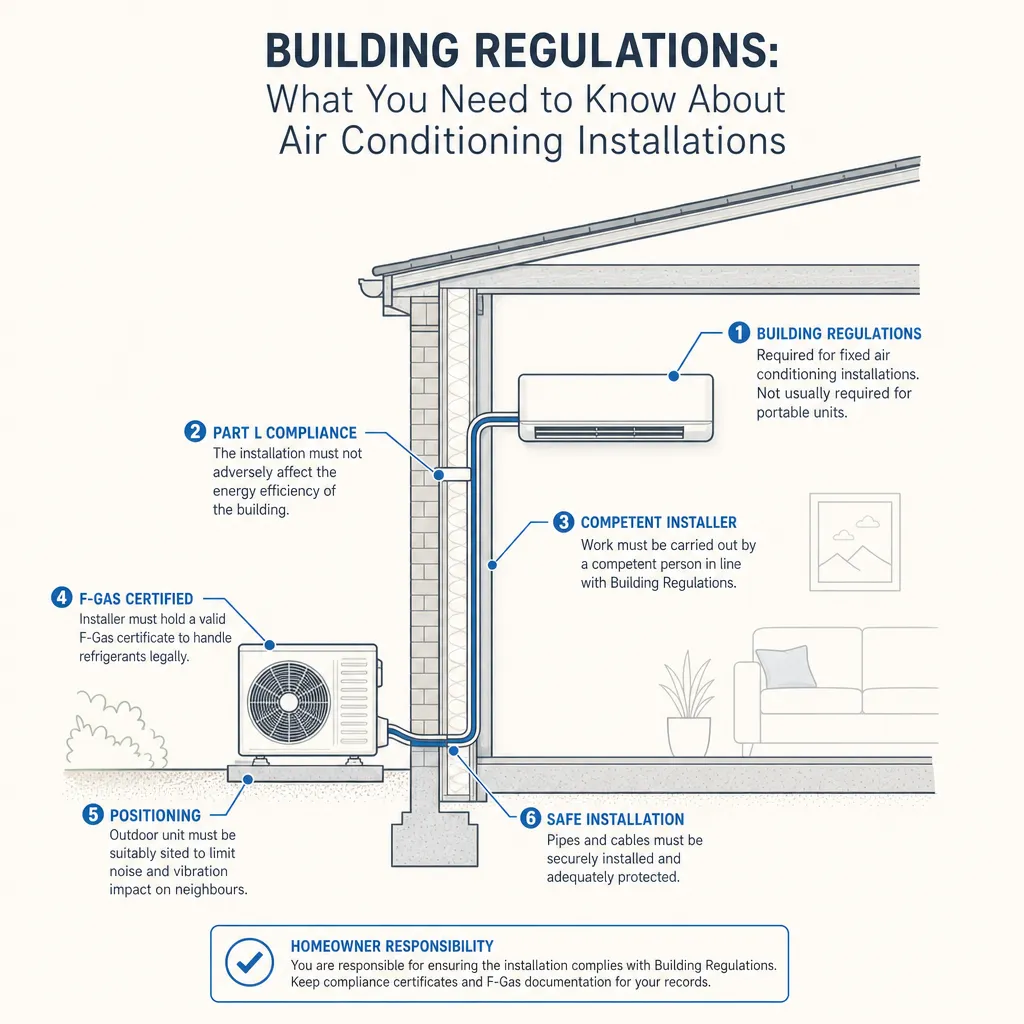
Building Regulations: What You Need to Know About Air Conditioning Installations
Air conditioning is increasingly common in UK homes — from wall-mounted split systems to multi-room units — and the regulatory picture is more layered than many installers and homeowners realise. Understanding which rules apply before work starts can prevent costly alterations, enforcement notices, or failed EPC assessments further down the line.
Key points
- Building Regulations Part L (Conservation of Fuel and Power) requires air conditioning systems in existing dwellings to meet minimum energy-efficiency standards, including adequate controls such as thermostats and timers.
- Part F (Ventilation) may also apply, particularly where refrigerant pipework or ductwork penetrates external walls and affects the building's air-tightness envelope.
- The F-Gas Regulation (SI 2015/310 as amended) requires engineers who handle fluorinated refrigerants to hold a relevant F-Gas certificate — this applies to most split and multi-split AC systems.
- The Energy Performance of Buildings (England and Wales) Regulations 2012 require a TM44 air conditioning inspection for systems with an effective rated output greater than 12 kW.
- External condenser units on a house may need planning permission; permitted development rights depend on property type, location, and local restrictions — always check with your local planning authority before installation.
Do air conditioning installations need building regulations approval?
In most cases, yes — at least in part. Building regulations approval is not a single box to tick; several separate regulatory requirements may apply simultaneously to a single AC installation.
Building Regulations Part L covers the thermal performance and energy efficiency of fixed building services, including air conditioning. When a system is installed, replaced, or materially altered in an existing dwelling, it must meet minimum efficiency thresholds and include adequate controls. The relevant guidance is Approved Document L (Volume 1 for dwellings).
Building Regulations Part F covers ventilation. If an installation involves penetrations through external walls — common for split-system refrigerant pipework — or affects the building's airtightness, the installer must ensure adequate ventilation is maintained and airtightness not significantly compromised.
For most domestic split-system installations, a competent person registered under a recognised scheme can self-certify compliance with Parts L and F, removing the need for a separate building control application. Always ask your installer whether they are registered under an applicable competent person scheme and request a completion certificate on finishing.
Which AC systems require a TM44 inspection?
The Energy Performance of Buildings (England and Wales) Regulations 2012 require regular air conditioning inspections for systems with an effective rated output above 12 kW. The inspection, known as a TM44 report (based on CIBSE guidance), must be carried out by an accredited energy assessor and results in a report the building owner must retain.
This threshold is most likely to be reached by larger domestic properties with multiple units or centralised AC systems, rather than a single domestic split unit. However, if you install several units in the same property, check whether the combined rated output exceeds the threshold before assuming no inspection is needed.
Planning permission for external condenser units
An external condenser unit is an almost universal feature of split-system AC. In England, planning permission may be required for external equipment attached to or installed at a dwelling, depending on:
- Whether the property is in a conservation area, national park, or Area of Outstanding Natural Beauty (AONB).
- Whether the property is listed.
- Whether the unit is visible from the highway.
- Local planning conditions or Article 4 directions that restrict permitted development rights.
If in doubt, contact your local planning authority (LPA) before purchasing equipment, or submit a Lawful Development Certificate application to obtain a formal ruling.
In Scotland, Wales, and Northern Ireland, separate planning frameworks apply and specific conditions differ. Consult the relevant national guidance or your LPA before proceeding.
Which installation triggers what? A decision tree
Use this to identify which regulatory requirements likely apply to your planned installation:
- Are you installing a split-system with a refrigerant circuit? → F-Gas Regulation applies; engineer must hold a valid F-Gas certificate.
- Is the system in an existing domestic dwelling? → Building Regulations Part L applies; competent person self-certification or building control approval required.
- Does the installation involve wall penetrations or ductwork? → Consider Part F ventilation impact; confirm airtightness is not significantly compromised.
- Is the combined rated output above 12 kW? → TM44 air conditioning inspection required under the Energy Performance of Buildings Regulations 2012.
- Is there an external condenser unit? → Check planning permission requirements with your LPA; listed buildings and conservation areas almost always require consent.
- Is the property listed or in a conservation area? → Listed building consent and/or planning permission likely required — seek professional advice before proceeding.
Regulatory requirements by installation type
Installation type | Part L applies | Part F consideration | F-Gas required | TM44 inspection | Planning check needed |
|---|---|---|---|---|---|
Single domestic split system (≤12 kW) | Yes | Possibly (wall penetrations) | Yes | No | Yes — check with LPA |
Multi-split domestic system (>12 kW combined) | Yes | Possibly | Yes | Yes | Yes |
Portable unit (no refrigerant pipework) | Marginal | No | No | No | No |
Central AC in larger dwelling | Yes | Yes | Yes | Yes (if >12 kW) | Yes |
Any unit on a listed building | Yes | Possibly | Yes (if refrigerant) | Depends on output | Yes — listed building consent required |
Regulations are subject to change. Verify current requirements with a building control body or qualified installer before committing to an installation.
Important limitations
This article provides general information about the regulatory framework for air conditioning installations in England and Wales as at 2026-05-11. Regulations, competent person scheme requirements, and permitted development rights vary by property type, location, local authority, and individual circumstances. Planning decisions are made by the relevant LPA and cannot be predicted from general guidance alone. A qualified installer, building control consultant, or planning consultant should assess your specific situation before you commit to any installation.
What to ask a qualified professional
Before instructing an AC installer or building control consultant, ask:
- Are you registered under a competent person scheme covering Part L and Part F compliance for this system type?
- Do you hold the relevant F-Gas certificates for the refrigerant this system uses?
- Will you notify building control on my behalf, or do I need to apply separately?
- Have you confirmed the permitted development position for the external condenser unit at this specific property?
- Will you provide a commissioning certificate and compliance documentation on completion?
- Is a TM44 report required for this installation, and if so, can you arrange it?
When to get professional help
Get professional advice — from a building control consultant or planning consultant — before proceeding if:
- The property is listed or in a conservation area.
- The installation is complex, involves multiple units, or has a combined output above 12 kW.
- You are unsure whether permitted development rights apply to the external condenser at your specific property.
- Previous unauthorised works have complicated the regulatory position.
- You need a formal building regulations completion certificate, for example for a future property sale.
How Housey can help
If you need support navigating the regulatory side of an AC installation, Housey can connect you with local building control consultants who can advise on compliance and manage the approval process. Where a formal building regulations application is required, specialists can also produce building regulations drawings to the standard required by your building control body.
Frequently asked questions
Do I need building regulations approval for a domestic split-system air conditioner?
In most cases, Part L and F-Gas compliance is required, but many domestic split-system installers self-certify compliance through a recognised competent person scheme, removing the need for a separate building control application. Ask your installer which scheme they are registered under and request a completion certificate as evidence of compliance.
Does an external AC condenser unit need planning permission?
This depends on your property type and location. In conservation areas, national parks, AONBs, and listed buildings, planning permission or listed building consent is usually required. In other locations it may fall within permitted development, but local Article 4 directions can restrict this. Always check with your local planning authority before installing an external unit.
What is an F-Gas certificate and why does my installer need one?
The F-Gas Regulation (SI 2015/310 as amended) requires engineers who install, service, or decommission systems containing fluorinated refrigerants to hold a relevant F-Gas certificate. Most split-system AC units use these refrigerants. Using an uncertified engineer is not permitted under the regulation and may invalidate your warranty and leave you without a valid compliance certificate.
What is a TM44 air conditioning inspection?
A TM44 inspection is a mandatory assessment under the Energy Performance of Buildings Regulations 2012, required for systems with an effective rated output above 12 kW. Carried out by an accredited energy assessor, it reviews the system's efficiency and controls, producing a report the building owner must retain and renew periodically.
Sources and further reading
- Building Regulations Approved Document L — GOV.UK
- Energy Performance of Buildings (England and Wales) Regulations 2012 — legislation.gov.uk
- Fluorinated gases (F-gases) — guidance — GOV.UK
- TM44: Inspection of Air Conditioning Systems — CIBSE
- Air conditioning units — planning guidance — Planning Portal
Useful next reads
 Planning & Pre-Build
Building Regulations: Requirements, Costs, and Compliance
Building regulations set minimum standards for how construction work is carried out in the UK, covering structural stability, fire safety, energy efficiency, and ventilation.
 Planning & Pre-Build
Understanding Building Regulations: Compliance, Approvals, and Your Project Requirements
Building regulations set minimum standards for design, construction, and alterations to buildings in England and Wales.
 Planning & Pre-Build
An Overview of Building Regulations for Home Improvements
Building regulations apply to most structural, energy, fire safety, and electrical work in UK homes — but not to like-for-like repairs or maintenance.
 Planning & Pre-Build
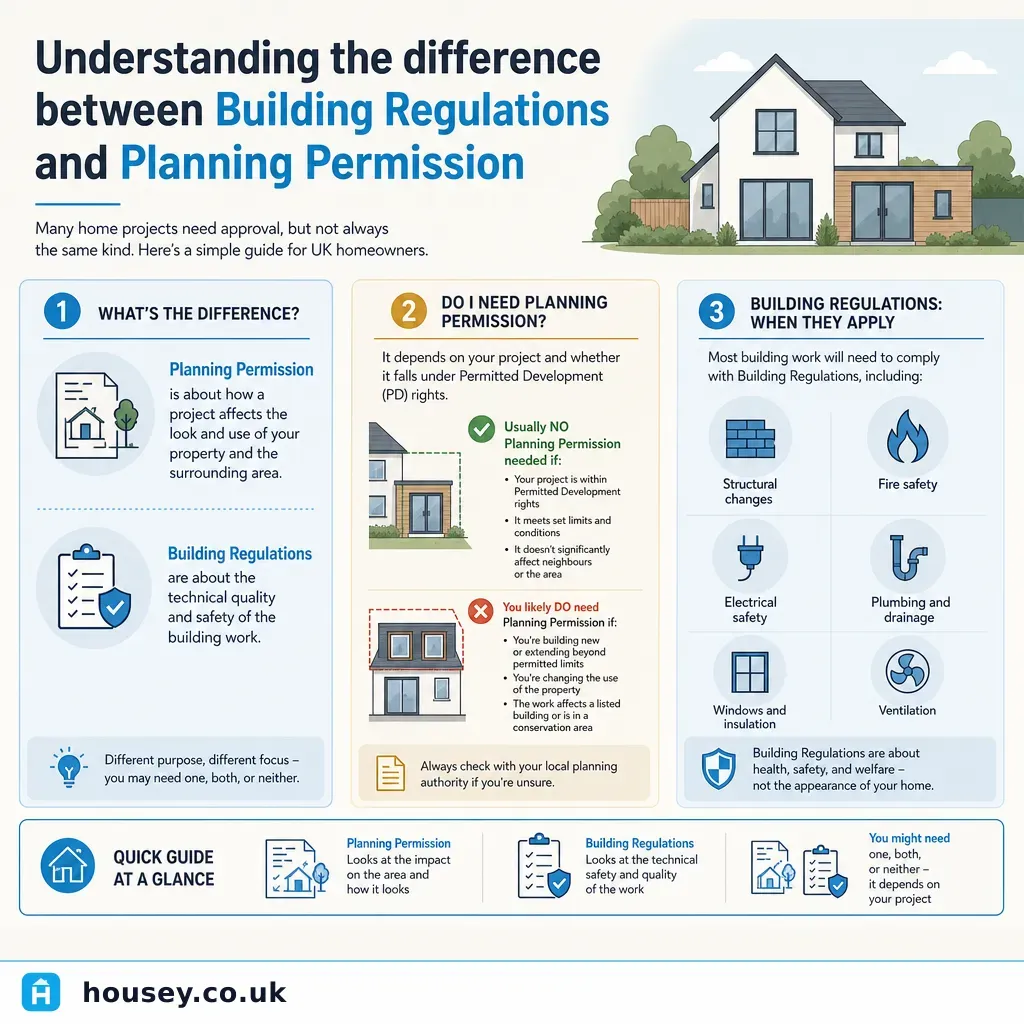
Understanding the difference between building regulations and planning permission
Planning permission is granted by your Local Planning Authority and controls whether a development is acceptable in principle — its appearance, use, and impact on the area.
 Planning & Pre-Build
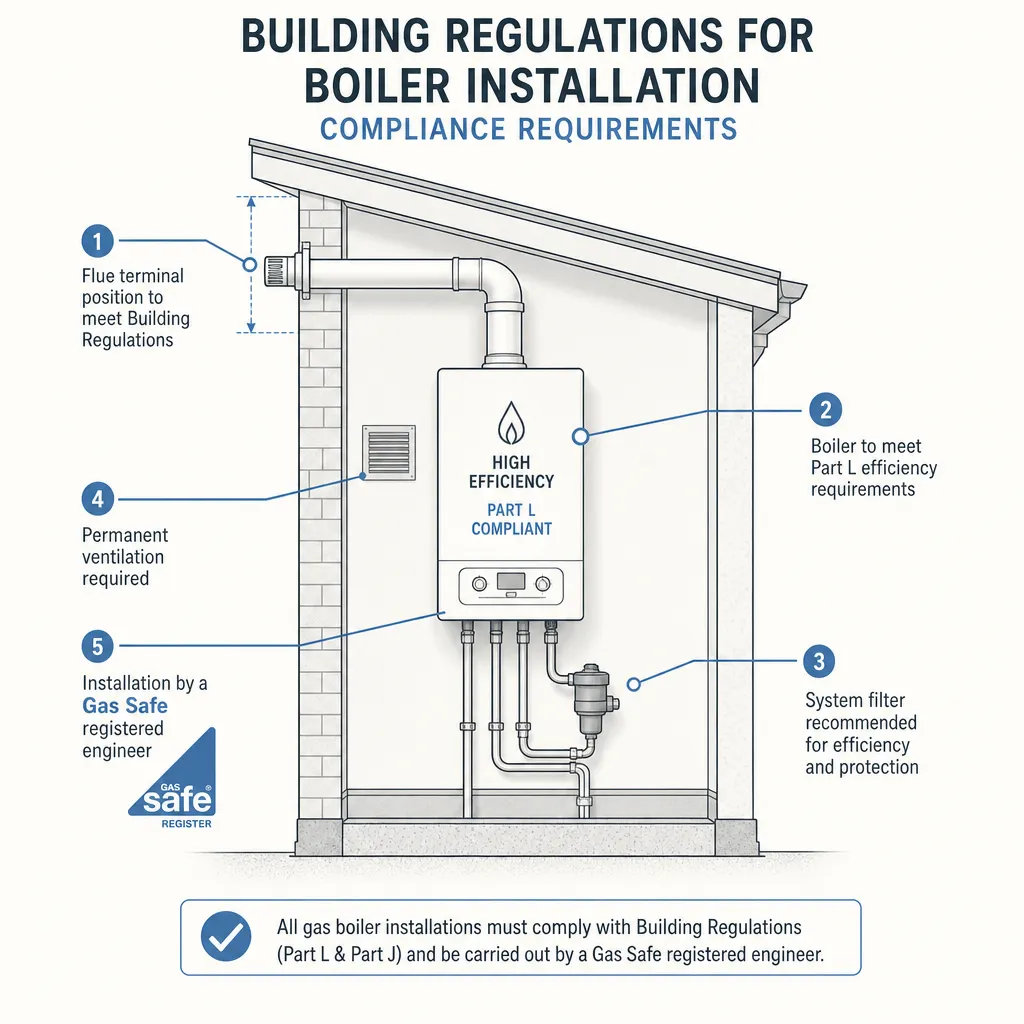
Building regulations for boiler installation: compliance requirements
Boiler installation is regulated under the Gas Safety (Installation and Use) Regulations 1998 and Building Regulations Parts J and L.