Understanding the difference between building regulations and planning permission
By Housey · Last reviewed 11th of May 2026
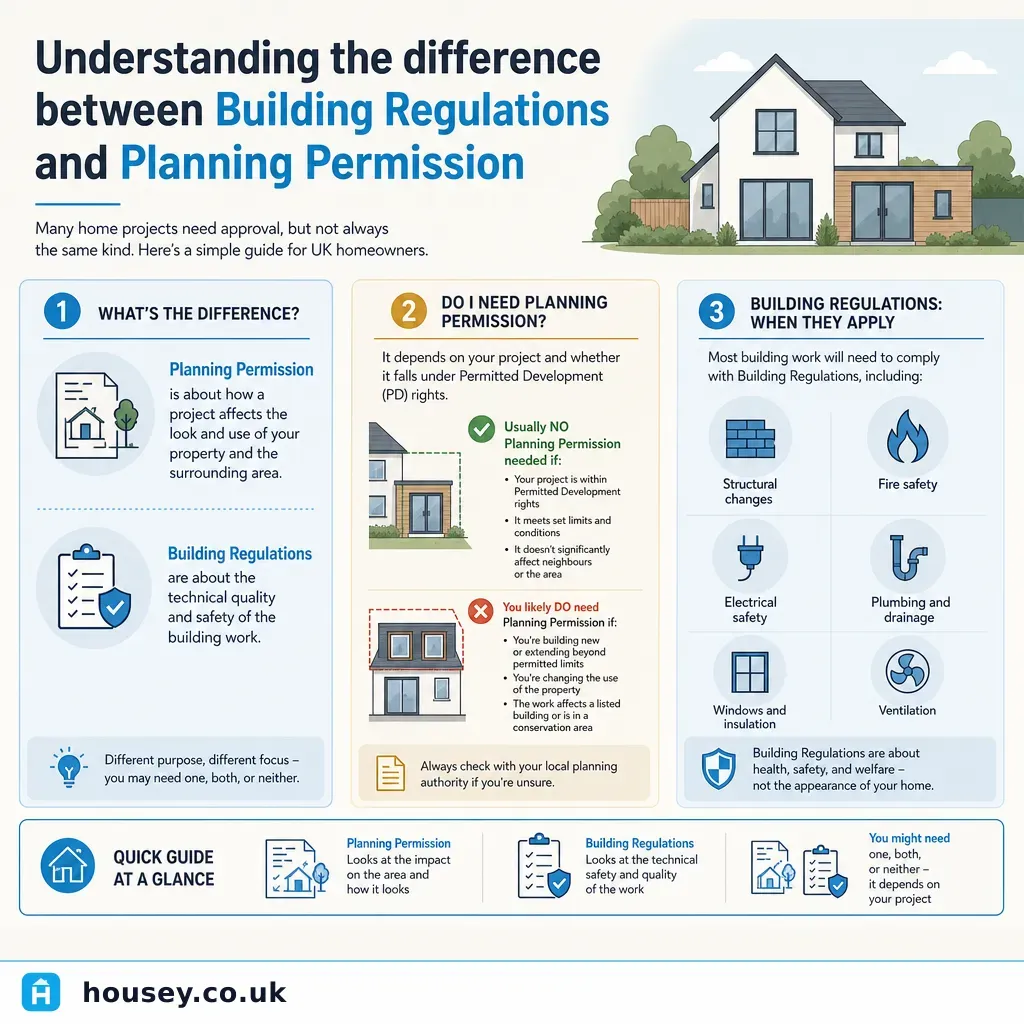
Understanding the difference between building regulations and planning permission
Two separate consent regimes govern almost every significant change to a UK property — and confusing them is one of the most common and costly mistakes homeowners make. Planning permission and building regulations are administered by different bodies, apply at different stages of a project, and check for entirely different things. Understanding which applies to your project — and when you need both — can save months of delay, significant cost, and complications when you come to sell.
Key points
- Planning permission is granted or refused by the Local Planning Authority (LPA) and controls whether a development may take place, considering its impact on the surrounding area, neighbours, and the character of the built environment.
- Building regulations are administered by Building Control (either the local authority or an approved inspector) and set minimum standards for how work must be carried out — covering structural integrity, fire safety, energy efficiency, drainage, ventilation, and accessibility.
- You can need one, both, or neither: a two-storey rear extension typically needs both; replacing internal heating controls needs neither; re-roofing a house in a conservation area may need planning permission but not a building regulations application.
- Permitted development rights allow a wide range of common works without a planning application, but those rights are reduced or removed for listed buildings, conservation areas, Areas of Outstanding Natural Beauty, and some new-build estates subject to an Article 4 Direction.
- Carrying out building work without the required building regulations approval can make a property legally difficult to sell and may require retrospective regularisation or indemnity insurance.
What is planning permission and what does it cover?
Planning permission is the process by which the Local Planning Authority — usually your district, borough, or unitary council — decides whether a proposed development is acceptable. It considers:
- The design, scale, and external appearance of the proposed works
- The impact on neighbouring properties, including light, privacy, and outlook
- The impact on the character of the area or street scene
- Compliance with the Local Plan and national planning policy (the National Planning Policy Framework, or NPPF)
- Heritage considerations for listed buildings and conservation areas
- Environmental impacts, including flood risk, protected species, and trees with Tree Preservation Orders (TPOs)
Planning permission controls whether something should be built — not how it is built. It does not evaluate structural adequacy, drainage, insulation, or fire safety.
Permitted development allows many common works without a formal application, including single-storey rear extensions within specified dimensions, loft conversions below certain volume thresholds, some garage conversions, and outbuildings within size limits. These rights are set out in the Town and Country Planning (General Permitted Development) (England) Order 2015, but can be removed locally by Article 4 Directions or as a condition of a previous planning consent.
Always verify whether your property retains its permitted development rights before starting work. Your LPA's planning department can advise, or you can apply for a Lawful Development Certificate (LDC) for formal written confirmation.
What do building regulations cover?
Building regulations set minimum technical standards for construction work. In England and Wales, they are set out in Approved Documents A through S, each addressing a different aspect of building performance:
Approved Document | Subject area |
|---|---|
Part A — Structure | Foundations, walls, roofs, floors, and structural loads |
Part B — Fire Safety | Escape routes, fire doors, spread of flame, and alarms |
Part C — Site Preparation | Resistance to contaminants, moisture, and radon |
Part E — Resistance to Sound | Acoustic insulation between dwellings and rooms |
Part F — Ventilation | Adequate fresh air supply and humidity control |
Part J — Combustion Appliances | Boilers, fires, flues, and air supply |
Part L — Conservation of Fuel and Power | Insulation U-values, boiler efficiency, and heating controls |
Part M — Access to and Use of Buildings | Accessible entrances, door widths, and bathroom layouts |
Part P — Electrical Safety | Fixed electrical installations in dwellings |
Building regulations apply to most construction work: extensions, loft conversions, new builds, re-roofing, new windows and doors, structural alterations, installation of new heating or electrical systems, and certain changes of use. Compliance is achieved by submitting a Full Plans application (inspected at design stage and during the build) or serving a Building Notice (inspected only during the build). For notifiable work by a tradesperson registered under a Competent Person Scheme — such as FENSA for windows and doors, or Gas Safe for boilers — the tradesperson self-certifies and notifies Building Control without the homeowner making a separate application.
Which do you need? A decision guide
- Planning permission only — change of use without structural alteration; works to a listed building's exterior that do not affect structure or drainage (though listed building consent is also required separately).
- Building regulations only — structural work within permitted development limits; replacement boiler or heating system; electrical rewiring; like-for-like re-roofing on a standard property.
- Both planning permission and building regulations — most extensions beyond permitted development thresholds; loft conversions; garage conversions that increase the dwelling's floor area; new outbuildings above size thresholds; changes of use involving structural alteration.
- May need neither — painting and decorating; replacing like-for-like kitchen units or bathroom fittings without altering drainage; garden landscaping not involving engineering structures.
- Check with your LPA and a qualified professional if — your property is listed, in a conservation area, subject to an Article 4 Direction, has an unusual planning history, or the project involves structural, fire safety, or drainage elements.
Comparison: planning permission vs building regulations
| Planning permission | Building regulations |
|---|---|---|
Administered by | Local Planning Authority (LPA) | Building Control (local authority or approved inspector) |
Core purpose | Controls whether development is acceptable in principle | Controls how work must be carried out to minimum safety and performance standards |
Timing | Granted before work starts | Inspections during the build; completion certificate issued after |
Primary concerns | Appearance, use, impact on area and neighbours | Structural integrity, fire safety, energy efficiency, drainage, health |
Approval routes | Full application, householder application, Lawful Development Certificate | Full Plans, Building Notice, Competent Person self-certification |
Consequences of non-compliance | Enforcement notice, requirement to demolish or alter, planning injunction | Regularisation certificate required; difficulty selling; structural or safety risk |
Enforcement time limits | 4 years for operational development and dwellings; 10 years for change of use | 12 months after completion for minor contraventions; unsafe work can be enforced at any time |
Nations | England and Wales (Scotland and Northern Ireland have separate but broadly similar systems) | England and Wales (Scotland: Building (Scotland) Act 2003 Technical Handbooks) |
What not to assume
Several common misunderstandings leave homeowners with non-compliant work and complications at the point of sale:
"Permitted development means no building regulations are needed." Permitted development rights exempt you from planning permission, not from building regulations. Most structural work covered by permitted development — extensions, loft conversions, garage conversions — still requires building regulations approval.
"My builder will handle all the paperwork." Ultimately the homeowner is responsible for ensuring building regulations approval is obtained and a completion certificate is issued. If a builder omits this, it becomes the homeowner's problem when selling.
"If building regulations approved it, planning cannot be an issue." Building Control does not check planning compliance. Work can pass building regulations while simultaneously being in breach of a planning condition — both systems operate independently.
"The four-year rule makes past work safe from enforcement." The four-year enforcement limit applies to operational development and the creation of a dwelling. Change of use has a ten-year limit. Listed building consent breaches carry no time limit at all, and injunctions can enforce against unsafe work regardless of its age.
"Listed building consent is just a type of planning permission." Listed building consent is a separate consent required in addition to planning permission, applies to both interior and exterior works, and carries no enforcement time limit. Failing to obtain it is a criminal offence.
Important limitations
This article provides a general overview of the planning permission and building regulations framework in England. Rules differ in Scotland, Wales, and Northern Ireland. Permitted development rights, local planning policies, and building standards requirements vary between local authority areas and property types. Whether any specific works require consent depends on the detail of the project, the property, its planning history, and any local designations. Always check with your LPA and consult a qualified planning consultant or building control specialist before starting work.
What to ask a qualified professional
Before starting any significant works, ask:
- Does this project require planning permission, permitted development, or a Lawful Development Certificate?
- Does this project require building regulations approval, and which Approved Documents apply?
- Is my property subject to any Article 4 Direction, conservation area designation, or listed building status that modifies my rights?
- Which approval route should I use — Full Plans or Building Notice — and why?
- Who is responsible for notifying Building Control, and at what stages will inspections occur?
- What documentation will I receive at the end, and is a completion certificate guaranteed?
- If works have already been carried out without consent, what is my current enforcement exposure?
When to get professional help
Consult a planning consultant or building control specialist if:
- You are unsure whether your project needs planning permission, building regulations, or both
- Your property is listed, in a conservation area, or subject to an Article 4 Direction
- You have carried out works without the required consents and are facing enforcement action or a property sale query
- A buyer's solicitor has raised questions about previous works and missing certificates
- Your project involves change of use, structural alterations, or fire safety provisions
How Housey can help
Navigating two separate consent regimes simultaneously can be complex, particularly if your property has restrictions or a mixed planning history. Housey connects homeowners with qualified building control consultants who can advise on approval routes, manage applications, and help regularise historic works. For planning strategy, permitted development advice, and formal applications, our planning consultancy service covers householder applications and Lawful Development Certificates across England and Wales.
Frequently asked questions
Can I apply for planning permission and building regulations approval at the same time?
Yes — they are separate processes administered by different parts of the council, or by an approved inspector for building regulations, and can run in parallel. Many homeowners apply for planning first, then progress building regulations drawings once planning is granted. However, developing detailed technical drawings for both together can save time and cost if you are confident planning will be approved.
What is a Lawful Development Certificate?
A Lawful Development Certificate (LDC) is a formal written determination from the LPA confirming that a development is lawful — either because it falls within permitted development rights or because the enforcement time limit has expired. It is often requested by buyers' solicitors and provides stronger legal protection than relying on permitted development informally. It does not replace building regulations approval.
What happens if I sell a property without a building regulations completion certificate?
Buyers' solicitors will request completion certificates for notifiable works carried out during your ownership. If these are missing, you may need indemnity insurance to cover the buyer against enforcement risk, or apply retrospectively for a regularisation certificate. Neither route is straightforward if the building has been closed up or significantly altered since the work was carried out.
Do planning permission and building regulations apply in Scotland?
Scotland has its own planning system under the Planning etc. (Scotland) Act 2006 and its own building standards under the Building (Scotland) Act 2003, supported by Technical Handbooks. The principle — planning controls whether, building standards control how — is similar, but the specific rules and permitted development thresholds differ. Always check with your Scottish local authority or a Scotland-based planning consultant.
Sources and further reading
- Planning permission: overview — GOV.UK
- Building regulations approval — GOV.UK
- Town and Country Planning (General Permitted Development) (England) Order 2015 — legislation.gov.uk
- Building Regulations Approved Documents — GOV.UK
- Competent Person Schemes — GOV.UK
- Planning Portal: do I need permission? — Planning Portal
Useful next reads
 Planning & Pre-Build
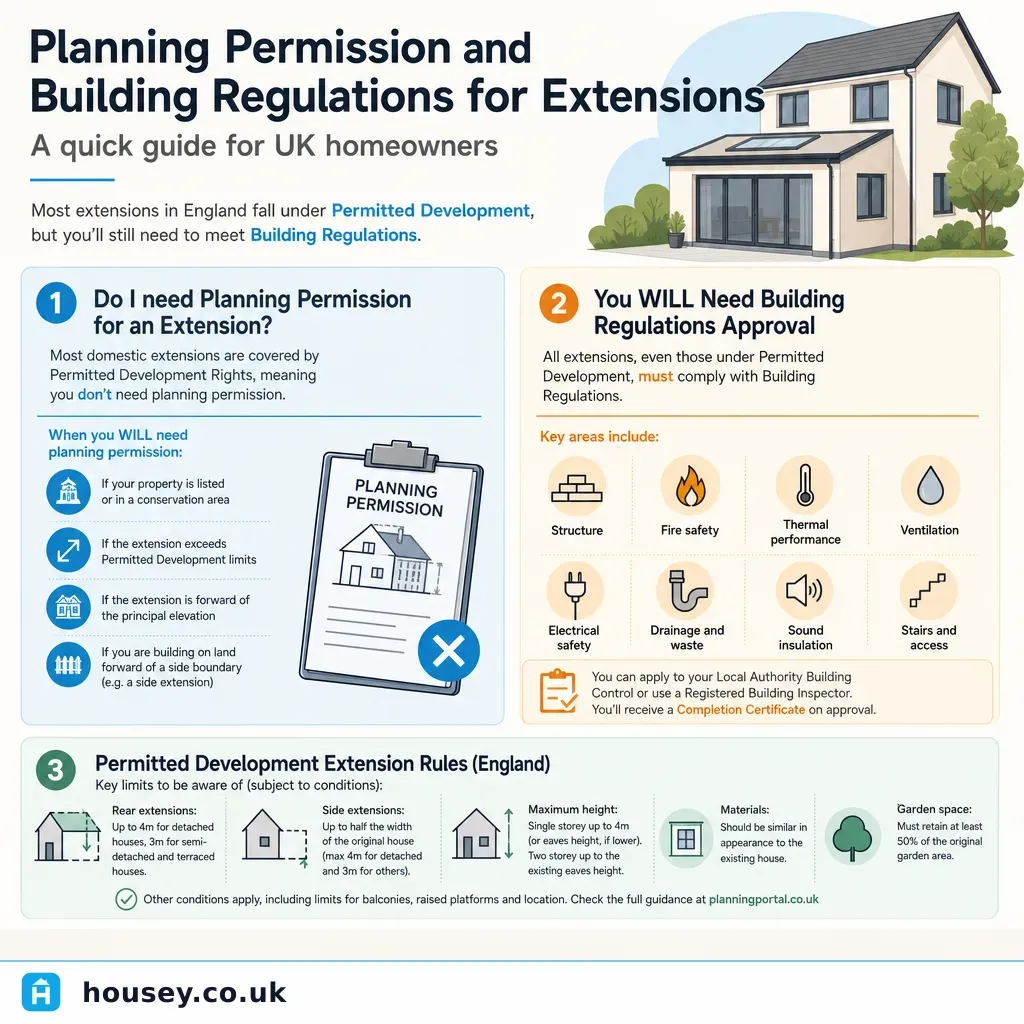
Planning Permission and Building Regulations for Extensions
UK home extensions usually require both planning permission and Building Regulations approval, though most smaller rear extensions qualify as Permitted Development under the GPDO 2015 and need no planning application.
 Planning & Pre-Build
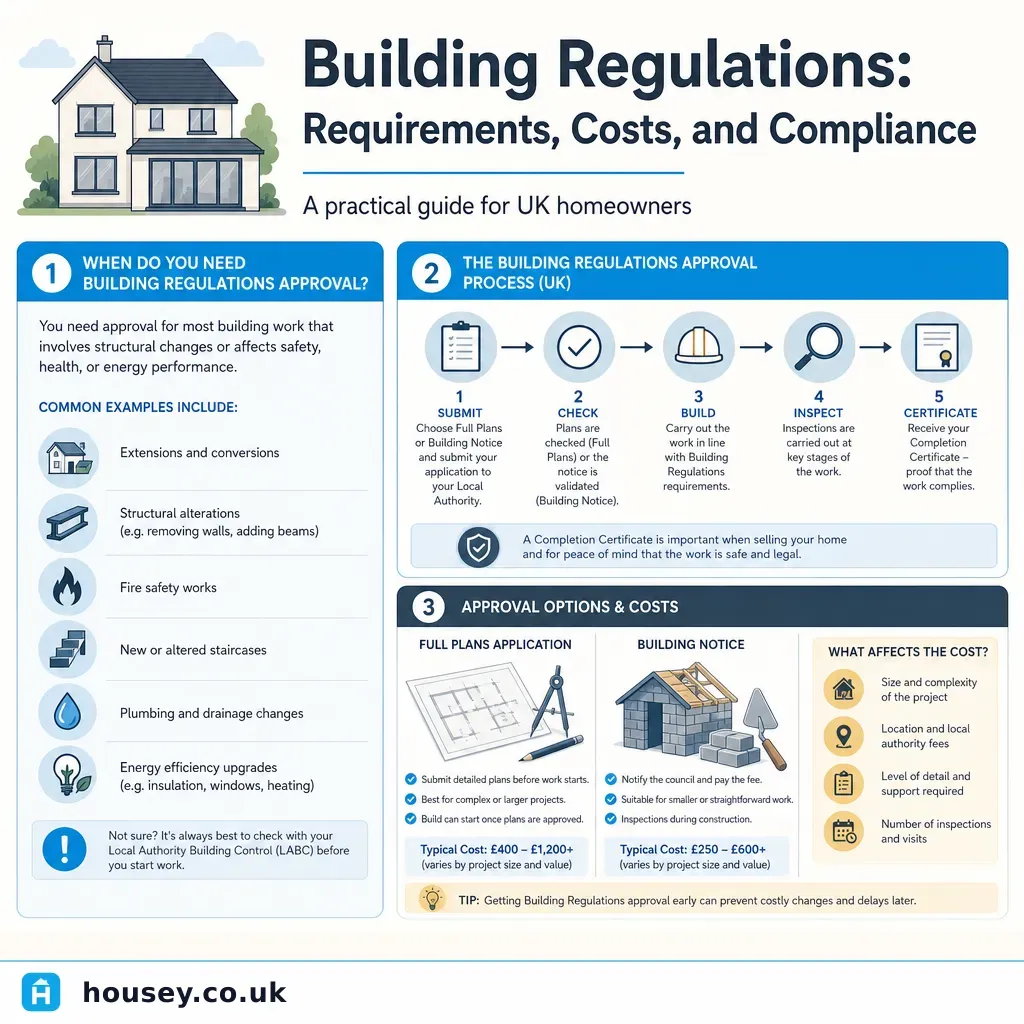
Building Regulations: Requirements, Costs, and Compliance
Building regulations set minimum standards for how construction work is carried out in the UK, covering structural stability, fire safety, energy efficiency, and ventilation.
 Planning & Pre-Build
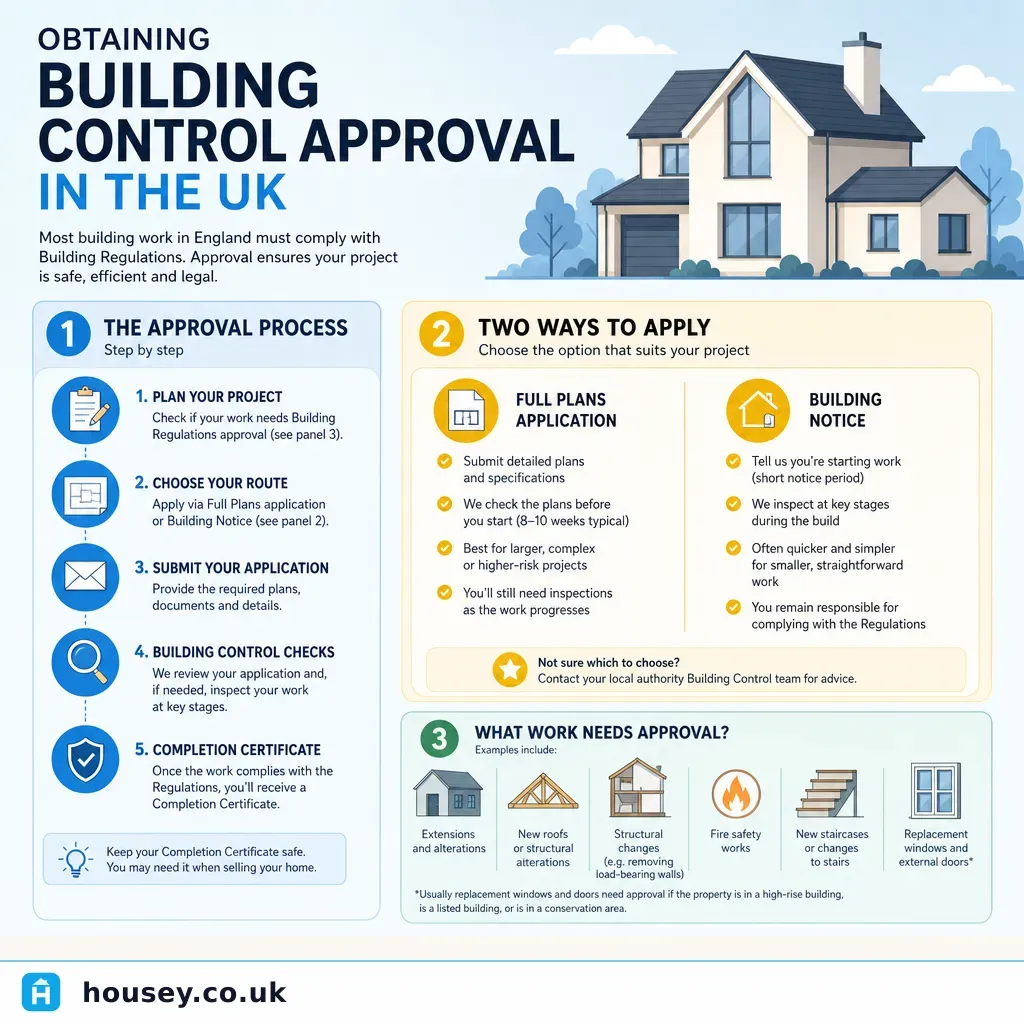
Obtaining Building Control Approval in the UK
Building control approval in the UK is required for most structural changes, extensions, loft conversions, and new builds.
 Planning & Pre-Build
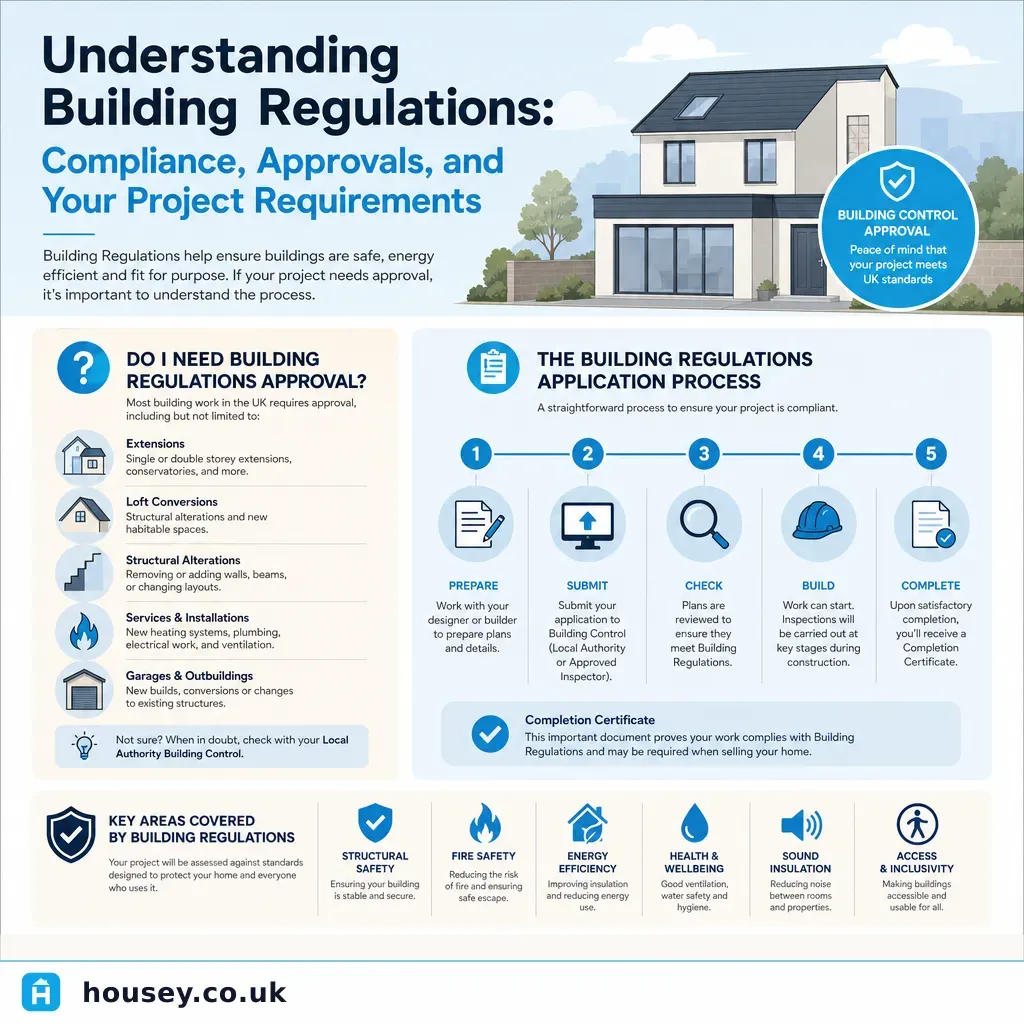
Understanding Building Regulations: Compliance, Approvals, and Your Project Requirements
Building regulations set minimum standards for design, construction, and alterations to buildings in England and Wales.
 Planning & Pre-Build
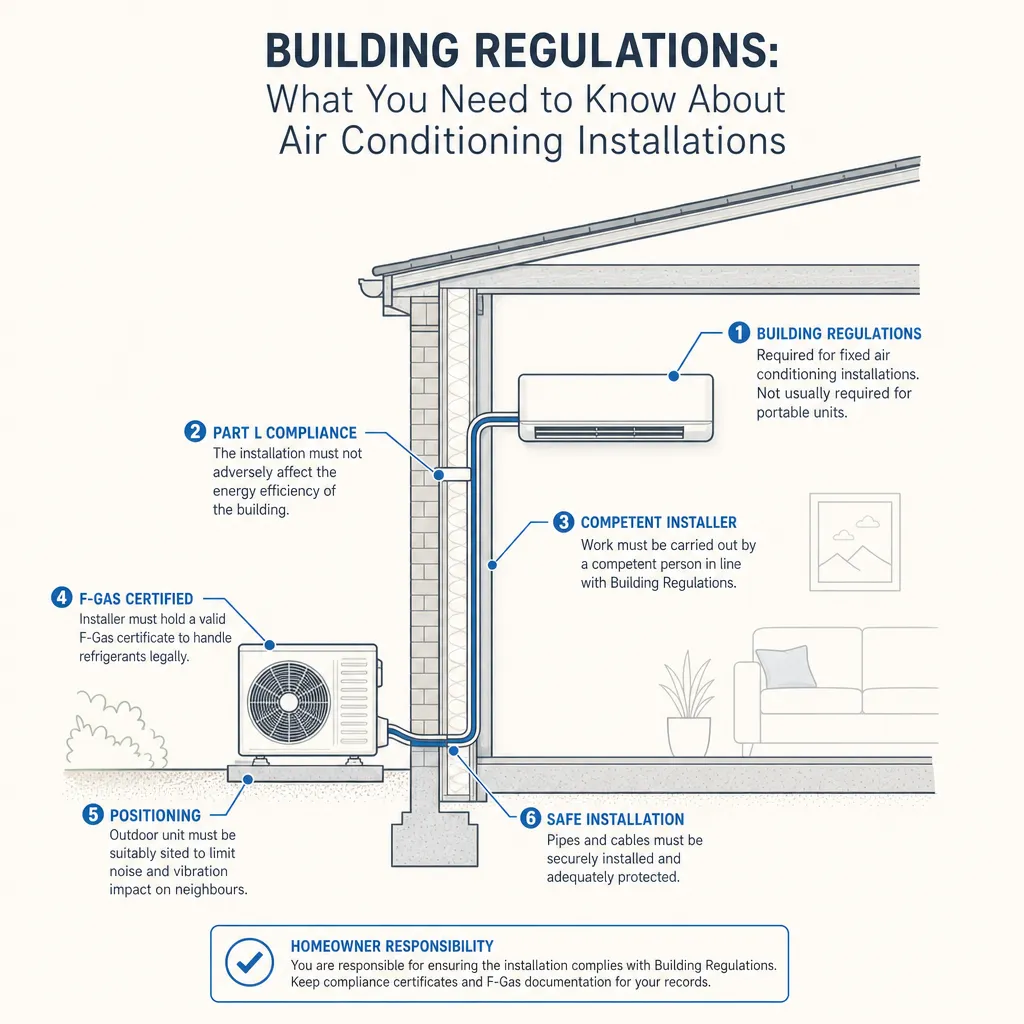
Building Regulations: What You Need to Know About Air Conditioning Installations
Most domestic air conditioning installations in England must comply with Building Regulations Part L (energy efficiency) and Part F (ventilation).