An Overview of Building Regulations for Home Improvements
By Housey · Last reviewed 11th of May 2026
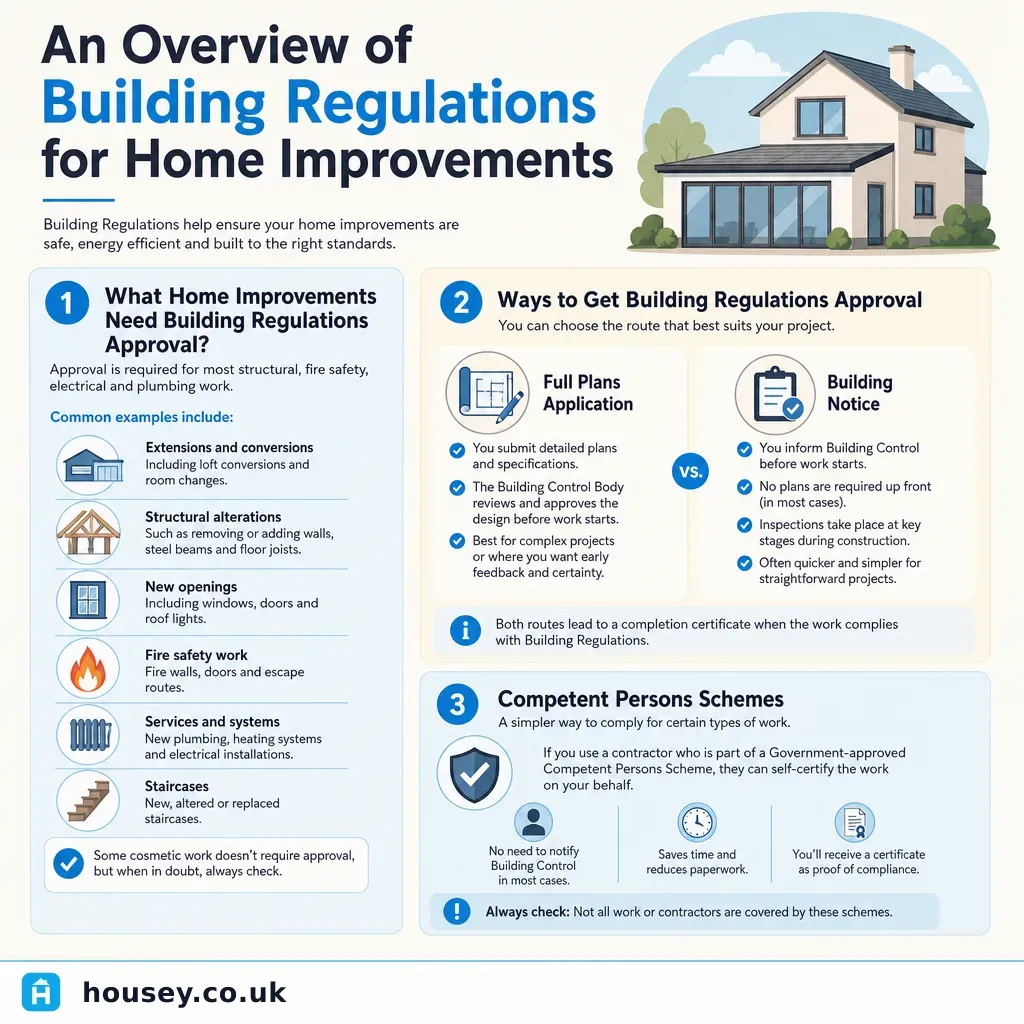
An Overview of Building Regulations for Home Improvements
Planning a home improvement — whether a kitchen refurbishment, a loft conversion, or a new bathroom — brings most homeowners into contact with the Building Regulations at some point. Understanding which works require approval, how the process works, and what happens if you skip it can save considerable time and cost, particularly when you come to sell or let a property.
Key points
- The Building Regulations 2010 (as amended) apply in England; Scotland, Wales, and Northern Ireland each have their own equivalent regulatory frameworks.
- Works requiring approval must be notified to a local authority building control body or a registered building control approver before work begins (full plans) or at the start of works (building notice).
- Certain trades can self-certify under government-approved competent persons schemes, including Gas Safe Register (gas work), FENSA or CERTASS (window replacement), and NICEIC or NAPIT (electrical work).
- A regularisation certificate can be applied for retrospectively for unauthorised building work completed after 11 November 1985, though the cost of opening up work for inspection can be significant.
- Building regulations approval is entirely separate from planning permission — both may be required for the same project, and having one does not grant the other.
What are the Building Regulations?
The Building Regulations 2010 set minimum standards for the design and construction of buildings in England to protect the health and safety of people in and around them, promote energy efficiency, and ensure accessibility. They are organised around Approved Documents (lettered A through S) that give practical guidance on how each requirement can be met.
Key Approved Documents relevant to home improvements include:
- Part A (Structure): Foundations, walls, roofs, and floors.
- Part B (Fire Safety): Means of escape, fire spread, and fire resistance.
- Part C (Resistance to Moisture): Damp-proofing and waterproofing.
- Part E (Sound Insulation): Walls and floors between dwellings.
- Part F (Ventilation): Fresh air provision and condensation management.
- Part G (Sanitation and Hot Water Safety): Bathrooms and unvented hot water cylinders.
- Part H (Drainage): Foul and surface water drainage.
- Part J (Combustion Appliances): Boilers, stoves, and flues.
- Part L (Conservation of Fuel and Power): Thermal performance and energy efficiency.
- Part P (Electrical Safety): Domestic electrical installations.
- Part Q (Security — Dwellings): Doors and windows.
Which home improvements need building regulations approval?
The key distinction is between building work (which is regulated) and like-for-like repairs or maintenance (which generally are not).
Home improvement | Building regs required? | Notes |
|---|---|---|
Loft conversion to habitable room | Yes | Structure, fire escape, insulation, and stair requirements all apply |
Single-storey rear extension | Yes | Structure, drainage, and thermal performance |
Garage conversion to habitable use | Yes | Insulation, fire separation, and ventilation |
New bathroom in existing footprint | Often yes | Drainage, ventilation, and Part P electrics |
Gas boiler replacement | Yes | Gas Safe self-certification route |
Re-roofing like-for-like | Usually no | Check if changing materials significantly alters thermal performance |
New electrical circuit or consumer unit | Yes (Part P) | NICEIC or NAPIT self-certification route |
Replacing windows | Yes | FENSA or CERTASS self-certification route |
Removing a load-bearing wall | Yes | Structural assessment and approval required |
Garden shed under 15 m² | Usually no | Subject to size, distance from boundary, and use rules |
Wood-burning stove installation | Yes | Parts J and B apply |
Conservatory meeting exemption criteria | No | Specific conditions apply — see FAQ |
How the building regulations approval process works
Route 1 — Full plans application
You submit detailed drawings and a specification to building control before work starts. The body approves them — or requests amendments — and then inspects at agreed stages during construction. This route is recommended for larger or more complex projects as it identifies compliance issues before any build cost is committed.
Route 2 — Building notice
You notify building control of your intention to proceed and pay a fee. No drawings are approved in advance, so any compliance issues are identified during the build rather than before it. Not suitable for all work types, and carries the risk of having to alter completed work.
Route 3 — Competent persons self-certification
For defined categories of work, a tradesperson registered with a government-approved scheme self-certifies that the work complies, notifies the local authority on your behalf, and issues a completion certificate. This is the standard route for gas boiler replacement, window replacement, and most new electrical circuits.
Route 4 — Regularisation (retrospective approval)
If notifiable building work was completed without approval after 11 November 1985, you can apply for a regularisation certificate. Fees are typically around 25% higher than the standard application rate. Building control may require work to be exposed for inspection, which can be both disruptive and costly.
Decision tree: which route applies to my project?
- Is the work maintenance or a like-for-like repair with no material change? Building regulations approval likely not required — confirm with building control if uncertain.
- Is a registered competent person carrying out the work? Use the self-certification route and ask them to handle the notification and completion certificate.
- Are you using a structural engineer or architect and want certainty before work starts? A full plans application is usually best.
- Is the project straightforward and starting imminently? A building notice may be appropriate — discuss with your local building control body.
- Has notifiable work already been completed without approval? Apply for a regularisation certificate before putting the property on the market.
Common misconceptions about building regulations
Planning permission and building regulations are the same thing. These are entirely separate processes. Planning approval governs the form, appearance, and use of a building; building regulations ensure the construction meets minimum safety and performance standards. A single project may need both, either, or in limited cases neither.
The builder is responsible for compliance, not the homeowner. As the property owner, you are ultimately responsible for ensuring notifiable work on your home has the necessary approvals. If your contractor fails to notify building control, the consequences fall on you — particularly when selling.
Old completed work does not matter. Solicitors acting for buyers routinely request building regulations completion certificates for all notifiable works carried out since November 1985. Missing certificates can delay sales, reduce buyer confidence, or require indemnity insurance — which covers enforcement risk only, not the cost of remediation.
When to get professional help
Seek qualified advice if:
- You are uncertain whether planned works require building regulations approval.
- The works involve structural alterations, extensions, or a loft conversion.
- You have bought a property where historical works lack documentation and you need to establish compliance.
- You are converting a property into flats or a house in multiple occupation (HMO), where fire safety requirements are more complex.
- You are carrying out works on a listed building, which may also require listed building consent.
Important limitations
The Building Regulations 2010 apply in England. Scotland, Wales, and Northern Ireland each have separate regulatory frameworks, and Approved Documents are updated periodically. Local authority building control bodies may interpret guidance slightly differently on specific points. This article reflects the general position in England as of May 2026. Always confirm current requirements with a qualified building control surveyor or registered building control approver before starting work.
What to ask a qualified professional
Before engaging a building control consultant or registered building control approver:
- Does this specific project require building regulations approval?
- Which notification route do you recommend — full plans or building notice — and why?
- What stages will be inspected during the build, and what notice do I need to give?
- What documentation will I receive at completion?
- Are there elements of this project likely to present compliance difficulties?
- If using a full plans application, what is the typical approval timescale with your building control body?
How Housey can help
If you need to establish the compliance requirements for a planned project, building control consultants on Housey can assess your proposals and advise on the correct notification route. If your project requires a formal submission, building regulations drawings specialists can prepare the drawings and specifications needed for a full plans application.
Frequently asked questions
Do I need building regulations for a conservatory?
A conservatory is exempt from building regulations if it is at ground level, has a floor area under 30 m², is separated from the house by walls, windows, or doors, and more than 75% of the roof area is translucent or transparent. If any of these conditions are not met, building regulations will apply to the whole structure.
How long does a building regulations full plans approval last?
A full plans approval is valid for three years from the date of deposit for the commencement of building work. If work has not started within three years, a new application is usually required. Once underway, there is no fixed completion deadline, though a reasonable timescale should be agreed with the building control body.
Can I sell my house without a building regulations completion certificate?
You can sell, but solicitors acting for buyers will raise enquiries. If a certificate cannot be produced for notifiable work, buyers typically request indemnity insurance as a condition of exchange. This protects the buyer against enforcement action but does not cover the cost of bringing non-compliant work up to standard — it is not a substitute for compliant construction.
Are building regulations the same across the UK?
No. England uses the Building Regulations 2010 and associated Approved Documents. Scotland operates under the Building (Scotland) Regulations 2004 and Technical Handbooks. Wales has its own version of Approved Documents, which differ from England's in certain respects. Northern Ireland is governed by the Building Regulations (Northern Ireland) 2012 and accompanying Technical Booklets.
Sources and further reading
- Building regulations approval — GOV.UK
- Approved Documents — full list — HM Government
- Find a certified tradesperson — competent persons schemes — HM Government
- Building Regulations 2010 — legislation.gov.uk
Useful next reads
 Planning & Pre-Build
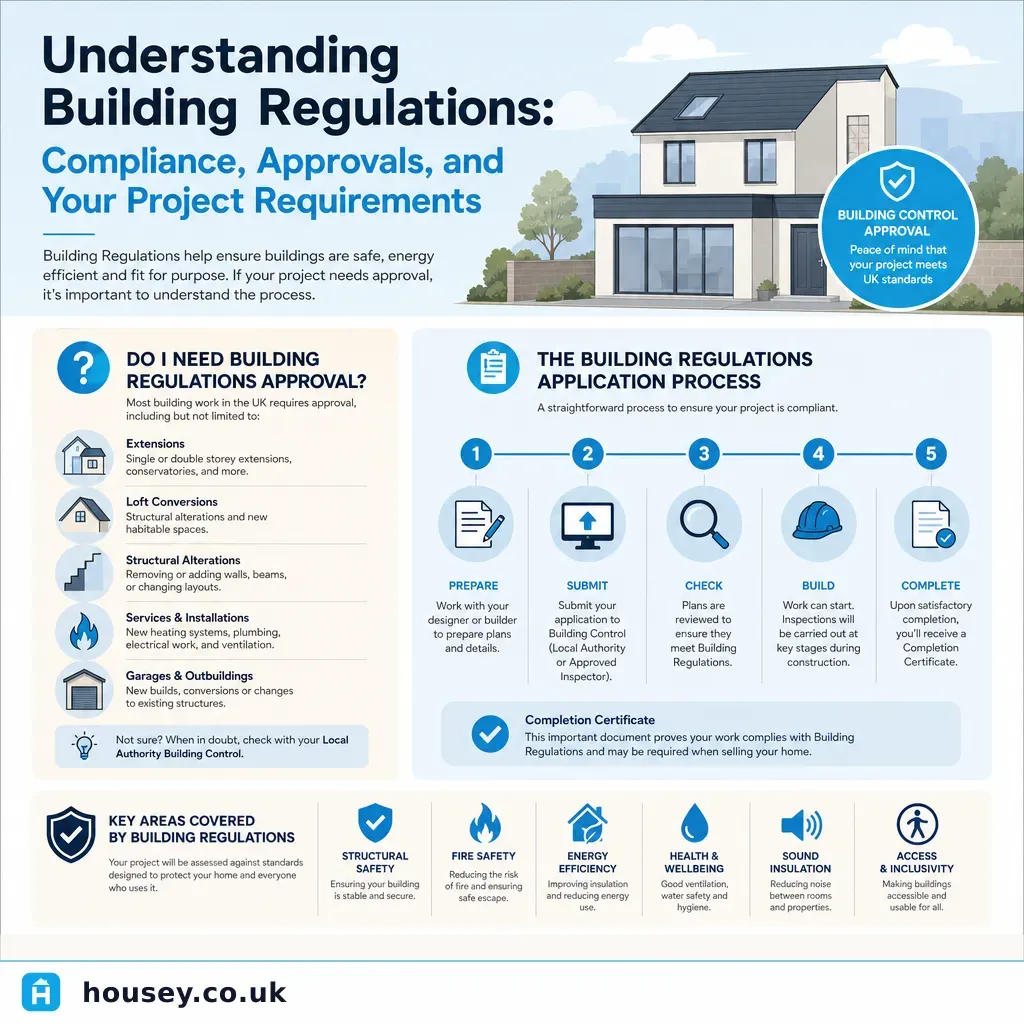
Understanding Building Regulations: Compliance, Approvals, and Your Project Requirements
Building regulations set minimum standards for design, construction, and alterations to buildings in England and Wales.
 Planning & Pre-Build
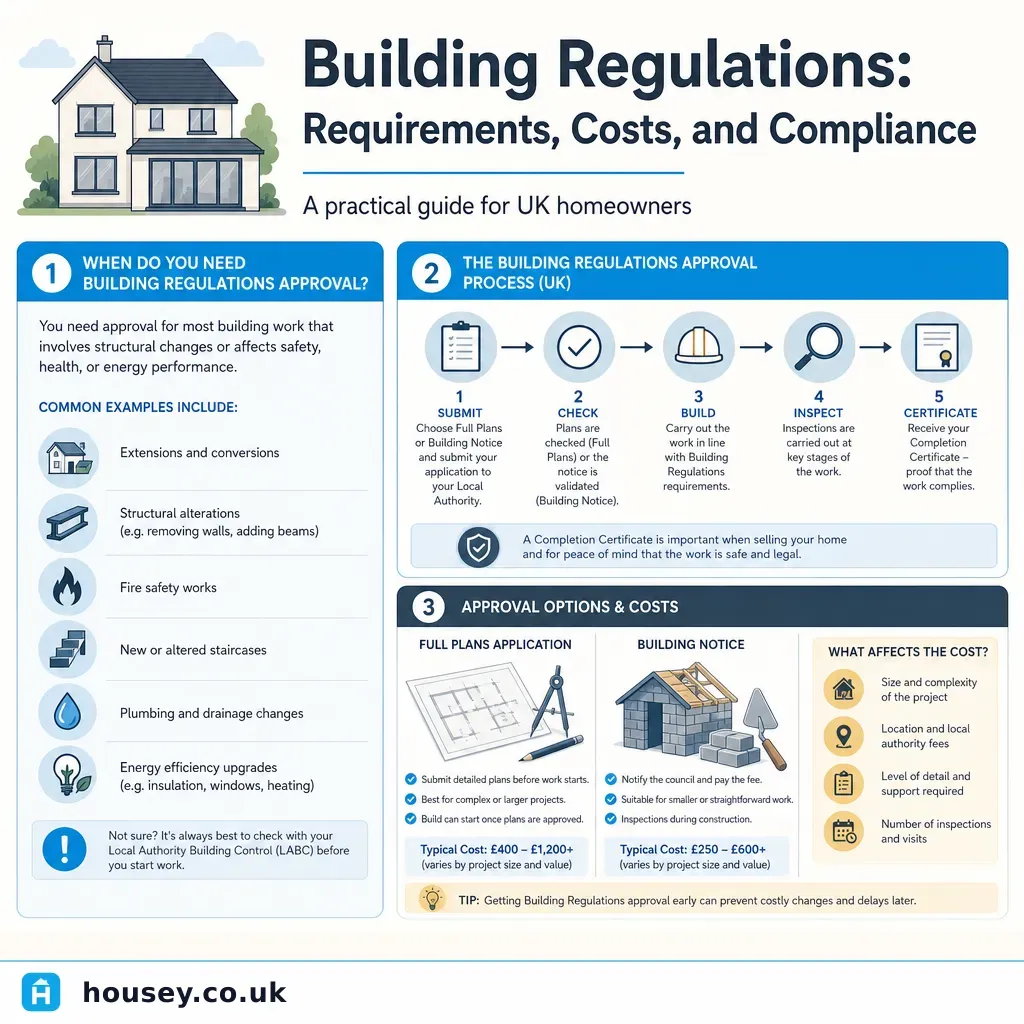
Building Regulations: Requirements, Costs, and Compliance
Building regulations set minimum standards for how construction work is carried out in the UK, covering structural stability, fire safety, energy efficiency, and ventilation.
 Planning & Pre-Build
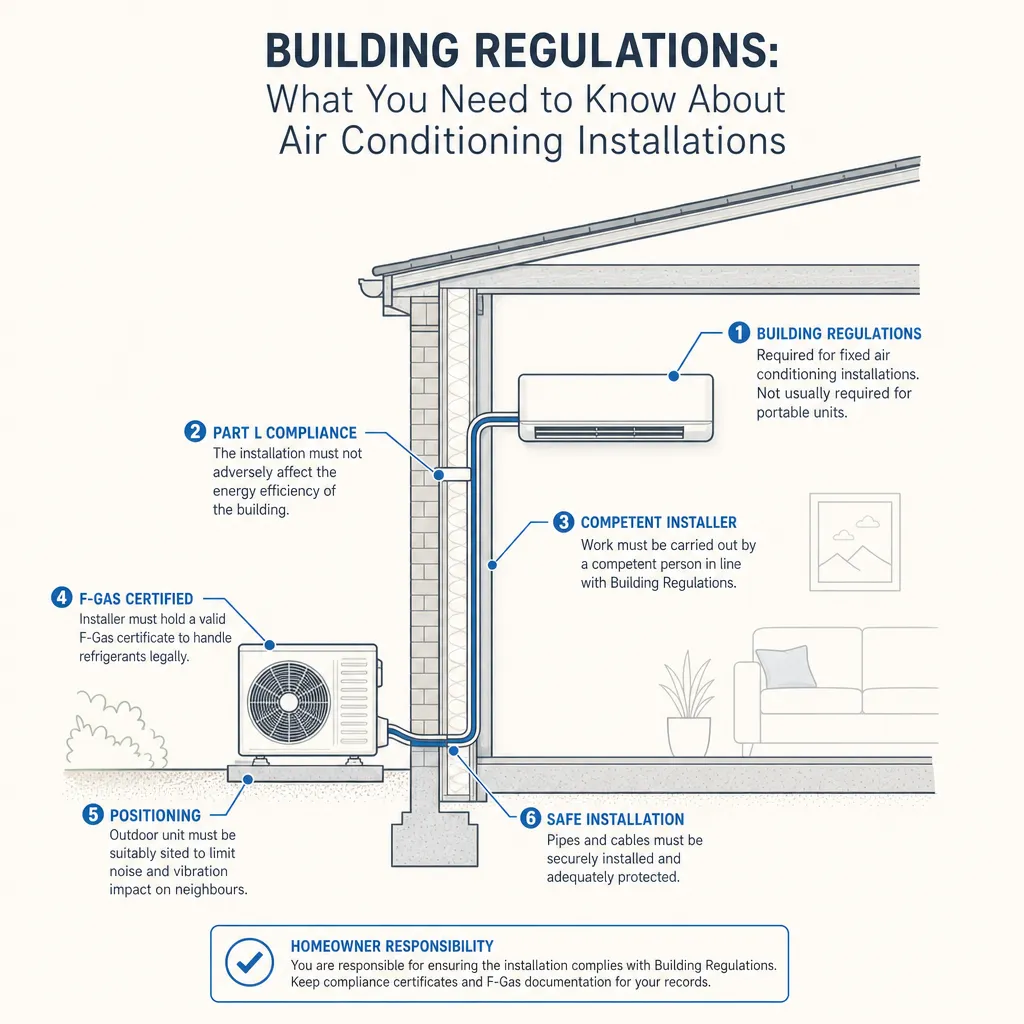
Building Regulations: What You Need to Know About Air Conditioning Installations
Most domestic air conditioning installations in England must comply with Building Regulations Part L (energy efficiency) and Part F (ventilation).
 Planning & Pre-Build
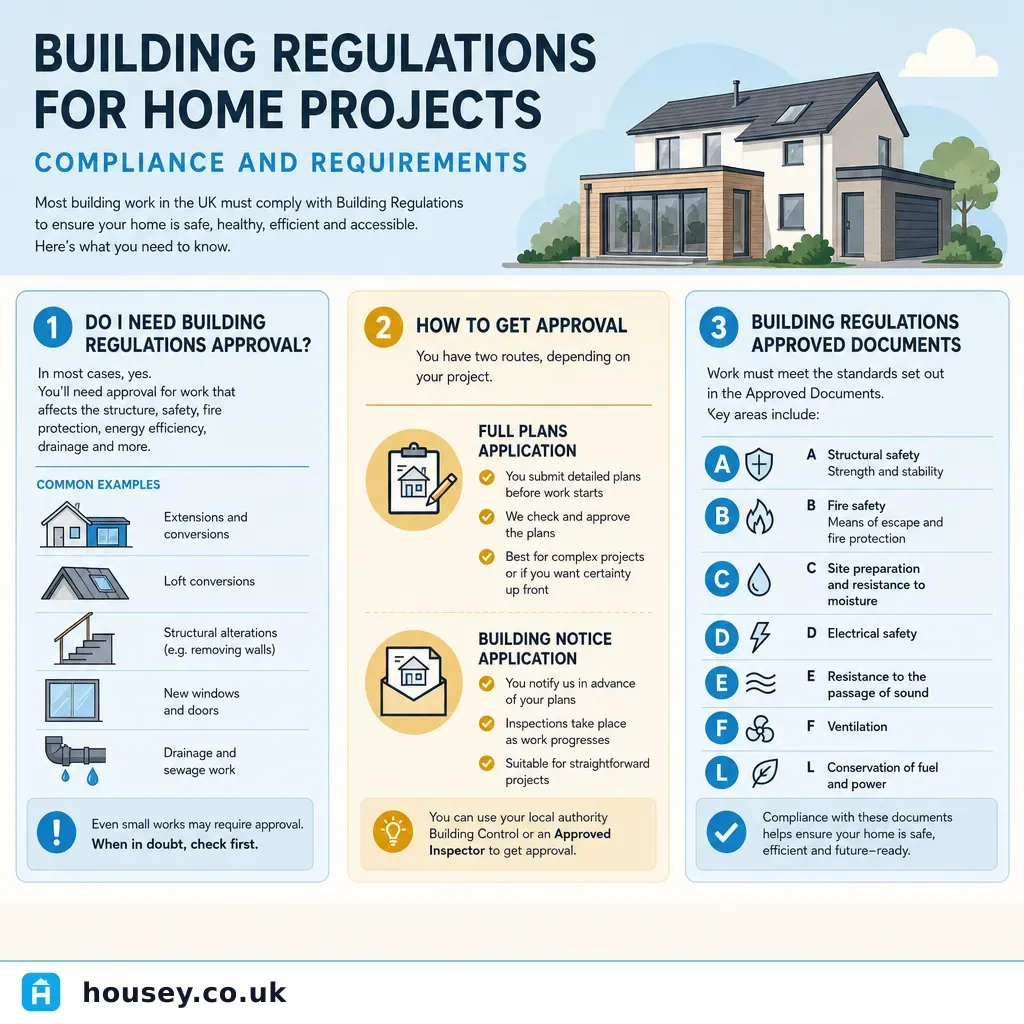
Building Regulations for Home Projects: Compliance and Requirements
Building regulations approval is needed for most structural, safety-related, and energy-related home projects in England and Wales, including extensions, loft conversions, and new heating systems.
 Planning & Pre-Build
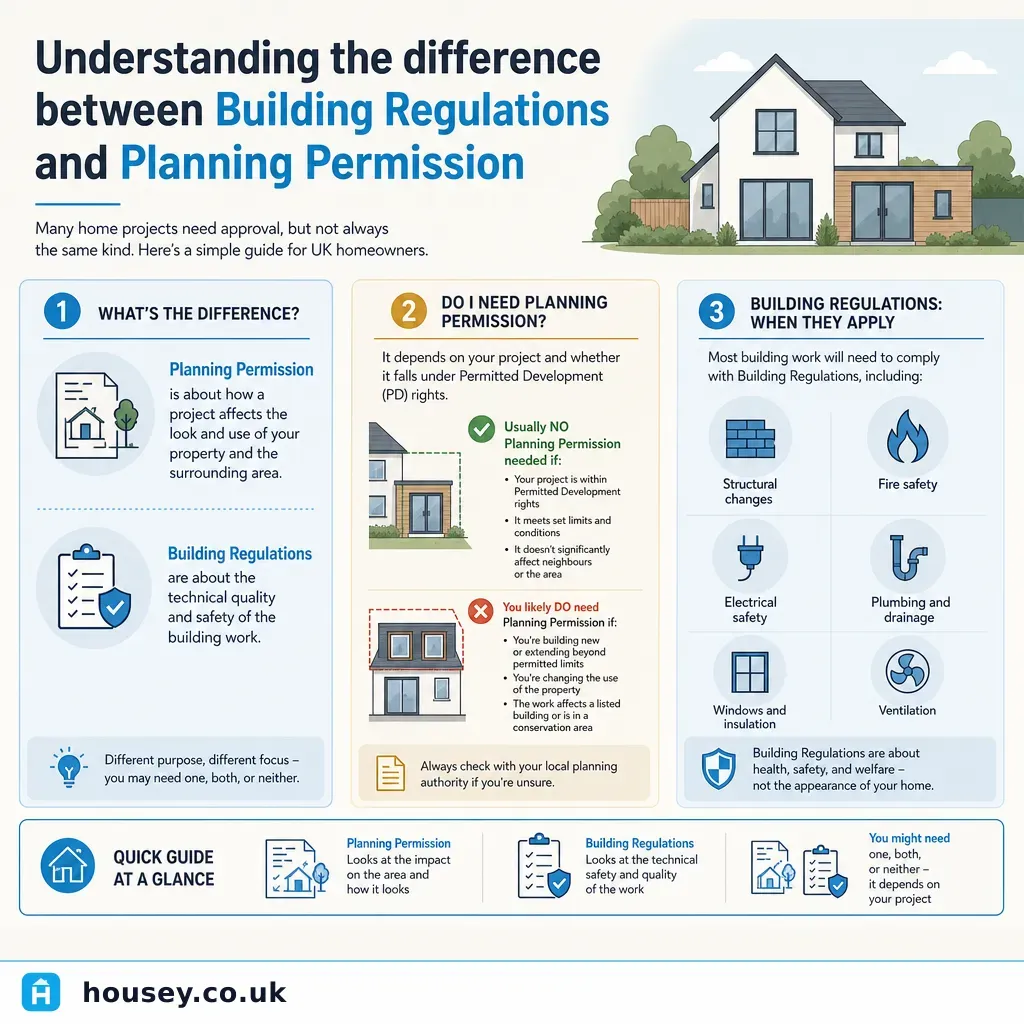
Understanding the difference between building regulations and planning permission
Planning permission is granted by your Local Planning Authority and controls whether a development is acceptable in principle — its appearance, use, and impact on the area.