Building regulations for boiler installation: compliance requirements
By Housey · Last reviewed 11th of May 2026
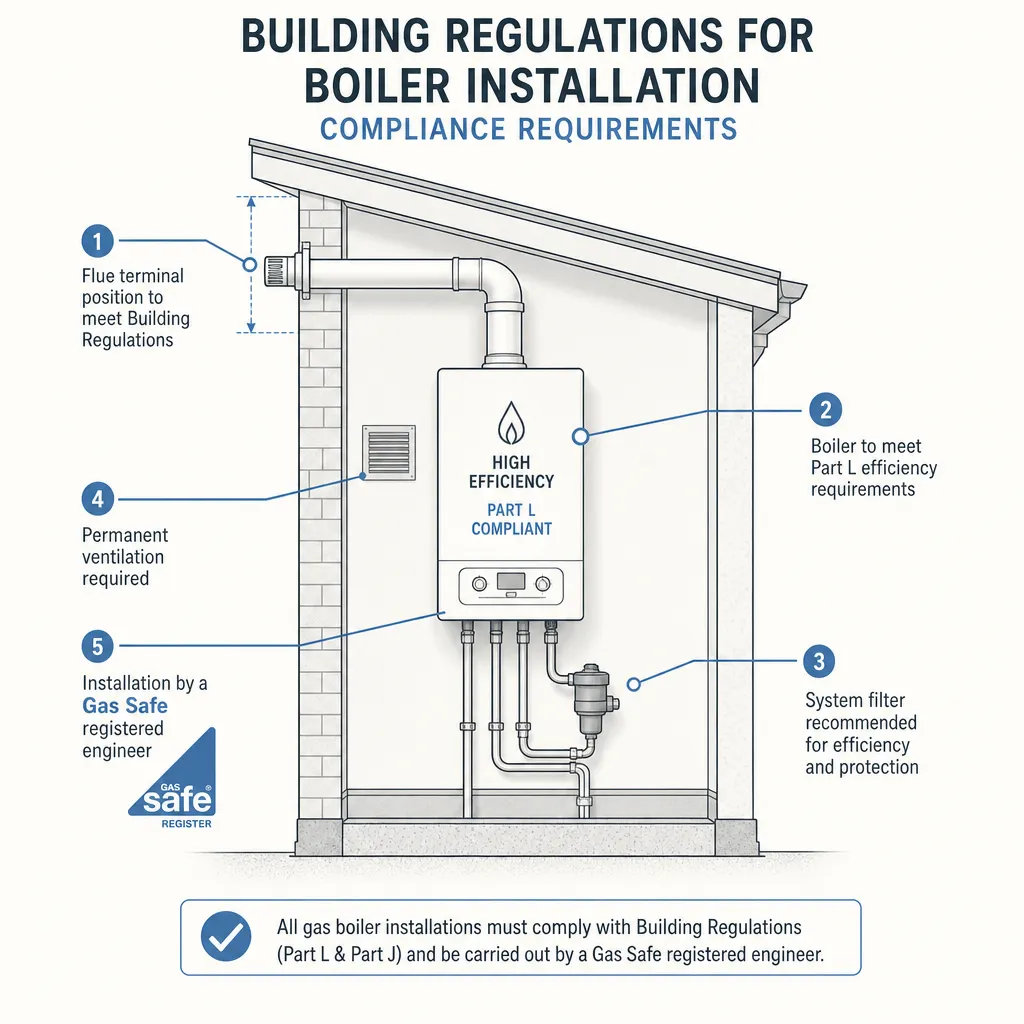
Building regulations for boiler installation: compliance requirements
A new boiler is one of the most common home improvements in the UK, yet it sits at the intersection of gas safety law, building regulations, and self-certification schemes in a way that catches many homeowners off guard. Whether you are replacing a combi, upgrading a system boiler, or relocating a flue, understanding the compliance framework helps you verify the work has been done correctly and protects you when you come to sell.
Key points
- All gas boiler installations must be carried out by a Gas Safe registered engineer under the Gas Safety (Installation and Use) Regulations 1998.
- New boilers must achieve a minimum seasonal efficiency of 92% ErP under Part L of the Building Regulations (Conservation of Fuel and Power).
- Engineers registered under a Competent Person Scheme can self-certify their work to Building Control without the homeowner making a separate application.
- After installation, you should receive a Gas Safety certificate and a Building Regulations Compliance Certificate (BRCC) within 30 days.
- Under the Future Homes Standard, gas boilers will not be permitted in new-build homes from 2025 onwards; replacement boilers in existing homes are currently unaffected.
Which building regulations apply to boiler installation?
Boiler installation in England and Wales touches three main Approved Documents:
Approved Document | Subject | Relevance to boiler installation |
|---|---|---|
Part J — Combustion Appliances | Flue design, air supply, hearth requirements | Governs flue positioning, terminal clearances, and air supply to the combustion chamber |
Part L — Conservation of Fuel and Power | Energy efficiency of fixed building services | Minimum boiler efficiency (92% ErP), heating controls (programmer, room thermostat, TRVs), pipework insulation |
Part P — Electrical Safety | Fixed electrical installations | Applies if the installation involves new electrical wiring connected to the consumer unit |
In Scotland, equivalent provisions appear in the Technical Handbooks (Domestic). In Northern Ireland, the Building Regulations (Northern Ireland) apply.
Do you need a separate building control application?
For most standard boiler replacements, the answer is no — your Gas Safe registered installer can self-certify the work under a Competent Person Scheme and notify Building Control on your behalf. This triggers the issue of a Building Regulations Compliance Certificate (BRCC), which should be sent to you within 30 days.
A separate Full Plans or Building Notice application may be required in these situations:
- Moving a flue to a new position that requires penetration through a fire-rated wall
- Installing a new boiler in a previously unheated building, such as a garage conversion
- Any associated work that falls outside the scope of the competent person scheme
- Listed buildings, where listed building consent from the local planning authority may also be needed
If your installer does not notify Building Control and does not provide a BRCC, you may need to apply retrospectively — which can complicate a future property sale.
Gas Safe registration: what the law requires
The Gas Safety (Installation and Use) Regulations 1998 make it a criminal offence for anyone who is not Gas Safe registered to install, commission, or maintain gas fittings in the UK. This applies to boilers, gas fires, hobs, and all other gas appliances.
You can verify any engineer's Gas Safe registration at the Gas Safe Register website. Every registered engineer carries a Gas Safe ID card listing the specific appliance types they are qualified to work on — ask to see it before any work begins.
Gas Safe registration is not the same as Gas Safe certification of a particular installation. The engineer must test and commission the appliance after installation and provide you with signed documentation confirming it is safe.
Efficiency and controls requirements under Part L
Part L of the Building Regulations requires that replacement boilers achieve a minimum seasonal efficiency of 92% ErP. In practice, this means a condensing boiler in almost all circumstances — non-condensing boilers fall well below this threshold and have been effectively prohibited in new installations since 2005.
Part L also requires the following controls to be in place:
- A programmer (time control) and room thermostat where there is central heating
- Thermostatic radiator valves (TRVs) on all radiators, except in the room where the room thermostat is located
- Insulation on primary heating pipework running through unheated spaces
- An interlock so the boiler only fires when there is a demand for heat or hot water
Failure to install the required controls is a common reason for Part L non-compliance. Your installer should check and, where necessary, fit controls as part of the job — not treat them as optional extras.
Homeowner compliance checklist
Use this checklist to verify your installation before your engineer leaves the property:
What to ask a qualified professional
- Are you Gas Safe registered, and may I see your ID card?
- Is this installation notifiable under a Competent Person Scheme, and will you handle the notification?
- Will the new boiler and controls fully meet Part L requirements?
- Will I receive both a Gas Safety certificate and a Building Regulations Compliance Certificate?
- Does the proposed flue position comply with Approved Document J clearances?
- Is there any associated electrical work requiring a separate Part P notification?
- What warranty does the manufacturer offer, and will you register it on my behalf?
Important limitations
This article provides general guidance on building regulations compliance for boiler installations in England and Wales. Requirements differ in Scotland and Northern Ireland. Your specific installation may be affected by the age and construction of your property, the existing heating system configuration, available flue routes, and local planning conditions — particularly for listed buildings and properties in conservation areas. A Gas Safe registered engineer should assess your situation, and you should verify their registration before any gas work begins.
When to get professional help
Call the National Gas Emergency Service on 0800 111 999 and leave the property immediately if you smell gas. Do not use light switches or naked flames.
Contact a Gas Safe registered engineer promptly if:
- Your boiler displays fault codes, makes unusual noises, or produces yellow or orange flames (a possible sign of incomplete combustion)
- Your carbon monoxide alarm activates
- You suspect a previous installation was carried out without proper notification or certification
For compliance queries about missing certificates ahead of a property sale, a building control consultant can advise on regularisation options.
How Housey can help
If you need to verify compliance with building regulations for a boiler installation — or you are dealing with missing certificates ahead of a sale — Housey can connect you with building control consultants who understand the self-certification framework and can advise on retrospective regularisation where needed.
Frequently asked questions
What is a Building Regulations Compliance Certificate for a boiler?
It is the formal confirmation from your local authority or an approved inspector that the installation has been notified and deemed to comply with building regulations. Your installer's Competent Person Scheme should arrange issue within 30 days of notification. Keep it securely — buyers' solicitors routinely request it during conveyancing, and a missing certificate can cause delays or require indemnity insurance.
What if my boiler was installed without building regulations sign-off?
If a previous boiler was installed without proper notification or certification, you may need to apply for a Regularisation Certificate from your local Building Control authority. This retrospectively approves the work and can resolve queries raised during a property sale. A building control consultant can help you navigate this process and advise on likely costs and timescales.
Can I install my own boiler?
Only if you are Gas Safe registered for that specific appliance type. Installing or commissioning a gas boiler without Gas Safe registration is a criminal offence under the Gas Safety (Installation and Use) Regulations 1998 and will also invalidate most home insurance policies. Even highly competent general DIYers cannot legally carry out this work.
Does replacing a boiler require planning permission?
In most cases, no. Boiler replacement is generally treated as permitted development. However, if the flue will be visible from a highway and the property is in a conservation area, or if the property is listed, you should check with your local planning authority before proceeding — flue positions and types may be subject to restrictions.
Sources and further reading
- Gas Safety (Installation and Use) Regulations 1998 — legislation.gov.uk
- Building Regulations Approved Document J: Combustion Appliances — GOV.UK
- Building Regulations Approved Document L: Conservation of Fuel and Power — GOV.UK
- Gas Safe Register: verify an engineer — Gas Safe Register
- Competent Person Schemes — GOV.UK
Useful next reads
 Planning & Pre-Build
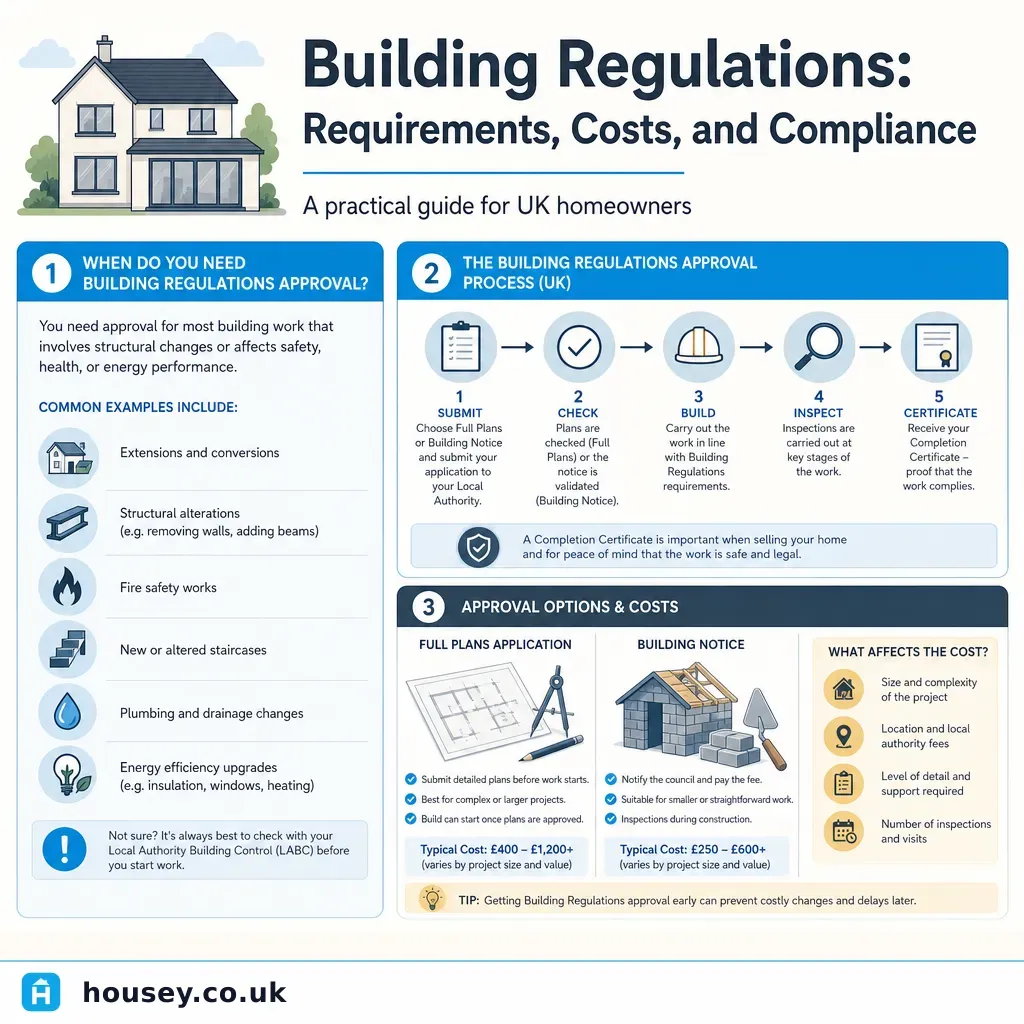
Building Regulations: Requirements, Costs, and Compliance
Building regulations set minimum standards for how construction work is carried out in the UK, covering structural stability, fire safety, energy efficiency, and ventilation.
 Planning & Pre-Build
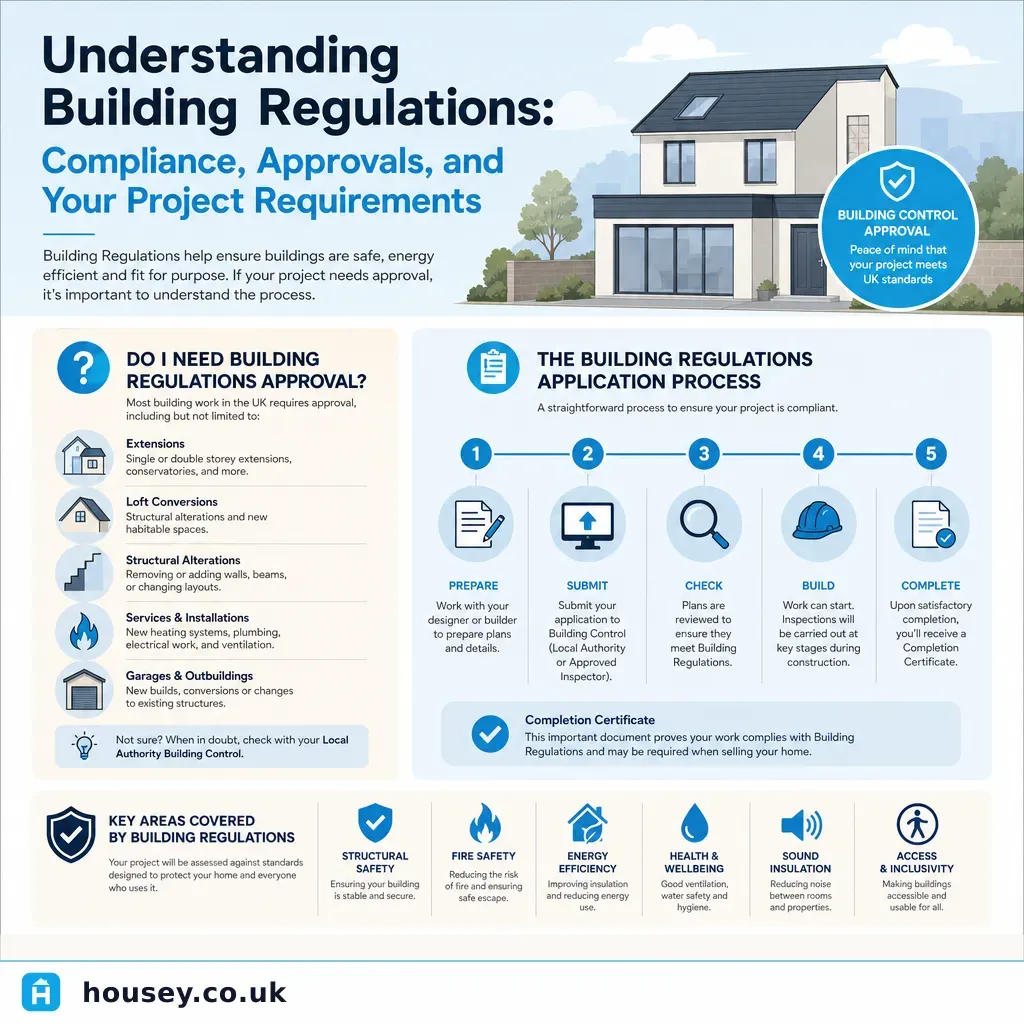
Understanding Building Regulations: Compliance, Approvals, and Your Project Requirements
Building regulations set minimum standards for design, construction, and alterations to buildings in England and Wales.
 Planning & Pre-Build
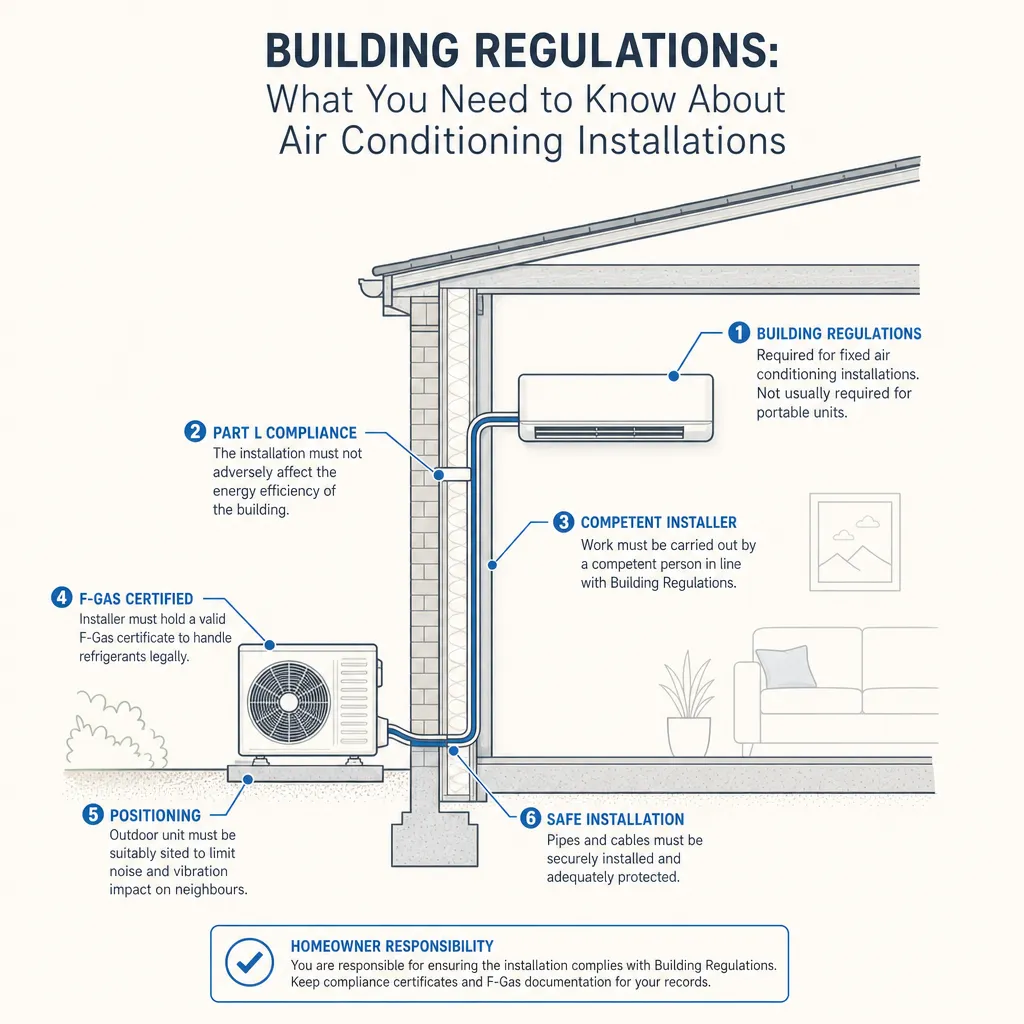
Building Regulations: What You Need to Know About Air Conditioning Installations
Most domestic air conditioning installations in England must comply with Building Regulations Part L (energy efficiency) and Part F (ventilation).
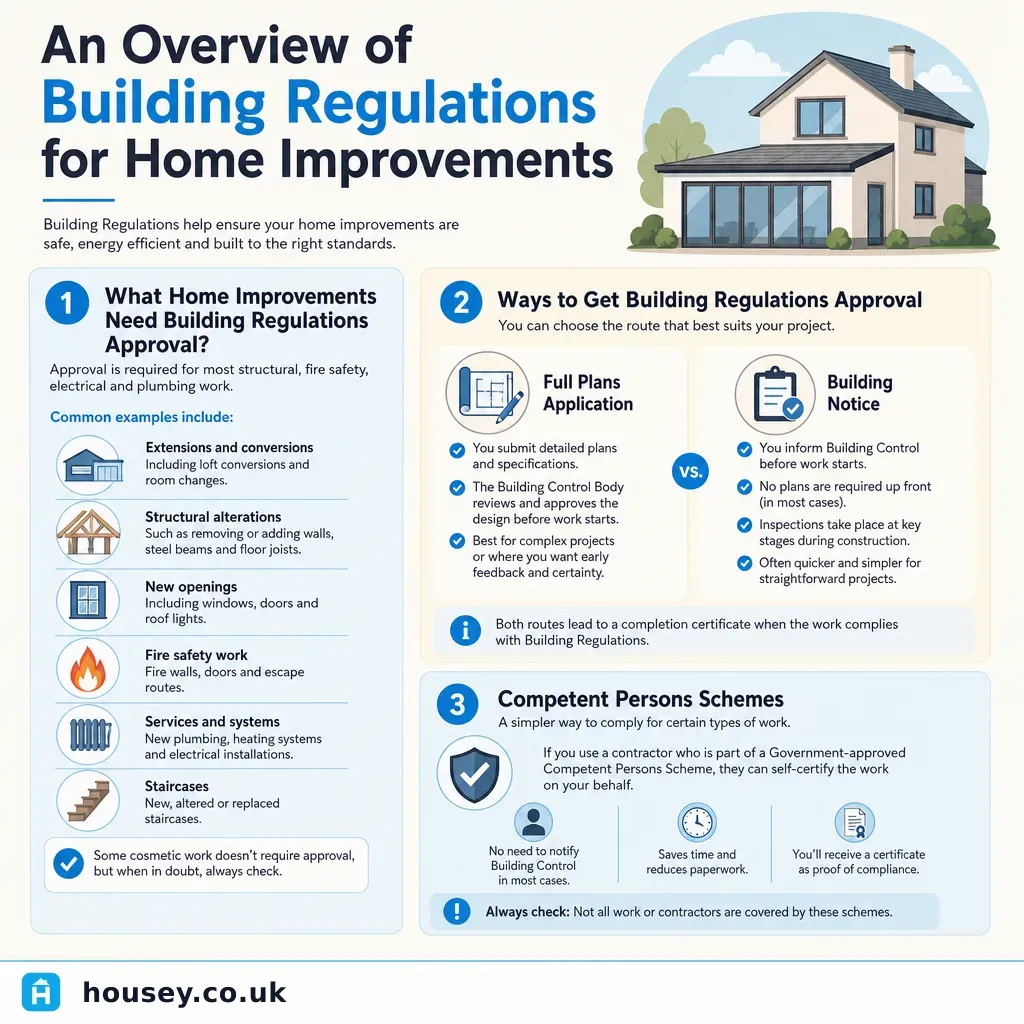 Planning & Pre-Build
An Overview of Building Regulations for Home Improvements
Building regulations apply to most structural, energy, fire safety, and electrical work in UK homes — but not to like-for-like repairs or maintenance.
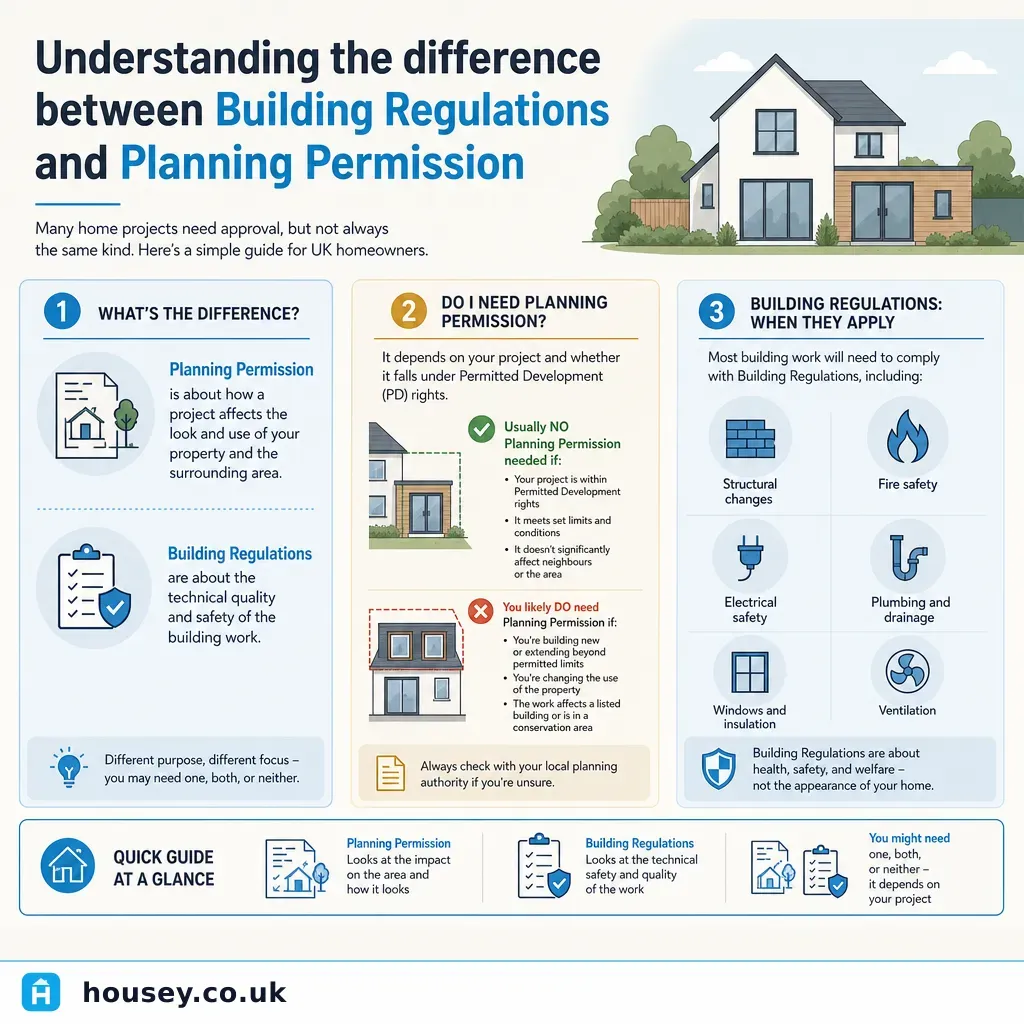 Planning & Pre-Build
Understanding the difference between building regulations and planning permission
Planning permission is granted by your Local Planning Authority and controls whether a development is acceptable in principle — its appearance, use, and impact on the area.