Building Regulations for Basement Wall Construction and Design
By Housey · Last reviewed 11th of May 2026
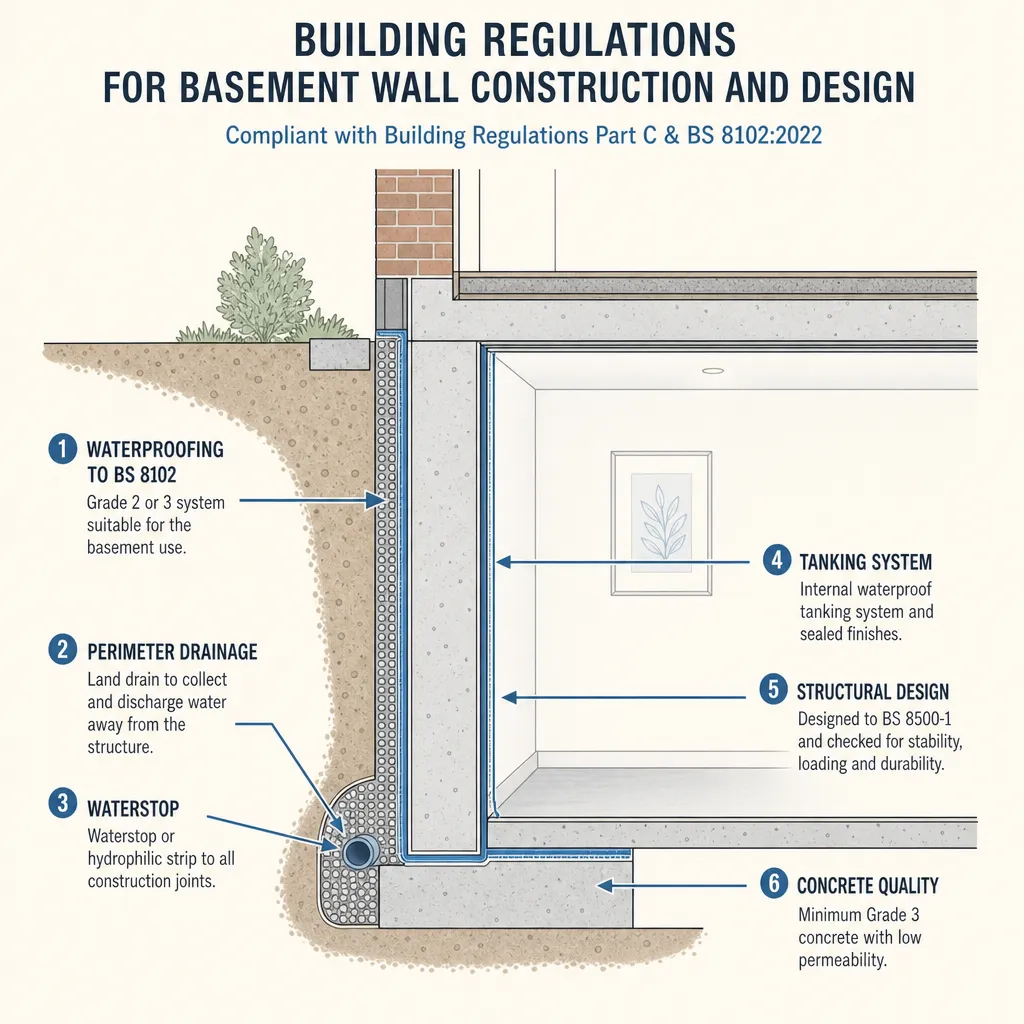
Building Regulations for Basement Wall Construction and Design
Constructing or converting a basement is one of the most tightly regulated categories of domestic building work in the UK. Whether you are underpinning a Victorian terrace to create lower-ground habitable space, digging beneath a 1930s semi for a home cinema, or tanking an existing cellar for use as a utility room, you will face intersecting obligations under multiple Approved Documents — as well as structural design requirements, waterproofing standards set by British Standard BS 8102:2022, and potentially the Party Wall etc. Act 1996. Understanding what applies, and in what sequence, avoids costly delays and enforcement problems before a spade has entered the ground.
Key points
- Basement construction and conversion in England and Wales requires Building Regulations approval under Approved Documents A (Structure), C (Resistance to Contaminants and Moisture), F (Ventilation), and L (Conservation of Fuel and Power) — work cannot lawfully begin without it.
- BS 8102:2022 classifies below-ground waterproofing into three grades; most habitable basement spaces require Grade 3 protection, combining a structural wall, waterproof membrane, and perimeter cavity drainage.
- Retaining walls and underpinning schemes require a chartered structural engineer's design calculations before Building Control will approve the work.
- Excavation within 3 metres of a neighbouring property's foundations triggers Section 6 of the Party Wall etc. Act 1996 — a party wall agreement must be in place before work starts.
- Habitable basement rooms must meet the ventilation requirements of Approved Document F (2021 edition) and the thermal fabric performance thresholds of Approved Document L.
Which Building Regulations apply to basement walls?
Basement wall construction rarely falls under a single Approved Document. The most relevant are:
Approved Document A — Structure: All load-bearing walls, retaining walls, and the structural frame of the basement must be engineered to support imposed loads safely. Any underpinning of existing foundations requires structural design calculations submitted to Building Control before work begins.
Approved Document C — Site Preparation and Resistance to Contaminants and Moisture: Basement walls and floors must resist moisture penetration from the ground. The required performance level is defined in BS 8102:2022 and varies depending on the intended use of the finished space.
Approved Document F — Ventilation (2021 edition): Habitable rooms below ground level typically have no openable windows, so mechanical ventilation — most often mechanical ventilation with heat recovery (MVHR) — is the standard solution. Building Control will expect to see the ventilation design strategy as part of the application submission.
Approved Document L — Conservation of Fuel and Power: Any new or converted habitable basement space must meet current U-value targets for external walls, floors, and any rooflight or door elements. Basement walls below ground level typically require additional insulation to achieve compliance.
Approved Document B — Fire Safety may also be relevant: if the basement is a habitable room and forms part of the means of escape from the dwelling, fire-protected lobby arrangements or fire-rated doors may be required.
What does BS 8102:2022 require for waterproofing?
BS 8102:2022 is the British Standard that sets out how below-ground structures should be protected against water ingress. It classifies waterproofing into three grades, and Building Control inspectors will expect to see a specification that references the appropriate grade and demonstrates the proposed system achieves it.
Grade | Typical use | Acceptable water ingress | Common approach |
|---|---|---|---|
Grade 1 | Plant rooms, car parks, utility storage | Some seepage and surface dampness tolerated | Single waterproof system acceptable |
Grade 2 | Workshops, commercial storage, leisure | No water ingress; surface moisture acceptable | Single or combination system |
Grade 3 | Habitable rooms — bedrooms, living rooms, home offices | No water ingress or dampness | Combination: structural wall + membrane + perimeter drainage |
Most basement conversions aimed at habitable use require Grade 3 protection. This typically combines the structural concrete or masonry wall, a Type A cavity drainage membrane or Type B cementitious render system, and a perimeter drainage channel at slab level discharging to a sump and pump. A specialist basement waterproofing contractor should produce a BS 8102:2022-compliant specification as part of the Building Regulations submission.
Structural requirements: retaining walls and underpinning
Basement walls that retain soil are retaining structures as well as building elements. Their design must account for:
- Lateral earth pressure: the horizontal force exerted by the retained soil, and any surcharge above it — a driveway, garden, or neighbouring structure.
- Water pressure: particularly significant where a high water table is present; a structural engineer will typically need ground investigation data before sizing the wall section.
- Underpinning depth and sequence: where the basement is excavated beneath existing foundations, a staged underpinning scheme is standard. Bays of around 1 metre are typically completed and allowed to cure before the adjacent bay is begun.
Building Control will not approve structural basement work without design calculations from a chartered structural engineer. These must be included in the Building Regulations application, and the engineer's details will appear on the completion documentation.
Party wall and planning considerations
Party Wall etc. Act 1996: Under Section 6 of the Act, a party wall notice must be served where excavation is proposed within 3 metres of a neighbouring building's foundations, or within 6 metres if the new excavation will cut below a 45-degree line drawn from the base of the neighbour's foundations. This notice must be served before work starts, and a party wall award — prepared by a party wall surveyor — sets out the conditions under which work may proceed.
Planning permission: Many basement conversions in England are permitted development and do not require a planning application, provided no external changes are visible from the street. However, properties in conservation areas, Article 4 Direction areas, or listed buildings face additional restrictions. External alterations — lightwells, access staircases, or visible extract terminals — typically require full planning permission. Always check with your local planning authority before assuming permitted development applies.
Important limitations
This article provides general information about UK building regulations as they apply to basement wall construction. Specific requirements vary considerably depending on property type, ground conditions, proximity to neighbouring structures, local authority practice, and the intended use of the finished space. Nothing in this article constitutes structural, waterproofing design, or legal advice. A chartered structural engineer, approved building inspector, or specialist basement contractor should assess your specific property and project before any work is commissioned.
When to get professional help
Seek qualified professional input before work begins — not after a problem appears. Contact a structural engineer or building control consultant if:
- You are planning to excavate below existing foundations or underpin any structural element.
- You can see cracks, bulging, or signs of movement in existing basement or cellar walls.
- Neighbouring properties are close and could be affected by ground movement during excavation.
- The site has a known high water table or a history of flooding or waterlogging.
- The property is listed or located within a conservation area.
- You are unsure whether planning permission or permitted development applies to your project.
- Your contractor and Building Control officer have given you conflicting guidance on approach.
What to ask a qualified professional
Before instructing a structural engineer, waterproofing specialist, or building control consultant for a basement project, ask:
- What ground investigation or soil survey do you recommend before designing the retaining wall?
- Which BS 8102:2022 waterproofing grade applies to my intended use, and what system do you specify to meet it?
- Will you produce the structural calculations for Building Control, or do I need to instruct an engineer separately?
- Who is responsible for overall building regulations compliance throughout the project?
- What party wall obligations apply, and do I need to appoint a party wall surveyor?
- At which construction stages will Building Control inspect, and when must work pause for an inspection?
- What completion certificate will I receive, and will it satisfy a future conveyancing solicitor or mortgage lender?
How Housey can help
Getting the paperwork right before basement work starts avoids costly mid-build changes and enforcement problems. Housey connects homeowners with specialists who prepare building regulations drawings for basement projects, and experienced building control consultants who can guide the approval process from initial application through to the issue of a completion certificate.
Frequently asked questions
Do I always need building regulations approval for a basement conversion in England?
Yes — converting an existing cellar or excavating a new basement is notifiable building work under the Building Regulations 2010, and you must obtain approval before starting. Failure to do so can make the property difficult to sell and may lead to enforcement action by the local authority. A completion certificate is issued on sign-off and will be required by conveyancers on resale or remortgage.
Can a basement conversion proceed under permitted development?
Permitted development is a planning concept, not a building regulations exemption. Many basement conversions do not require a planning application if no external changes are visible from the street, but building regulations approval is always required for the construction work itself. External alterations such as lightwells or access staircases typically need full planning permission. Listed buildings require listed building consent for all structural works.
How long does building regulations approval for a basement project typically take?
A full plans application — where drawings are submitted before work begins — typically takes five to eight weeks for a decision, though structurally complex schemes may take longer. A building notice allows work to start sooner but carries greater risk if inspectors require mid-build changes. Most basement projects use the full plans route to avoid costly alterations during construction.
What is a building regulations completion certificate and why does it matter for a basement?
A completion certificate is issued by Building Control after all inspections confirm the work meets the Building Regulations. Without one, mortgage lenders and conveyancing solicitors will query the basement when you come to sell or remortgage. It is particularly important for basement work, where structural, waterproofing, and ventilation elements are each checked at staged inspection intervals.
Sources and further reading
- Approved Document A: Structure — GOV.UK
- Approved Document C: Site Preparation and Resistance to Contaminants and Moisture — GOV.UK
- Approved Document F: Ventilation (2021 edition) — GOV.UK
- BS 8102:2022 Code of practice for protection of below ground structures against water from the ground — BSI
- Party Wall etc. Act 1996: explanatory booklet — GOV.UK
Useful next reads
 Planning & Pre-Build
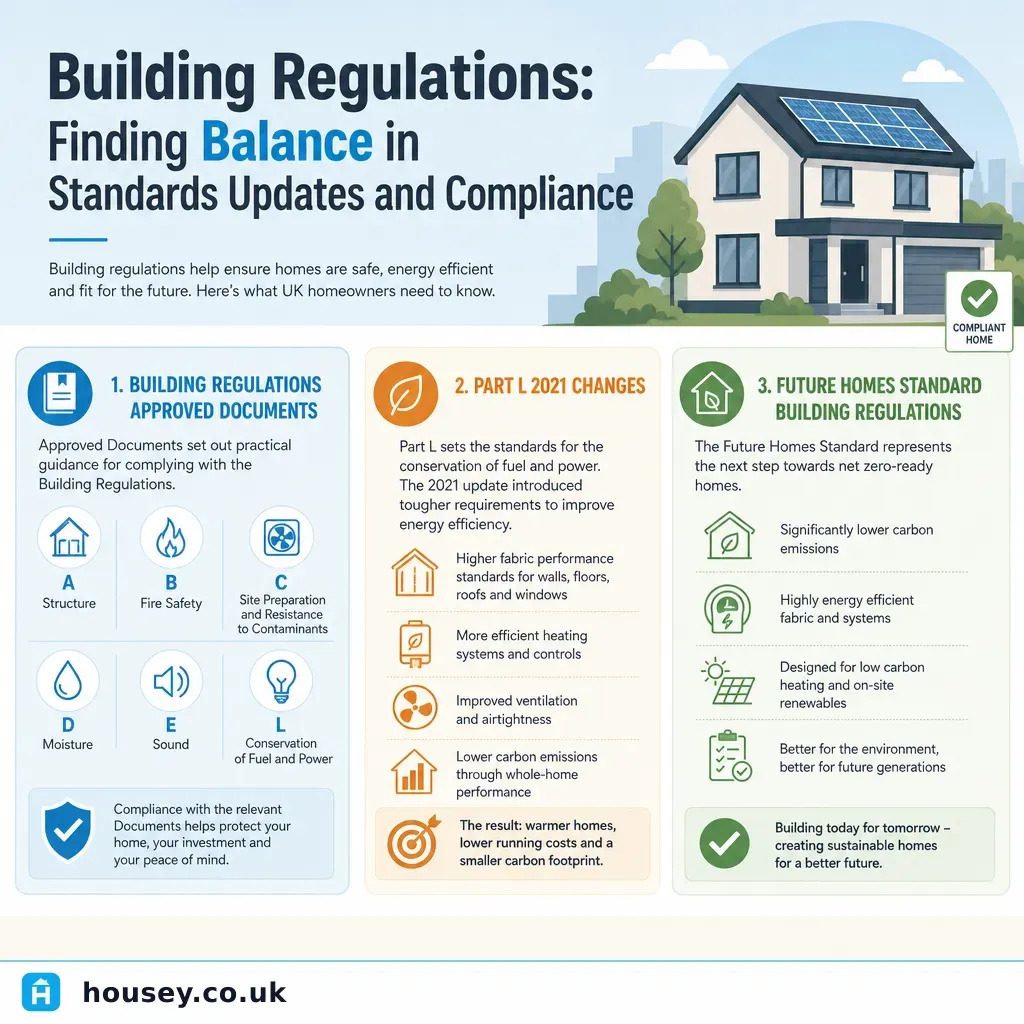
Building Regulations: Finding Balance in Standards Updates and Compliance
Building regulations in England and Wales set minimum standards for construction, covering structure, fire safety, energy efficiency, and ventilation.
 Planning & Pre-Build
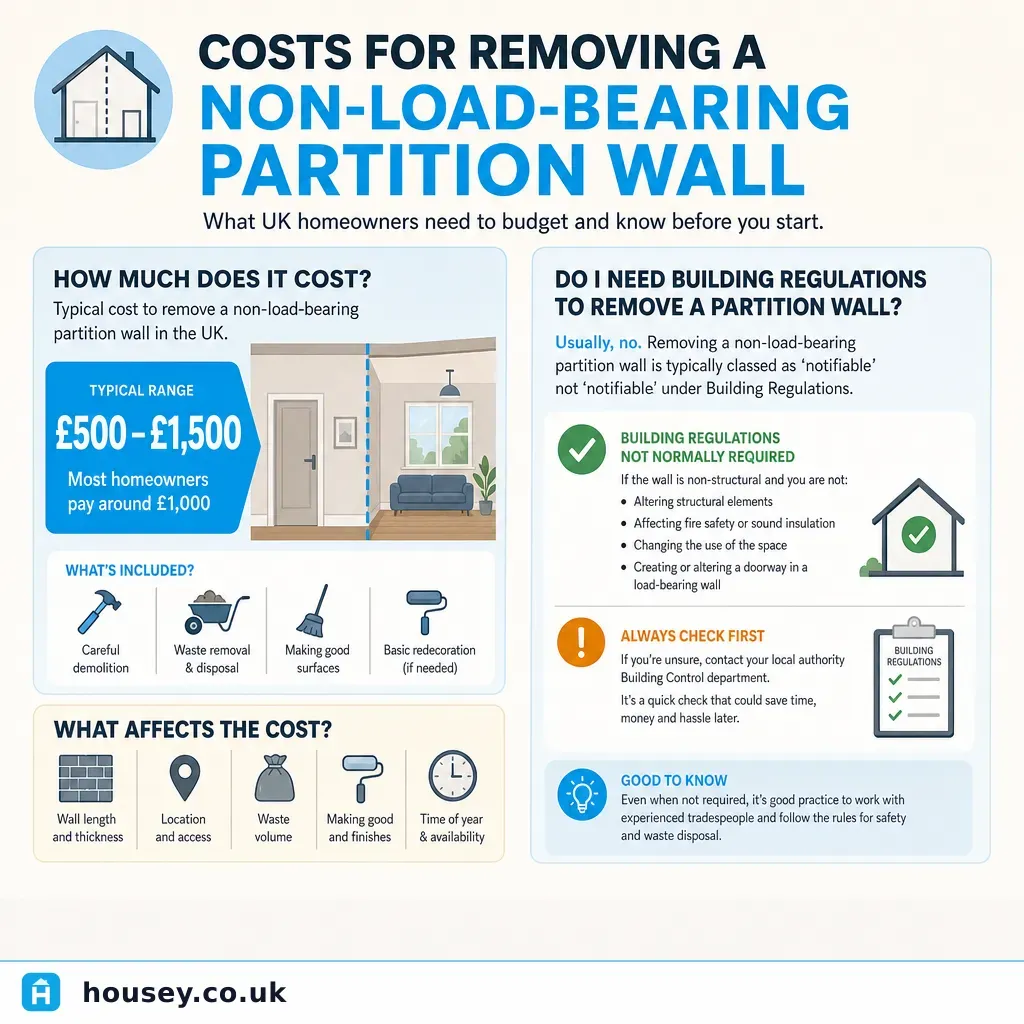
Costs for removing a non-load-bearing partition wall
Removing a non-load-bearing partition wall in a UK home typically costs £300–£1,500 in labour, plus £200–£600 or more for replastering and making good.
 Planning & Pre-Build
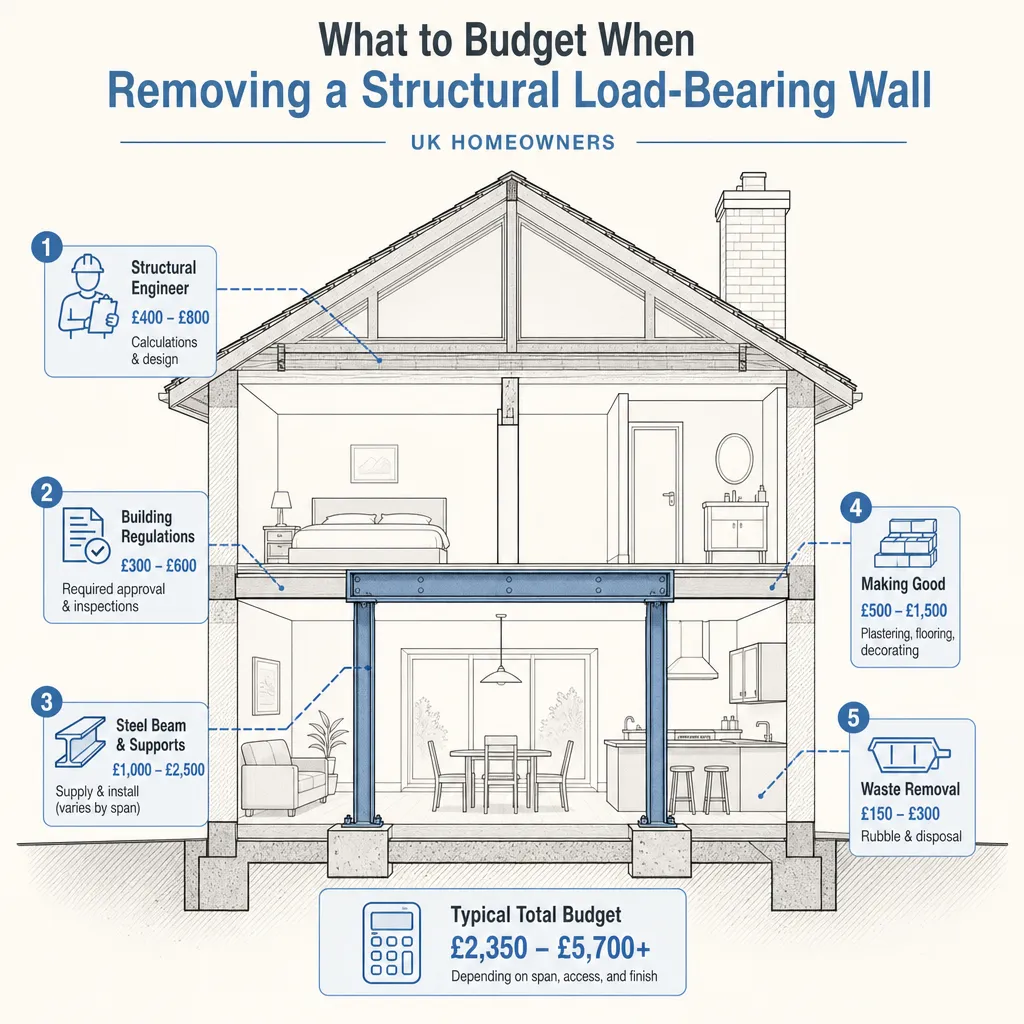
What to Budget When Removing a Structural Load-Bearing Wall
Removing a load-bearing wall in a typical UK home costs £2,500–£8,000 or more in total, covering a structural engineer's calculations, Building Regulations approval, the steel beam, builder's labour, and replastering.
 Planning & Pre-Build
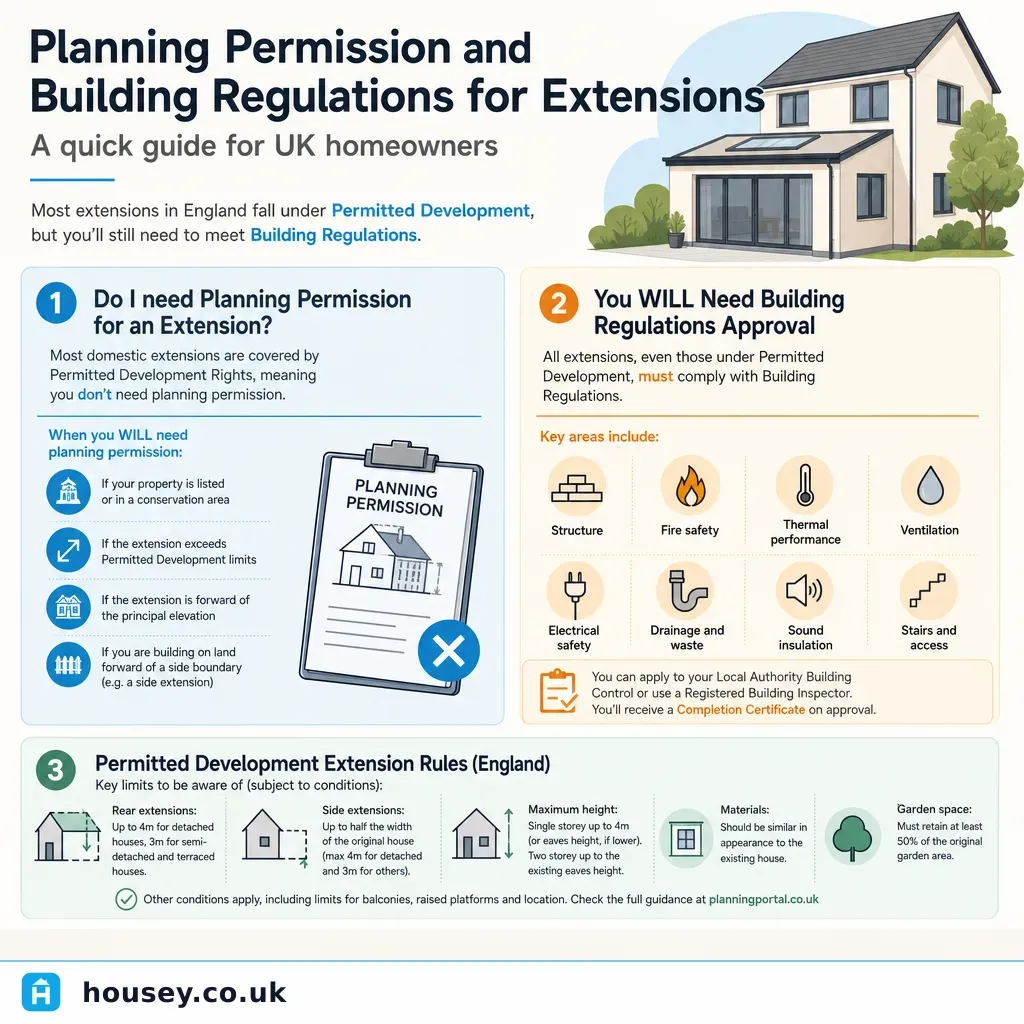
Planning Permission and Building Regulations for Extensions
UK home extensions usually require both planning permission and Building Regulations approval, though most smaller rear extensions qualify as Permitted Development under the GPDO 2015 and need no planning application.
 Planning & Pre-Build
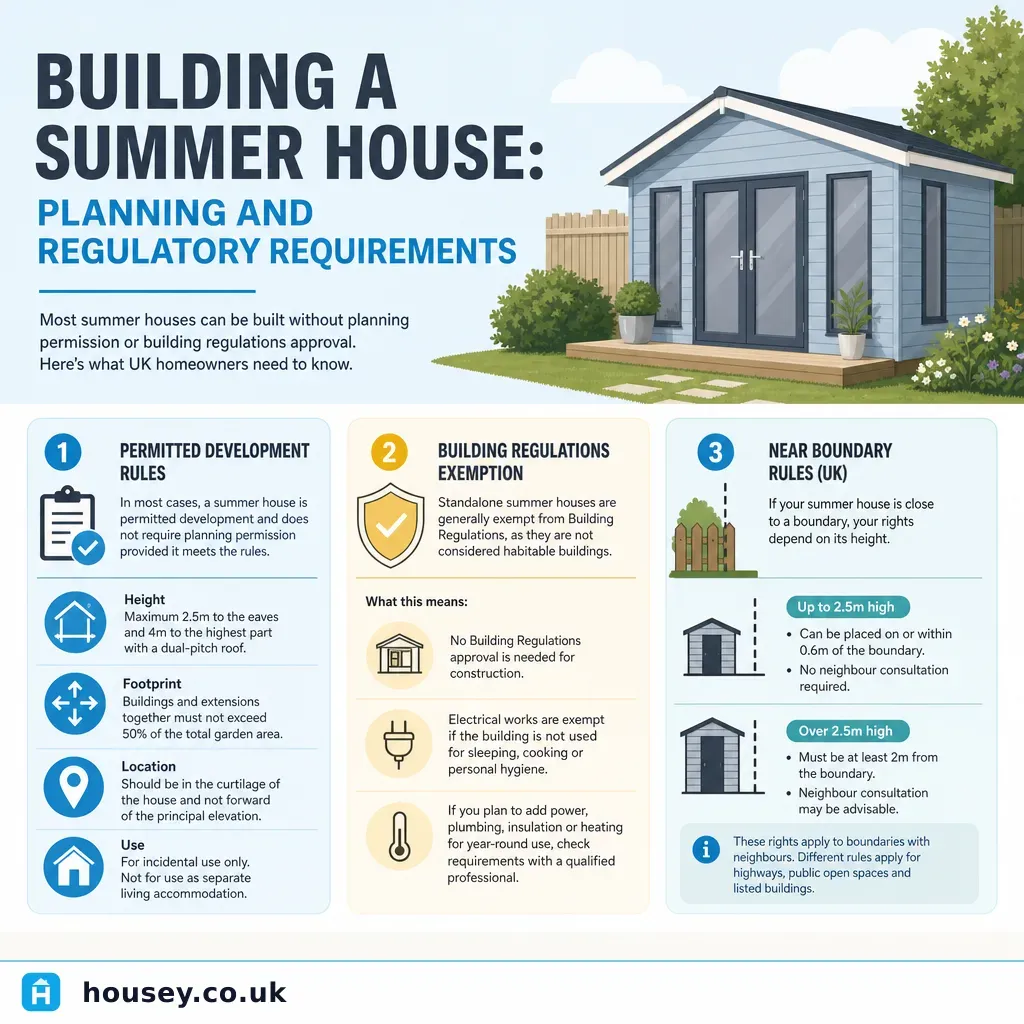
Building a Summer House: Planning and Regulatory Requirements
Most garden summer houses in England fall under Class E permitted development and need no planning permission, provided they are single-storey, within height limits, and not used for sleeping.