Building Regulations: Finding Balance in Standards Updates and Compliance
By Housey · Last reviewed 1st of June 2026
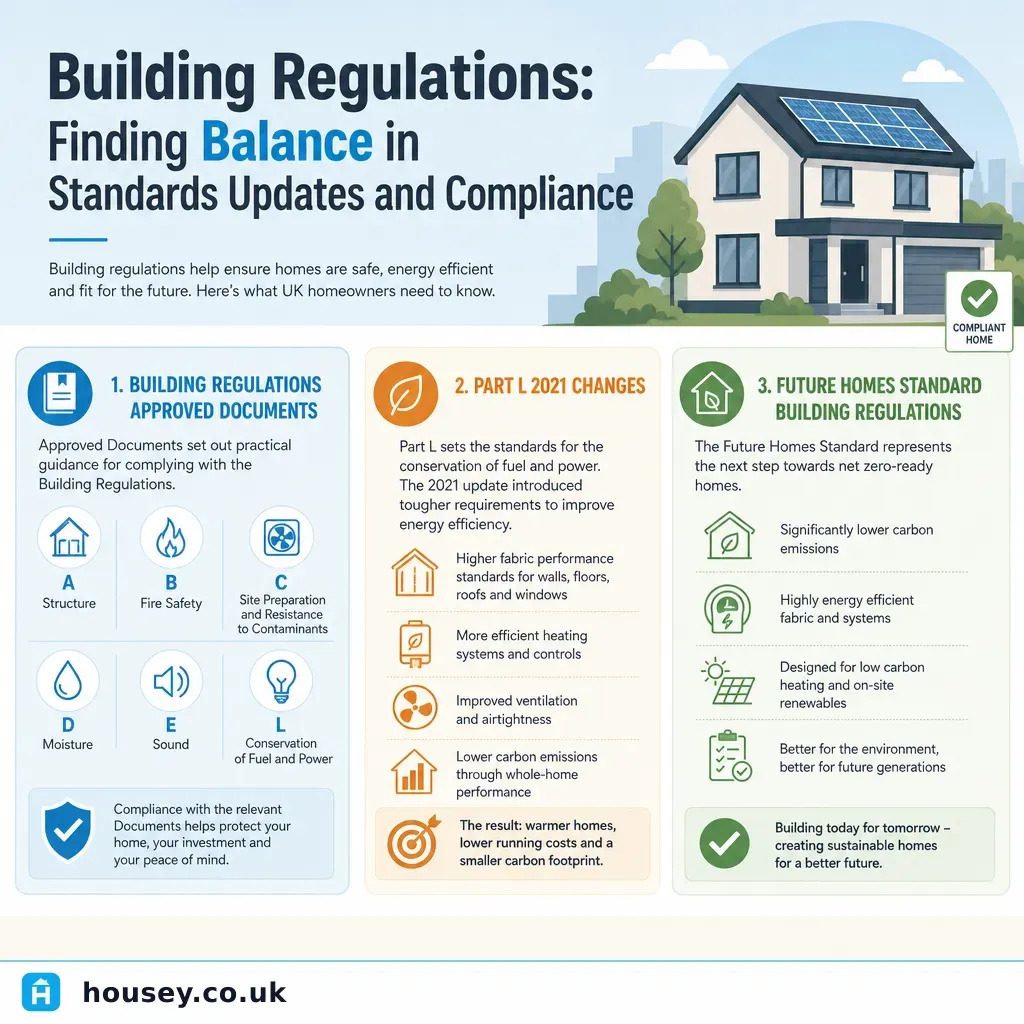
Building Regulations: Finding Balance in Standards Updates and Compliance
Building regulations underpin almost every significant construction or alteration project in England and Wales — from a modest single-storey rear extension to a new-build development. They protect the health and safety of building occupants and future users, but they are not static: the regulatory framework is updated regularly in response to new evidence, energy policy, and high-profile safety reviews. For homeowners, developers, and their advisers, keeping pace with those changes while managing cost and programme is a genuine practical challenge.
Key points
- Building regulations in England and Wales are made under the Building Act 1984 and currently sit in the Building Regulations 2010 (as amended), with technical guidance set out in a series of Approved Documents labelled A through S.
- The 2021 amendments introduced significant changes to Part L (conservation of fuel and power), Part F (ventilation), and the new Part O (overheating prevention), raising minimum standards for new homes and certain extensions in England.
- The Building Safety Act 2022 established the Building Safety Regulator (BSR), hosted within the Health and Safety Executive (HSE), and introduced mandatory gateway approvals for higher-risk buildings (HRBs) — defined as those over 18 metres or 7 storeys containing multiple dwellings.
- Most notifiable building work requires either a local authority building control (LABC) application or engagement with a registered building control approver (RBCA) before work commences.
- Competent Person Schemes — including Gas Safe, NICEIC, FENSA, CERTASS, and HETAS — allow qualified tradespeople to self-certify specific types of work without a separate building control application, provided they are registered for the work in question.
What building regulations cover — and what they do not
The Approved Documents are technical guidance documents, not law in themselves, but following them demonstrates one accepted method of meeting the legal requirements of the Building Regulations 2010. Each document covers a defined area of building performance:
Approved Document | Subject | Key recent changes |
|---|---|---|
Part A | Structure | Minor updates; no major 2021 revisions |
Part B | Fire safety | Volume 2 (buildings over 18m) substantially revised following the Grenfell Tower inquiry |
Part F | Ventilation | Revised 2021 — new minimum flow rates and purge ventilation requirements for new dwellings |
Part L | Conservation of fuel and power | Revised 2021 — tightened U-values and airtightness targets ahead of the Future Homes Standard |
Part O | Overheating | New in 2021 — applies to new residential buildings in England |
Part S | EV charging infrastructure | New in 2021 — applies to new and materially altered buildings with associated car parks |
These Approved Documents apply in England. Wales has its own consolidated building regulations through the Welsh Government; Scotland uses the Building (Scotland) Regulations 2004; and Northern Ireland has separate provisions. If your project involves a listed building or a conservation area, additional consent requirements apply alongside building regulations, and the interaction between them requires careful management.
Building regulations generally apply to structural work, extensions, loft conversions, garage conversions, replacement windows and doors (unless installed by a registered FENSA or CERTASS member), electrical work beyond minor additions, and certain plumbing alterations. Redecorating, replacing like-for-like fixtures, and most garden works are excluded from the regime.
How standards evolve — and what this means for live projects
The pace of regulatory change has accelerated since 2021. The government's trajectory towards the Future Homes Standard — intended to require new homes to produce substantially fewer carbon emissions than those built to 2013 standards — means further revisions to Part L and Part F are anticipated. PAS 2035, the publicly available specification for domestic retrofit work, already governs energy improvement projects funded through ECO4 and the Great British Insulation Scheme.
For homeowners with projects already underway, the general principle is that the regulations in force at the time of the initial building control application govern that project. If work stalls significantly or a fresh application becomes necessary, the standards current at that point apply. This is a practical reason to submit a building control application promptly once planning permission — where required — has been secured.
Notable milestones to track:
- 2021 Part L, F, and O amendments: Now in force in England. Part L requires a 31% reduction in CO₂ emissions for new dwellings compared with the previous standard.
- Future Homes Standard: Detailed technical specifications are expected before the standard's intended 2025 implementation date; check GOV.UK's Future Homes Standard collection for the latest updates.
- Building Safety Act 2022: Gateway 2 (design approval before construction begins) and Gateway 3 (completion sign-off before occupation) are now mandatory for HRBs and enforced by the Building Safety Regulator.
Navigating building control — which route is right for your project?
For most domestic projects in England, there are two main compliance routes, plus Competent Person Schemes for defined work types.
Decision tree: choosing your building control route
- Choose local authority building control (LABC) if your project is in a sensitive location (listed building, conservation area), if your local authority has strong service levels and local knowledge, or if you prefer inspections by a public-sector body.
- Choose a registered building control approver (RBCA) if your contractor or architect has an established working relationship with a particular approver, if your programme requires a flexible inspection schedule, or if you are working on a larger or technically complex scheme.
- Use a Competent Person Scheme if the work falls squarely within a scheme's defined scope — for example, a Gas Safe-registered engineer fitting a new boiler, a NICEIC-registered electrician rewiring a kitchen, or a FENSA-registered installer replacing windows. Always request a completion certificate and verify the registration independently before work begins.
- Seek specialist building control advice if your project involves an HRB, a novel structural system, a material change of use, or substantial work to a listed building. The Building Safety Regulator guidance on higher-risk buildings sets out the gateway requirements in detail.
Whatever route you use, secure a formal completion certificate when the work is inspected and signed off. Solicitors will request this document during conveyancing, and its absence can delay or jeopardise a sale.
Common compliance pitfalls for UK homeowners
Starting work without notification. Some homeowners begin building work and discover a building control application was needed only when they come to sell. Retrospective regularisation certificates are available but not guaranteed; an inspector may require elements to be opened up, tested, or rebuilt to verify compliance.
Assuming permitted development means no building regulations apply. Planning permission and building regulations are entirely separate legal systems. A project may benefit from permitted development rights — meaning no planning application is required — and still require building control approval. These are independent obligations, and one does not substitute for the other.
Using unregistered tradespeople for notifiable work. If an installer is not registered with a Competent Person Scheme for the specific work they are carrying out, a separate building control application is needed. Failing to make that application is a breach of the regulations and can create problems at the point of sale.
Overlooking the 2021 Part L or Part O requirements. Homeowners adding habitable rooms through extensions or loft conversions may find the 2021 overheating and energy efficiency standards now apply to the new elements and, in some cases, trigger a whole-dwelling energy assessment. Check with a building control professional before finalising your design.
Red flags — when to stop and seek professional input immediately
- A contractor suggests bypassing or delaying the building control application to save time or money
- Work has already started and you are unsure whether a building control application was ever submitted
- The project involves structural alteration — removal of load-bearing walls, creation of large new openings, or underpinning
- The property is listed, situated in a conservation area, or qualifies as a higher-risk building (over 18 metres or 7 storeys)
- You are changing the use of a building — for example, converting commercial space to residential, or subdividing a house into separate flats
- A completion certificate cannot be located for previous work on a property you are in the process of purchasing
Important limitations
This article provides general information about the building regulations framework in England. The requirements that apply to any specific project depend on the nature, scale, and location of the work; the property's type, age, and listing status; the Approved Documents relevant to the scope of works; and any site-specific conditions. Nothing in this article constitutes legal or professional building control advice. Always verify current requirements with a qualified building control professional or your local authority building control team before committing to a programme or starting work.
What to ask a qualified professional
Before appointing a building control approver or engaging a Competent Person Scheme member, consider asking:
- Which Approved Documents and regulations apply to my specific project, and have any been amended recently that I should be aware of?
- Is the proposed work notifiable under the Building Regulations 2010, and if so, which application route — full plans, building notice, or RBCA — is most appropriate?
- If my building qualifies as a higher-risk building, what gateway approvals are required and what is a realistic timeline?
- Will a formal completion certificate be issued at the end of the project, and what scope of work does it cover?
- Are there elements of the proposed design that risk non-compliance with Part L, Part F, or Part O as currently amended?
- How does building control interact with any listed building consent or conservation area requirements that apply to my property?
When to get professional help
Building regulations compliance is not a process most homeowners can manage without professional support. A building control professional — via your local authority or a registered building control approver — is essential for any notifiable work. Beyond building control itself, a structural engineer may be required for load-bearing alterations, and a qualified energy assessor may be needed to demonstrate Part L compliance for larger extensions. If you are purchasing a property and discover that previous works were carried out without the necessary approvals, raise this with your solicitor before exchange: you may need a regularisation certificate, indemnity insurance, or further investigation to protect your position.
How Housey can help
Housey connects you with vetted building control consultants who can advise on the most appropriate compliance route for your project, review your designs against the current Approved Documents, and guide you through the application and inspection process — whether you are planning a home extension, loft conversion, or a more complex development.
Frequently asked questions
Do I always need building regulations approval for an extension?
Most extensions in England require building regulations approval, regardless of whether they qualify as permitted development for planning purposes. Smaller single-storey extensions may use the building notice route rather than a full plans application, but confirm the appropriate process with your local authority building control team or a registered building control approver before any work begins.
What happens if I sell a property without a building regulations completion certificate?
Missing completion certificates for notifiable work typically cause delays during conveyancing. Buyers' solicitors will raise formal enquiries, and the seller may need a regularisation certificate — if the local authority agrees one can be issued — or indemnity insurance. Neither route is guaranteed to satisfy a buyer's lender. It is far simpler to obtain the completion certificate when the work is done and signed off.
How do the 2021 Part L changes affect my extension project?
Extensions in England must now meet the tightened 2021 Part L requirements, which typically mean lower U-values for walls, roofs, and floors, improved window and door specifications, and in some cases an assessment of the impact on the whole dwelling's energy performance. Your building control officer or a qualified energy assessor can confirm the specific requirements for your project's size and construction type.
What is a Competent Person Scheme and how do I verify my installer is registered?
Competent Person Schemes allow qualified tradespeople to self-certify defined types of work without a separate building control application. Key schemes include Gas Safe (gas appliances), NICEIC or NAPIT (electrical work), FENSA or CERTASS (windows and doors), and HETAS (solid fuel appliances). Verify registration on each scheme's website before work begins and always ask for a signed completion certificate when the job is finished.
Does the Building Safety Act 2022 affect ordinary domestic projects?
For most single-dwelling homes, the Act's mandatory gateway process does not directly apply — it primarily governs higher-risk buildings over 18 metres or 7 storeys containing multiple dwellings. However, the Act has raised industry-wide expectations for documentation, competence, and traceability that may influence how contractors and building control approvers approach all residential projects, including domestic extensions and conversions.
Sources and further reading
- Building Regulations Approval — GOV.UK
- Approved Documents — GOV.UK
- Building Safety Act 2022 — legislation.gov.uk
- Building Safety Regulator — Health and Safety Executive (HSE)
- Competent Person Schemes — GOV.UK
- Future Homes Standard — GOV.UK
Useful next reads
 Planning & Pre-Build
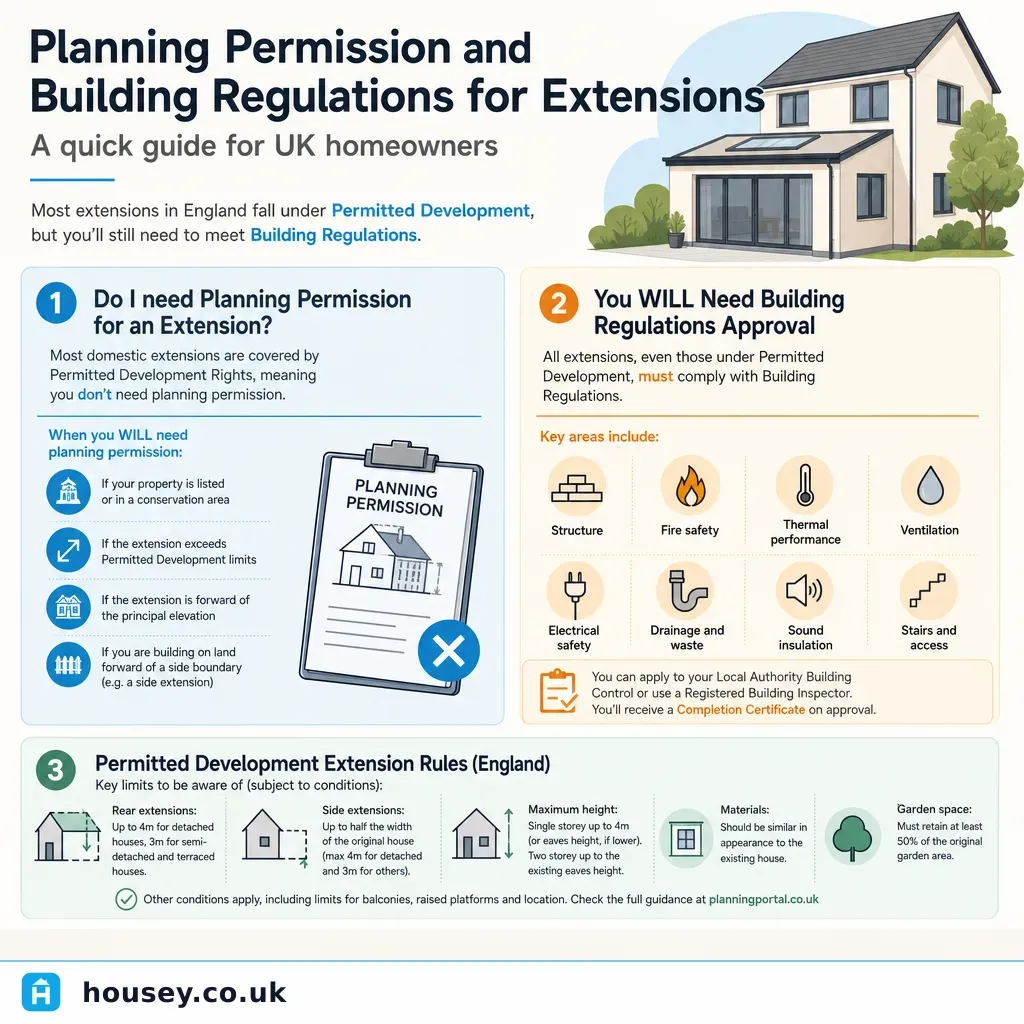
Planning Permission and Building Regulations for Extensions
UK home extensions usually require both planning permission and Building Regulations approval, though most smaller rear extensions qualify as Permitted Development under the GPDO 2015 and need no planning application.
 Planning & Pre-Build
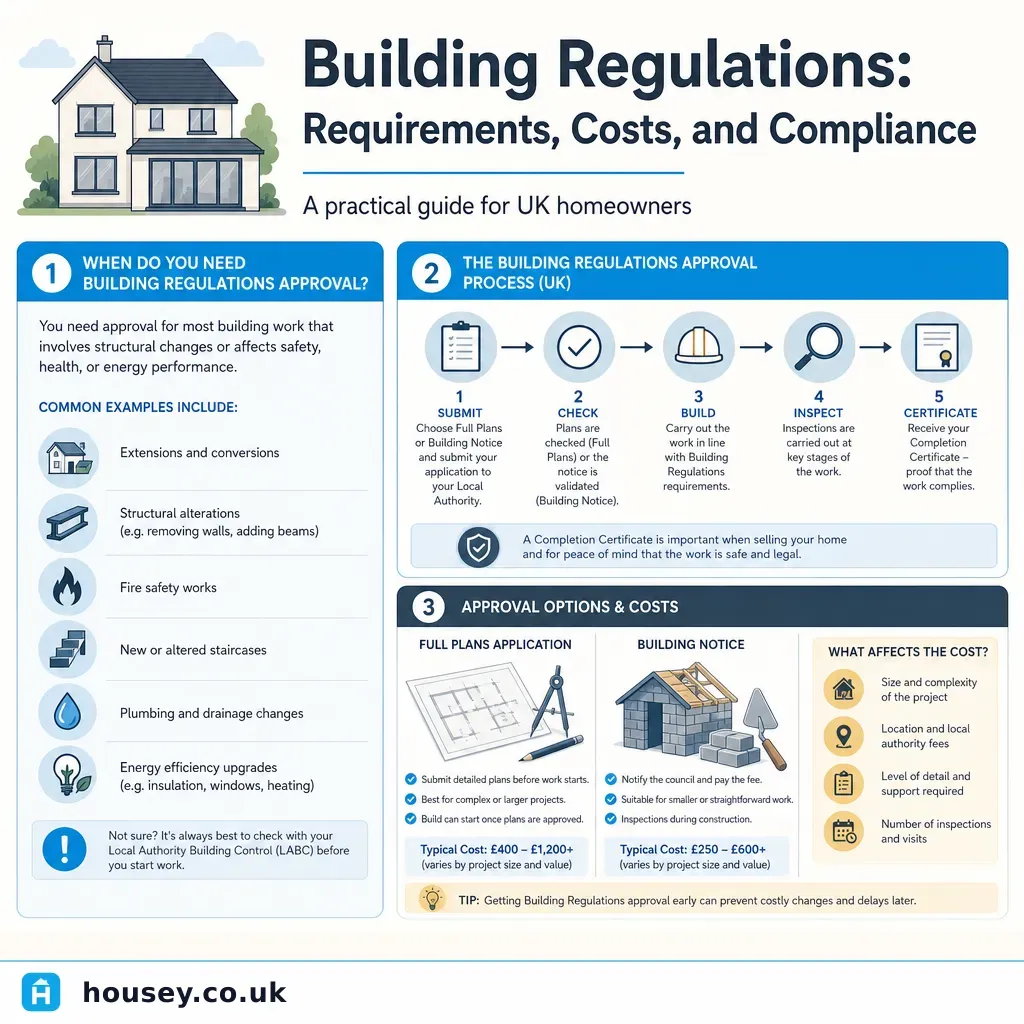
Building Regulations: Requirements, Costs, and Compliance
Building regulations set minimum standards for how construction work is carried out in the UK, covering structural stability, fire safety, energy efficiency, and ventilation.
 Planning & Pre-Build
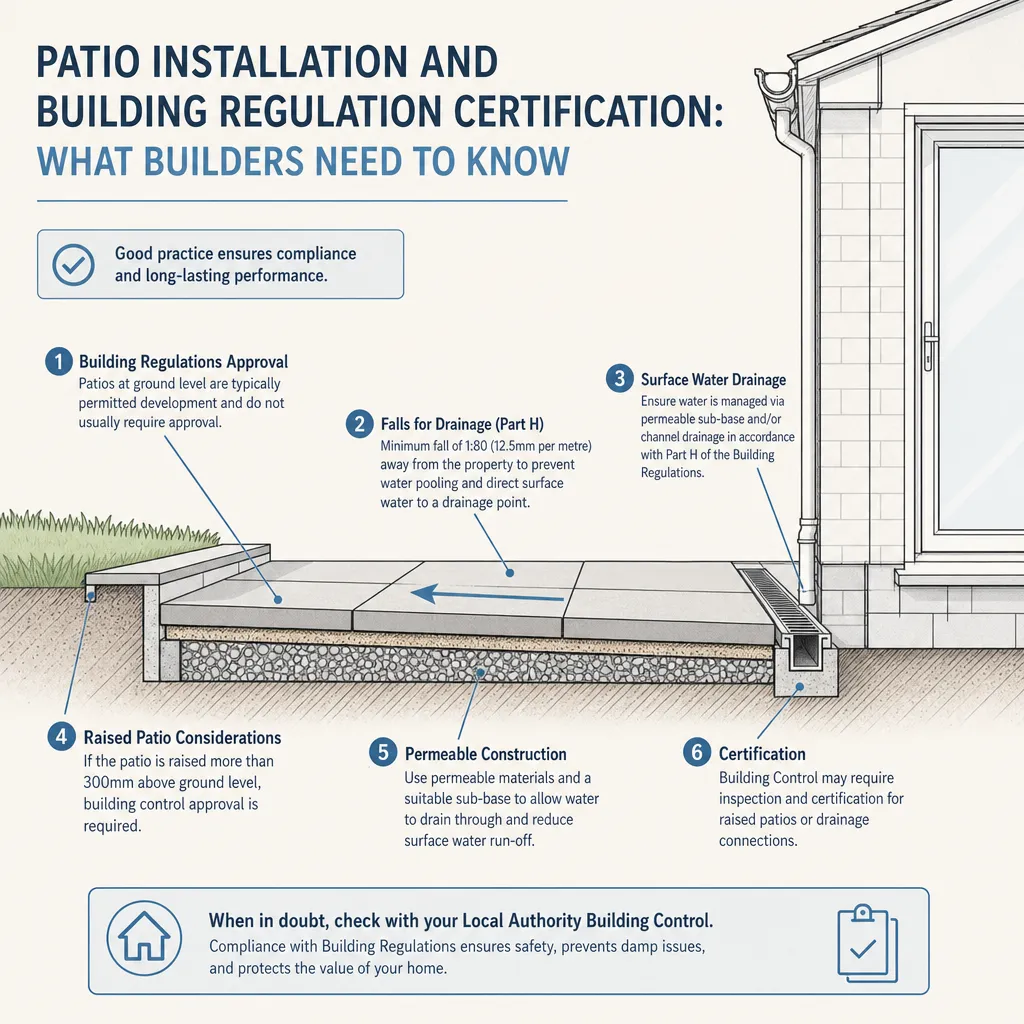
Patio Installation and Building Regulation Certification: What Builders Need to Know
Most ground-level patios in England do not require building regulations approval.
 Planning & Pre-Build
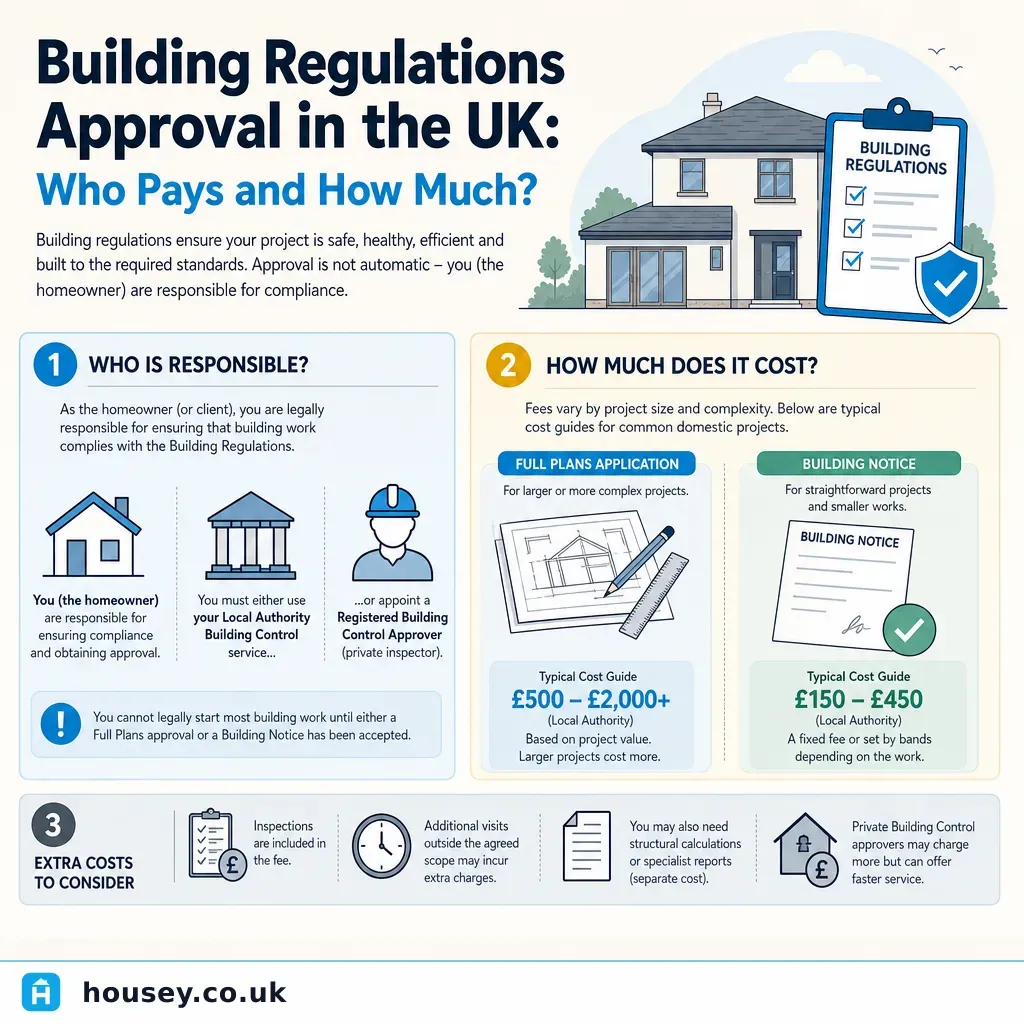
Building Regulations Approval in the UK: Who Pays and How Much?
Building regulations approval fees are almost always paid by the homeowner or the person commissioning the work, not the contractor.
 Planning & Pre-Build
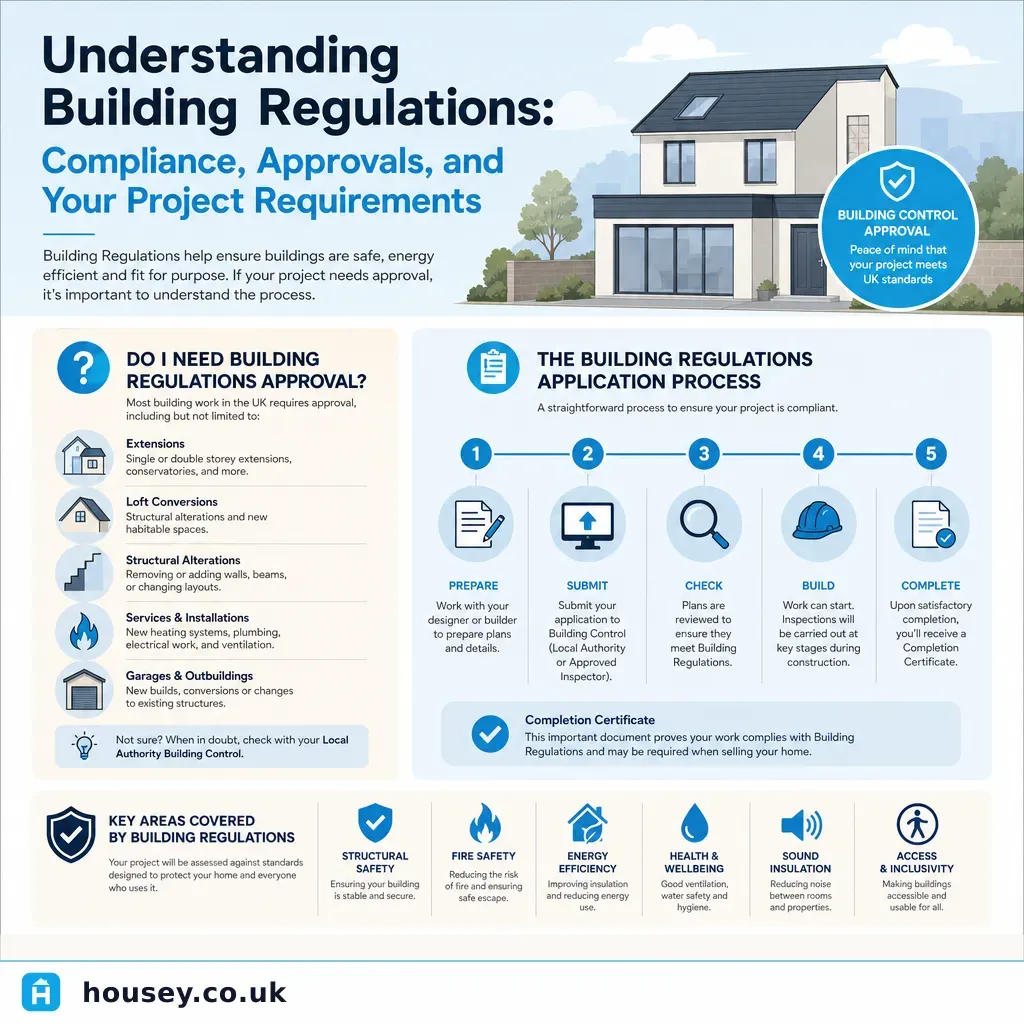
Understanding Building Regulations: Compliance, Approvals, and Your Project Requirements
Building regulations set minimum standards for design, construction, and alterations to buildings in England and Wales.