Building Regulations: Contractor Permit Requirements
By Housey · Last reviewed 31st of May 2026
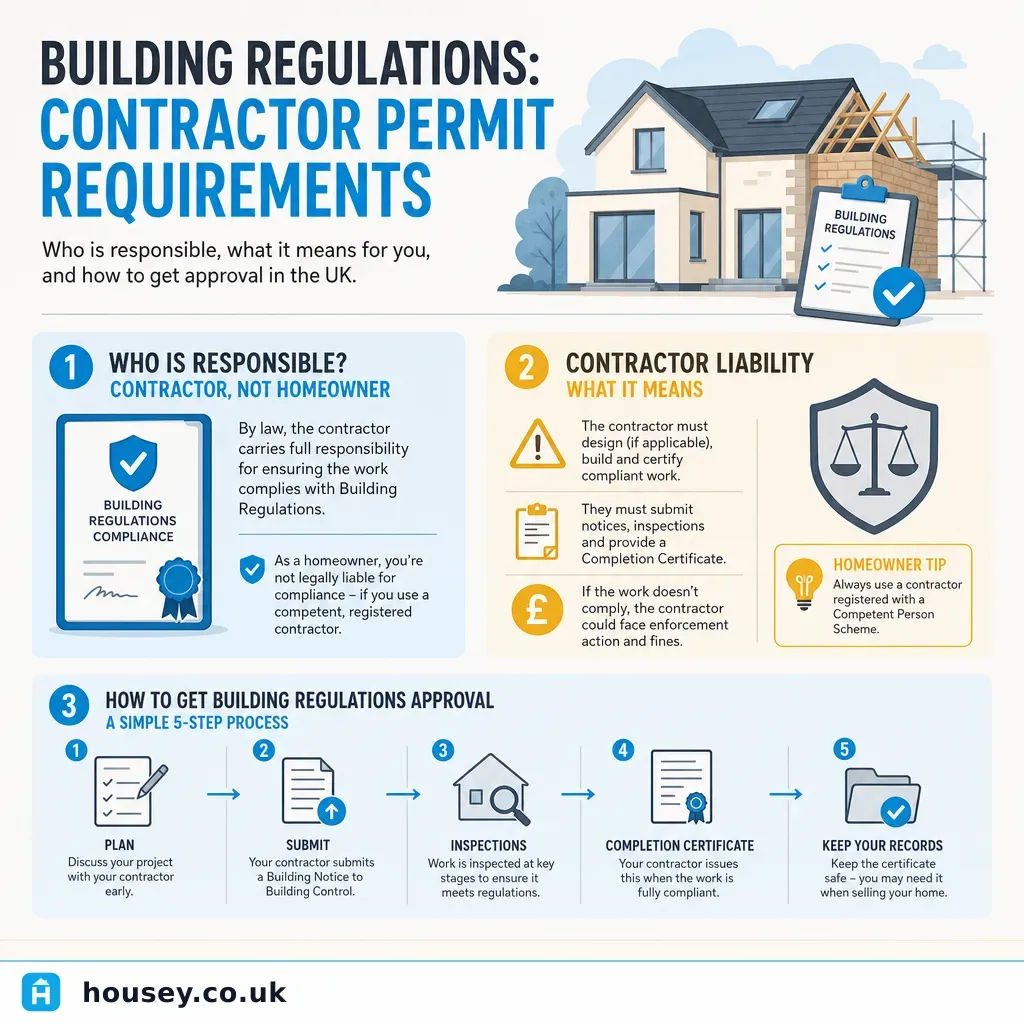
Building Regulations: Contractor Permit Requirements
Building regulations compliance is one of the most commonly misunderstood areas of home improvement in England and Wales. Whether you are extending a kitchen, rewiring a house, or fitting a new boiler, the question of who is legally responsible for notifying building control — you or your contractor — matters enormously. Getting it wrong can mean enforcement notices, expensive remediation works, and serious difficulties when you come to sell.
Key points
- Under Regulation 12 of the Building Regulations 2010, the legal duty to comply falls on the "person carrying out the work" — this is usually the contractor, but can be the homeowner if they are acting as project manager or employing trades directly.
- There are two approval routes: Local Authority Building Control (LABC) or a Registered Building Control Approver (RBCA), the latter introduced under the Building Safety Act 2022 to replace Approved Inspectors.
- Permitted development rights are entirely separate from building regulations — having one does not exempt you from the other.
- Competent person schemes (Gas Safe, NICEIC/NAPIT for Part P electrical, FENSA for windows) allow registered contractors to self-certify certain work without a separate building regulations application.
- The Building Safety Act 2022 introduced mandatory pre-commencement Building Control approval for higher-risk buildings — defined as residential buildings over 18 m or 7 storeys.
Who is legally responsible for building regulations compliance?
Regulation 12 of the Building Regulations 2010 places the legal duty to comply on the person "carrying out the work." In practice:
- If a contractor is engaged: the contractor is usually the responsible person. They must notify building control before work starts (or at the foundation stage for new builds), arrange inspections at prescribed stages, and obtain the completion certificate.
- If you are managing the project yourself — acting as principal contractor or employing trades directly — you may become the responsible person, even if individual trades carry out the physical work.
- If you are undertaking DIY: you are the responsible person and must notify building control yourself for any notifiable work.
A common misconception is that paying a contractor automatically transfers all legal responsibility. It does not. If a contractor fails to notify building control and this comes to light when you sell, you — as the property owner — will need to resolve it.
Approval routes compared: LABC vs Registered Building Control Approver
Route | Who typically uses it | How to apply | Key distinction |
|---|---|---|---|
Local Authority Building Control (LABC) | Any contractor or homeowner in England and Wales | Full plans application or building notice to your local council | Operated by local authorities; enforcement powers under the Building Act 1984 |
Registered Building Control Approver (RBCA) | Larger contractors and developers | Direct appointment; RBCA must be registered with the Building Safety Regulator | Private sector; introduced under the Building Safety Act 2022; replaced the former Approved Inspector regime |
For most domestic extensions and conversions, LABC is the more common route. RBCAs tend to be used on larger or more complex schemes.
Competent person schemes: when self-certification applies
Certain categories of work can be self-certified by contractors registered with an approved competent person scheme. This removes the need for a separate building regulations application, because the scheme notifies building control on the contractor's behalf.
Common schemes include:
- Gas Safe Register — gas boiler installations and gas work
- NICEIC / NAPIT (Part P) — domestic electrical installation work in dwellings
- FENSA / Certass — replacement windows and doors
- HETAS — solid fuel and biomass heating appliances
- BESCA / APHC — heating and plumbing systems
If your contractor claims to be self-certifying, ask for proof of scheme registration before work begins and confirm you will receive a certificate on completion. Self-certification is only valid if the contractor is currently registered — not simply claiming to be.
Which works require building regulations approval?
Decision tree: does this work need building regulations?
- Does the work involve structural alterations — removing a wall, adding a storey, or underpinning? → Yes — building regulations required; full plans application recommended.
- Does the work involve installing or replacing a boiler or heating system? → Likely yes — Gas Safe registration or building regulations notification required.
- Does the work involve electrical installation such as new circuits, a consumer unit, or full rewiring? → Yes — Part P notification or NICEIC/NAPIT registration required.
- Does the work involve a loft conversion, garage conversion, or extension? → Yes — building regulations required for structural, fire, insulation, and drainage elements.
- Is the work purely cosmetic — repainting, like-for-like tile replacement, or replacing kitchen units without structural or services work? → Usually exempt — check with building control or a consultant if uncertain.
- Is the property a listed building? → Listed building consent may also be required — check with your local planning authority before starting work.
What happens if building regulations were not obtained?
If building regulations approval was not obtained for notifiable work, the property owner faces several practical risks:
- Enforcement action: local authorities can issue enforcement notices requiring work to be opened up for inspection or removed and redone. This power lasts for up to two years after completion for most domestic work.
- Indemnity insurance: conveyancers routinely require retrospective building regulations indemnity insurance when approval cannot be demonstrated. Insurers typically provide this only where the works are over 12 months old and no enforcement action has been taken.
- Mortgage and sale complications: lenders and buyers may require evidence of building regulations compliance. Missing certificates will need to be resolved before exchange can proceed.
Indemnity insurance covers conveyancing risk only — it does not guarantee the work was carried out safely or to the required standard.
Important limitations
This article provides general information about building regulations procedures in England and Wales. Rules and responsibilities differ in Scotland (Building (Scotland) Regulations 2004) and Northern Ireland (Building Regulations (Northern Ireland) 2012), and may vary by property type, construction method, listed status, and local authority. Nothing in this guide constitutes legal or professional advice. A qualified building control officer, RICS-accredited building surveyor, or registered building control consultant should assess your specific project.
When to get professional help
Seek professional advice if:
- Your contractor has completed notifiable work without obtaining building regulations approval.
- You are buying a property where the seller cannot provide completion certificates for extensions, conversions, or notifiable works.
- The work involves structural alterations, underpinning, or alterations to load-bearing elements.
- The property is listed, in a conservation area, or subject to additional regulatory requirements.
- You are managing a project on a higher-risk building (over 18 m or 7 storeys) under the Building Safety Act 2022.
- Any dispute arises between you and a contractor about who is responsible for notifications.
What to ask a qualified professional
Before appointing a contractor or building control consultant, ask:
- Who will act as the responsible person for building regulations notification — me or you?
- Which building control route will you use — LABC or a Registered Building Control Approver?
- Are you registered with a competent person scheme? Can you provide your current registration certificate?
- At what stages will building control inspections take place, and who is responsible for arranging them?
- What completion documentation will I receive, and in what format?
- What happens if building control identifies non-compliant work during an inspection?
- Will you indemnify me if building regulations certification cannot be provided at completion?
How Housey can help
If you are planning works that require building regulations approval — or need help resolving a missing-certificate issue — Housey can connect you with experienced building control consultants who can advise on the correct approval route, manage notifications on your behalf, and help you navigate enforcement or retrospective compliance situations.
Frequently asked questions
Can a homeowner apply for building regulations approval instead of the contractor?
Yes. The homeowner can apply directly — by submitting a full plans application or a building notice to the local authority — and then engage contractors to carry out the work. This gives the homeowner more control but also more direct responsibility for coordinating inspections and obtaining the completion certificate.
What is the difference between planning permission and building regulations?
Planning permission controls whether a development can happen and what it looks like — size, design, and use. Building regulations control how the work is carried out: structural safety, fire resistance, insulation, drainage, and so on. Many projects need both; some need one but not the other. They are entirely separate regimes managed by different parts of the local authority.
How long does building regulations approval take?
For a full plans application, building control must respond within five weeks, or two months with your agreement. A building notice does not require formal approval — work can start 48 hours after submission, but the risk of non-compliant work sits with the applicant. The completion certificate is issued after the final inspection, which can take several weeks to arrange once work is finished.
What is a competent person scheme completion certificate worth?
A completion certificate from a competent person scheme — such as Gas Safe, NICEIC, or FENSA — serves as evidence that the notifiable work has been registered and self-certified under the Building Regulations. It should be retained with your property documents and disclosed to buyers or mortgage lenders on request. It does not replace an LABC completion certificate for works outside the scheme's scope.
Sources and further reading
- Building Regulations 2010 — legislation.gov.uk
- Building regulations approval — GOV.UK
- Building Safety Act 2022 — legislation.gov.uk
- Competent person schemes: current schemes and how they work — GOV.UK
- Local Authority Building Control (LABC) — LABC
Useful next reads
 Planning & Pre-Build
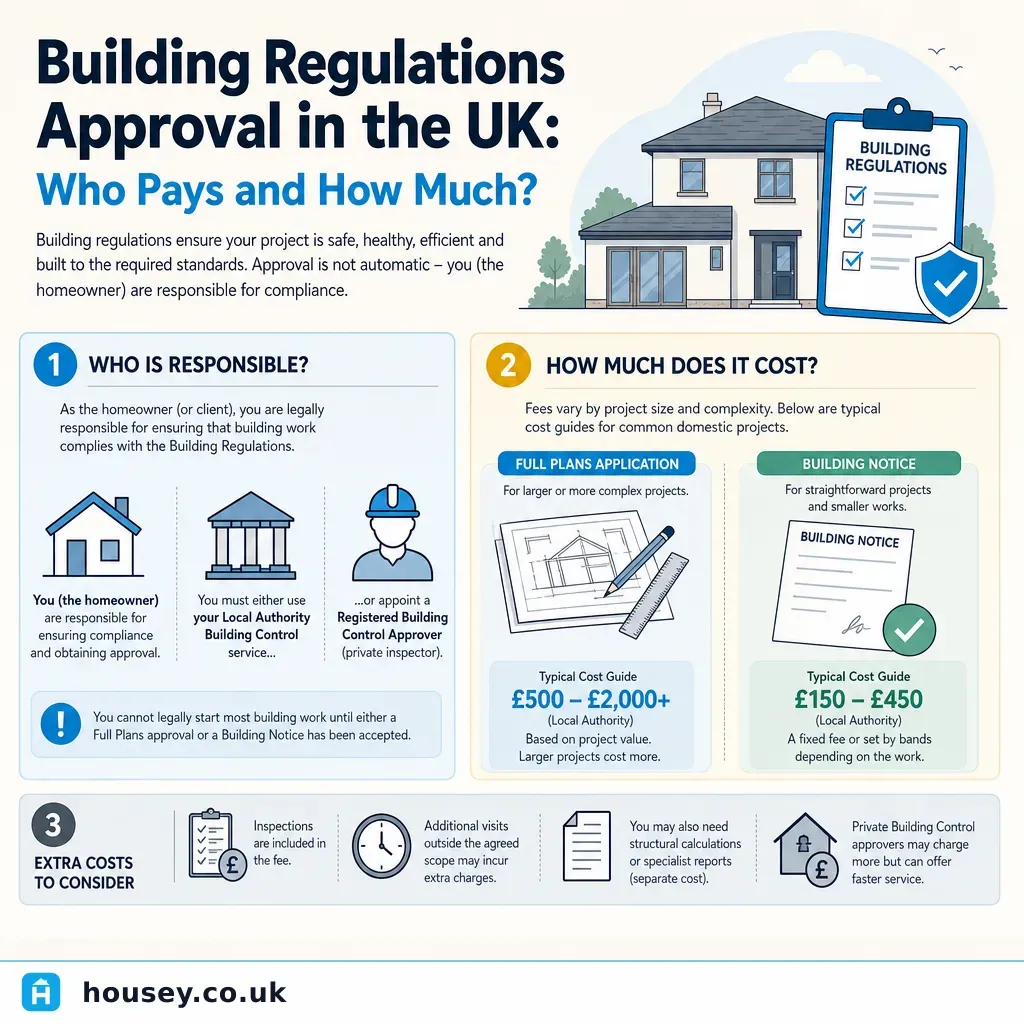
Building Regulations Approval in the UK: Who Pays and How Much?
Building regulations approval fees are almost always paid by the homeowner or the person commissioning the work, not the contractor.
 Planning & Pre-Build
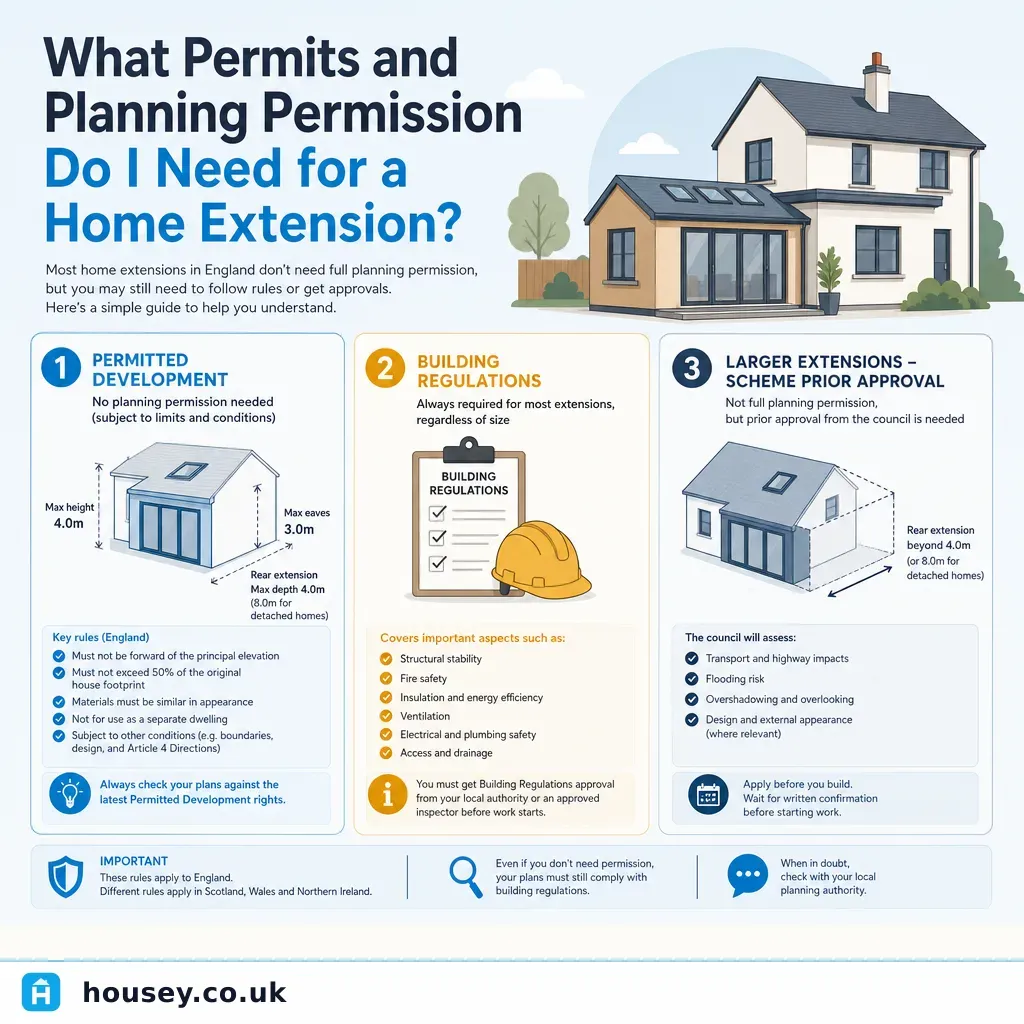
What Permits and Planning Permission Do I Need for a Home Extension?
Most single-storey rear extensions fall under permitted development and do not need a formal planning application, provided they stay within size limits set out in the Town and Country Planning (General Permitted Development) (England) Order 2015.
 Planning & Pre-Build
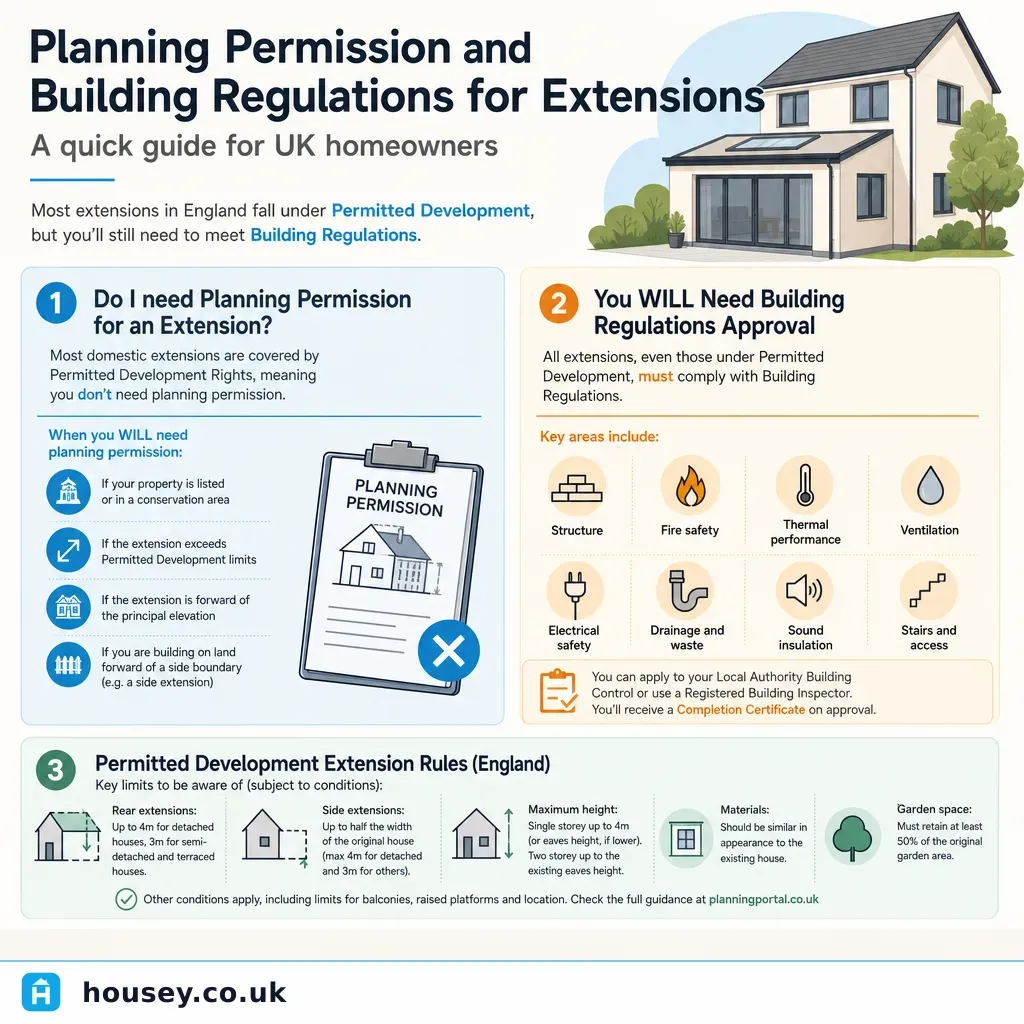
Planning Permission and Building Regulations for Extensions
UK home extensions usually require both planning permission and Building Regulations approval, though most smaller rear extensions qualify as Permitted Development under the GPDO 2015 and need no planning application.
 Planning & Pre-Build
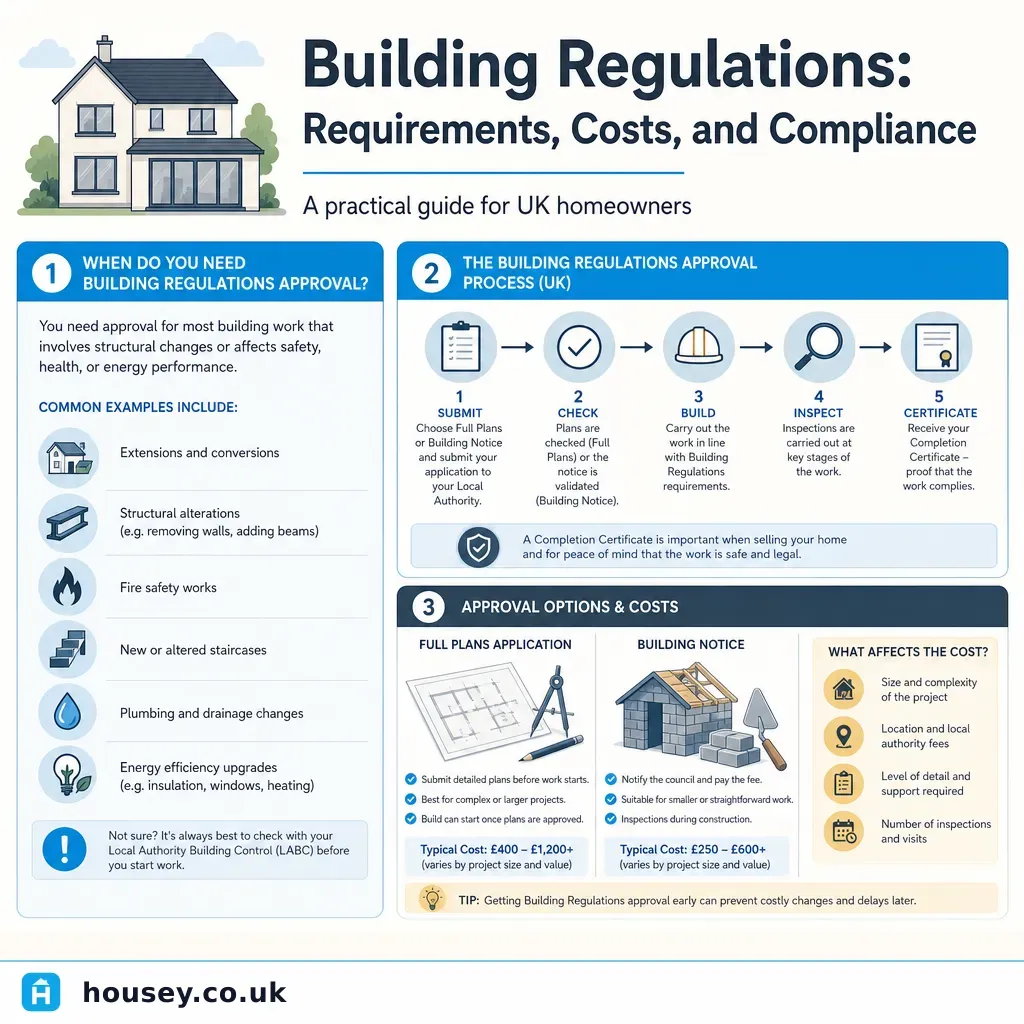
Building Regulations: Requirements, Costs, and Compliance
Building regulations set minimum standards for how construction work is carried out in the UK, covering structural stability, fire safety, energy efficiency, and ventilation.
 Planning & Pre-Build
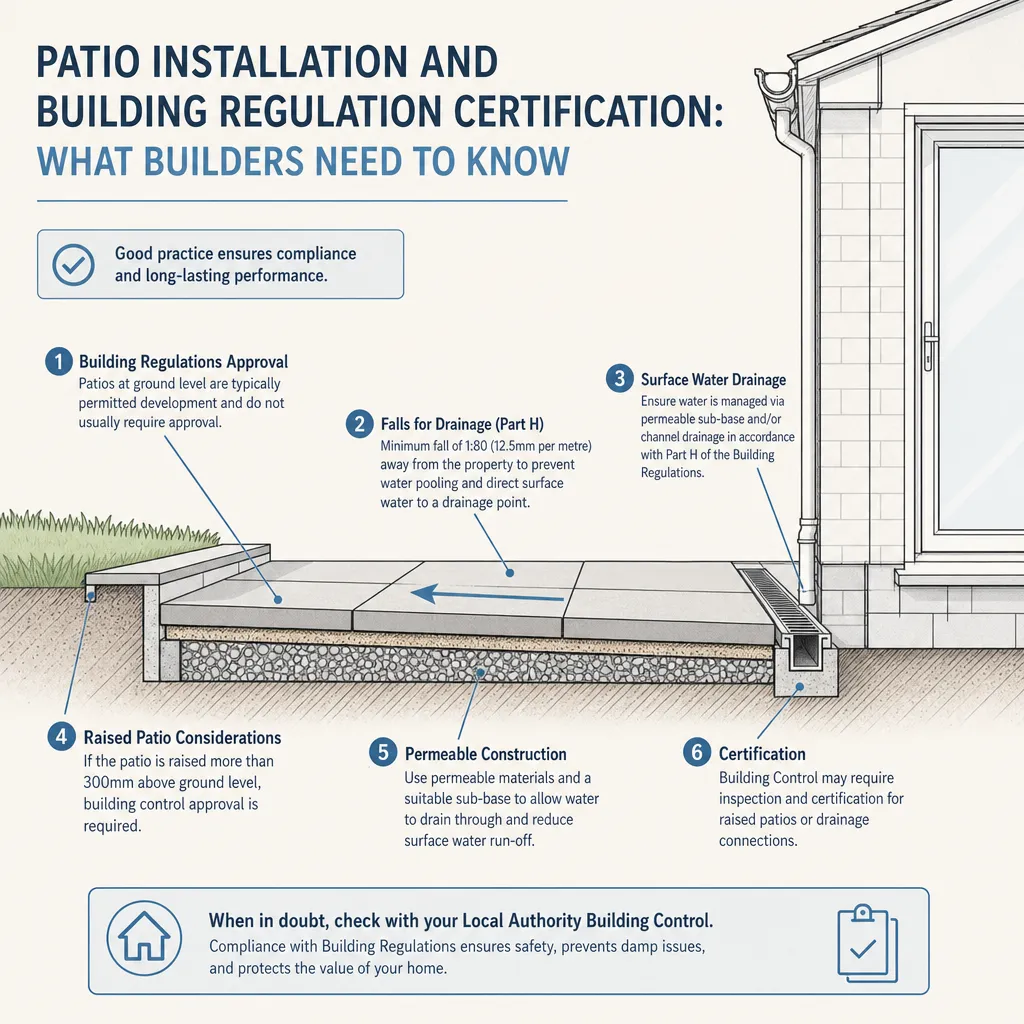
Patio Installation and Building Regulation Certification: What Builders Need to Know
Most ground-level patios in England do not require building regulations approval.