What Permits and Planning Permission Do I Need for a Home Extension?
By Housey · Last reviewed 31st of May 2026
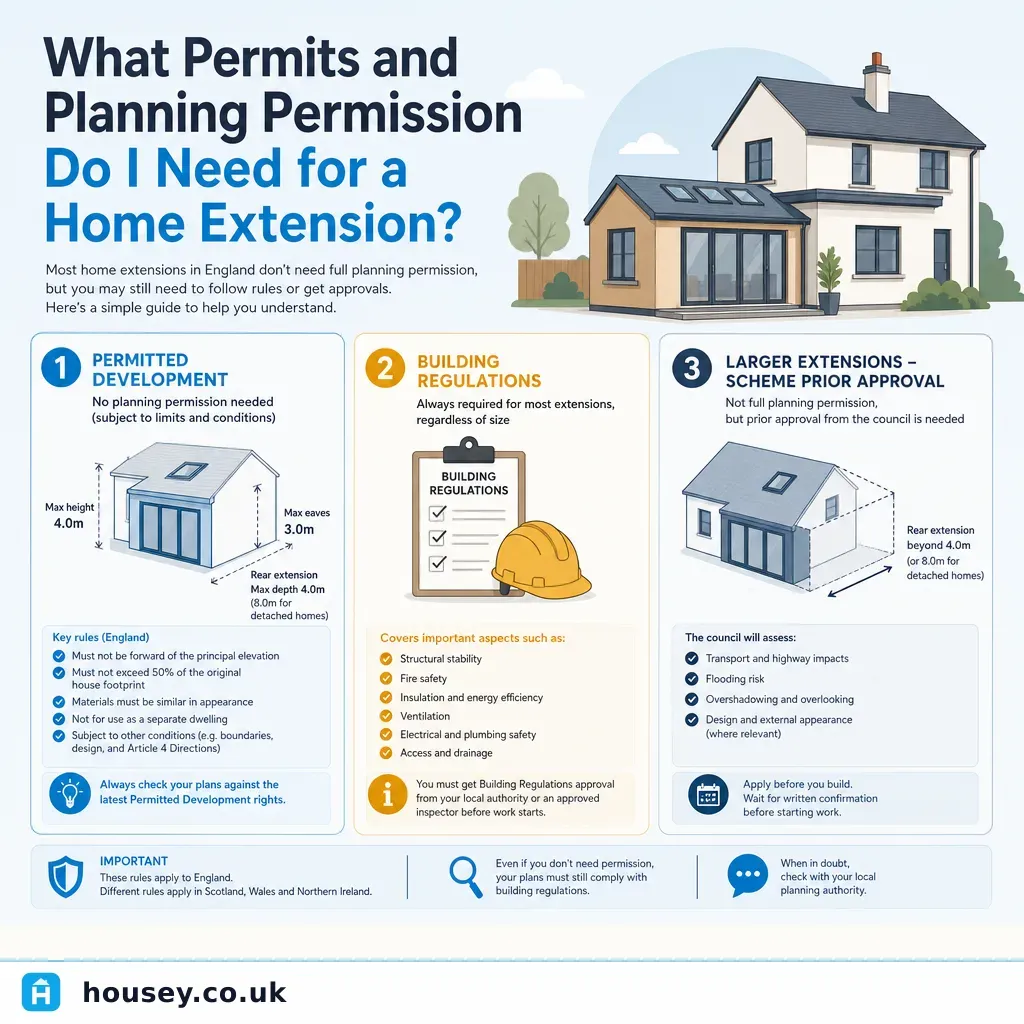
What Permits and Planning Permission Do I Need for a Home Extension?
Extending a home is one of the most common improvement projects UK homeowners undertake, yet the approvals framework catches many people off guard. Two entirely separate regimes apply: planning permission (controlled by your local planning authority) and Building Regulations (administered by a building control body). They operate independently — depending on your property type, location, and the scale of your proposed works, you may need one, both, or in limited cases, neither formal approval. Getting this wrong before work starts can create costly enforcement problems and difficulties when you come to sell.
Key points
- The Town and Country Planning (General Permitted Development) (England) Order 2015 grants automatic planning permission (permitted development) for many householder extensions without a formal application.
- Standard permitted development allows single-storey rear extensions up to 4 metres for detached houses and 3 metres for semi-detached and terraced houses; the Larger Home Extension Scheme (prior approval route) can double these limits to 8 metres and 6 metres respectively.
- Building Regulations approval is required for virtually all structural extensions — even those that are permitted development — covering structural integrity (Part A), energy efficiency (Part L), ventilation (Part F), fire safety (Part B), and electrical work (Part P).
- Listed buildings require Listed Building Consent for any extension; permitted development rights do not apply.
- Scotland, Wales, and Northern Ireland each have separate permitted development orders with different limits and conditions from those in England.
Do I need planning permission for my extension?
Whether you need a planning application depends on the size, position, and type of extension; your property type; and any local restrictions. Work through the decision tree below before committing to build costs.
Decision tree: does my extension need planning permission?
- Is the property a flat or maisonette? Permitted development does not apply to flats. You will almost certainly need full planning permission for any external extension.
- Is the property listed? Listed Building Consent is required in addition to (or instead of) standard planning permission. Contact your local planning authority before doing anything.
- Is the property in a conservation area, Area of Outstanding Natural Beauty, National Park, or World Heritage Site? Additional restrictions apply, particularly to side extensions and external materials. Confirm your position with the local planning authority before starting.
- Is the extension to the rear, single-storey, and within 4 m (detached) or 3 m (other houses) of the original rear wall? This is likely to be permitted development, subject to height, coverage, and other conditions. Consider the Larger Home Extension Scheme if you want to go further.
- Is the extension to the side? Side extensions under half the width of the original house may be permitted development, but are restricted in conservation areas and must not face a highway.
- Has the house already been significantly extended, or does the proposal involve a new upper storey? Permitted development limits are measured against the original house footprint. Cumulative additions count toward the totals.
- Still unsure? Apply for a Lawful Development Certificate (LDC) from your local planning authority before starting work. This provides written confirmation that the works are lawful under current planning rules and is strongly recommended before committing to full build costs.
What are the permitted development size limits?
The table below summarises the main size thresholds for extensions in England under the Town and Country Planning (General Permitted Development) (England) Order 2015.
Extension type | Detached house | Semi-detached or terraced | Notes |
|---|---|---|---|
Single-storey rear (standard PD) | Up to 4 m from original rear wall | Up to 3 m from original rear wall | Must not exceed 4 m at eaves; must not cover more than 50% of curtilage |
Single-storey rear (Larger Home Extension Scheme) | Up to 8 m | Up to 6 m | Requires prior approval from local planning authority; neighbour notification applies |
Two-storey rear | Up to 3 m from original rear wall | Up to 3 m from original rear wall | Must be at least 7 m from the rear boundary |
Side extension | Up to half the width of the original house | Up to half the width of the original house | Not permitted in conservation areas; must not front a highway |
Total ground-floor coverage | Must not exceed 50% of the original curtilage | Must not exceed 50% of the original curtilage | Includes all extensions and outbuildings |
These figures apply in England only. Check your local planning authority for any Article 4 directions that may remove or restrict permitted development rights in your specific area.
Do I need Building Regulations approval?
Yes, in virtually all cases — regardless of whether a planning application is required. Building Regulations approval ensures the extension is structurally sound, energy-efficient, safe, and habitable. Key Approved Documents that apply to most extensions include:
- Part A (Structure): foundations, walls, floors, and roof must be designed to carry loads safely. A structural engineer is usually required for any extension involving new load-bearing elements.
- Part L (Conservation of fuel and power): new walls, windows, and roofs must meet minimum U-value standards updated under the 2021 Building Regulations uplift, which came into force in June 2022.
- Part F (Ventilation): adequate ventilation must be provided in new habitable rooms.
- Part B (Fire safety): escape routes and fire separation at party walls or near boundaries must comply.
- Part P (Electrical safety): electrical work in the extension must be carried out by a competent person scheme member or notified to building control.
You have two routes for Building Regulations approval: local authority building control (LABC), where a council building control officer inspects at key stages; or a registered building control approver (RBCA), a private body operating under the reformed regime introduced by the Building Safety Act 2022. Both issue a completion certificate on satisfactory completion — keep this document, as solicitors will ask for it when you sell.
What is the Larger Home Extension Scheme?
The Larger Home Extension Scheme — sometimes called the prior approval route — allows single-storey rear extensions beyond standard permitted development limits (up to 8 m for detached houses and 6 m for all other houses) without a full planning application, provided you obtain prior approval from the local planning authority.
The process involves notifying the local planning authority of the proposed works. Adjoining owners and occupiers then have 21 days to raise objections. If no objections are received and the authority raises no concerns about impact on amenity, the works may proceed. If objections are raised, the authority assesses the impact and decides whether to grant prior approval.
Building Regulations approval must still be obtained separately — prior approval addresses the planning dimension only.
Important limitations
This article provides general information about planning permission and Building Regulations for home extensions in England, based on national rules as of May 2026. Rules vary significantly by property type, planning history, local authority, and site-specific conditions. A local planning authority may impose Article 4 directions that remove permitted development rights in specific areas. This guide cannot replace advice tailored to your property and must not be relied upon as a substitute for professional planning or building regulations advice.
When this becomes urgent
Stop and seek professional advice immediately if:
- Your property is listed — any extension requires Listed Building Consent, which is a separate statutory process.
- You have already started work without obtaining the necessary permissions — apply for a Lawful Development Certificate or retrospective building regulations regularisation before proceeding.
- A builder advises you to skip Building Regulations approval for any structural extension — this is unlawful and creates serious liability on sale.
- The extension abuts a party wall or is within 3–6 metres of a neighbour's foundations — the Party Wall etc. Act 1996 may be triggered, requiring formal notices and potentially a party wall award.
- Your property is subject to an Article 4 direction — permitted development rights may not apply, and proceeding without planning permission could result in enforcement action.
What to ask a qualified professional
Before instructing an architect, planning consultant, or builder for a home extension, ask:
- Will this extension be permitted development, or does it need a full planning application — and will you apply for a Lawful Development Certificate to provide written confirmation?
- What Building Regulations apply to this design, and which Approved Documents are relevant?
- Are there any Article 4 directions, restrictive covenants, or conditions on existing planning consents that affect what I can build?
- Does the Party Wall etc. Act 1996 apply, and will a party wall surveyor be needed?
- What structural engineering input is required, and is this included in your fee?
- Will you manage the Building Regulations application and liaise with building control during construction?
- What completion documents will I receive — including the completion certificate, structural engineer's sign-off, and FENSA or CERTASS certificates for any new windows?
How Housey can help
Navigating planning permission and Building Regulations for a home extension is considerably easier with the right professionals from the outset. Housey can connect you with a planning consultant who can advise on permitted development status, prepare planning applications, and apply for a Lawful Development Certificate on your behalf. For Building Regulations compliance through construction, our building control consultants can manage the approval process from foundation design to completion certificate.
Frequently asked questions
What is a Lawful Development Certificate and do I need one for an extension?
A Lawful Development Certificate (LDC) is written confirmation from your local planning authority that a development is lawful — because it qualifies as permitted development or because enforcement time limits have passed. You are not legally required to obtain one, but it is strongly recommended before committing to build costs. It provides certainty, satisfies solicitors at sale, and reduces enforcement risk. The application fee is typically around half that of a full planning application.
Can I start building before receiving Building Regulations approval?
You can use a building notice, which allows work to begin 48 hours after notifying the local authority rather than waiting for full plans approval. However, you proceed at risk — if a building control officer finds non-compliant work during inspection, you may need to alter or demolish it. For significant extensions, full plans approval is usually preferable, as the design is checked and approved before work starts on site.
Does a conservation area extension always need planning permission?
In a conservation area, permitted development rights are restricted but not always removed. Rear single-storey extensions may still qualify as permitted development in many cases. However, side extensions and changes to front elevations typically require a planning application. External materials — particularly cladding, roofing, and windows — are more closely controlled. Check your local planning authority's requirements before starting any works, as restrictions vary by area and designation.
How long does a householder planning application take?
A standard householder planning application takes eight weeks from the date of a valid submission for the local planning authority to issue a decision. Complex or contentious applications may take longer. Prior approval under the Larger Home Extension Scheme has a shorter 42-day determination period. Lawful Development Certificates typically take 6–8 weeks. Delays can occur if the application is returned as invalid and requires resubmission with additional information.
Will my extension trigger a council tax band reassessment?
An extension may lead to a higher council tax band, but typically only when the property is next sold. The Valuation Office Agency (VOA) reassesses properties on change of ownership, at which point a materially larger home may attract a higher band. The construction of the extension itself does not usually trigger an immediate reassessment. Check the current VOA guidance if you are concerned about the impact on your specific property.
Sources and further reading
- Planning Portal: House extensions — Planning Portal
- GOV.UK: Permitted development rights for householders — technical guidance — Department for Levelling Up, Housing and Communities
- Town and Country Planning (General Permitted Development) (England) Order 2015 — legislation.gov.uk
- GOV.UK: Building regulations approval — GOV.UK
- Party Wall etc. Act 1996 — legislation.gov.uk
Useful next reads
 Planning & Pre-Build
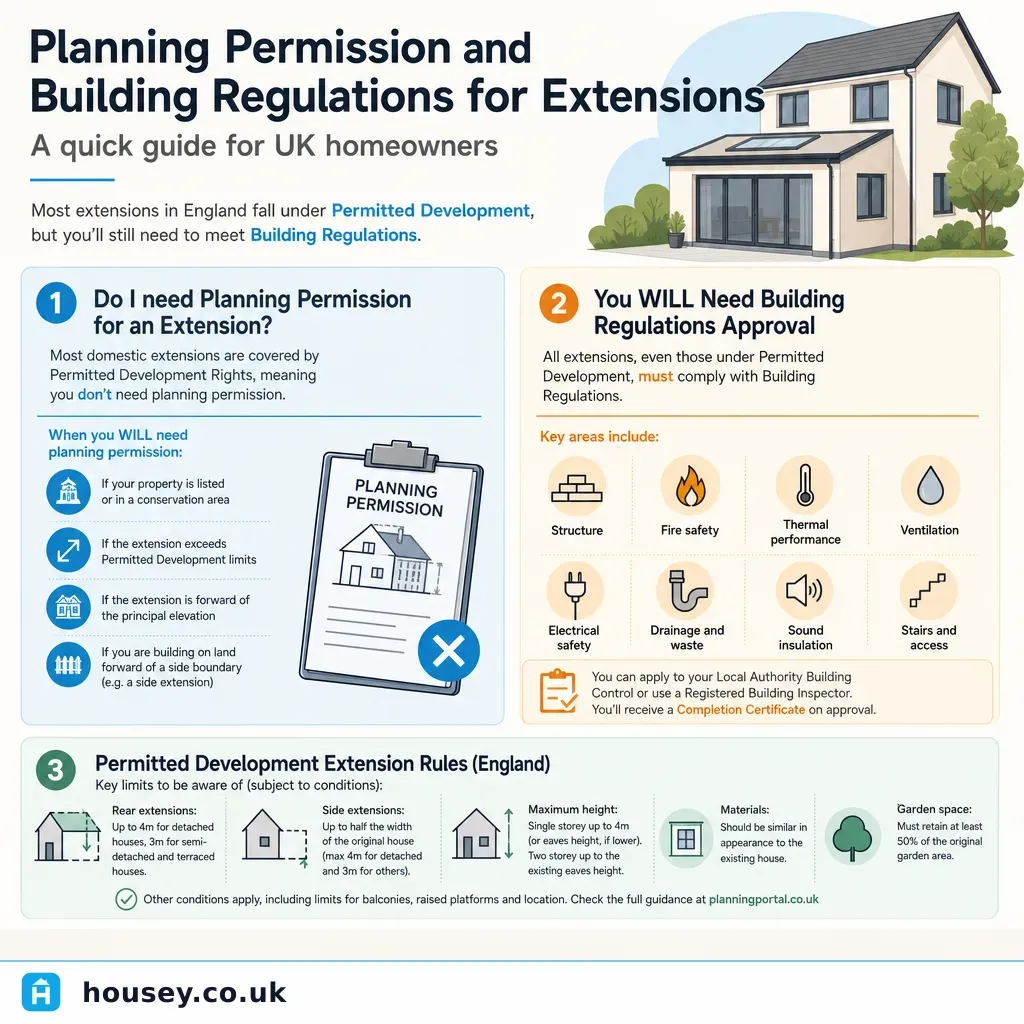
Planning Permission and Building Regulations for Extensions
UK home extensions usually require both planning permission and Building Regulations approval, though most smaller rear extensions qualify as Permitted Development under the GPDO 2015 and need no planning application.
 Planning & Pre-Build
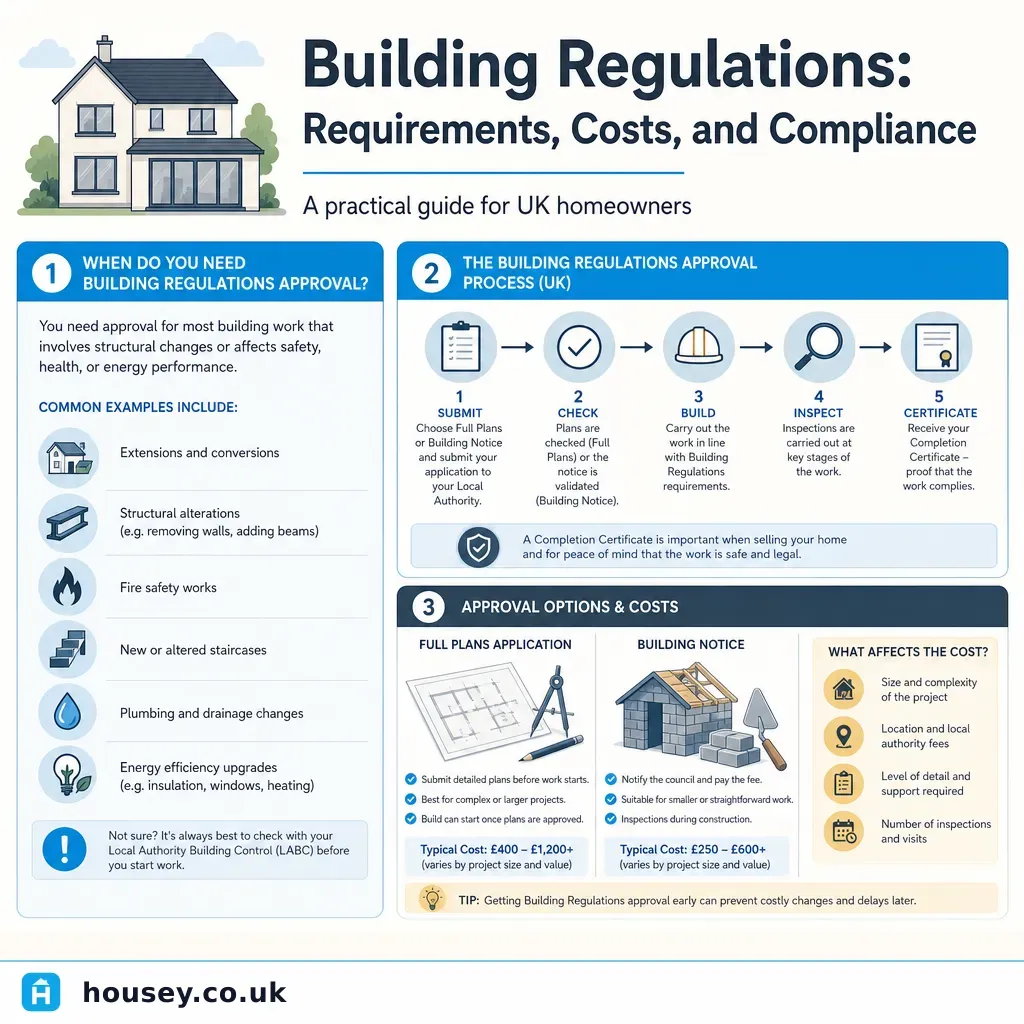
Building Regulations: Requirements, Costs, and Compliance
Building regulations set minimum standards for how construction work is carried out in the UK, covering structural stability, fire safety, energy efficiency, and ventilation.
 Planning & Pre-Build
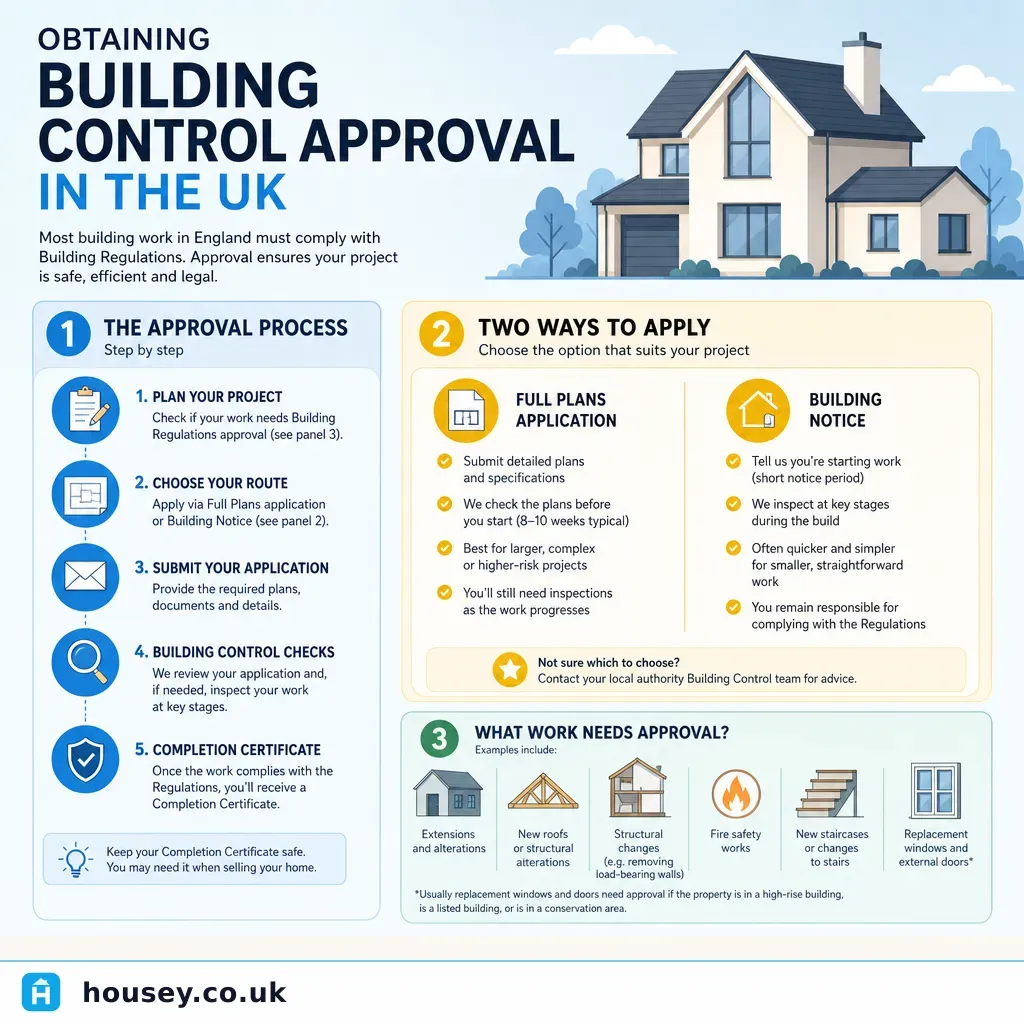
Obtaining Building Control Approval in the UK
Building control approval in the UK is required for most structural changes, extensions, loft conversions, and new builds.
 Planning & Pre-Build
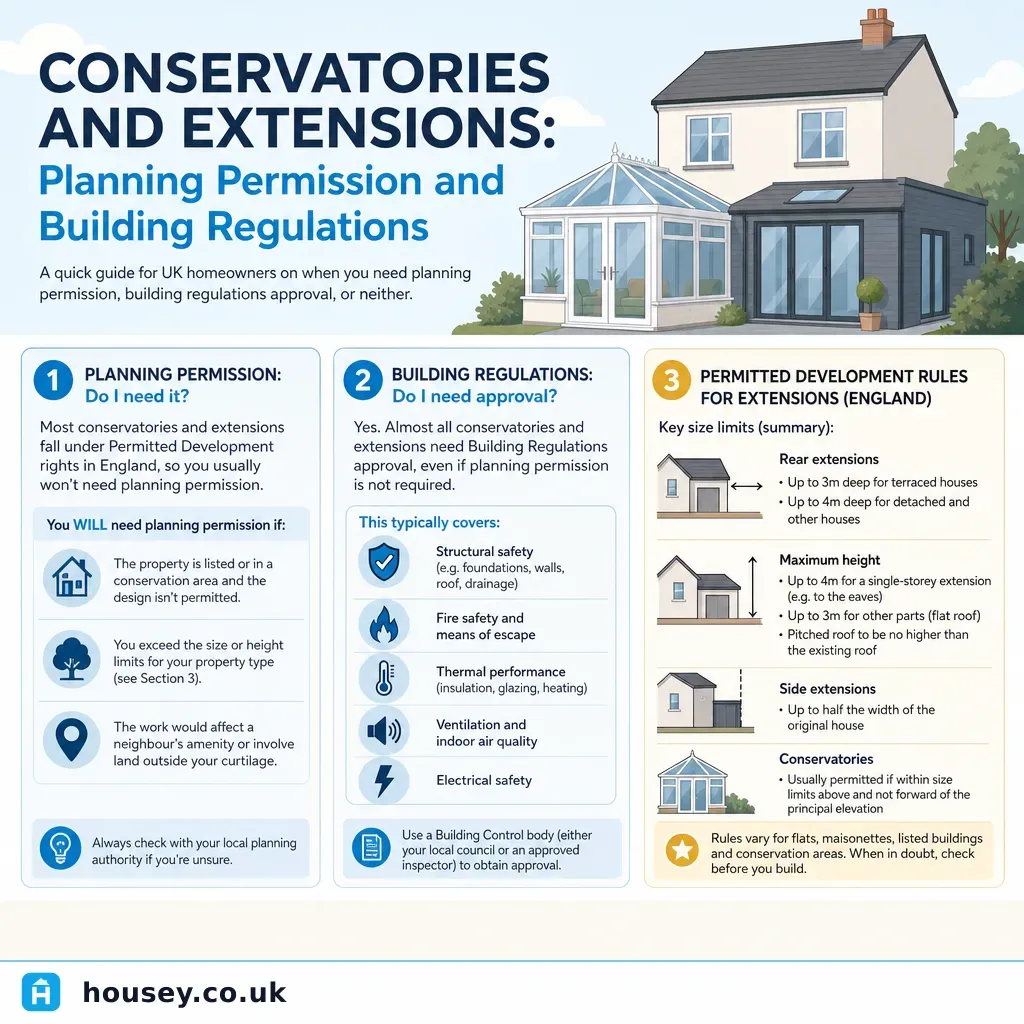
Conservatories and Extensions: Planning Permission and Building Regulations
Whether your conservatory or extension needs planning permission depends on its size, height, position, and property type.
 Planning & Pre-Build
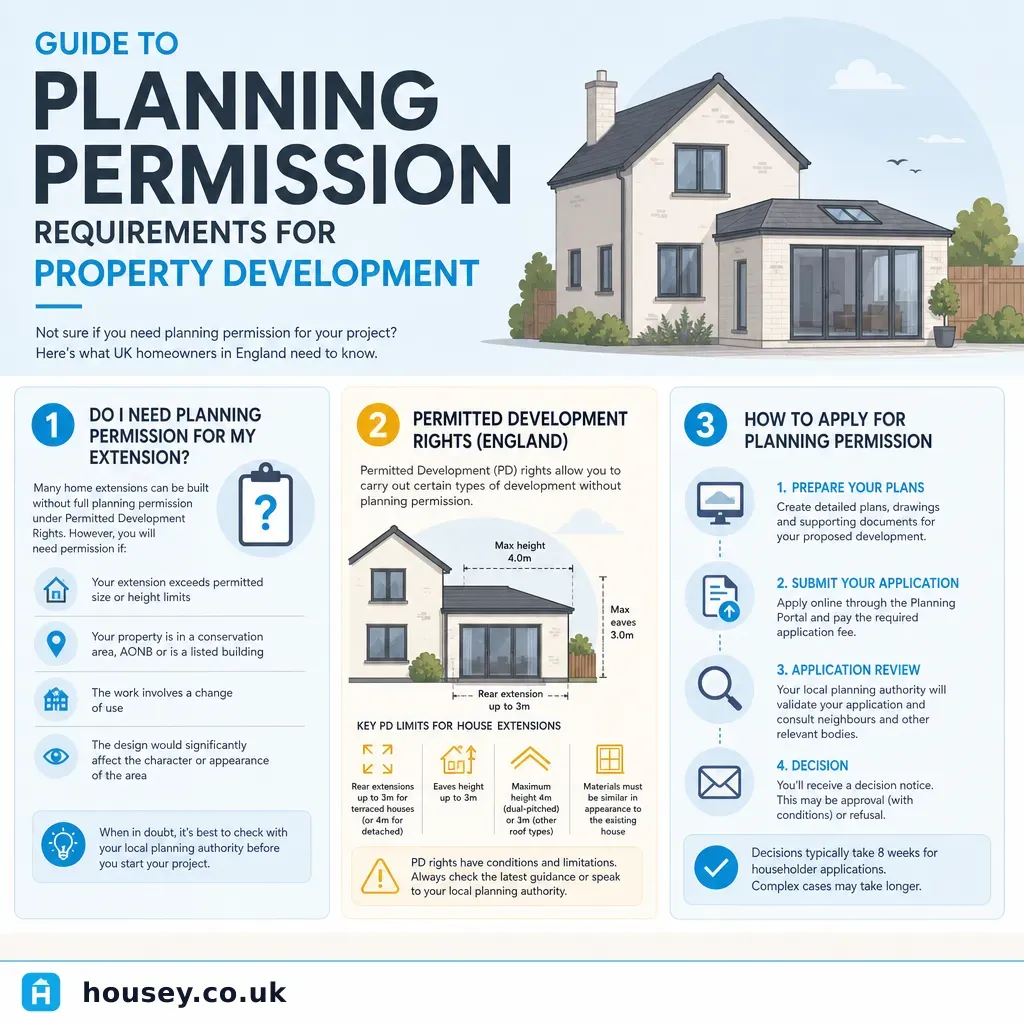
Guide to Planning Permission Requirements for Property Development
Most home improvements in England fall within permitted development rights and do not need a planning application.