Patio Installation and Building Regulation Certification: What Builders Need to Know
By Housey · Last reviewed 4th of May 2026
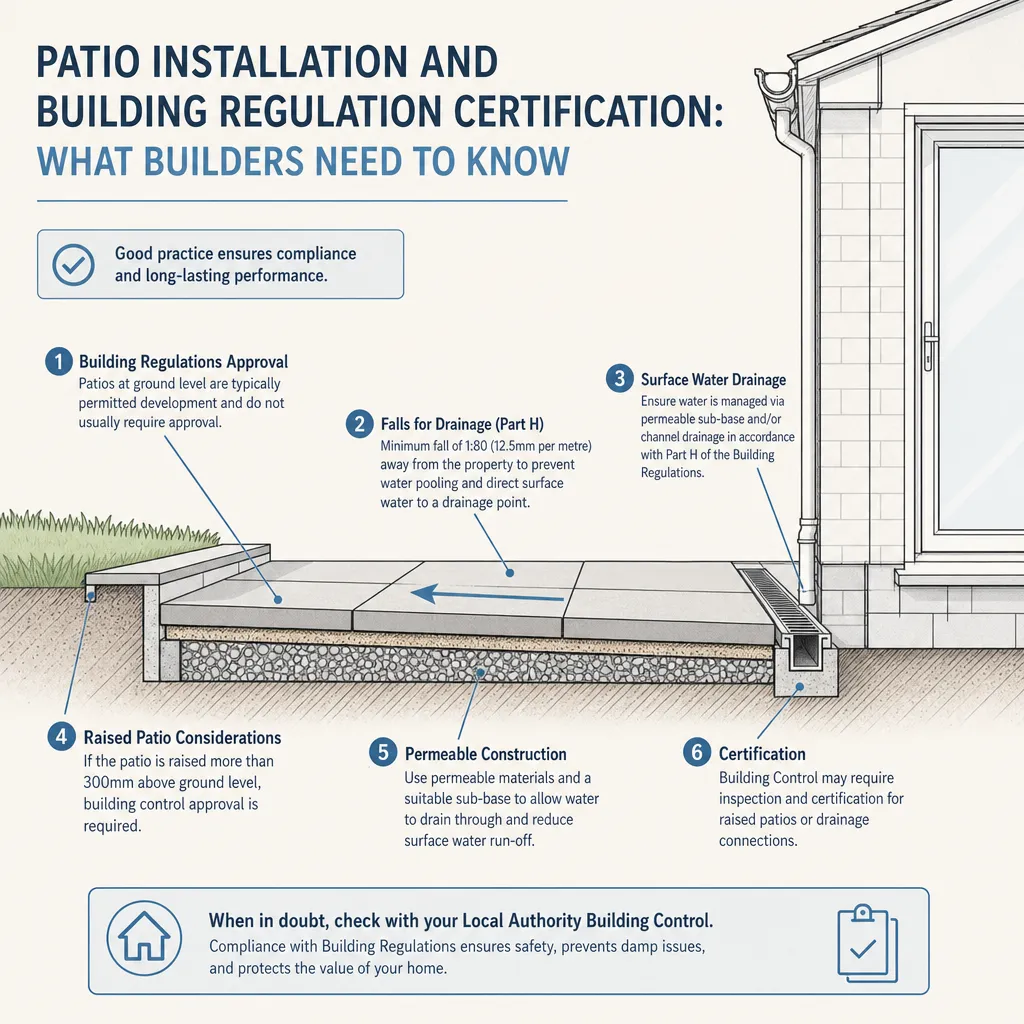
Patio Installation and Building Regulation Certification: What Builders Need to Know
Whether you are a builder quoting a garden project or a homeowner planning a new terrace, understanding when building regulations apply to a patio can prevent costly enforcement action and complications on a future property sale. Most ground-level patios sit comfortably outside formal building control scope, but a specific set of circumstances — drainage connections, level changes, and structural elements — bring them firmly within regulated territory. Getting the classification right at the outset protects both the builder and the client.
Key points
- Most ground-level patios in England do not require building regulations approval, but Approved Document H (drainage) applies if surface water is directed to a public combined or foul sewer.
- A raised terrace or patio with an accessible edge drop of more than 600mm requires edge protection meeting Approved Document K (protection from falling, collision, and impact).
- Under the Highways Act 1980, any new impermeable hard-standing that allows surface water to run onto a public highway is unlawful; permeable paving or a suitable soakaway is normally required.
- Planning permission is generally not required for a ground-level patio under permitted development rights, but conservation areas, listed buildings, and raised terraces that overlook neighbours are common exceptions.
- A structural retaining wall of over approximately 1.2m built as part of a patio project typically requires a structural engineer's design and building control notification.
Does a patio need building regulations approval?
For most standard patios laid at or near ground level, the answer is no. The Building Regulations 2010 apply to the erection and alteration of buildings and to certain controlled services and fittings. A simple flag-and-mortar or block-paving patio at near-ground level is generally not a building within the meaning of the Regulations.
Building regulations do apply in the following circumstances:
- Raised terraces and changes in level: If the patio involves a change in level with an accessible drop of more than 600mm on any side, Approved Document K requires appropriate edge protection — balustrades, barriers, or kerb upstands meeting the relevant loading standards. A structural retaining wall of over approximately 1.2m may require a structural engineer's design and building control oversight.
- Drainage to a public combined or foul sewer: Approved Document H covers drainage. If surface water from the patio is directed to a combined or foul sewer rather than a soakaway or permeable system, a building regulations application may be required and the water company's consent is likely needed.
- Part of a larger regulated project: If the patio is immediately adjacent to a rear extension or other regulated building work, the existing building control application normally covers the hard-standing. Confirm this with the building control body.
- Listed buildings and curtilage: Any alteration to the curtilage of a listed building, including the formation of a new patio, may require listed building consent in addition to any planning or building regulations requirements.
Decision tree: does my patio need building regulations approval?
Use this guide to identify the likely compliance path before committing to a design:
- Is the patio at or very close to existing ground level with no level change exceeding 600mm? → Probably no building regulations required for the patio structure itself. Proceed to check drainage.
- Does all surface water drain to a soakaway or permeable surface? → Building regulations approval for drainage is not normally required.
- Does any surface water drain to a public combined or foul sewer? → A building regulations application for the drainage connection may be needed — check with the local authority building control body before proceeding.
- Is there an accessible drop of more than 600mm from any patio edge? → Approved Document K applies; edge protection is required and building control should be notified before works begin.
- Does the design include a retaining wall over approximately 1.2m? → Seek structural engineering input and confirm whether a building regulations application is required.
- Is the property listed or in a conservation area? → Consult the local planning authority and heritage officer before commencing any work.
- Is the patio part of a larger project with an existing building control application? → Confirm with the building control body whether the approved application covers the patio works.
When does planning permission apply?
In England, installing a patio or hard-standing at ground level is generally covered by permitted development rights and does not require a planning application. The key rules under the Town and Country Planning (General Permitted Development) (England) Order 2015 include:
- Permeable or draining paving: Permitted development for hard-standing near a dwelling applies where the material is permeable (gravel, block paving with open joints, permeable concrete) or where surface water drains to a lawn or planted border and not onto the public highway.
- Raised terraces: A raised patio at first-floor level, or one that constitutes a raised platform creating a meaningful privacy impact on adjacent properties, may require planning permission even where the structural element does not trigger building regulations.
- Conservation areas and Article 4 Directions: Permitted development rights are restricted in conservation areas and for properties subject to an Article 4 direction. Always check with the local planning authority before proceeding.
- Wales, Scotland, and Northern Ireland: Planning and building regulations rules differ across the UK nations. This article focuses on England; builders and homeowners elsewhere should consult the relevant national guidance.
Patio scenarios and compliance requirements
Scenario | Planning permission likely needed? | Building regulations approval likely needed? | Key professional to consult |
|---|---|---|---|
Ground-level slab or block patio, permeable surface, no level change | No | No | None for compliance; contractor for build quality |
Ground-level patio, impermeable, drains to soakaway | No | No (drainage only if soakaway adequate) | Drainage contractor; check soakaway capacity |
Ground-level patio, impermeable, drains to public combined sewer | No | Possibly — Part H drainage application | Building control body; drainage contractor; water company |
Raised terrace, accessible drop over 600mm | Possibly (privacy impact) | Yes — Approved Document K edge protection; possibly Part A | Building control body; structural engineer |
Retaining wall over approximately 1.2m as part of patio design | Possibly | Yes — structural design required | Structural engineer; building control body |
Patio within curtilage of a listed building | Yes (listed building consent) | Possibly | Heritage officer; local planning authority |
Patio in conservation area, impermeable surface | Possibly — check with LPA | As above per drainage and level | Local planning authority; building control consultant |
What builders need to check before starting work
Builders tendering for patio work should carry out the following checks before accepting a contract:
What to ask before accepting a quote or appointing a building control body
These questions help both builders and homeowners clarify compliance obligations at the outset:
- Does the patio design involve any change of level that could trigger Approved Document K?
- Where will surface water discharge, and does this require a building regulations application or soakaway capacity assessment?
- Is the property listed, in a conservation area, or subject to an Article 4 direction?
- If a retaining wall is involved, will a structural engineer's design be required before or during the application?
- Will the building control body require a site inspection at any stage during or after the works?
- Will a completion certificate be issued on this project, and if so, what does it cover?
- For listed buildings — has listed building consent been sought separately from any planning or building regulations application?
Important limitations
This article provides general guidance on building regulations and planning requirements for patio installations in England as at May 2026. Rules vary by local authority, property type, proximity to boundaries, and the precise nature of the works. This information is not a substitute for a formal pre-application enquiry with your local planning authority or building control body. Proceeding without required approvals can result in enforcement notices, required demolition, and complications on a future property sale or remortgage.
What to ask a qualified professional
Before instructing a building control consultant or making a formal application, ask:
- Does this specific project fall within the scope of the Building Regulations 2010 in any respect — structure, drainage, or protection from falling?
- Is a full plans application or a building notice more appropriate for this project, and what are the implications for the completion certificate?
- For drainage: will the building control body require evidence of soakaway capacity or permeability testing before or after the works?
- For a raised terrace: will the structural design and edge protection specification need to be submitted and approved before work commences on site?
- Are there any local authority conditions, section 106 obligations, or local development order restrictions affecting this property that could affect the patio design?
When to get professional help
Seek professional advice from a building control consultant or structural engineer before works begin if:
- The patio includes any accessible level change with a drop exceeding 600mm.
- The design includes a retaining wall of any significant height.
- The property is listed, in a conservation area, or subject to an Article 4 direction.
- Surface water drainage to a public sewer is proposed.
- The works form part of a larger project that already has, or will require, a building control application.
- You are unsure whether the client's property carries any planning restrictions that could affect the patio design.
How Housey can help
If you need guidance on whether your patio project requires building regulations approval, Housey can connect you with qualified building control consultants who can advise on compliance obligations before work begins — saving time, reducing risk, and avoiding enforcement problems further down the line.
Frequently asked questions
Does a standard block-paved patio need building regulations approval?
In most cases, no. A ground-level block-paved patio in England does not require building regulations approval, provided surface water drains to a soakaway or permeable system rather than a public foul sewer, and there is no significant change in level that triggers Approved Document K. Always check drainage arrangements and confirm the property is not listed or in a conservation area before starting work.
Do I need a completion certificate for a patio?
Only if building regulations approval was required for your specific project — for example where the patio involved a raised terrace, edge protection, a structural retaining wall, or a drainage connection to a public sewer. If no building regulations application was needed, no completion certificate is issued. A building control consultant can confirm whether certification applies to your project.
Can surface water from a patio drain to a combined sewer?
This is generally discouraged and in new developments often prohibited under Approved Document H and the Water Industry Act 1991. Surface water should drain to a soakaway, permeable surface, or designated surface water drain wherever practicable. If connection to a combined sewer is unavoidable, you will likely need a building regulations application and consent from the relevant water company.
Does a raised patio need planning permission?
A raised patio or terrace at first-floor level, or at a level that creates a meaningful privacy impact on neighbouring properties, is likely to need planning permission in England. The key test is whether the raised element constitutes a balcony, veranda, or raised platform under Class A of the permitted development rules. Always check with your local planning authority before committing to a raised design.
Sources and further reading
- Building regulations approval: when you need it — GOV.UK
- Approved Document H: Drainage and waste disposal — Ministry of Housing, Communities and Local Government
- Approved Document K: Protection from falling, collision and impact — Ministry of Housing, Communities and Local Government
- Town and Country Planning (GPDO) 2015 — Class F hard surfaces — legislation.gov.uk
- Highways Act 1980, Section 163: surface water — legislation.gov.uk
- Hard surfaces around your home: do I need permission? — Planning Portal
Useful next reads
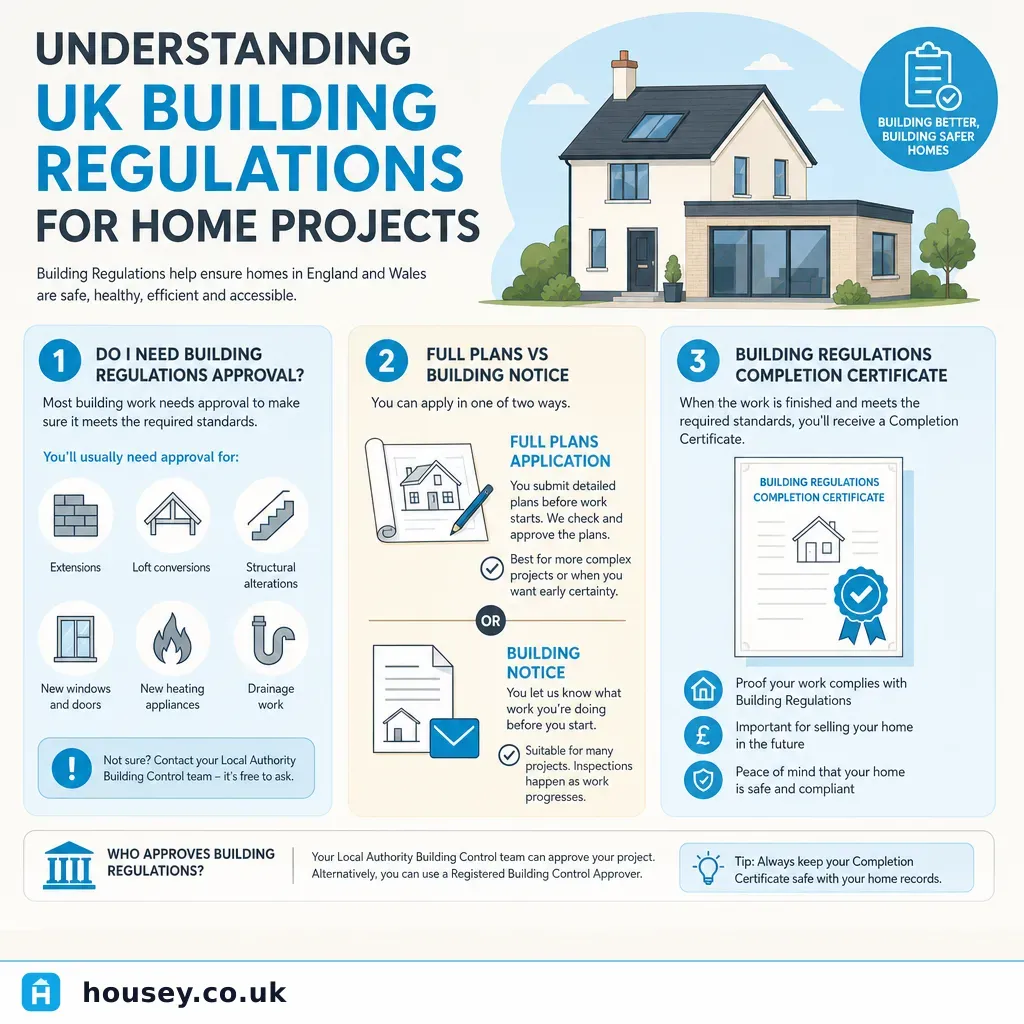 Planning & Pre-Build
Understanding UK Building Regulations for Home Projects
UK building regulations set minimum construction standards covering structure, fire safety, ventilation, and energy efficiency.
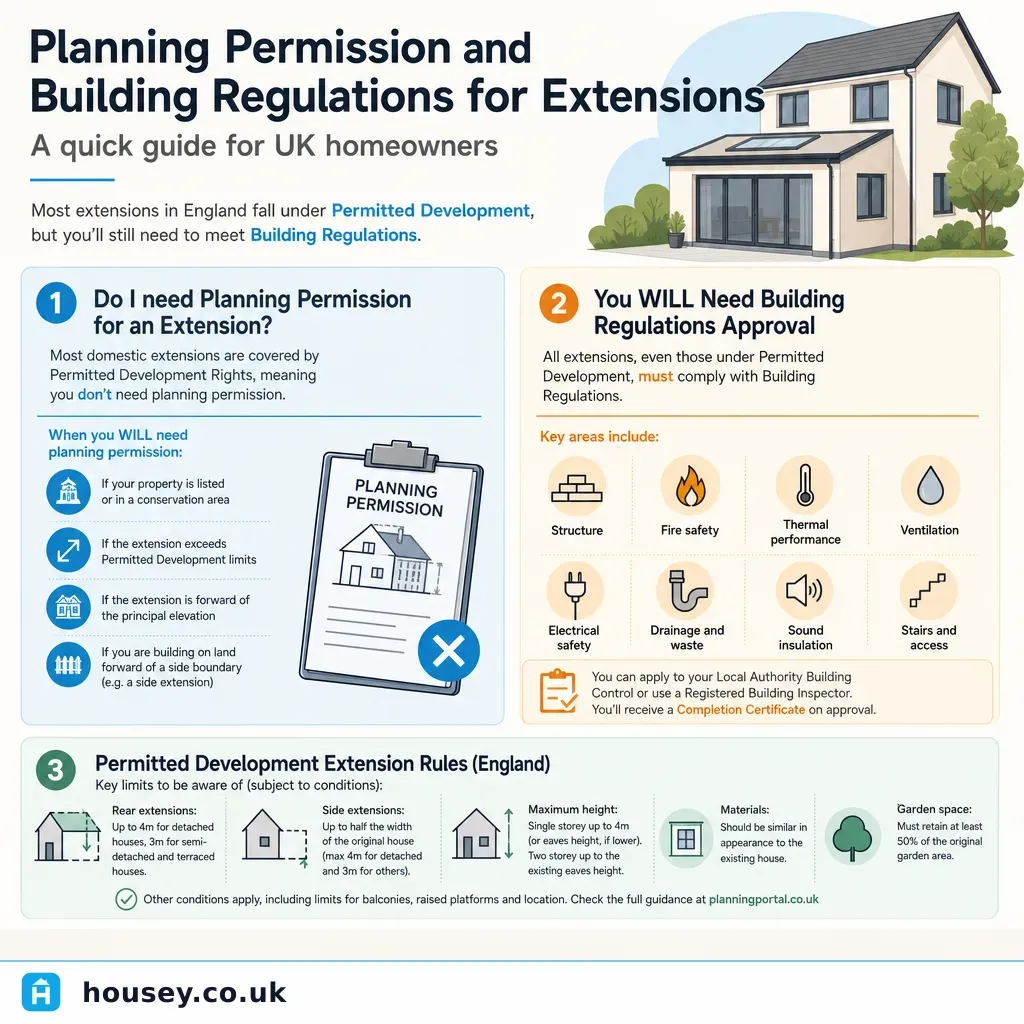 Planning & Pre-Build
Planning Permission and Building Regulations for Extensions
UK home extensions usually require both planning permission and Building Regulations approval, though most smaller rear extensions qualify as Permitted Development under the GPDO 2015 and need no planning application.
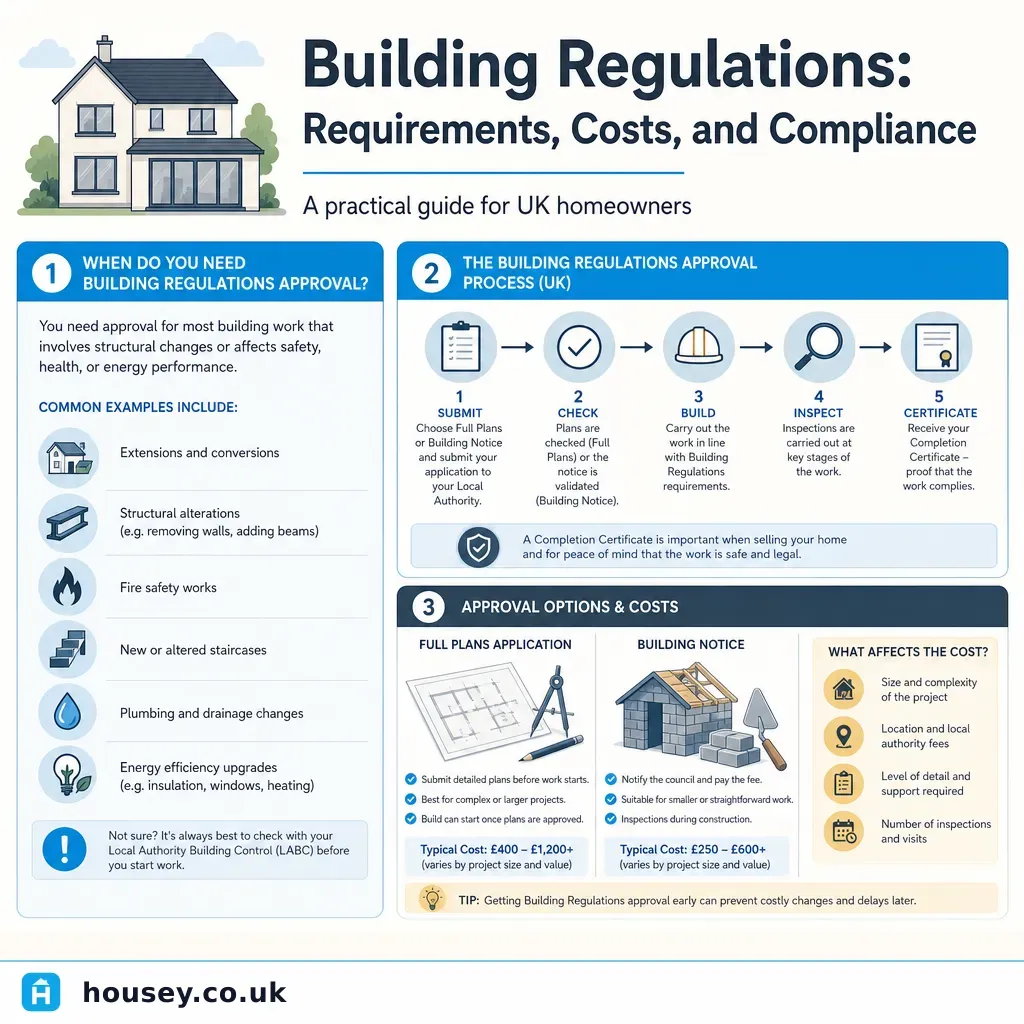 Planning & Pre-Build
Building Regulations: Requirements, Costs, and Compliance
Building regulations set minimum standards for how construction work is carried out in the UK, covering structural stability, fire safety, energy efficiency, and ventilation.
 Planning & Pre-Build
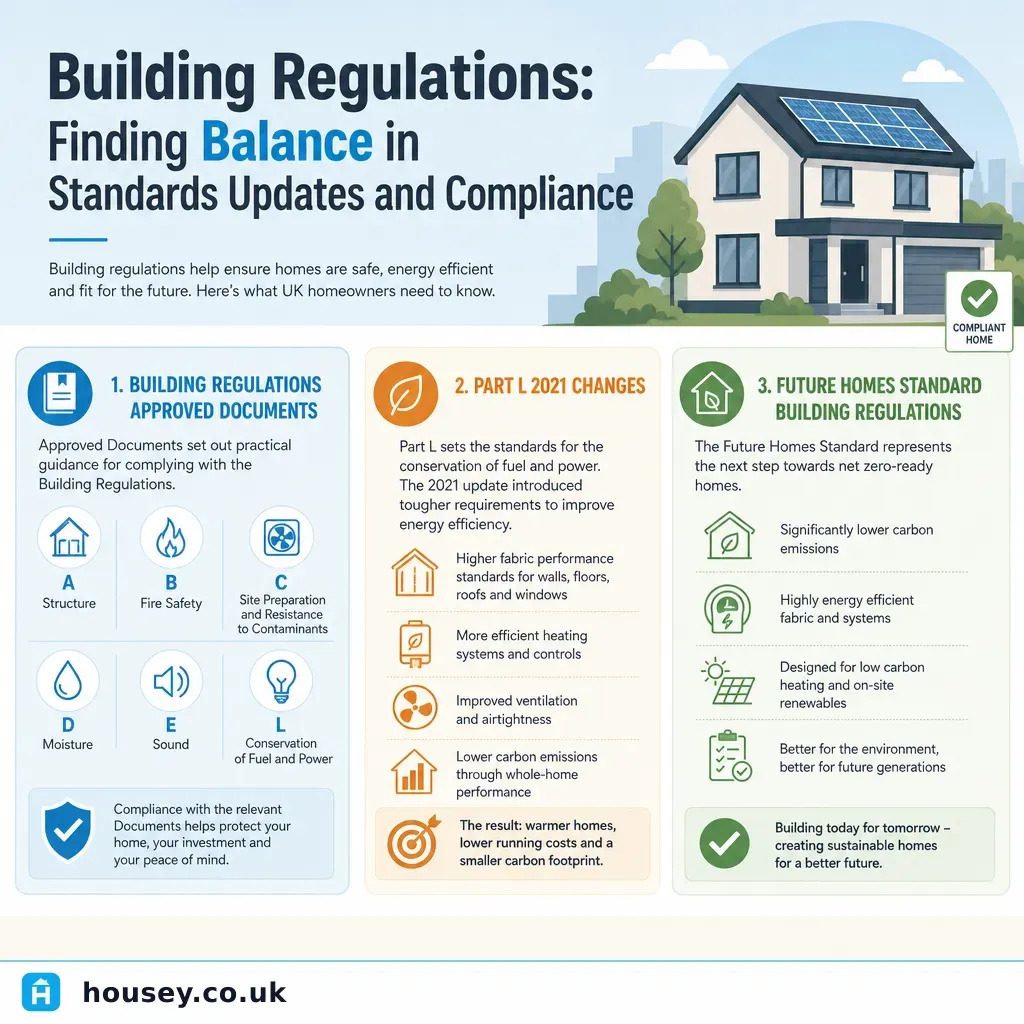
Building Regulations: Finding Balance in Standards Updates and Compliance
Building regulations in England and Wales set minimum standards for construction, covering structure, fire safety, energy efficiency, and ventilation.
 Planning & Pre-Build
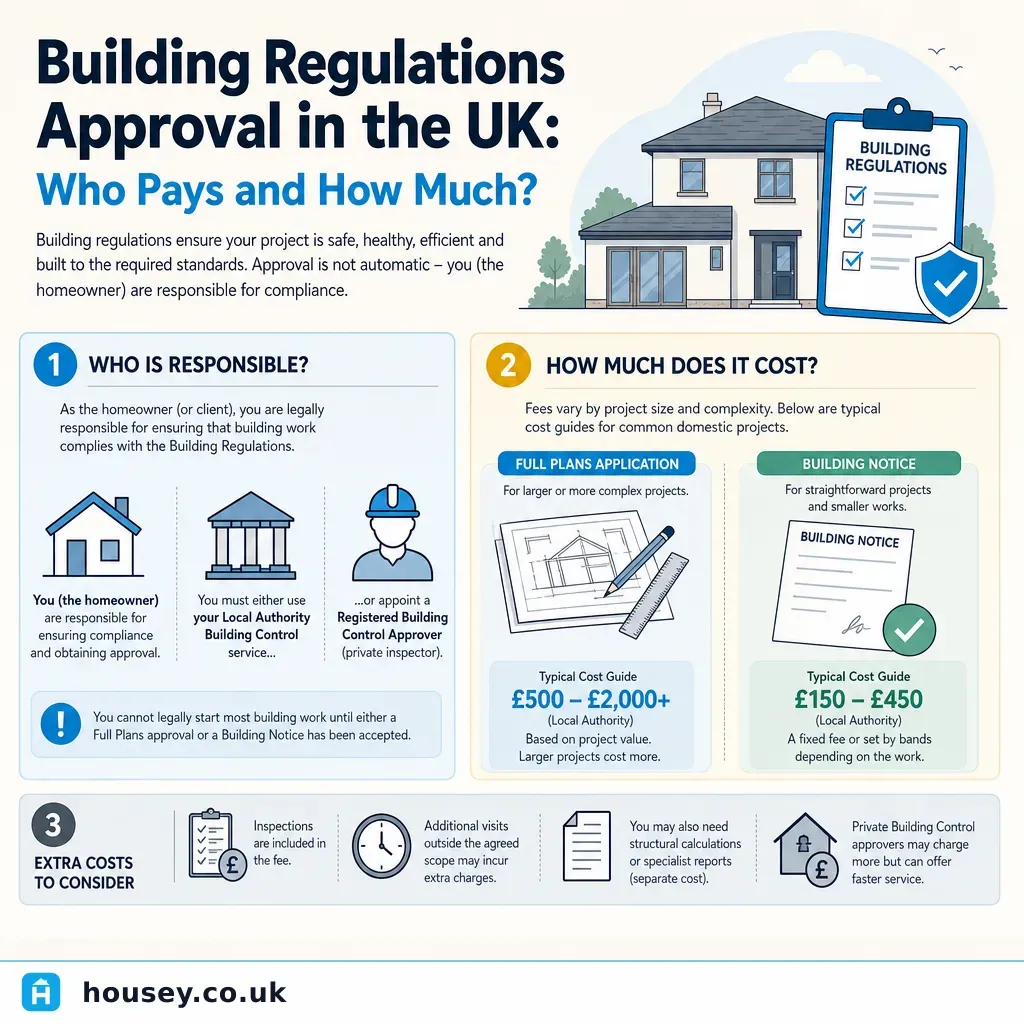
Building Regulations Approval in the UK: Who Pays and How Much?
Building regulations approval fees are almost always paid by the homeowner or the person commissioning the work, not the contractor.