Understanding UK Building Regulations for Home Projects
By Housey · Last reviewed 19th of May 2026
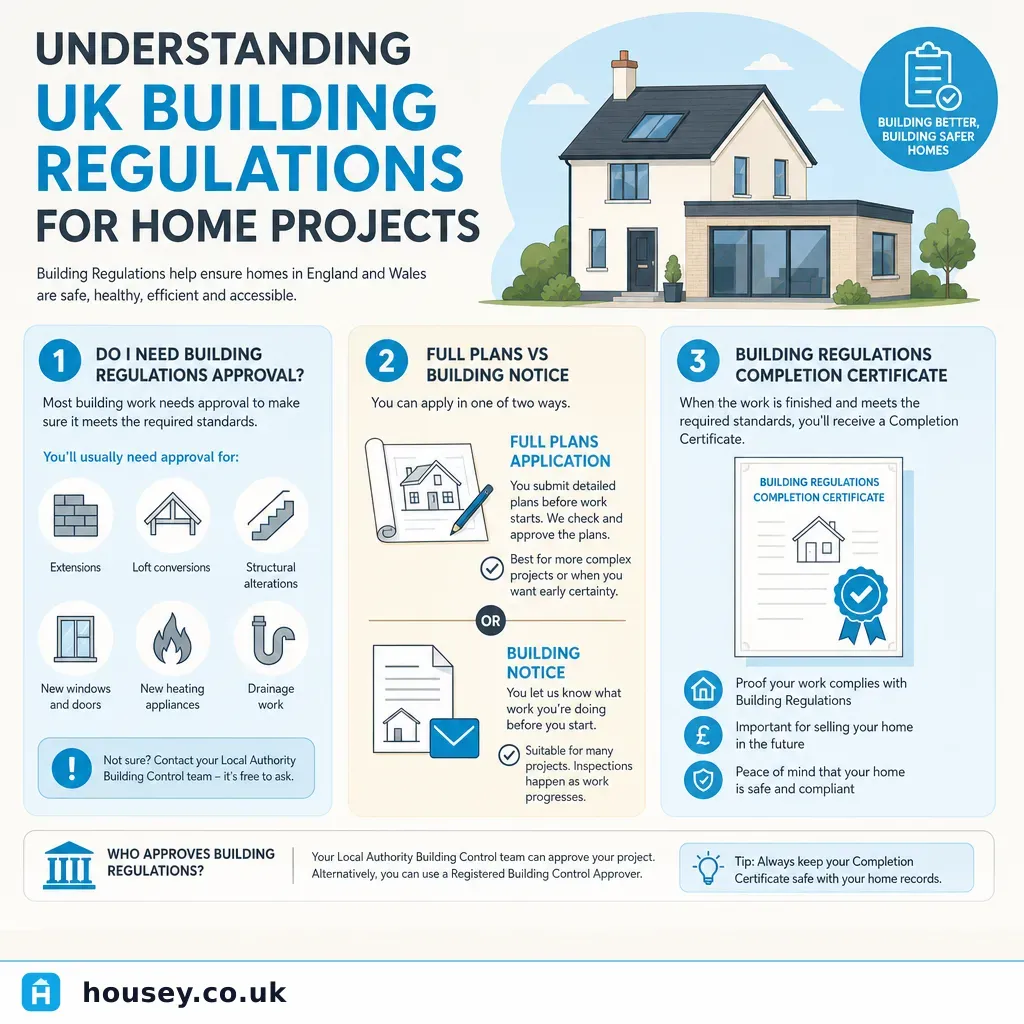
Understanding UK Building Regulations for Home Projects
Building regulations approval is a legal requirement for a wide range of home improvement projects, yet many homeowners discover this mid-way through a build — or when a buyer's solicitor requests completion certificates that do not exist. The regulations set minimum standards for health, safety, energy efficiency, and accessibility, and they apply whether or not planning permission is also required. Building regulations and planning permission are distinct consents: you may need one, both, or neither depending on the nature and scale of the work.
Key points
- The Building Regulations 2010 (SI 2010/2214) apply in England; Wales, Scotland, and Northern Ireland each operate under separate but broadly equivalent regulations.
- There are 18 Approved Documents (Parts A through S, plus Regulation 7 on materials), covering structure (Part A), fire safety (Part B), ventilation (Part F), energy efficiency (Part L), and more.
- A completion certificate, issued by building control after a satisfactory final inspection, is an important document for future sale or remortgage — its absence can delay or complicate conveyancing.
- Since October 2023, approved inspectors have been replaced by Registered Building Control Approvers (RBCAs) under the Building Safety Act 2022; both local authority building control and RBCAs are now overseen by the Building Safety Regulator.
- Carrying out notifiable work without building regulations approval is not a criminal offence for the homeowner in most cases, but it can lead to enforcement action, required remediation, and significant difficulties when selling.
What work needs building regulations approval?
Not all home projects require approval. Schedule 2 of the Building Regulations 2010 sets out classes of exempt work.
Work that typically requires approval:
- Extensions of any size that create new habitable space
- Loft conversions
- Garage conversions to habitable space
- New or replacement windows and rooflights (unless installed by a FENSA-registered installer who self-certifies)
- Structural alterations, including removing load-bearing walls
- New or replacement electrical installations in most rooms (unless completed by a Part P-registered electrician who self-certifies)
- New or replacement boilers and heating systems
- Roof alterations beyond like-for-like repair
- Underpinning and basement conversions
Work that is usually exempt:
- Like-for-like repairs (for example, replacing slates with equivalent slates)
- Detached outbuildings under 15 m² with no sleeping accommodation
- Conservatories with a thermally separated door or window from the main house
- Small porches under 30 m²
- Boundary walls, fences, and gates
When in doubt, check with your local authority building control department or a building control consultant before starting work.
Full Plans, Building Notice, or Regularisation?
There are three main routes to building regulations approval for most domestic projects. Choosing the right one depends on the complexity of the work and how much certainty you need before starting on site.
Route | How it works | Best for | Key risk |
|---|---|---|---|
Full Plans application | Detailed drawings submitted for approval before work starts; building control inspects at key stages; completion certificate issued on final inspection | Extensions, loft conversions, structural alterations — anything complex | Longer process upfront, but gives written certainty before significant expenditure on construction |
Building Notice | Notice submitted before work starts; no drawings approved upfront; inspections at key stages | Straightforward works, experienced contractors, smaller projects | No approved plans — issues are identified only during inspection, potentially mid-build |
Regularisation certificate | Applied for retrospectively after work is completed without prior approval | Purchasing a property with unregulated past work; correcting past omissions before a sale | Exposure of finished work may be required; certificate may not be available if work does not comply |
For most extensions and loft conversions, a Full Plans application is the more cautious route — it gives you written approval and flags design issues before spending significant money on construction.
The inspection process: what to expect
Building control inspectors (local authority or RBCA) visit at key stages during construction. You are responsible for notifying them before covering up work — do not pour concrete over foundations or close up structural elements before the relevant inspection has taken place.
Typical inspection stages for a domestic extension:
- Commencement — notify building control before work begins (usually 48 hours' notice required)
- Foundation excavations — before concrete is poured
- Damp-proof course — before the floor slab is laid
- Structural frame — before covering (for timber frame or steel)
- Roof structure — before tiling
- Drainage — before backfilling
- Final inspection — when work is complete, to issue the completion certificate
Missing a stage does not automatically mean failure, but the inspector may require exposure of covered work to verify compliance. Inspection stages for loft conversions, garage conversions, and other project types differ — confirm the schedule with your building control body at the outset.
Homeowner checklist: before you start a regulated project
Important limitations
This article provides general information only and is not a substitute for professional advice on your specific project. Building regulations requirements vary by project type, property type, and in some cases by local authority. The Building Safety Act 2022 continues to be implemented in phases, and requirements for higher-risk buildings (over 18 m or seven or more storeys) are subject to a separate and more stringent regulatory regime. Regulations differ across England, Wales, Scotland, and Northern Ireland. Always confirm current requirements with your local authority building control or a Registered Building Control Approver before starting work.
What to ask a qualified professional
Before instructing a building regulations consultant, architect, or contractor to manage the approval process:
- Which Approved Documents apply to my specific project, and are there any local or property-specific variations I should know about?
- Should I apply via Full Plans or Building Notice for this type and scale of work?
- Who will prepare the building regulations drawings, and what level of detail is required by building control?
- Who will submit the application and manage notifications at each inspection stage?
- If structural work is involved, who will provide the calculations, and will building control review these before work starts?
- If work has already been completed without approval, can a regularisation certificate be obtained, and what exposure works might be required?
- Is this project also subject to planning permission, and are those applications being handled separately?
When to get professional help
A building regulations consultant, architect, or experienced contractor can manage the entire approval process on your behalf. Professional advice is particularly important when:
- The project involves structural alterations — always obtain structural engineer calculations before removing load-bearing walls or altering foundations.
- The property is listed or in a conservation area, where building regulations interact with separate listed building consent or conservation area requirements.
- Work has been carried out without building regulations approval and a regularisation certificate is needed before a sale or remortgage can proceed.
- The project is complex or phased, with multiple Approved Documents in scope and several trades involved.
- You are buying a property where building regulations compliance for past works cannot be evidenced by completion certificates.
How Housey can help
Housey connects you with experienced building control consultants who can advise on the correct application route and manage the process from submission through to completion certificate. If your project requires technical drawings, Housey also connects you with professionals who produce building regulations drawings. For structural work, our network of structural engineers can provide the calculations building control will need. Submit a request to receive quotes from qualified professionals in your area.
Frequently asked questions
Do I need building regulations approval if I already have planning permission?
Yes, usually — these are two separate consents. Planning permission controls what you build and where; building regulations govern how it is built to minimum safety standards. Most projects that require planning permission also require building regulations approval. Some permitted development work does not need planning permission but still requires building regulations approval.
What happens if I sell a property without a building regulations completion certificate?
The buyer's solicitor will typically identify the missing certificate during conveyancing and may ask you to obtain indemnity insurance to cover the risk. In some cases buyers may require the work to be exposed, inspected, and certified before exchange. Missing completion certificates can cause delays and additional costs — always ensure they are issued at the time of the work.
How long does a Full Plans application take?
Local authority building control must determine a Full Plans application within five weeks of submission, or eight weeks if an extended period is agreed. In practice, complex applications may take longer if additional information is requested. Planning ahead and submitting early avoids delays to your build programme and allows time to address any queries raised by the inspector.
Can my builder submit the building regulations application on my behalf?
Yes, the applicant for building regulations approval can be the contractor, architect, or a building regulations consultant — not just the homeowner. However, as the property owner you remain ultimately responsible for ensuring the required approval is in place and that a completion certificate is issued and retained with the property deeds.
Sources and further reading
- Building regulations approval — GOV.UK
- The Building Regulations 2010 (SI 2010/2214) — legislation.gov.uk
- Building Safety Act 2022 — legislation.gov.uk
- Approved Documents — Building Regulations — GOV.UK
- LABC — Local Authority Building Control — LABC
Useful next reads
 Planning & Pre-Build
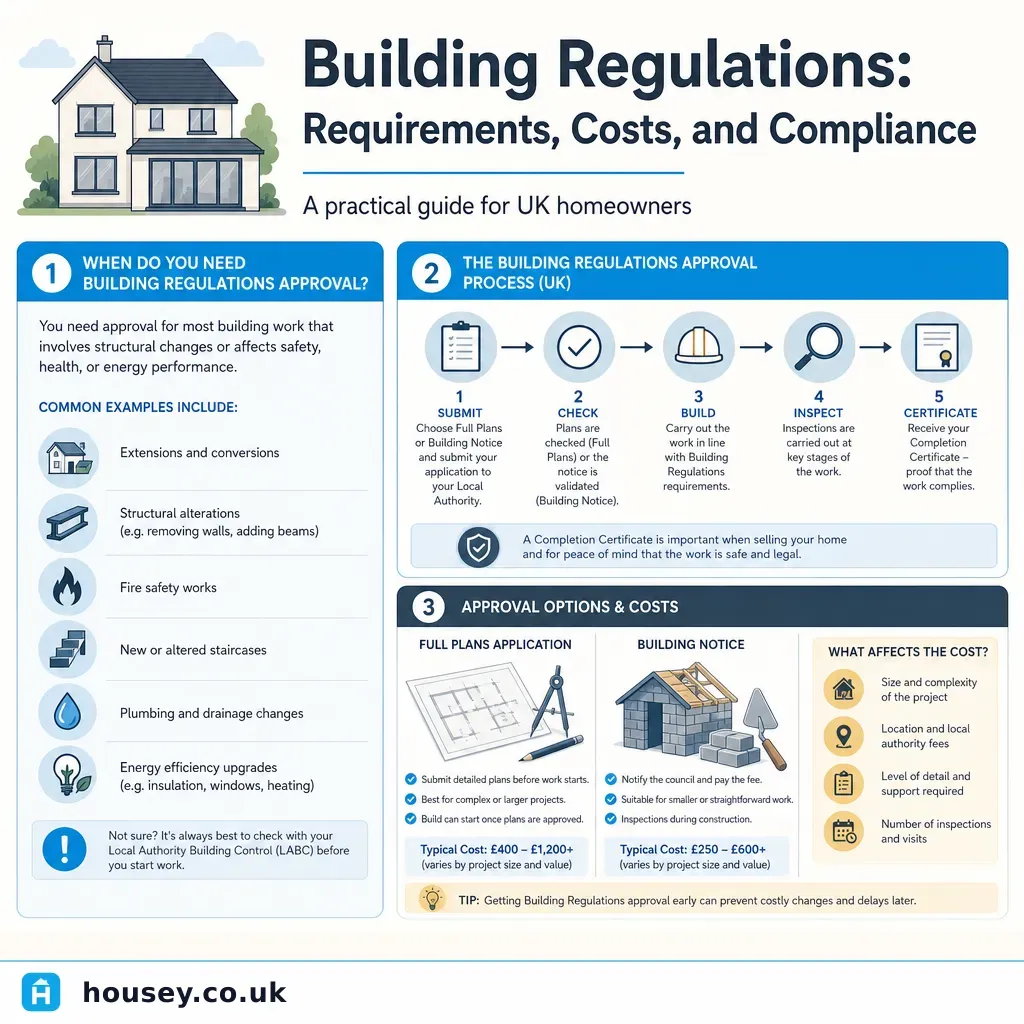
Building Regulations: Requirements, Costs, and Compliance
Building regulations set minimum standards for how construction work is carried out in the UK, covering structural stability, fire safety, energy efficiency, and ventilation.
 Planning & Pre-Build
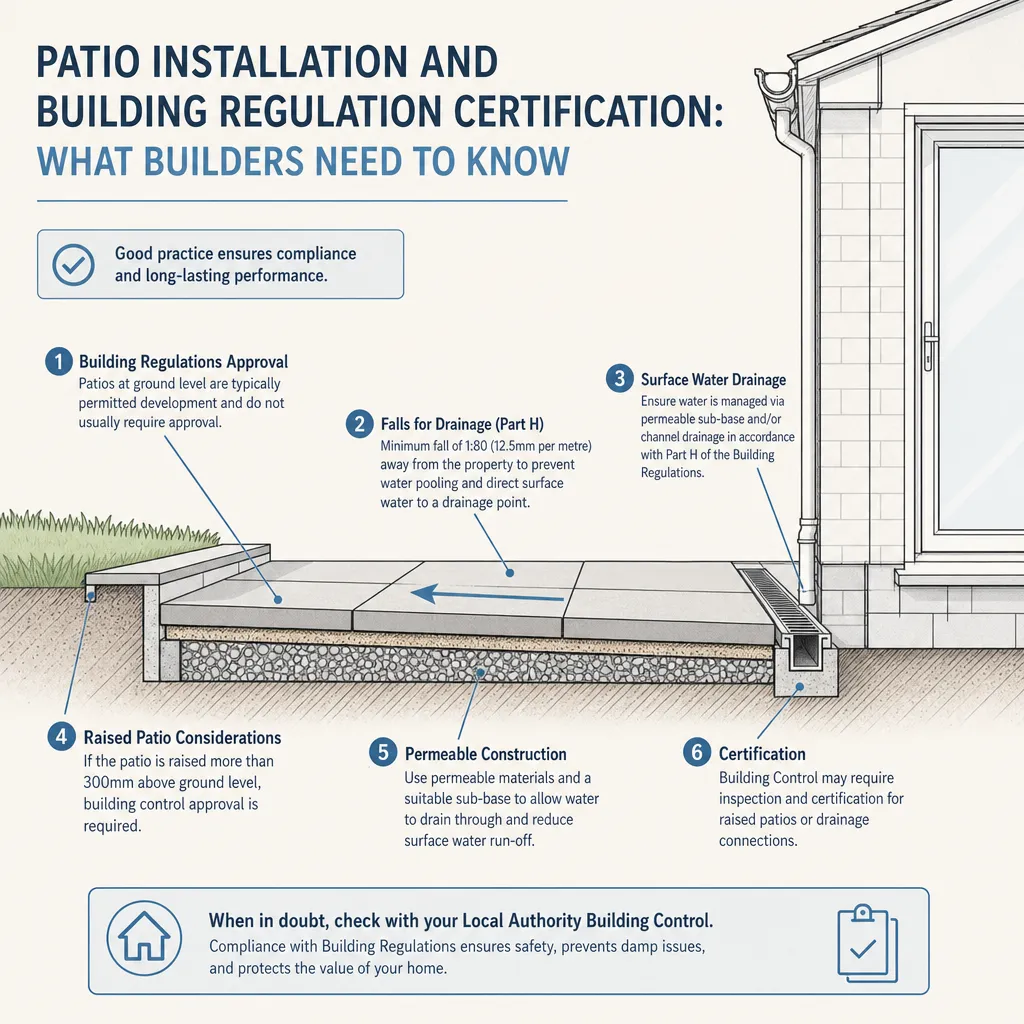
Patio Installation and Building Regulation Certification: What Builders Need to Know
Most ground-level patios in England do not require building regulations approval.
 Planning & Pre-Build
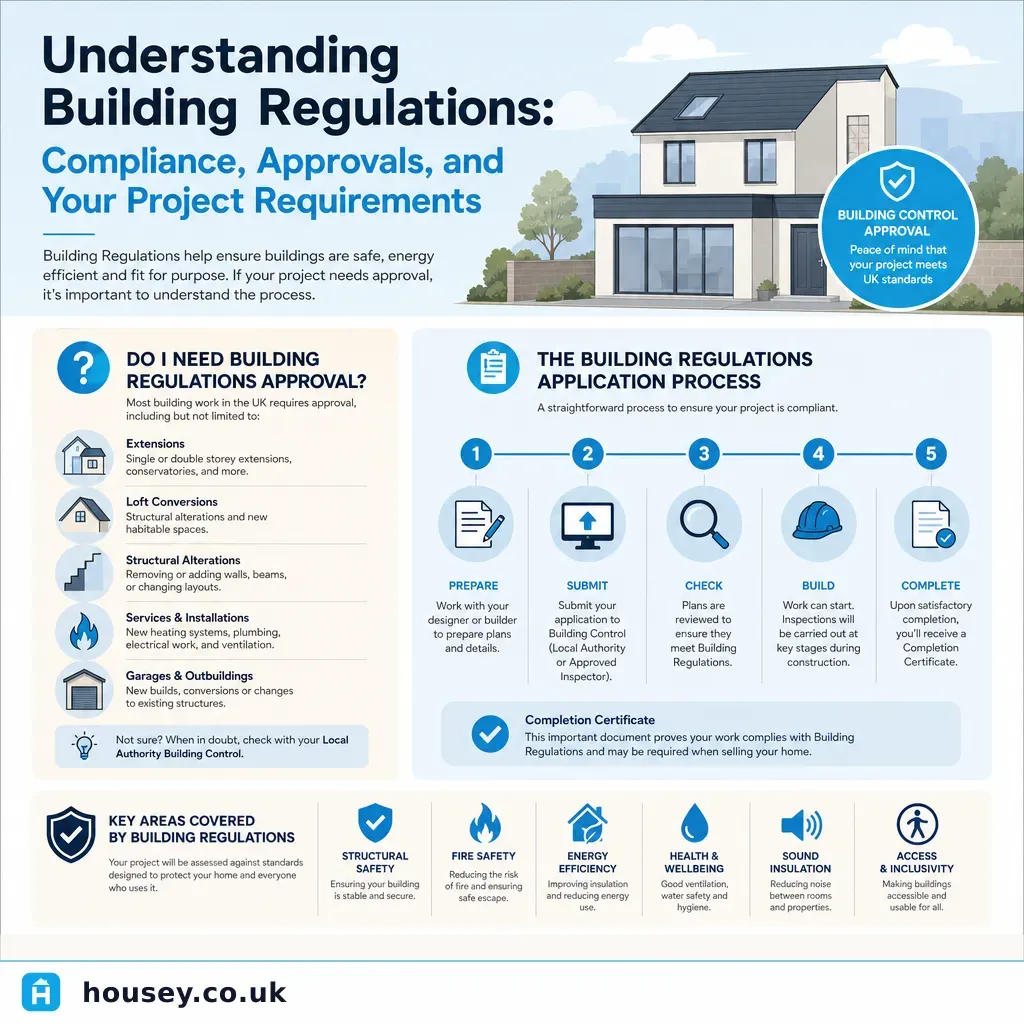
Understanding Building Regulations: Compliance, Approvals, and Your Project Requirements
Building regulations set minimum standards for design, construction, and alterations to buildings in England and Wales.
 Planning & Pre-Build
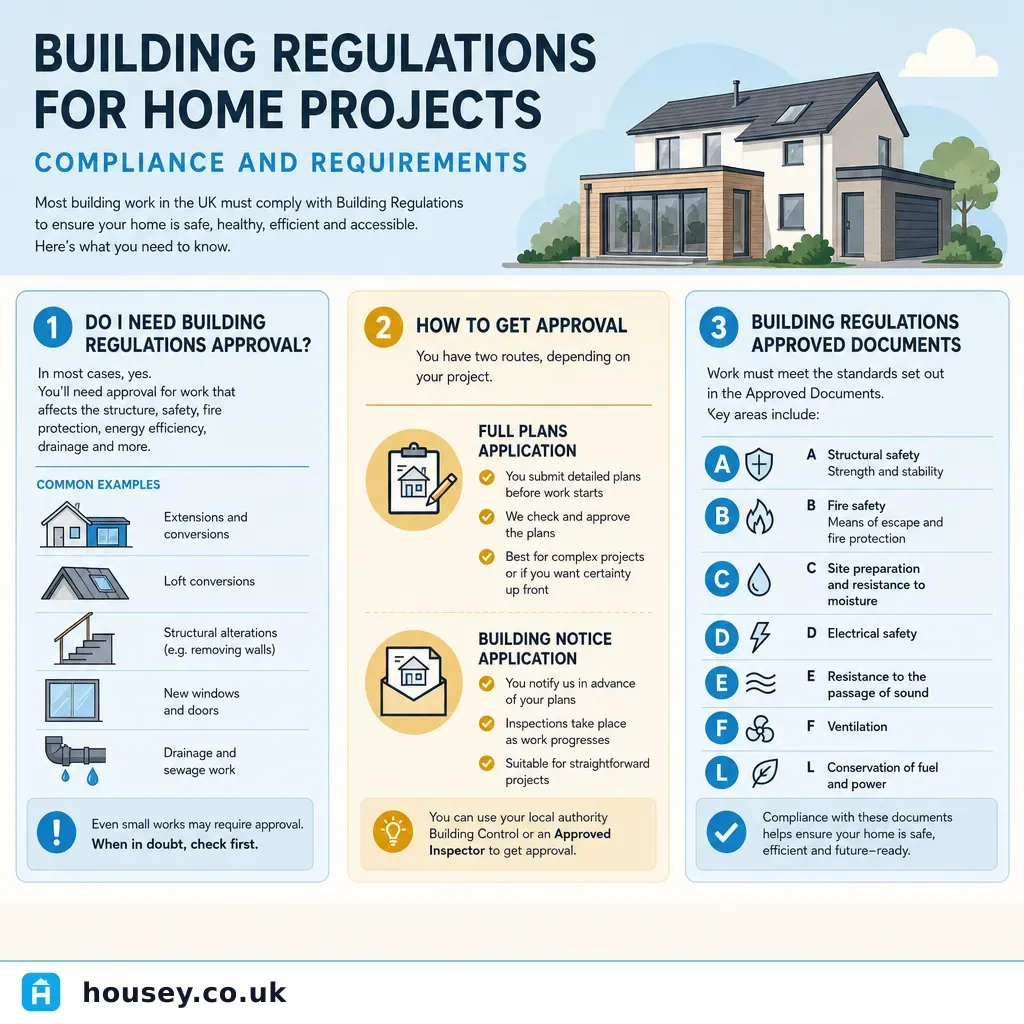
Building Regulations for Home Projects: Compliance and Requirements
Building regulations approval is needed for most structural, safety-related, and energy-related home projects in England and Wales, including extensions, loft conversions, and new heating systems.
 Planning & Pre-Build
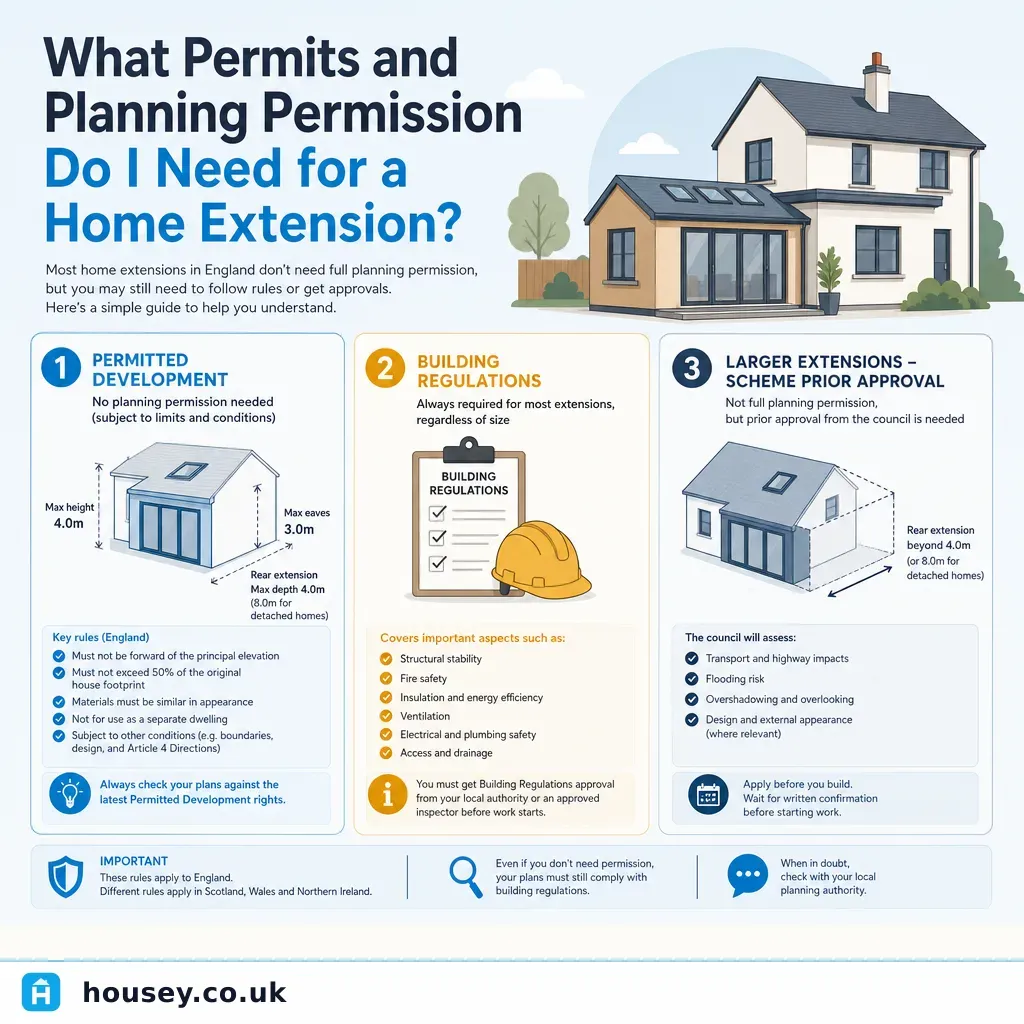
What Permits and Planning Permission Do I Need for a Home Extension?
Most single-storey rear extensions fall under permitted development and do not need a formal planning application, provided they stay within size limits set out in the Town and Country Planning (General Permitted Development) (England) Order 2015.