Building Regulations and Window Replacement in Bedrooms
By Housey · Last reviewed 11th of May 2026
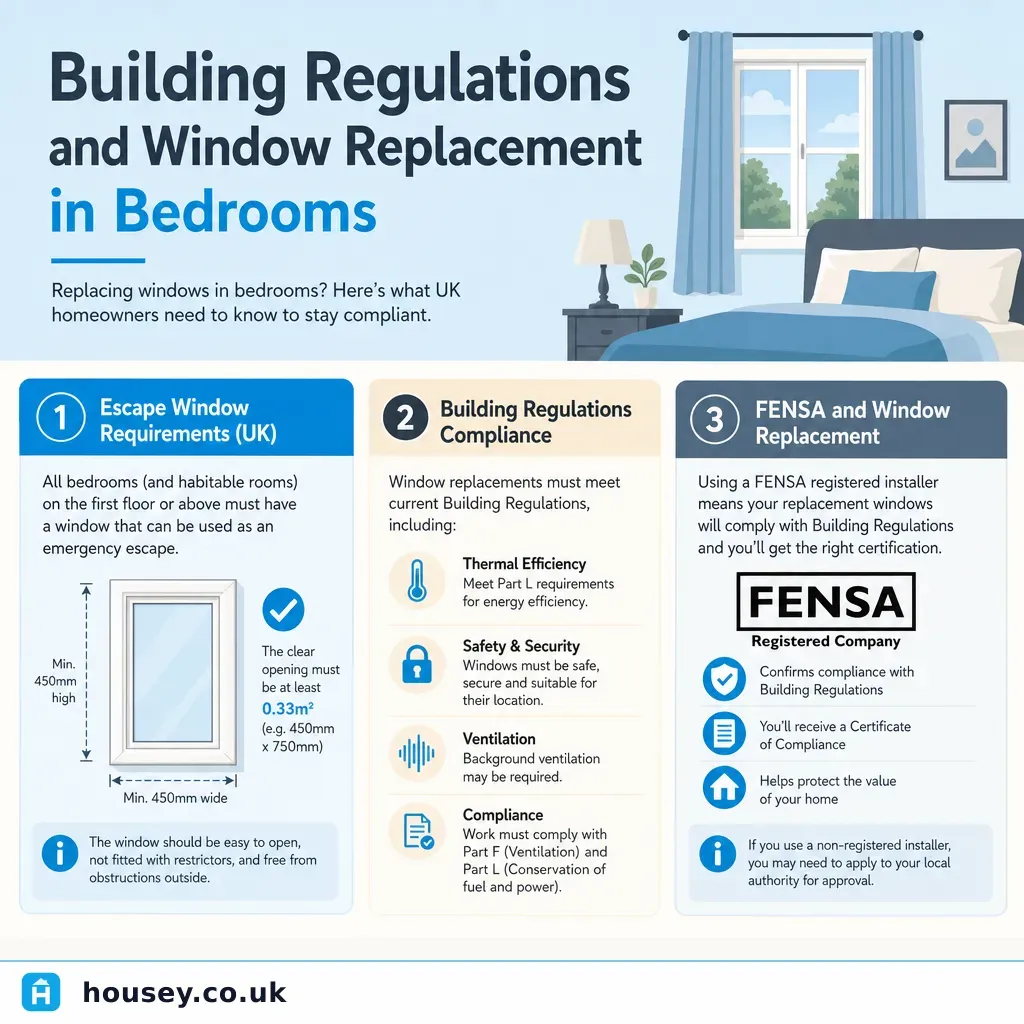
Building Regulations and Window Replacement in Bedrooms
Bedroom windows sit at the intersection of energy performance, fire safety, and security legislation, which means even a straightforward like-for-like swap can trigger several compliance requirements. The stakes are real: an incorrectly installed window in a bedroom can remove a resident's only means of escape in a fire, or leave a landlord unable to let a property legally under the Homes (Fitness for Human Habitation) Act 2018.
Key points
- Approved Document B (Fire Safety) requires a suitable escape window in every habitable room on upper floors and in ground-floor rooms used as sleeping accommodation in England.
- Escape windows must have a minimum unobstructed opening area of 0.33 m², with neither the openable height nor width less than 450 mm, and a sill no higher than 1,100 mm above finished floor level.
- Part L of the Building Regulations sets a minimum replacement window U-value of 1.6 W/m²K for the whole window unit in existing dwellings in England.
- Part Q (Security — Dwellings) requires that ground-floor and accessible windows in new dwellings and some extensions resist manual attack to PAS 24 or equivalent standard.
- Window installers registered with a competent persons scheme such as FENSA or CERTASS can self-certify compliance and issue a completion certificate without a separate building control application.
Do bedroom window replacements always need building regulations approval?
Most window replacements in existing dwellings require building regulations notification, primarily because they must comply with energy performance standards under Part L. The practical route for most homeowners is to use a FENSA- or CERTASS-registered installer, who self-certifies the work and notifies the local authority on your behalf.
If you use an unregistered contractor, you must either:
- Submit a building notice to your local authority building control before work starts, or
- Apply for a full plans submission for approval in advance.
Purely decorative changes — such as replacing a misted glazing unit within an existing, unchanged frame — may not trigger notification, but confirm this with building control or a registered installer before proceeding.
Escape window requirements under Approved Document B
Approved Document B sets minimum requirements for means of escape in case of fire. For a window to count as a compliant escape route from a bedroom, all of the following must be met:
Requirement | Minimum specification |
|---|---|
Total unobstructed opening area | 0.33 m² |
Minimum opening height | 450 mm |
Minimum opening width | 450 mm |
Maximum sill height from floor | 1,100 mm |
Accessibility | Openable from inside without a key |
These requirements apply to ground-floor rooms used as sleeping accommodation and to all upper-floor habitable rooms where an alternative internal escape route is not provided. In a typical three-bedroom semi-detached house, every first-floor bedroom should have a compliant escape window.
Common compliance issues arise when:
- A new, larger frame raises the sill height above 1,100 mm.
- Tilt-and-turn or top-hung fittings do not provide the full 0.33 m² unobstructed opening when set to their restricted open position.
- Child safety restrictors reduce the effective opening below the minimum — these must be the removable type, openable without tools or a key in an emergency.
Note: Scotland uses the Scottish Building Standards (Technical Handbook: Domestic), Wales follows broadly the same Approved Documents as England though some amendments apply, and Northern Ireland is governed by the Building Regulations (Northern Ireland) 2012 — provisions may differ in each nation.
Energy performance requirements under Part L
Part L (Conservation of Fuel and Power) requires that replacement windows in existing dwellings achieve a minimum whole-window U-value of 1.6 W/m²K, or a minimum Window Energy Rating of Band C, in England. A lower U-value means less heat passes through the unit.
Glazing type | Typical whole-window U-value | Likely to meet Part L? |
|---|---|---|
Single glazing | 5.0–5.8 W/m²K | No |
Standard double glazing (air-filled) | 2.6–3.0 W/m²K | No |
Low-E double glazing (argon-filled) | 1.2–1.6 W/m²K | At the borderline — confirm the rated value with the manufacturer |
Triple glazing | 0.6–1.0 W/m²K | Yes |
Your installer should provide a British Fenestration Rating Council (BFRC) certificate confirming the energy rating of the product installed. Retain this with your property records alongside any building control completion certificate.
Which professional do I need?
Scenario | Who to instruct |
|---|---|
Straightforward like-for-like replacement, same aperture size | FENSA- or CERTASS-registered window installer |
Window affecting a structural lintel or requiring the opening to be enlarged | Structural engineer assessment before ordering |
Listed building or conservation area property | Listed building consent from local planning authority; specialist joinery may be required |
Windows forming part of a new extension | Building control sign-off as part of the wider extension project |
Retrospective compliance query before a property sale | Building control surveyor or building regulations consultant |
When to get professional help
Window replacement is generally a competent-person task, but seek qualified advice if:
- You notice cracking above the window opening, or the frame appears to be under load — have a structural engineer or chartered surveyor assess it before proceeding.
- Your property is listed or in a conservation area — permitted development rights may be restricted and additional consents required.
- The proposed window design would reduce the openable area below 0.33 m² in a bedroom (for example, a fixed-light or very narrow casement).
- You are a landlord and the property is subject to an improvement notice — building control compliance forms part of your legal obligations.
- Work has already been carried out without certification and you need a regularisation certificate before selling.
Important limitations
This article reflects general guidance on Approved Document B and Part L as applied in England. Requirements can vary by nation (Scotland, Wales, Northern Ireland), building type (listed building, HMO, flat), and the nature of the alteration. A qualified building control surveyor, FENSA-registered installer, or building regulations consultant should confirm compliance for your specific property and window specification. Nothing in this article constitutes legal or fire safety advice.
What to ask a qualified professional
Before instructing a window installer or building control consultant:
- Are you registered with FENSA, CERTASS, or another government-approved competent persons scheme?
- Will the replacement window meet the 1.6 W/m²K U-value requirement under Part L, and can you provide the BFRC certificate?
- Does the proposed design comply with Approved Document B escape window requirements for this room type?
- Will you notify the local authority and provide a completion certificate?
- Is a structural assessment of the lintel needed before widening or repositioning the opening?
- If this is a listed building or conservation area property, have you worked on similar properties, and what consents will be needed?
How Housey can help
If you need guidance on compliance before instructing an installer, building control consultants on Housey can review your plans and confirm whether a building notice or full plans application is needed. For the installation itself, window and door installers registered with competent persons schemes can self-certify the work and handle building control notification on your behalf.
Frequently asked questions
Do I need planning permission to replace bedroom windows?
Usually no — replacing like-for-like windows is permitted development for most dwellings. However, if your property is in a conservation area, is listed, or the new windows would significantly alter the external appearance (for example, changing from timber to UPVC in a designated area), check with your local planning authority before proceeding.
What happens if I replace a bedroom window without building regulations approval?
Without a registered installer or building control notification, you will not have a completion certificate. Solicitors acting for buyers routinely request this evidence. You can apply for a regularisation certificate retrospectively, though building control may require part of the work to be opened up for inspection, adding both cost and disruption to your plans.
Can child safety restrictors be fitted to escape windows in bedrooms?
Yes, but only removable or override-able restrictors are permitted — the window must be fully openable in an emergency without tools or a key. Fixed restrictors that permanently limit the opening to less than 0.33 m² would not comply with Approved Document B and should not be installed on a designated escape window.
Does the escape window requirement apply to bungalows?
Approved Document B requires escape windows in ground-floor rooms used as sleeping accommodation as well as upper-floor bedrooms. Ground-floor bedrooms in bungalows are therefore covered by the same specifications — minimum 0.33 m² unobstructed opening, no dimension below 450 mm, and sill height no greater than 1,100 mm from the finished floor.
Sources and further reading
- Approved Document B: Fire Safety (Volume 1) — HM Government
- Approved Document L1B: Conservation of Fuel and Power in Existing Dwellings — HM Government
- FENSA: How the scheme works for homeowners — FENSA
- Building regulations approval — GOV.UK
Useful next reads
 Planning & Pre-Build
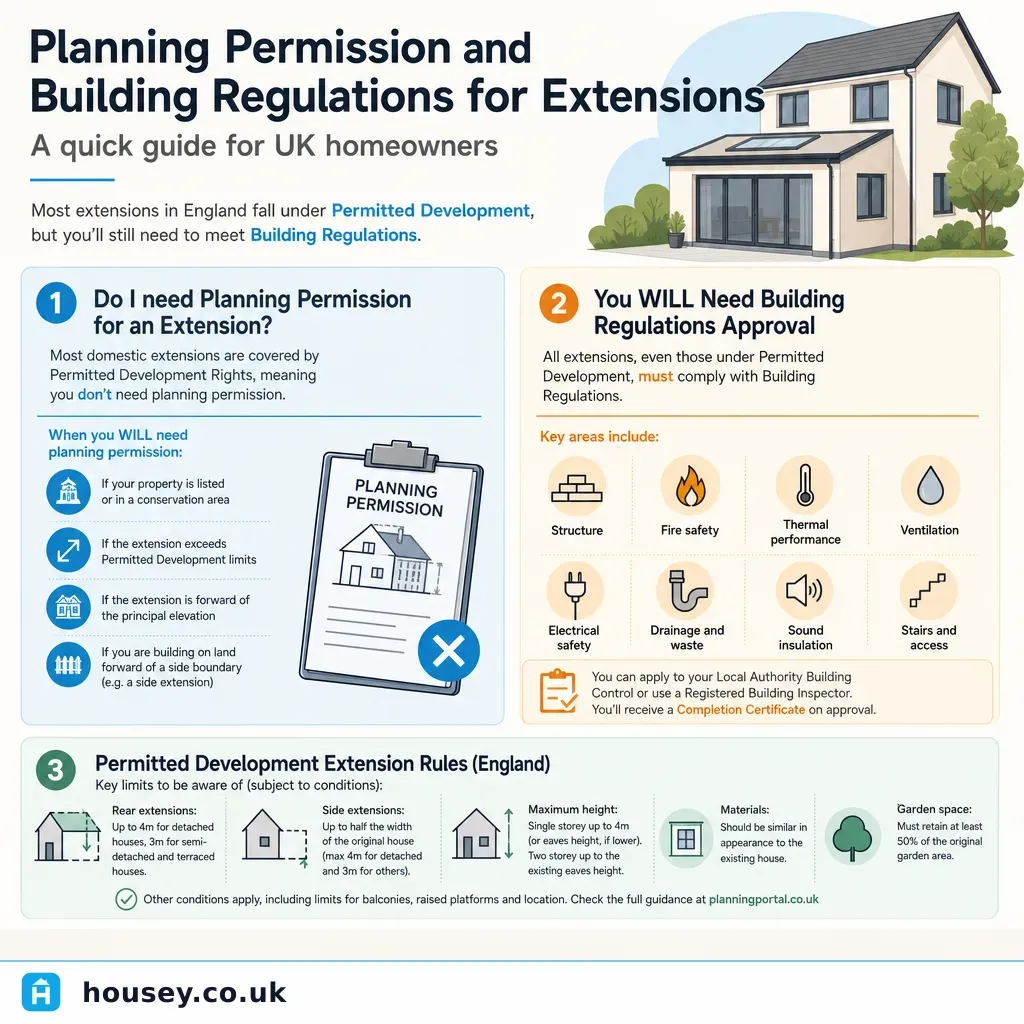
Planning Permission and Building Regulations for Extensions
UK home extensions usually require both planning permission and Building Regulations approval, though most smaller rear extensions qualify as Permitted Development under the GPDO 2015 and need no planning application.
 Planning & Pre-Build
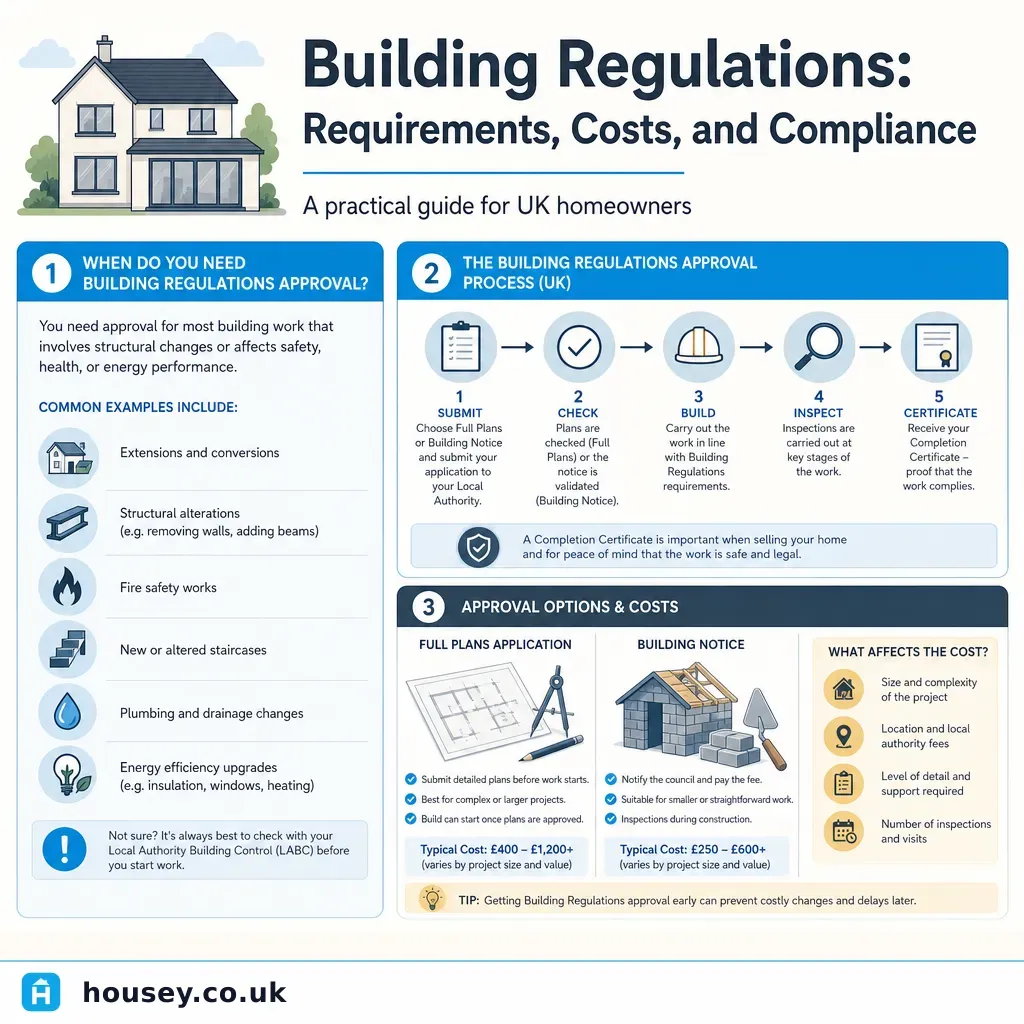
Building Regulations: Requirements, Costs, and Compliance
Building regulations set minimum standards for how construction work is carried out in the UK, covering structural stability, fire safety, energy efficiency, and ventilation.
 Planning & Pre-Build
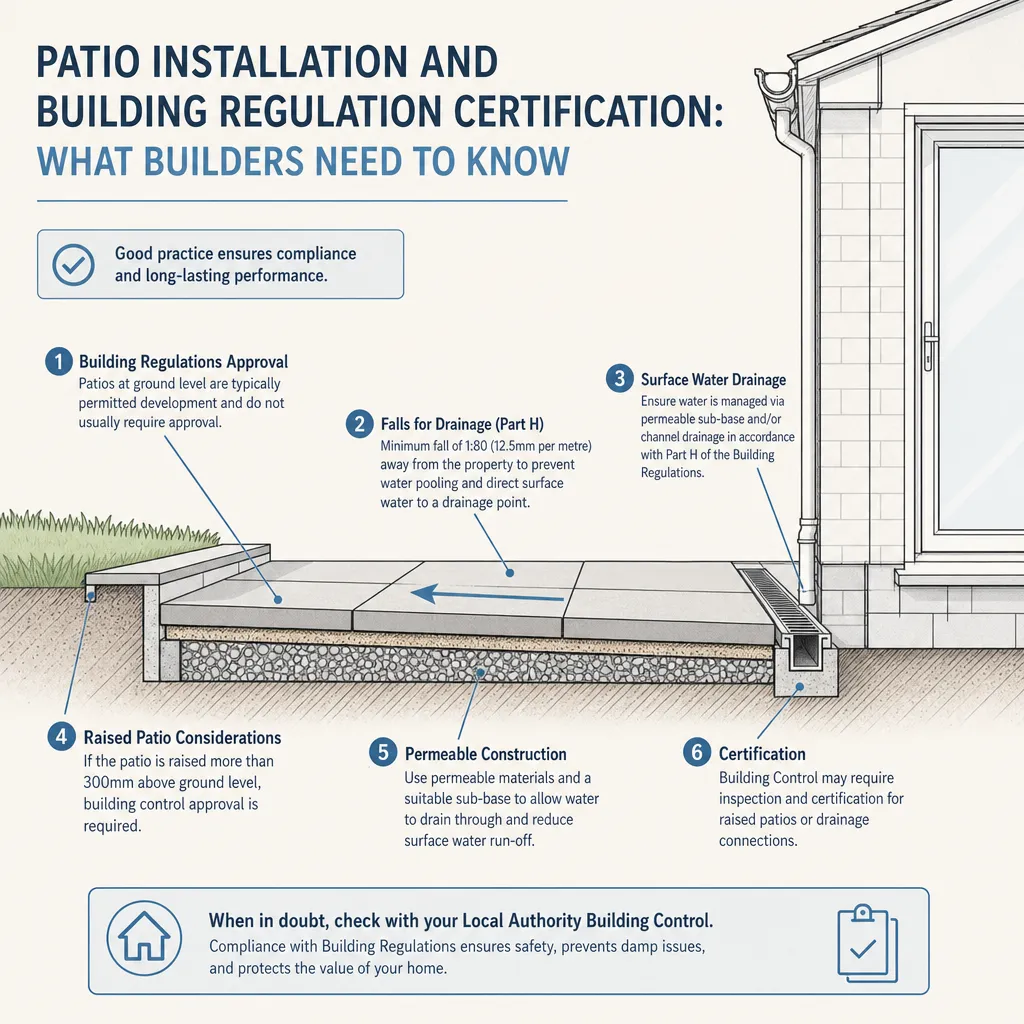
Patio Installation and Building Regulation Certification: What Builders Need to Know
Most ground-level patios in England do not require building regulations approval.
 Planning & Pre-Build
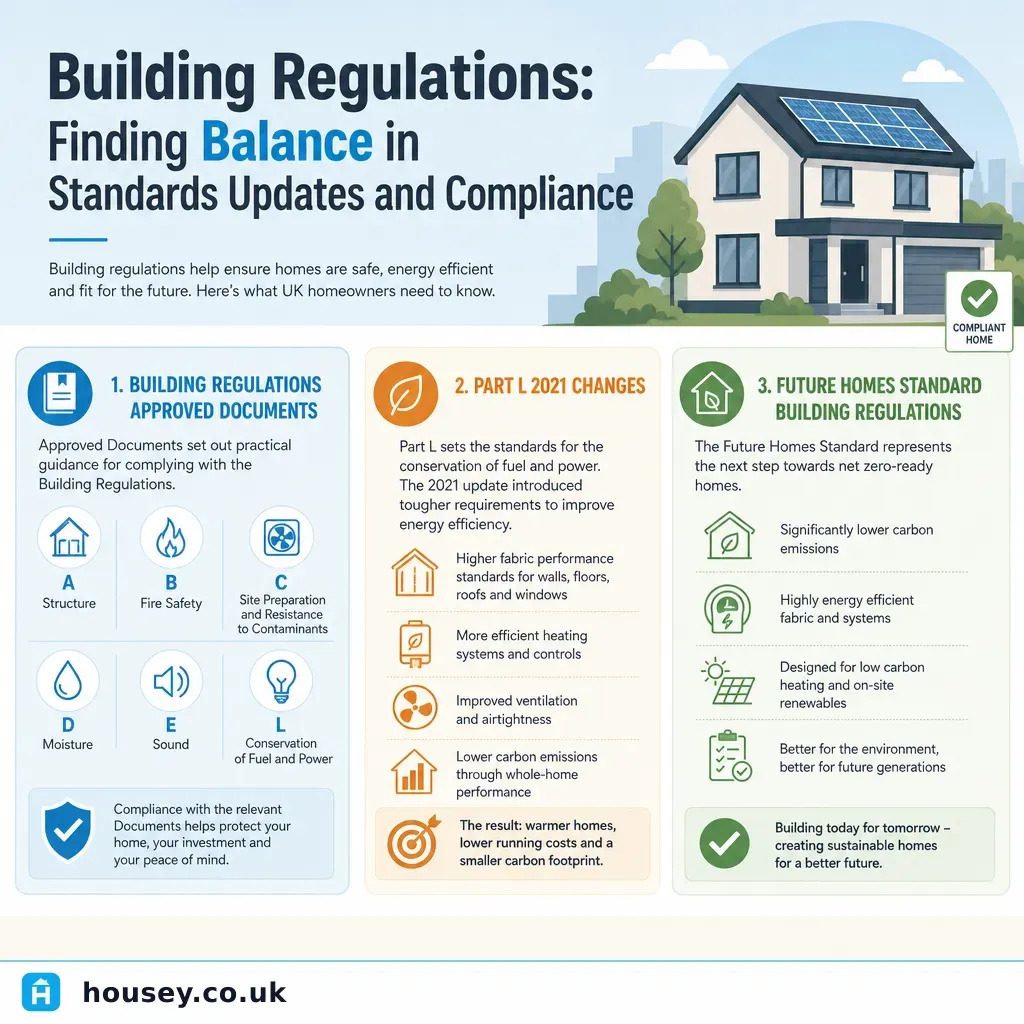
Building Regulations: Finding Balance in Standards Updates and Compliance
Building regulations in England and Wales set minimum standards for construction, covering structure, fire safety, energy efficiency, and ventilation.
 Planning & Pre-Build
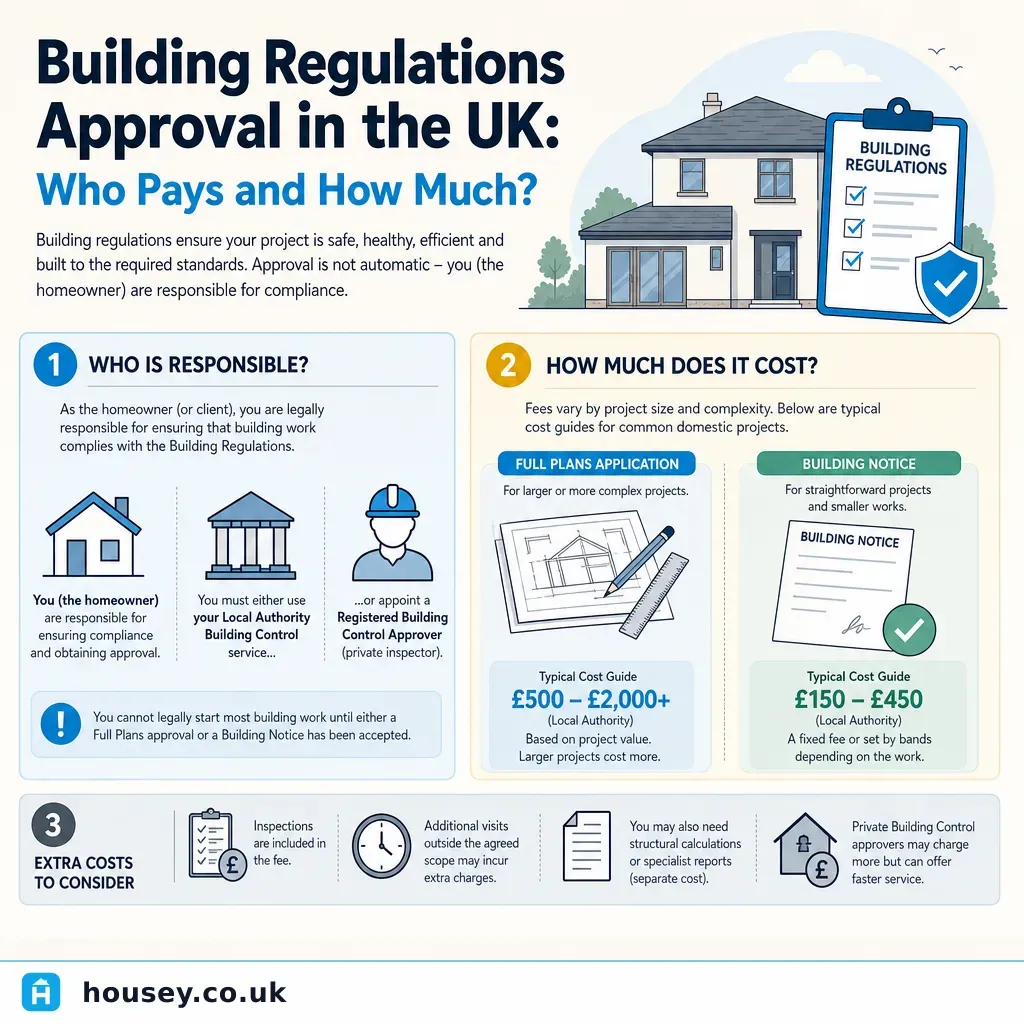
Building Regulations Approval in the UK: Who Pays and How Much?
Building regulations approval fees are almost always paid by the homeowner or the person commissioning the work, not the contractor.