Building Resilience: How Construction Practices Are Adapting to Climate Challenges
By Housey · Last reviewed 24th of May 2026
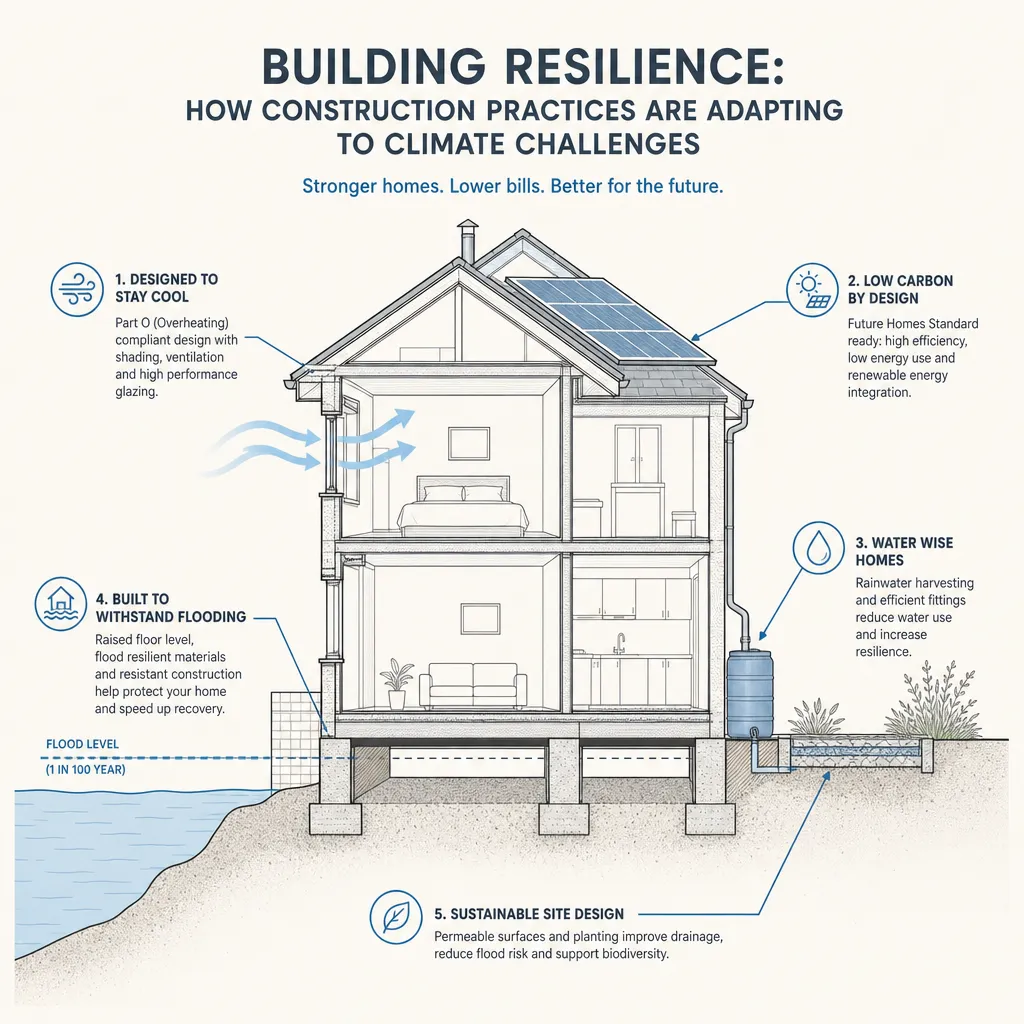
Building Resilience: How Construction Practices Are Adapting to Climate Challenges
The physical risks that UK homes face from a changing climate — more intense rainfall, prolonged summer heat, and increasingly severe storms — are now embedded in Building Regulations and planning policy, not merely in environmental commentary. For anyone planning a self-build, significant extension, or whole-house renovation, understanding how construction practice is evolving in response to these risks is part of responsible project planning, not an optional extra.
Key points
- Part O of the Building Regulations (England), in force since June 2022, sets legally binding limits on overheating risk in new dwellings and specifies two compliance routes: a simplified method based on glazing percentage and shading, and dynamic thermal modelling for complex or glazing-heavy designs.
- The Future Homes Standard aims to require new homes to produce 75–80% less carbon than homes built under previous regulations; the planned implementation was around 2025 but remains subject to government review — check GOV.UK for current status.
- CIRIA's Property Flood Resilience (PFR) Code of Practice (2021) is the authoritative UK technical guide covering both flood-resistance (keeping water out) and flood-resilience (minimising damage if water enters) approaches and materials specifications.
- Sustainable Urban Drainage Systems (SuDS) are a planning requirement for most new-build developments in England, and have been mandatory in Wales since January 2019 under Schedule 3 of the Flood and Water Management Act 2010.
- Around 5.2 million properties in England are in flood-risk areas according to the Environment Agency; properties in Flood Zones 2 and 3 face additional planning requirements, including a sequential test before development can proceed.
What climate risks matter most for UK buildings?
Overheating is increasingly significant for new and recently built homes. Urban heat island effects, combined with more frequent and prolonged warm spells, mean thermally lightweight buildings — particularly those with large south- or west-facing glazing — can become uncomfortably hot in summer without mechanical cooling. Part O addresses this through maximum permissible solar gain thresholds, requiring designers to consider glazing orientation, size, external shading, thermal mass, and night-time ventilation from the earliest design stage.
Flooding remains the most widespread climate hazard for UK residential property. Surface-water flooding from overwhelmed drains and run-off affects a wide range of property types well beyond formal river flood zones. For planning applications in Flood Zone 2 or 3, a sequential test — and in some cases an exceptions test — is required under the National Planning Policy Framework (NPPF) before development can be approved. Even outside formal flood zones, surface-water risk is worth checking via the Environment Agency's Flood Map for Planning before purchasing or committing to a site.
Driving rain, wind, and moisture remain persistent challenges, particularly for older solid-wall properties and exposed sites in western or upland regions. Approved Document C (Site preparation and resistance to contaminants and moisture) sets baseline weather-resistance requirements, covering cavity wall construction, wall tie specification, and render detailing.
Practical adaptive design strategies
Strategy | Climate risk addressed | When it applies |
|---|---|---|
High thermal mass (concrete, brick, or stone structure) | Overheating | New builds and extensions with significant south- or west-facing glazing |
External shading (brise-soleil, deep window reveals, overhangs) | Overheating | High-glazing contemporary designs |
Flood-resilient fitout (raised electrics, water-resistant finishes, non-return valves) | Flooding | Properties in Flood Zone 2 or 3, or with surface-water risk |
Permeable paving, green roofs, and rain gardens | Surface-water flooding | Any property with substantial hard-standing or roof drainage concerns |
Insulated concrete formwork (ICF) or closed-panel timber frame | Overheating and heat loss | Self-builds prioritising fabric-first efficiency |
Enhanced weatherproofing and cavity drainage membranes | Driving rain and damp | Exposed coastal, upland, or solid-wall properties |
Which regulations and standards apply?
Several regulatory and technical documents set baseline requirements that building control bodies check for compliance:
- Approved Document O (Overheating, 2022, England): sets compliance thresholds for new dwellings. Scotland and Wales have separate provisions under their respective national building standards.
- Approved Document L (Conservation of fuel and power, 2021 update): sets U-value and air-permeability targets. The 2021 uplift significantly tightened these as an interim step ahead of the Future Homes Standard.
- Approved Document C (Site preparation and resistance to contaminants and moisture): covers weather resistance, ground moisture, and site drainage.
- NPPF Planning Practice Guidance — Flood Risk and Coastal Change: governs how flood risk is addressed in planning applications in England.
- PAS 2035 (Retrofitting dwellings for energy efficiency): the publicly available specification applicable where energy-efficiency upgrades are carried out alongside climate-adaptive measures in existing homes.
Which approach should your project take?
- New build in any flood zone → appoint a flood-risk consultant and check planning requirements with your local planning authority (LPA) before the design stage.
- Extension with significant south- or west-facing glazing → check Part O compliance using the simplified method early in design; commission dynamic thermal modelling if the simplified method is not met.
- Renovation of a solid-wall pre-1919 property → commission a whole-house energy and moisture strategy under PAS 2035 before specifying internal or external insulation.
- Any project increasing hard-standing or roof drainage area → discuss SuDS requirements with building control and your LPA before submitting a planning application.
- Listed building or conservation area → additional planning constraints apply; work with a heritage-aware energy consultant to balance climate measures against conservation requirements.
- Uncertain about your specific project → ask a building control consultant to review the proposal at feasibility stage, before significant design costs have been incurred.
When to get professional help
Climate-adaptive construction involves regulatory, structural, and environmental factors that interact in ways that are difficult to assess without specialist knowledge. Seek professional input when:
- Your site is in or near a flood zone — check the Environment Agency Flood Map for Planning before design begins.
- Your project involves significant glazing where Part O compliance needs to be formally demonstrated.
- You are planning deep energy retrofit alongside structural or building-envelope changes, where moisture and ventilation risks require careful assessment.
- The property is listed or in a conservation area, where climate measures must be balanced against heritage requirements.
- Your project involves a green roof, rain garden, or permeable drainage system that benefits from engineering input.
How Housey can help
For most extensions, structural changes, and new builds, building control approval is a legal requirement. Working with an experienced building control consultant from the earliest design stage helps ensure that climate-adaptive strategies are developed in line with the relevant Approved Document requirements, rather than identified as a compliance problem after detailed design is complete. Housey can connect you with qualified professionals in your area.
Frequently asked questions
Does Part O apply to extensions as well as new builds?
Part O currently applies to new dwellings and residential buildings undergoing a material change of use in England. Extensions to existing homes are not subject to Part O compliance in most cases, though large south- or west-facing glazed additions may still need to demonstrate Part L compliance. Check with your building control body for your specific project.
What is the difference between flood resistance and flood resilience?
Flood resistance aims to keep water out using barriers, raised thresholds, and sealed structures — appropriate where flood depths are likely to remain below around 0.3–0.6 metres. Flood resilience accepts that water may enter but limits damage through water-resistant materials, raised electrical installations, and layout design. CIRIA's Property Flood Resilience Code of Practice covers both approaches in detail.
Is the Future Homes Standard already in force?
Not in its final form. A significant interim uplift to Part L and Part F came into force in 2021. The full Future Homes Standard — targeting 75–80% lower carbon emissions for new homes — was planned for implementation around 2025, but the precise timeline remains subject to government review. Check GOV.UK for the latest status before designing a new build.
Do SuDS requirements apply to small residential extensions?
In England, the Schedule 3 SuDS planning requirement applies to new developments, but its application to small householder extensions varies by local planning authority. In Wales, Schedule 3 has been in force since January 2019 for all new developments with drainage implications. Confirm requirements with your local planning authority before submitting a planning application.
Sources and further reading
- Approved Document O: Overheating — HM Government
- Future Homes and Buildings Standards: 2023 consultation — Department for Energy Security and Net Zero
- Property Flood Resilience Code of Practice — CIRIA
- Approved Document L: Conservation of fuel and power — HM Government
- Flood Map for Planning — Environment Agency
Useful next reads
 Planning & Pre-Build
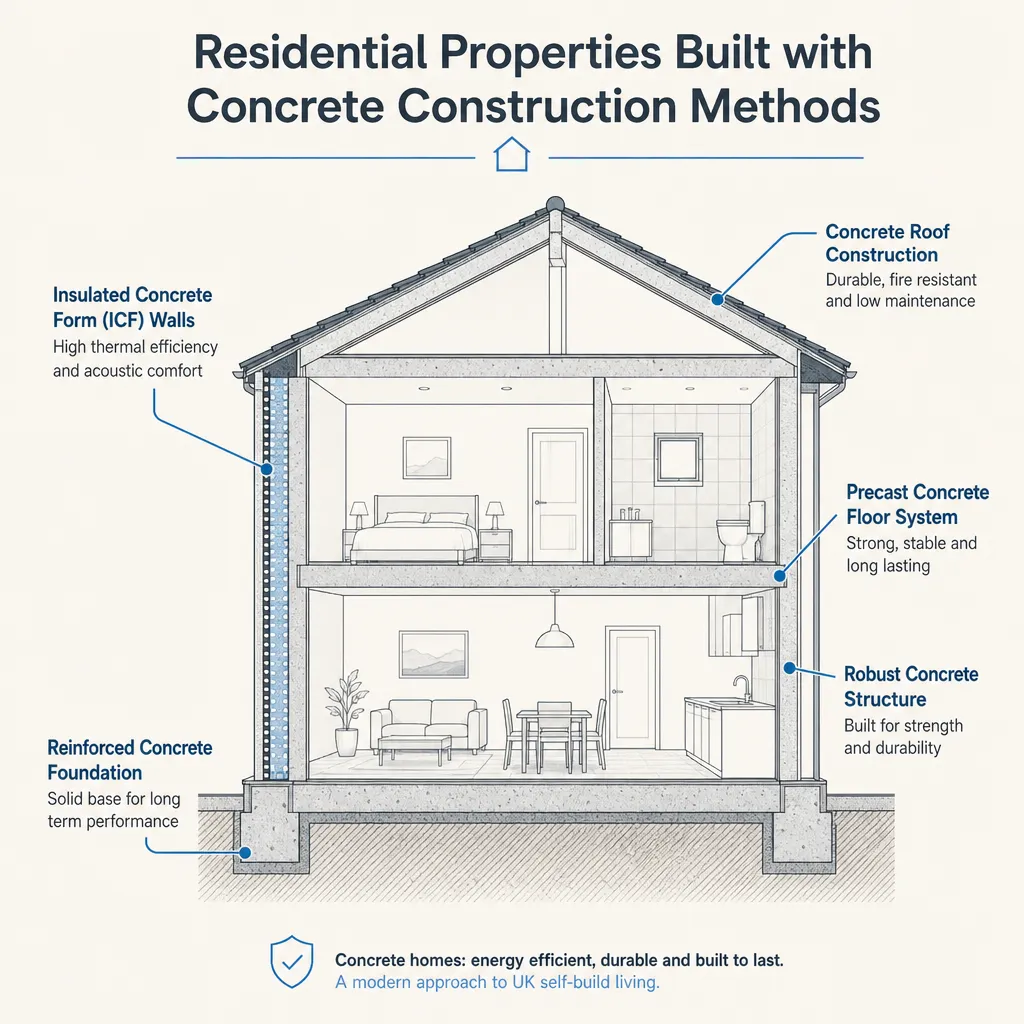
Residential Properties Built with Concrete Construction Methods
UK homes are built using several concrete methods: in-situ cast concrete, precast panel systems, insulating concrete formwork (ICF), and older non-traditional types such as Wimpey No-Fines and Laing Easiform.
 Planning & Pre-Build
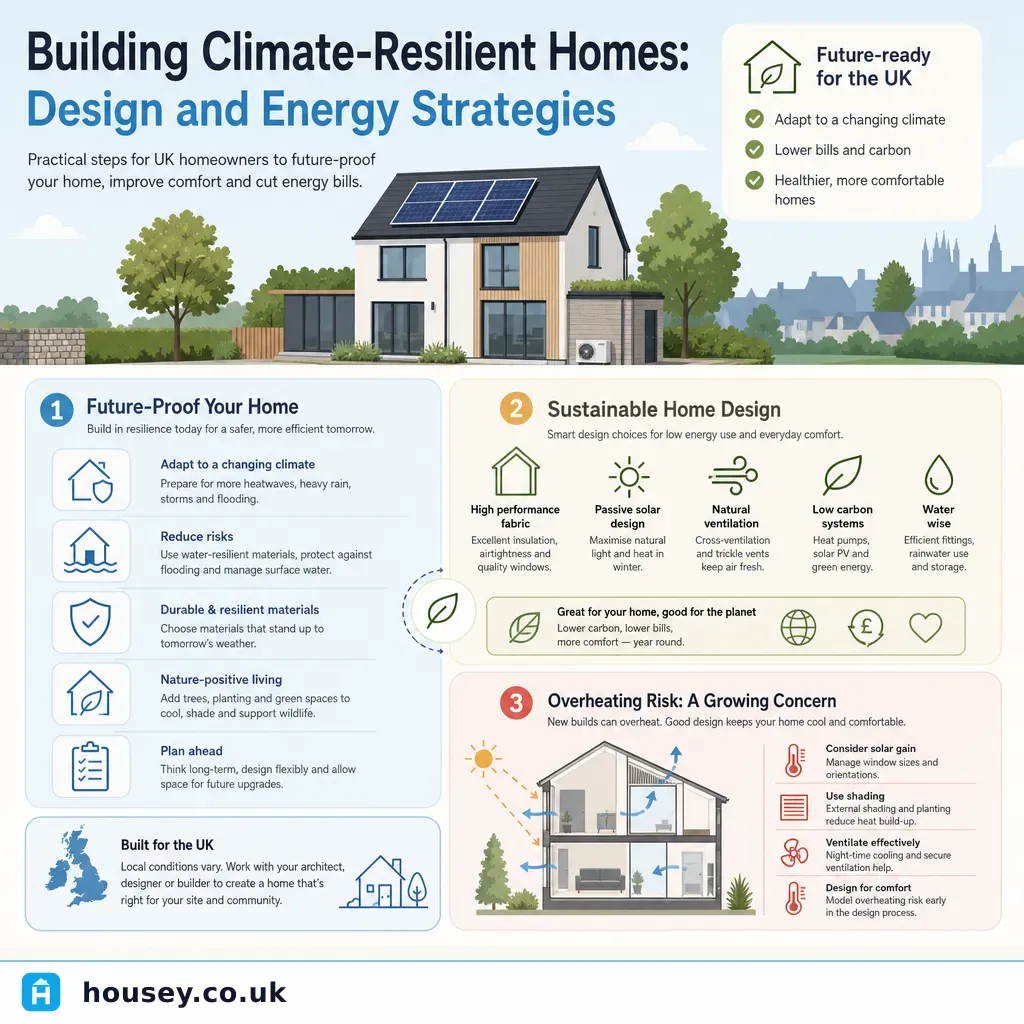
Building Climate-Resilient Homes: Design and Energy Strategies
A climate-resilient UK home handles hotter summers, wetter winters, and rising energy costs through high-performance insulation, overheating mitigation, flood-resilient construction, low-carbon heating, and good water management.
 Planning & Pre-Build
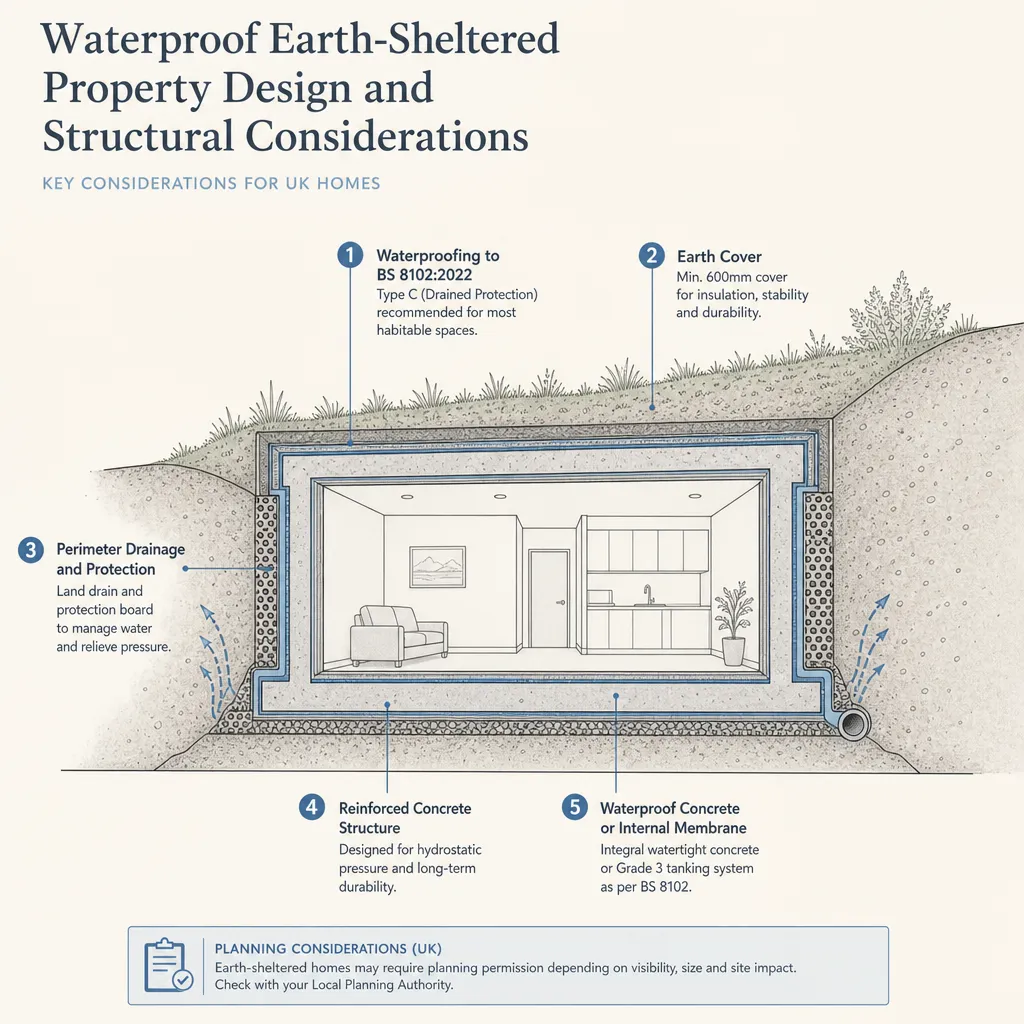
Waterproof Earth-Sheltered Property Design and Structural Considerations
Earth-sheltered homes in the UK require specialist structural design to manage lateral soil pressure and hydrostatic loads, along with a waterproofing strategy compliant with BS 8102:2022.
 Planning & Pre-Build
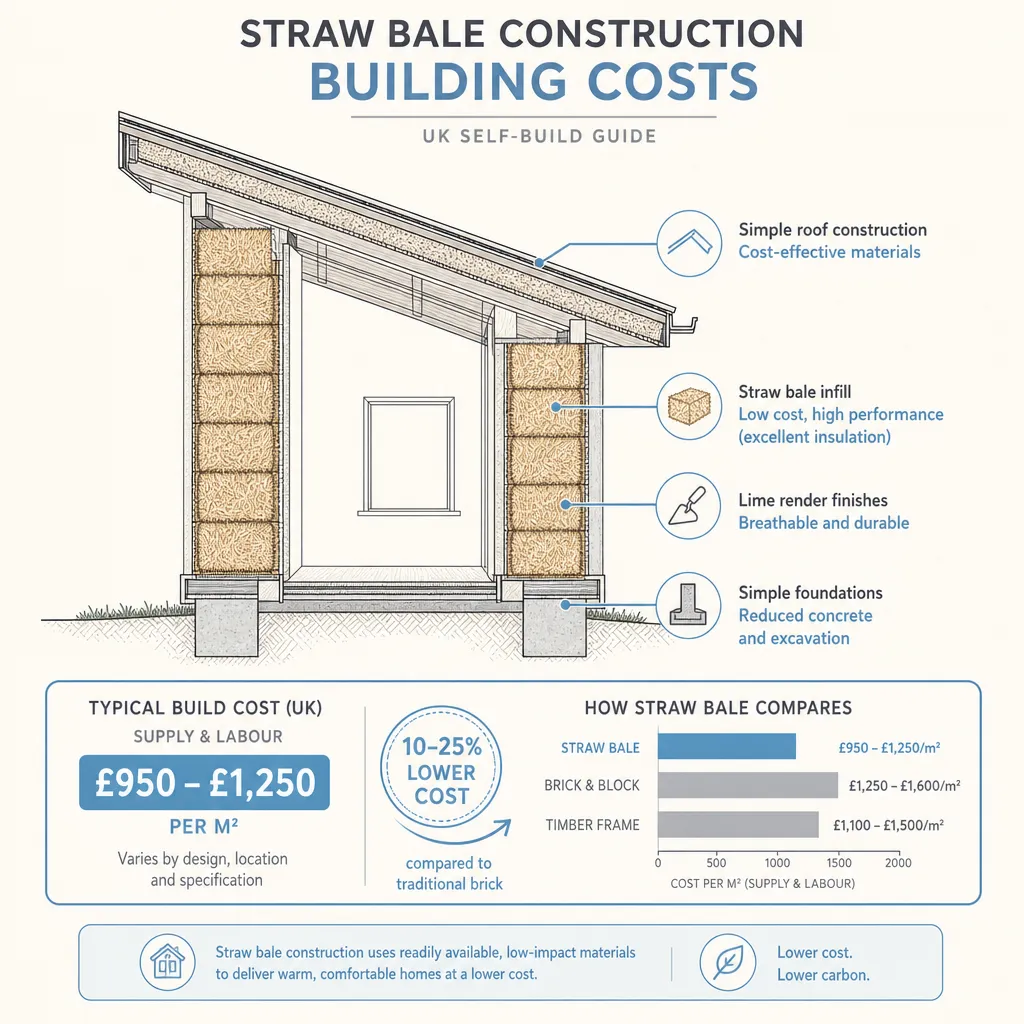
Straw Bale Construction Building Costs
Straw bale construction in the UK typically costs £1,500–£2,500 per square metre for a fully contracted self-build, though costs vary by design, render specification, and contractor experience.
 Planning & Pre-Build
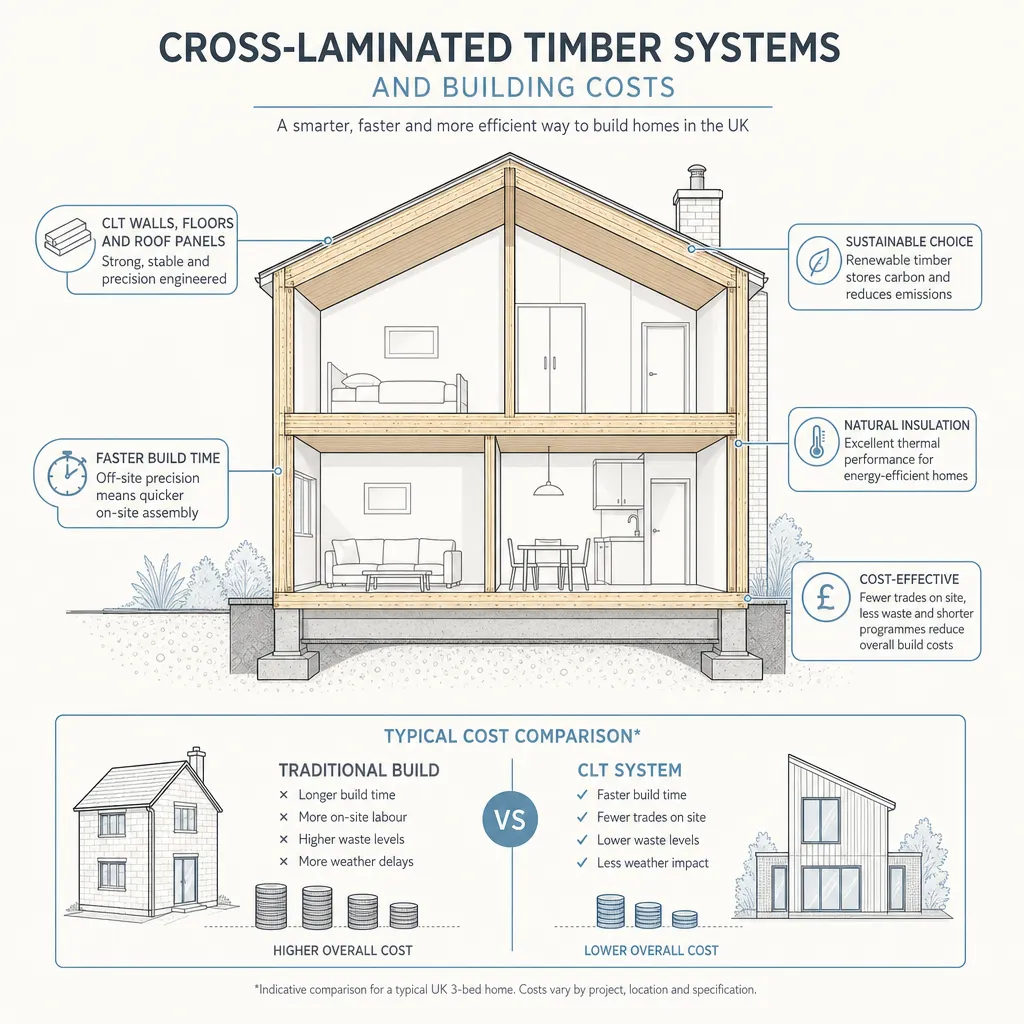
Cross-Laminated Timber Systems and Building Costs
Cross-laminated timber (CLT) panels for UK residential projects typically cost £150–£350 per m² for panel supply, with total build costs ranging from £1,800 to £3,000 per m² GIA including structure, envelope, and fit-out.