Waterproof Earth-Sheltered Property Design and Structural Considerations
By Housey · Last reviewed 24th of May 2026
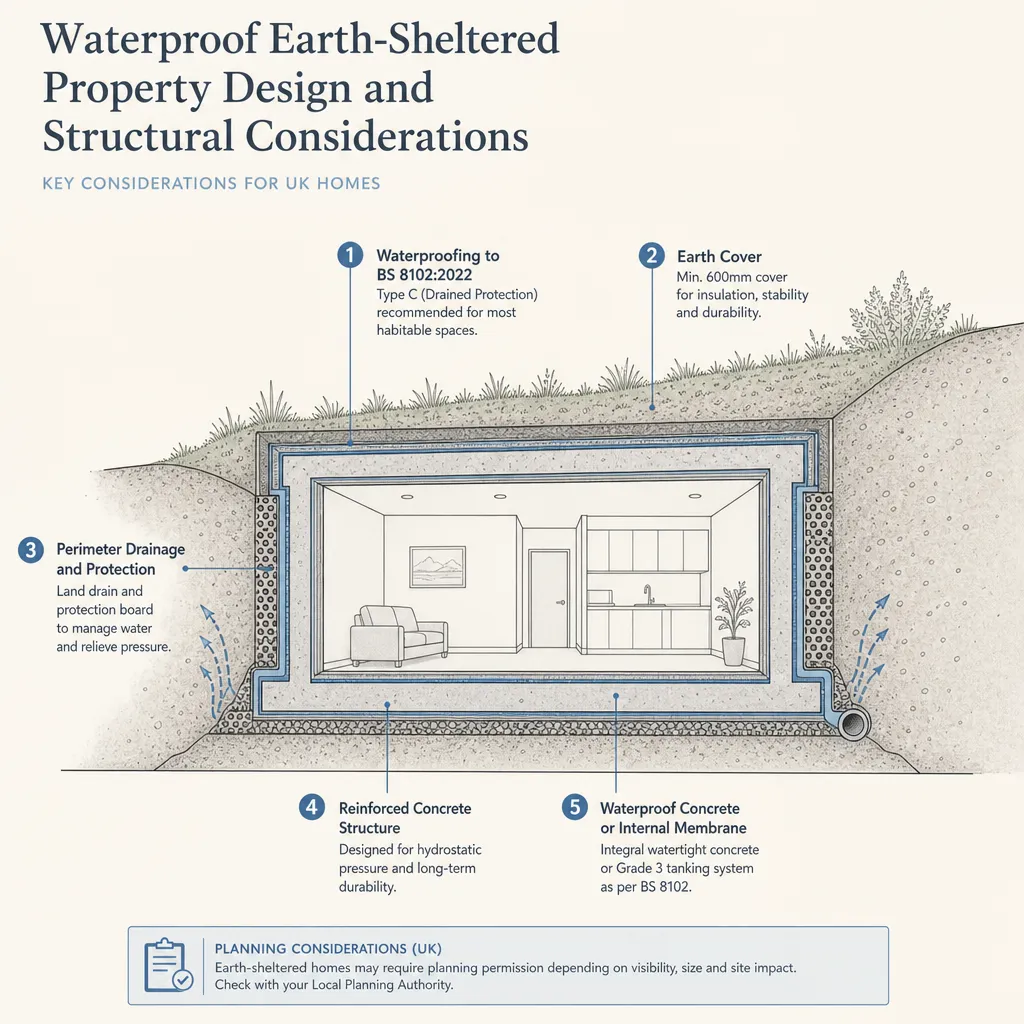
Waterproof Earth-Sheltered Property Design and Structural Considerations
Earth-sheltered homes — where part or all of the building is built into or covered by ground — occupy a distinctive corner of UK self-build and sustainable architecture. They appeal because of their thermal mass, reduced visual impact on the landscape, and potential for planning consent in sensitive green belt or Area of Outstanding Natural Beauty (AONB) locations where a conventional dwelling would face refusal. The design challenges are considerable, however: waterproofing, lateral earth pressure, drainage, ventilation, and building control compliance all demand specialist expertise from the earliest stages.
Key points
- BS 8102:2022 (Code of practice for protection of below-ground structures against water ingress) classifies waterproofing into Type A (barrier/tanking), Type B (structurally integral concrete), and Type C (drained cavity) — most earth-sheltered residential projects combine at least two types to achieve the required redundancy.
- A habitable earth-sheltered dwelling requires Grade 3 waterproofing protection as a minimum under BS 8102:2022, meaning no water penetration under any circumstances — this rules out relying on a single membrane type alone.
- Planning permission is always required; earth-sheltered homes do not fall within householder permitted development rights, and green belt, AONB, and National Park locations impose additional policy constraints that must be addressed in the application.
- Lateral soil pressure on retaining walls is governed by Eurocode 7 (BS EN 1997); design must be carried out by a chartered structural or geotechnical engineer — standard house structural details cannot be applied to below-ground construction.
- Building Regulations Part F (ventilation) typically requires mechanical ventilation with heat recovery (MVHR) for habitable below-ground spaces, because natural stack ventilation does not function reliably in earth-sheltered conditions.
What is an earth-sheltered home?
Earth-sheltered construction covers two main approaches in UK residential self-build. In cut-and-cover construction, the building is assembled in a prepared excavation and backfilled over the roof. In earth-bermed construction, the building sits at or above ground level but soil is banked against one or more elevations. Green roofs — where a shallow growing medium is laid on a conventional roof structure — are a lighter variant and are not usually classed as earth-sheltered for structural or planning purposes.
Waterproofing strategy: the BS 8102 types explained
Type | Method | Common application | Key risk if poorly specified |
|---|---|---|---|
Type A — Barrier | Membranes, renders, crystalline coatings applied to the structure | Used as part of a combined strategy; rarely sufficient alone | Membrane puncture during backfill; no self-healing capacity |
Type B — Structurally integral | Designed waterproof concrete (WPC) with controlled crack widths and mix design | Main structure of cut-and-cover buildings | Requires quality control from mix design through pour; relies on construction accuracy |
Type C — Drained cavity | Cavity drain membrane with sump pump and drainage collection | Internal face of retaining walls; secondary protection layer | Sump pump failure; requires ongoing maintenance access and mains power |
BS 8102:2022 strongly recommends combining types for redundancy. A habitable dwelling needs Grade 3 protection — no water penetration under any circumstances. Your structural engineer and a specialist waterproofing consultant should specify the strategy together. Look for consultants who hold British Board of Agrément (BBA) Certificate accreditation or who are members of the Property Care Association's structural waterproofing section.
Structural design considerations
Earth-sheltered buildings carry loads that are unfamiliar to designers used to conventional housing:
- Lateral soil pressure: retaining walls must resist horizontal thrust from the retained soil mass. Pressure increases with retained height, soil density, and water content — saturated clay at 2 m retained height produces substantially greater pressure than the same height of well-drained granular fill.
- Hydrostatic pressure: if the water table rises seasonally to or above floor level, the structure must also resist buoyancy. Anti-flotation design — ground anchors, tension piles, or additional mass concrete — may be required.
- Surcharge loading: any vehicle access, planting, or future outbuildings positioned over the roof structure must be included in the design loading from the outset.
- Differential settlement: earth-sheltered buildings often sit on raft or piled foundations due to variable soil conditions. Settlement must be considered in the waterproofing joint and movement joint design.
Eurocode 7 (Geotechnical Design, BS EN 1997) and Eurocode 2 (Concrete Structures, BS EN 1992) govern this work in the UK. All structural design must be completed by a chartered structural engineer (MIStructE or CEng) and approved under Building Regulations.
Planning considerations
Most earth-sheltered homes require full planning permission as a new dwelling. Key factors include:
Green belt: earth-sheltered homes are not automatically permitted in green belt. The fact that a building has a low visual profile does not make it appropriate development — you must demonstrate either that it falls outside the definition of inappropriate development or make an exceptional circumstances case.
AONB and National Parks: the relevant authority (National Park Authority or local planning authority) will apply heightened landscape policy weight. Impact on the setting, drainage, and surface hydrology all receive scrutiny.
Construction traffic: heavily excavated projects generate significant construction vehicle movements. A Construction Method Statement is often required as a planning condition or pre-condition of determination.
A pre-application consultation with the local planning authority is strongly recommended before committing to detailed design — earth-sheltered projects are unusual enough that early engagement identifies policy hurdles before significant design fees are incurred.
Which professionals do you need?
- Always appoint a chartered structural engineer (MIStructE or CEng) — lateral soil pressure and hydrostatic load calculations cannot be carried out by a general contractor or standard house designer.
- Always commission a geotechnical investigation before structural design begins — soil conditions and groundwater levels govern the foundation type, waterproofing specification, and anti-flotation strategy.
- Appoint a specialist waterproofing consultant if your structural engineer does not hold specific BS 8102 design experience — look for Property Care Association members or BBA-certified contractors.
- Instruct an architect with demonstrable below-ground residential experience — drained cavity system design, MVHR integration, and thermal bridging at wall-to-roof junctions require specialist knowledge.
- Appoint an ecology consultant if the site has hedgerows, trees, or undisturbed ground — protected species surveys are routinely required before a planning application can be determined.
- Instruct a planning consultant before submission if the site is in green belt, AONB, or a National Park.
- Check with the local planning authority at pre-application stage in all cases — early engagement is particularly valuable for unusual building types.
Important limitations
This article is general guidance only. Earth-sheltered design is a specialist field where the correct approach depends entirely on site-specific soil conditions, groundwater levels, climate exposure, local planning policy, and individual structural calculations. No design decisions should be made on the basis of this article alone. Listed building consent law and planning enforcement are serious matters. Always appoint qualified professionals before committing to any scheme or purchasing a site specifically for earth-sheltered development.
What to ask a qualified professional
Before appointing a structural engineer or waterproofing consultant, ask:
- Have you designed earth-sheltered or fully below-ground habitable structures before? Can you provide project references?
- At what stage should the geotechnical investigation be commissioned, and what parameters — bearing capacity, groundwater level, permeability, soil classification — does it need to establish for your design?
- Which combination of BS 8102 waterproofing types do you recommend for this site, and what redundancy does the strategy provide if one layer is compromised?
- How will seasonal groundwater fluctuation affect the design, and is anti-flotation detailing required?
- What are the Building Regulations submission requirements for this structure, and will building control request a third-party structural check?
- What are the ongoing maintenance obligations for the waterproofing and drainage system?
When to get professional help
If you are seriously considering an earth-sheltered home, professional involvement is not optional — it should begin before any design work is commissioned. Appoint a geotechnical engineer before any soil-specific design decisions are taken, and a structural engineer before scheme drawings are finalised. Do not apply standard house-type structural details to any below-grade element. If you are purchasing land for this purpose, commission a preliminary geotechnical appraisal before exchange of contracts.
How Housey can help
Housey connects self-builders and developers with qualified structural engineering services and geotechnical and soil investigation specialists experienced in complex below-ground projects. You can also find professionals who prepare building regulations drawings for submission to building control on technically demanding schemes.
Frequently asked questions
Do earth-sheltered homes need planning permission in the UK?
Yes. Earth-sheltered homes constitute new dwellings and always require full planning permission regardless of how little of the building is visible above ground. They do not benefit from householder permitted development rights. Sites in green belt, AONB, or National Parks face additional policy constraints, and a pre-application consultation with the local planning authority is strongly recommended before committing to detailed design.
How much does it cost to build an earth-sheltered home in the UK?
Earth-sheltered construction typically costs more per square metre than a conventional timber-frame or masonry house due to reinforced concrete structure, specialist waterproofing, and extensive groundwork. Indicative figures of £2,500–£4,000 per square metre (gross internal area) are sometimes cited for UK self-build projects, but costs vary enormously by site conditions and specification. Always obtain detailed contractor quotes. Indicative UK costs, last reviewed 2026-05-24.
What Building Regulations apply to earth-sheltered homes?
Building Regulations apply in full. The most relevant parts are Part A (structural stability, including retaining walls and roof loads), Part C (resistance to moisture and waterproofing), Part F (ventilation — MVHR is typically required for habitable below-ground spaces), and Part L (conservation of fuel and power — thermal performance of roof and walls). Building control approval is mandatory before any work begins.
Are earth-sheltered homes energy efficient?
Earth-sheltered homes can achieve very low heating demand because the surrounding soil acts as a thermal buffer, moderating temperature swings and reducing heat loss. Well-designed examples can meet Passivhaus standards. Cooling and ventilation require careful design, however — overheating risk in summer and condensation risk in winter must both be managed through MVHR, thermal modelling, and appropriate insulation specification.
Sources and further reading
- BS 8102:2022 — Code of practice for protection of below-ground structures against water from the ground — BSI Group
- Eurocode 7: Geotechnical Design (BS EN 1997) — BSI Group
- Planning Practice Guidance — Green Belt — GOV.UK
- Building Regulations Approved Documents — GOV.UK
- Property Care Association — Structural waterproofing guidance — Property Care Association
Useful next reads
 Planning & Pre-Build
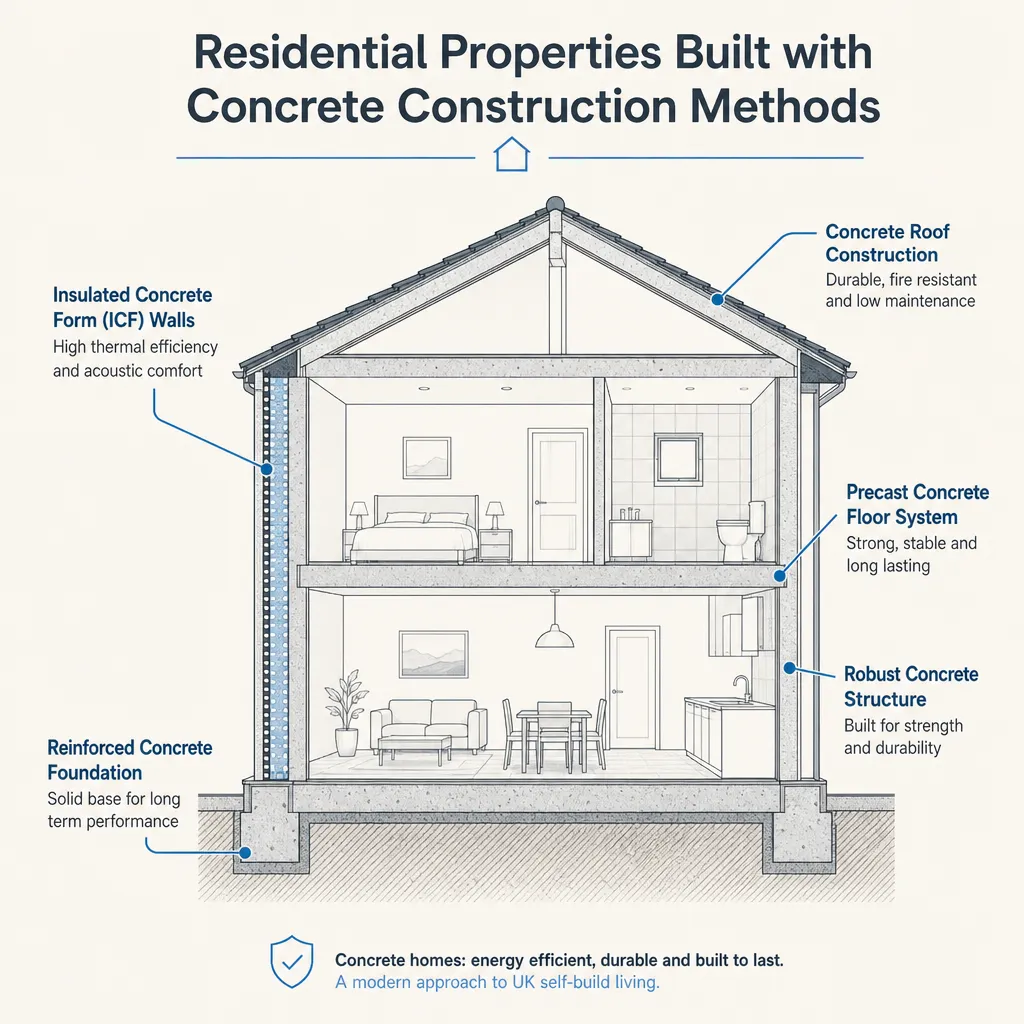
Residential Properties Built with Concrete Construction Methods
UK homes are built using several concrete methods: in-situ cast concrete, precast panel systems, insulating concrete formwork (ICF), and older non-traditional types such as Wimpey No-Fines and Laing Easiform.
 Planning & Pre-Build
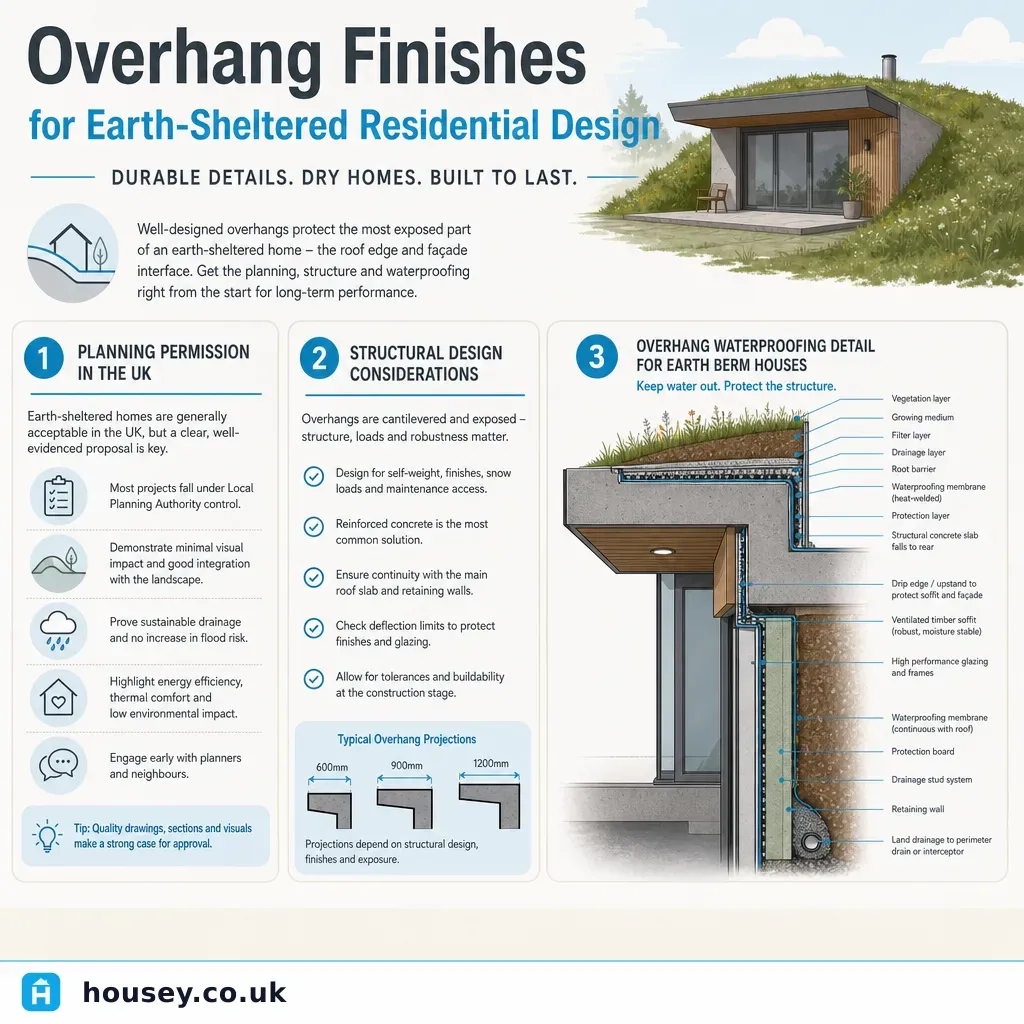
Overhang Finishes for Earth-Sheltered Residential Design
Overhang design in earth-sheltered homes combines structural, waterproofing, thermal, and planning requirements that must be integrated from the earliest design stage.
 Planning & Pre-Build
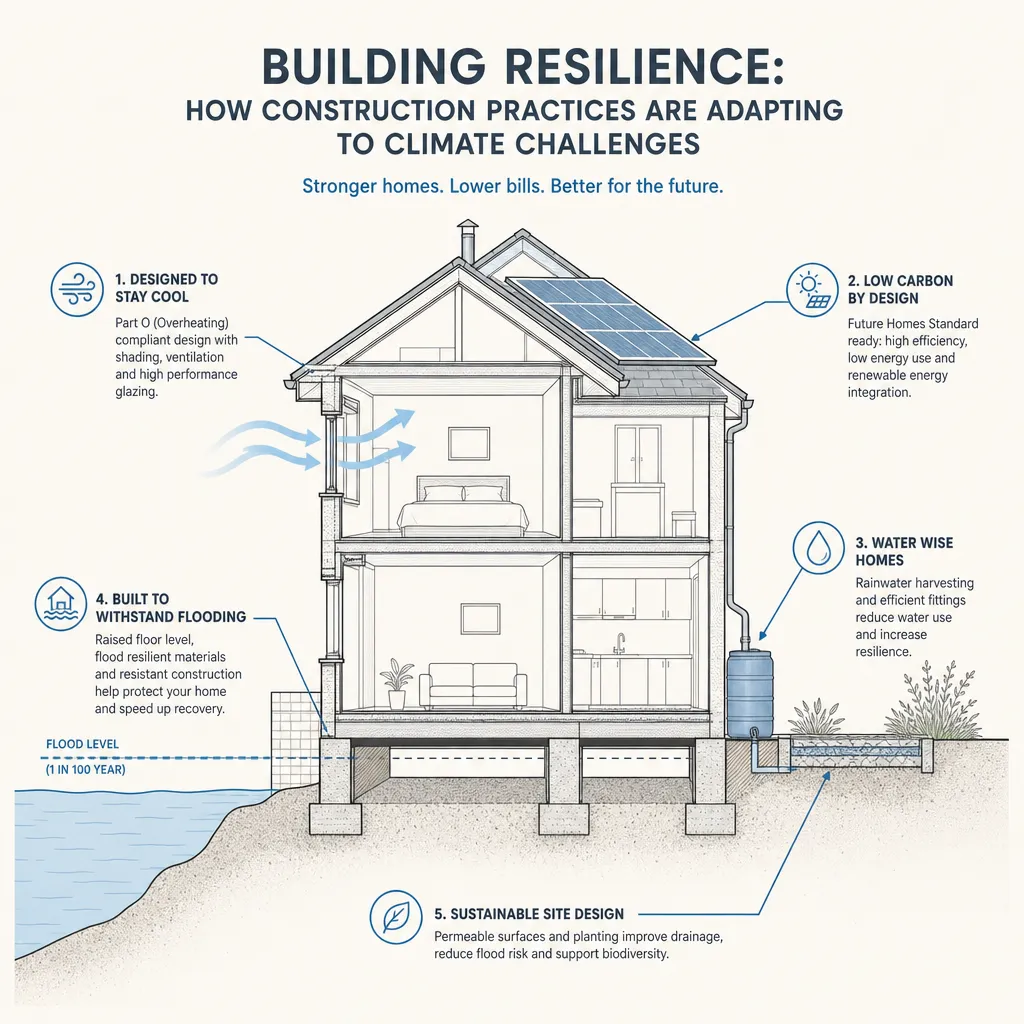
Building Resilience: How Construction Practices Are Adapting to Climate Challenges
UK construction is adapting to climate change through updated Building Regulations.
 Planning & Pre-Build
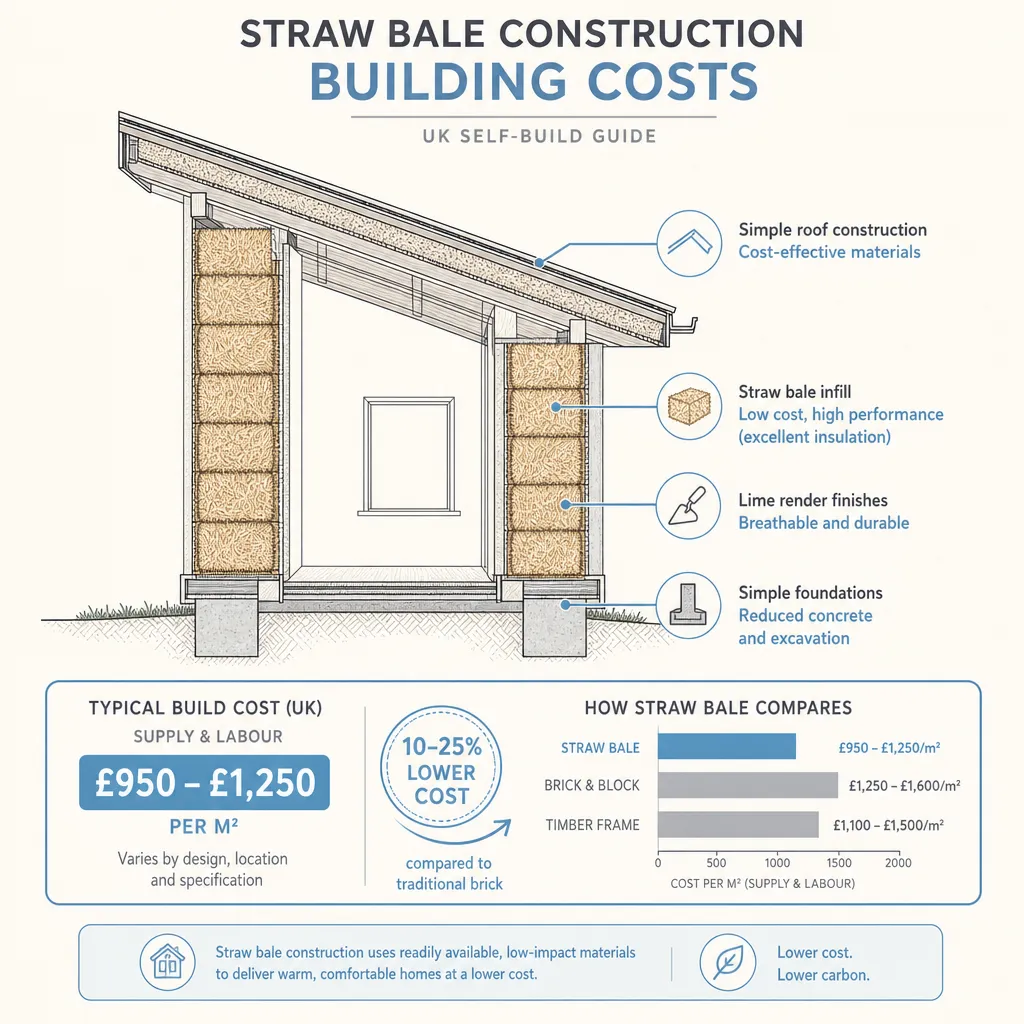
Straw Bale Construction Building Costs
Straw bale construction in the UK typically costs £1,500–£2,500 per square metre for a fully contracted self-build, though costs vary by design, render specification, and contractor experience.
 Planning & Pre-Build
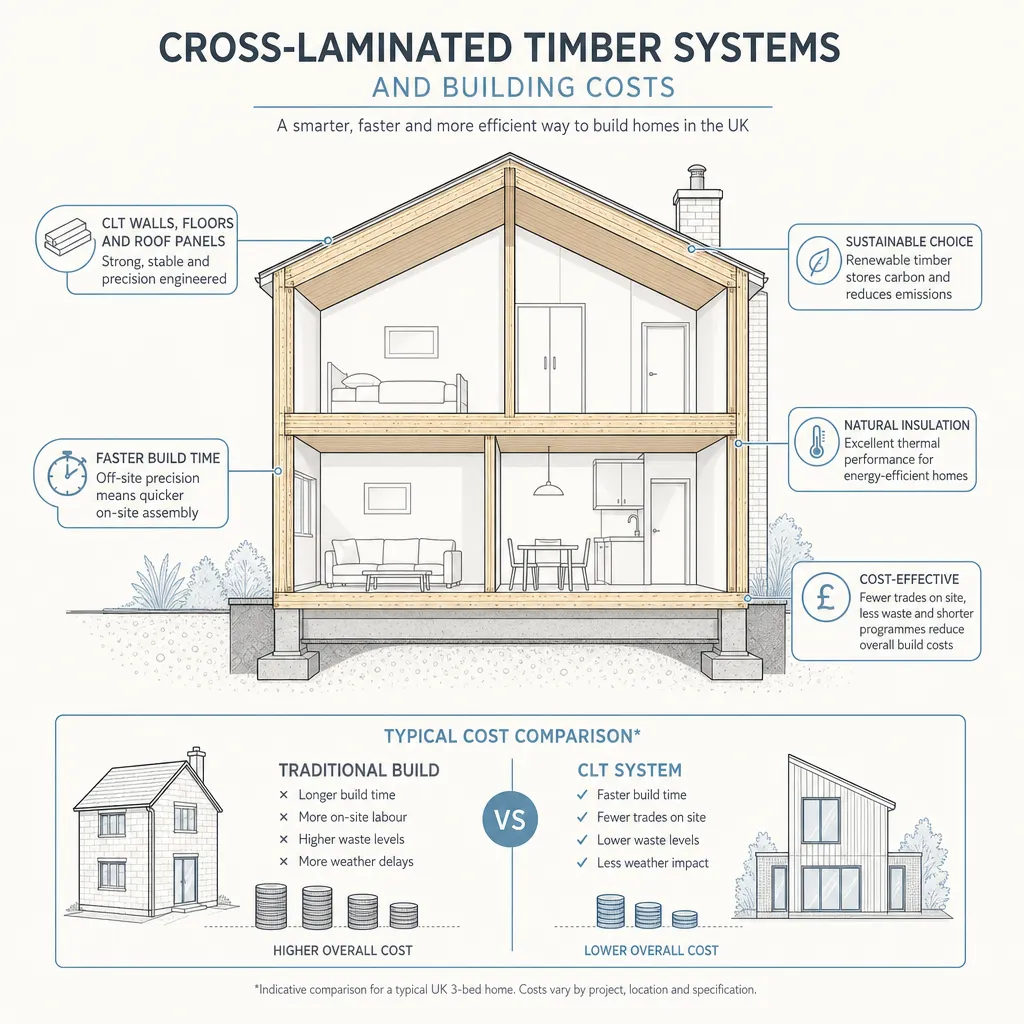
Cross-Laminated Timber Systems and Building Costs
Cross-laminated timber (CLT) panels for UK residential projects typically cost £150–£350 per m² for panel supply, with total build costs ranging from £1,800 to £3,000 per m² GIA including structure, envelope, and fit-out.