Cross-Laminated Timber Systems and Building Costs
By Housey · Last reviewed 6th of May 2026
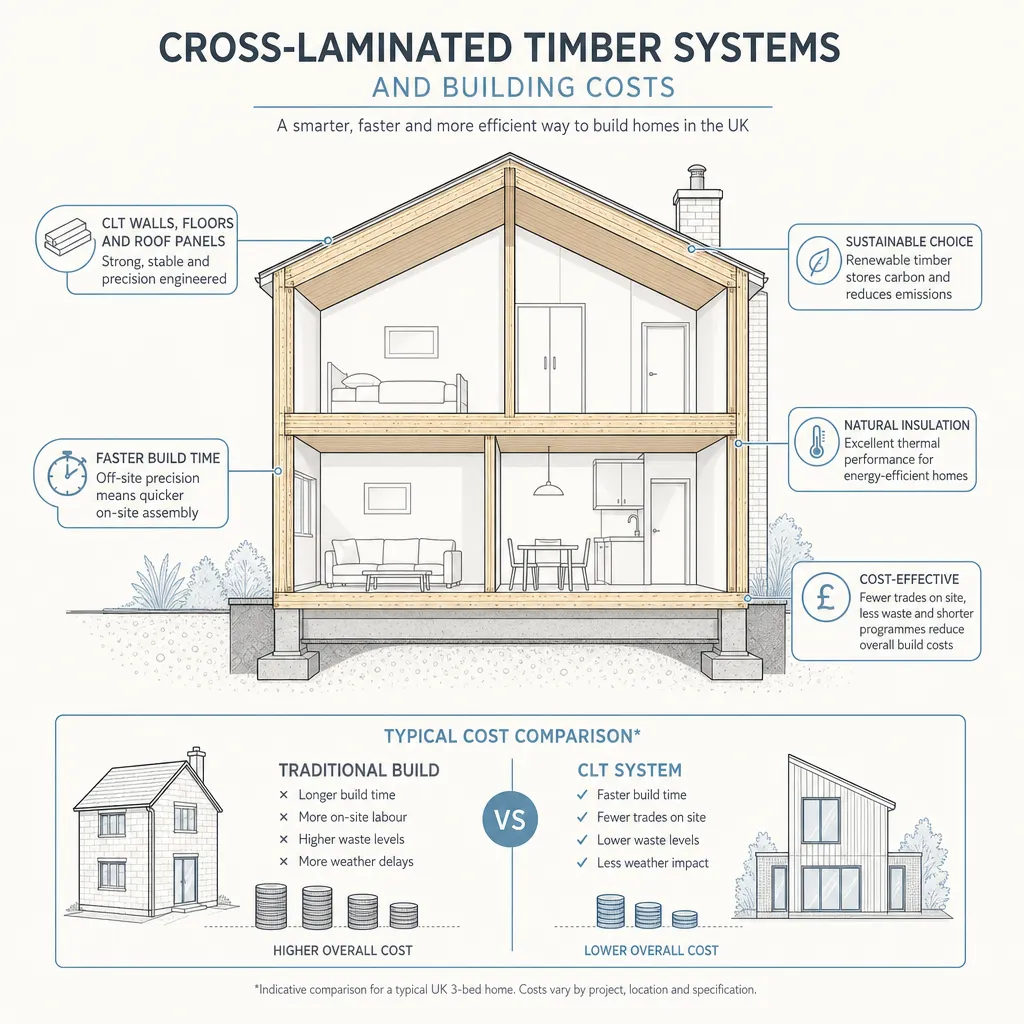
Cross-Laminated Timber Systems and Building Costs
Cross-laminated timber (CLT) has moved from niche architectural experiment to a mainstream structural option for UK residential and commercial projects over the past decade. Whether you are planning a self-build home, a multi-storey residential scheme, or a significant extension, understanding how CLT works and what it genuinely costs is essential before committing to a structural system. CLT projects require specialist professionals from the very beginning — the design, engineering, and construction programme cannot be treated as a standard build with a different material bolted on.
Key points
- CLT panels are manufactured to BS EN 16351 from kiln-dried softwood layers bonded at 90° alternating angles; structural performance must be verified against Building Regulations Approved Document A.
- Indicative UK residential CLT project costs range from £1,800 to £3,000 per m² of gross internal area (GIA) for a complete build including structure, envelope, and fit-out; panel supply alone typically costs £150–£350 per m² GIA (Indicative UK costs, last reviewed 2026-05-06).
- Buildings over 11m in height require additional fire protection measures under Building Regulations Approved Document B, including encapsulation of CLT panels with fire-resistant board or char-rate structural calculations agreed with building control.
- CLT design requires a structural engineer with engineered timber competence; most architectural technologists and architects will need to appoint or collaborate with a CLT-specialist structural engineer at an early stage.
- Planning permission for CLT structures follows standard Permitted Development and full planning rules — there is no separate planning category for timber construction, though local planning authorities in conservation areas may impose external material conditions.
What is cross-laminated timber and how does a CLT build work?
Cross-laminated timber consists of softwood planks (typically spruce or pine) arranged in alternating perpendicular layers and bonded under pressure with structural adhesive. The resulting panels are dimensionally stable, carry both axial and bending loads, and are prefabricated to high tolerances in a factory before delivery to site.
In a typical UK residential CLT project, the sequence runs as follows:
- Design and engineering: An architect or architectural technologist with experience in modern construction methods develops the spatial layout; a CLT structural engineer produces panel layouts, connection details, and structural calculations to BS EN 16351.
- Factory manufacture: Panels are CNC-cut to size, with openings for windows, doors, and services pre-formed.
- Site preparation: Standard strip or raft foundations are used; CLT requires a moisture-resistant threshold detail at ground level.
- Panel erection: A specialist CLT contractor — often also the panel supplier — erects the shell. A two-storey residential dwelling shell can typically be erected in three to ten working days.
- Building envelope: Insulation, breather membrane, cladding, and roofing are applied over the CLT shell.
- Services, fit-out, and finishes: Standard trades complete the interior.
The speed of the erection phase is one of the principal commercial arguments for CLT, but it depends entirely on all pre-construction documentation and panel details being finalised before manufacture begins.
How much does a CLT build cost in the UK?
CLT costs depend on several variables: panel grade and thickness, number of storeys, facade complexity, site access, contractor experience, and current timber market prices.
Indicative UK costs, last reviewed 2026-05-06 (quotes will vary by project, specification, and region):
Cost element | Indicative range | Notes |
|---|---|---|
CLT panel supply only | £150–£350 per m² GIA | Structure only; varies by panel grade and supplier |
CLT shell erection (panels + labour) | £400–£700 per m² GIA | Typically quoted by CLT specialist contractor |
Full build (structure, envelope, fit-out) | £1,800–£3,000 per m² GIA | Comparable to high-spec timber frame; varies widely by specification |
Structural engineer (CLT specialist) | £3,000–£8,000+ per project | Depends on project size and complexity |
Architectural technologist or architect | Varies | Typically 8–15% of build cost; obtain fee proposals early |
Projects in London and the South East tend to sit at the upper end of these ranges; rural projects with good site access may cost less. Professional fees are in addition to build costs.
Key cost drivers to discuss with your team
- Panel grade: Exposed internal CLT (visible grain finish) costs more than panels intended to be covered with plasterboard.
- Connection complexity: More complex junction details increase fabrication time and erection cost.
- Site access: Crane hire and restricted access add cost and programme time.
- Programme: Rushed design phases increase the risk of costly panel re-cuts or delays on site.
CLT vs traditional masonry: a comparison
Factor | CLT | Traditional masonry (brick/block) |
|---|---|---|
Speed of construction | Shell erected in days; faster overall programme | Slower wet trades; typically 4–8 weeks for shell |
Thermal performance | Requires additional insulation to meet Part L; achievable with appropriate build-up | Cavity wall achieves Part L with appropriate insulation |
Fire resistance | Must be engineered to Approved Document B; char-rate calculations or encapsulation required | Masonry is inherently non-combustible |
Acoustic performance | Requires careful specification; CLT can transmit impact sound | Inherently higher mass for both airborne and impact noise |
Embodied carbon | Lower embodied carbon than concrete or masonry for equivalent structure | Higher embodied carbon |
Vapour management | Requires careful vapour control layer detailing; risk of interstitial condensation if poorly specified | More tolerant of vapour management errors |
Contractor availability | Fewer experienced CLT contractors; concentrated in larger specialist firms | Wide availability of masonry contractors nationwide |
Planning permission and Building Regulations for CLT
CLT construction does not have a separate planning category. Planning permission requirements — or Permitted Development rights — follow the same rules as any comparable new build, extension, or conversion.
Conservation areas and listed buildings: If the external cladding of a CLT building uses timber or an unusual material, a local planning authority may impose material conditions. Always check with your local planning authority before finalising external finishes.
Building Regulations key considerations:
- Part A (Structure): CLT structural calculations must demonstrate compliance; this requires a structural engineer with CLT or engineered timber competence.
- Part B (Fire safety): Buildings over 11m require CLT panels to be either encapsulated with fire-resistant board or assessed using the char-rate method. For buildings over 18m, further restrictions apply under Approved Document B.
- Part L (Conservation of fuel and power): CLT panels alone typically achieve a U-value of approximately 0.3–0.5 W/m²K; additional insulation is required to meet current Part L targets.
- Part E (Acoustic): Sound transmission through CLT requires careful detailing, particularly for party walls in terraced or semi-detached construction.
Building control approval — via a local authority building control body or a registered building control approver — is required before structural work begins.
Worked UK scenario: a two-storey self-build in the Midlands
A homeowner in Derbyshire designed a 180 m² GIA two-storey self-build using CLT. An architectural technologist with experience in modern construction methods who had prior experience on modern methods of construction projects developed the design and planning drawings. A CLT-experienced structural engineer produced panel layouts, connection details, and Building Regulations submissions. A CLT specialist contractor (also the panel supplier) erected the shell in six working days, after which standard trades completed the envelope and interior.
Total indicative build cost: approximately £2,200 per m² GIA for a mid-specification finish, before professional fees. Planning was granted under standard full planning permission with no material conditions imposed.
The homeowner noted that the speed of erection reduced scaffold hire costs and allowed the building to become weathertight quickly — a significant practical advantage during an autumn build.
Important limitations
This article provides general information about CLT construction and indicative cost guidance only. It is not a substitute for advice from a qualified structural engineer, architect, building control body, or CLT specialist contractor. CLT projects involve complex structural, fire safety, vapour management, and acoustic design decisions that depend on the specific property, site, programme, height, and specification. Rules and requirements vary by project type, building height, location, and local planning authority. Always engage suitably qualified professionals before committing to a structural system or budget. Cost figures are indicative; actual quotes will vary. Obtain at least three competitive quotes from CLT-experienced professionals before finalising a budget.
What to ask a qualified professional
Before appointing a structural engineer or CLT contractor, ask:
- Do you have specific experience with CLT or mass timber construction, and can you share project references?
- Which CLT panel suppliers do you work with, and are panels manufactured to BS EN 16351?
- How do you detail the junction between CLT panels and the ground-floor slab to manage moisture risk?
- Are your fire safety calculations based on the char-rate method or encapsulation, and has this approach been agreed with the building control body?
- What coordination is required between structural, architectural, and services drawings before panels are manufactured?
- What is the programme from panel order confirmation to site erection?
- How are design changes handled after panels have been cut — what are the cost and programme implications?
When to get professional help
CLT construction requires qualified professionals from the outset. Seek specialist input immediately if:
- You are planning any multi-storey CLT structure
- Your site is in a conservation area, near a listed building, or subject to an Article 4 Direction
- You are unsure whether your structural engineer has specific CLT or engineered timber competence
- Your project involves a CLT party wall shared with a neighbour, which also triggers the Party Wall etc. Act 1996
- Building Regulations fire safety queries arise for buildings over 11m or 18m
How Housey can help
If you are in the early stages of planning a CLT or modern timber project, an architectural technologist with experience in modern construction methods can help you develop a compliant design, coordinate specialist structural input, and prepare planning and Building Regulations drawings. Housey can help you request and compare quotes from qualified professionals.
Frequently asked questions
Is CLT more expensive than traditional timber frame?
CLT panels typically cost more per m² than open- or closed-panel timber frame due to the additional manufacturing process. However, CLT can allow longer spans without internal load-bearing walls. For most residential self-builds, the total build cost is broadly comparable to high-specification timber frame — typically £1,800–£3,000 per m² GIA including structure, envelope, and fit-out (Indicative UK costs, last reviewed 2026-05-06).
Does CLT need planning permission in the UK?
CLT construction follows the same planning rules as any other structural system. Whether you need planning permission depends on the project type and whether Permitted Development rights apply. The structural material is not itself a planning consideration, although external cladding choices may be subject to material conditions in conservation areas or where a local planning authority imposes conditions.
How fire-safe is CLT?
CLT chars at a predictable rate (typically around 0.65 mm per minute for spruce), and the char layer provides some insulation to the structural core. For buildings up to 11m, exposed CLT can be used with appropriate char-rate structural calculations. Above 11m, Building Regulations Approved Document B requires additional fire protection. A structural engineer and building control body should confirm the approach for each project.
Can CLT be used for residential extensions in the UK?
Yes. Single-storey and two-storey CLT extensions have been built throughout the UK. An architectural technologist or architect typically designs the extension; a structural engineer should check the connection between the CLT extension and the existing structure. Planning requirements are the same as for any extension, and building control approval is required before structural work begins.
What foundations does a CLT building need?
CLT structures are relatively lightweight compared to masonry, which can reduce foundation loads. Standard strip, pad, or raft foundations are typically used depending on ground conditions. A structural engineer should specify foundations after appropriate ground investigation. CLT also requires careful moisture detailing at the threshold between the structural panel and the ground-floor slab.
Sources and further reading
- Building Regulations Approved Document A (Structure) — GOV.UK
- Building Regulations Approved Document B (Fire Safety) — GOV.UK
- Building Regulations Approved Document L (Conservation of Fuel and Power) — GOV.UK
- BS EN 16351: Timber structures — Cross laminated timber — BSI Group
- TRADA: Cross-laminated timber guidance — Timber Research and Development Association (TRADA)
- RIBA: Designing with mass timber — Royal Institute of British Architects
Useful next reads
 Planning & Pre-Build
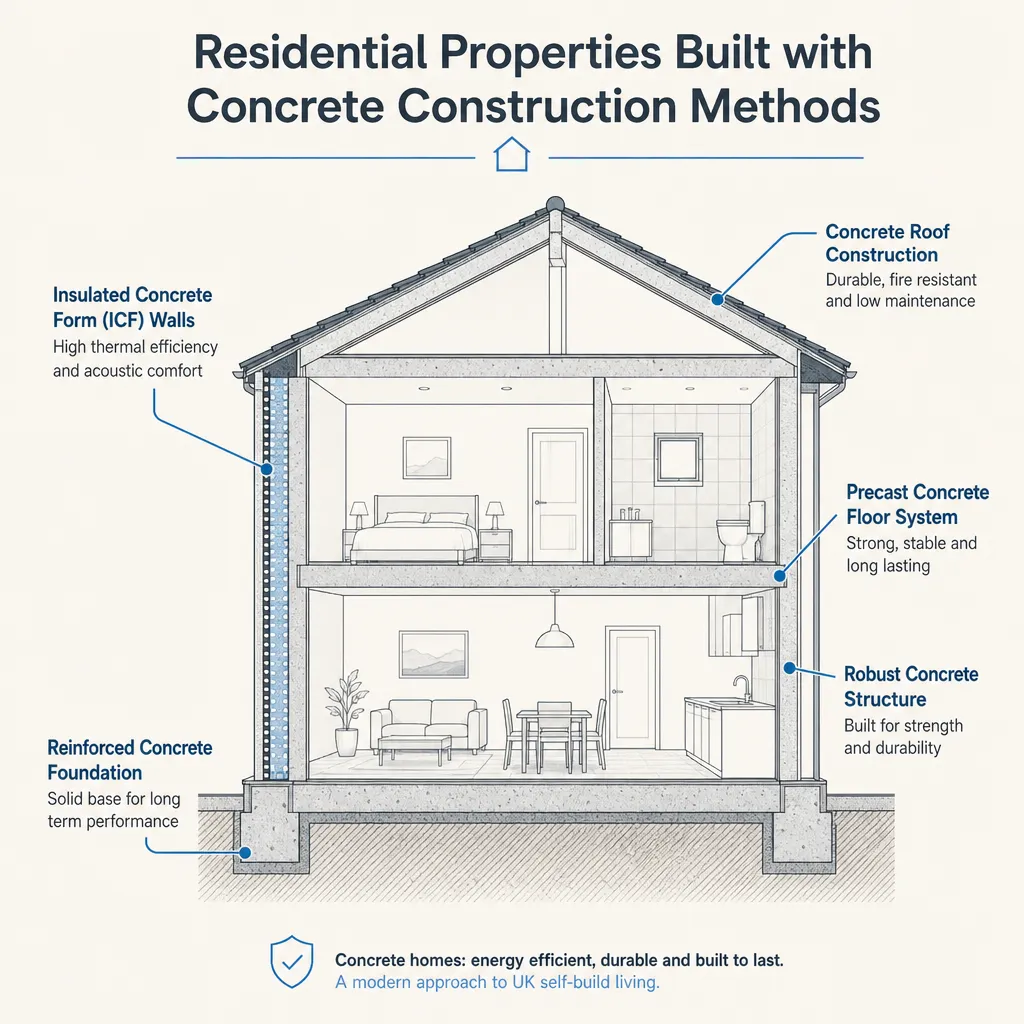
Residential Properties Built with Concrete Construction Methods
UK homes are built using several concrete methods: in-situ cast concrete, precast panel systems, insulating concrete formwork (ICF), and older non-traditional types such as Wimpey No-Fines and Laing Easiform.
 Planning & Pre-Build
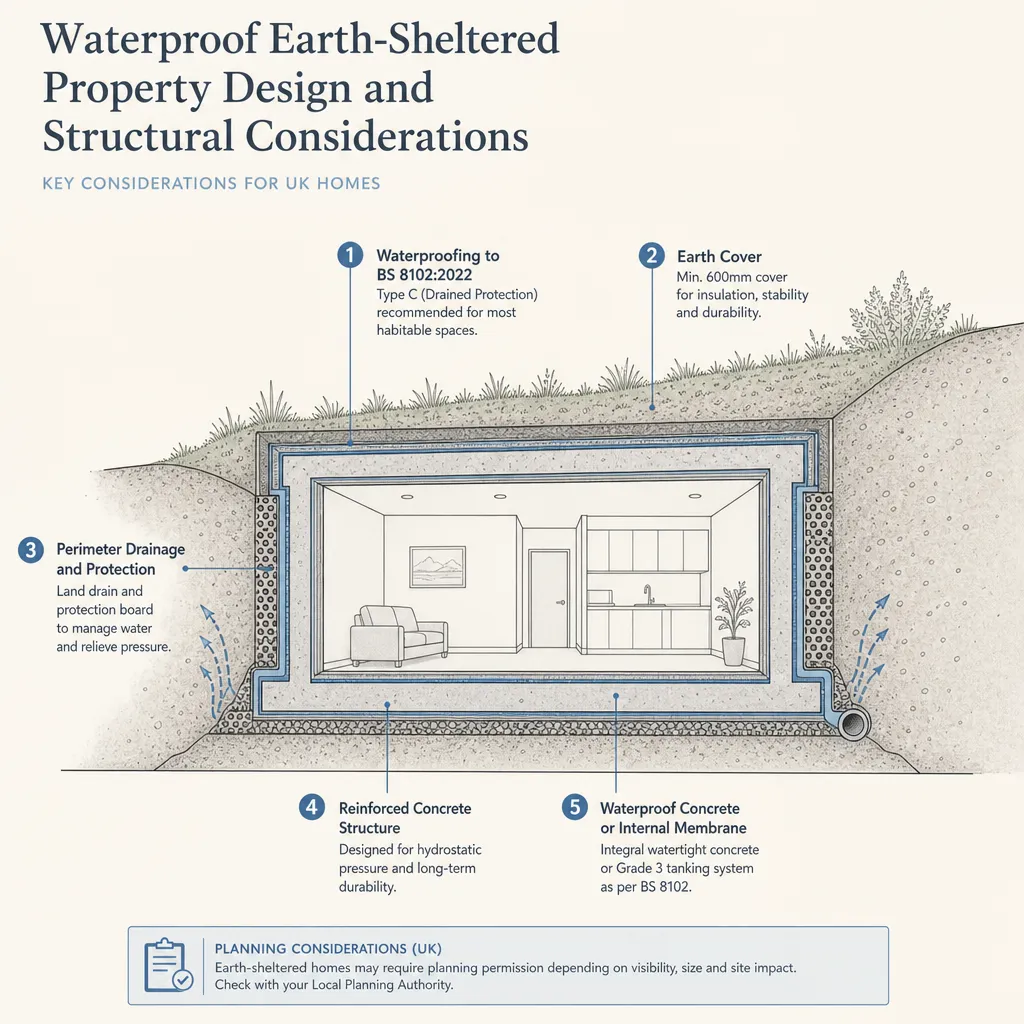
Waterproof Earth-Sheltered Property Design and Structural Considerations
Earth-sheltered homes in the UK require specialist structural design to manage lateral soil pressure and hydrostatic loads, along with a waterproofing strategy compliant with BS 8102:2022.
 Planning & Pre-Build
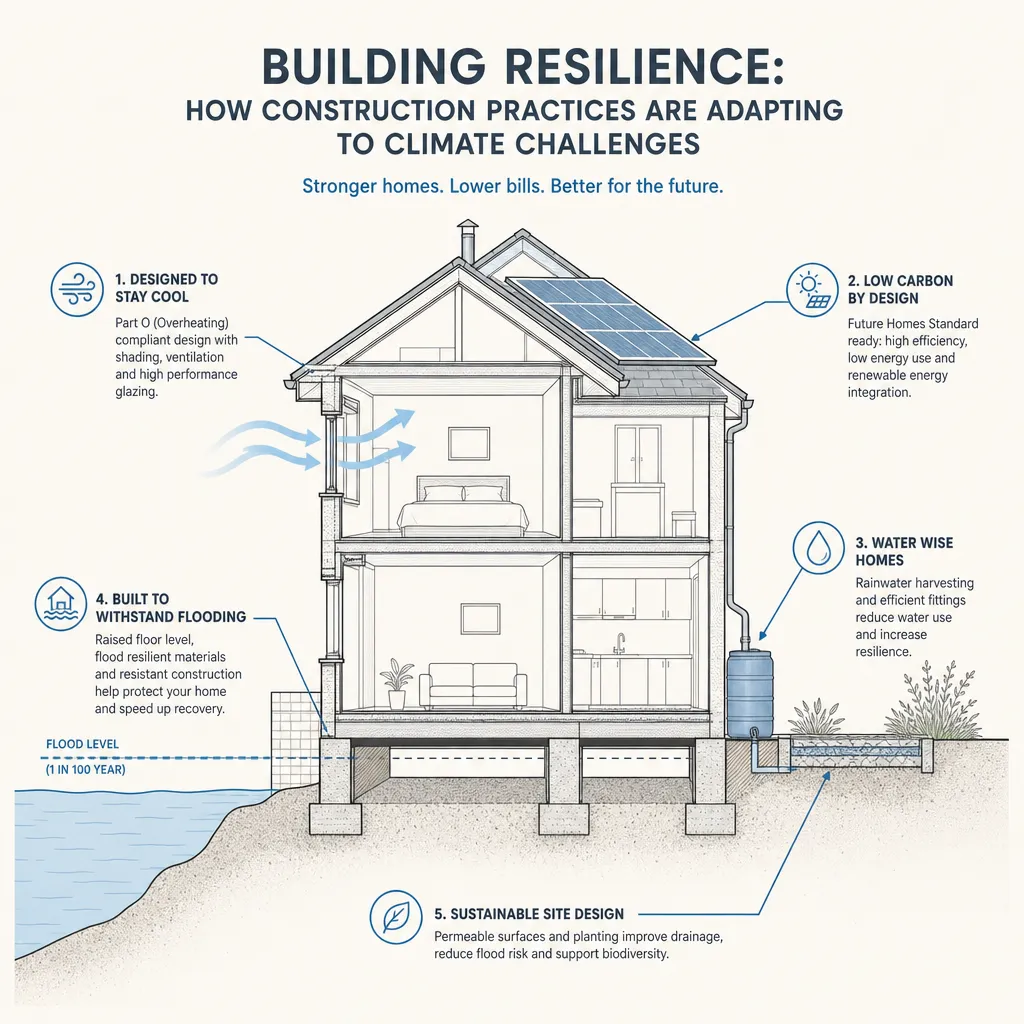
Building Resilience: How Construction Practices Are Adapting to Climate Challenges
UK construction is adapting to climate change through updated Building Regulations.
 Planning & Pre-Build
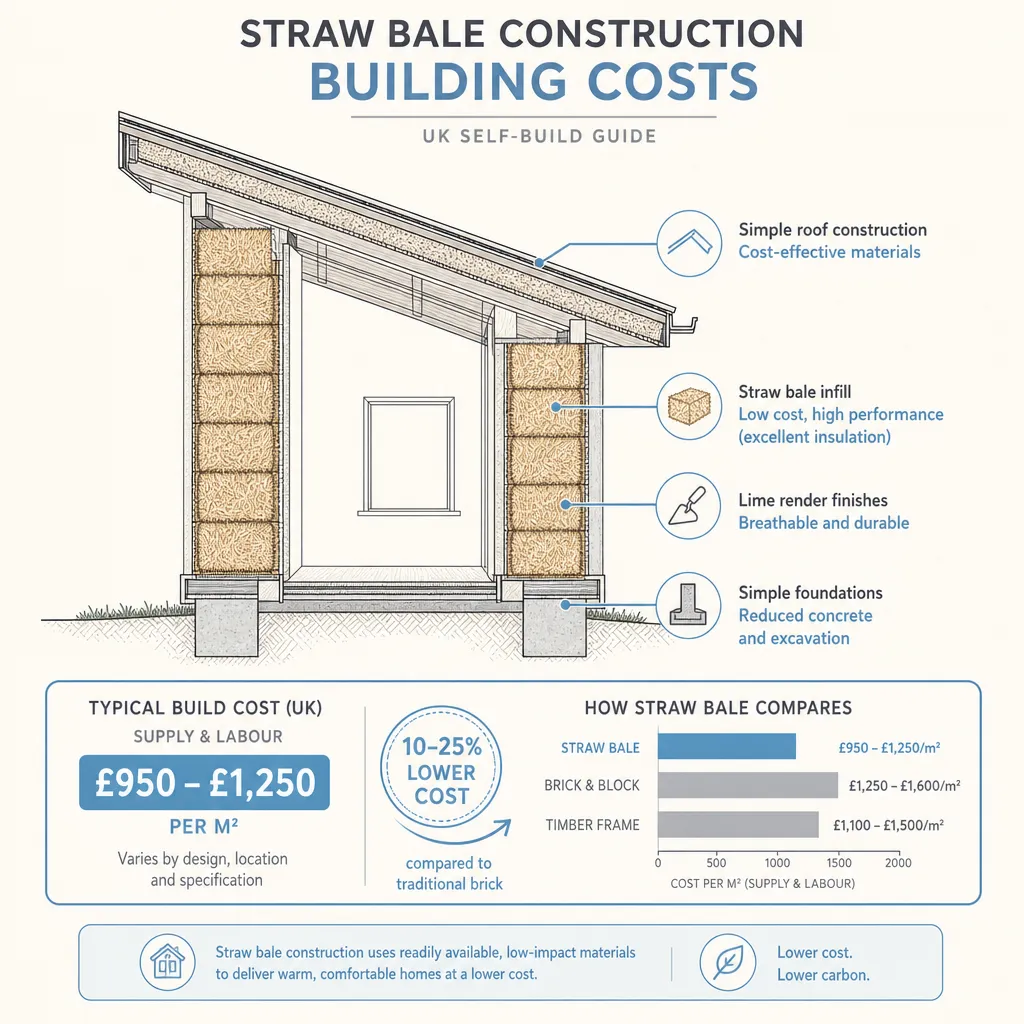
Straw Bale Construction Building Costs
Straw bale construction in the UK typically costs £1,500–£2,500 per square metre for a fully contracted self-build, though costs vary by design, render specification, and contractor experience.
 Planning & Pre-Build
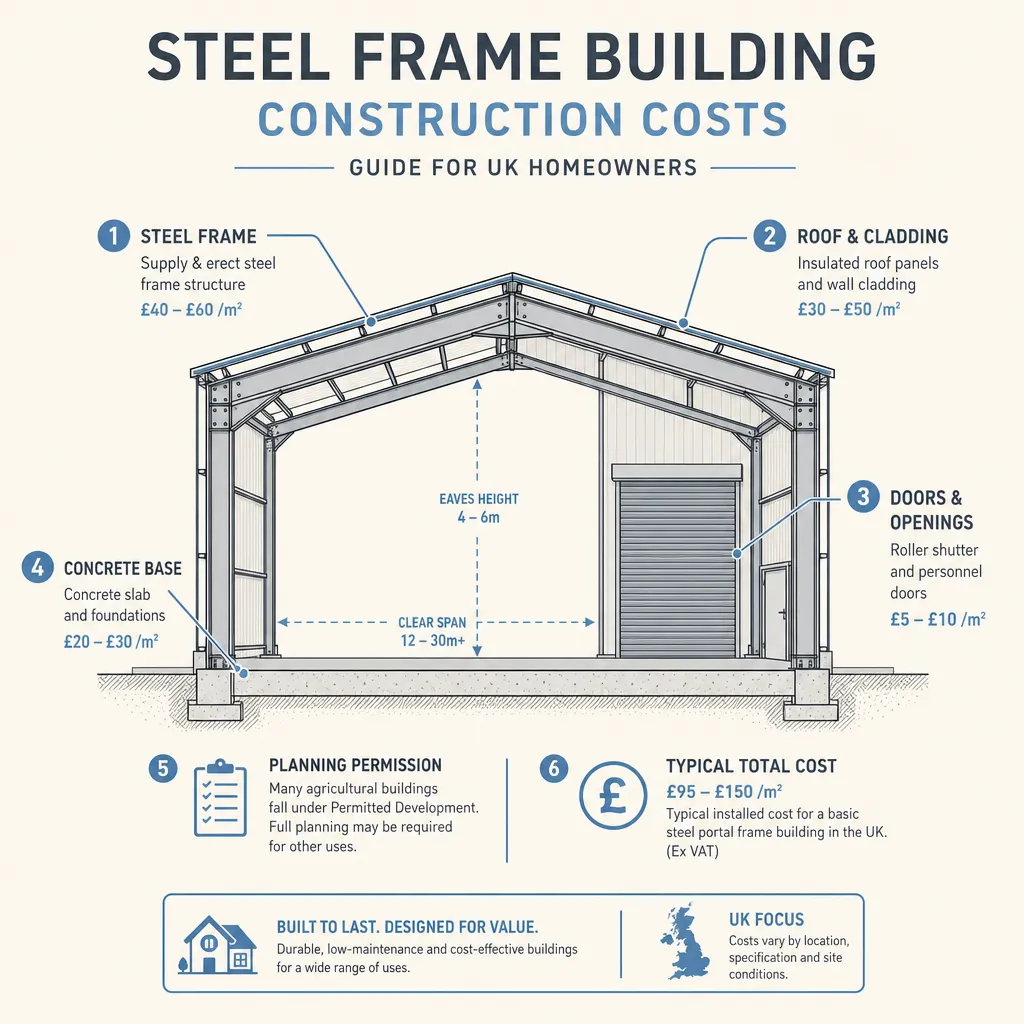
Steel Frame Building Construction Costs
Steel frame buildings in the UK cost from around £400 to over £1,200 per square metre of floor area, depending on building type, size, cladding, insulation, and fit-out level.