Buying a Seaside Property: What to Check Before You Exchange
By Housey · Last reviewed 30th of May 2026
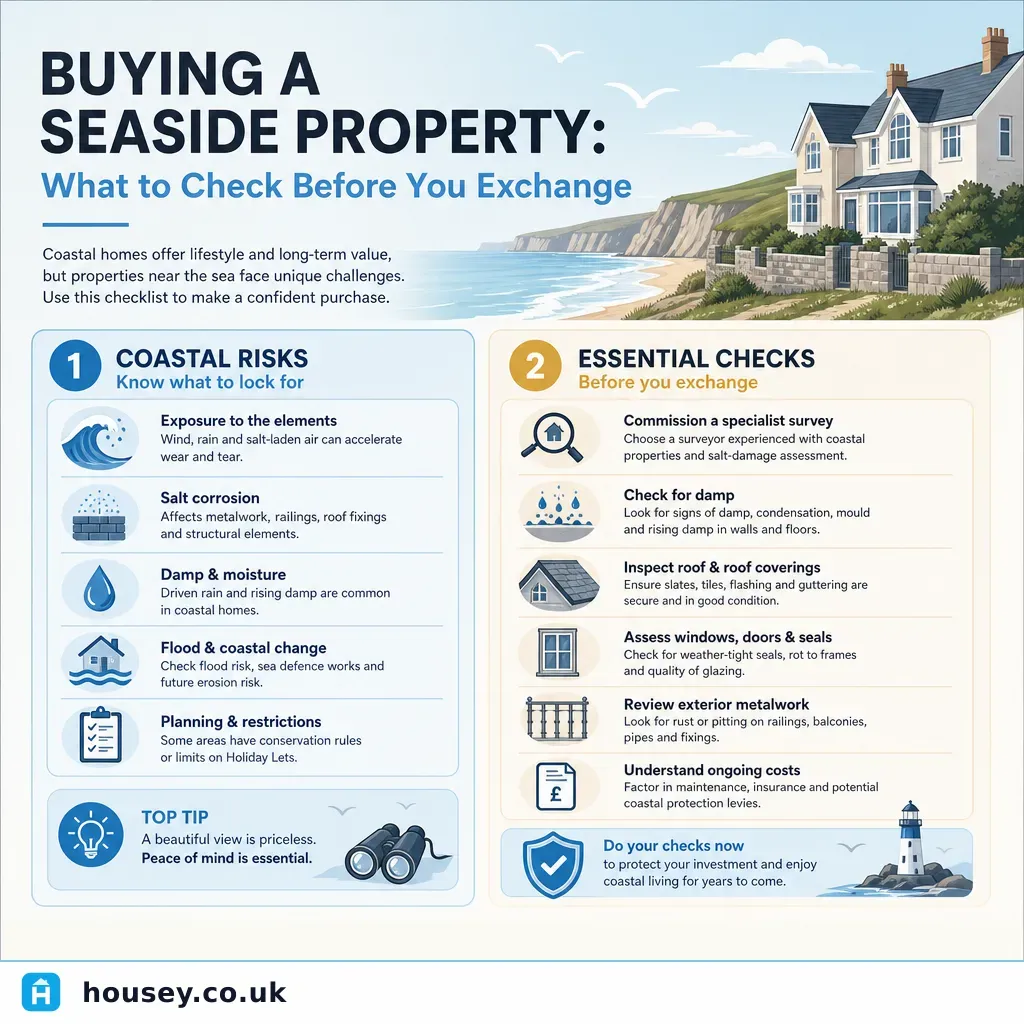
Buying a Seaside Property: What to Check Before You Exchange
The appeal of a seaside home is easy to understand — views, fresh air, and proximity to the coast — but UK coastal properties are exposed to conditions that accelerate building deterioration in ways that rarely affect inland homes. Whether you are buying a Victorian terrace in Whitby, a 1930s bungalow in Broadstairs, or a converted fisherman's cottage in Cornwall, the environment places extra demands on the building fabric that a standard survey often does not fully capture.
Key points
- A RICS Level 3 Building Survey is strongly advisable for most coastal properties because of accelerated weathering, potential structural movement, and the higher likelihood of hidden defects beneath weathered render or cladding.
- Salt spray corrosion can degrade metal fixings, window frames, external joinery, and roof flashings within 500m of the shoreline — sometimes within 100m on very exposed headlands.
- Properties in Environment Agency Flood Zone 2 or 3 may require specialist flood insurance; some mortgage lenders will not lend on Zone 3 properties without evidence of affordable cover.
- Many coastal homes sit within National Landscape (formerly AONB), Conservation Area, or Heritage Coast designations, which significantly restrict permitted development and external alterations.
- The National Coastal Erosion Risk Mapping (NCERM) dataset, published by the Environment Agency, records long-term erosion rates by shoreline cell and should be reviewed before exchanging on a property near a cliff, eroding bank, or exposed headland.
Why coastal properties need specialist survey attention
Coastal locations create a combination of risks — salt-laden air, driving rain, persistent damp, and in some locations ground movement — that are unusual elsewhere in the UK. A RICS Level 2 Home Survey will note visible defects, but its format (no specialist tests, no invasive investigation) can miss the deeper moisture ingress and corrosion that is common in exposed coastal buildings.
For most coastal purchases, a RICS Level 3 Building Survey is the more appropriate choice. This provides a detailed assessment of the building fabric, comments on concealed areas of concern, and sets out repair priorities. For properties on cliff edges, near sea walls, or showing visible cracking, a separate structural engineer's inspection may also be warranted.
Salt spray and weathering: what to look for
Salt air accelerates corrosion of metals and degrades many building materials faster than in inland locations. Key areas to inspect:
- Window and door frames: Timber frames in coastal locations often suffer accelerated rot where paint maintenance has lapsed. uPVC frames may yellow and weaken faster than inland equivalents.
- Roof flashings and fixings: Lead and zinc flashings are vulnerable to accelerated deterioration. Roof tile fixings and ridge fixings can corrode and loosen progressively over time.
- Render and external coatings: Traditional lime render often copes better than modern sand-cement render, which can trap moisture and allow salt-water penetration behind the face. Spalled or hollow-sounding render is a common coastal finding.
- Metal components: Ferrous fixings in timber-framed walls, structural steel beams, balcony railings, and external pipework are all corrosion risks in coastal zones.
A thermographic survey can reveal moisture distribution behind surfaces that appear dry to the naked eye, and is worth considering for properties with a history of damp complaints or recent external redecoration.
Structural and foundation risks
Risk type | When it applies | Who to instruct |
|---|---|---|
Coastal erosion | Properties within 50–200m of a cliff edge or eroding shoreline | Structural engineer and NCERM data check |
Settlement and subsidence | Made ground, soft coastal soils, silty or peaty ground common in estuaries | Structural engineer |
Sea wall or coastal defence dependency | Property sits behind or below a managed coastal defence | Environment Agency or local authority, plus structural engineer |
Flood scour | Properties on a riverine coast or tidal estuary | Structural engineer and Environment Agency flood maps |
For any property where the NCERM shows a meaningful erosion rate for that shoreline cell, or where land is classified as at risk of rapid retreat, specialist structural and legal advice is essential before exchange.
Flood risk and insurance
The Environment Agency's Check your long-term flood risk service shows a property's flood zone classification by postcode. Zones 2 and 3 carry meaningful risk:
- Flood Zone 2: Medium probability of flooding from rivers or sea.
- Flood Zone 3a: High probability. New residential development here requires a Sequential Test from the local planning authority.
- Flood Zone 3b: Functional floodplain. Very restrictive for residential development.
The government-backed Flood Re scheme provides a reinsurance backstop that helps insurers offer more affordable cover to many higher-risk homes built before 1 January 2009. It does not cover properties built after that date, leasehold flats in blocks, or certain other property types. Always confirm insurance availability and cost before exchange — not after.
Planning restrictions in coastal locations
Coastal properties frequently sit within one or more of the following designations, each of which affects what you can alter without formal consent:
- National Landscape (formerly AONB): Heightened scrutiny of applications affecting landscape character. Permitted Development Rights may be restricted.
- Conservation Area: Many coastal villages and seafronts are designated. Permitted Development Rights are curtailed; Article 4 Directions may restrict them further.
- Listed Building: Common in historic fishing ports and resort towns. All alterations require Listed Building Consent in addition to any planning permission.
- Flood Zone 3a or 3b: Development restrictions apply; residential proposals may require a Sequential Test and Exceptions Test.
Always check the local planning authority's GIS mapping and the Historic England National Heritage List for England before assuming permitted development applies.
Coastal property buyer checklist
Red flags: when to pause the purchase
Stop and seek specialist advice immediately if any of the following apply:
- The property sits within 50m of a cliff edge, eroding bank, or a coastal defence structure that appears unmaintained.
- The flood zone classification is 3a or 3b.
- You are unable to obtain buildings insurance quotes at standard or near-standard rates from multiple insurers.
- The building shows visible cracking, bulging walls, or clear signs of settlement.
- External render sounds hollow when tapped or shows extensive spalling across large areas.
- The property has been recently redecorated externally in a way that appears incongruously fresh relative to the rest of the building fabric.
Important limitations
This article provides general information only. Coastal locations across the UK vary considerably — the risks facing a property on the Jurassic Coast differ from those in the Solent, the Firth of Forth, or a sheltered Welsh harbour. Local authority planning policies, Environment Agency flood mapping, and individual building condition all require professional assessment specific to the property. Nothing here replaces a qualified surveyor's inspection, a structural engineer's report, or legal advice from a conveyancer familiar with coastal property transactions.
When this becomes urgent
Stop relying on a general guide and seek professional help without delay if:
- The NCERM dataset shows the shoreline cell is retreating at more than 0.5m per year over any epoch.
- Flood insurance has been declined or quoted at a significantly elevated premium by multiple insurers.
- A crack is widening, runs diagonally through brickwork, or is accompanied by sticking doors or windows — ask a chartered surveyor or structural engineer to inspect before proceeding.
- The local authority has issued or is consulting on a Coastal Change Management Area policy that includes the property's location.
What to ask a qualified professional
Before instructing a surveyor for a coastal property purchase, ask:
- Have you surveyed similar coastal or maritime properties in this area?
- Will you test for damp and comment specifically on salt-related deterioration?
- Can you advise whether a separate structural engineer's inspection is warranted given the location?
- Will you comment on proximity to coastal defences, cliff edges, or flood-risk features near the property?
- Are there areas you will be unable to inspect, and what are the limitations of your report in that context?
When to get professional help
For any coastal purchase, commission a RICS Level 3 Building Survey before exchange. If the survey identifies structural concerns, a structural survey or structural engineer's assessment should follow before you commit legally. If you are unable to secure insurance at a reasonable cost, treat that as a material risk requiring professional and legal advice — not something to defer until after exchange.
How Housey can help
Housey connects you with qualified professionals for every stage of a coastal property purchase. Find specialists to carry out a structural survey, a damp and timber survey, or a roof survey suited to the demands of maritime buildings. If you want to understand hidden moisture before committing, a thermographic survey can reveal what lies beneath the surface without disturbing the fabric. Compare quotes from experienced local surveyors through Housey.
Frequently asked questions
Do I need a specialist surveyor for a coastal property?
A RICS Level 3 Building Survey is the appropriate level for most coastal purchases, but it is worth confirming the surveyor has experience with maritime buildings. Salt corrosion, spray-driven damp, and coastal movement are less familiar to surveyors who work primarily inland. Ask about their experience with similar properties before instructing.
Will flood risk affect my mortgage application?
It can. Properties in Environment Agency Flood Zone 3 may face higher rates, additional lender conditions, or declined applications. The government-backed Flood Re scheme improves insurance availability for eligible homes built before 1 January 2009, but it does not guarantee mortgage approval. Speak to a mortgage broker with experience in high-flood-risk properties early in your search.
Can I extend a coastal property?
Possibly, but planning restrictions are more common near the coast. Conservation Areas, National Landscape designations, and Listed Building status all restrict permitted development. Even where development is technically permitted under national rules, local planning policies for coastal areas may apply additional criteria. Always check with your local planning authority before assuming any works are permitted.
What is the NCERM dataset and why does it matter?
The National Coastal Erosion Risk Mapping dataset, maintained by the Environment Agency, estimates how far the shoreline may retreat over 20, 50, and 100 years for stretches of the English coast. A property on a shoreline cell with a significant erosion rate may face land loss over its expected lifespan, affecting insurability, mortgageability, and long-term value.
Sources and further reading
- Check your long term flood risk — GOV.UK
- National Coastal Erosion Risk Mapping — Environment Agency
- Flood Re: can it help me? — Flood Re
- RICS Home Survey Standards — RICS
- National Heritage List for England — Historic England
Useful next reads
 Surveys & Inspections
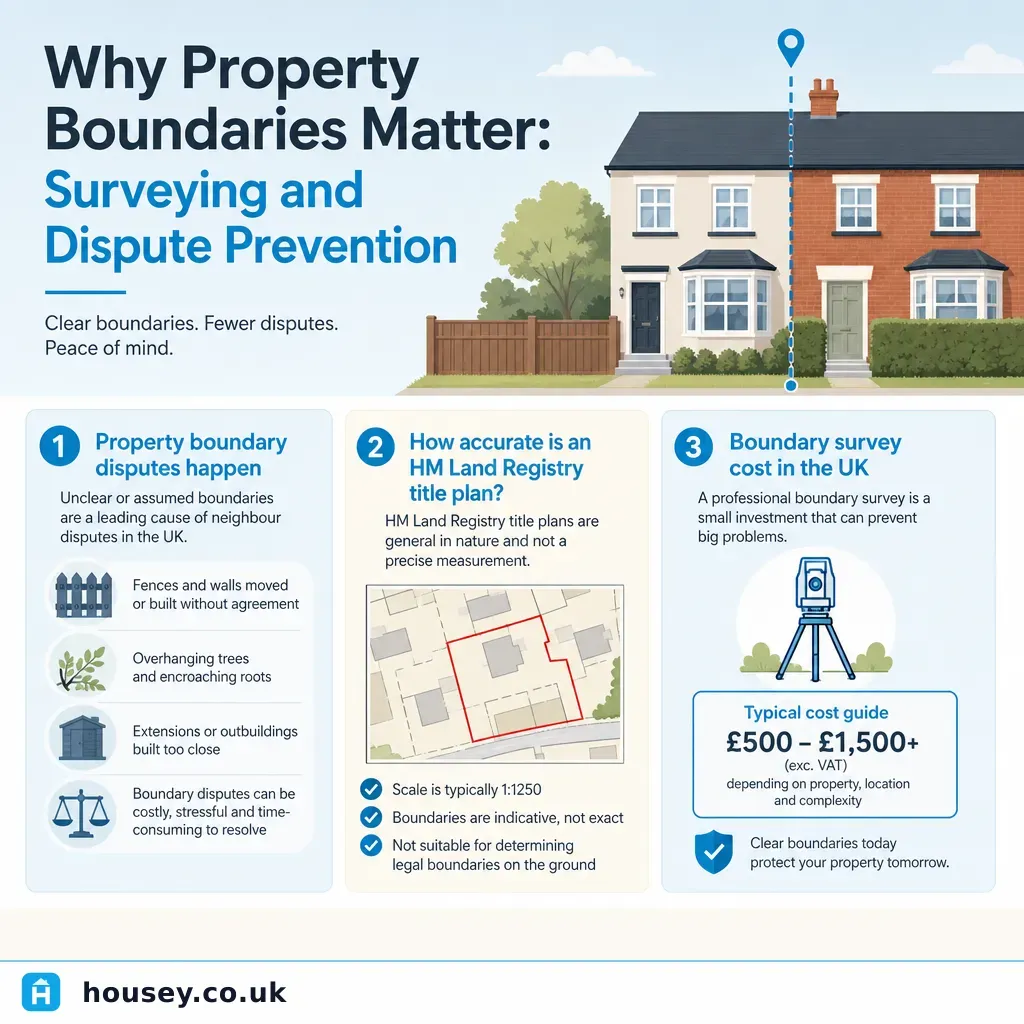
Why Property Boundaries Matter: Surveying and Dispute Prevention
Property boundaries in England and Wales are recorded as general boundaries by HM Land Registry — not precise measurements.
 Surveys & Inspections
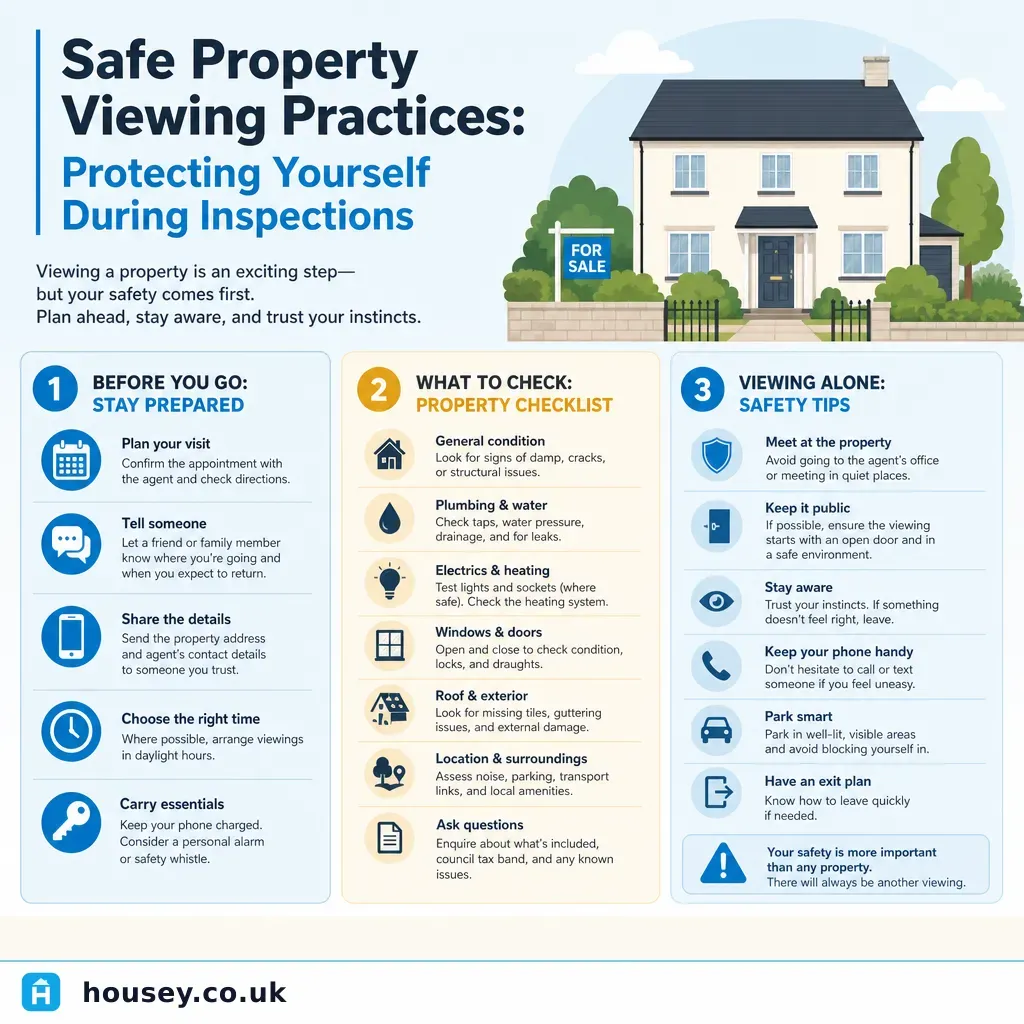
Safe Property Viewing Practices: Protecting Yourself During Inspections
When viewing a property in the UK, always tell someone where you are going and share the full address before you leave.
 Surveys & Inspections
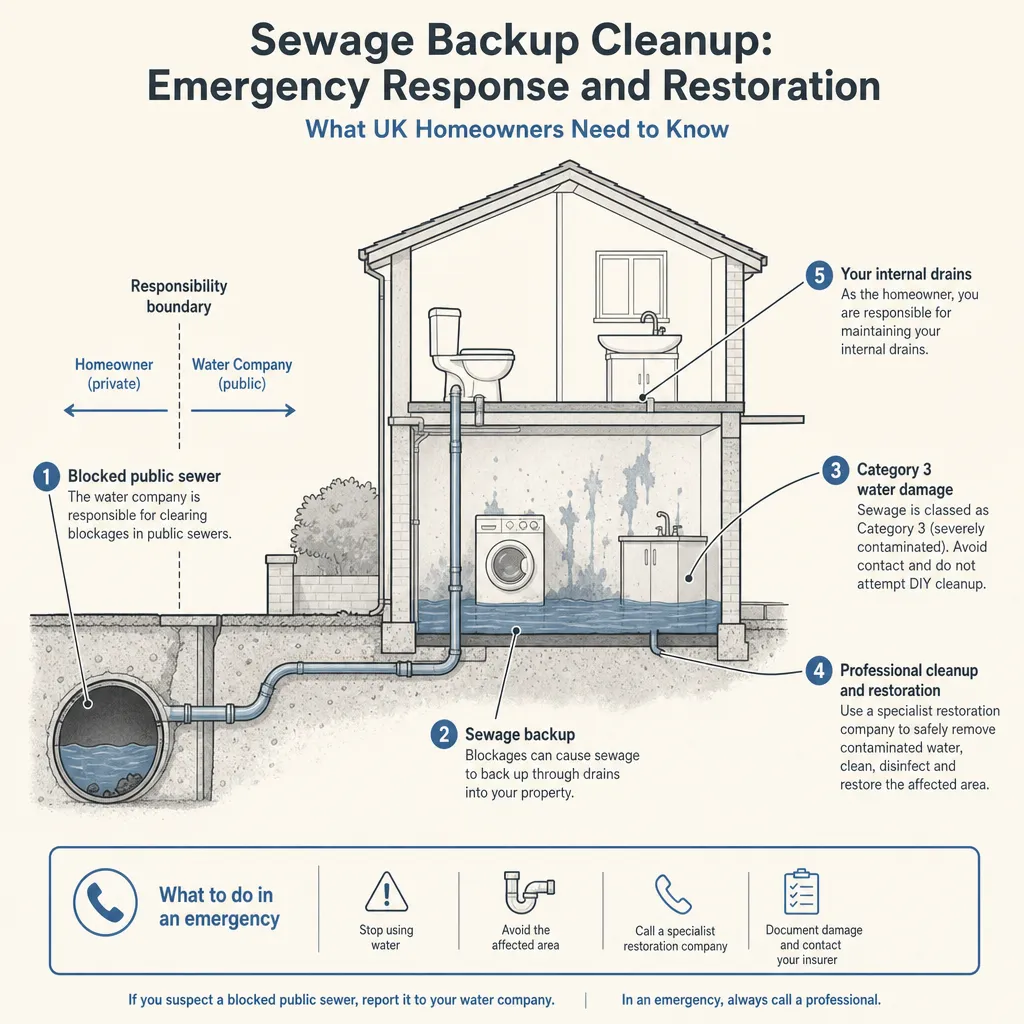
Sewage Backup Cleanup: Emergency Response and Restoration
A sewage backup should be treated as a Category 3 contamination event.
 Surveys & Inspections
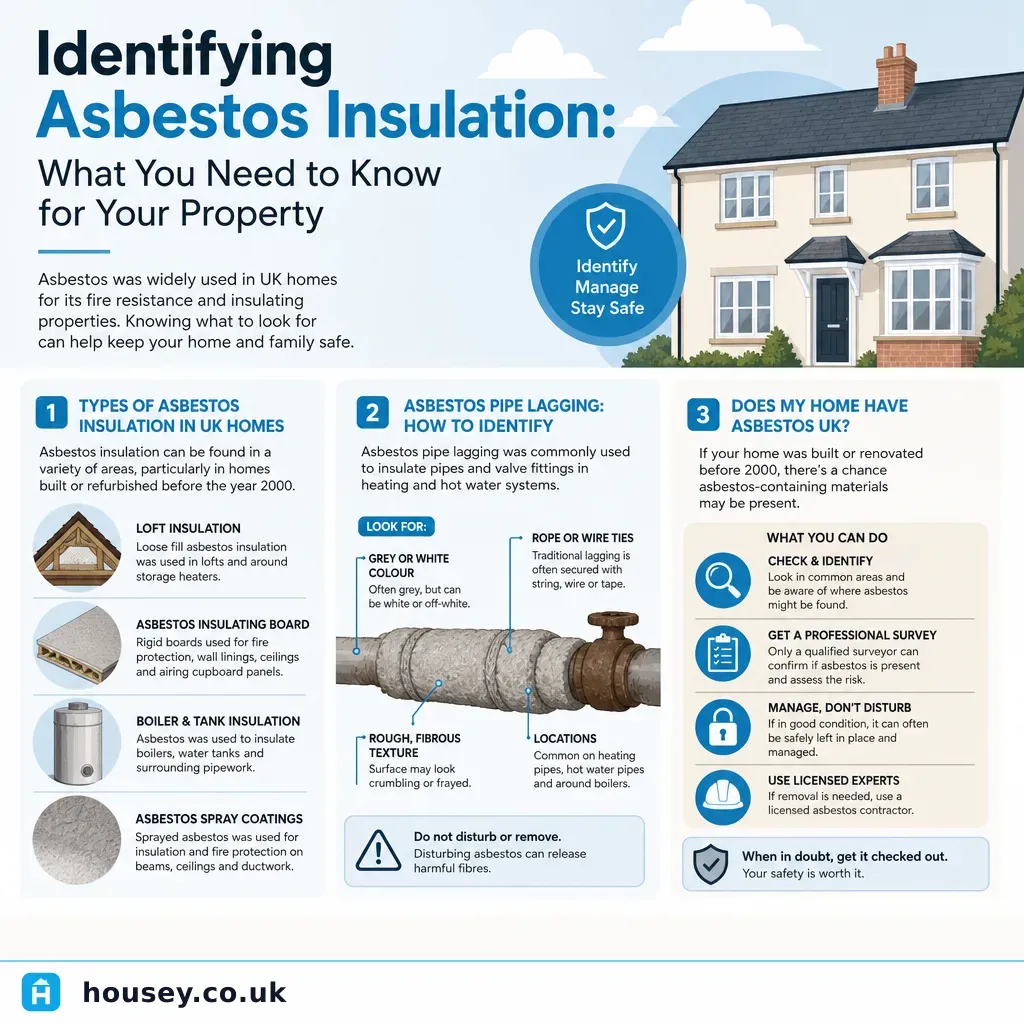
Identifying Asbestos Insulation: What You Need to Know for Your Property
Asbestos insulation was widely used in UK properties built before 2000, commonly found in pipe lagging, ceiling tiles, loose-fill loft insulation, and around boilers.
 Surveys & Inspections
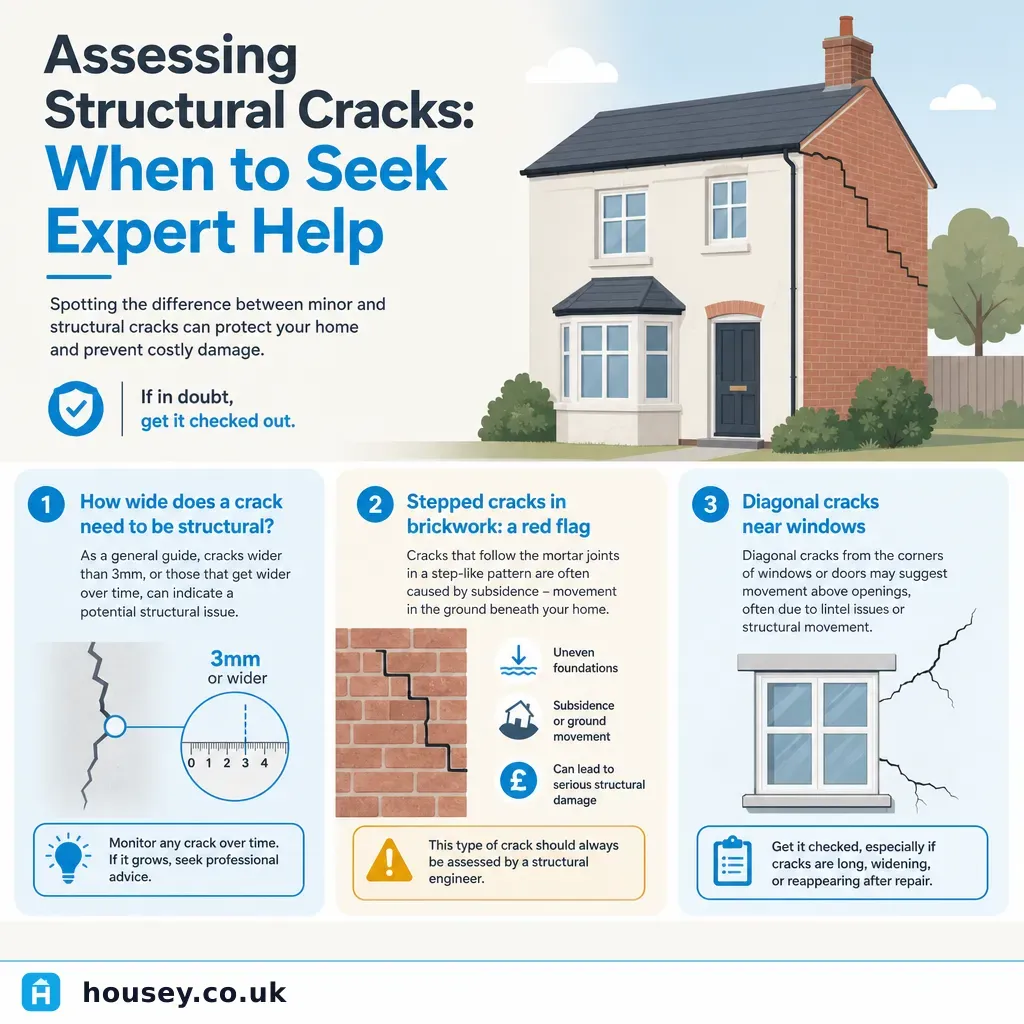
Assessing Structural Cracks: When to Seek Expert Help
Structural cracks range from harmless shrinkage hairlines to signs of subsidence or foundation movement.