Sewage Backup Cleanup: Emergency Response and Restoration
By Housey · Last reviewed 30th of May 2026
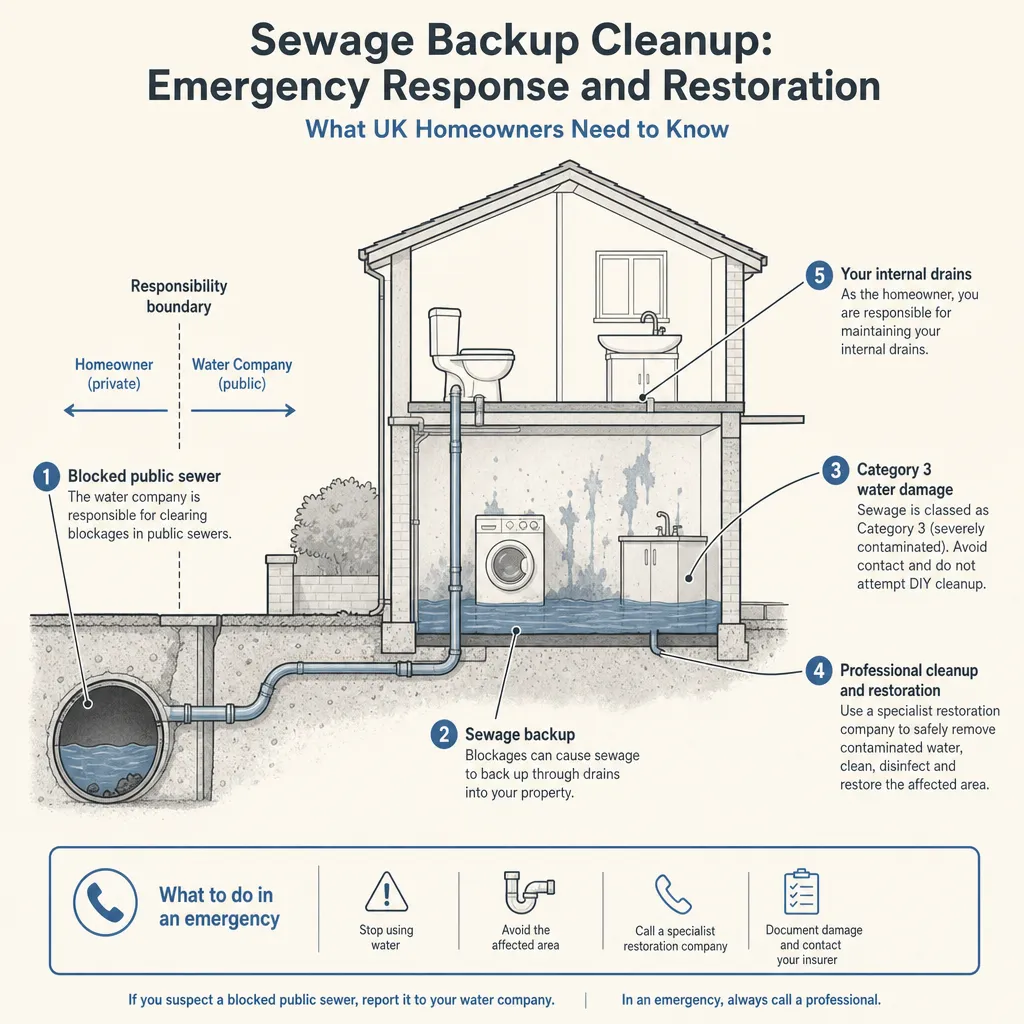
Sewage Backup Cleanup: Emergency Response and Restoration
A sewage backup — where waste water reverses through household drains and enters living spaces — ranks among the most urgent property emergencies a UK homeowner can face. It can strike any connected property without warning, creating immediate health, structural, and contents risks. Handling the situation correctly from the first minutes substantially limits both the hazard and the eventual cost of restoration, but the process is complicated by questions of liability: different sections of the drainage network carry different ownership, and understanding which applies to your property determines both who should act and who ultimately bears the cost.
Key points
- Sewage is classified as Category 3 (black water) contamination — it contains bacteria, viruses, and parasites that make DIY cleanup unsafe for most occupants without professional-grade personal protective equipment.
- Under the Water Industry Act 1991 (as amended), water companies in England and Wales took on responsibility for shared lateral drains and private sewers in October 2011; blockages in these are the water company's responsibility to clear.
- Category 3 water damage to flooring, walls, and soft furnishings requires specialist decontamination and structural drying; replacement of saturated porous materials is often necessary.
- Buildings insurance policies frequently cover sewage escape and resultant damage — check your policy before commissioning private remediation, as paying out of pocket without notifying your insurer may affect a future claim.
- A CCTV drain survey is the most reliable way to identify the cause of a backup — blockage, collapse, root ingress, or structural failure — and to determine the correct long-term remedy.
Who is responsible for the blocked drain?
Understanding drain ownership is essential before deciding who to call and who bears the cost. In England and Wales the framework works as follows:
- Private drains serving a single property up to the property boundary (or the point where they join a shared drain) are the homeowner's responsibility.
- Shared lateral drains — pipes carrying sewage from more than one property before joining the public sewer — were transferred to water companies in October 2011 under the Water Industry (Schemes for Adoption of Private Sewers) Regulations 2011.
- Public sewers are the responsibility of the regional water company (Thames Water, Severn Trent, United Utilities, Yorkshire Water, and others).
In practice, identifying exactly where the blockage sits often requires a CCTV drain survey, particularly where backups are intermittent or affect more than one property. The position in Scotland (Scottish Water) and Northern Ireland (NI Water) differs in certain respects; check directly with your regional utility.
Decision tree: who to call first
- Call your water company's emergency line if the backup is affecting multiple neighbouring properties, if sewage is escaping from a manhole in the road or pavement, or if you suspect the blockage is in the public sewer.
- Call your insurer first (before commissioning any remediation) if there is significant damage to floors, walls, or contents — an assessor may need to attend and document the damage before cleanup begins.
- Call a specialist drainage contractor if the blockage appears to be in your private drain or you need emergency clearance while awaiting your insurer's or water company's response.
- Contact your local authority environmental health if sewage is escaping to the public highway, a watercourse, or neighbouring land, or if your water company is unresponsive to a known public sewer issue.
- Commission a CCTV drain survey once the immediate backup is cleared, to establish the underlying cause and prevent recurrence.
The cleanup process: what to expect from a professional
A specialist remediation contractor working to Category 3 contamination standards — aligned with BS 8422 (restoration after flood or water damage) and BDMA (British Damage Management Association) guidelines — will typically follow this sequence:
- Site safety assessment — identify contamination extent, isolate electrical sources in affected areas, and establish a decontamination zone.
- Solids and standing water removal — using industrial pumps and wet vacuums rated for biohazardous material.
- Disposal of non-salvageable materials — saturated carpets, underlay, and damaged porous materials are removed as Category B (biological) waste.
- Biocidal treatment — spray application of an appropriate biocidal solution to all affected hard surfaces, with dwell time observed per the product data sheet.
- Structural drying — dehumidifiers and air movers placed for a monitored drying period, typically 3–7 days for a timber subfloor and longer for solid concrete.
- Moisture verification — readings taken across affected areas to confirm drying targets have been met before reinstatement begins.
- Written clearance report — provided to the homeowner and insurer confirming decontamination and drying standards have been achieved.
Comparison: emergency response routes
Response route | Best for | Main limitation | Likely cost |
|---|---|---|---|
Water company call-out | Public sewer or adopted lateral drain blockage | May not address internal damage; response speed varies | Free if fault is in adopted sewer |
Insurance claim | Significant structural or contents damage | Excess applies; potential future premium impact | Covered minus policy excess |
Private drainage contractor | Private drain blockage; emergency clearance needed | You bear cost unless insured or water company is liable | £150–£600 for clearance; more for full remediation |
Local authority environmental health | Sewage escaping to public space or watercourse | Enforcement and advisory role; not direct remediation | No direct charge |
Indicative UK costs, last reviewed 2026-05-30. Costs vary significantly by contractor, extent of contamination, and property type.
Red flags requiring immediate professional action
- Sewage or strong foul odour from multiple outlets simultaneously (toilets, sinks, bath) — suggests a main drain blockage rather than a single fixture fault; stop using water and call a professional immediately.
- Standing sewage on hard floors — do not enter without appropriate PPE; evacuate children and vulnerable occupants from affected areas.
- Water escaping through walls or floor finishes — may indicate structural penetration; structural drying must begin promptly to prevent timber rot and mould growth.
- Multiple neighbouring properties affected — indicates a public sewer issue; call your water company's emergency line without delay.
- Sewage reaching a garden, watercourse, or road — notify your water company and local authority environmental health; this constitutes a reportable pollution event.
- Recurring backups at the same fixture — may indicate partial collapse or root ingress; commission a CCTV drain survey before further clearance attempts.
Important limitations
This article provides general guidance on sewage backup response in England and Wales. Drain ownership rules in Scotland and Northern Ireland differ in certain respects, and the exact boundaries of shared sewer adoption may be unclear for properties built before 1937 or served by private drainage systems. The health risks associated with Category 3 contamination mean professional assessment is always preferable to DIY response, particularly where vulnerable occupants are involved. Nothing in this article constitutes legal, insurance, or public health advice.
What to ask a qualified professional
Before instructing a drainage contractor or remediation specialist, ask:
- Are you a BDMA member or do you hold equivalent certification for biohazard remediation?
- Do you carry appropriate waste carrier licences for Category B (biological) waste disposal?
- What is your process for confirming decontamination has been achieved, and do you provide a written clearance report?
- Can you liaise directly with my insurer, or provide documentation in a format insurers accept?
- Will you carry out a CCTV drain survey to establish the root cause of the backup?
- What structural drying equipment will you use, and how will you confirm drying targets have been met?
When to get professional help
Contact a professional immediately if:
- There is any standing sewage inside your home.
- The backup has affected floor or wall structures, not just surface finishes.
- You or any occupant has had skin contact with sewage water.
- The backup is affecting more than one property.
- You cannot determine whether the blockage is in your private drain or the public sewer.
How Housey can help
Housey connects homeowners with vetted drainage contractors for emergency clearance and longer-term pipe repair, as well as professionals offering CCTV drain surveys to identify the underlying cause of a backup and advise on whether responsibility lies with you or your water company.
Frequently asked questions
Who is responsible for a shared sewer backing up into my home in England?
Since October 2011, water companies in England and Wales are responsible for shared lateral drains and private sewers adopted under the Water Industry (Schemes for Adoption of Private Sewers) Regulations 2011. If the blockage is in an adopted sewer, contact your water company's emergency line — they are required to respond. For drains serving only your property within your boundary, you are responsible for clearance costs.
Is sewage backup covered by home insurance?
Many buildings insurance policies cover sudden and unforeseen escape of water, which typically includes sewage backup. Cover varies: some policies exclude gradual deterioration or pre-existing blockages. Always contact your insurer before starting remediation — an assessor may need to document damage before cleanup begins. Photograph all affected areas before anything is removed.
Can I clean up a sewage backup myself?
For minor contamination on non-porous surfaces, cleaning with appropriate biocidal products is possible with correct PPE. Where sewage has penetrated porous materials — carpet, timber, plasterboard — professional decontamination and structural drying is needed to achieve safe re-occupation standards. Do not attempt DIY cleanup where contamination is extensive or vulnerable occupants are present.
How long does sewage cleanup and reinstatement typically take?
Emergency clearance and initial biocidal treatment can usually be completed within one day. Structural drying typically takes 3–10 days depending on construction type and extent of saturation. Reinstatement of flooring and finishes follows once drying is confirmed and may take a further one to four weeks. Your contractor and insurer should provide a written programme.
Sources and further reading
- Water Industry Act 1991 — legislation.gov.uk
- Water Industry (Schemes for Adoption of Private Sewers) Regulations 2011 — legislation.gov.uk
- Drains and sewers: responsibilities — Citizens Advice
- British Damage Management Association professional standards — BDMA
- Biological hazards: general guidance — HSE
Useful next reads
 Surveys & Inspections
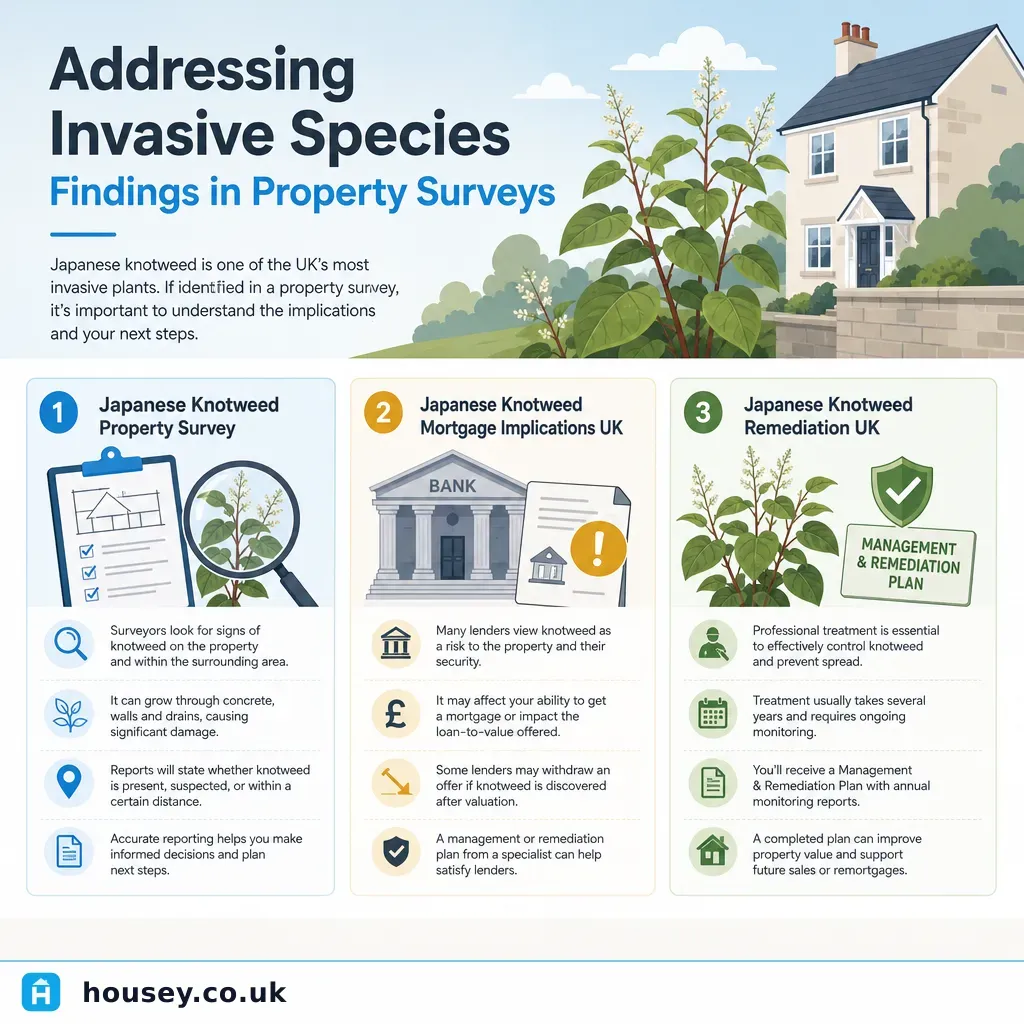
Addressing Invasive Species Findings in Property Surveys
If a property survey flags an invasive species such as Japanese knotweed, you should commission a specialist ecological or knotweed survey to confirm the extent and obtain a management plan.
 Surveys & Inspections
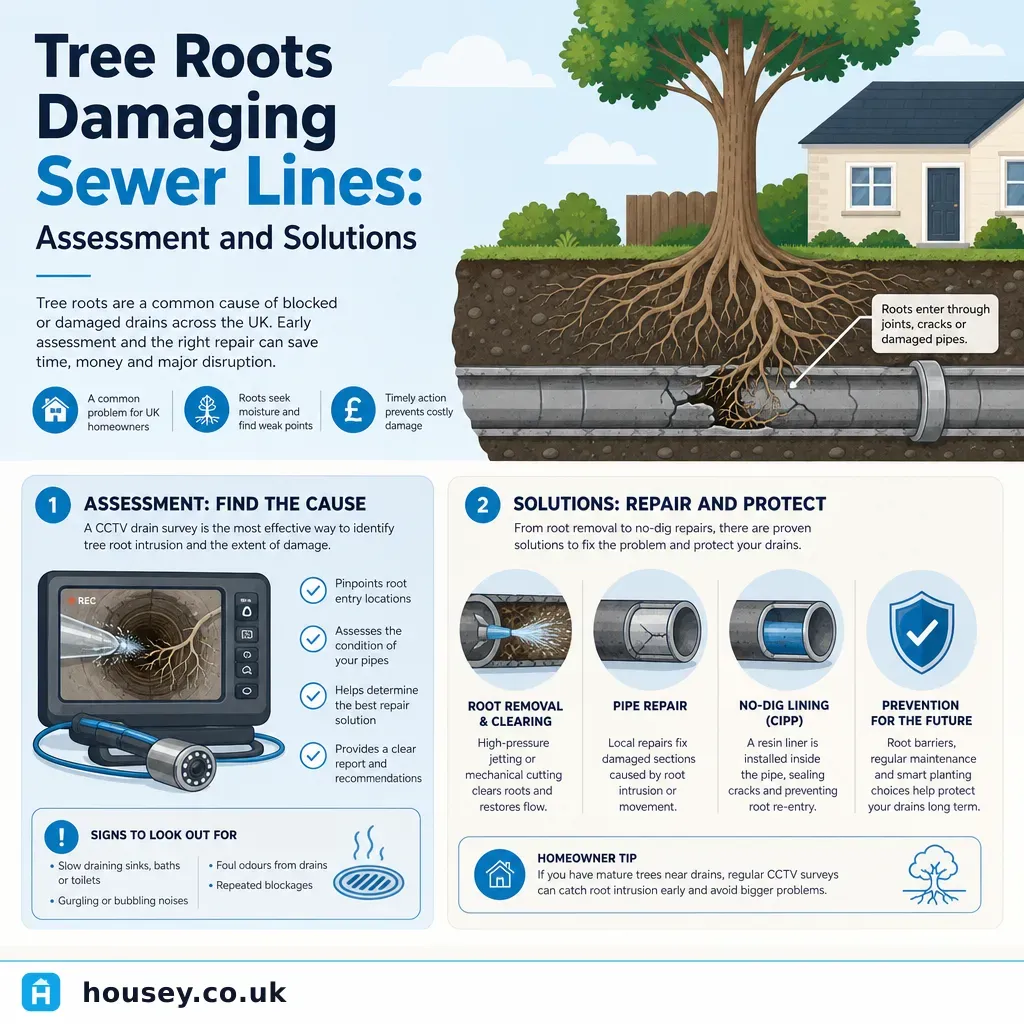
Tree Roots Damaging Sewer Lines: Assessment and Solutions
Tree roots enter UK drain pipes through hairline cracks and displaced joints, progressively blocking and damaging the pipe structure.
 Surveys & Inspections
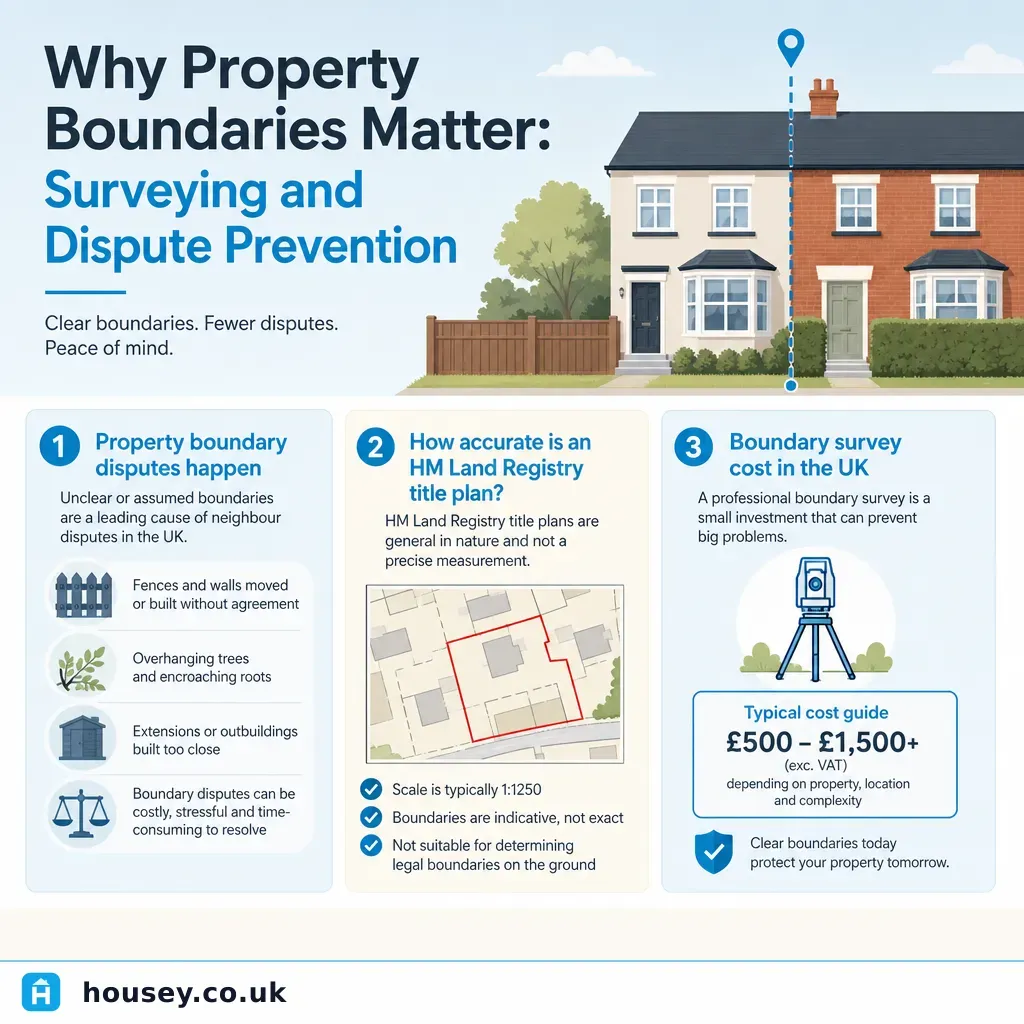
Why Property Boundaries Matter: Surveying and Dispute Prevention
Property boundaries in England and Wales are recorded as general boundaries by HM Land Registry — not precise measurements.
 Surveys & Inspections
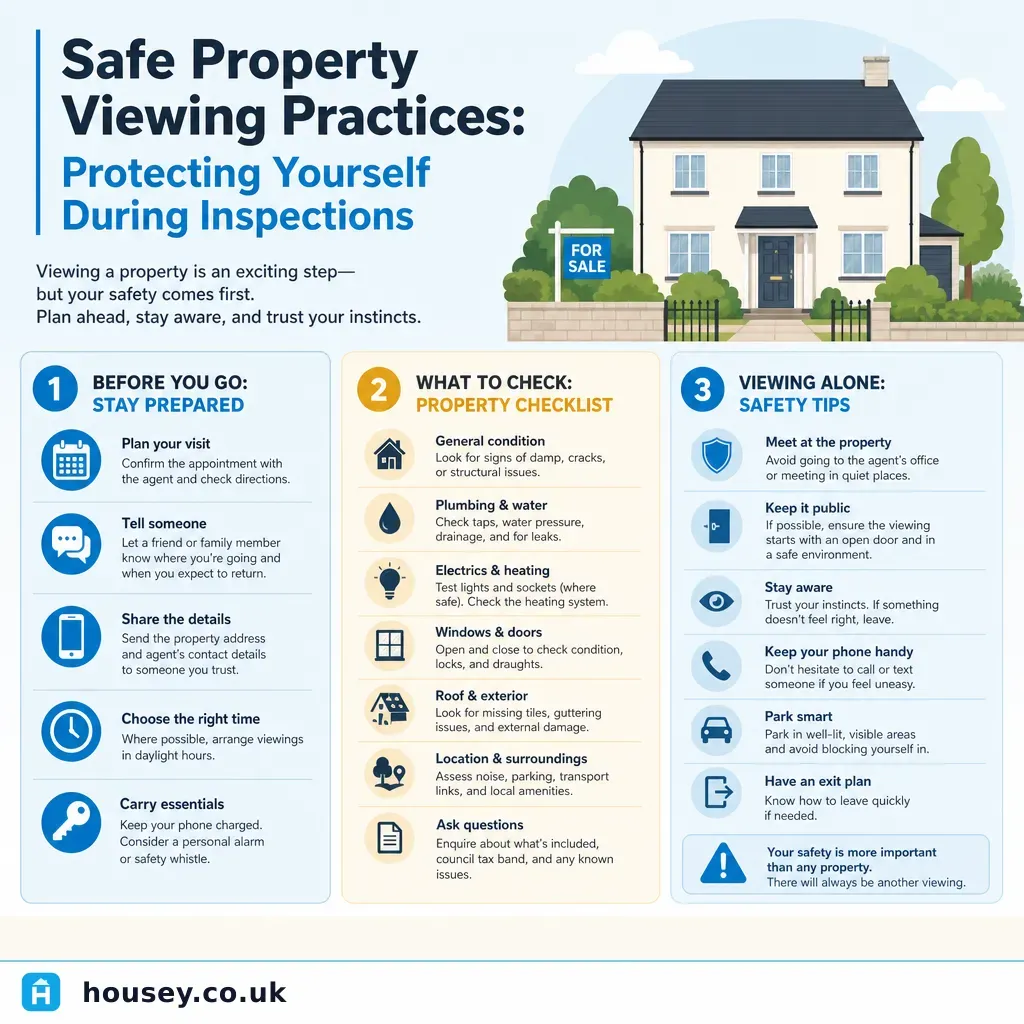
Safe Property Viewing Practices: Protecting Yourself During Inspections
When viewing a property in the UK, always tell someone where you are going and share the full address before you leave.
 Surveys & Inspections
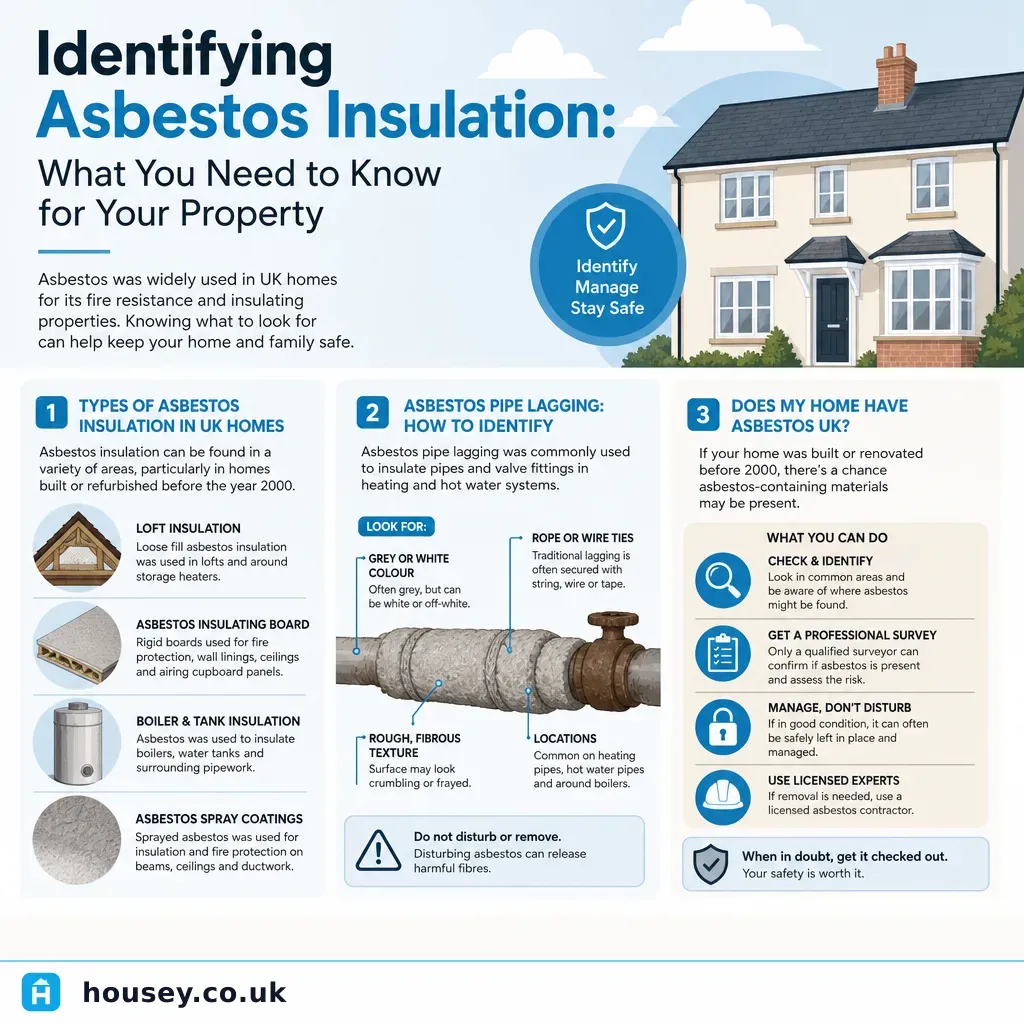
Identifying Asbestos Insulation: What You Need to Know for Your Property
Asbestos insulation was widely used in UK properties built before 2000, commonly found in pipe lagging, ceiling tiles, loose-fill loft insulation, and around boilers.