Buying a Home: Balancing Emotion With Property Assessment and Due Diligence
By Housey · Last reviewed 18th of May 2026
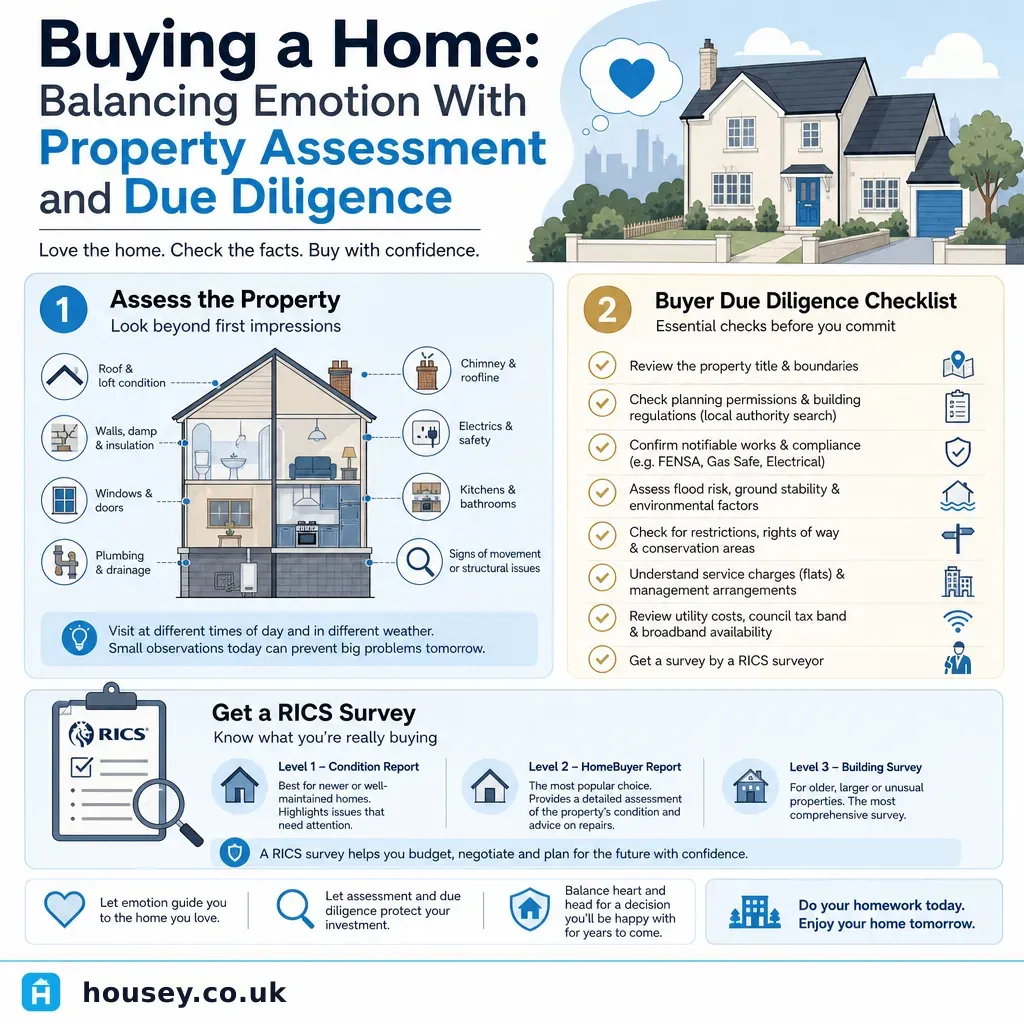
Buying a Home: Balancing Emotion With Property Assessment and Due Diligence
Most buyers know within moments of a viewing whether a property feels right — long before any formal checks have taken place. That instinct is a reasonable starting point, but the competitive pace of the UK market can turn emotional momentum into a liability. Pressure to make quick offers, reluctance to commission a survey in case it complicates the purchase, or dismissing a surveyor's findings because of attachment to a home are all patterns that transfer risk from vendor to buyer. The challenge is not to suppress emotion but to make sure the evidence base keeps pace with the enthusiasm.
Key points
- Around 30% of UK property sales fall through before completion, according to Rightmove estimates — surveys and searches revealing unexpected problems are among the leading causes
- A RICS Level 2 Home Survey is typically appropriate for post-1945 conventional homes in reasonable visible condition; a RICS Level 3 Building Survey provides considerably more detail and is recommended for older, extended, or visibly defective properties
- Estate agents act for the vendor under the Consumer Protection from Unfair Trading Regulations 2008 and are not required to proactively disclose defects they are unaware of
- Conveyancing searches (local authority, drainage and water, environmental, and chancel repair) reveal planning history, flood risk, and infrastructure issues invisible during a viewing
- Exchange of contracts is the legally binding point in England and Wales — any concerns about the property should be resolved before exchange, not after
Why emotion isn't the problem — the timing is
Feeling strongly about a property is not itself a mistake. The problem arises when emotional momentum compresses or bypasses the due diligence process. Common patterns include:
- Making an offer after a single viewing, without returning to assess the property more carefully
- Waiving or downgrading a survey to appear a more attractive buyer, or to avoid delay
- Treating assurances from the estate agent as a substitute for independent legal and structural checks
- Minimising or dismissing concerns raised in a survey because of attachment to the purchase
Each of these transfers risk from the vendor to the buyer. Due diligence is not an obstacle to buying the property you want — it is how you confirm the decision is sound, or protect yourself from a costly mistake.
What due diligence actually covers
Due diligence in a UK residential purchase has several distinct layers, each covering different types of risk.
Layer | What it covers | Who provides it |
|---|---|---|
RICS Level 2 or Level 3 survey | Structural condition, visible defects, damp, roof, drainage, maintenance needs | RICS-qualified chartered surveyor |
Mortgage valuation | Whether the lender considers the property adequate security for the loan | Lender's appointed surveyor (not the buyer's independent check) |
Conveyancing searches | Local authority planning history, drainage and water, environmental hazards, flood risk, chancel repair liability | Licensed conveyancer or solicitor |
Land Registry title checks | Ownership, restrictive covenants, easements, charging orders, boundaries | Solicitor or licensed conveyancer |
Specialist surveys | Subsidence, asbestos, drainage CCTV, damp and timber, roof | Specialist contractor or structural engineer |
A mortgage valuation is not a survey. The lender's valuation confirms the property is adequate security for the loan — it does not assess condition in detail and carries no liability to the buyer. Many buyers discover this distinction only after completion.
Decision tree: which survey should you commission?
- Choose RICS Level 2 if the property is a conventional post-1945 home in visible reasonable condition, with no obvious structural concerns, no recent major alterations, and standard construction (brick cavity walls, tile or slate roof, standard joinery)
- Choose RICS Level 3 if the property is pre-1919, has visible cracks, damp, or water ingress; has had extensions, loft conversions, or other alterations; uses non-standard construction (timber frame, in situ concrete, steel frame, large-panel systems); or you want the most detailed assessment available
- Commission a structural engineer if the surveyor identifies suspected movement, heave, or subsidence and recommends specialist investigation — a general survey can flag concern but cannot provide an engineering diagnosis
- Commission a specialist damp and timber survey if there is visible damp, a history of damp treatments, or a cellar or basement
- Speak to a qualified asbestos professional if the property is pre-2000 and has artex ceilings, older floor tiles, or lagged pipes — do not disturb suspected asbestos-containing materials
What not to assume
These are common misunderstandings that buyers under emotional pressure often make.
"The estate agent would have told me if something was wrong." Estate agents act for the vendor and are not required to proactively disclose defects they are unaware of. Under the Consumer Protection from Unfair Trading Regulations 2008 they must not make false or misleading statements, but your protection comes from your own independent survey and legal checks — not from the agent.
"The surveyor said it was fine." A RICS Level 2 survey is a visual inspection of accessible areas on a single visit. It cannot open walls, lift floors, or test drains. No significant concerns on a Level 2 report means no visible concerns on the day of inspection — not a structural guarantee.
"It's been recently renovated so it must be sound." Recent cosmetic renovation can conceal problems as readily as it resolves them. Fresh plasterboard, new paint, and new flooring can obscure damp, rot, or structural defects. A RICS Level 3 Building Survey is particularly important for recently renovated older properties.
"My offer has been accepted, so I'm committed." In England and Wales, there is no legal commitment until contracts are exchanged. You can withdraw at any point before exchange, though you will lose survey and search costs already paid. In Scotland the position differs — once missives are concluded, the agreement is legally binding.
Red flags during a viewing
Some concerns are worth noting before instructing any professional:
- Cracks wider than a few millimetres, particularly stepped cracks through brick joints or diagonal cracks from window or door corners
- Evidence of damp or previous damp treatment — tide marks, flaking plaster, or fresh paint on the lower sections of walls
- Sagging or uneven floors in an older property
- Recent cosmetic work that appears rushed — new plasterboard over old, fresh render patches, or mismatched paintwork
- Misaligned or sticking doors and windows, which can indicate structural movement
- Strong odours: damp, mould, or drain smells
- Gaps between an extension and the original structure
- Low water pressure or discoloured water from taps
None of these necessarily means walking away — but all are reasons to commission the most detailed survey available for the property type.
When to get professional help
If a survey identifies potential subsidence, significant structural movement, or any concern requiring specialist investigation, a chartered structural engineer should assess the property before exchange — not just a general surveyor. If your solicitor identifies title complications (restrictive covenants, missing planning consents, a lease below 80 years), take their advice seriously before proceeding.
Buyers in Scotland should note that the conveyancing process operates differently; solicitor involvement from the earliest stages is standard practice, and the legal weight of an accepted offer differs from England and Wales.
How Housey can help
Housey connects you with RICS-qualified surveyors for the right level of inspection before you commit. Whether you need a RICS Home Survey to assess the property's condition, or an independent valuation survey to check you're paying a fair price, getting the facts before exchange is the most reliable way to make a confident decision you can stand behind.
Frequently asked questions
Can I negotiate a lower price based on survey findings?
Yes, and this is common practice in England and Wales. If a RICS survey identifies significant remedial works — roof repairs, structural movement, or damp treatment — you can renegotiate before exchange. The vendor is not obliged to reduce the price, but many will, particularly where the issue would need addressing regardless. Your solicitor can handle this formally before exchange is agreed.
Can I pull out of a purchase after a survey reveals problems?
In England and Wales, you can withdraw before exchange of contracts without legal penalty, though you will lose the cost of any survey and searches already paid. If the vendor made a fraudulent misrepresentation — falsely denying known defects — you may have a legal remedy, though this is uncommon. In Scotland, withdrawal after missives are concluded carries greater risk of legal liability.
Is a RICS Level 3 survey worth the extra cost?
For Victorian terraces, interwar semis, period properties, or any home with extensions, loft conversions, or visible concerns, a Level 3 survey typically costs £400–£800 more than a Level 2 but can provide considerably greater value — either through renegotiation leverage or by revealing hidden serious defects before commitment. For a standard post-1985 conventional home in good condition, a Level 2 is usually proportionate. Indicative UK costs, last reviewed 2026-05-18.
Do I need a survey if I'm buying with cash?
There is no legal requirement for a survey in a cash purchase. However, without a lender requiring any form of valuation, there is no external check whatsoever. Commissioning an independent RICS survey is particularly advisable for cash buyers precisely because the absence of a mortgage removes the only other party who would otherwise conduct even a basic assessment of the property.
Sources and further reading
- RICS Home Survey Standard — RICS
- Consumer Protection from Unfair Trading Regulations 2008 — legislation.gov.uk
- Buying a home: conveyancing — GOV.UK
- Buying a home — Citizens Advice
Useful next reads
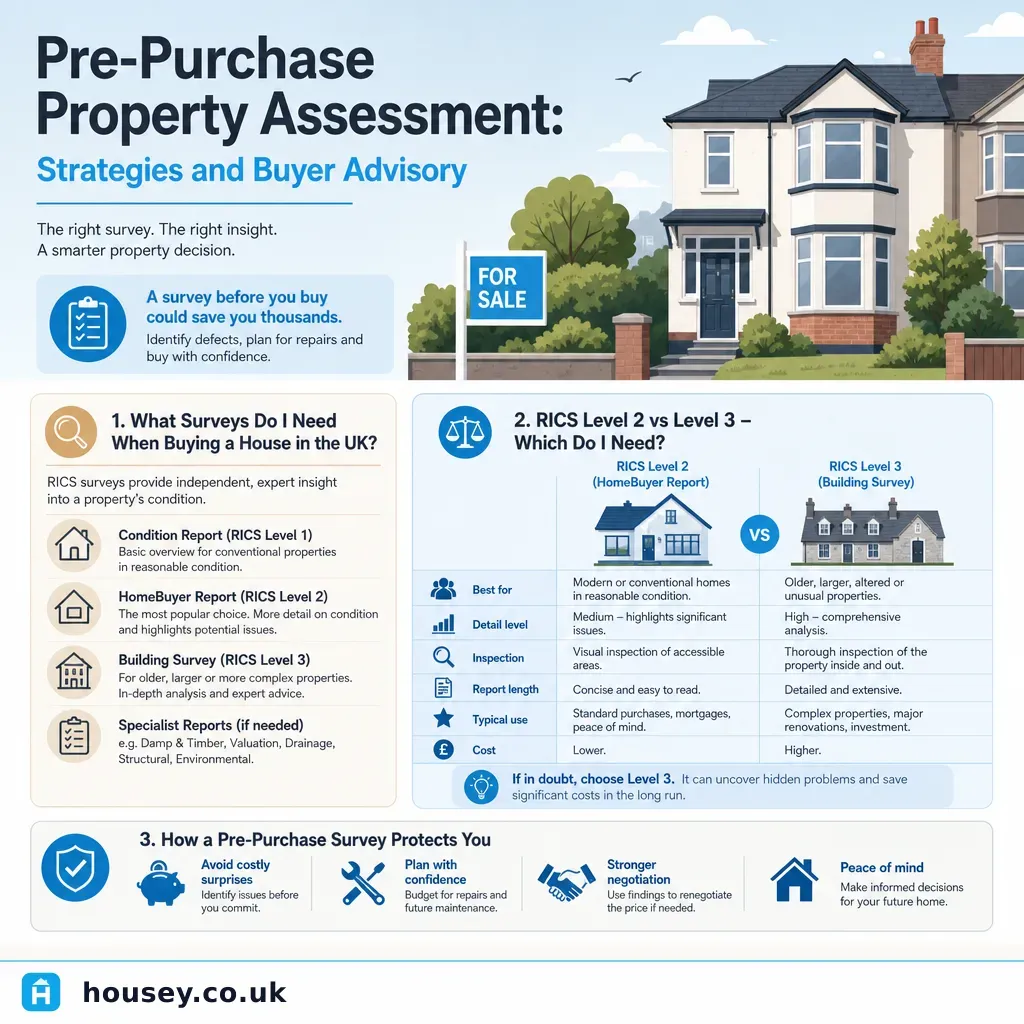 Buying & Moving
Pre-Purchase Property Assessment: Strategies and Buyer Advisory
A pre-purchase property assessment in the UK typically combines an independent RICS Home Survey, conveyancing searches, and specialist inspections for damp or electrical condition where needed.
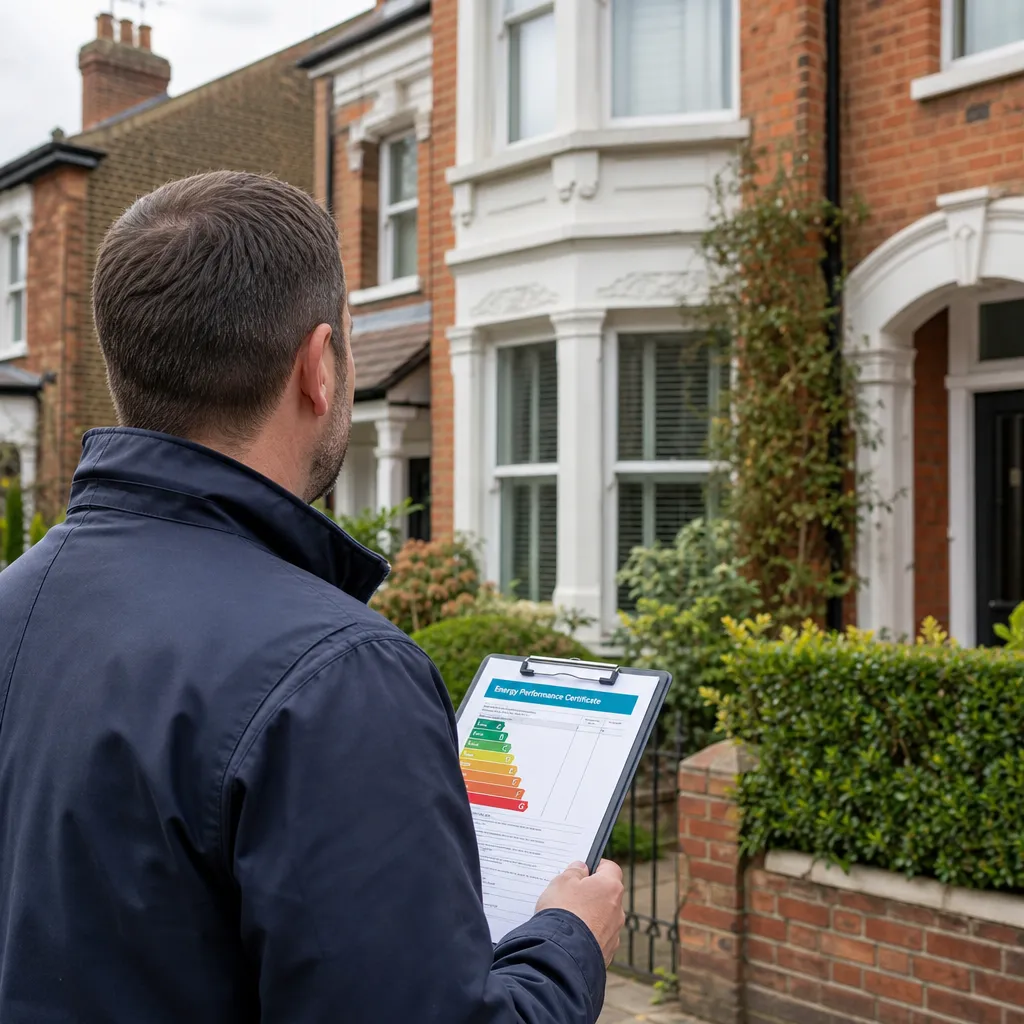 Buying & Moving
What Do EPC Ratings Tell You? Understanding Energy Performance Certificates When Buying Property
An Energy Performance Certificate (EPC) rates a property from A (most efficient) to G (least efficient) using a score out of 100, based on estimated energy costs, insulation, heating systems, and carbon emissions.
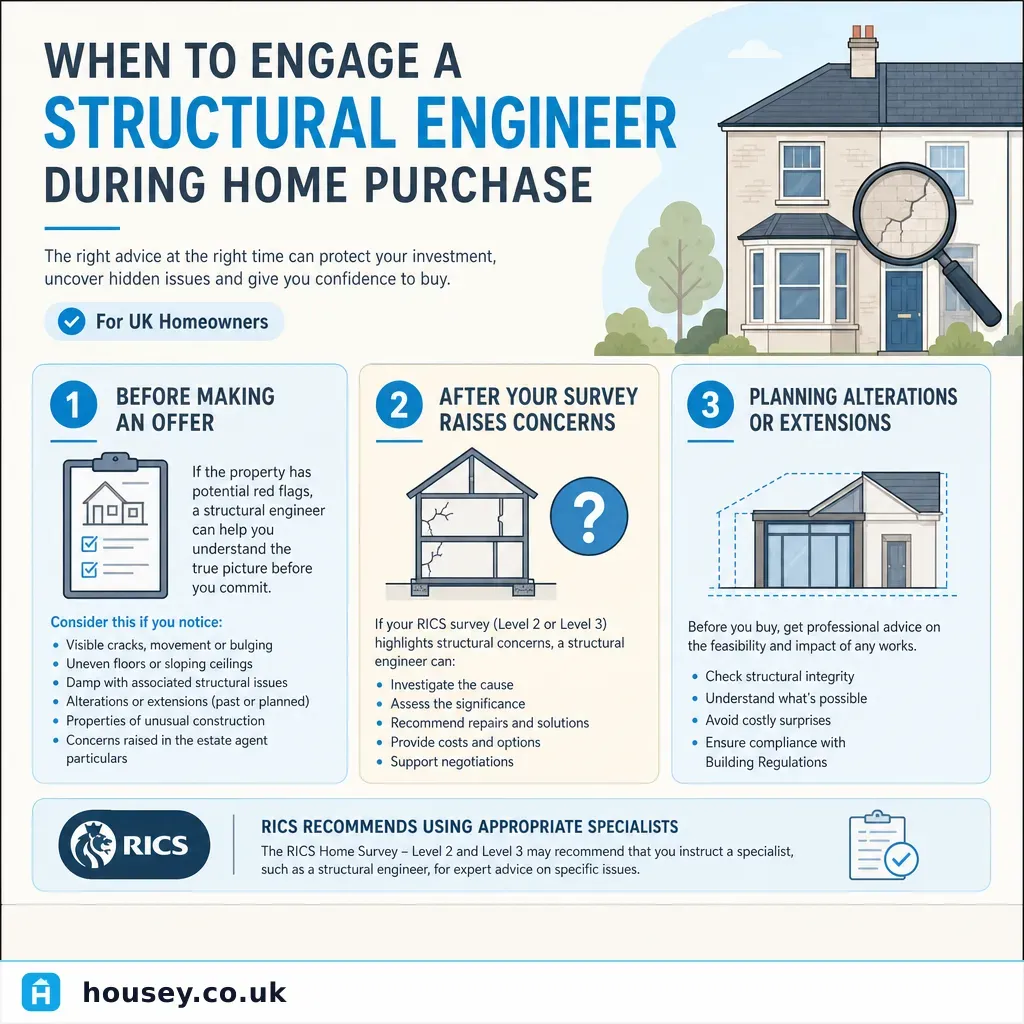 Buying & Moving
When to Engage a Structural Engineer During Home Purchase
Instruct a structural engineer before exchange if your RICS survey flags movement, cracking rated condition 3, or suspected subsidence.
 Buying & Moving
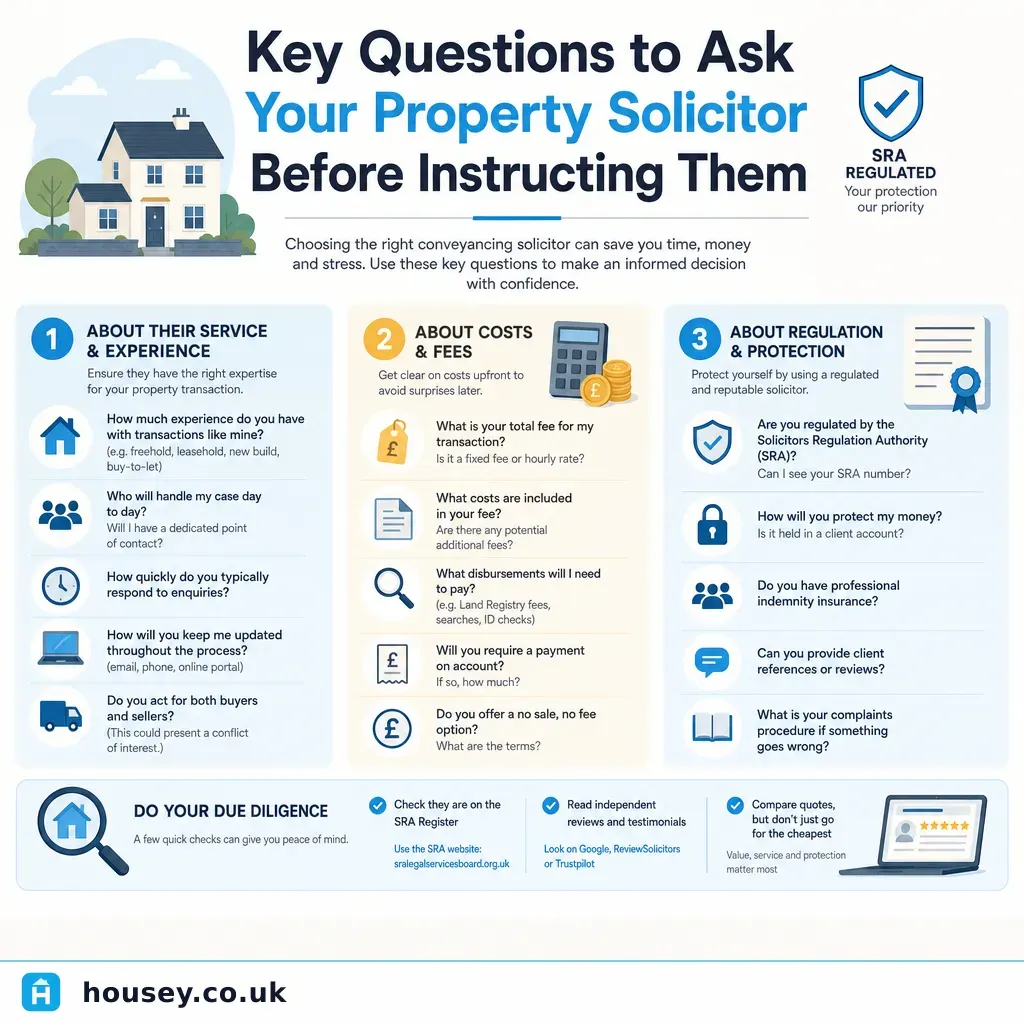
Key Questions to Ask Your Property Solicitor Before Instructing Them
Before instructing a property solicitor, ask whether they are on your mortgage lender's approved panel, whether their quote is fixed and includes VAT and all disbursements, who will personally handle your case, and what their abortive-fee policy is.
 Buying & Moving
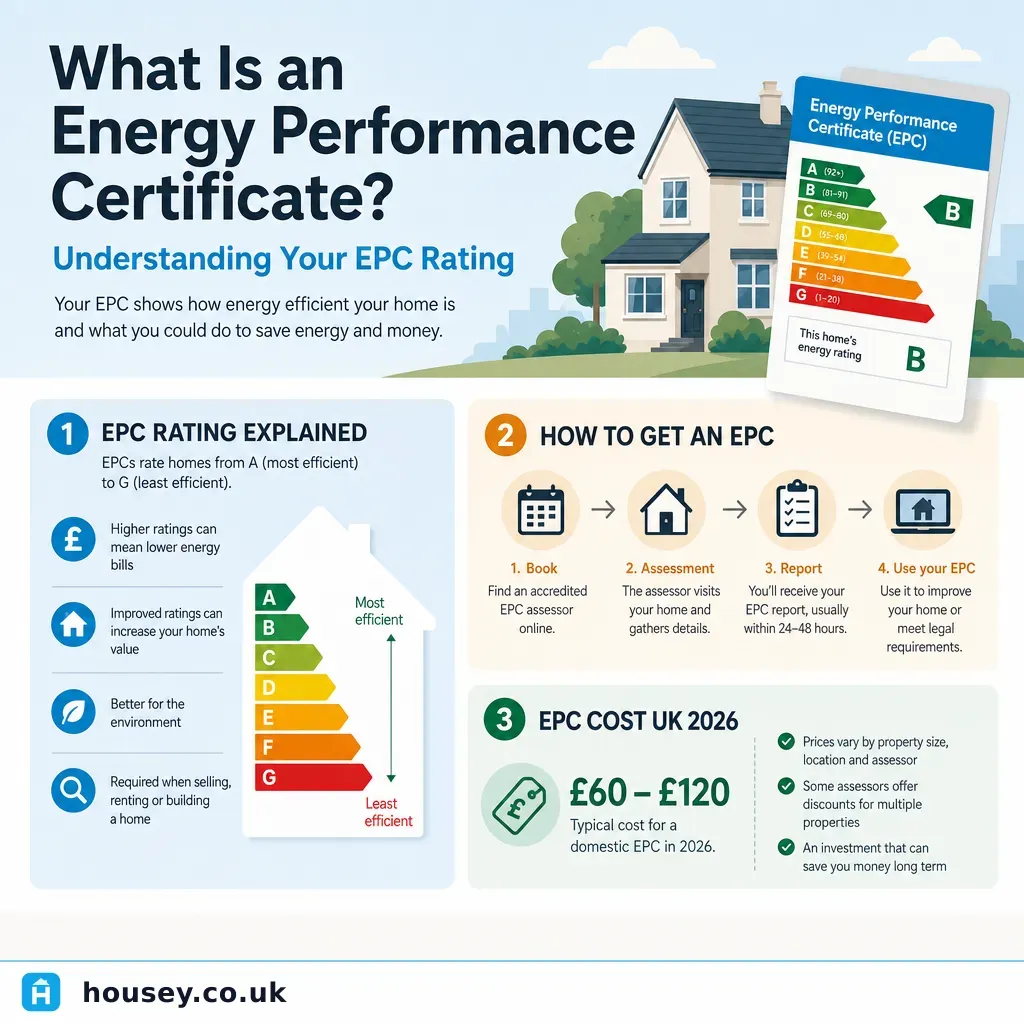
What Is an Energy Performance Certificate: Understanding Your EPC Rating
An Energy Performance Certificate (EPC) rates a property's energy efficiency from A (most efficient) to G (least efficient) using a 1–100 SAP score.