Pre-Purchase Property Assessment: Strategies and Buyer Advisory
By Housey · Last reviewed 18th of May 2026
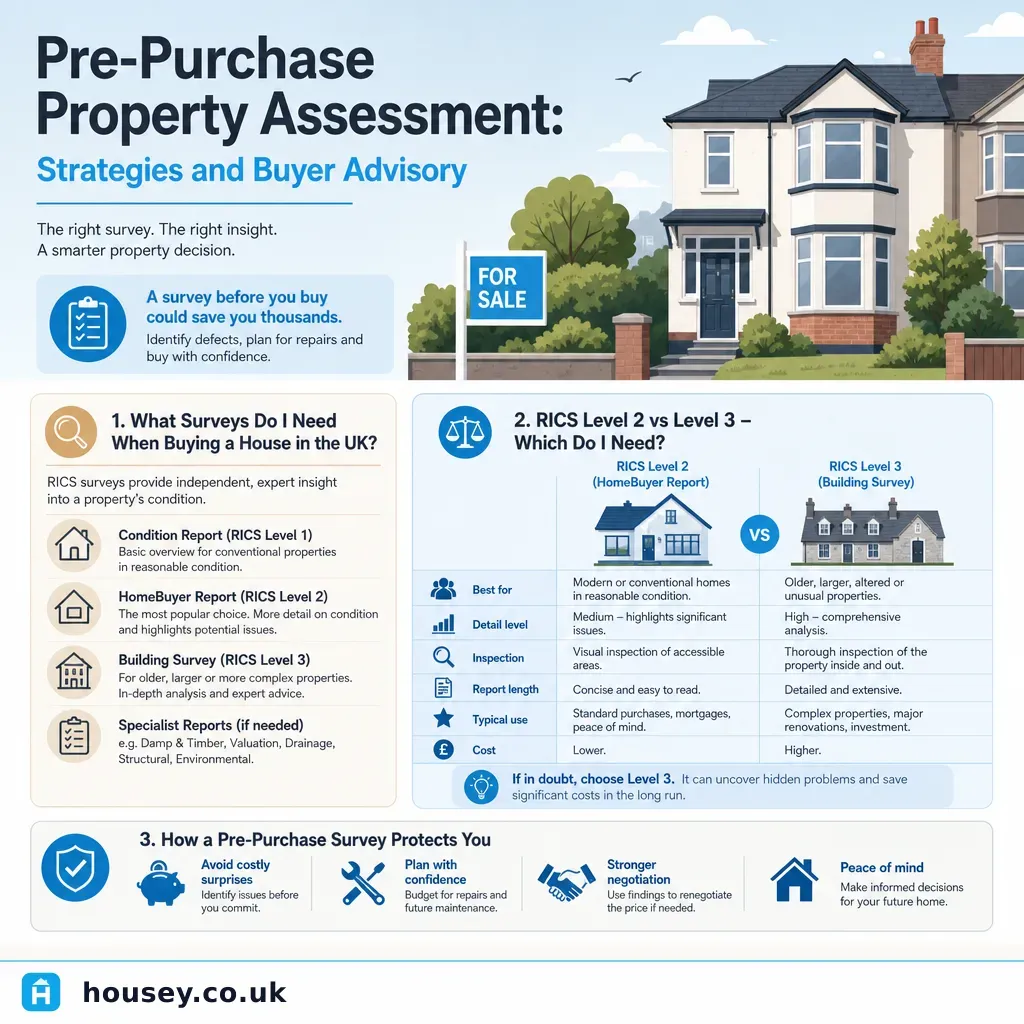
Pre-Purchase Property Assessment: Strategies and Buyer Advisory
In England and Wales, residential property is sold on the principle of caveat emptor — buyer beware. Sellers have limited legal duty to disclose most physical defects, so the burden of identifying problems before exchange falls almost entirely on the buyer. The right combination of assessments, carried out in the right order, is what separates an informed purchase from an expensive surprise.
Key points
- In England and Wales, sellers have no general legal obligation to disclose physical defects; buyers take on the property in the condition it is in at the point of exchange.
- A RICS Level 2 HomeBuyer Report is appropriate for conventional homes in reasonable condition; a RICS Level 3 Building Survey is required for pre-1919 properties, those with visible defects, or those with unexplained past works.
- Conveyancing searches — local authority, drainage and water, environmental, and chancel repair — reveal legal and regulatory risks that no physical survey covers.
- An Electrical Installation Condition Report (EICR) is not routinely provided by sellers of residential property; buyers should request one or arrange their own for any property built before 2000.
- Valuations carried out by mortgage lenders assess lending risk, not property condition — they are not a substitute for an independent buyer's survey.
Important limitations
This article provides general guidance on pre-purchase property assessment in England and Wales. The law of property in Scotland is materially different, and processes in Northern Ireland also differ. Rules vary by property type, tenure, construction, and local authority. A qualified solicitor or conveyancer should advise on legal matters; a RICS-chartered surveyor should assess the structural condition of any property you intend to buy.
Which assessment does your property need?
The appropriate combination of surveys depends on the property's age, condition, tenure, construction type, and intended use. The decision tree below is a starting point — always confirm the right approach with your surveyor once they know the property.
Decision tree: choosing your pre-purchase assessment
- New-build from a registered developer with an NHBC Buildmark warranty? → Consider a RICS Level 1 Condition Report or professional snagging survey before legal completion.
- Post-1990 conventional house in good visible condition? → A RICS Level 2 HomeBuyer Report is usually sufficient; add an EICR check if the wiring appears original or old.
- Pre-1919 terrace, Victorian or Edwardian property? → Commission a RICS Level 3 Building Survey; add a damp and timber survey if any moisture signs are visible.
- Property with a visible crack, bulge, or suspected structural movement? → Commission a structural engineer's report alongside or instead of the RICS survey.
- Leasehold flat in a multi-storey block? → RICS Level 2 plus thorough solicitor review of service charge accounts, lease length (below 80 years can affect mortgage availability), and any section 20 major works notices.
- Thatched, timber-framed, cob, or listed building? → RICS Level 3 with a surveyor who has demonstrable experience in historic construction methods.
- Property with extension, loft conversion, or basement works? → Verify building control completion certificates; if missing, commission a specific defect survey or structural engineer's inspection.
What each assessment covers — and what it misses
Assessment type | What it identifies | What it does NOT cover | Who provides it |
|---|---|---|---|
RICS Level 2 HomeBuyer Report | Visible defects, condition ratings, urgent repairs, legal issues to raise | Hidden defects; detailed structural diagnosis; services condition | RICS-chartered surveyor |
RICS Level 3 Building Survey | Full structural assessment, accessible concealed defects, remediation advice | Invasive investigation; services testing unless added separately | RICS-chartered surveyor |
Structural engineer's report | Engineering diagnosis of movement, cracking, or load-bearing concerns | General property condition; legal or planning matters | Chartered structural engineer (MIStructE or CEng) |
Damp and timber survey | Moisture source identification, timber decay, woodworm | General condition; structural integrity | Specialist damp surveyor (independent preferred) |
EICR | Electrical installation condition, faults, non-compliant circuits | Gas, drainage, structure | NICEIC- or NAPIT-registered electrician |
Conveyancing searches | Planning history, enforcement notices, flood risk, drainage, contaminated land | Physical condition; structural integrity; services | Licensed conveyancer or solicitor |
What not to assume when buying a property
A significant proportion of post-completion surprises stem from common misconceptions:
Do not assume the mortgage valuation confirms the property is structurally sound. A valuation is a brief inspection to confirm the lender's security. The valuation surveyor's duty runs to the lender, not you.
Do not assume visible works had planning permission. Extensions, outbuildings, and loft conversions require either planning permission or a formal determination that permitted development rights apply. Check the local planning authority portal by address before exchange.
Do not assume planning approval means building control was also obtained. These are entirely separate processes. A property may have valid planning permission but no completion certificate — meaning the build quality was never inspected by the local authority. Missing certificates may require a regularisation application and can affect a future sale.
Do not assume damp is "just condensation". Sellers and agents often attribute damp to lifestyle factors. Penetrating damp, rising damp, failed tanking, and drainage defects all present similarly to an untrained eye but carry very different remediation costs.
Do not assume a survey finding means the deal is off. Most surveys identify some issues. The key question is whether findings are cosmetic, manageable, or indicative of serious structural or legal risk. Your surveyor should help you calibrate severity and prioritise accordingly.
Red flags that warrant additional investigation
If you observe any of the following at a viewing or in a survey report, seek specialist advice before exchange:
- Stepped or diagonal cracks running through brickwork or blockwork, particularly if wider at one end or accompanied by wall bowing.
- Windows or doors that visibly bind or have been planed down — often a sign of structural movement rather than simply age.
- A persistent smell of damp, visible tide marks, or white efflorescence (salt deposits) on lower walls.
- Fresh paint or new plaster on a localised area of wall — can conceal recent crack or damp repairs.
- Corrugated or flat-roofed outbuildings or extensions where the roofing material is unidentified — possible asbestos-containing material; do not disturb.
- An extension or loft conversion where the vendor cannot produce building control or planning paperwork.
- A leasehold property where a section 20 notice has recently been served — possible indication of a large forthcoming service charge demand.
How to use survey findings strategically
A survey report is not just a health check — it is a negotiating document. When defects are identified:
- Ask your surveyor to clarify the severity and likely remediation cost of each flagged item.
- Obtain written contractor quotes for significant works before exchange where possible.
- Use the report and quotes to support a price renegotiation request or ask the vendor to address specific items.
- If the vendor declines and identified costs are material, weigh whether to proceed, renegotiate further, or withdraw.
Neither party is legally obliged to renegotiate, but using a survey report as the basis for a price discussion is standard practice in UK residential transactions.
When this becomes urgent
Seek immediate professional advice if: a survey reveals active structural movement or a widening crack; conveyancing searches return an outstanding enforcement notice or a contaminated land entry; or the building control history reveals underpinned foundations with no engineer's sign-off. Do not exchange while material structural, legal, or environmental issues remain unresolved.
What to ask a qualified professional
Before instructing a surveyor:
- Is this property more appropriate for a Level 2 or Level 3 survey, given its age, construction, and visible condition?
- Will the report include advice on which defects require specialist follow-up before exchange?
- Can I speak to you after the report is issued to discuss findings and their implications?
- Are you independent, or do you also offer remediation services for damp and timber?
Before instructing a conveyancer:
- What searches do you recommend for this property type and location?
- How will you flag title defects or planning irregularities as they arise?
- What is your process if building control completion certificates are missing?
When to get professional help
Commission an independent survey before exchange, not after. If structural concerns are flagged, instruct a structural engineer for a follow-up opinion before proceeding. If environmental or planning issues appear in conveyancing searches, ask your solicitor to explain the risk clearly before committing. Never rely solely on a seller's representations or an estate agent's description of condition.
How Housey can help
Housey connects buyers with qualified professionals for every stage of pre-purchase due diligence. Find RICS-chartered surveyors for RICS Home Surveys, structural surveys, and damp and timber surveys, as well as conveyancing specialists and professionals for Electrical Installation Condition Reports (EICR) and gas safety certificates.
Frequently asked questions
Is a pre-purchase survey legally required in England and Wales?
No. A pre-purchase survey is not a legal requirement. Sellers have no general obligation to disclose physical defects, and the buyer takes on the property as it is at exchange. A survey is your primary protection against undisclosed or undiscovered problems, and its cost is usually modest relative to the risks it helps identify.
Can a survey help me renegotiate the purchase price?
Yes — using survey findings to negotiate is standard practice in UK residential transactions. If the report identifies material defects with associated remediation costs, these form the basis of a written request for a price reduction or specific repairs. Supporting a renegotiation request with contractor quotes strengthens your position considerably.
What is a conveyancing search and why does it matter?
Conveyancing searches are formal enquiries made by your solicitor to official bodies to reveal legal, regulatory, and environmental risks. A local authority search may reveal planning enforcement notices or conservation area restrictions. A drainage search confirms sewer connections. An environmental search covers flood risk, contaminated land, and radon. Searches complement a physical survey — they cover risks no surveyor can assess on site.
What should I do if my survey flags suspected asbestos?
Do not disturb any material that may contain asbestos. Arrange a professional asbestos survey by a UKAS-accredited contractor before planning any intrusive works. Asbestos-containing materials are common in UK properties built between the 1950s and late 1990s. When undisturbed they are not inherently dangerous, but they require professional management. See HSE guidance for detailed information.
Sources and further reading
- RICS Home Survey Standard — RICS
- GOV.UK: Planning permission — GOV.UK
- GOV.UK: Building regulations approval — GOV.UK
- Citizens Advice: Buying a home — Citizens Advice
- HSE: Asbestos guidance — Health and Safety Executive
- Electrical Safety First: EICR guidance — Electrical Safety First
Useful next reads
 Buying & Moving
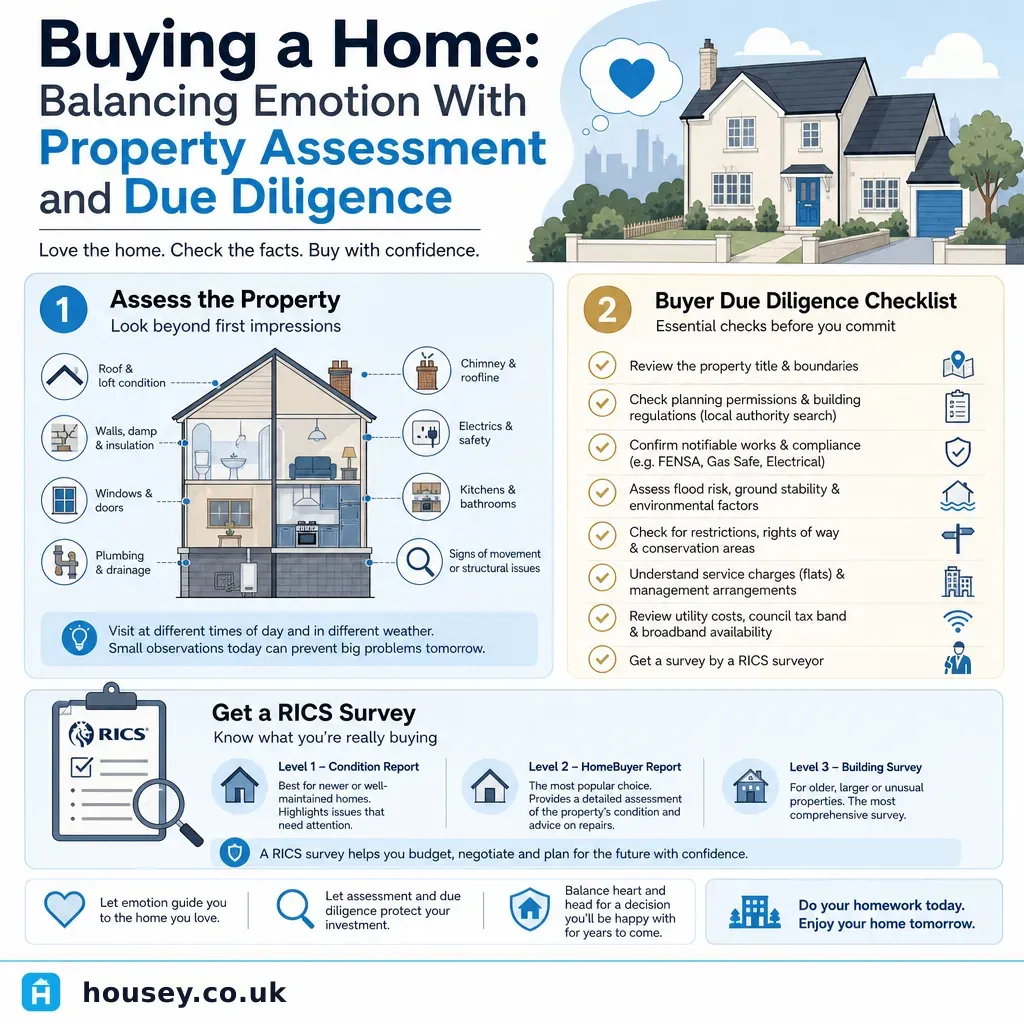
Buying a Home: Balancing Emotion With Property Assessment and Due Diligence
It's natural to feel strongly about a property, but buying decisions should be supported by a formal survey, proper searches, and independent legal advice.
 Buying & Moving
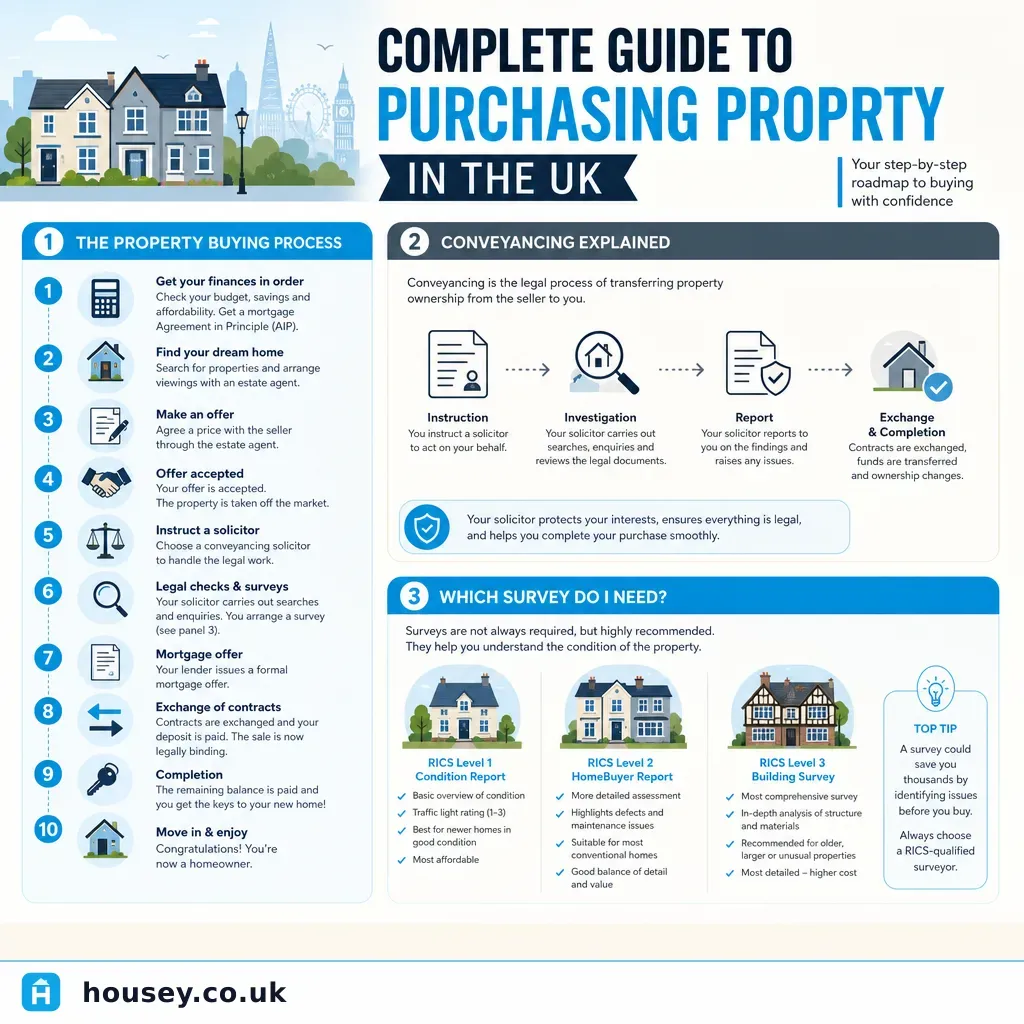
Complete Guide to Purchasing Property in the UK
Buying property in England and Wales typically takes 12 to 16 weeks from offer acceptance to completion.
 Buying & Moving
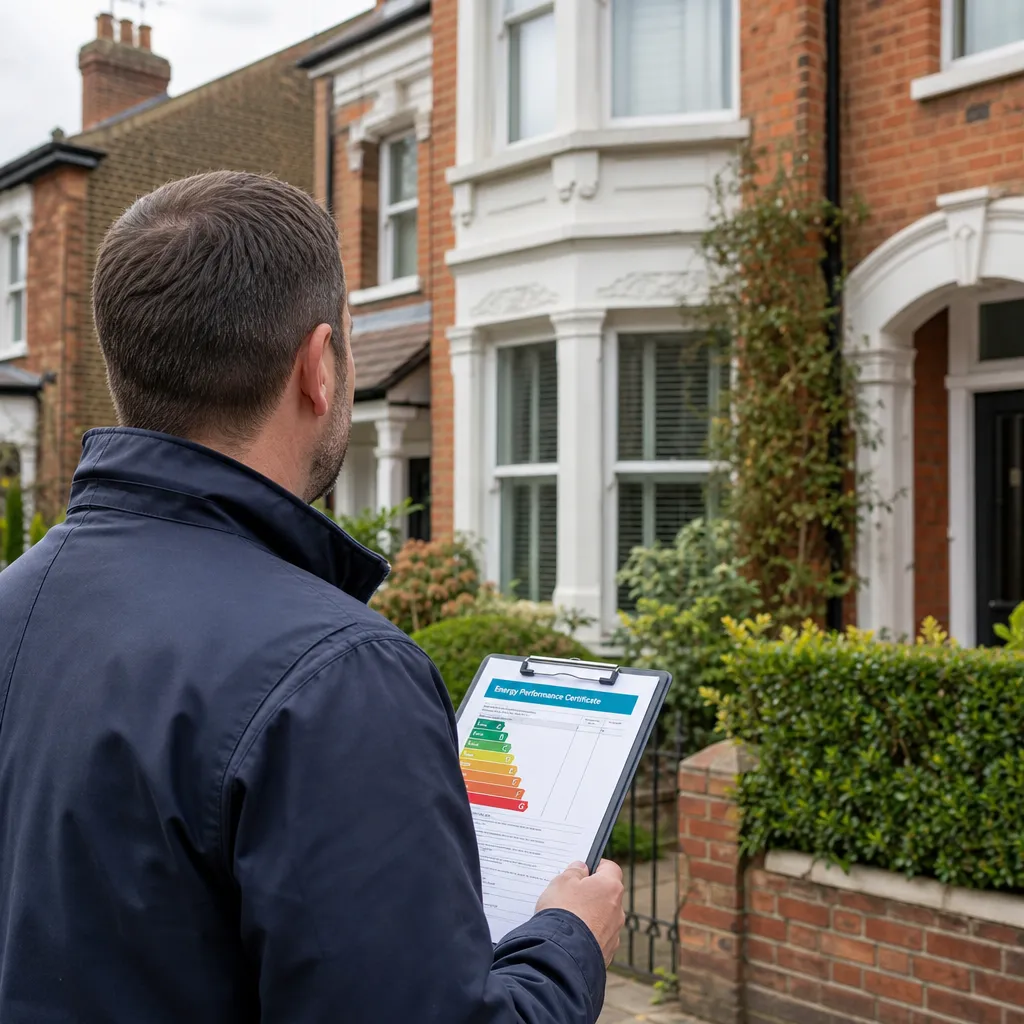
What Do EPC Ratings Tell You? Understanding Energy Performance Certificates When Buying Property
An Energy Performance Certificate (EPC) rates a property from A (most efficient) to G (least efficient) using a score out of 100, based on estimated energy costs, insulation, heating systems, and carbon emissions.
 Buying & Moving
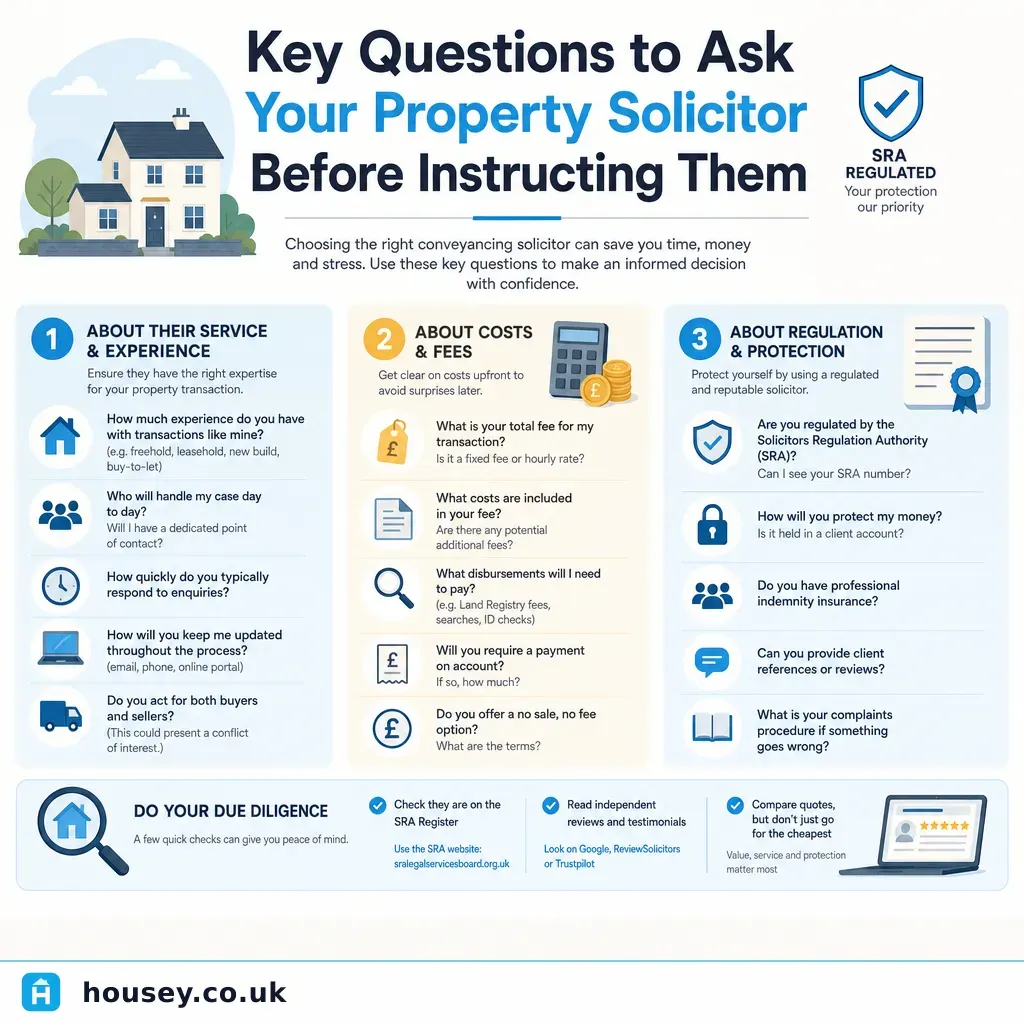
Key Questions to Ask Your Property Solicitor Before Instructing Them
Before instructing a property solicitor, ask whether they are on your mortgage lender's approved panel, whether their quote is fixed and includes VAT and all disbursements, who will personally handle your case, and what their abortive-fee policy is.
 Buying & Moving
Complete Homebuying Checklist and Essential Services for First-Time Buyers
First-time buyers in the UK should commission an independent RICS Home Survey before exchange — a mortgage lender's valuation does not protect you.