What Do EPC Ratings Tell You? Understanding Energy Performance Certificates When Buying Property
By Housey · Last reviewed 10th of May 2026
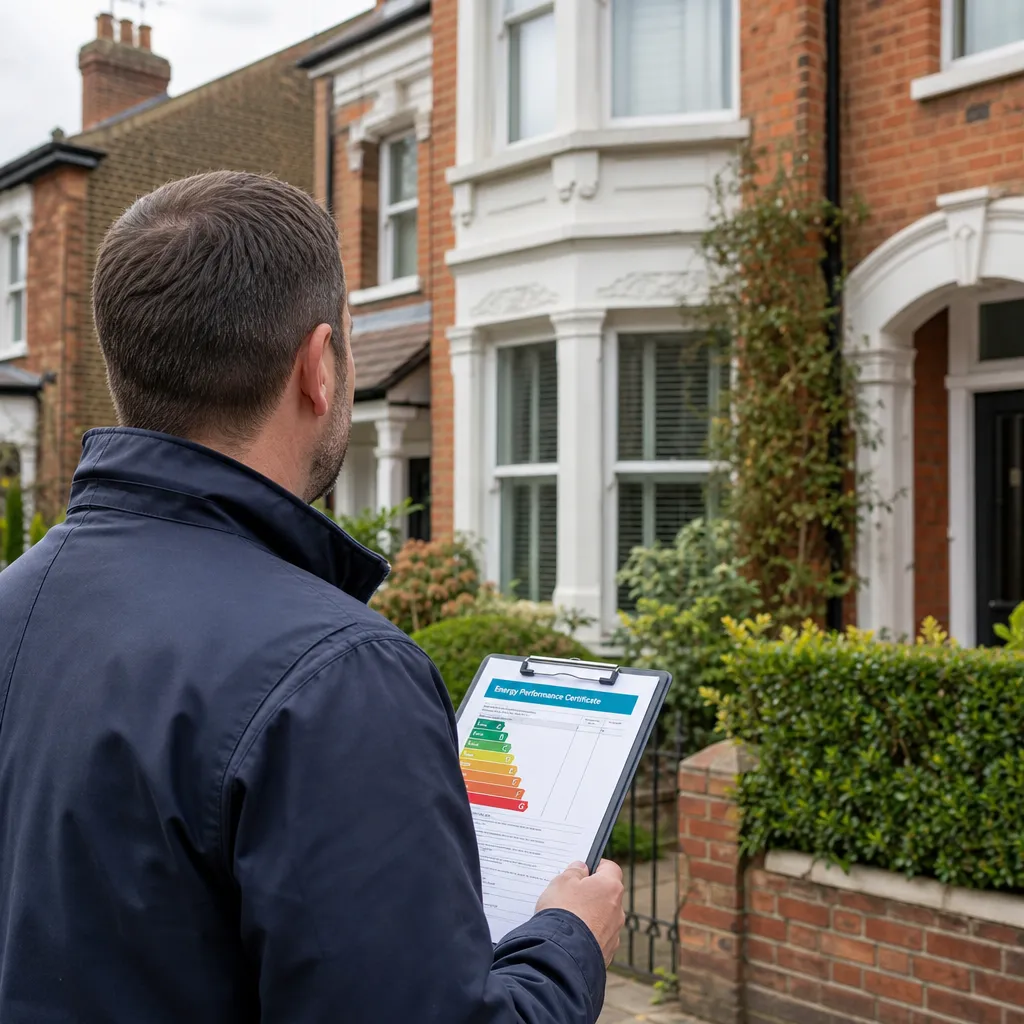
What Do EPC Ratings Tell You? Understanding Energy Performance Certificates When Buying Property
When you receive the property details for a home you are considering, one document sellers are legally required to provide is the Energy Performance Certificate (EPC). For many buyers, the rating feels like an afterthought — a letter on a page that rarely changes the decision. In reality, EPC data can reveal meaningful differences in annual running costs, highlight properties that may require significant investment to meet future regulations, and help you compare otherwise similar homes in ways that a viewing alone cannot.
Key points
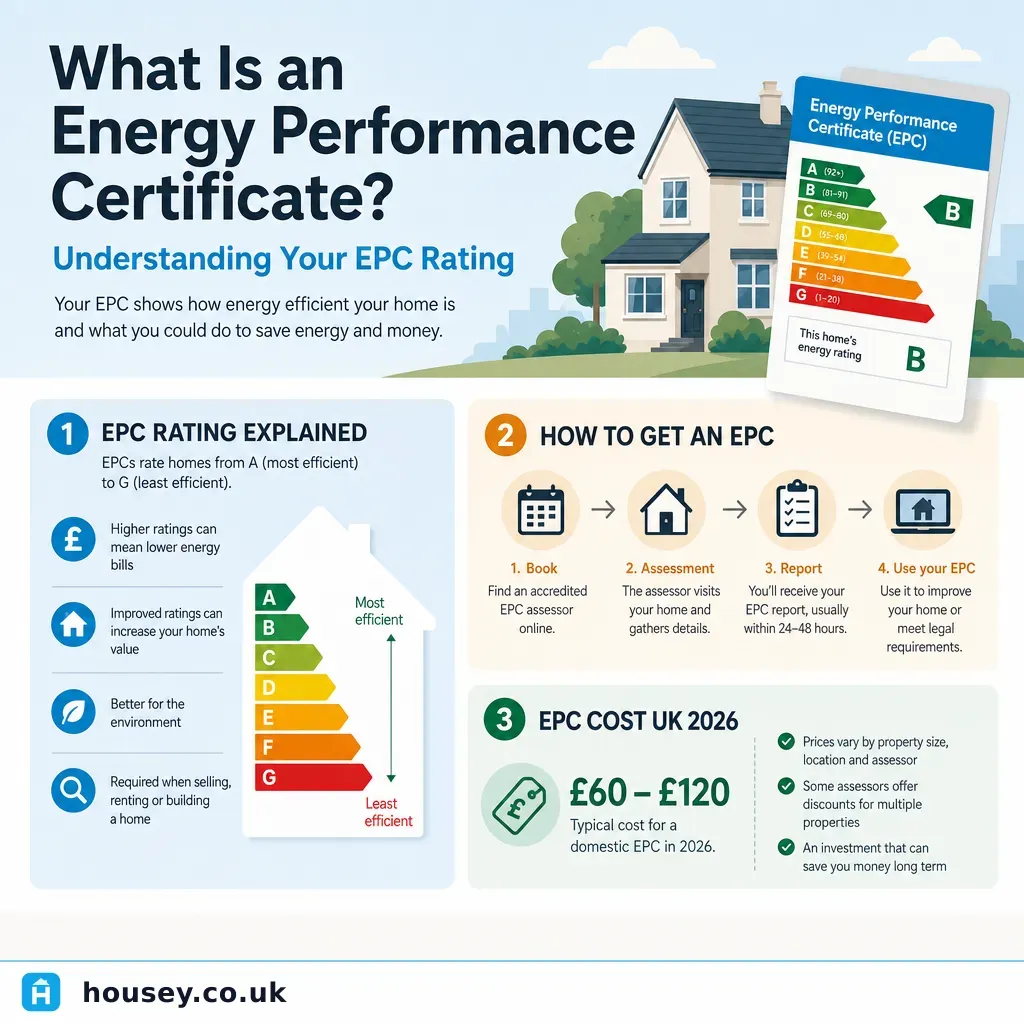
- EPCs rate properties from A (most efficient, score 92–100) to G (least efficient, score 1–20) using the Standard Assessment Procedure (SAP).
- Sellers must commission a valid EPC before marketing a property; buyers can check any registered EPC free of charge on the GOV.UK EPC register.
- An EPC includes the property's current SAP score and a potential score achievable if all recommended improvements are made.
- Rental properties in England and Wales must currently meet a minimum EPC E rating under the Minimum Energy Efficiency Standards (MEES) Regulations 2015.
- EPC ratings do not reflect actual energy bills — they are based on standardised assumptions about occupancy and usage, not your specific consumption patterns.
What the EPC rating scale means
An EPC assigns a letter from A to G based on a numerical SAP score calculated under the Government's Standard Assessment Procedure. The bands are defined as follows:
Band | SAP score | Description |
|---|---|---|
A | 92–100 | Extremely efficient; typical of new-builds or Passivhaus-standard homes |
B | 81–91 | Very efficient; well-insulated newer properties |
C | 69–80 | Above average; often 2000s–2010s builds or well-retrofitted older homes |
D | 55–68 | Average; the most common band in England and Wales |
E | 39–54 | Below average; common in older, less insulated properties |
F | 21–38 | Poor; significant improvement investment likely required |
G | 1–20 | Very poor; often uninsulated Victorian or Edwardian stock |
Most properties in England and Wales fall in bands D or E. According to the Department for Energy Security and Net Zero (DESNZ), fewer than 5% of homes currently achieve band A or B.
What information does an EPC contain?
Beyond the headline letter rating, an EPC report includes:
- Current and potential scores: the SAP score as assessed, and the score the property could reach if all recommended measures were implemented.
- Estimated energy costs: annual costs for heating, hot water, and lighting under standardised assumptions, shown for both current and potential scenarios.
- Environmental impact rating: the property's estimated CO₂ emissions in kg per year.
- Recommended improvements: a list of measures such as loft insulation, cavity wall insulation, or solar photovoltaic panels, with indicative cost ranges and estimated annual savings.
- Assessment details: the assessor's name and accreditation number. The certificate is valid for 10 years from the date of issue.
It is worth noting that the EPC captures the property as assessed, which may not reflect significant improvements made after the certificate was issued.
How EPC ratings affect buying decisions
Running costs and mortgage lending
A lower EPC band typically indicates higher estimated energy bills. The gap between a band D and a band F property can amount to several hundred pounds per year in estimated heating costs alone, though actual bills depend on occupant behaviour, tariff, and fuel type.
Some lenders offer preferential green mortgage rates for properties at EPC C or above. Halifax, Nationwide, and Barclays have all offered products in this space, though availability and terms change regularly — check with your mortgage broker for current options.
Renovation potential
An EPC with a low current score but a high potential score is worth examining carefully. A property scoring E (40) with a potential of B (85) suggests achievable improvement routes exist, but implementing all recommended measures may cost tens of thousands of pounds. Use the recommended improvements section alongside independent quotes from a retrofit assessor before assuming the potential figure is easily or cheaply achievable.
Leasehold flats
For leasehold flats, some improvement measures — such as external wall insulation or communal heating upgrades — require freeholder or managing agent consent and may involve service charge contributions from multiple leaseholders. The EPC's potential rating may be technically correct but practically difficult to achieve without collective agreement.
How to use the EPC when making an offer
Use the following guide when weighing up a property's EPC at offer stage:
- EPC A or B: running costs are likely to be low; no immediate improvement investment expected. Check the assessment date — a certificate issued in 2015 may not reflect current fabric condition.
- EPC C: broadly acceptable for most buyers; check what measures would push it to B if you plan to let the property.
- EPC D: average; identify which recommended measures are most cost-effective and factor into offer negotiations or post-purchase budgeting.
- EPC E: acceptable for owner-occupiers; if you intend to let the property, verify whether it meets the minimum MEES threshold and what improvement to EPC C might cost.
- EPC F or G: the property cannot legally be rented until improved to at least EPC E. For owner-occupiers, this signals a need for significant insulation and heating upgrades. Always obtain independent quotes before exchange.
- No EPC on record: if a property being marketed has no valid EPC, ask the agent or seller to provide one before progressing. It is a legal requirement for marketed residential properties in England and Wales.
EPC ratings and rental investment properties
If you are buying with the intention to let, EPC compliance is non-negotiable. Under the MEES Regulations, residential lettings in England and Wales must have at least an EPC E rating. Properties rated F or G cannot be legally let without an approved exemption registered on the PRS Exemptions Register.
Government consultations have proposed raising the minimum to EPC C for new tenancies, though the final policy and timeline remain subject to legislation. An energy-efficiency consultant can advise on the realistic cost and pathway to EPC C for any property you are considering as an investment.
When to get professional help
An EPC is a standardised snapshot, not a detailed energy audit. Consider seeking specialist advice if:
- The EPC is more than five years old and the property has had significant work — extensions, heating replacement, window upgrades — since assessment.
- The potential improvement section lists measures that seem inappropriate for the property type, such as cavity wall insulation recommended for a solid-wall Victorian terrace.
- You are buying a listed building or a property in a conservation area, where permitted improvement measures may be restricted by planning constraints.
- You are considering an F- or G-rated investment property and need a realistic improvement route to reach minimum lettings standards.
An EPC assessment or a full retrofit assessment can provide much greater granularity than the standard certificate.
How Housey can help
Housey connects UK buyers and homeowners with accredited EPC assessors, energy-efficiency consultants, and retrofit assessors who can carry out detailed energy surveys, advise on improvement pathways, and help you understand what an EPC rating means in practice for a specific property. Compare quotes from local professionals before committing to any energy improvement works.
Frequently asked questions
How long does an EPC last in the UK?
An EPC is valid for 10 years from the date of issue. Sellers are not legally required to obtain a new EPC if a valid one already exists, even if improvements have been made since assessment. Buyers can check the current registered certificate on the GOV.UK Energy Performance of Buildings Register.
Can I challenge an EPC rating?
You can ask an accredited assessor to reassess the property if you believe the rating is inaccurate. Assessors are accredited through schemes such as Elmhurst Energy, Stroma, or ECMK. Complaints about an assessor's work can be raised directly with the relevant accreditation scheme.
Does a poor EPC rating affect a property's value?
Research from Nationwide and others suggests properties with higher EPC ratings may command a modest premium over equivalent lower-rated homes, though the effect varies by location and property type. A poor EPC rating may also extend time on market as buyer awareness of energy costs continues to grow.
Do new-build homes always have a high EPC rating?
Most new-build homes in England achieve EPC B or above, as they must comply with Part L of the Building Regulations, which sets minimum fabric and heating efficiency standards. From 2025, the Future Homes Standard introduces further requirements that will push new-build performance higher still.
Sources and further reading
- Find an energy certificate — GOV.UK
- Guidance on energy performance certificates for the marketing, sale and let of dwellings — GOV.UK
- The Energy Efficiency (Private Rented Property) (England and Wales) Regulations 2015 — legislation.gov.uk
- Standard Assessment Procedure — GOV.UK
- Energy saving tips for your home — Energy Saving Trust
Useful next reads
 Buying & Moving
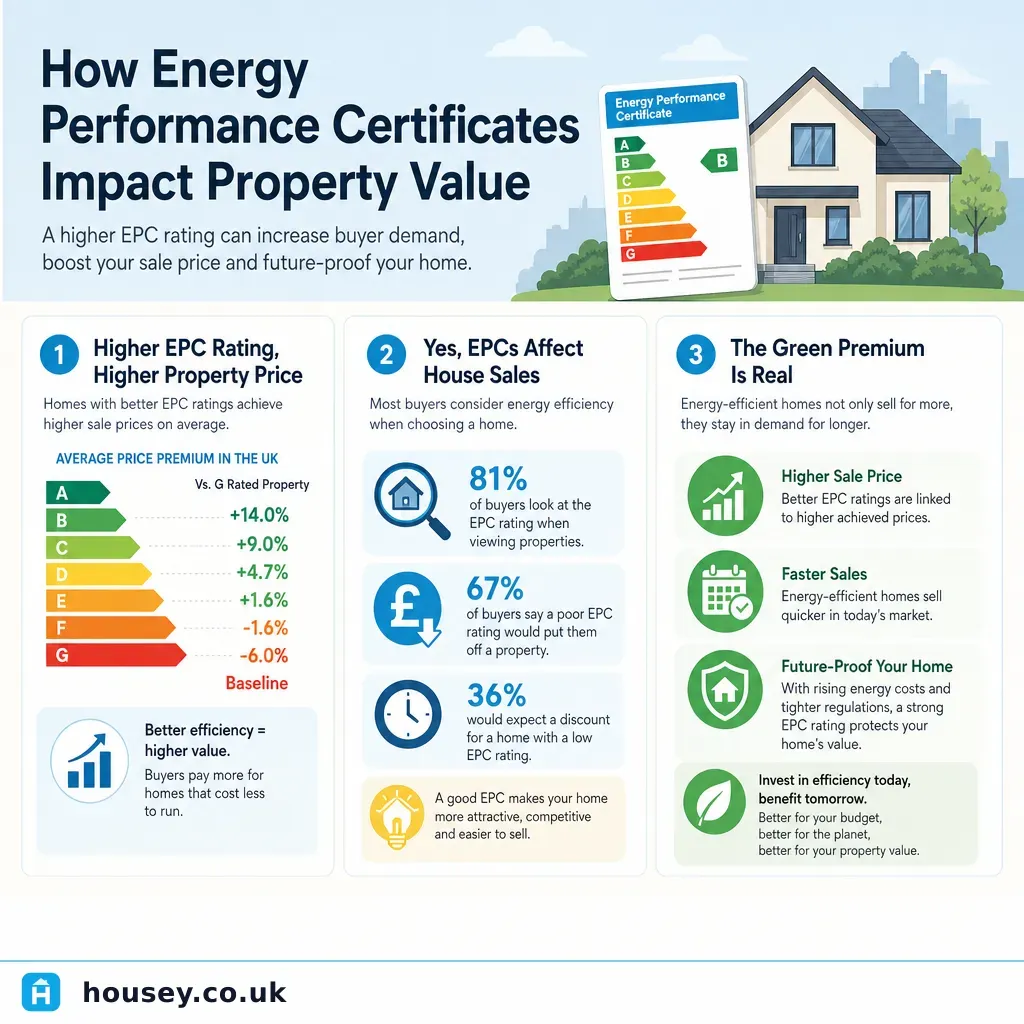
How Energy Performance Certificates Impact Property Value
A higher EPC rating can add measurable value to a UK property through a 'green premium' on open market sales, preferential green mortgage rates, and stronger buyer confidence.
 Buying & Moving
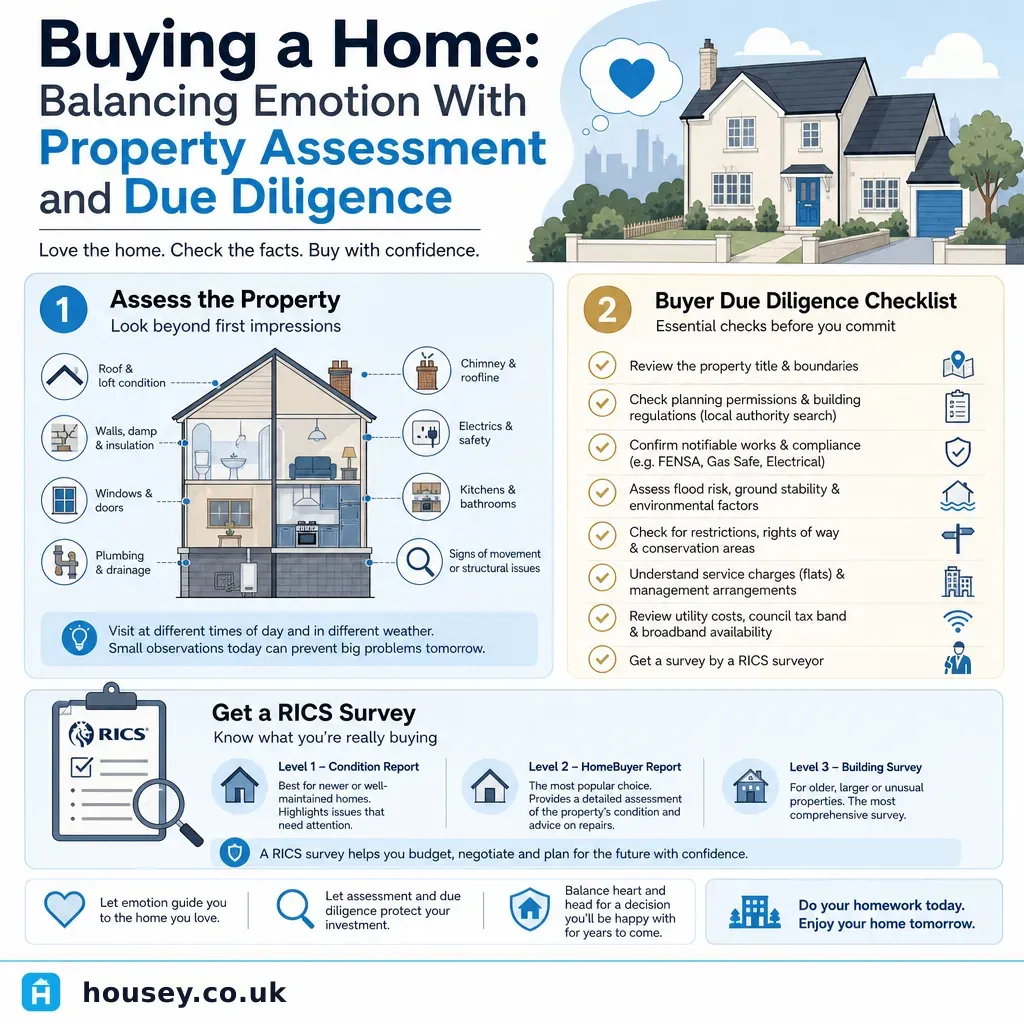
Buying a Home: Balancing Emotion With Property Assessment and Due Diligence
It's natural to feel strongly about a property, but buying decisions should be supported by a formal survey, proper searches, and independent legal advice.
 Buying & Moving
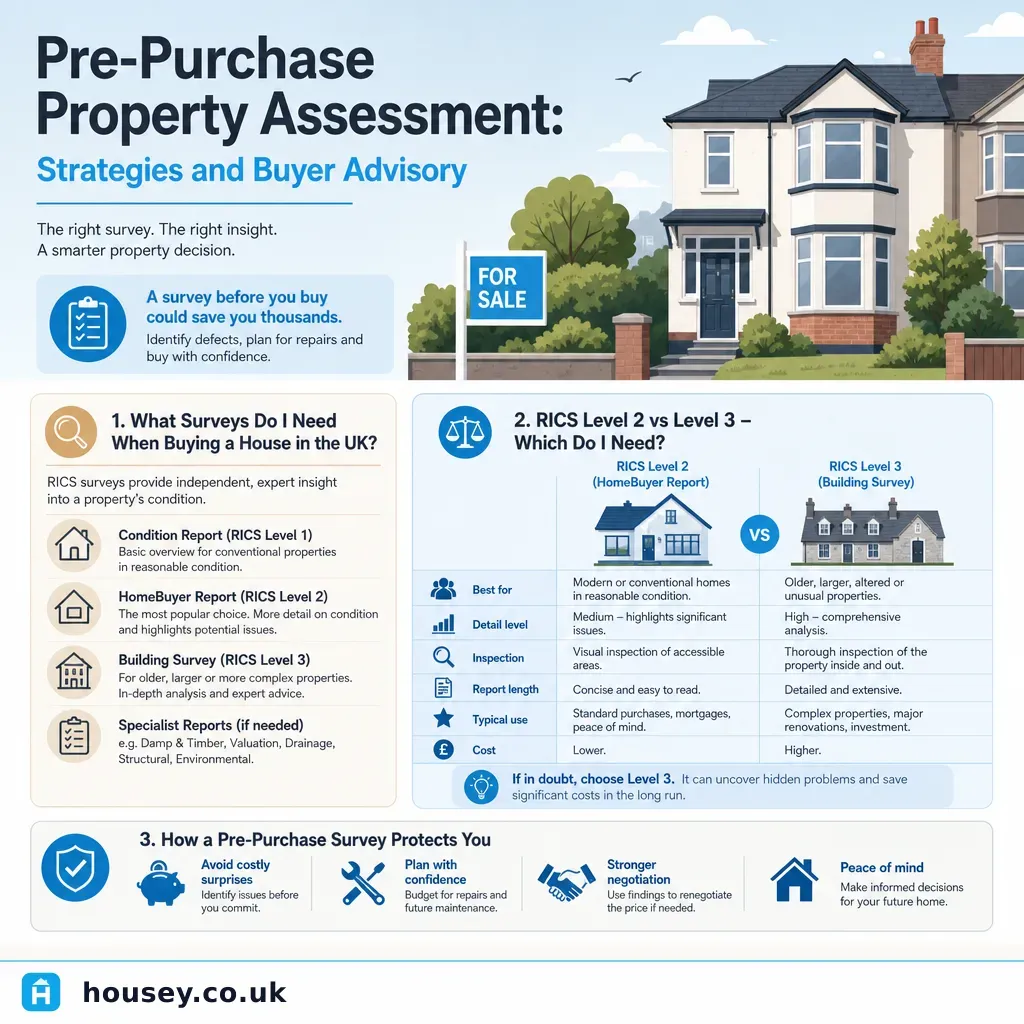
Pre-Purchase Property Assessment: Strategies and Buyer Advisory
A pre-purchase property assessment in the UK typically combines an independent RICS Home Survey, conveyancing searches, and specialist inspections for damp or electrical condition where needed.
 Buying & Moving
EPC Exemptions and Circumstances: When Energy Certificates Are Not Required
An EPC is not required for listed buildings where energy measures would unacceptably alter their character, standalone buildings under 50 m², places of worship, certain temporary structures, and holiday lets occupied for less than four months per year.
 Buying & Moving
What Is an Energy Performance Certificate: Understanding Your EPC Rating
An Energy Performance Certificate (EPC) rates a property's energy efficiency from A (most efficient) to G (least efficient) using a 1–100 SAP score.