How to Buy Property at Auction: Valuations, Surveys, and Legal Pack Essentials
By Housey · Last reviewed 17th of May 2026

How to Buy Property at Auction: Valuations, Surveys, and Legal Pack Essentials
Residential property auctions in the UK can offer genuine buying opportunities — distressed properties, probate sales, and repossessions often reach the auction room before the open market. But unlike a private treaty purchase, the legal process is compressed into a single moment: when the auctioneer's hammer falls, contracts exchange and you are bound. The preparation required before that moment is extensive, non-negotiable, and directly proportional to the financial risk involved.
Key points
- Under Common Auction Conditions (4th Edition), contracts exchange immediately on the fall of the hammer — there is no cooling-off period or survey contingency.
- The standard completion period is 28 days from auction date; buyers pay a 10% deposit on the day.
- A RICS Red Book valuation gives you an independent, evidence-based maximum bid figure, separate from the auctioneer's guide price.
- The legal pack — title register, searches, and special conditions of sale — must be reviewed by a solicitor before you bid.
- A RICS Level 3 Building Survey is advisable for pre-1919 properties, visibly distressed lots, and any property with structural alterations or obvious defects.
Why auction conditions make pre-bid preparation non-negotiable
Under the RICS/Propertymark Common Auction Conditions (4th Edition), the fall of the hammer constitutes exchange of contracts. There is no survey or solicitor review period after the auction. If you discover a defect, a planning issue, or an adverse title restriction after the hammer falls, you cannot withdraw without forfeiting your deposit.
Completion is usually required within 28 days. Standard residential mortgage lenders rarely advance within this timeframe, so most auction buyers use bridging finance or are cash buyers. If you intend to use a residential mortgage, confirm with your lender whether they can meet auction timescales before attending.
Legal packs are sometimes released as little as seven to ten days before auction day. Instructing a solicitor and surveyor the moment a lot interests you — not the week of the auction — is essential.
Which valuation and survey do you need before bidding?
The right combination depends on the property's condition, age, and your intended use.
Assessment type | Best for | Not ideal for | Typical output | Main risk if skipped |
|---|---|---|---|---|
RICS Red Book valuation | Setting a rational maximum bid; required by most lenders and insurers | Understanding physical condition | Written market valuation report | Overbidding by a material amount |
RICS Level 2 Home Survey | Conventional post-war properties in reasonable condition | Pre-1919, altered, or distressed properties | Condition ratings and brief cost notes | Missing moderate defects |
RICS Level 3 Building Survey | Pre-1919, extended, altered, structurally suspect, or unusual lots | Modern properties in good condition | Detailed defect analysis and repair guidance | Missing significant defects before exchange |
Specific defect survey | Single identified issue such as a crack or damp patch | Whole-property assessment | Focused report on one element | Incomplete picture of wider condition |
For most auction lots — which tend to be older, in need of work, or sold by motivated vendors — a RICS Level 3 Building Survey combined with an independent RICS Red Book valuation provides the strongest basis for a confident, informed bid.
Reviewing the legal pack before auction day
The legal pack is the auction equivalent of the conveyancing file. It typically contains:
- Title register and title plan (from HM Land Registry)
- Local authority search, drainage search, and environmental search
- Special conditions of sale — additional terms that may override standard conditions and impose unusual obligations on the buyer
- Property information form (if provided by the seller)
- Tenancy agreements (if the property is occupied or let)
- Planning permissions, building regulations completion certificates, or guarantees
A solicitor experienced in auction conveyancing should review this pack and confirm whether the title is clean, whether searches reveal any issues (enforcement notices, flood risk, road adoption status), and whether special conditions impose unusual buyer liabilities such as indemnity for defective title or a contribution to the seller's legal costs.
Ask your solicitor to confirm their findings in writing before auction day. If they identify a material issue, you can make an informed decision about whether to bid at all — or adjust your maximum accordingly.
Setting your maximum bid using professional advice
A RICS Red Book valuation gives you an independent, evidence-based view of the property's open market value. Your maximum bid should reflect:
- The RICS valuation figure — open market value in current condition
- Estimated cost of works — from your Level 3 survey or a contractor's pre-auction walk-through where the auctioneer permits access
- Your target end value — if buying to renovate or let
- Transaction costs — stamp duty land tax (SDLT), legal fees, the auction buyer's premium (typically 1–2% plus VAT), survey and valuation fees, and any bridging finance arrangement fees
Having a written maximum figure prepared before entering the room — and committing not to exceed it — is the most practical safeguard against auction-room bidding pressure.
Which professional do you need, and when?
Professional | What they do | When to instruct |
|---|---|---|
RICS-registered valuer | Provides Red Book market valuation | As soon as the lot is identified |
RICS surveyor (Level 2 or Level 3) | Inspects condition and identifies defects | As soon as viewing access is confirmed |
Auction conveyancing solicitor | Reviews legal pack and advises on title and special conditions | Immediately on receiving the legal pack |
Structural engineer | Diagnoses structural movement or foundation concerns | If Level 3 survey identifies a structural issue |
Bridging finance broker | Arranges short-term completion funding | Before the auction if using finance |
Important limitations
This article provides general information only. Auction law, the Common Auction Conditions, and individual legal packs vary by auction house and property. Nothing here constitutes legal or financial advice. Property valuations depend on condition, location, comparable evidence, and prevailing market conditions — a written RICS Red Book valuation from a regulated professional is the only reliable basis on which to make a legally binding bid. Always instruct a qualified solicitor to review the legal pack before bidding on any lot.
What to ask a qualified professional
Ask your RICS valuer:
- What comparable sales evidence supports the valuation figure?
- What assumptions have you made about condition, and how might discovered defects alter your opinion of value?
- Is this a Red Book-compliant valuation that will be acceptable to my lender or insurer?
Ask your RICS surveyor:
- Is there evidence of structural movement, damp penetration, or significant roof defects?
- What is your estimated cost range for remedial works?
- Are there issues that would warrant a structural engineer's assessment before I bid?
Ask your solicitor:
- Are there any onerous special conditions in the auction pack?
- Is the title clean and marketable, with no undisclosed restrictions or encumbrances?
- Are there planning enforcement notices, outstanding building regulations, or restrictive covenants affecting my intended use?
- What are your estimated total legal fees for completion within 28 days?
When to get professional help
Do not bid at auction without professional advice if any of the following apply:
- The property shows signs of structural movement — stepped cracks, bulging walls, sticking doors or windows
- The legal pack contains special conditions you do not fully understand
- You have not received a solicitor's written review of the title and searches
- You have not obtained an independent valuation or survey
- The lot description mentions asbestos, Japanese knotweed, flood history, or disputed rights of way
- You plan to use mortgage finance and have not confirmed your lender can complete within 28 days
How Housey can help
Housey connects you with RICS-registered professionals for valuation surveys and RICS Home Surveys — both essential before auction day. For full legal support, our conveyancing service connects you with auction-experienced solicitors. For older or distressed lots, a structural survey from a qualified RICS surveyor gives you the detailed defect analysis needed to bid with real confidence.
Frequently asked questions
Can I get a mortgage on an auction property?
Standard residential mortgages rarely complete within the 28-day auction completion window. Most buyers use bridging finance or cash. Some lenders offer specialist auction finance products, but you must confirm your funding arrangements in full before bidding — not after the hammer falls. Speak to a broker who understands auction timescales before attending any sale.
What happens if I win the auction but cannot complete?
If you fail to complete within the agreed period, you forfeit your 10% deposit. The seller may also pursue you for any shortfall if they resell at a lower price, plus their legal costs. This legal exposure makes pre-auction due diligence — survey, valuation, and legal pack review — financially essential, not optional.
Can I view an auction property before bidding?
Most auction houses arrange open viewing days before the auction. In some cases you can negotiate independent surveyor access through the auctioneer. Always request access and arrange a professional inspection before bidding. Never bid on a property you have not seen or had professionally assessed — the contract is legally binding the moment the hammer falls.
Is the guide price a reliable indicator of value?
Guide prices are indicative only and do not reflect the seller's reserve price or the property's open market value. Properties regularly sell above or below guide price. An independent RICS Red Book valuation provides a more reliable basis for setting your maximum bid than the auctioneer's guide price alone.
Do I pay buyer's fees on top of the hammer price?
Most auction houses charge a buyer's premium — typically 1–2% plus VAT of the purchase price — payable on the day alongside your 10% deposit. Check the auction catalogue and special conditions of sale for the exact figure before bidding, as this varies between auction houses and can materially affect your total acquisition cost.
Sources and further reading
- Common Auction Conditions (4th Edition) — RICS
- Stamp Duty Land Tax guidance — GOV.UK
- RICS Home Survey Standard — RICS
- Search the Land Registry — HM Land Registry
Useful next reads
 Buying & Moving
Complete Homebuying Checklist and Essential Services for First-Time Buyers
First-time buyers in the UK should commission an independent RICS Home Survey before exchange — a mortgage lender's valuation does not protect you.
 Buying & Moving
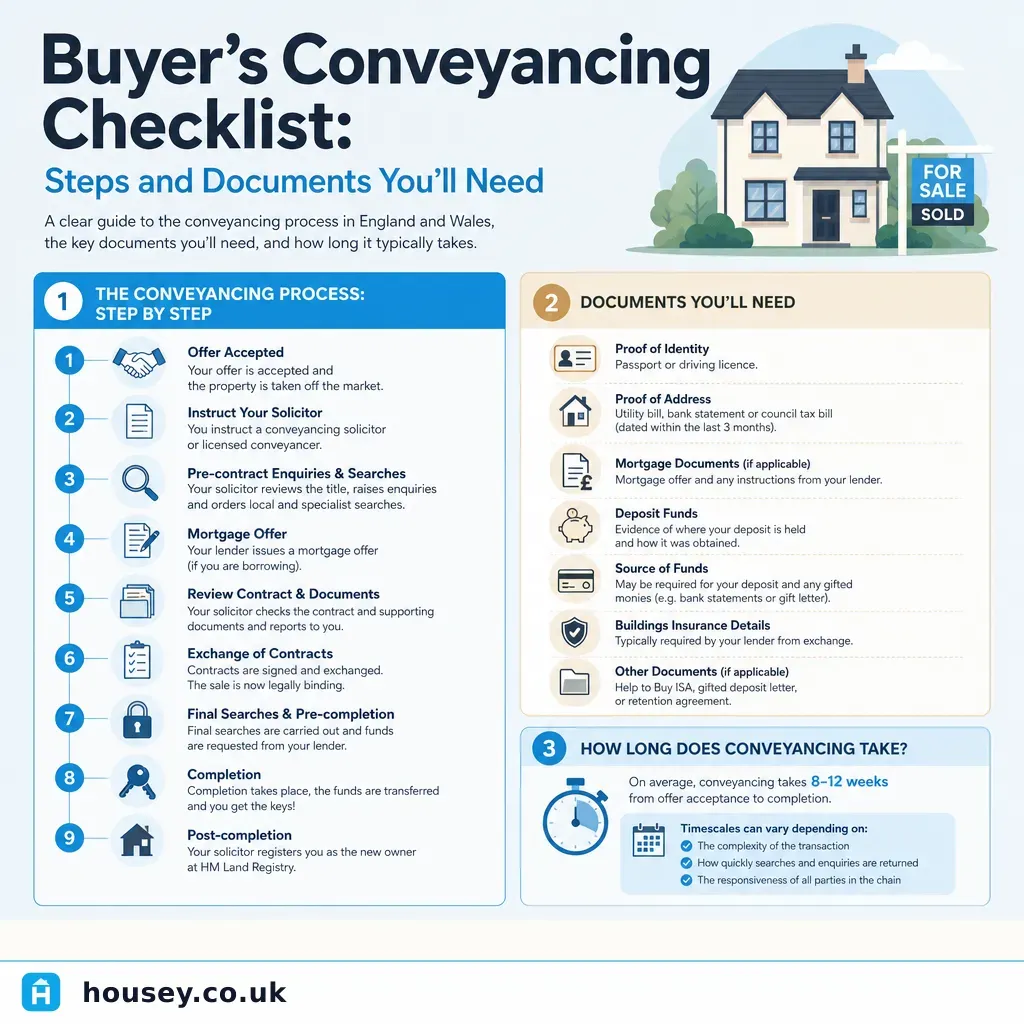
Buyer's Conveyancing Checklist: Steps and Documents You'll Need
Conveyancing for buyers in England and Wales typically takes 8–16 weeks across five stages: instruction and ID checks, searches, mortgage offer and enquiries, exchange, and completion.
 Buying & Moving
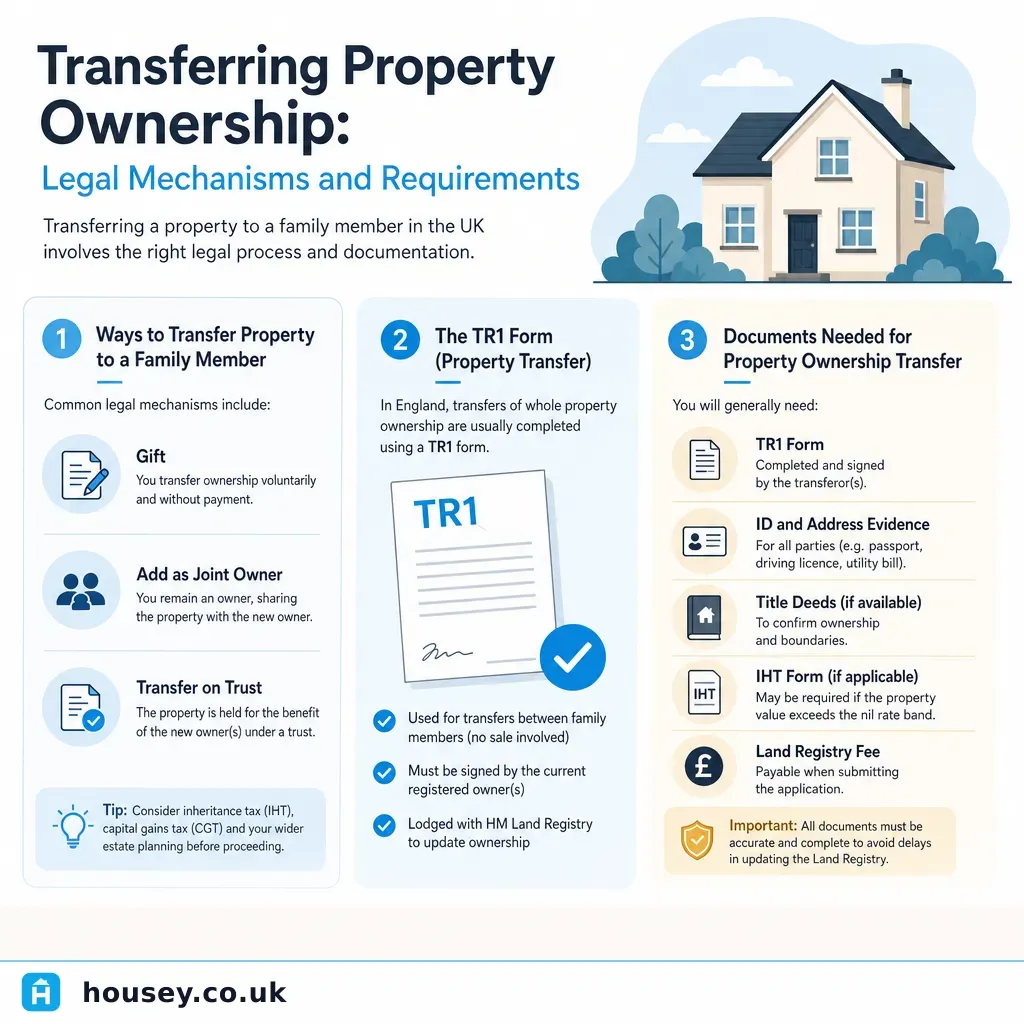
Transferring Property Ownership: Legal Mechanisms and Requirements
In England and Wales, property ownership transfers when HM Land Registry records a change of proprietor, triggered by a completed TR1 deed for full transfers or a TP1 for partial ones.
 Buying & Moving
Evaluating Lease Extension and Freehold Purchase Options for Flat Owners
Flat owners in England and Wales can extend their lease by 90 years — increasing to 990 years under pending 2024 reforms — or collectively purchase the freehold.
 Buying & Moving
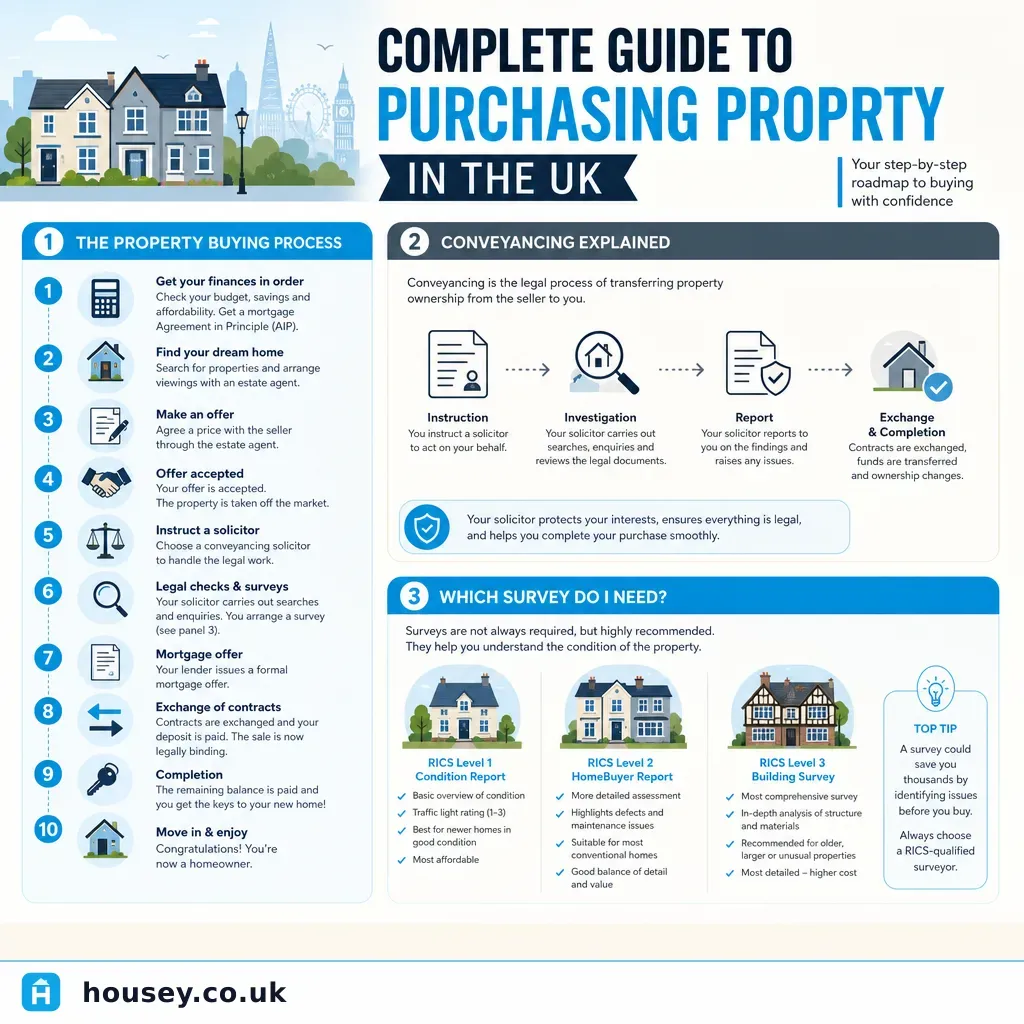
Complete Guide to Purchasing Property in the UK
Buying property in England and Wales typically takes 12 to 16 weeks from offer acceptance to completion.