Evaluating Lease Extension and Freehold Purchase Options for Flat Owners
By Housey · Last reviewed 30th of May 2026
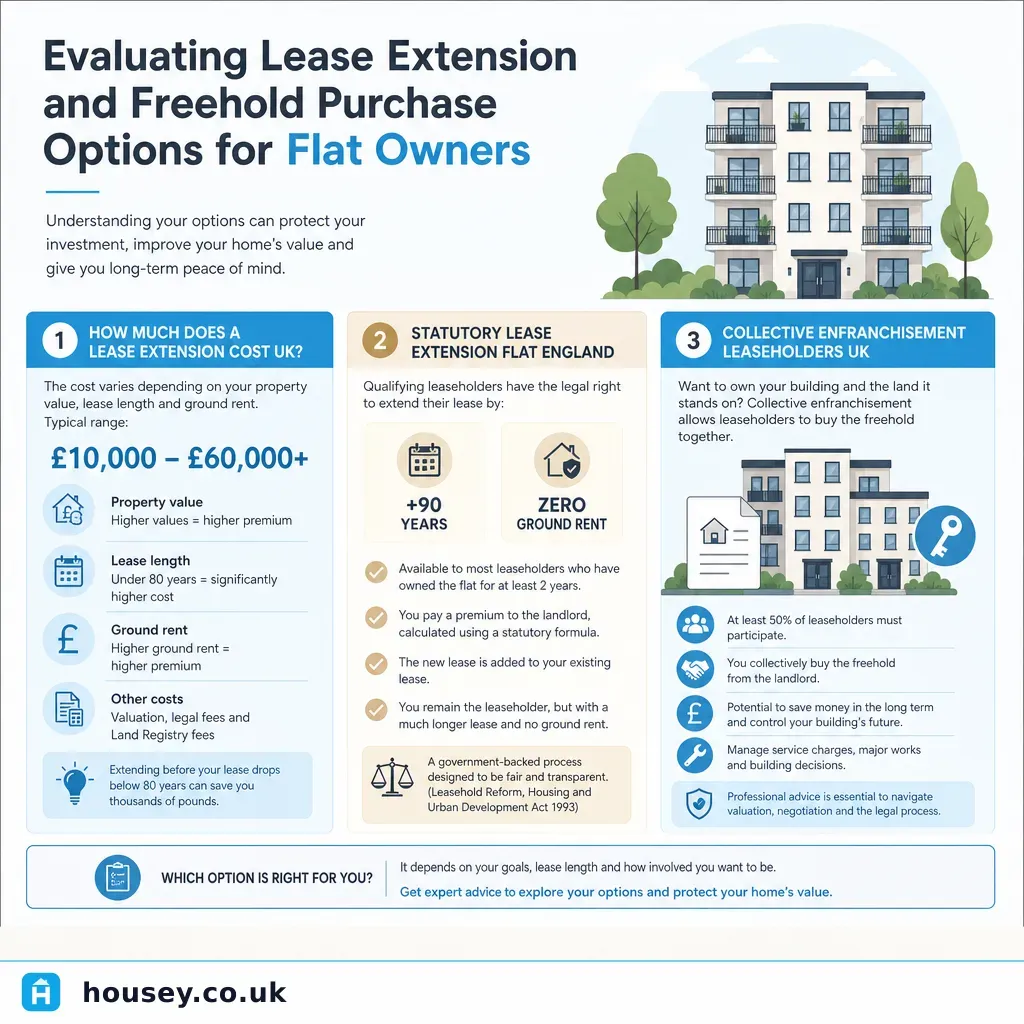
Evaluating Lease Extension and Freehold Purchase Options for Flat Owners
Leasehold flat ownership in England and Wales creates a finite interest in a property — as the lease shortens, market value typically erodes and mortgage lenders become increasingly cautious. Many flat owners reach a point where they need to decide whether to extend the lease, join with neighbours to buy the freehold collectively, or explore informal arrangements with their landlord. The Leasehold and Freehold Reform Act 2024 has changed some of the rules, though many provisions are still awaiting commencement orders — making this a fast-evolving area of property law where up-to-date specialist advice matters more than ever.
Key points
- Qualifying flat owners have a statutory right to a lease extension under the Leasehold Reform, Housing and Urban Development Act 1993, adding 90 years to the existing term (increasing to 990 years once relevant provisions of the 2024 Act commence).
- You must have owned the flat for at least two years to exercise the statutory lease extension right; this qualification is due to be removed once the relevant 2024 Act provisions commence.
- When a lease has fewer than 80 years remaining, marriage value is currently payable as part of the premium — significantly increasing the cost; marriage value was abolished under the Leasehold and Freehold Reform Act 2024, but the commencement date for that provision is not yet confirmed.
- Collective enfranchisement — buying the freehold jointly with other leaseholders — requires at least 50% of qualifying leaseholders in a building to participate under the 1993 Act.
- A RICS-registered surveyor with leasehold valuation expertise is required to negotiate or verify the premium for either a statutory lease extension or a collective freehold purchase.
What are the options for flat owners?
Flat owners with a diminishing lease broadly have three routes available.
1. Statutory lease extension (Section 42 notice)
Under the 1993 Act, a qualifying leaseholder can serve a formal notice on their landlord requiring a lease extension. The extension adds 90 years to the existing term and reduces the ground rent to a peppercorn. The premium — the price paid to the landlord for the extension — is determined by a statutory formula and, if not agreed, set by the First-tier Tribunal (Property Chamber).
2. Informal (voluntary) lease extension
Some landlords will negotiate an extension outside the statutory process. This avoids the formal procedure but means you have no legal framework fixing the terms — the landlord can offer any term length and any premium. Informal routes can be quicker, but the terms may be less favourable unless you also hold the statutory right to fall back on.
3. Collective enfranchisement (buying the freehold)
Two or more qualifying leaseholders, representing at least 50% of the total flats in a qualifying building, can collectively serve an initial notice on the landlord to purchase the freehold. Once the freehold is owned — typically through a nominee purchaser company formed by the leaseholders — each participating flat owner can extend their lease for a nominal premium.
Comparison: the main options for flat owners
Option | Minimum qualification | Typical timeline | Ground rent outcome | Who sets the premium? | Main advantage |
|---|---|---|---|---|---|
Statutory lease extension | 2 years' ownership; qualifying lease | 3–12 months | Peppercorn (zero) | Statutory formula; First-tier Tribunal if disputed | Legally enforceable right; peppercorn ground rent |
Informal lease extension | None (landlord must agree) | Variable | Negotiated | Negotiated | Can be faster; flexible terms possible |
Collective enfranchisement | 50% of qualifying leaseholders; qualifying building | 12–24 months | Becomes irrelevant (freehold owned) | Statutory formula; First-tier Tribunal if disputed | Long-term management control; low-cost extensions thereafter |
How the lease length affects your decision
The shorter the lease, the more urgent action becomes — but also, in many cases, the more expensive.
Decision tree: which option should you consider?
- Lease above 80 years: you have time, but act before it falls below 80 years to avoid marriage value under current law. A statutory extension is usually straightforward.
- Lease between 70 and 80 years: marriage value is not yet triggered, but you are approaching the threshold. Instruct a RICS surveyor for a valuation and begin the statutory process without delay.
- Lease below 80 years: marriage value currently applies, increasing the premium significantly. Check whether the 2024 Act provision abolishing marriage value has yet commenced. Model both statutory extension and collective enfranchisement costs before deciding.
- Lease below 60 years: many mainstream mortgage lenders will not lend on the property. Extending the lease becomes a prerequisite for any future sale.
- Lease below 40 years: very difficult to mortgage or sell; costs escalate sharply. Seek specialist advice immediately.
- You and your neighbours want management control: collective enfranchisement may be more valuable long-term, even if it takes longer and requires sustained co-operation among leaseholders.
Understanding the premium calculation
For a statutory lease extension, the premium is calculated using a formula that takes into account:
- The ground rent currently payable and its review pattern.
- The value of the landlord's right to possession at the end of the current lease term.
- Marriage value (where the lease is below 80 years under current law).
- The relativity discount — the ratio of the current leasehold value to the freehold value.
Premium calculations are complex and jurisdiction-specific. A RICS-registered surveyor with leasehold valuation expertise should prepare or review any valuation before the leaseholder serves notice or agrees a figure. Instructing a valuer before entering negotiations — even informal ones — significantly reduces the risk of overpaying.
Indicative lease extension costs vary enormously — from a few thousand pounds for a long lease with no marriage value to tens of thousands for a short lease with high marriage value in a high-value area. These are indicative UK costs, last reviewed 2026-05-30. Solicitor fees (typically £1,500–£3,500+), valuer fees, and any Tribunal costs are additional to the premium.
The 2024 leasehold reforms: what has changed?
The Leasehold and Freehold Reform Act 2024 received Royal Assent on 24 May 2024. Its main provisions include:
- Abolition of marriage value for lease extensions — a significant potential cost saving for those with short leases, but this requires a commencement order to take effect.
- 990-year standard extension term for flats (replacing the current 90 years), again subject to commencement.
- Removal of the two-year ownership qualification (pending commencement).
- Changes to the prescribed rate for ground rent capitalisation, which affects how premiums are calculated.
As of May 2026, not all provisions had commenced. Check GOV.UK's leasehold reform guidance for the current commencement status before acting — do not assume the new rules apply without verifying.
Important limitations
This article provides general information only. Leasehold law in England and Wales is highly technical, and premiums are calculated using a specialist valuation methodology that depends on property-specific inputs. The Leasehold and Freehold Reform Act 2024 is being brought into force in stages; some provisions may not yet be in effect. The rules in Scotland (governed by different legislation) and Northern Ireland differ from those in England and Wales. Always instruct a specialist leasehold solicitor and a RICS-registered valuer before serving any statutory notice or agreeing a premium. Nothing in this article constitutes legal or valuation advice.
When this becomes urgent
- Your lease has fewer than 85 years remaining — begin the process now before the 80-year marriage value threshold is crossed.
- You are considering selling and your buyer's solicitor has flagged the short lease as a problem.
- Your mortgage is due for renewal and your lender requires a minimum remaining lease term.
- You are experiencing difficulties with the freeholder over service charges, major works, or access for repairs.
What to ask a qualified professional
When instructing a RICS leasehold valuer:
- What is the estimated premium range for a statutory lease extension on this property?
- Has the marriage value provision of the Leasehold and Freehold Reform Act 2024 commenced, and how does that affect the calculation?
- What relativity figure is being applied, and what evidence supports it?
- Is collective enfranchisement likely to be cheaper or more advantageous than a standalone extension?
When instructing a specialist leasehold solicitor:
- Am I a qualifying tenant under the Leasehold Reform, Housing and Urban Development Act 1993?
- What is the correct procedure and timetable for serving a Section 42 notice?
- Are there any complications with the landlord structure — for example, an absentee freeholder or intermediate leaseholders?
- What are the risks if the landlord does not respond to the initial notice within the statutory period?
When to get professional help
Serving a statutory notice under the 1993 Act triggers a formal legal process with strict timelines. If you miss a counter-notice deadline or serve notice incorrectly, you may lose your statutory right for a period and be liable for the landlord's reasonable costs. You should instruct a specialist leasehold solicitor before serving any notice.
Similarly, negotiating a premium without RICS advice risks overpaying. Always obtain a surveyor's valuation before agreeing a figure — whether informally or under the statutory process.
How Housey can help
Housey connects flat owners with professionals who specialise in leasehold matters. If you need a lease extension valuation to understand the likely premium and prepare for negotiation with your freeholder, or if you need a specialist conveyancing solicitor experienced in leasehold reform work and statutory notice procedures, you can compare quotes from qualified professionals through our platform.
Frequently asked questions
How much does a statutory lease extension cost?
The cost has two components: the premium paid to the landlord (calculated using a statutory formula) and professional fees (solicitor and valuer). For a flat with a lease above 80 years and a low ground rent, premiums can be modest — perhaps £3,000–£8,000 for a lower-value property. For short leases or high-value London flats, premiums can reach tens of thousands. Indicative UK costs, last reviewed 2026-05-30.
What is collective enfranchisement?
Collective enfranchisement is the right of leaseholders in a qualifying building to buy the freehold together. Under the Leasehold Reform, Housing and Urban Development Act 1993, at least 50% of qualifying leaseholders must participate. Once the freehold is owned through a nominee purchaser company, the participating leaseholders gain control of building management and can extend their individual leases for a nominal sum.
Does the Leasehold and Freehold Reform Act 2024 affect me now?
Some provisions of the Act are in force, but many key reforms — including the abolition of marriage value and the 990-year extension term — require commencement orders that had not been made as of May 2026. Check the GOV.UK leasehold reform pages for current commencement status. Do not assume all provisions are in force without checking.
Can I extend my lease informally without using the statutory route?
Yes — many landlords will negotiate outside the statutory process. An informal extension can be completed more quickly and avoids the formal procedure. However, you have no legal protection on the terms offered, and the statutory right acts as important leverage in informal negotiations. Do not relinquish that leverage without taking specialist advice from a leasehold solicitor.
Sources and further reading
- Leasehold Reform, Housing and Urban Development Act 1993 — legislation.gov.uk
- Leasehold and Freehold Reform Act 2024 — legislation.gov.uk
- Leasehold Reform (Ground Rent) Act 2022 — legislation.gov.uk
- Leasehold property: extending a lease — GOV.UK
- RICS standards and guidance: valuation — RICS
- Citizens Advice: leasehold — Citizens Advice
Useful next reads
 Buying & Moving
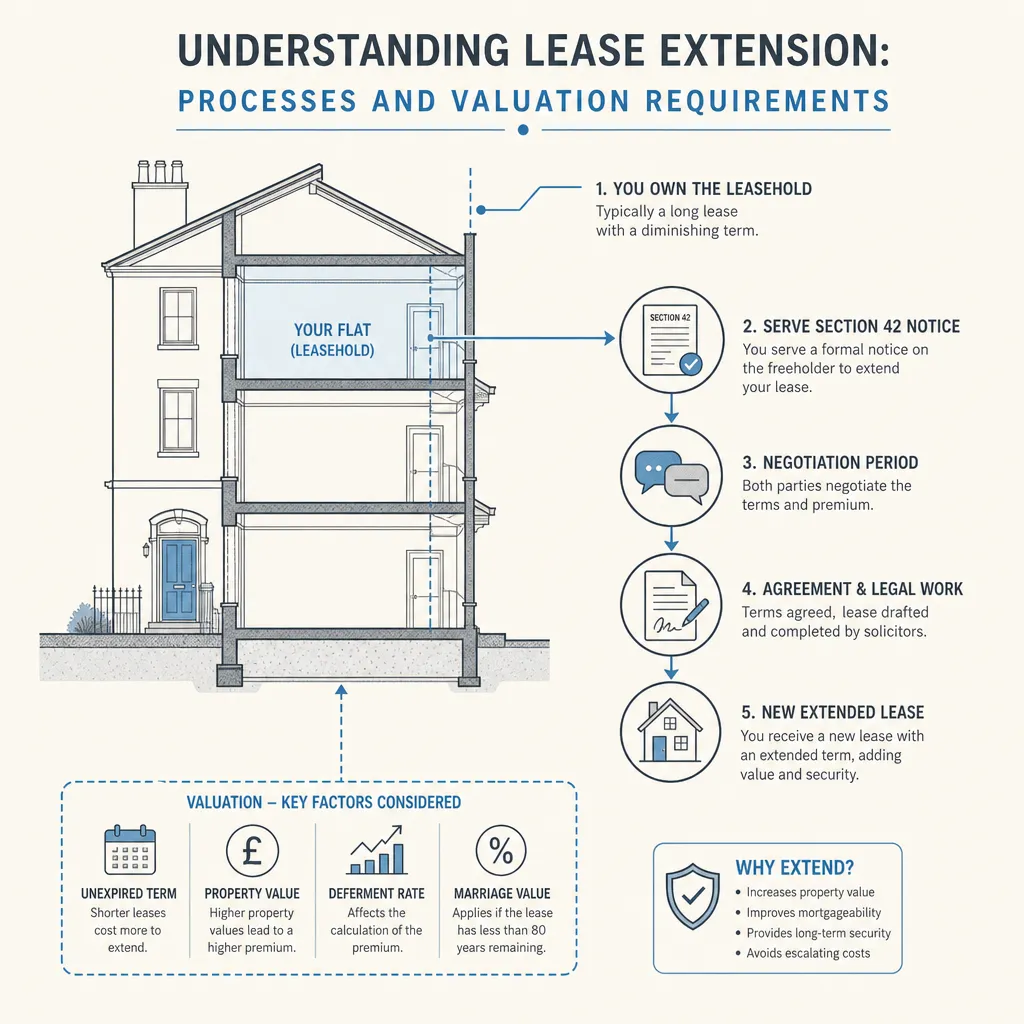
Understanding Lease Extension: Processes and Valuation Requirements
Qualifying flat owners in England and Wales can extend their lease by 90 years under the Leasehold Reform, Housing and Urban Development Act 1993, provided they have owned the property for at least two years.
 Buying & Moving
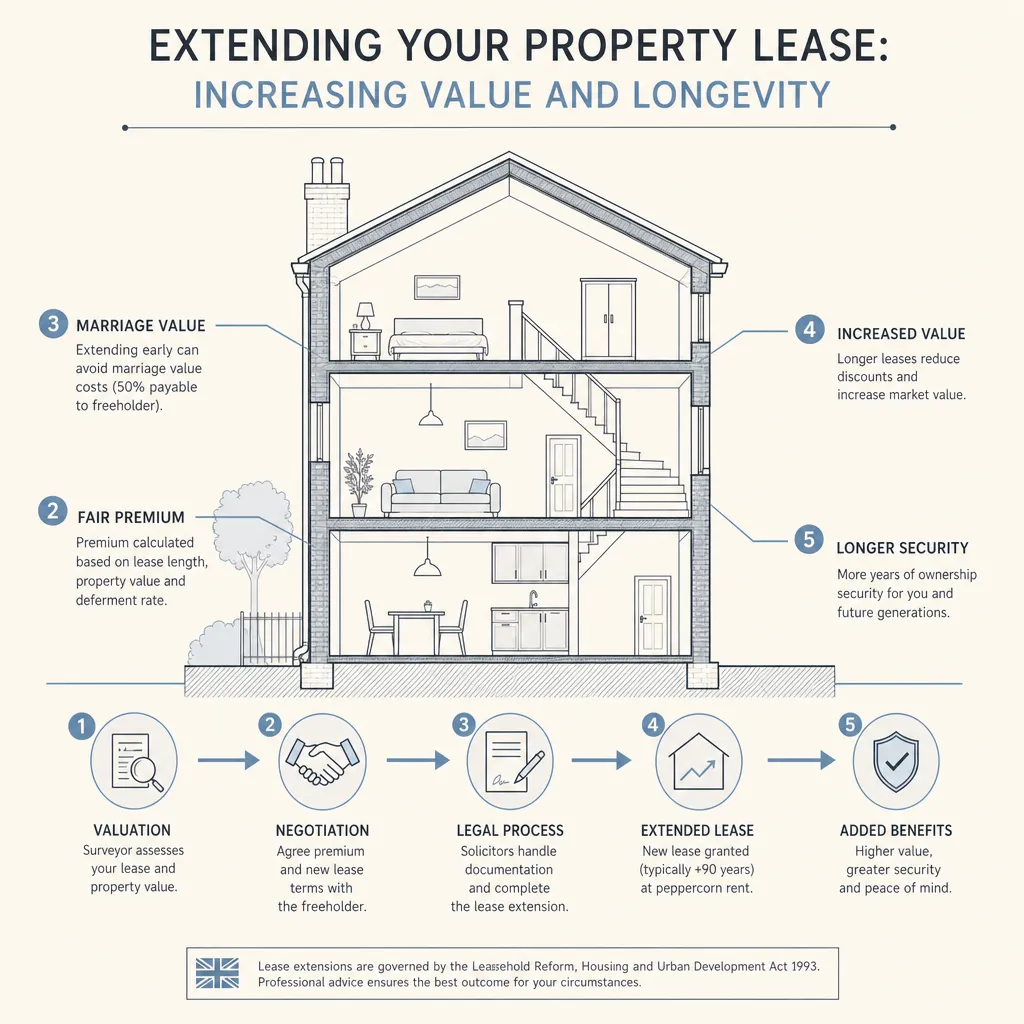
Extending Your Property Lease: Increasing Value and Longevity
Qualifying leaseholders in England and Wales can extend their lease by 90 years at a peppercorn ground rent under the Leasehold Reform, Housing and Urban Development Act 1993.
 Buying & Moving
How to Buy Property at Auction: Valuations, Surveys, and Legal Pack Essentials
Buying at auction means contracts exchange the moment the hammer falls — there is no cooling-off period.
 Buying & Moving
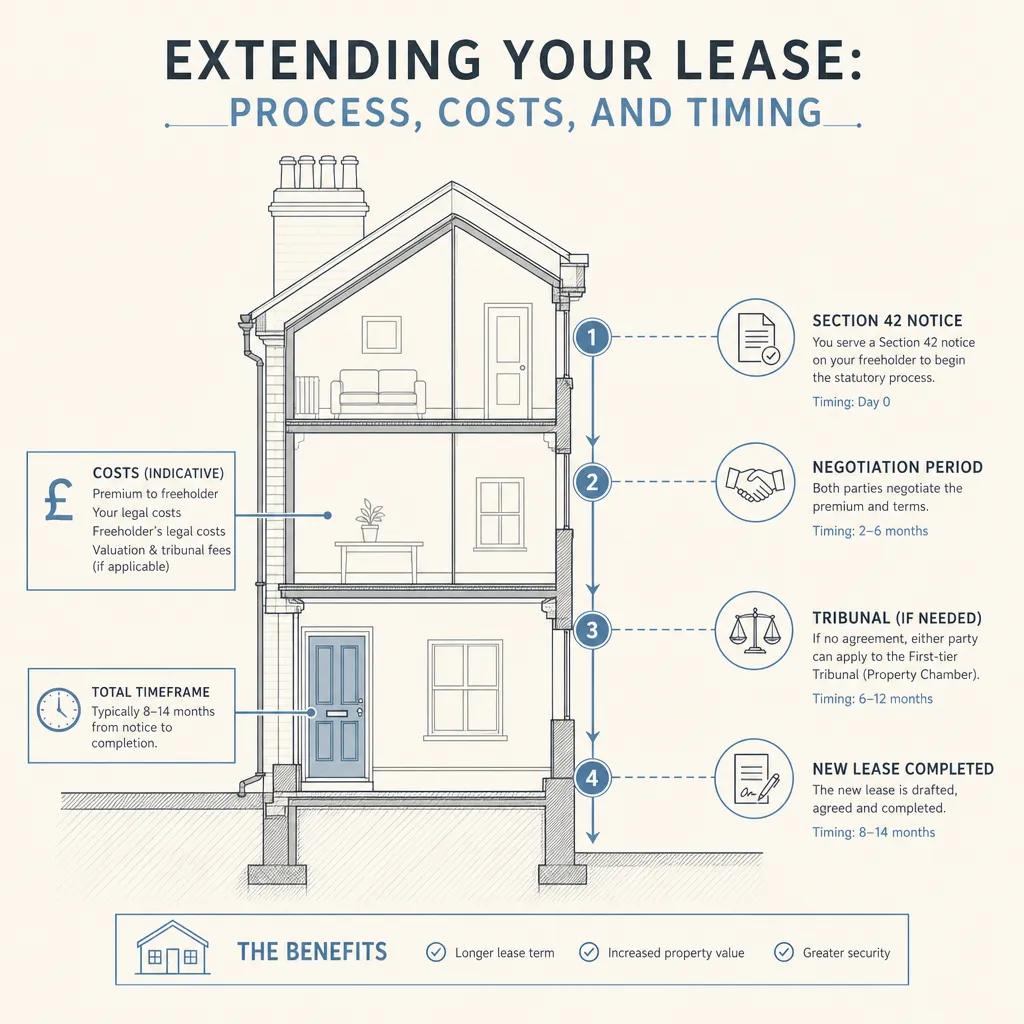
Extending Your Lease: Process, Costs, and Timing
Qualifying leaseholders in England and Wales have a statutory right to extend their lease by 90 years at a peppercorn (nil) ground rent under the Leasehold Reform, Housing and Urban Development Act 1993, provided they have owned for at least two years.
 Buying & Moving
Extending Your Leasehold: What Homeowners Need to Know
Qualifying flat owners in England and Wales can extend their lease by 90 years under the Leasehold Reform, Housing and Urban Development Act 1993.