Complete Homebuying Checklist and Essential Services for First-Time Buyers
By Housey · Last reviewed 18th of May 2026
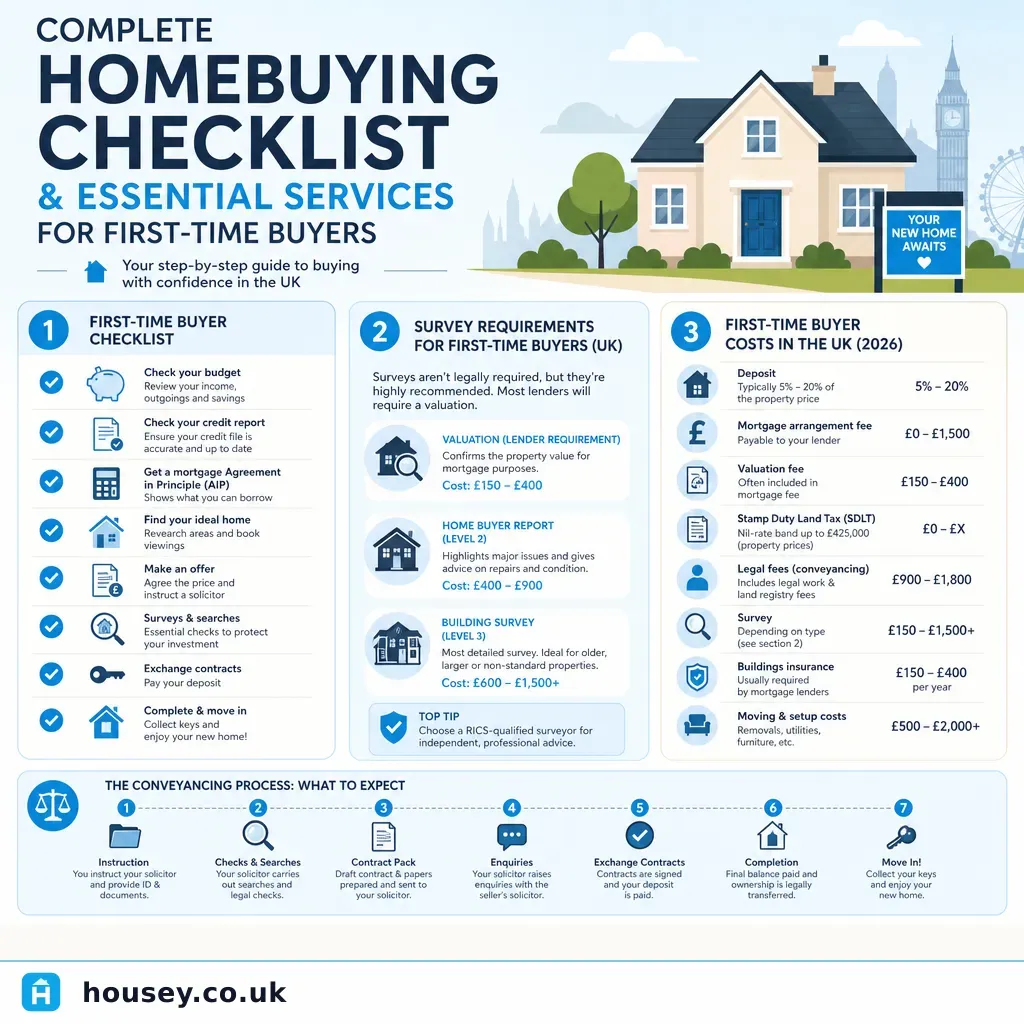
Complete Homebuying Checklist and Essential Services for First-Time Buyers
Buying your first home in the UK involves a sequence of legal, financial, and practical steps that run in parallel and depend on each other. Each stage — from instructing a conveyancer to commissioning a survey — has implications if it is delayed or skipped, and the process is rarely as linear as it first appears.
Key points
- Stamp Duty Land Tax (SDLT) relief for first-time buyers in England applies on properties up to £500,000; the nil-rate threshold is £425,000 as of 2026 — check GOV.UK for current figures, as thresholds are subject to change.
- A mortgage lender's valuation is not a property survey — it protects the lender's security, not you; commissioning an independent RICS Home Survey is a separate and essential step.
- Conveyancing searches (local authority, drainage and water, environmental, chancel repair) are ordered by your solicitor and typically take 2–6 weeks to return.
- Leasehold properties require additional legal scrutiny: service charge history, ground rent terms, lease length, and any section 20 major works notices.
- Buildings insurance must be in place at exchange of contracts — not completion; failing to arrange cover in time can invalidate the exchange.
Important limitations
This article provides general guidance on the UK homebuying process in England and Wales. Tax thresholds, legal requirements, and processes differ in Scotland (where the law of property is distinct) and Northern Ireland. A licensed conveyancer or solicitor should advise on your specific transaction, and a qualified RICS-chartered surveyor should assess any property before you commit to purchase.
Stage-by-stage checklist: offer to completion
The typical process from offer acceptance to completion takes 8–16 weeks, though leasehold transactions, chain complications, or title issues can extend this significantly.
Stage 1 — Offer accepted
Stage 2 — Surveys and searches
Stage 3 — Exchange
Stage 4 — Completion and moving in
Which survey does a first-time buyer need?
Survey level | Best for | What you get | Notable limitation |
|---|---|---|---|
RICS Level 1 (Condition Report) | Near-new or new-build properties in excellent condition | Traffic-light condition ratings for key elements | No repair advice; no detailed structural assessment |
RICS Level 2 (HomeBuyer Report) | Conventional homes in reasonable condition (typically post-1920s) | Condition ratings, defect notes, urgent repairs, legal issues to raise | Limited-access inspection; does not open up finishes |
RICS Level 3 (Building Survey) | Older, altered, unusual, or visibly defective properties | Full structural assessment, detailed defect analysis, maintenance priorities | No market valuation unless added separately |
For most first-time buyers purchasing a pre-war terrace, a 1960s–1980s semi, or any property with visible defects or past alterations, a RICS Level 2 or Level 3 survey is appropriate. If uncertain, ask your surveyor which level they recommend for the specific property — a good surveyor will advise honestly based on the property's profile.
Document preparation list
Gather these before or shortly after offer acceptance:
- Proof of identity and address — passport, driving licence, or utility bill dated within the last three months (required for anti-money-laundering checks by your solicitor).
- Proof of deposit funds — bank statements showing the deposit amount, or a signed gift letter if funds are partly gifted.
- Help to Buy ISA or Lifetime ISA — if applicable, the closure instruction must reach your solicitor before completion; Lifetime ISA bonus claims can take up to 30 days to process.
- Mortgage offer letter — send a copy to your solicitor as soon as received.
- Buildings insurance schedule — required at exchange, not completion.
What to ask before accepting a quote
Whether for a conveyancer, surveyor, or removal firm, ask:
- What is included and excluded from this price?
- What qualifications and accreditations do you hold?
- What is the estimated timeline, and what could cause delays?
- Is VAT included in the quoted figure?
- If complications arise — for example, title defects or survey findings — how are additional costs handled?
- Will I have a named point of contact throughout the process?
Indicative first-time buyer costs
The following are indicative UK costs, last reviewed 2026-05-18. Always obtain individual quotes as costs vary by location, property value, and provider. See GOV.UK for current SDLT rates and thresholds.
Cost item | Indicative range |
|---|---|
Conveyancing (solicitor or licensed conveyancer) | £1,000–£2,500 including disbursements |
RICS Level 2 HomeBuyer Report | £400–£900 |
RICS Level 3 Building Survey | £600–£1,500+ |
Mortgage arrangement fee | £0–£2,000 (varies by lender and product) |
Mortgage valuation | Often lender-included; or £150–£400 |
Buildings insurance (first year) | £150–£500+ depending on property |
Removal costs | £600–£2,000+ depending on volume and distance |
SDLT (first-time buyer purchasing at £300,000) | £0 (below nil-rate threshold as of 2026) |
When to get professional help
Instruct a licensed conveyancer or solicitor the moment an offer is accepted. For properties showing signs of damp, cracking, past alterations, or where the vendor cannot produce paperwork for previous works, a RICS Level 3 Building Survey is advisable. Red flags warranting additional specialist assessment include:
- Stepped or diagonal cracks in external brickwork.
- Evidence of damp, staining, or efflorescence on lower internal walls.
- Vendor unable to produce building control certificates for extensions or loft conversions.
- Lease term below 85 years remaining on a leasehold property.
- No record of gas or electrical inspection within the last 5–10 years.
When this becomes urgent
Seek qualified advice immediately if: a survey flags structural movement or suspected asbestos-containing materials; a conveyancing search returns a contaminated land entry or outstanding enforcement notice; your mortgage offer contains conditions you do not understand; or you are being pressed to exchange before searches and the survey report are complete. Do not exchange contracts under time pressure without understanding all outstanding issues.
What to ask a qualified professional
Before instructing a conveyancer:
- Are you regulated by the Solicitors Regulation Authority (SRA) or the Council for Licensed Conveyancers (CLC)?
- What additional searches do you recommend for this property type and area?
- How will you communicate progress — client portal, email, or telephone?
- What is your process if building control certificates are missing for previous works?
Before instructing a surveyor:
- What survey level do you recommend for this specific property, and why?
- Will the report flag issues that could affect mortgage lending?
- Can I speak to you after the report is issued to discuss findings and their implications?
How Housey can help
Housey makes it straightforward to compare quotes from qualified professionals at every stage of a first purchase. Find RICS-chartered surveyors for RICS Home Surveys, compare conveyancing solicitors, and arrange valuation surveys. For older properties, you can also book damp and timber surveys and Electrical Installation Condition Reports (EICR) through the Housey marketplace.
Frequently asked questions
Is a property survey legally required when buying a home in England?
No. A survey is not a legal requirement in England and Wales. Your mortgage lender requires a valuation, but this is not a condition survey and does not protect your interests. It is strongly advisable to commission an independent RICS Home Survey — properties purchased without one have no recourse if significant defects are discovered after completion.
What is the difference between a conveyancer and a solicitor?
A licensed conveyancer specialises exclusively in property law and is regulated by the Council for Licensed Conveyancers (CLC). A solicitor is regulated by the Solicitors Regulation Authority (SRA) and may practise across multiple areas of law. Both can handle residential conveyancing; communication style, responsiveness, and cost are often more important differentiators than qualification type.
How does Stamp Duty Land Tax work for first-time buyers in England?
First-time buyers in England pay no SDLT on the first £425,000 of a property's purchase price, provided the total price does not exceed £500,000 (as of 2026). Properties above £500,000 do not qualify for first-time buyer relief and are taxed at standard rates. Different taxes apply in Scotland and Wales. Always verify current thresholds on GOV.UK or with your solicitor.
How long does conveyancing typically take for a first-time buyer?
Most straightforward freehold purchases take 8–12 weeks from offer acceptance to completion. Leasehold transactions, chains, or slow search returns can extend this to 16 weeks or more. Instructing your conveyancer promptly and responding quickly to all information requests are the most reliable ways to minimise delays.
Sources and further reading
- GOV.UK: Stamp Duty Land Tax — first-time buyers — GOV.UK
- GOV.UK: Find an energy certificate — GOV.UK
- RICS Home Survey Standard — RICS
- Citizens Advice: Buying a home — Citizens Advice
- Council for Licensed Conveyancers — Council for Licensed Conveyancers
- HM Land Registry: Register land or property — HM Land Registry
Useful next reads
 Buying & Moving
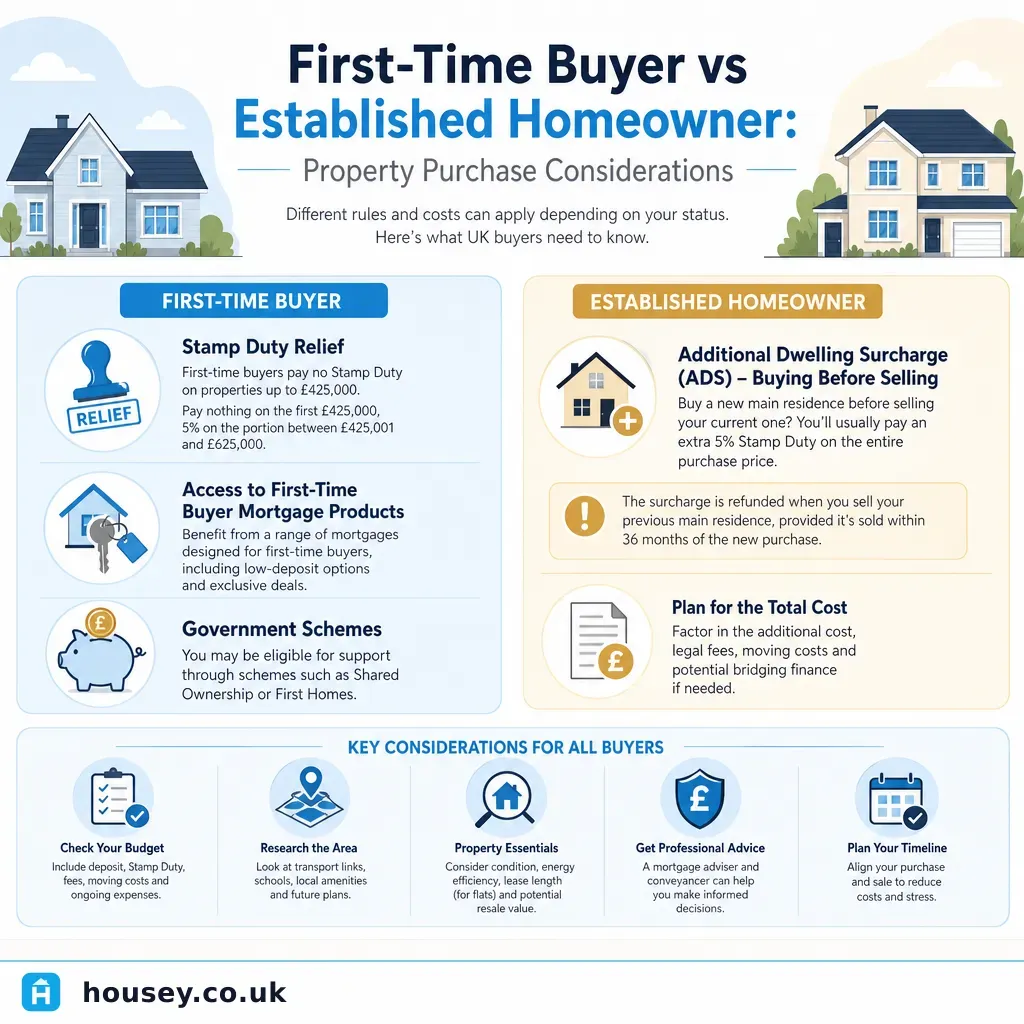
First-Time Buyer vs Established Homeowner: Property Purchase Considerations
First-time buyers in England pay no stamp duty on the first £300,000 of a property worth up to £500,000 and may access specific mortgage products.
 Buying & Moving
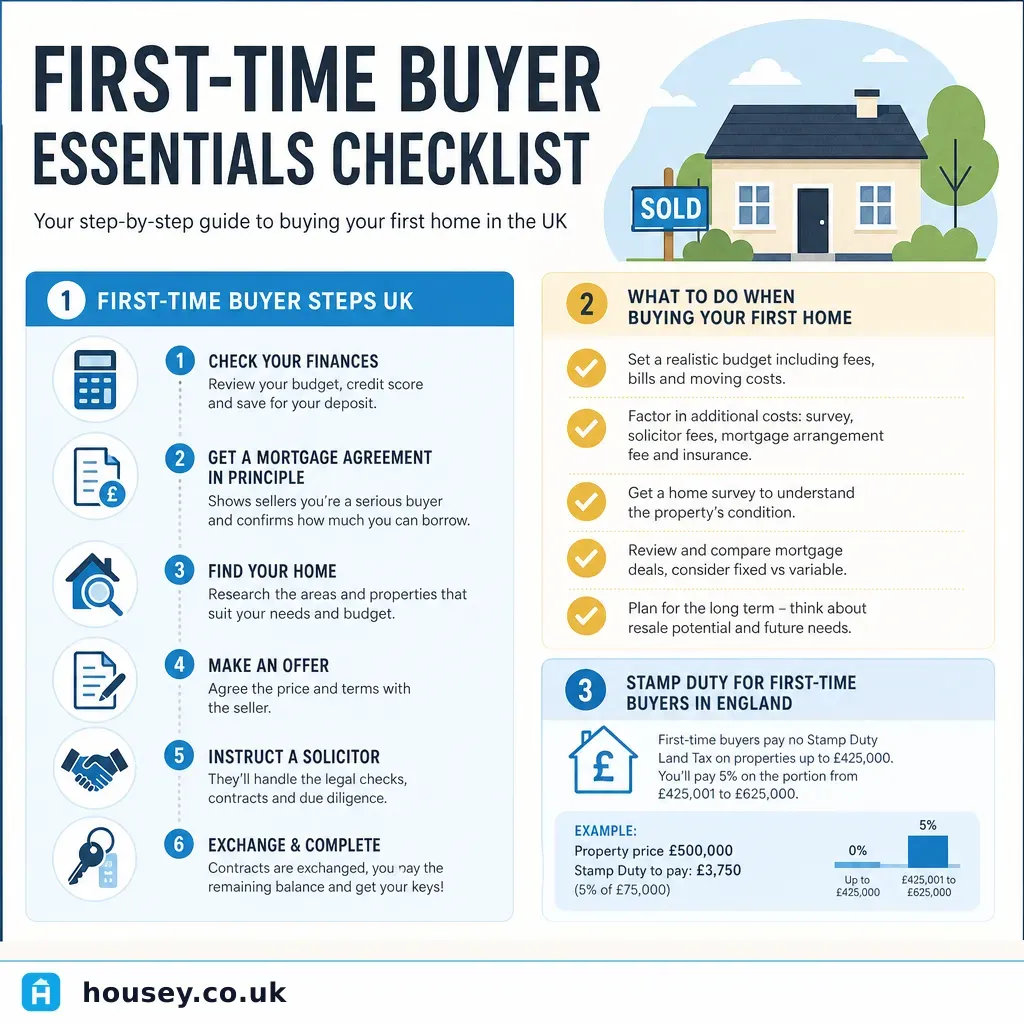
First-Time Buyer Essentials Checklist
Buying your first home involves obtaining a mortgage in principle, making an offer, instructing a solicitor, arranging a survey, and exchanging contracts before completion.
 Buying & Moving
Safeguarding Your Property Purchase: Fraud Prevention Strategies
Property purchase fraud in the UK most commonly involves criminals intercepting emails to redirect completion funds to fraudulent bank accounts.
 Buying & Moving
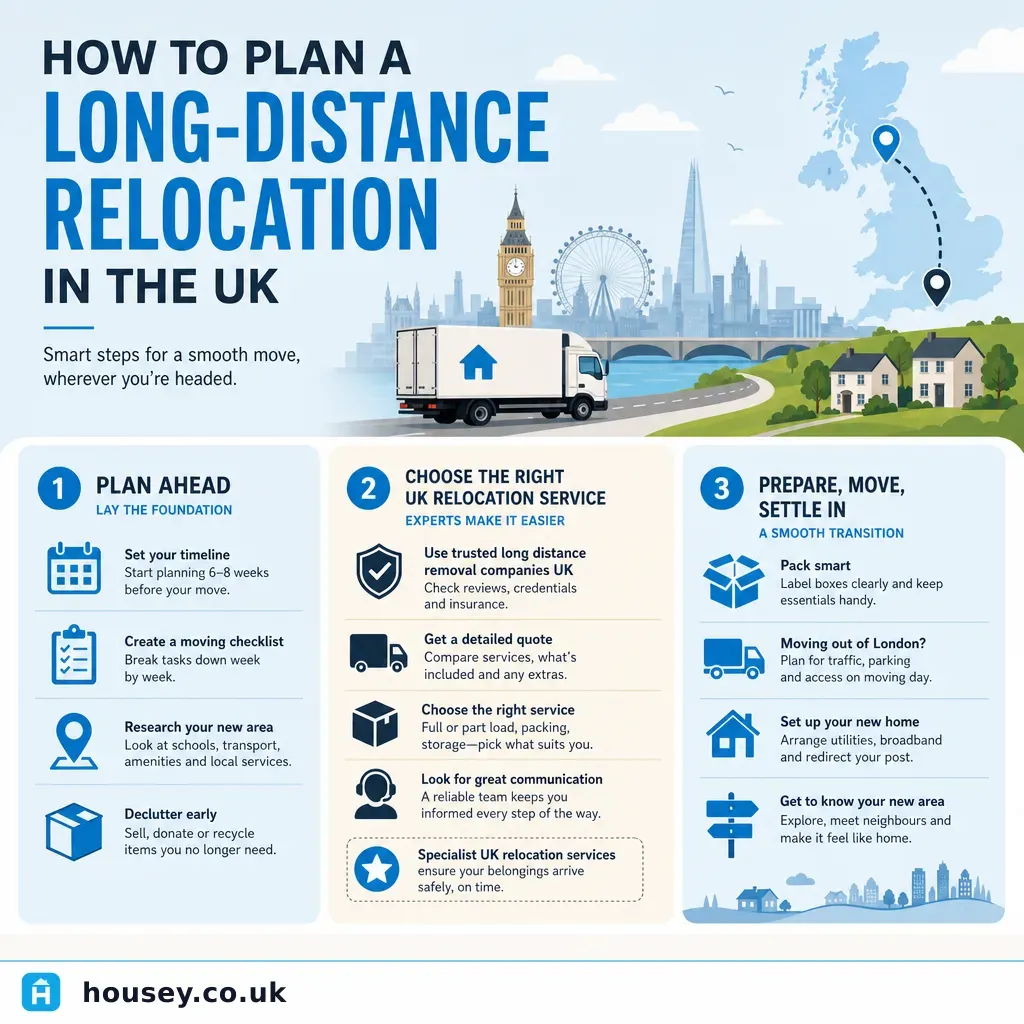
How to Plan a Long-Distance Relocation in the UK
A successful long-distance relocation in the UK involves coordinating removals, conveyancing, storage, and area research well in advance.
 Buying & Moving
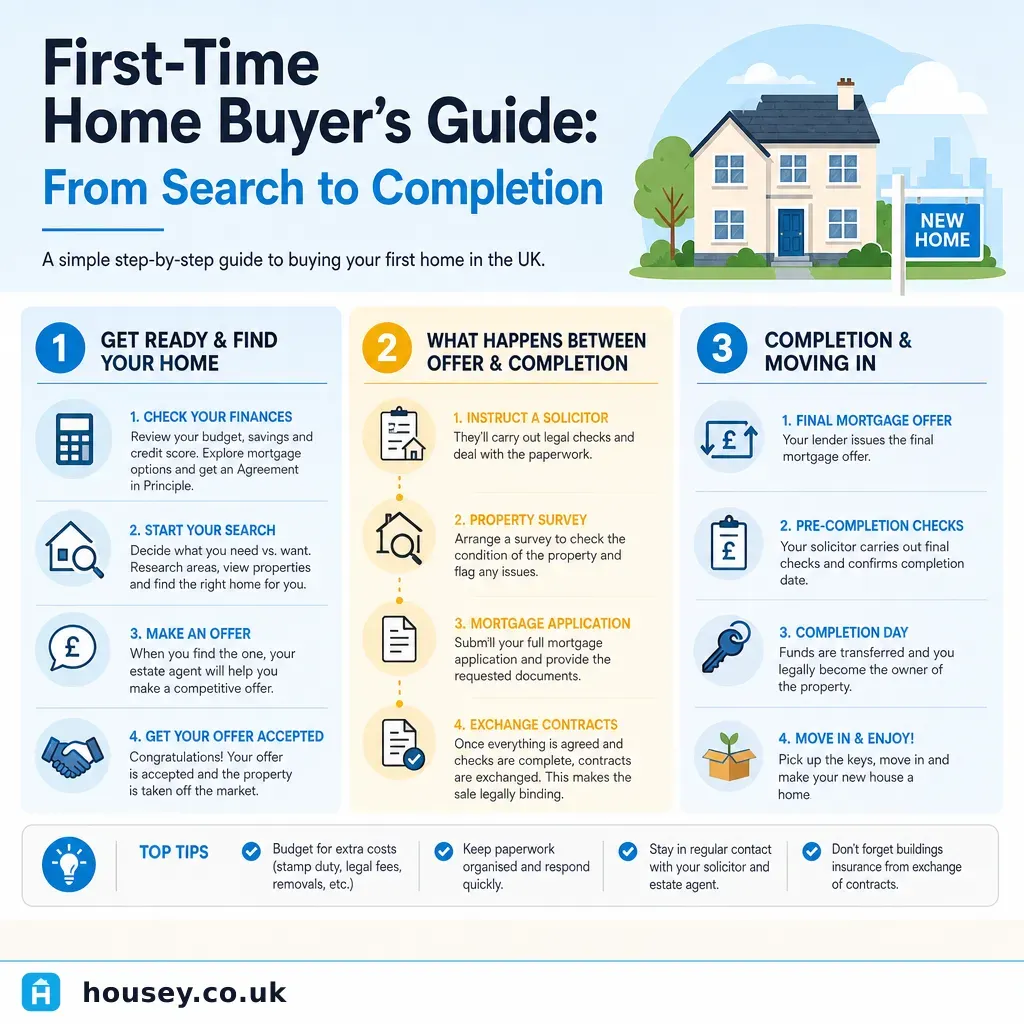
First-Time Home Buyer's Guide: From Search to Completion
Buying your first home in the UK typically takes 3–6 months from offer acceptance to completion.