Can You Build Without Planning Permission? Legal Considerations
By Housey · Last reviewed 11th of May 2026
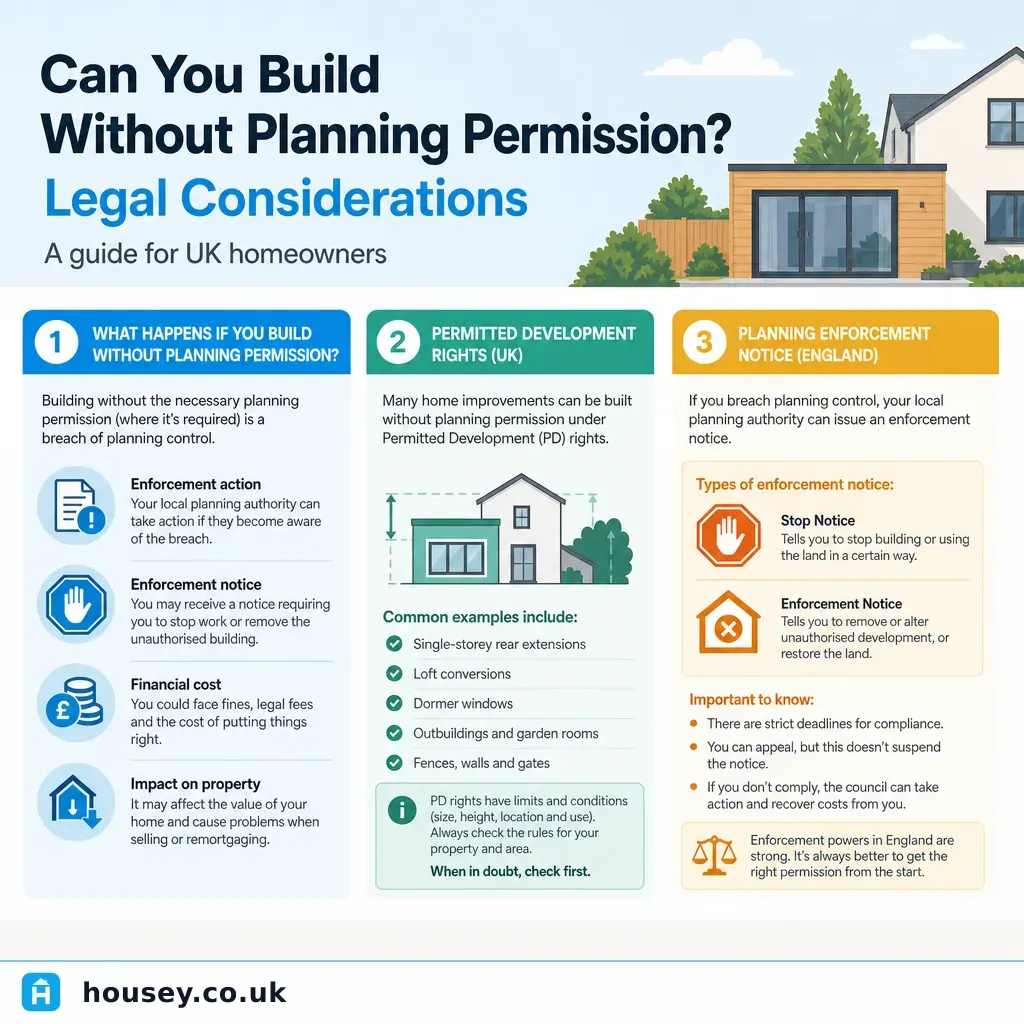
Can You Build Without Planning Permission? Legal Considerations
Disputes over unauthorised development are among the most stressful situations a homeowner or developer can face. Questions about whether work requires formal consent typically arise when a project is already under way, when a property is being bought or sold, or when a neighbour raises an objection. In England and Wales, the planning system is governed by the Town and Country Planning Act 1990, and whether permission is required depends on the type, scale, and location of the works—as well as the history and designation of the property.
Key points
- In England, many works fall under permitted development rights (PDR), meaning they do not need a formal planning application—but PDR does not apply to listed buildings, many conservation area properties, or homes where PDR has been removed by a condition or Article 4 Direction.
- A local planning authority (LPA) has four years to take enforcement action against most unauthorised operational development, but ten years for a breach of a planning condition or most other changes of use.
- Building without permission where it is required can result in an Enforcement Notice, a Stop Notice, or—in serious cases—a requirement to demolish works or restore land to its previous condition.
- A Lawful Development Certificate (LDC) provides written confirmation that works were or are lawful, and is increasingly required by mortgage lenders and conveyancers when a property is sold.
- Retrospective planning permission (applying after works begin or complete) is possible in England but is not guaranteed, and an LPA can still require works to be reversed if permission is refused.
What counts as development requiring planning permission?
Under section 55 of the Town and Country Planning Act 1990, development broadly means any building, engineering, mining, or other operations on land, and any material change in the use of land or buildings. Not all development requires an application: some is exempt (such as internal works that do not affect a building's external appearance or routine maintenance), and some is permitted development under the Town and Country Planning (General Permitted Development) (England) Order 2015.
Common works that typically do not require a planning application in England (subject to limits and conditions):
- Single-storey rear extensions up to 4 m deep for a detached house, or 3 m for a semi-detached or terraced house, under standard PDR; the prior approval neighbour consultation scheme allows up to 8 m and 6 m respectively.
- Loft conversions adding up to 40 m³ of additional roof space for a terraced house, or 50 m³ for a detached or semi-detached house.
- Outbuildings in a rear garden that are single-storey and under 2.5 m in eaves height if within 2 m of a boundary, or up to 4 m ridge height otherwise.
- Replacement windows and doors on non-listed residential buildings outside a conservation area.
These limits are subject to multiple conditions. Always consult the Planning Portal interactive house guide or speak to your LPA before relying on PDR.
When permitted development does not apply
PDR is withdrawn or restricted in several circumstances:
Situation | Effect on PDR |
|---|---|
Listed building (any grade) | PDR withdrawn; listed building consent required for works affecting character |
Conservation area | Certain PDR restricted (e.g. cladding, roof alterations, larger extensions) |
Article 4 Direction in force | LPA has formally removed specified PDR across the area |
Condition on a prior planning consent | Condition may remove PDR for that specific property |
Flat or maisonette | Most householder PDR does not apply |
New-build on estate | Developer's original consent may have removed PDR |
If your property falls into any of these categories, contact your LPA before starting any external or structural works.
Which option should you choose?
- Apply for planning permission if the proposed works exceed PDR limits, the property is listed or in a conservation area, or you are unsure whether PDR applies.
- Apply for a Lawful Development Certificate (proposed) if you want written confirmation that planned works are permitted development—particularly useful if you intend to sell within a few years.
- Apply for a Lawful Development Certificate (existing) if works have already been completed and you need legal certainty—for instance, when a buyer's solicitor raises a planning requisition.
- Seek retrospective planning permission if works were carried out without consent and do not qualify as permitted development—but be aware the LPA can impose conditions or refuse.
- Consult a planning consultant if the situation involves a listed building, a conservation area, an Article 4 area, a complex enforcement history, or a dispute with a neighbour.
- Check with your LPA if you are uncertain—most authorities offer pre-application advice, sometimes for a fee.
What can happen if you build without permission?
An LPA can serve an Enforcement Notice requiring the breach to be remedied—typically by reversing the works—within a set period. Failure to comply is a criminal offence. The LPA can also serve:
- A Stop Notice (or Temporary Stop Notice) requiring works to halt immediately.
- A Breach of Condition Notice for failure to comply with a planning condition.
- An Injunction via the courts to restrain or remedy a breach, with no time limit.
Red flags that suggest enforcement action may be imminent:
- A neighbour has formally complained to the LPA about the works.
- The LPA has written to you about the development.
- A planning officer has attended the site without prior arrangement.
- Works involved a listed building, conservation area, Green Belt land, or a Site of Special Scientific Interest (SSSI).
- You have received any formal written notice from the council.
If you receive any formal communication from an LPA, take professional advice promptly. Enforcement notices carry a right of appeal, but the appeal window is limited.
Worked scenario: rear extension on a Victorian terrace
A homeowner in Bristol extends a Victorian mid-terrace by 5 m to the rear as a single storey. The house is not listed, is not in a conservation area, and there is no Article 4 Direction in the area. Under the neighbour consultation scheme, a single-storey rear extension of up to 6 m on a terraced house is permitted development, provided the LPA does not object following a 42-day neighbour consultation. The homeowner submits a prior approval application—not a full planning application—at lower cost and with a faster decision. If no objection is raised within 42 days, the extension can proceed.
After completion, the homeowner applies for a Lawful Development Certificate (existing) so that the certificate is on file when the property is sold. This scenario would not apply if the house were in a conservation area, the extension had more than one storey, or a previous planning condition had removed PDR.
Important limitations
This article provides general information about the planning system in England only. Planning rules in Wales, Scotland, and Northern Ireland differ in significant ways. Permitted development limits, conditions, and local restrictions vary by property, local authority, and development history. Nothing in this article constitutes legal or planning advice. A qualified planning consultant, planning solicitor, or your local planning authority should be consulted before starting, modifying, or regularising any works.
When to get professional help
Seek professional advice before proceeding if:
- Your property is listed (any grade), in a conservation area, in the Green Belt, or subject to an Article 4 Direction.
- You have received an enforcement notice, stop notice, or any formal letter from the LPA.
- You are buying or selling a property where the solicitor has raised a planning requisition.
- You are unsure whether works already carried out were lawful.
- Works involved a change of use, subdivision, or any external or structural alteration to a flat or maisonette.
- A neighbour has formally objected or threatened to contact the council.
What to ask a qualified professional
Before instructing a planning consultant or planning solicitor, ask:
- Does my property have any Article 4 Directions, conservation area designations, or conditions on existing consents that restrict permitted development?
- Would you recommend a Lawful Development Certificate (proposed), a Lawful Development Certificate (existing), or a full planning application for this situation?
- What is the risk of an enforcement notice being served, and how long does the LPA have to act?
- If I apply for retrospective permission and it is refused, what are my realistic options?
- What documents or drawings will I need to provide?
- Are there time limits on my appeal rights if the application is refused or an enforcement notice is upheld?
How Housey can help
If you need guidance on whether your project requires consent—or need to regularise works already under way—planning consultancy through Housey can connect you with an experienced professional who will assess your specific property and advise on the most appropriate route.
Frequently asked questions
What is permitted development and does my property qualify?
Permitted development rights allow certain works to proceed without a planning application under the Town and Country Planning (General Permitted Development) (England) Order 2015. Whether your property qualifies depends on its designation (listed, conservation area), its tenure (house vs flat), local Article 4 Directions, and any conditions attached to previous planning consents. Check the Planning Portal's interactive guide and confirm with your LPA before starting works.
Can I apply for retrospective planning permission?
Yes. In England you can apply for planning permission after works have begun or been completed. The LPA assesses the application as if the works had not yet taken place. If granted, the works are lawfully authorised. If refused, the LPA can require them to be reversed. There is no guarantee of approval, and the process does not suspend any enforcement action already initiated.
How long does a local planning authority have to take enforcement action?
In England, the LPA generally has four years to issue an enforcement notice for most unauthorised building works or a change of use to a dwelling. For most other changes of use and breaches of planning condition, the period is ten years. After these periods, a Lawful Development Certificate (existing) can confirm immunity from enforcement. Deliberate concealment of the breach can reset the clock.
What is a lawful development certificate and do I need one?
A Lawful Development Certificate (LDC) is a formal LPA decision confirming that specific works are lawful—either because they are permitted development or because the enforcement time limit has expired. An LDC is not legally required, but it provides certainty and is increasingly expected by mortgage lenders and solicitors when buying or selling a property where works have been carried out without a planning application.
What happens if I buy a property where unauthorised works were carried out?
If the enforcement period has not expired, the LPA can still serve an enforcement notice on you as the new owner. This is why conveyancers raise planning requisitions about works without consent. Indemnity insurance is sometimes used to mitigate the risk, but it does not regularise the works—it only insures against successful enforcement action. A Lawful Development Certificate provides considerably stronger protection.
Sources and further reading
- Apply for planning permission — GOV.UK
- Permitted development rights for householders: technical guidance — GOV.UK / DLUHC
- Ensuring effective enforcement — GOV.UK Planning Practice Guidance
- Town and Country Planning Act 1990 — legislation.gov.uk
- Planning Portal interactive house guide — Planning Portal
Useful next reads
 Planning & Pre-Build
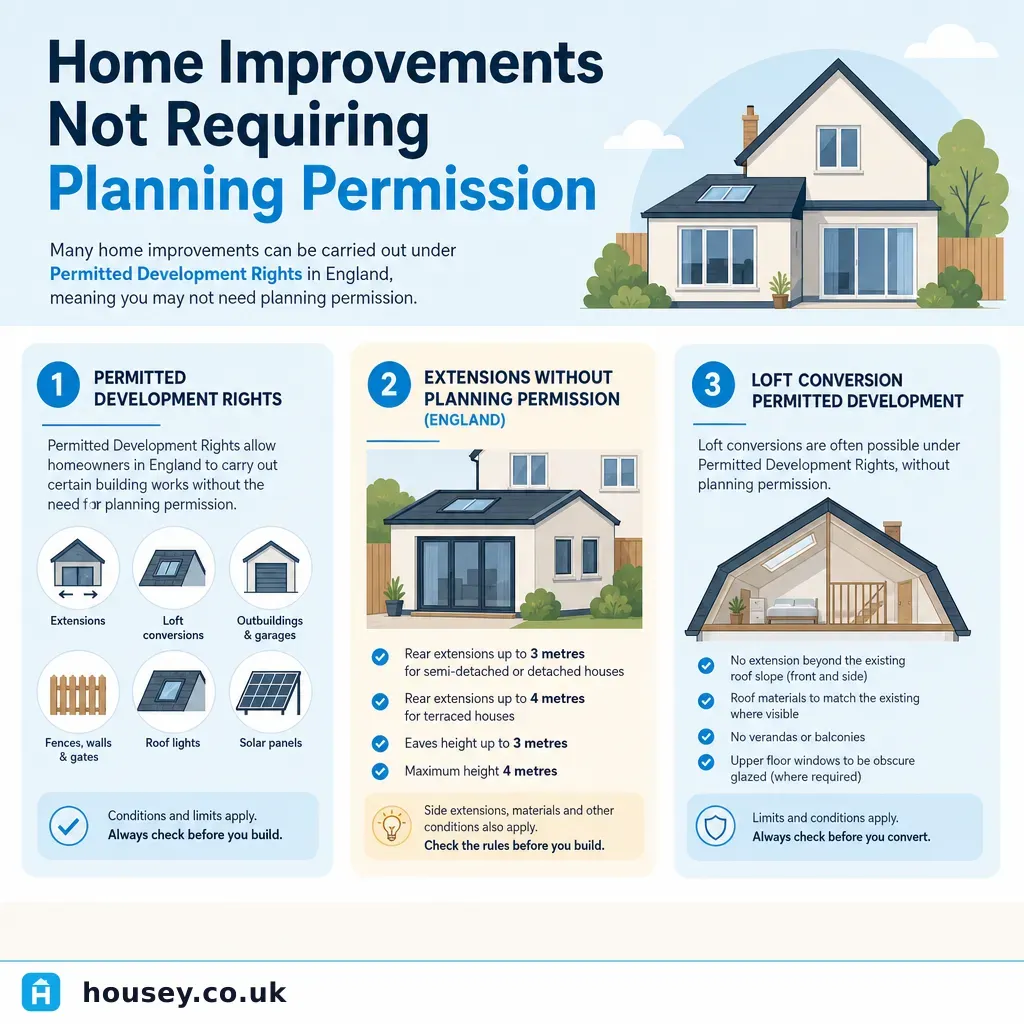
Home Improvements Not Requiring Planning Permission
Many common home improvements in England fall under Permitted Development Rights and do not require a planning application.
 Planning & Pre-Build
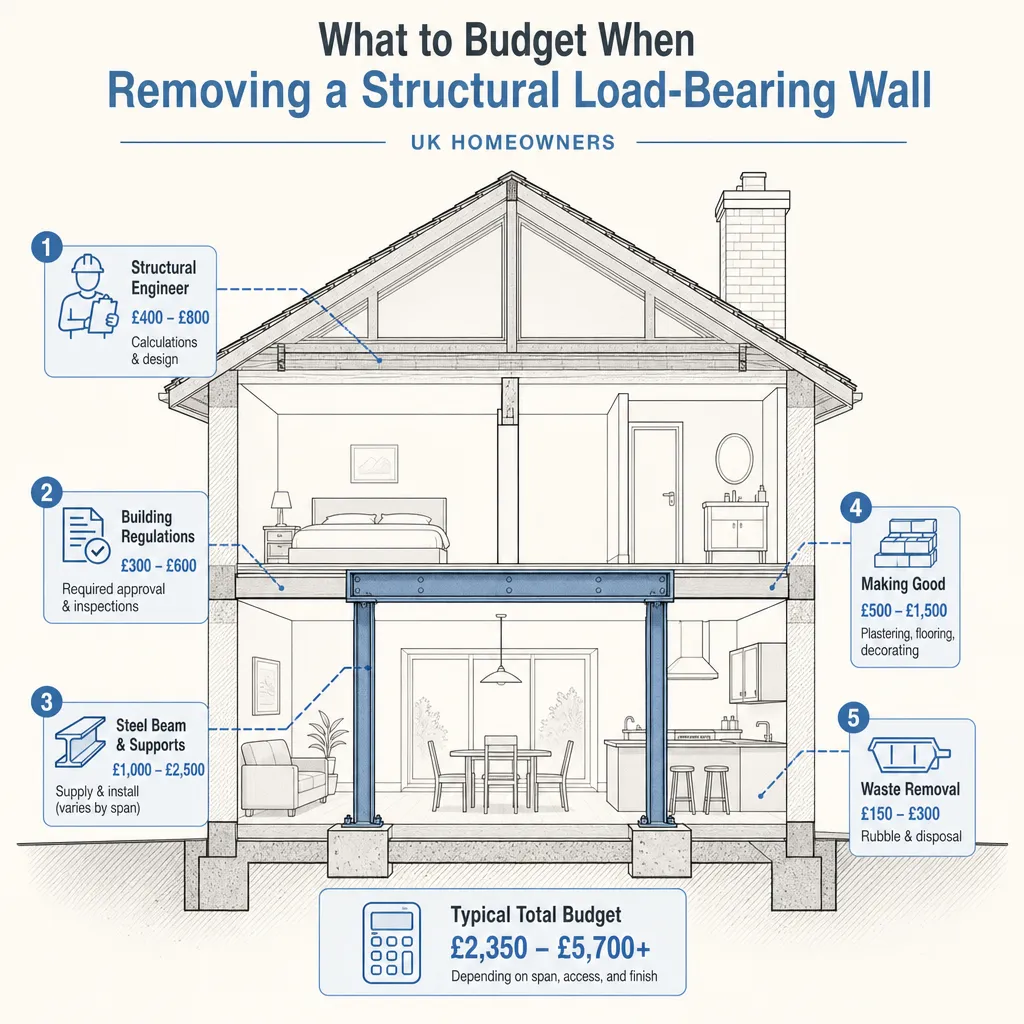
What to Budget When Removing a Structural Load-Bearing Wall
Removing a load-bearing wall in a typical UK home costs £2,500–£8,000 or more in total, covering a structural engineer's calculations, Building Regulations approval, the steel beam, builder's labour, and replastering.
 Planning & Pre-Build
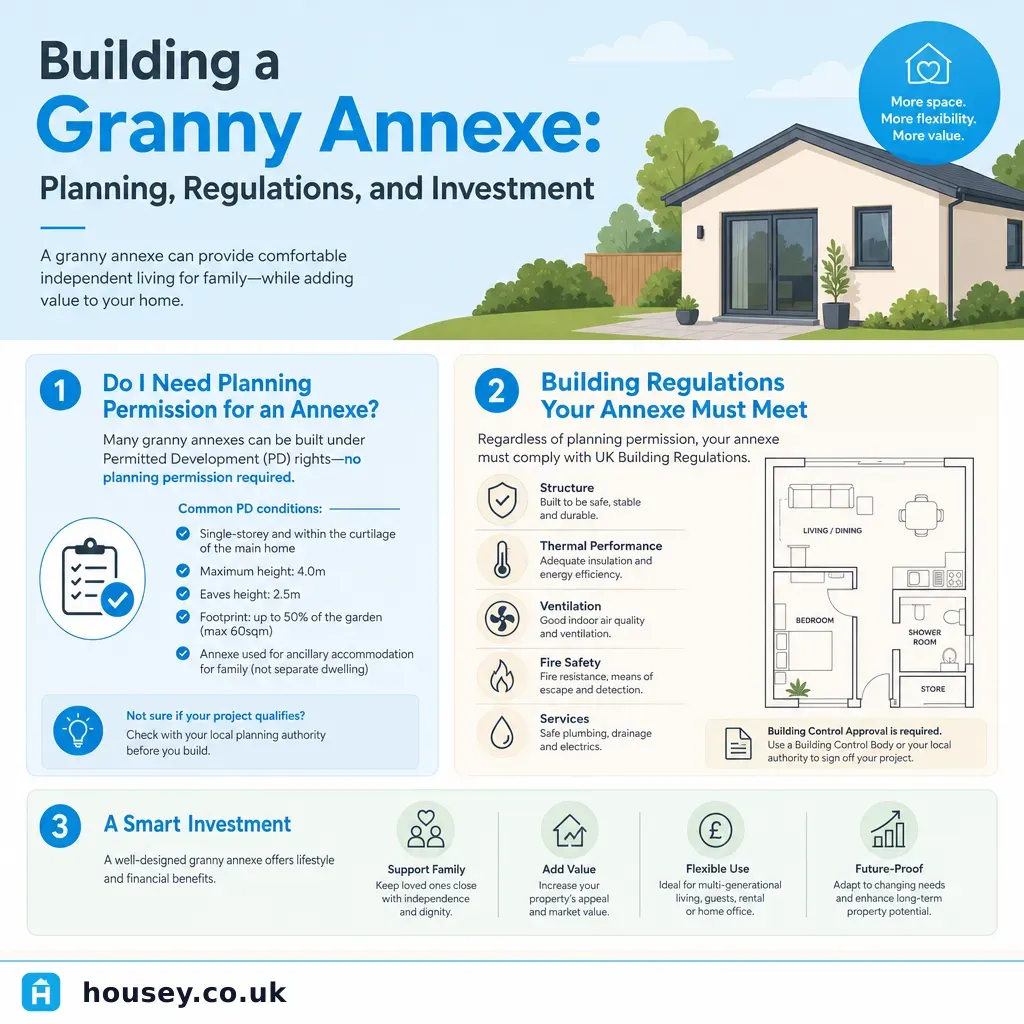
Building a Granny Annexe: Planning, Regulations, and Investment
A granny annexe in the UK may or may not need planning permission depending on whether it is classed as incidental to the main house or as a separate dwelling.
 Planning & Pre-Build
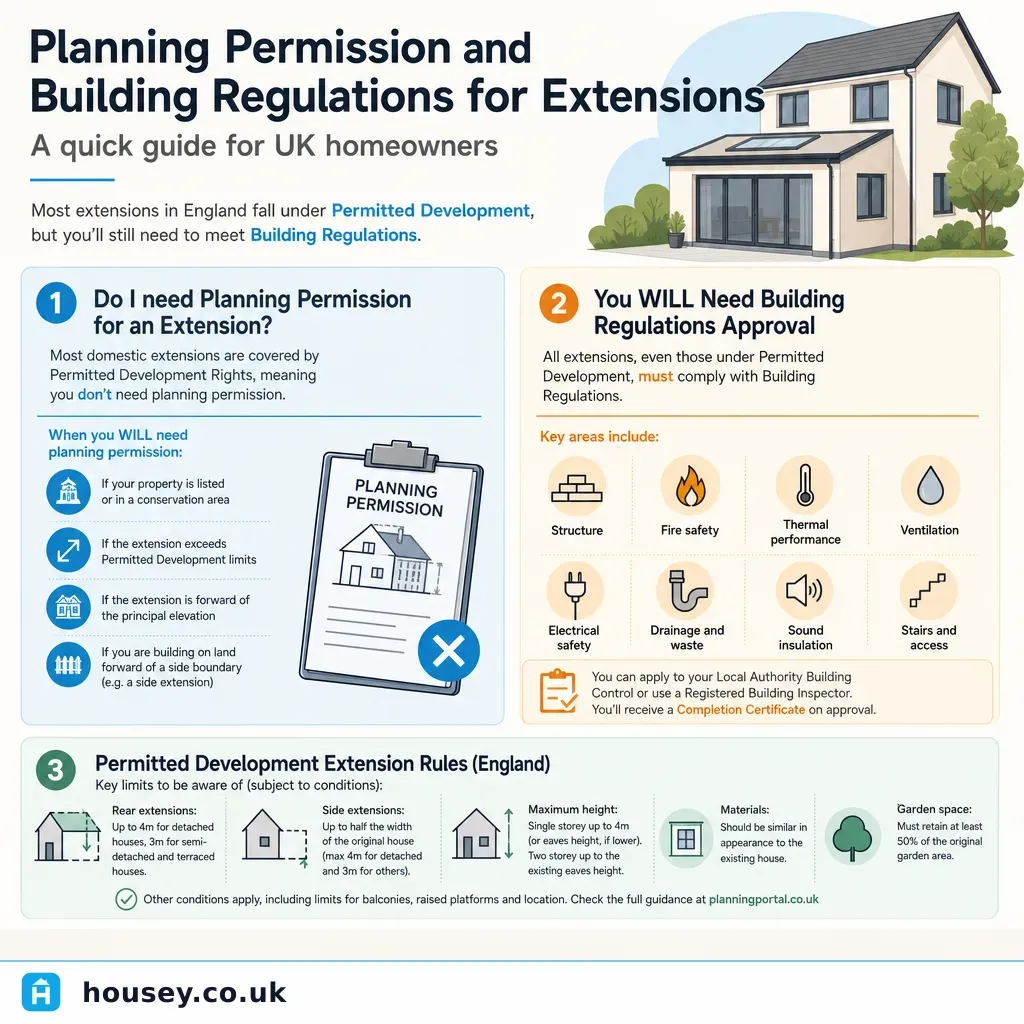
Planning Permission and Building Regulations for Extensions
UK home extensions usually require both planning permission and Building Regulations approval, though most smaller rear extensions qualify as Permitted Development under the GPDO 2015 and need no planning application.
 Planning & Pre-Build
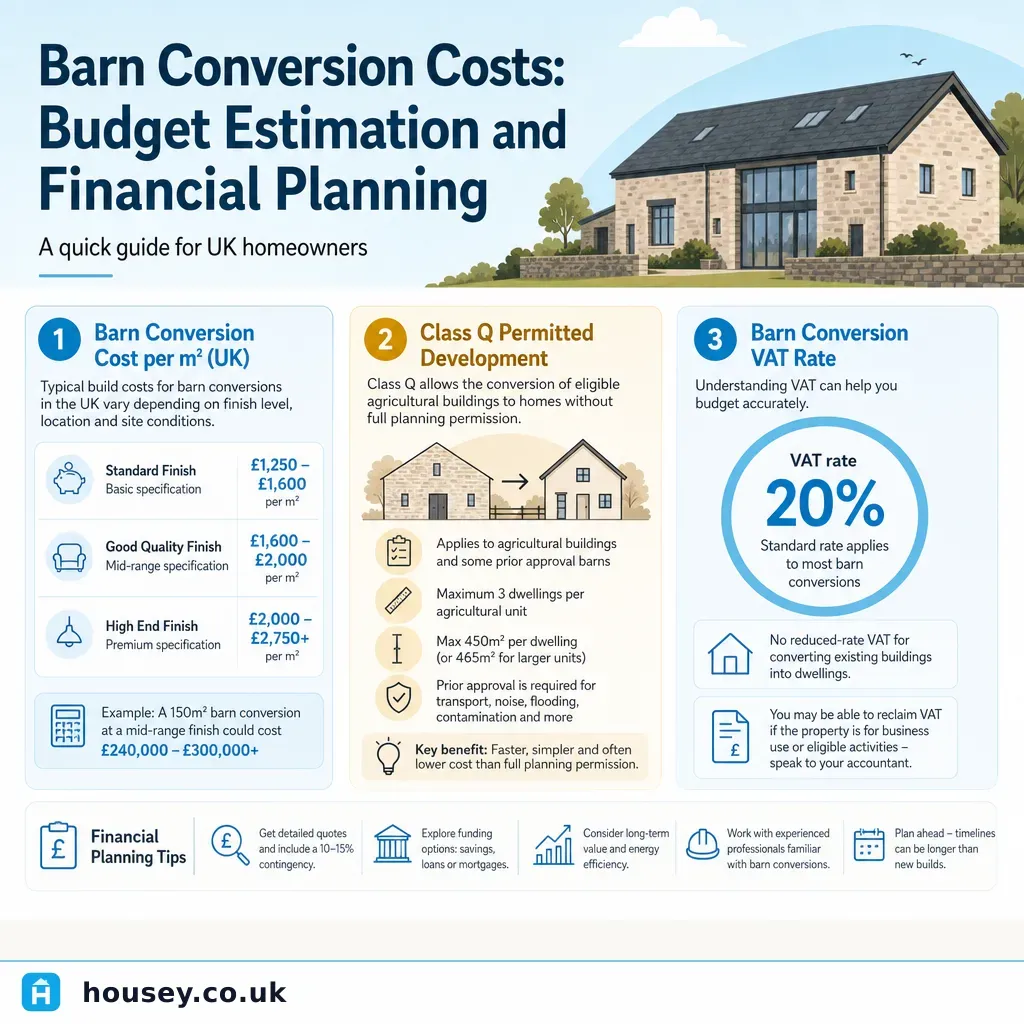
Barn Conversion Costs: Budget Estimation and Financial Planning
Barn conversions in the UK typically cost £1,500–£3,000 or more per square metre depending on structural condition, specification, and location.