Casement Windows: Style, Performance and Installation Guide
By Housey · Last reviewed 26th of May 2026
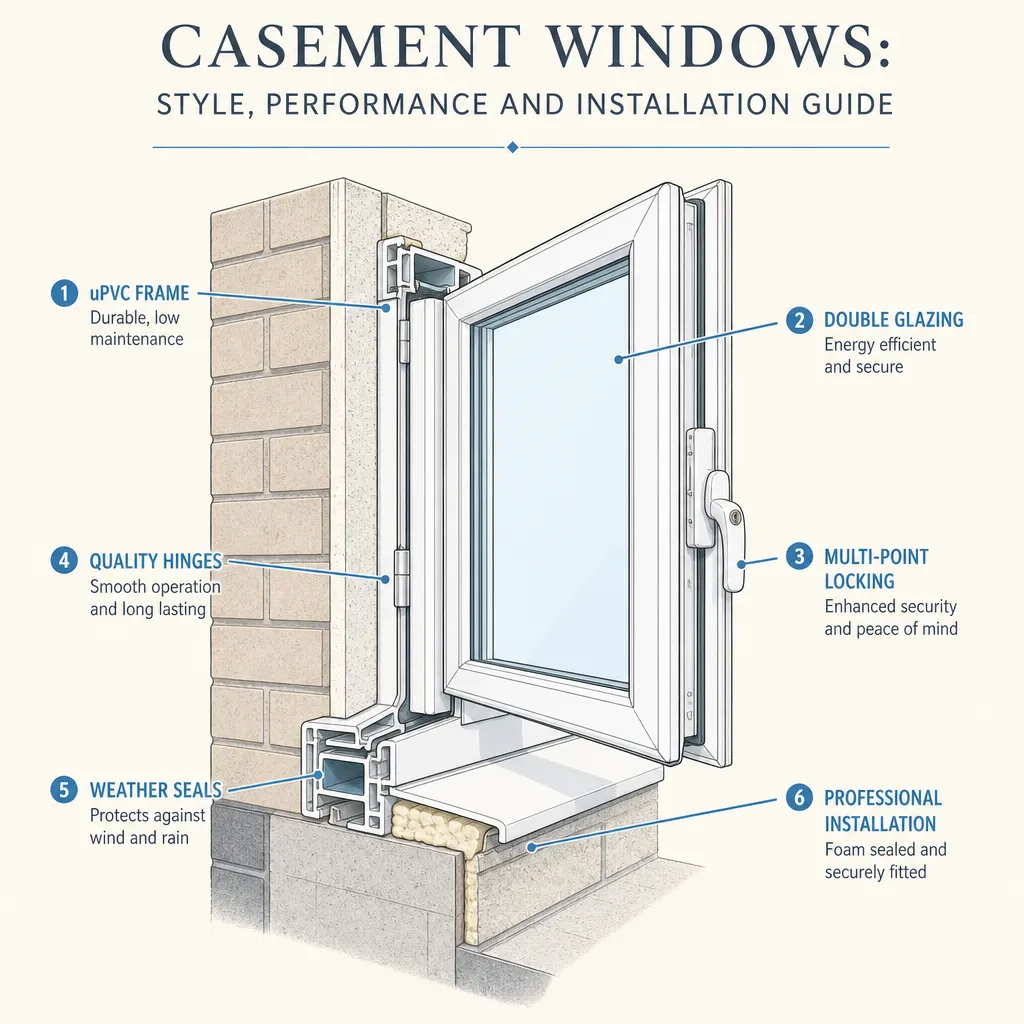
Casement Windows: Style, Performance and Installation Guide
Casement windows are the dominant window type in UK homes built since the 1930s, and they remain the most common choice for replacement window projects today. Homeowners typically revisit their casement specification when replacing ageing uPVC units, upgrading from single glazing in a pre-war property, or planning a new extension. The choice of frame material, glazing specification, hardware, and opening configuration affects energy performance, maintenance demand, security rating, and building control compliance in ways that are not always apparent at the point of purchase.
Key points
- Casement windows are hinged on a vertical side jamb and open outward; tilt-and-turn variants can also tilt inward on a bottom hinge for ventilation or swing fully inward for cleaning and emergency escape.
- Building Regulations Part L requires replacement windows in England to achieve a whole-window U-value of no more than 1.4 W/m²K, or a Window Energy Rating (WER) of Band C or better under the BFRC rating scheme.
- Replacement window installations in England must be carried out by a FENSA- or CERTASS-registered installer, or separately notified to the local authority building control as a building regulation application.
- Timber casements in listed buildings or conservation areas may require listed building consent or planning permission before replacement, and uPVC frames may be restricted by local planning policy.
- Casement windows used as a means of escape from sleeping accommodation must provide a clear opening of at least 0.33 m², with both height and width no less than 450 mm, per Approved Document B.
How casement windows work
A casement window has one or more sashes hinged to the outer frame. The most common arrangement in UK domestic construction is a single side-hung casement with a fixed-light panel alongside or above. Key opening configurations include:
- Side-hung casement: Hinged on the left or right jamb, opens outward. The most common type across all construction eras.
- Top-hung vent light: Hinged at the top, opens outward at the bottom — often used as a secondary ventilation vent above a fixed panel.
- Tilt-and-turn: Tilts inward on a bottom hinge for ventilation, or opens fully inward on a side hinge for cleaning and escape. Common in upper-floor rooms and flats.
- French casement (double casement): Two sashes meeting at the centre without a central mullion; used for wide openings and for a visual connection to outside.
Most UK casement windows are outward-opening, which provides an effective weather seal when closed but requires consideration of clearance over paths, drives, and at low-level openings.
Frame materials: a comparison
The choice of frame material is the most commercially significant decision for most homeowners, affecting cost, appearance, thermal performance, maintenance burden, and longevity.
Frame material | Typical lifespan | Maintenance | Thermal performance | Best suited to |
|---|---|---|---|---|
uPVC | 20–35 years | Low (wipe clean) | Good with multi-chamber profiles | Cost-conscious replacements; modern houses |
Aluminium (powder-coated) | 35–45 years | Low | Moderate — must specify thermal break | Contemporary styling; slim sightlines; large spans |
Softwood timber | 30–50 years with maintenance | High (repaint every 5–7 years) | Good (natural insulator) | Period properties; conservation area work |
Engineered timber | 30–50 years | Moderate | Good | Wide spans needing dimensional stability |
Aluminium-clad timber | 35–50 years | Low externally | Good | Conservation areas wanting low external maintenance |
Indicative UK supply-only costs for a standard 1,200 × 1,050 mm double-casement unit: uPVC £400–£800; softwood timber £600–£1,500; aluminium £700–£1,400. Installation costs are additional and vary by location and access. Indicative UK costs, last reviewed 2026-05-26. Always obtain multiple quotes.
Glazing specification and energy performance
Under Building Regulations Part L, replacement windows must achieve:
- A whole-window U-value of 1.4 W/m²K or better, or
- A Window Energy Rating (WER) of Band C or better under the British Fenestration Rating Council (BFRC) scheme.
Standard double-glazed units with a 16–20 mm argon-filled cavity and a low-emissivity (low-e) soft-coat inner pane typically achieve centre-pane U-values of around 1.0–1.2 W/m²K. Whole-window figures — including the frame and edge zones — typically range from 1.2 to 1.6 W/m²K depending on frame specification.
Triple glazing achieves whole-window U-values of around 0.7–1.0 W/m²K and is increasingly specified in new-build and deep-retrofit projects. It is heavier than double glazing, and the additional sash weight must be accommodated in the frame and ironmongery specification.
Warm-edge spacer bars (replacing traditional aluminium spacers around the perimeter of the sealed unit) reduce thermal bridging at the glass edge and lower the risk of condensation forming on the inner face of the glass during cold UK winters.
Security standards
Window security performance is assessed under PAS 24:2022 (Enhanced security performance requirements for doorsets and windows in new and existing dwellings). Most reputable UK casement window manufacturers test their products to this standard. Key security features include:
- Multi-point locking mechanisms engaging at multiple points around the frame.
- Anti-jemmy rebates — reinforced frame sections that resist crowbar attack.
- Laminated glass on ground-floor or other vulnerable openings.
- Shootbolt espagnolette hardware for wider casement spans.
Where a new window installation must comply with Secured by Design accreditation — required by some planning conditions and social landlords — PAS 24:2022 compliance is typically mandatory.
What to ask before accepting a quote
Before instructing an installer, confirm the following:
- What whole-window U-value will the specified unit achieve? Ask for the BFRC certificate or product test data.
- Is the installer registered with FENSA or CERTASS, and will they provide a completion certificate on the day?
- What frame material and profile system is being quoted? What BSI Kitemark or CE marking does the manufacturer hold?
- What glazing configuration is included — cavity width, gas fill, and spacer bar type?
- Does the ironmongery and locking hardware meet PAS 24:2022?
- Are removal of existing frames and disposal of old glazing included in the quoted price?
- What are the guarantee periods on frames, sealed units, and installation workmanship respectively?
Planning and permitted development
Replacing an existing casement window in the same opening is normally permitted development in England — no planning permission is required, provided the installer is registered with FENSA or CERTASS. Exceptions include:
- Listed buildings: Any replacement requires listed building consent, regardless of whether it is like-for-like.
- Conservation areas: Replacement with different materials — for example, uPVC replacing traditional timber sashes — may require planning permission. Check your local planning authority's supplementary planning document for guidance on acceptable window types.
- Article 4 directions: Some local authorities remove permitted development rights for window replacement in specific streets or areas. Verify with the LPA before ordering.
Creating a new window opening requires both building regulations approval (structural calculation, lintel specification) and may require planning permission depending on location and opening size.
When to get professional help
Most replacement casement window projects can be handled by a FENSA- or CERTASS-registered installer without additional professional involvement. However, specialist advice is advisable when:
- The property is listed or in a conservation area and the original windows have historic significance.
- Structural alterations are needed to enlarge or create a new window opening.
- The building has solid brick or stone walls where the lintel condition is unknown.
- Previous installations have resulted in water ingress, damp reveals, or cracking around the frame.
- A planning condition specifies window style, material, or profile.
How Housey can help
Housey connects UK homeowners with vetted window and door installers who are FENSA- or CERTASS-registered. Describe your window project and receive competitive quotes from qualified local professionals, whether you are replacing one casement or retrofitting a whole property.
Frequently asked questions
How long do uPVC casement windows last?
A well-manufactured uPVC casement window should last 20–35 years in typical UK conditions. The sealed glass unit often requires replacement after 15–25 years if the argon-gas fill dissipates or the perimeter seal fails, indicated by persistent misting between the panes. The uPVC frame usually outlasts the glazed unit.
Can I replace casement windows myself?
Replacing a window in an existing opening is technically possible for a competent DIYer, but the installation will not be covered by a FENSA or CERTASS certificate. You would need to notify local authority building control and pay for an inspection, which typically costs more than the saving and may complicate any future property sale.
Do new casement windows need building regulations approval?
All replacement windows in England must comply with Building Regulations Part L (thermal performance) and Part B (escape windows where applicable). Installations by a FENSA- or CERTASS-registered installer are self-certified. If the installer is not registered, a separate building regulation application must be submitted to the local authority.
What is the difference between a casement window and a sash window?
A casement window is hinged and swings open — usually outward. A sash window slides vertically or horizontally and does not project when opened. Sash windows are the period-appropriate choice for pre-1920 properties; casements have been standard in UK houses built from the 1930s onwards and in most new build.
Sources and further reading
- Building Regulations Approved Document L: Conservation of fuel and power — GOV.UK
- Building Regulations Approved Document B: Fire Safety — GOV.UK
- FENSA: Competent Person Scheme for glazing — FENSA
- CERTASS: Competent Person Scheme for windows and doors — CERTASS
- British Fenestration Rating Council: Window Energy Ratings — BFRC
- PAS 24:2022 – Enhanced security performance requirements for doorsets and windows — BSI
Useful next reads
 Improvement & Build
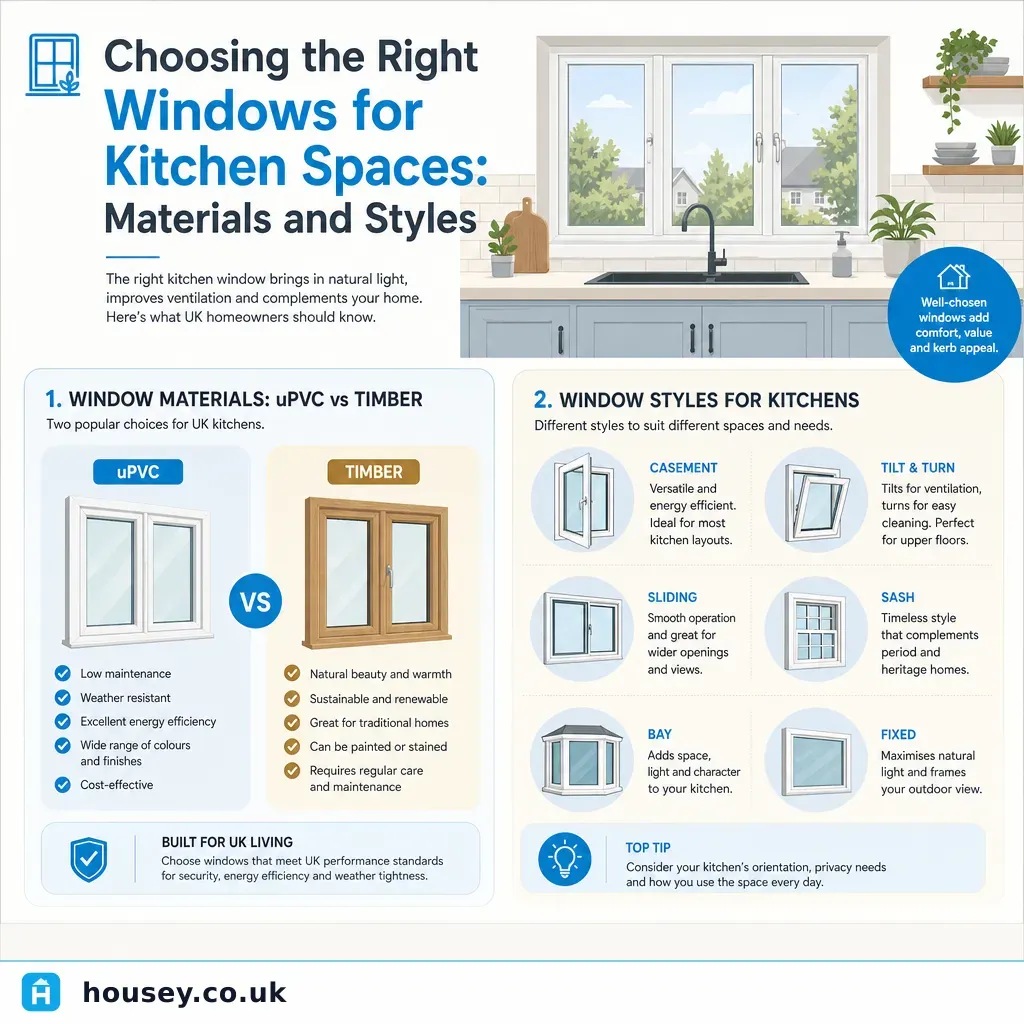
Choosing the Right Windows for Kitchen Spaces: Materials and Styles
Kitchen windows must meet Building Regulations Part L, achieving at least Window Energy Rating Band C.
 Improvement & Build
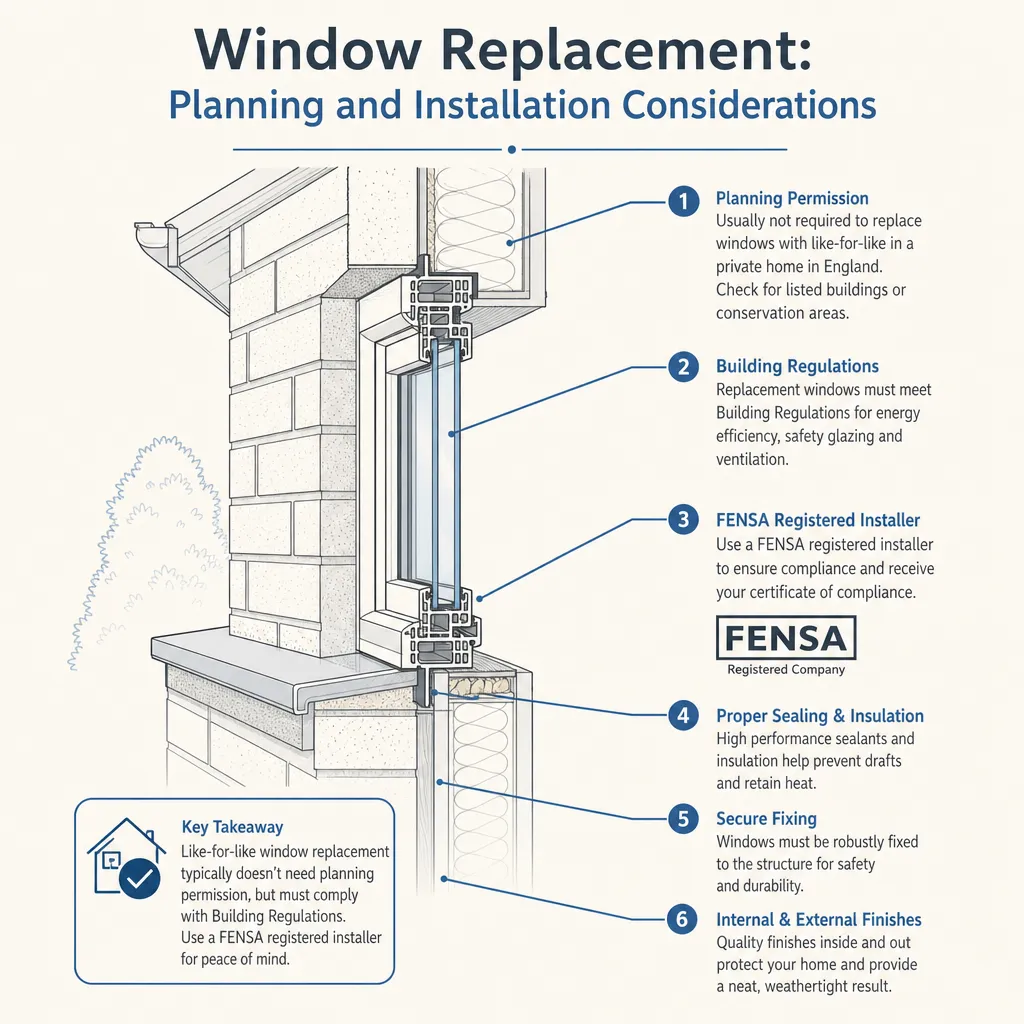
Window Replacement: Planning and Installation Considerations
Most window replacements in England fall under permitted development and do not need planning permission, though listed buildings, flats, and conservation areas are exceptions.
 Improvement & Build
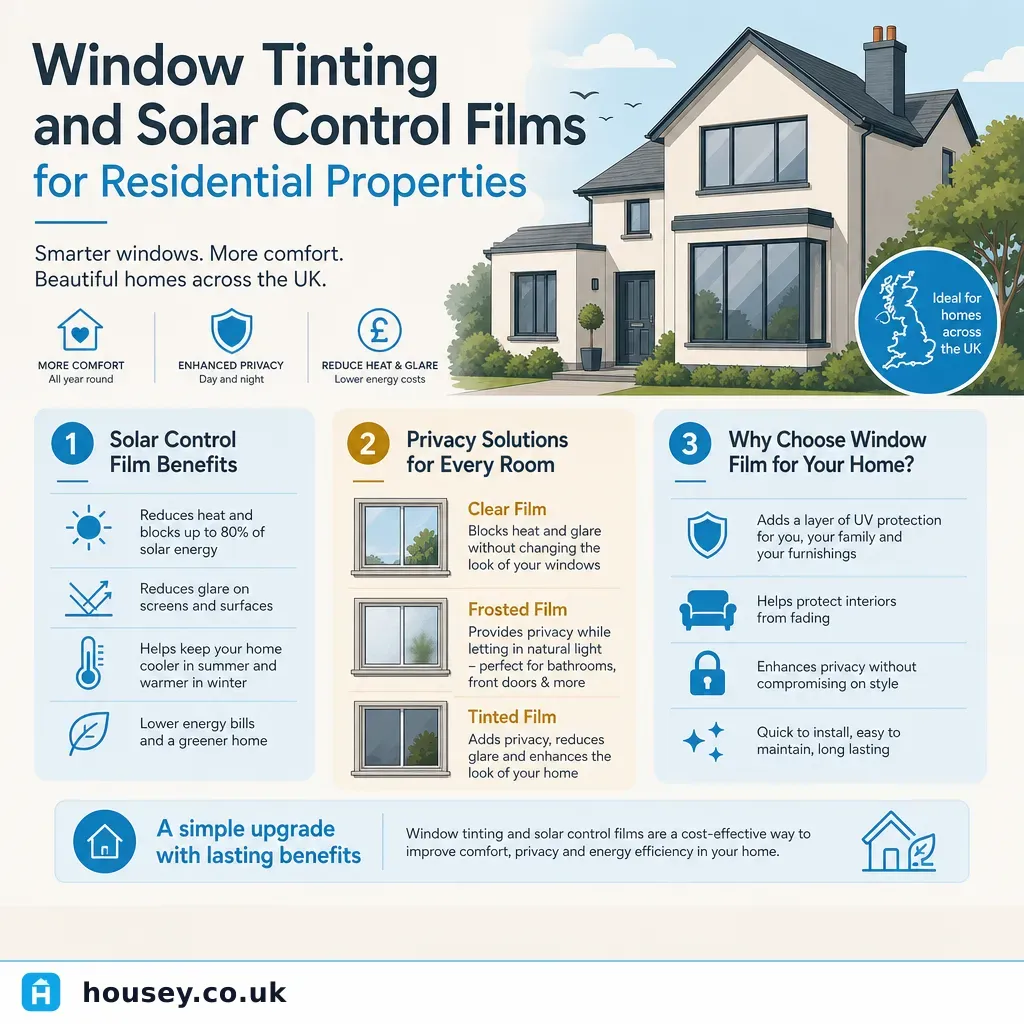
Window Tinting and Solar Control Films for Residential Properties
Solar control window films reject 40–80% of total solar energy and block 99% of UV radiation, reducing overheating and fading without replacing glazing.
 Improvement & Build
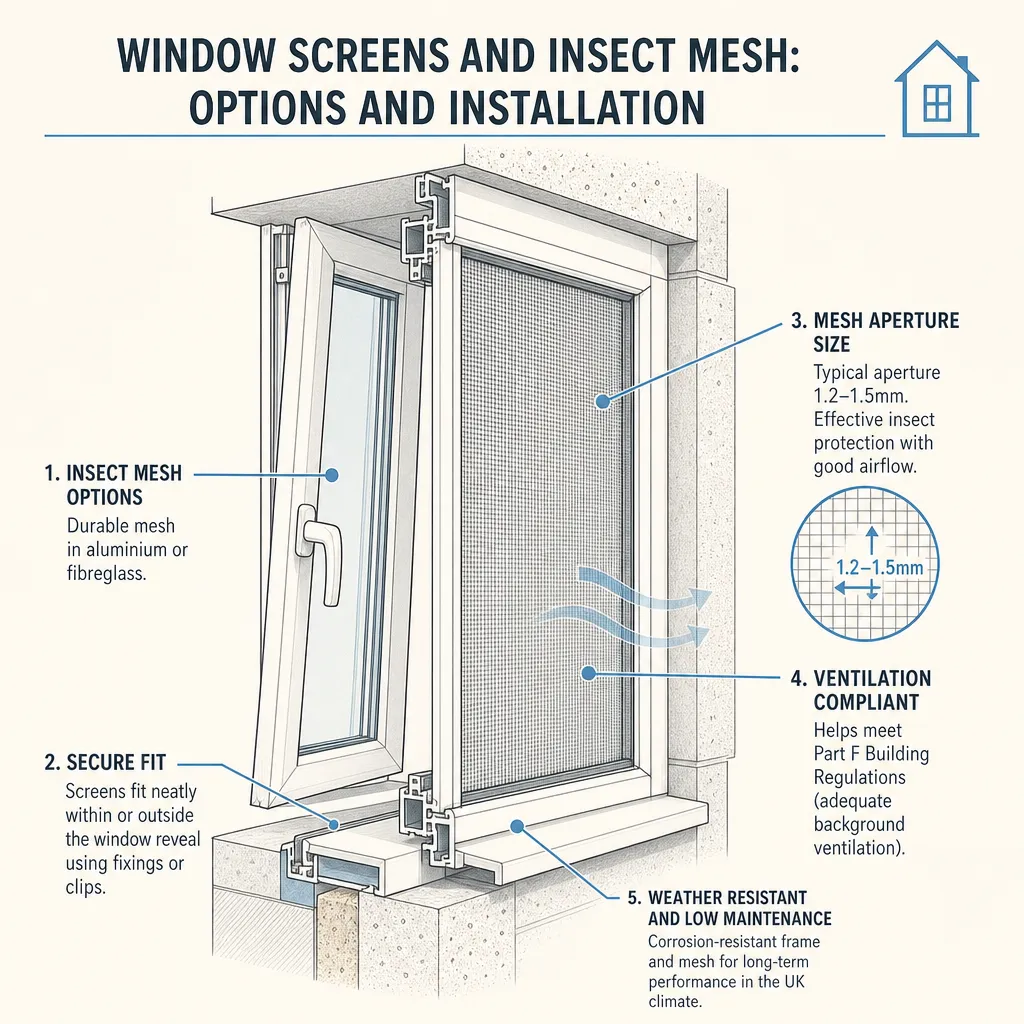
Window Screens and Insect Mesh: Options and Installation
UK window screens fall into four main types: fixed frame, roller retractable, pleated folding, and magnetic snap-fit.
 Improvement & Build
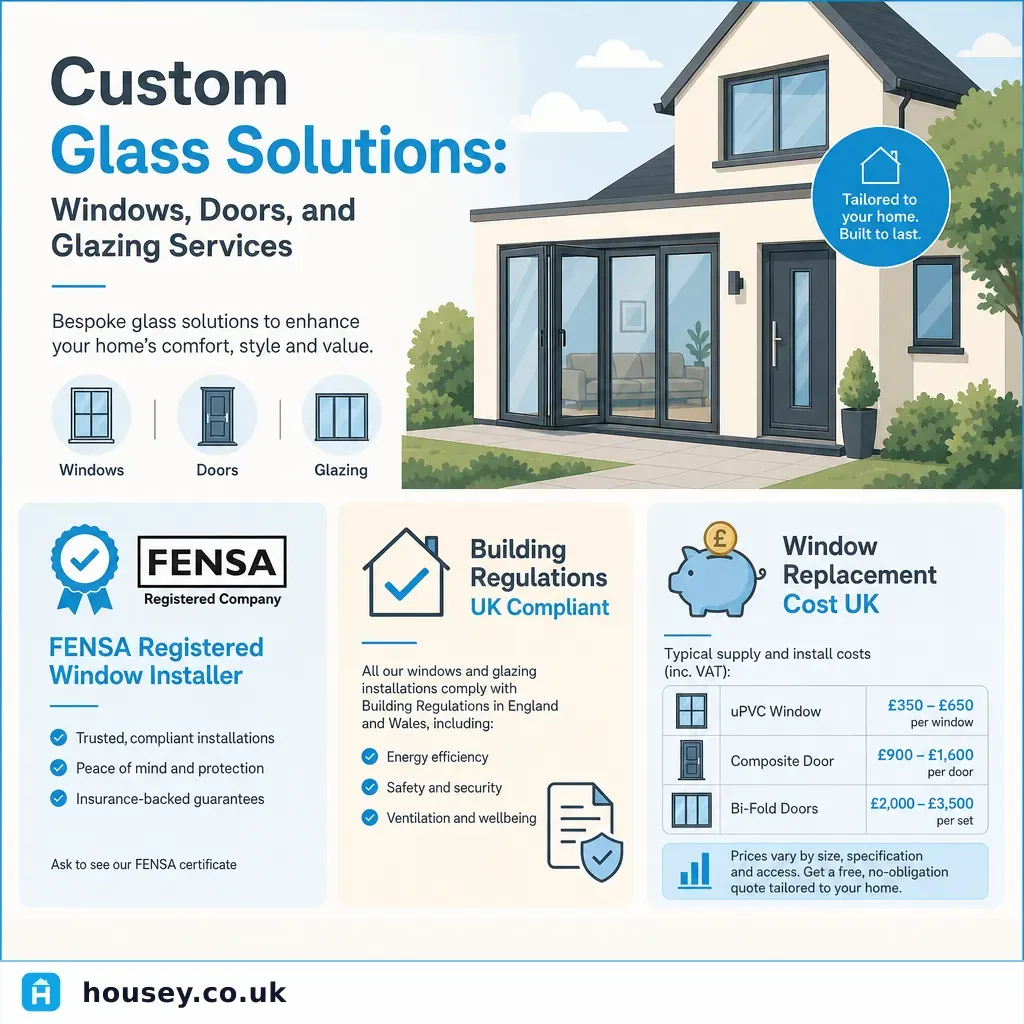
Custom Glass Solutions: Windows, Doors, and Glazing Services
Replacement windows and doors in England and Wales must comply with Building Regulations Approved Document L (2022), requiring a whole-window U-value of 1.