CCTV Drain Survey Pricing and What to Expect
By Housey · Last reviewed 5th of May 2026
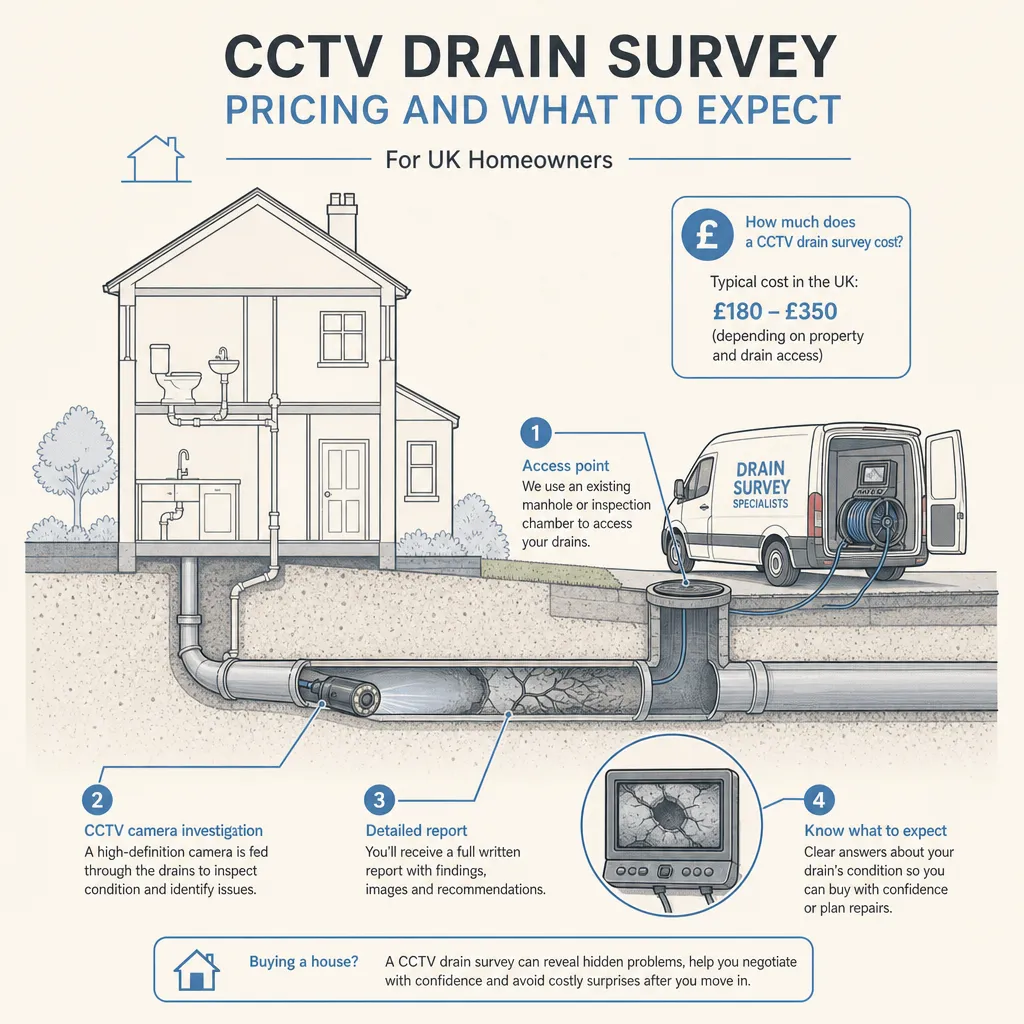
CCTV Drain Survey Pricing and What to Expect
Drainage problems are among the most disruptive issues a UK homeowner can face, and many develop gradually — cracked pipes, root ingress, displaced joints — long before a blockage or collapse becomes obvious. A CCTV drain survey is the standard diagnostic tool for assessing underground drainage without excavation, and it is increasingly requested by conveyancers, mortgage lenders, and buyers before exchange on older UK properties. Knowing what the survey involves, what it typically costs, and how to read the report helps you act on any findings with confidence.
Key points
- Standard residential CCTV drain surveys typically cost £150–£400 in the UK, with larger or more complex drain networks attracting higher fees (indicative UK costs, last reviewed 2026-05-05).
- Drainage contractors use WRc (Water Research Centre) condition codes — graded 1 to 5 — to classify defects; codes 4 and 5 indicate severe or immediate structural failure risk and require prompt action.
- The survey produces a video recording of the drain interior, a written condition report, and usually a site plan marking drain runs, manholes, and defect locations with distance measurements.
- Shared or combined drainage systems connecting to a public sewer are governed by the Water Industry Act 1991 — repair work on shared sections may require involvement from the sewerage undertaker.
- Pre-purchase CCTV surveys are particularly important for properties built before 1970, where clay or pitch fibre pipes are common and prone to root ingress and joint displacement.
What is a CCTV drain survey?
A CCTV drain survey passes a small, remotely operated camera through the drainage system via an existing access point — usually a manhole, inspection chamber, or rodding eye. The camera transmits live footage to a surface monitor, and the operator records the full run as a video file. Defects are coded using standard WRc condition codes and a written report is produced.
The survey is non-destructive: no excavation is needed. It can cover foul drains (carrying waste from WCs and plumbing), surface water drains, and combined systems. It cannot inspect pressurised water supply pipes or sections of drainage with no accessible entry point.
How much does a CCTV drain survey cost?
Costs vary by property size, drain length, number of access points, and the scope of the work. The table below shows indicative price ranges for common residential scenarios.
Survey type | Indicative cost | Typical scope |
|---|---|---|
Pre-purchase survey (standard house) | £150–£300 | Single drain run, up to 30m |
Full property survey (larger house or multiple runs) | £250–£500 | Two or more runs, all manholes |
Commercial or multi-unit property | £400–£1,000+ | Multiple large-diameter runs |
Emergency diagnostic survey | £200–£450 | Rapid response, may include jetting |
Combined survey and jet clean | £250–£550 | Survey plus high-pressure jetting |
Indicative UK costs, last reviewed 2026-05-05. Prices vary by region and contractor. Always request itemised quotes.
Some drainage companies include a basic jet clean before surveying as standard — ask whether this is included, as it improves the quality of footage and may avoid a second mobilisation fee.
When do you need a CCTV drain survey?
Use this decision guide to determine whether a survey is appropriate for your situation.
- Commission a survey before buying if the property was built before 1970 — clay and pitch fibre pipes common in this era are prone to root ingress and joint displacement.
- Commission a survey before buying if there are large trees adjacent to the garden, a history of recurring blockages, or if the vendor cannot provide any drainage records.
- Commission a survey if the same drain blocks more than twice a year — a structural defect rather than a behavioural cause is likely.
- Commission a survey if you are planning an extension or loft conversion — building control may require confirmation of drain locations before approving plans.
- Commission a survey if there is unexplained ground movement, subsidence, or sinkholes in the garden — drainage leaks can saturate ground and contribute to settlement.
- Commission a post-repair survey after any drain repair by excavation or pipe lining, to confirm the work has been carried out correctly.
- A survey is probably unnecessary for a post-2000 property in good condition with no history of blockages, no trees near drain runs, and a full drainage map provided by the seller.
What the survey involves: step by step
- Access setup. The operator locates the nearest accessible manhole or inspection chamber. On some older properties, access points may be buried or covered over, which can add time and cost to the visit.
- Pre-survey jet clean (if included). High-pressure water jetting removes debris and sediment from pipe walls before the camera enters, improving visibility of structural defects.
- Camera insertion. A self-propelled crawler camera — or a push-rod camera for smaller residential pipes — is fed through the drain. Standard residential drainage is typically 100mm or 150mm diameter.
- Survey run. The operator moves the camera along the drain at a controlled pace, recording continuous footage. Distance counters allow defect locations to be logged precisely.
- Defect coding. Any defects — cracks, root ingress, displaced joints, deposits, collapsed sections — are coded using WRc condition codes and noted with their distance from the access point.
- Report production. The written report is usually delivered within 24–48 hours and includes the video file, a site plan, a schedule of defects with WRc codes and distances, and repair recommendations.
Understanding the WRc condition codes
WRc code | Description | Urgency |
|---|---|---|
1 | Minor defect — no effect on function | Monitor only |
2 | Moderate defect — some effect on performance | Plan maintenance |
3 | Significant defect — affecting flow or integrity | Repair within 12 months |
4 | Severe structural defect — risk of failure | Repair promptly |
5 | Immediate structural failure risk | Repair immediately |
A report with only code 1–2 findings is generally reassuring. Codes 4 or 5 should prompt a repair quote and, for a property purchase, may be grounds to renegotiate the agreed price or request the vendor resolves the defect before exchange.
What to ask before accepting a quote
- What diameter and length of drain does the survey cover, and is more than one run included in the price?
- Is a pre-survey jet clean included, or quoted separately?
- What format will the report take — video file plus written WRc-coded report, or verbal summary only?
- How soon after the survey will the written report be available?
- Are repair recommendations included, or is that an additional service?
- Is VAT included in the quoted price?
- If access points cannot be located or are inaccessible, how is that handled — and does the price change?
- Are you a member of the National Association of Drainage Contractors (NADC) or another recognised trade body?
When to get professional help
A CCTV drain survey is itself a professional service — always engage a qualified drainage contractor rather than attempting a camera inspection yourself. Seek specialist advice promptly if:
- The survey finds a code 4 or 5 defect — particularly for a property purchase, where you may need independent verification of repair costs before exchange.
- The drain runs beneath or close to a shared boundary or a public sewer — repairs may require involvement from the sewerage undertaker under the Water Industry Act 1991.
- The survey reveals the drain passes under a proposed extension footprint — building control will need to see drainage details before approving the plans.
- Ground movement, cracking, or garden sinkholes suggest drain failure may be contributing to a wider structural problem requiring a structural engineer's assessment.
How Housey can help
Housey connects you with qualified drainage professionals for both CCTV drain surveys and fuller drainage surveys. You can request and compare quotes from local contractors, review their credentials, and make an informed decision before committing to any drainage work.
Frequently asked questions
How long does a CCTV drain survey take?
A standard residential survey covering one drain run typically takes 45 minutes to two hours on site, including setup. Larger properties with multiple runs or hard-to-locate access points can take half a day. The written report is usually delivered within 24–48 hours of the site visit.
Can a CCTV drain survey be used as evidence in a property dispute?
Yes. The time-stamped video footage and WRc-coded written report provide objective evidence of drain condition at a specific date. This is useful for disputes between buyers and sellers, between neighbours sharing drainage, or when engaging a sewerage undertaker over adoption of a private drain.
Do I need a CCTV drain survey before buying any house?
It is not legally required, but it is strongly advisable for properties with older clay or pitch fibre drainage, large trees near the drain run, a history of blockages, or any sign of subsidence. Many conveyancers recommend one alongside the building survey for properties built before 1970.
What is the difference between a CCTV drain survey and a drainage survey?
A CCTV drain survey focuses on the internal condition of drain pipes using camera footage. A broader drainage survey may also include manhole inspections, flow or pressure tests, and a full network site plan. For most pre-purchase purposes, a CCTV survey is sufficient; a full drainage survey suits complex or commercial drainage arrangements.
Who is responsible for repairing shared drains?
Drains within the curtilage of a single property are generally the owner's responsibility. Where drains are shared between properties or connect to the public sewer, responsibility may partly lie with the sewerage undertaker. The Water Industry Act 1991 governs this boundary — your solicitor or the sewerage undertaker can confirm the position for a specific property.
Sources and further reading
- GOV.UK: Sewers and drains — responsibilities — GOV.UK, overview of drain and sewer ownership and responsibilities
- Water Industry Act 1991 — legislation.gov.uk, defines public and private drain responsibilities
- National Association of Drainage Contractors (NADC) — trade association for accredited UK drainage contractors
- RICS Home Survey Standard — RICS, context on what standard surveys do and do not cover for drainage
Useful next reads
 Surveys & Inspections
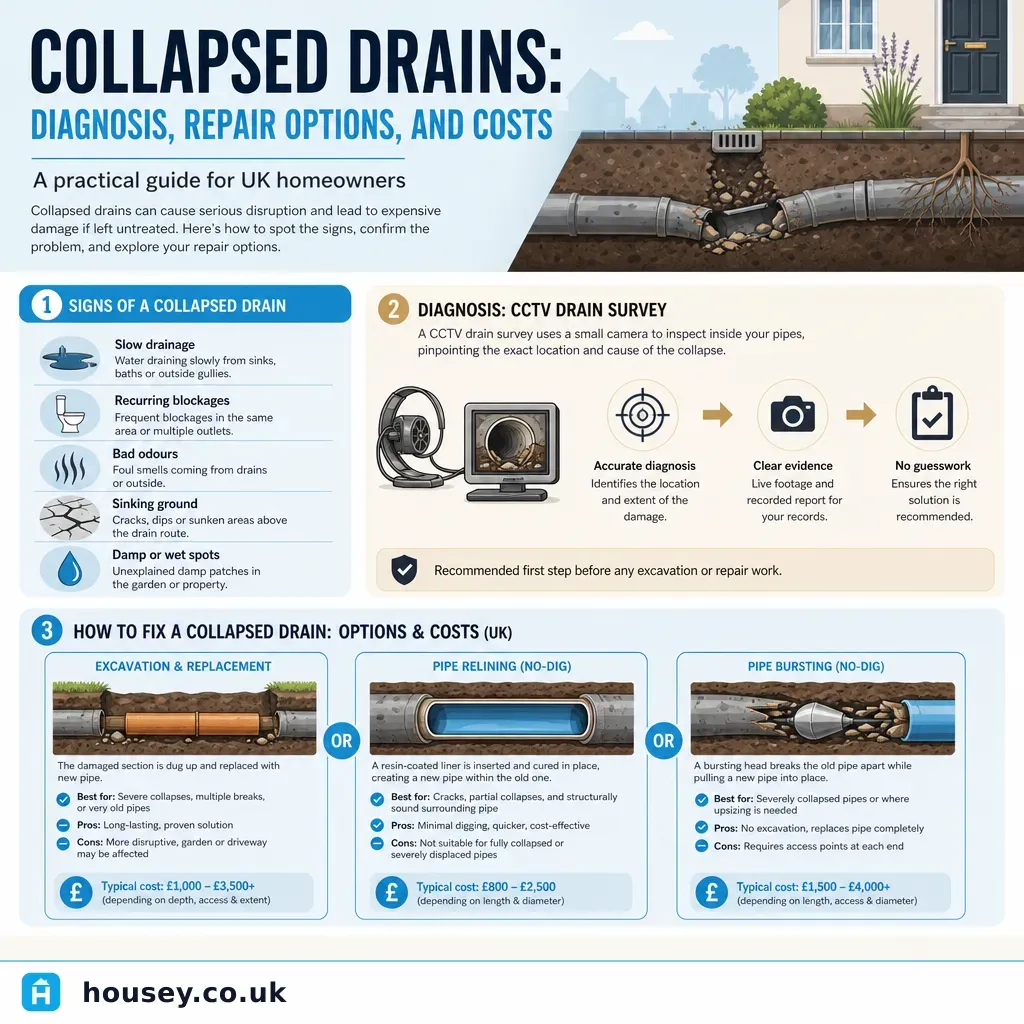
Collapsed Drains: Diagnosis, Repair Options, and Costs
A collapsed drain is a structural pipe failure that cannot be fixed by jetting alone.
 Surveys & Inspections
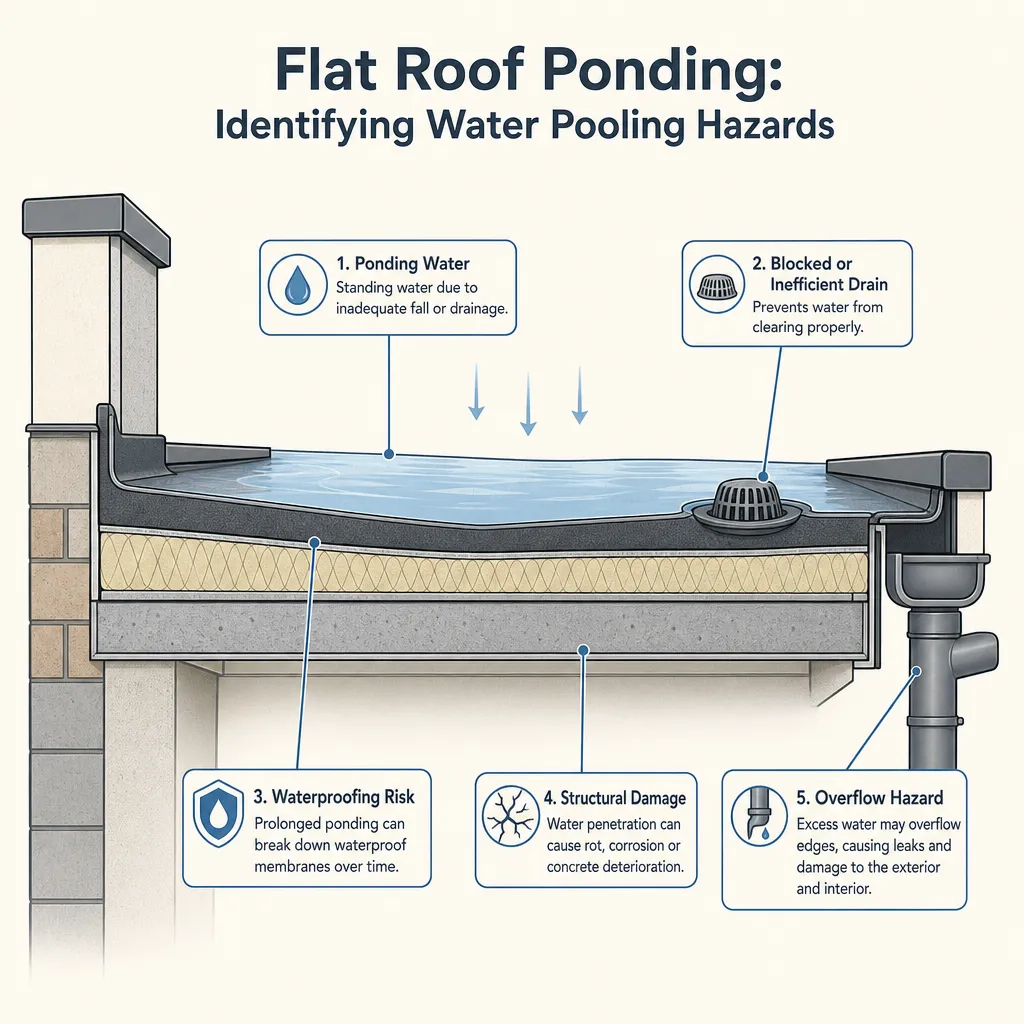
Flat Roof Ponding: Identifying Water Pooling Hazards
Flat roof ponding lasting more than 24–48 hours after rainfall warrants investigation.
 Surveys & Inspections
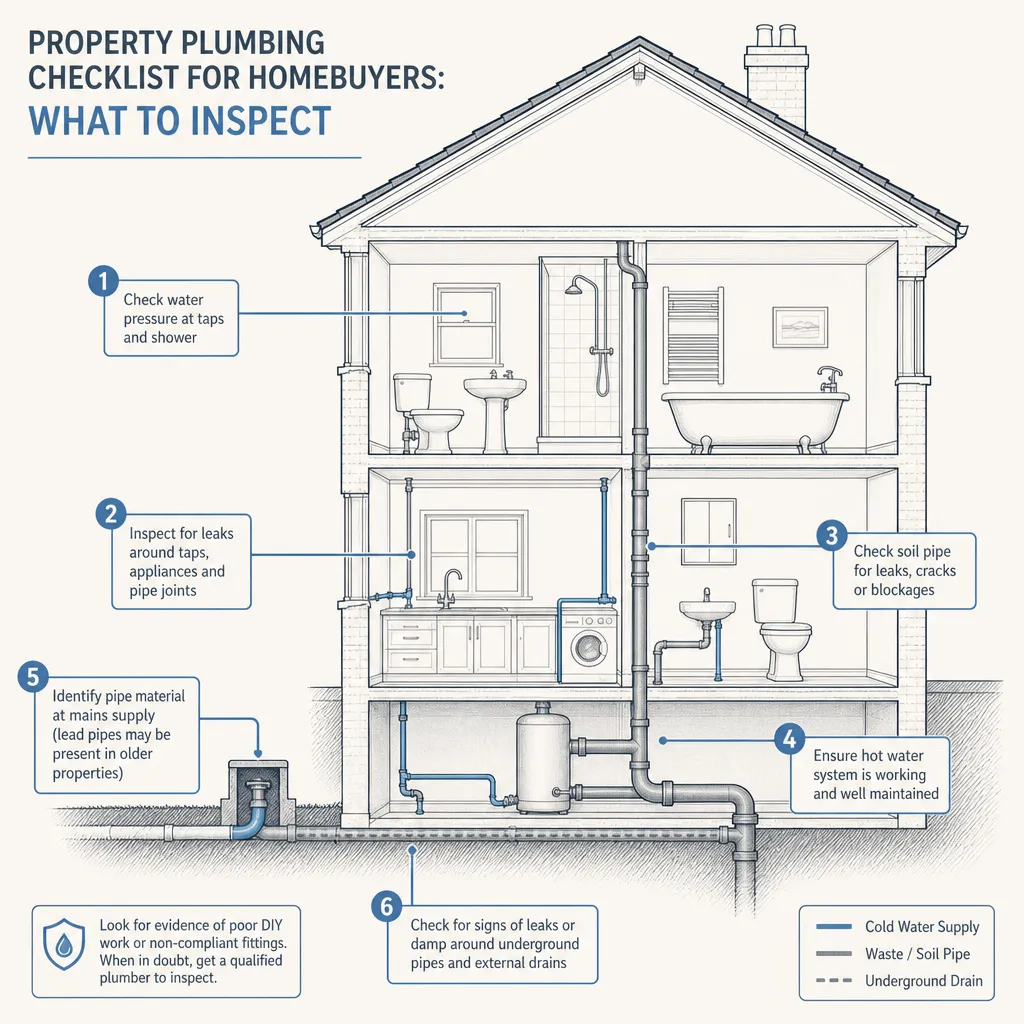
Property Plumbing Checklist for Homebuyers: What to Inspect
Before exchanging on a UK property, check water pressure at multiple outlets, look for signs of damp or staining around pipes, confirm whether any lead pipework remains, inspect the boiler age and service history, and ask your surveyor about drainage.
 Surveys & Inspections
Ceiling Water Damage: Assessment and Repair Costs
Ceiling water damage is assessed by tracing the leak source, measuring moisture content in the ceiling substrate and any exposed timber, and checking for structural softening.
 Surveys & Inspections
Cavity Wall Drainage: Understanding Materials and Moisture Control
Cavity walls control moisture through a drainage system of weep holes, cavity trays, and DPC at ground level.