Collapsed Drains: Diagnosis, Repair Options, and Costs
By Housey · Last reviewed 5th of May 2026
Collapsed Drains: Diagnosis, Repair Options, and Costs
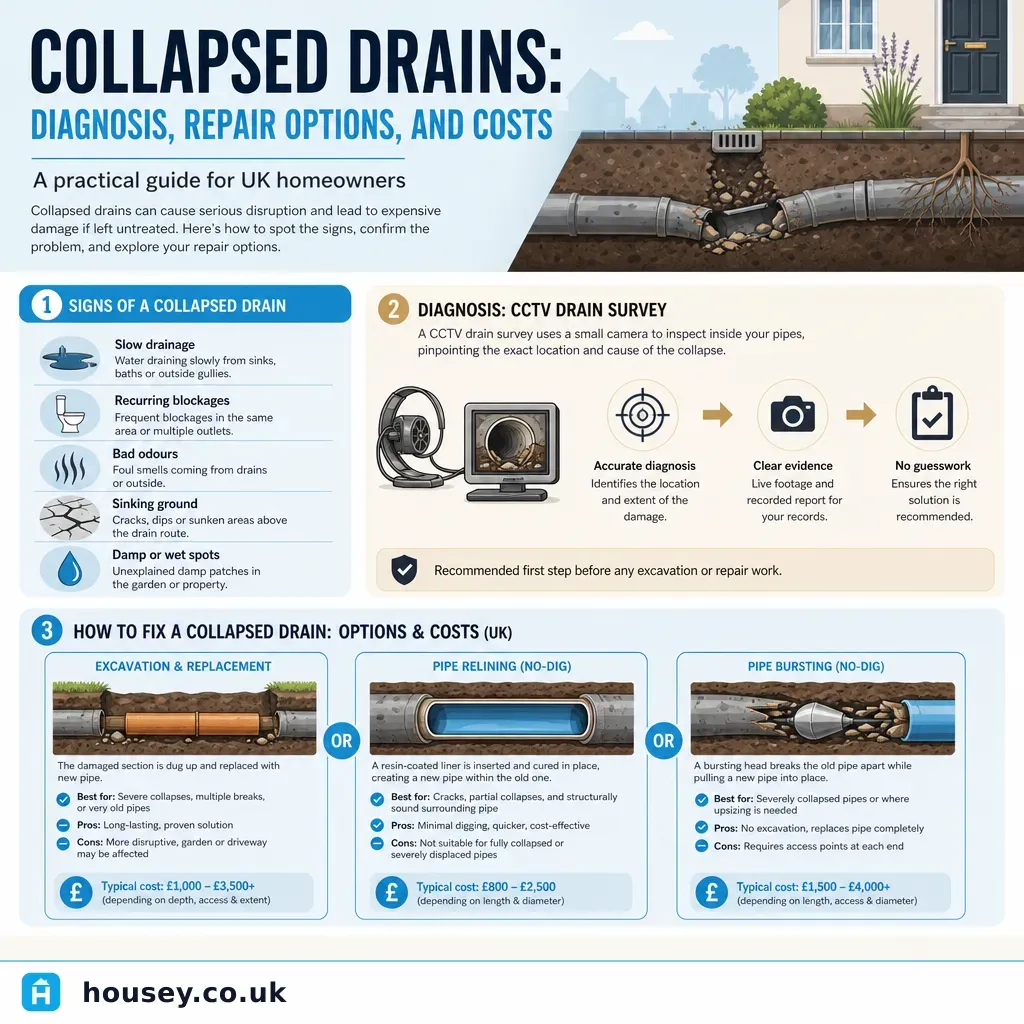
A collapsed drain is one of the more disruptive drainage failures a UK homeowner can face. Unlike a simple blockage that clears with rods or a jetter, a structural collapse means the pipe itself has failed and will not self-correct. The problem is common in older properties where clay or pitch-fibre pipes have reached the end of their design life, and in newer homes where poor installation or ground movement has caused early failure. Acting quickly limits secondary damage to foundations, gardens, and neighbouring land.
Key points
- A CCTV drain survey is the only reliable way to distinguish a collapsed drain from a blockage, locate the failure point, and determine the correct repair method — quotes without a survey are based on guesswork.
- Repair options range from no-dig patch lining (approximately £500–£1,500 per section) to cured-in-place pipe (CIPP) relining (£1,500–£4,000 per run) or full excavation and replacement (£2,000–£6,000+).
- Lateral drains — the section from your property boundary to the public sewer — became the responsibility of water and sewerage companies in England and Wales following the Water Industry (Schemes for Adoption of Private Sewers) Regulations 2011.
- Many standard home insurance policies exclude gradual drain deterioration; check your policy wording carefully before assuming costs are covered.
- Jetting a structurally collapsed pipe without a prior CCTV inspection can worsen pipe displacement and increase repair costs.
How to identify a collapsed drain
Common symptoms
- Persistent or recurring slow drainage despite jetting or rodding
- Wet or sunken patches in the garden, particularly in a linear path following the pipe run
- Sinkholes or depressions forming close to downpipes, inspection chambers, or along the drainage line
- Unexplained cracks in paving, paths, or patios near drainage outlets
- Foul smells from the garden or within inspection chambers
- Gurgling sounds from multiple outlets simultaneously when one fixture is used
These symptoms overlap with blockages, root intrusion, and joint displacement — which is why visual inspection is always the starting point.
Diagnostic decision tree
- Drains are slow but still flowing? → Likely a partial blockage or root intrusion. Commission a CCTV drain survey to confirm the cause before jetting.
- Drains have stopped flowing completely? → Could be a blockage or a collapse. Do not jet without knowing the cause — jetting a collapsed section can worsen displacement. Arrange a CCTV survey first.
- Garden is sinking or wet patches are appearing along the pipe run? → Possible collapse with loss of ground support. Reduce use of affected drainage if possible and arrange a CCTV survey urgently.
- Inspection chamber is holding water and not clearing? → Confirm whether the chamber itself is cracked or the downstream pipe is blocked or collapsed. A CCTV survey will establish which.
- Wall cracks or ground movement close to the drainage run? → A building surveyor or structural engineer should assess alongside the drainage investigation.
What a CCTV drain survey shows
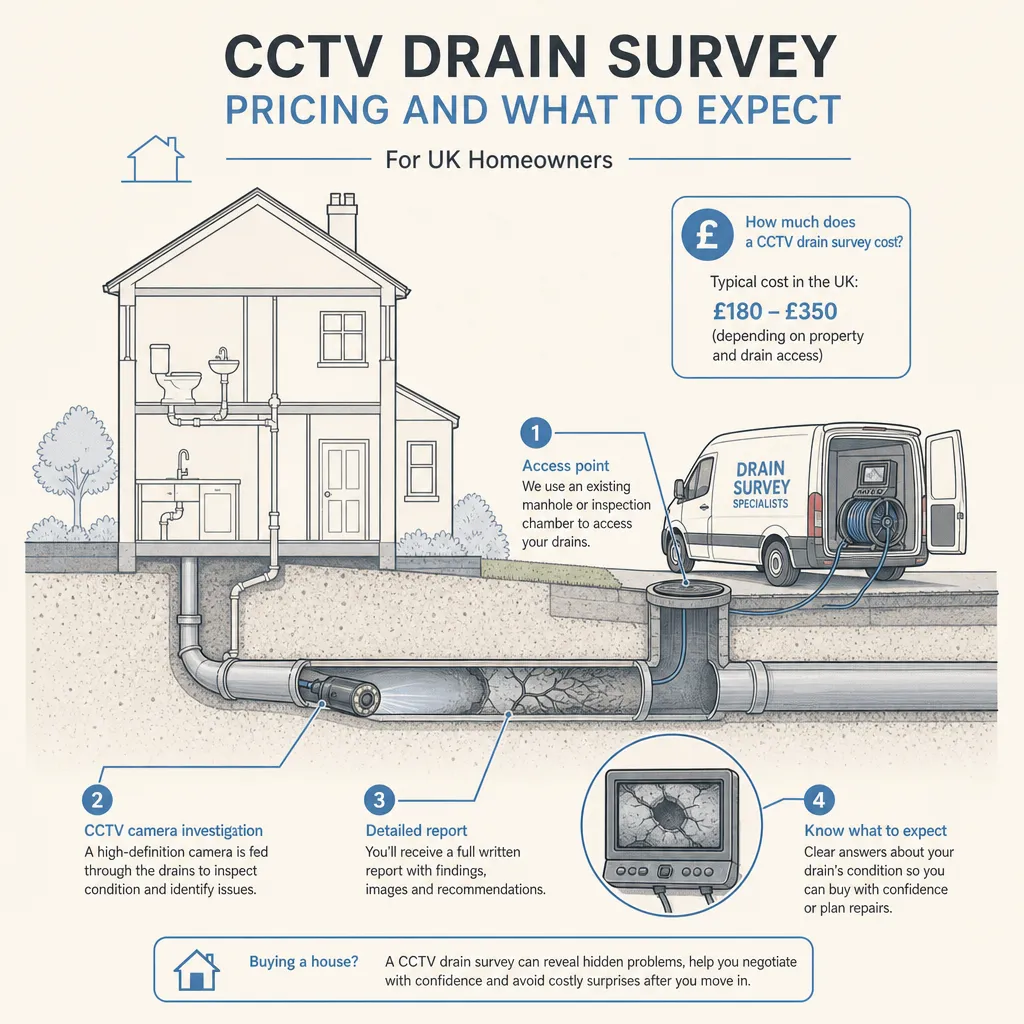
A CCTV drain survey passes a camera through the drainage system to identify the type, location, and severity of defects. The surveyor produces a video report with a written condition assessment. Common findings include root intrusion at joints, joint displacement, pipe deformation, full collapse, and fractures allowing ground water ingress or sewage egress. A domestic CCTV drain survey typically costs £150–£350, depending on pipe length and access conditions. Some contractors include the survey cost within the overall repair quote.
Repair options compared
Repair method | Best for | Limitations | Indicative cost |
|---|---|---|---|
Patch lining | Localised fracture or single joint failure where the pipe is otherwise sound | Not suitable for full collapse or heavily deformed pipe | £500–£1,500 per section |
Full CIPP relining | Long section of cracked or root-damaged pipe accessible at both ends | Reduces internal diameter slightly; pipe must retain enough shape to accept the liner | £1,500–£4,000 per run |
Excavation and replacement | Full collapse, heavily displaced joints, pipe too deformed to reline | Most disruptive; may require breaking through paths, driveways, or planted areas | £2,000–£6,000+ |
Patch repair plus monitoring | Minor displacement with no active leakage; access for full repair is not currently practical | Risk of progressive failure; follow-up CCTV within 6–12 months is essential | £500–£1,200 |
Indicative UK costs, last reviewed 2026-05-05. Final cost depends on depth, pipe diameter, soil type, surface above the pipe, and regional labour rates. Always obtain at least three written quotes.
Cured-in-place pipe lining (CIPP): how it works
CIPP is a no-dig technique in which a resin-impregnated liner is pulled or inverted into the damaged pipe and then cured using hot water, steam, or UV light to form a new pipe within the old one. It avoids excavation, is suitable for pipes from 100–600 mm in diameter, and can significantly extend the service life of a compromised drain. CIPP requires clear access points at each end of the run and works best where the existing pipe retains enough shape to allow the liner to pass through.
When excavation is unavoidable
Excavation is required when the pipe has fully collapsed, shifted significantly at joints, or is too deformed for a liner to pass. Works involve breaking through the surface above the failure point, removing and replacing the failed section with new uPVC pipe, backfilling in layers, and reinstating the surface. The deeper the drain and the harder the surface above — tarmac, concrete, or block paving — the greater the labour cost and disruption.
Whose responsibility is the drain?
- Drains within your property boundary serving only your property: your responsibility under the Water Industry Act 1991.
- Lateral drains (from your boundary to the public sewer): the responsibility of the water and sewerage company in England and Wales since October 2011, following the adoption regulations. Contact your water company before commissioning repairs to this section.
- Shared drains serving more than one property: ownership may be shared between neighbours or may have transferred to the sewerage company — check your property deeds and contact your water company to confirm.
- Public sewers: entirely the water and sewerage company's responsibility. Report to them directly using their emergency line.
Home insurance and collapsed drains
Policy wording varies considerably. Before assuming your insurer will cover the cost, check:
- Whether the policy covers sudden, unexpected drain collapse or excludes gradual deterioration
- Whether there is an underground services or escape of water section that may apply
- Whether accidental damage cover extends to drain failures
- Whether reinstatement of the surface above the repaired drain — paving, tarmac, or turf — is included for a covered repair
Keep the CCTV survey report as evidence of a sudden structural failure rather than a long-term maintenance issue, as insurers may request this to assess whether the collapse qualifies as an insured event.
Red flags to watch for when hiring a drainage contractor
- No CCTV survey before quoting for repair — diagnosis must precede repair to avoid unnecessary excavation or relining of the wrong section.
- Verbal-only quotes with no written specification — a written quote should detail the repair method, pipe length, depth, materials, and surface reinstatement.
- Jetting proposed without investigation — jetting a structurally compromised pipe can worsen displacement and increase costs.
- No mention of surface reinstatement — confirm whether the price includes reinstating paths, paving, or turf disturbed during excavation.
- No waste carrier licence — contractors removing excavated spoil or contaminated material must hold a valid Environment Agency registered waste carrier licence. You can verify this on the GOV.UK public register.
- Pressure to commit without a second opinion — a genuine emergency can be addressed with temporary isolation; a legitimate contractor will not refuse you time to get a written quote.
When to get professional help
Arrange a drainage inspection without delay if:
- The drain serves a bathroom, kitchen, or WC and has stopped functioning — sewage backing up is a health hazard requiring urgent attention
- A sinkhole or significant ground depression is forming along the pipe run
- Cracks are visible in external walls close to the drainage run and ground movement is suspected
- The collapse is thought to be on or near a shared drain or public sewer
- You are buying or selling a property and a pre-purchase CCTV drain survey has revealed structural defects
Do not attempt to excavate down to inspect a collapsed drain yourself. Failed ground can be unstable, and disturbing the area without knowing the full extent of the collapse risks further failure and potential injury.
How Housey can help
Housey connects UK homeowners with qualified drainage professionals at every stage of the process. If you suspect a collapsed drain, start with a CCTV drain survey to get an accurate diagnosis before committing to any repair. For a full condition assessment of the system, a drainage survey provides a comprehensive picture of the pipework. Once you know the extent of the problem, request competing quotes from vetted drainage contractors to compare methods and costs.
Frequently asked questions
How do I know if my drain is collapsed or just blocked?
A blocked drain often clears with rodding or jetting and typically affects one outlet. A collapsed drain usually causes recurring problems despite jetting, may affect multiple outlets simultaneously, and often presents with garden sinking, wet patches, or foul smells. Only a CCTV drain survey can definitively confirm which problem you have before any repair work is committed to.
Can a collapsed drain cause subsidence?
Yes. A collapsed drain leaking water into surrounding soil can erode the ground beneath paths, patios, and foundations over time, leading to localised subsidence or sinkholes. The risk is higher on clay soils and near older properties. If you notice wall cracks or significant ground movement close to a drainage run, arrange both a drainage assessment and a structural or building surveyor inspection.
Who pays for a collapsed drain repair?
If the drain is wholly within your boundary and serves only your property, the repair is your responsibility. If it is on the lateral drain from your boundary to the public sewer in England or Wales, the water and sewerage company is responsible following the 2011 adoption of private sewers — contact them first. Check your property deeds and home insurance policy before authorising any repair work.
How long does a drain repair take?
A patch lining or CIPP relining job on a straightforward domestic run typically takes one to two days. Full excavation and pipe replacement can take two to five days depending on depth, pipe length, and the extent of surface reinstatement required. Complex repairs involving multiple runs, deep pipes, or hard surface breakout take longer — get a written programme from your contractor before works begin.
Will I need building regulations approval for drain repairs?
Repairs that maintain the drain in the same position and size generally do not require building regulations approval. However, if you are adding inspection chambers, altering the drainage layout, or renewing drainage beneath a building, check with your local building control authority. Building Regulations 2010 Approved Document H covers drainage requirements for England and Wales.
Sources and further reading
- Water Industry Act 1991 — legislation.gov.uk
- Water Industry (Schemes for Adoption of Private Sewers) Regulations 2011 — legislation.gov.uk
- Building Regulations Approved Document H: Drainage and waste disposal — GOV.UK
- Ofwat: Sewers and drains — responsibilities — Ofwat
Useful next reads
 Surveys & Inspections
CCTV Drain Survey Pricing and What to Expect
A CCTV drain survey typically costs £150–£400 for a standard residential property in the UK, depending on drain length and property size.
 Surveys & Inspections
Repairing Slate Roof Tiles: Methods and Materials
Slipped or cracked slate tiles are usually repaired using a lead tingle or hook-and-nail method.
 Surveys & Inspections
Ceiling Water Damage: Assessment and Repair Costs
Ceiling water damage is assessed by tracing the leak source, measuring moisture content in the ceiling substrate and any exposed timber, and checking for structural softening.
 Surveys & Inspections
Flat Roof Leaks: Identification, Diagnosis, and Repair
A flat roof leak rarely enters directly above the visible damp patch — water typically tracks along the roof deck before it appears inside.
 Surveys & Inspections
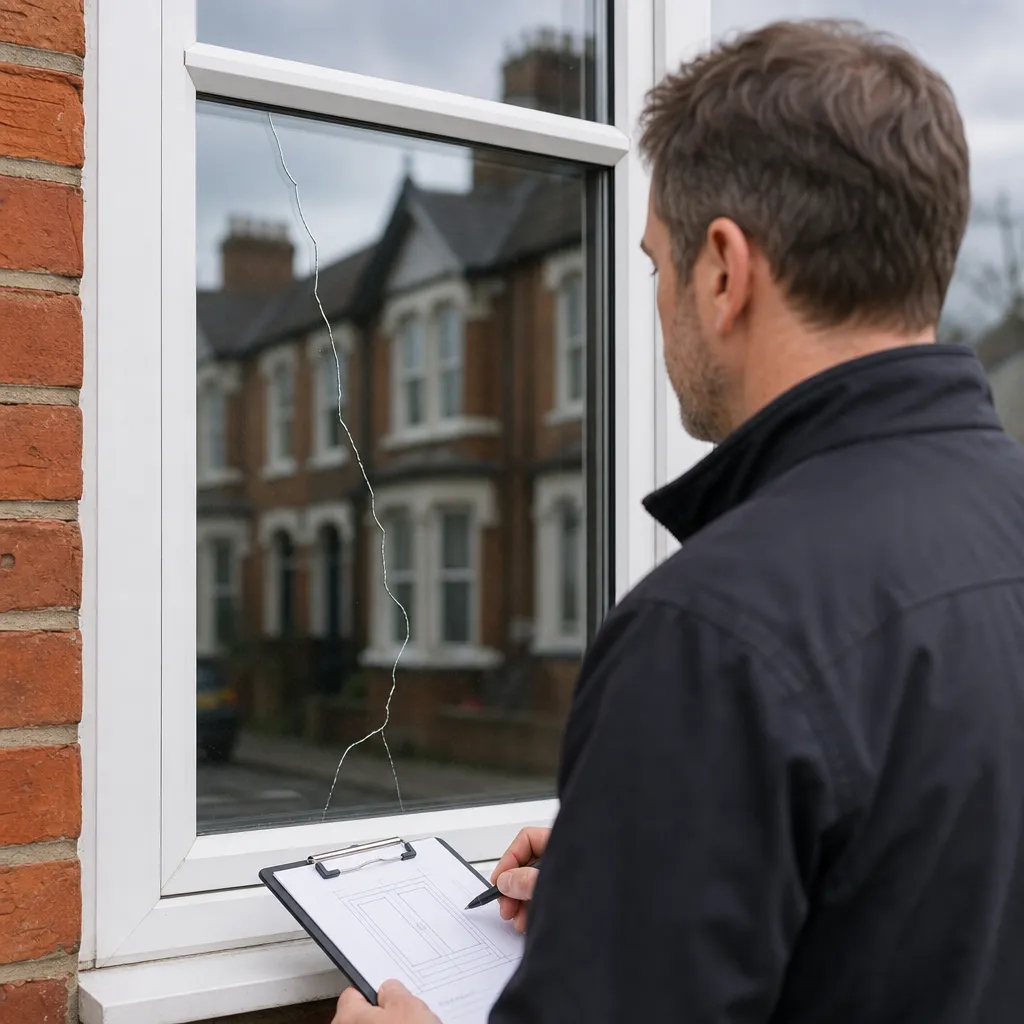
Understanding thermal stress cracks in windows
Thermal stress cracks occur when one part of a glass pane heats or cools faster than another, creating internal tension that the glass cannot absorb.