Flat Roof Ponding: Identifying Water Pooling Hazards
By Housey · Last reviewed 24th of May 2026
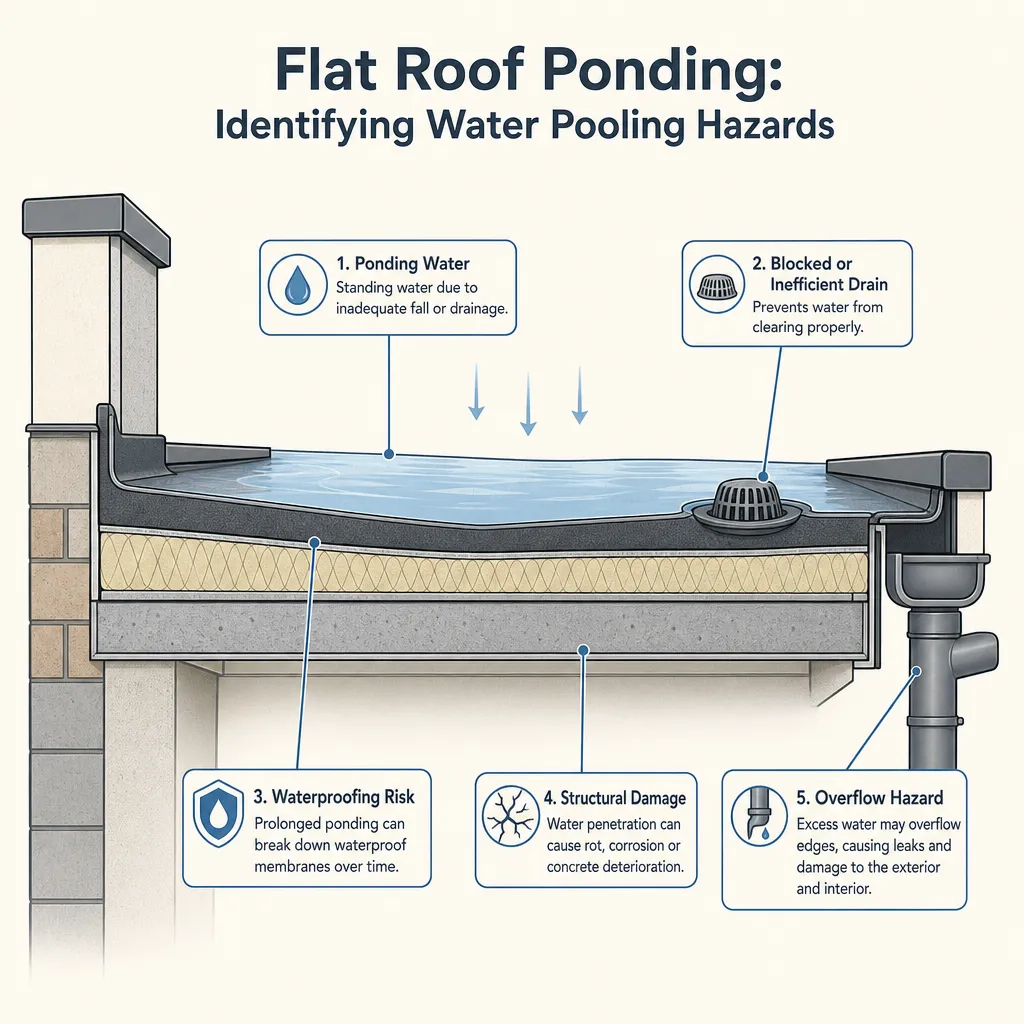
Flat Roof Ponding: Identifying Water Pooling Hazards
Flat and low-pitch roofs are a feature of millions of UK homes — on rear extensions, garages, outbuildings, and contemporary single-storey additions alike. When rainwater gathers in shallow pools rather than draining away within a day or two of rainfall, it is worth understanding whether you are looking at a blocked outlet, a design flaw in the roof's fall, or early signs of structural deck deflection. Catching the underlying cause promptly is usually far cheaper than dealing with the consequences once the membrane has been breached and water ingress has begun.
Key points
- British Standard BS 6229:2003 recommends a minimum designed fall of 1:80 for flat roofs, with a preferred fall of 1:40 to allow for structural deflection and construction tolerances.
- Industry guidance generally considers ponding acceptable for up to 24–48 hours after rainfall; water persisting beyond this warrants professional investigation.
- The four most common flat roof membranes in UK residential construction — built-up felt, EPDM rubber, GRP (fibreglass), and liquid-applied coatings — each respond differently to standing water.
- Prolonged ponding adds structural load: water weighs approximately 1,000 kg/m³, which matters if deck deflection has already reduced the roof's designed fall and created a self-reinforcing bowl effect.
- A professional roof survey can reliably distinguish between a blocked outlet (often a straightforward fix) and a structural fall or deck issue requiring more significant remediation.
Why flat roofs pond — and what it tells you
Ponding has several possible causes, and identifying the correct one determines the remedy. Treating a symptom without addressing the underlying cause — for example, adding a sump outlet without investigating structural deflection — is unlikely to resolve the problem permanently.
Common causes include:
- Blocked or undersized outlets and gutters: the most frequent cause and usually the easiest to remedy. Leaves, moss, debris, and silt accumulate at outlets and prevent drainage.
- Inadequate designed fall: the roof was never built to BS 6229's recommended 1:40 fall, or the as-built fall is less than designed because of construction tolerances.
- Structural deck deflection: the roof deck — timber joists, concrete slab, or steel decking — has deflected under load over time, creating a low-point bowl that retains water.
- Membrane deformation: some single-ply or liquid-applied membranes can develop surface dips under UV exposure and temperature cycling.
- Failed or settled tapered insulation: tapered insulation boards are installed to create fall; if boards have settled, shifted, or been incorrectly laid, the designed fall can be partially or wholly lost.
How to identify the cause — a homeowner checklist
Before calling a roofer or arranging a roof survey, a basic inspection from ground level or a safely positioned fixed ladder can help narrow the cause. Do not walk on a flat roof without appropriate non-slip footwear, fall protection, and confidence in the deck's load-bearing condition.
A "yes" to the final question — or to visible membrane damage — means professional inspection is advisable without delay.
Flat roof membranes and their response to ponding
Different membrane systems have different tolerances for standing water. Understanding which system you have affects both the urgency of investigation and the range of remediation options available.
Membrane type | Typical UK lifespan | Ponding tolerance | Common failure mode under ponding |
|---|---|---|---|
Built-up felt (3-layer) | 10–20 years | Low — water can penetrate lap joints and cause delamination | Split seams, lap joint failure, blistering |
EPDM rubber (single-ply) | 25–40 years | Moderate — EPDM itself tolerates water well but laps and penetrations are vulnerable | Lap adhesive failure, punctures at roof penetrations |
GRP fibreglass | 20–30 years | Moderate — solid laminate is tolerant but surface crazing can allow ingress | Surface crazing, delamination at upstands and trims |
Liquid-applied coating | 10–25 years (product-dependent) | Variable — depends on film thickness and substrate adhesion | Thin film areas, disbonding at substrate joints |
Mastic asphalt | 20–50 years | Good — dense seamless surface resists water penetration | Cracking at upstands; thermal movement splits at junctions |
Indicative lifespans. Actual performance depends on installation quality, maintenance history, and exposure conditions.
Red flags that need prompt professional attention
Contact a qualified roofer or arrange a roof survey without delay if you notice any of the following:
- Damp patches, water staining, or active water ingress on ceilings or walls below the flat roof area — the membrane has already been breached.
- Ponding that has not cleared within 48 hours after the last rainfall, particularly if it has been recurring across multiple seasons.
- Visible cracking, splitting, or lifting of the membrane at seams, upstands, or around any roof penetrations (pipes, rooflights, fixings).
- Sagging, bowing, or visible deflection of the roof deck when viewed from the side or from the room below.
- Blistering across a significant area of the membrane, not just at isolated points.
- Established moss or plant growth in the pooling zone — this indicates prolonged moisture and can physically damage the membrane over time.
- The roof is over 15–20 years old and has not received a professional inspection or maintenance in that period.
What a professional roof inspection covers
A professional inspection — whether from a specialist flat roofing contractor or as part of a formal roof survey — should assess:
- The integrity of the membrane across its full area, with close attention to seams, upstands, drip edges, and all penetrations.
- Whether outlets, overflows, and gutters are appropriately sized, correctly positioned, and unobstructed.
- The measured or estimated falls across the roof surface and whether they meet the BS 6229 minimum.
- Evidence and condition of any previous repairs.
- Any indication of deck deflection or substrate deterioration, assessed visually from above and, where possible, from the room below.
- Insulation condition where accessible, relevant to both thermal performance and condensation risk.
A written inspection report with dated photographs is standard practice and should form the basis of any remediation specification or contractor quote.
Remediation options
Depending on the cause and extent of the problem, remediation ranges from straightforward maintenance to full roof replacement:
- Outlet and gutter clearance: lowest cost; appropriate where ponding is solely due to blockage and the membrane is otherwise sound.
- Localised membrane repair: patching splits or re-bonding failed seams; suitable for isolated defects on a membrane that remains structurally intact.
- Tapered insulation overlay: adding tapered insulation boards above the existing membrane to improve falls without full strip-out; cost-effective on concrete or steel-deck roofs where the existing waterproofing is still watertight.
- Full membrane replacement: necessary when the existing membrane is at or beyond end of life, or where defects are widespread.
- Structural remediation: required if deck deflection is the root cause; involves a structural engineer's assessment and cannot be resolved by roofing works alone.
When to get professional help
For any ponding that persists more than 48 hours, is accompanied by membrane damage, or has resulted in internal damp or staining, contact a qualified flat roofing specialist or commission a professional inspection. Where structural deflection — rather than a drainage or membrane issue — is suspected as the cause, a structural engineer should be involved before remediation work is specified.
How Housey can help
Housey connects homeowners with qualified roofers experienced in flat roof repair and replacement, and with professionals who carry out roof surveys to diagnose the cause of ponding before you commit to any remediation expenditure.
Frequently asked questions
Is ponding water on a flat roof dangerous?
Persistent ponding is not immediately dangerous to occupants, but it accelerates membrane degradation, increases structural loading on the deck, and — once the membrane is breached — causes water ingress, internal damp, and potential mould growth. The longer ponding is left uninvestigated, the more expensive remediation is likely to be. Prompt investigation after persistent ponding is always advisable.
How much does it cost to fix a ponding flat roof?
Costs depend heavily on the cause. Clearing a blocked outlet may cost £50–£150 for a maintenance visit. Localised membrane repairs typically range from £150–£600. Full flat roof replacement on a typical UK extension of 20–30 m² commonly ranges from £1,500–£4,000 depending on membrane type, specification, and access. Indicative UK costs, last reviewed 2026-05-24. Always obtain at least three quotes.
Does a flat roof need planning permission to replace?
Like-for-like membrane repairs and replacement generally do not require planning permission under permitted development. If you change the roof material significantly, add a rooflight, alter the roof height, or the property is listed or in a conservation area, check with your local planning authority before proceeding. When in doubt, contact your local planning authority for a pre-application enquiry.
How often should a flat roof be inspected?
Annual visual checks and clearing of outlets and gutters are recommended as routine maintenance. A professional inspection every three to five years — or whenever persistent ponding is noticed, internal damp appears, or the roof is approaching 15 years of age — helps identify defects before they become costly failures and may be required by your building insurer.
Sources and further reading
Useful next reads
 Surveys & Inspections
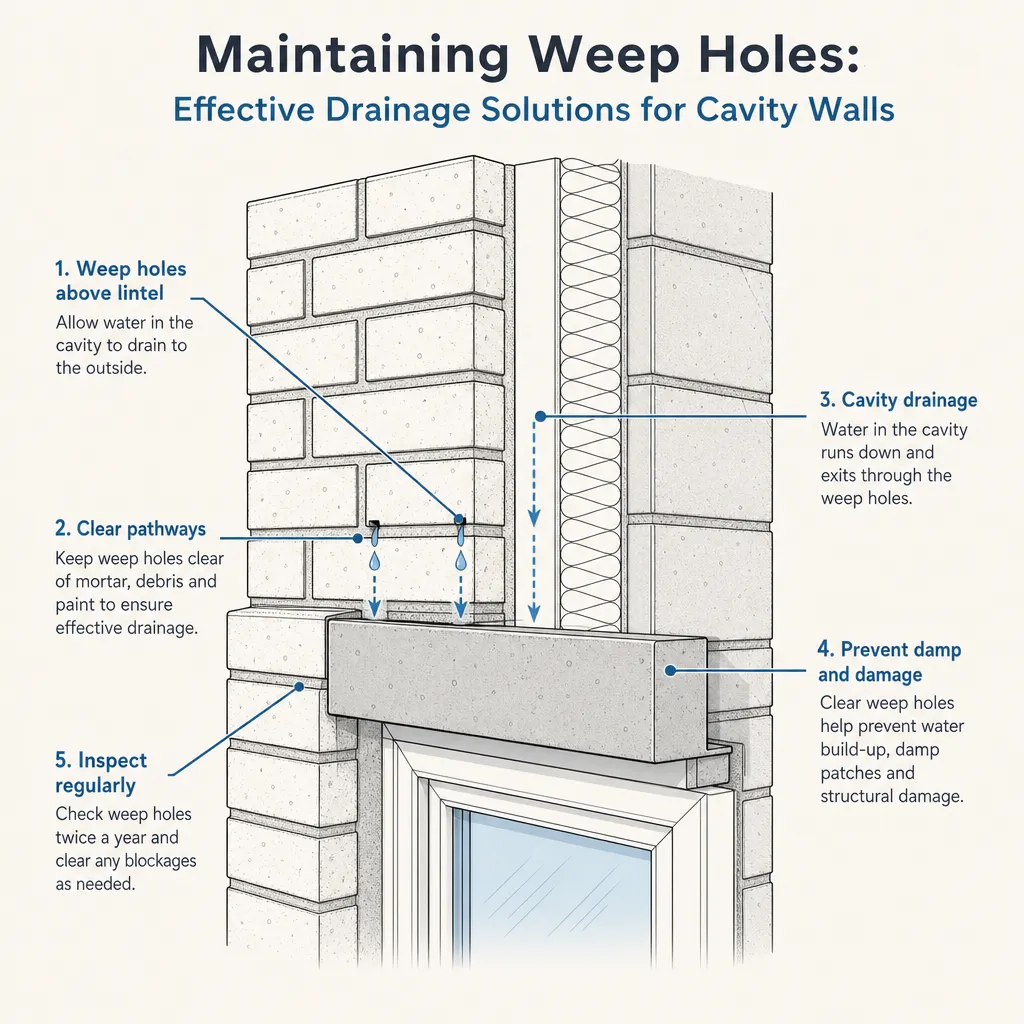
Maintaining Weep Holes: Effective Drainage Solutions for Cavity Walls
Weep holes are unmortered perpend joints in the outer leaf of a cavity wall, positioned at DPC level and above lintels, allowing moisture that enters the cavity to drain outward.
 Surveys & Inspections
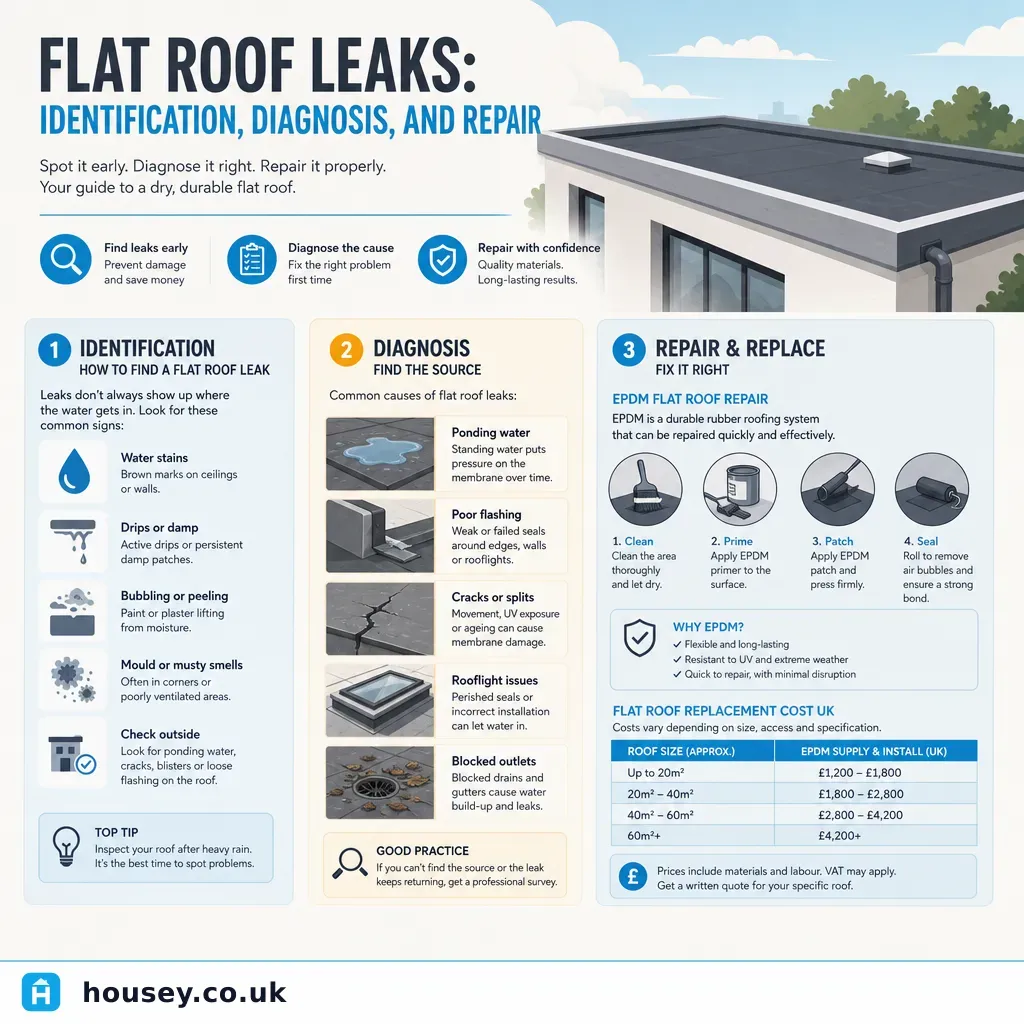
Flat Roof Leaks: Identification, Diagnosis, and Repair
A flat roof leak rarely enters directly above the visible damp patch — water typically tracks along the roof deck before it appears inside.
 Surveys & Inspections
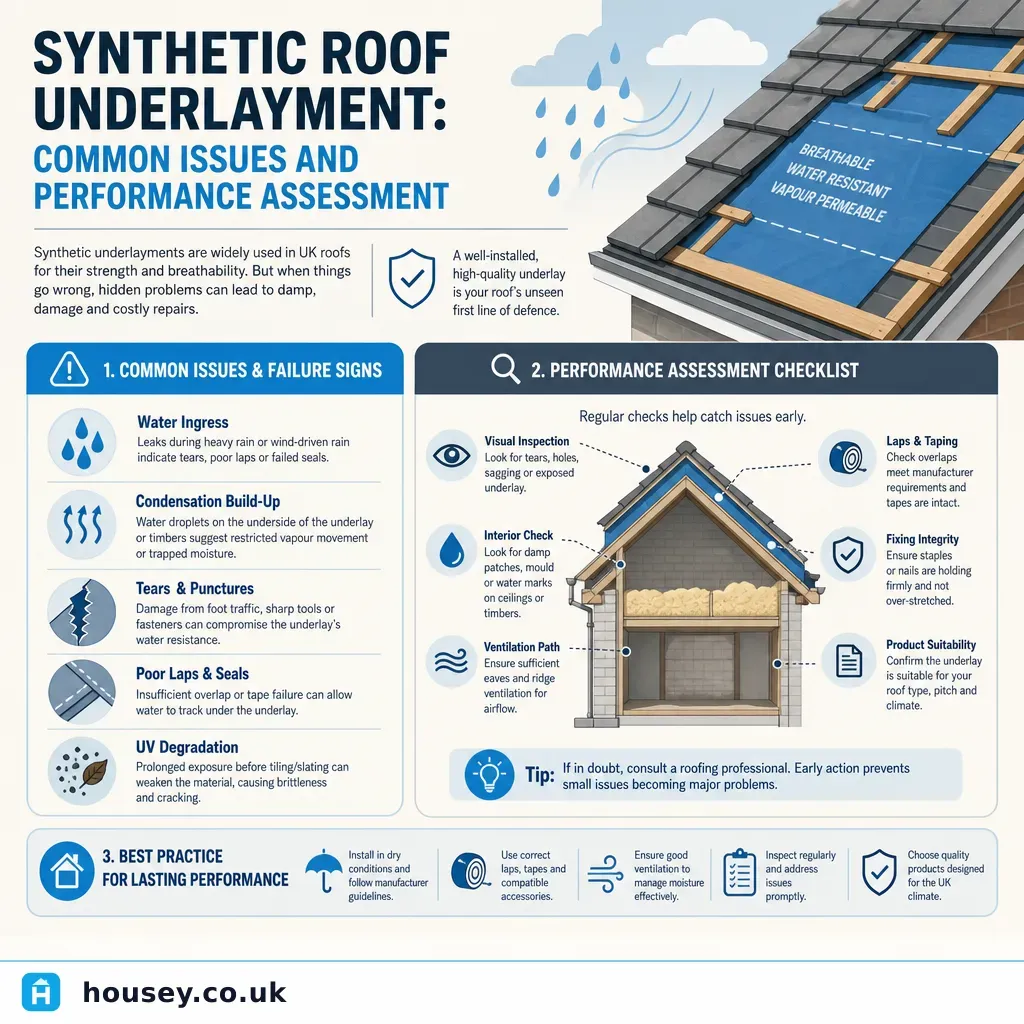
Synthetic Roof Underlayment: Common Issues and Performance Assessment
Synthetic vapour-permeable roof underlayment sits below your tiles and acts as the last barrier against moisture.
 Surveys & Inspections
Annual Home Maintenance Checklist and Schedule
A structured annual maintenance schedule helps UK homeowners catch small problems before they become costly repairs.
 Surveys & Inspections
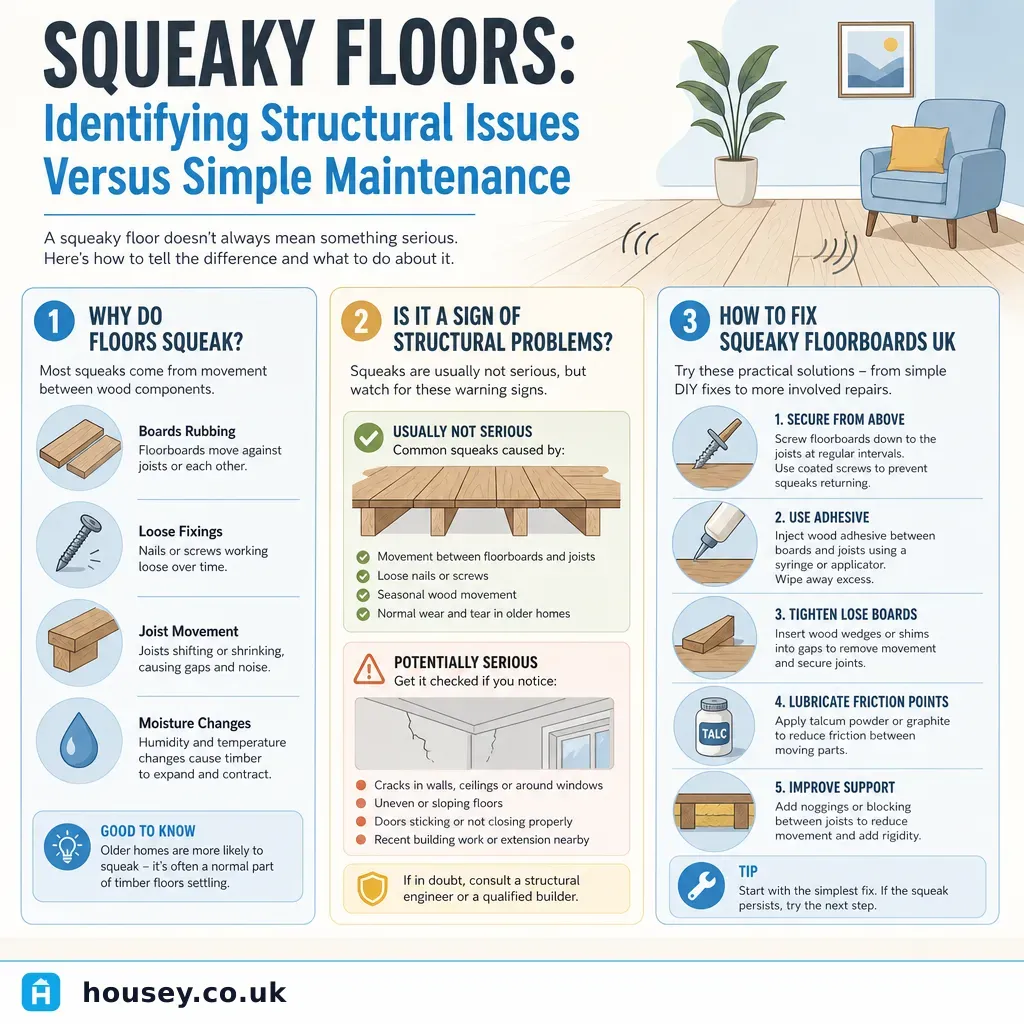
Squeaky Floors: Identifying Structural Issues Versus Simple Maintenance
Most squeaky floors in UK homes are caused by floorboards rubbing against each other or against fixings as they expand and contract — a maintenance issue rather than a structural one.