CCTV Drain Survey Costs and What to Expect
By Housey · Last reviewed 18th of May 2026
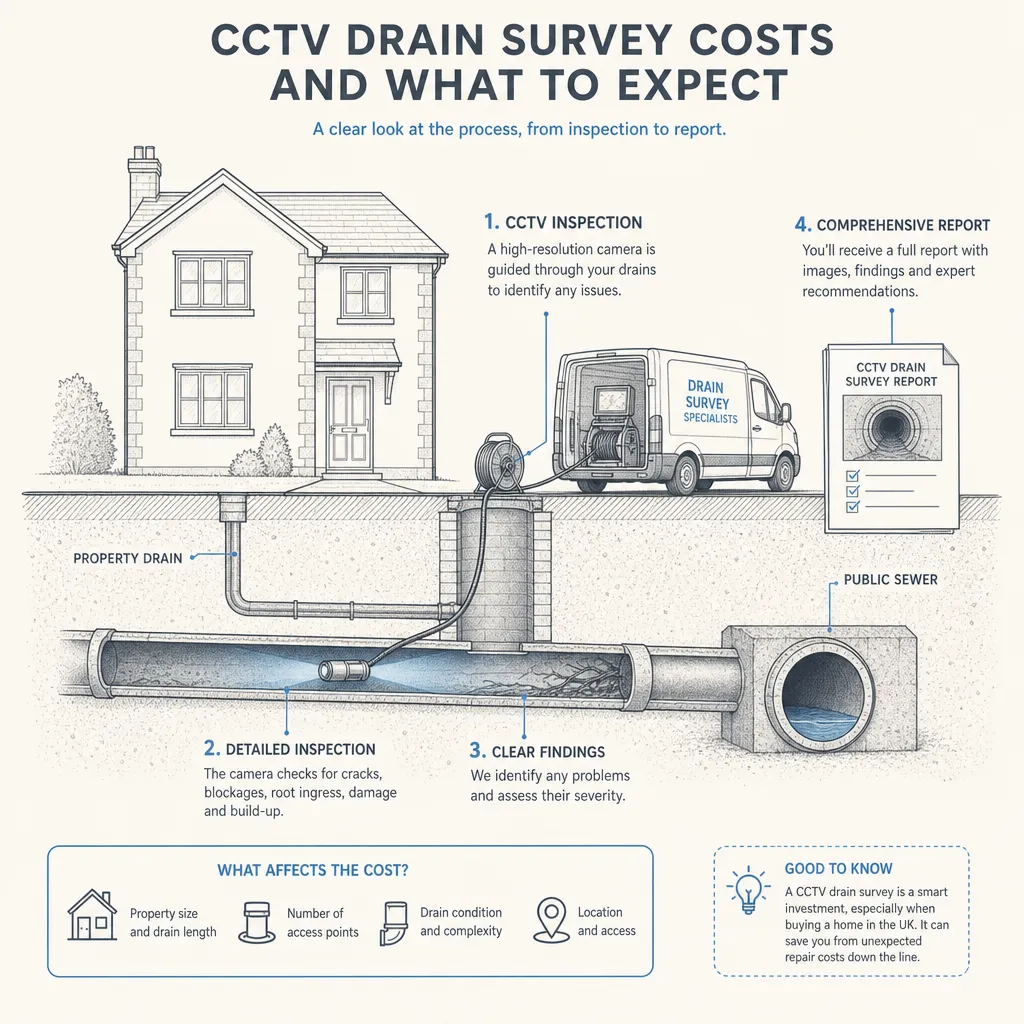
CCTV Drain Survey Costs and What to Expect
Drainage problems often stay hidden until they become expensive — a collapsed pipe, a persistent blockage, or a slow drain that signals a serious structural defect in the underground system. A CCTV drain survey is the standard method for investigating underground drainage without excavation, and it is increasingly requested by conveyancers, mortgage lenders, and buildings insurers as part of property transactions across the UK.
Key points
- Indicative UK costs for a standard residential CCTV drain survey range from £150 to £400 for one or two drainage runs, depending on scope and access conditions (Indicative UK costs, last reviewed 2026-05-18).
- A CCTV drain survey uses a camera pushed or driven along drainage runs to record footage identifying cracks, root ingress, displaced joints, blockages, and pipe collapse.
- Surveys are typically reported to WRC (Water Research Centre) coding standards — the UK industry-standard classification system for drainage defects.
- Pre-purchase drain surveys are not included in a standard RICS Level 2 or Level 3 Home Survey and must be commissioned separately.
- Under the Water Industry Act 1991 (as amended in 2011), most private lateral drains connecting to the public sewer were transferred to water company ownership — so the boundary of your responsibility may not be where you expect.
What does a CCTV drain survey involve?
A CCTV drain survey involves a trained drainage engineer accessing your drains through an inspection chamber (manhole) or a rodding eye. A camera — pushed on a reel for smaller domestic pipes, or mounted on a self-propelled crawler unit for larger runs — is fed through each drainage run, recording footage as it travels.
The footage is reviewed by the engineer (often live on a surface monitor) and compiled into a written report. Defects are logged by location (distance from the insertion point), type, and severity, using WRC coding conventions.
At the end of the survey, you should receive:
- A written condition report with defect descriptions and measured locations.
- Video footage on USB, DVD, or via a cloud download link.
- A sketch or scale drawing of the drainage layout (included in more comprehensive surveys).
- Recommendations for repair or maintenance where defects are identified.
How much does a CCTV drain survey cost?
Costs vary by scope, region, and contractor. The table below sets out indicative ranges (Indicative UK costs, last reviewed 2026-05-18):
Survey type | Indicative cost range | What is usually included |
|---|---|---|
Single drainage run (e.g. one soil stack to manhole) | £150 – £250 | Camera inspection, verbal summary, basic footage |
Standard residential survey (2–3 runs) | £250 – £400 | Written WRC-coded report, footage, layout sketch |
Pre-purchase drain survey | £300 – £500 | Full written report suitable for conveyancer or insurer |
Commercial or complex residential (large gardens, multiple outfalls) | £500 – £1,500+ | Multiple runs, full drainage drawing, engineer's signed report |
Prices are indicative, exclude VAT, and vary by region and contractor. Obtain at least two quotes.
Key cost drivers include:
- Number of drainage runs surveyed — soil, surface water, and combined runs each add to the scope.
- Access difficulty — overgrown inspection chambers, deep manholes, or remote access points add time and cost.
- Report format — a formal written WRC-coded report costs more than a verbal briefing or raw footage only.
- Location — costs are generally higher in London and the South East.
- Urgency — same-day call-out rates are substantially higher than planned survey rates.
When do you need a CCTV drain survey?
Before buying a property
A standard home survey (RICS Level 2 or Level 3 Home Survey) does not include a drain inspection. If a property has older drains, a history of drainage problems, or sits on clay soil (susceptible to tree root ingress), a pre-purchase CCTV survey is worth commissioning before exchange. Conveyancers and mortgage lenders are increasingly requesting drainage reports on older and larger properties.
After a blockage or persistent slow drainage
If a drain blocks repeatedly, or multiple appliances drain slowly at the same time, a CCTV survey can establish whether there is a structural defect — such as a displaced joint, root ingress, or partial collapse — rather than a simple accumulation of debris. Clearing a blockage without addressing an underlying structural defect is usually only a short-term fix.
For insurance claims
Buildings insurers may require a CCTV drainage report to support or defend a claim involving subsidence, flooding, or drain damage. Obtaining the survey before committing to repair works can also protect against disputes over the cause of damage.
For new build or extension drainage connections
Building Regulations Approved Document H (Drainage and Waste Disposal) sets minimum standards for new drainage installed as part of an extension. A CCTV survey of existing drains before connecting new runs can identify issues that would otherwise be concealed once the works are complete.
Pre-purchase drain survey checklist
Use this checklist before commissioning a pre-purchase CCTV drain survey:
What to ask before accepting a quote
- What drainage runs are included in the scope, and which are excluded?
- Is the price fixed for the agreed scope, or charged at an hourly rate?
- Will I receive a formal written WRC-coded condition report?
- In what format will footage be provided, and for how long will access be available?
- Is VAT included in the quoted price?
- What happens if access is obstructed or inspection chambers cannot be located on the day?
- Are you a member of a recognised trade body such as the National Association of Drainage Contractors (NADC) or CEDA?
When to get professional help
A CCTV drain survey must always be carried out by a specialist drainage contractor — it is not a DIY task. Seek professional input promptly if:
- The survey identifies a defect at a shared manhole or a pipe that appears to cross a boundary, as ownership and responsibility may need legal clarification.
- You notice sinkholes, ground settlement, or subsidence near drainage runs — a collapsed sewer can undermine foundations and requires urgent professional assessment.
- Multiple properties in the same terrace or development are experiencing the same drainage problems, which may indicate a shared or adopted sewer issue to be raised with the water company.
How Housey can help
Housey connects homeowners and buyers with experienced contractors offering CCTV drain surveys. Compare quotes and credentials before instructing, and check that any pre-purchase report will be provided in a format acceptable to your conveyancer and insurer.
Frequently asked questions
Is a CCTV drain survey the same as a drainage survey?
A CCTV drain survey is the most common type of drainage survey for residential properties and inspects pipes using a camera. A broader drainage survey may also include above-ground inspection, manhole surveying, dye testing, or drain tracing to establish the drainage layout — useful where the system is unknown or complex. Always confirm the scope with the contractor before booking.
Who pays for a drain survey when buying a house?
Typically the buyer commissions and pays for a pre-purchase CCTV drain survey. Where a vendor has disclosed drainage issues, it may be possible to negotiate the cost as part of the offer. There is no legal obligation on either party to commission a drain survey — it is a matter for negotiation rather than a statutory requirement.
What defects does a CCTV survey typically find?
Common findings include root ingress from trees or shrubs, displaced or cracked joints in clay pipe systems, pipe deformation from ground movement, accumulated silt or fat deposits, broken connections, and — in older properties — deteriorating brick-built culverts or egg-shaped sections. Not all defects require immediate repair; a WRC-coded report grades severity to help prioritise action.
Can a CCTV camera access all drains?
Not always. Pipes smaller than 75mm diameter, long runs with multiple tight bends, and drains with obstructions may limit camera access. Contractors use push cameras for smaller pipes and self-propelled crawlers for larger ones. Always confirm the scope and any likely access limitations with the contractor before the survey begins to avoid incomplete results.
Sources and further reading
- Building Regulations Approved Document H: Drainage and Waste Disposal — GOV.UK
- Water Industry Act 1991 — legislation.gov.uk
- WRc Drain and Sewer Survey Manual — WRc plc
- Sewers for Adoption — Water UK
Useful next reads
 Surveys & Inspections
Structural Building Survey Costs
A RICS Level 3 Building Survey typically costs £500–£1,500 in the UK, depending on property size, age, and location.
 Surveys & Inspections
Understanding Property Surveys: Types and When You Need Them
The three main RICS survey types are the Level 1 Condition Report (for standard properties in good condition), the Level 2 Home Survey (conventional homes in reasonable condition), and the Level 3 Building Survey (older, unusual, or defective properties).
 Surveys & Inspections
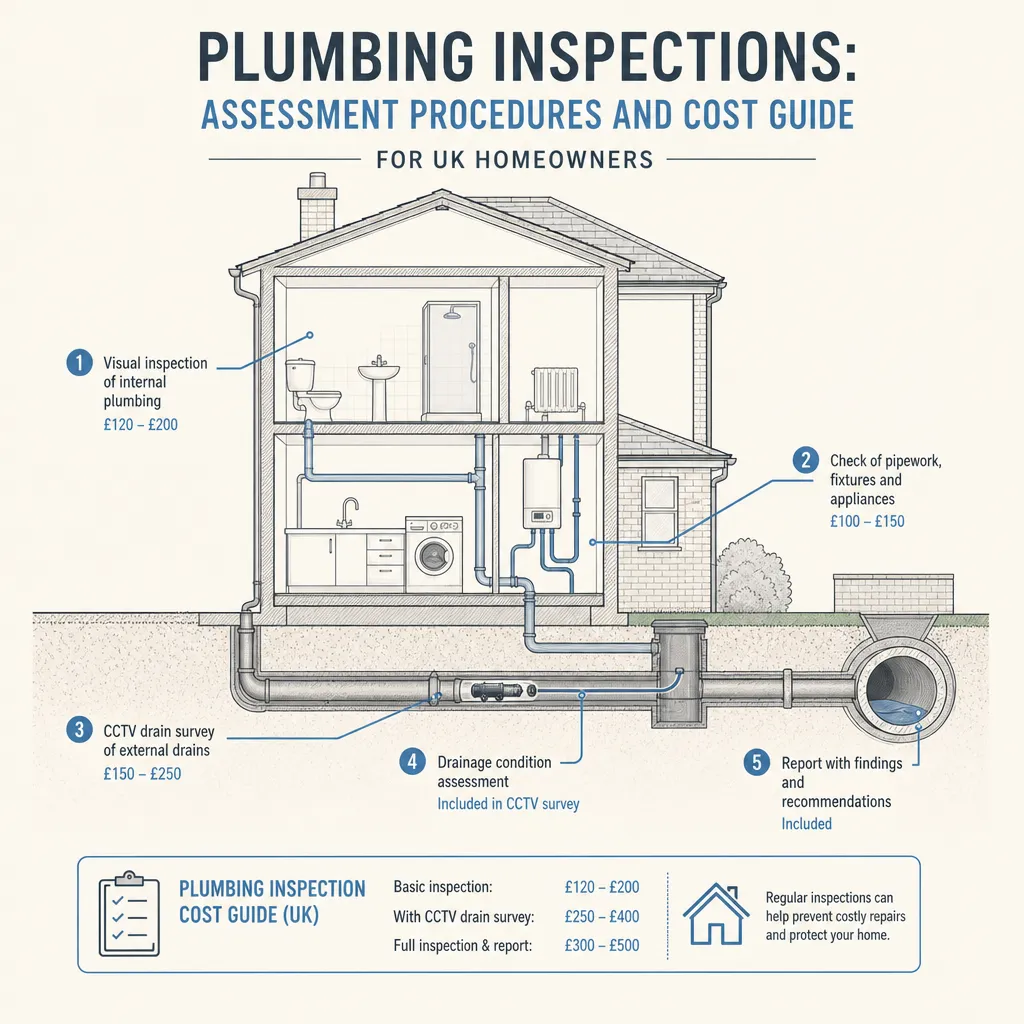
Plumbing Inspections: Assessment Procedures and Cost Guide
A professional plumbing inspection in the UK typically covers water pressure, pipe condition, boiler and hot water systems, and visible drainage.
 Surveys & Inspections
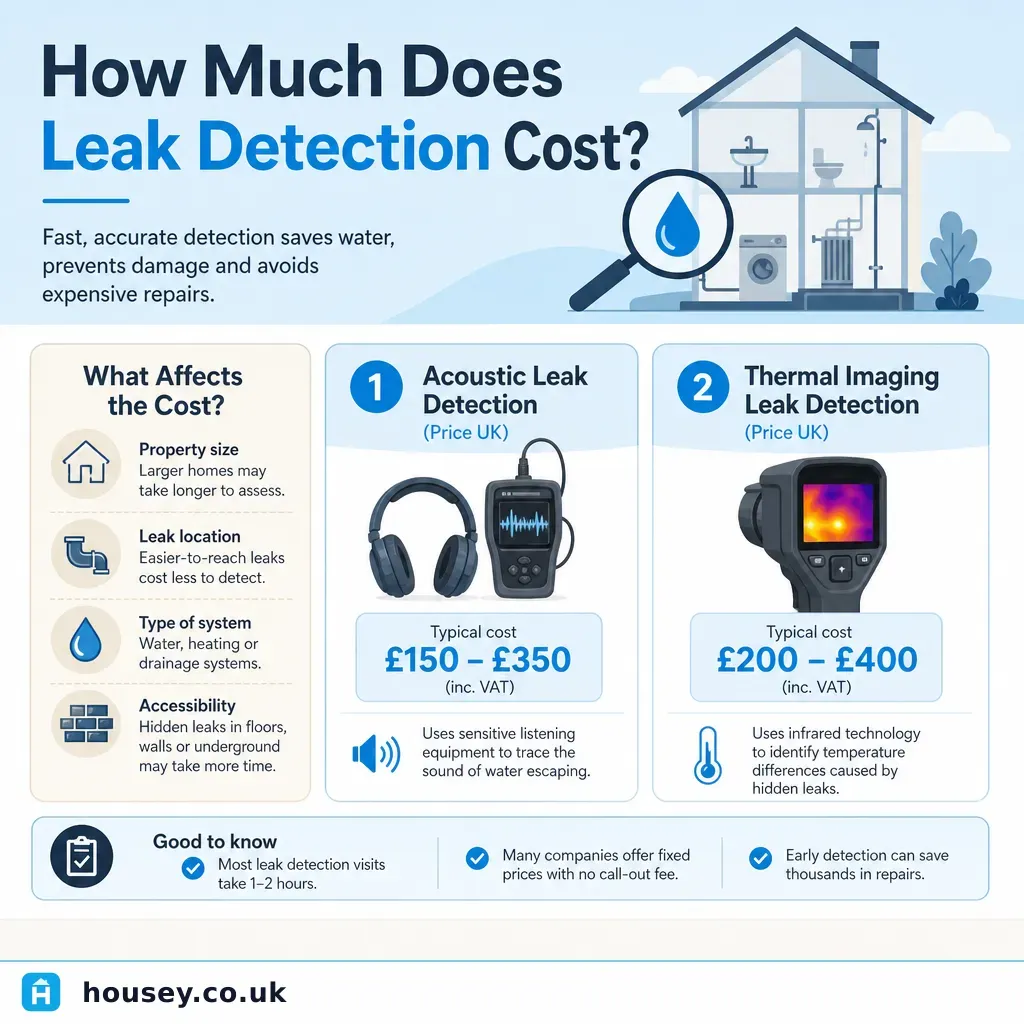
How Much Does Leak Detection Cost?
Leak detection in the UK typically costs £150–£600 for a standard residential survey, rising to £1,000 or more for complex cases requiring multiple methods.
 Surveys & Inspections
Land Surveys and Boundary Measurement: Who Pays
There is no statutory rule in England and Wales that determines who pays for a boundary or land survey.