Central Heating Maintenance: Keeping Your System Efficient and Safe
By Housey · Last reviewed 19th of May 2026
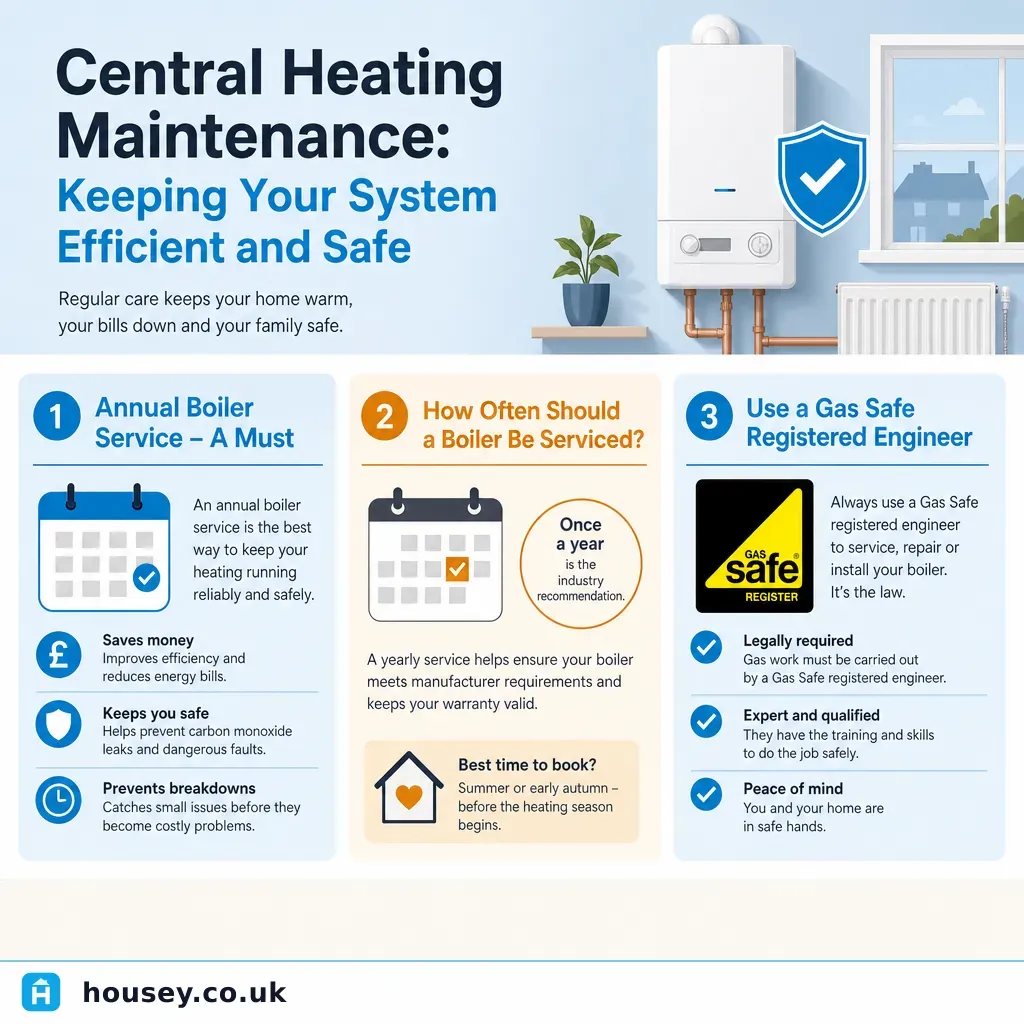
Central Heating Maintenance: Keeping Your System Efficient and Safe
Most UK homes rely on a wet central heating system — a combination boiler, system boiler, or conventional boiler connected to radiators via pressurised or open-vented pipework. When properly maintained, these systems run reliably for 10–15 years or more. When neglected, they accumulate sludge, lose pressure, develop leaks, and in the worst cases create carbon monoxide risks that are invisible and odourless. Understanding which maintenance tasks require a qualified professional and which a homeowner can manage is the starting point for keeping your heating both safe and cost-effective.
Key points
- Gas boilers must be serviced annually by a Gas Safe registered engineer; servicing by an unregistered person is illegal under the Gas Safety (Installation and Use) Regulations 1998.
- An annual boiler service in the UK typically costs £60–£120 for a standard condensing combination boiler (Indicative UK costs, last reviewed 2026-05-19).
- Skipping annual servicing can void most boiler manufacturer warranties, which usually require annual evidence of a completed service.
- Bleeding radiators, topping up system pressure, and dosing central heating inhibitor are homeowner tasks that do not require a Gas Safe registered engineer.
- Magnetite sludge builds up in systems over time; a power flush (£300–£600) is typically recommended when multiple radiators are cold at the base or the pump is making noise.
What an annual boiler service includes
A Gas Safe registered engineer carrying out a standard annual service will typically:
- Inspect the boiler casing and check for signs of damage or corrosion.
- Check gas pressure and the gas rate at the meter.
- Inspect and clean the burner and heat exchanger where accessible.
- Test all safety controls, including the pressure relief valve and thermostats.
- Check the flue for correct operation and any signs of leakage or obstruction.
- Review the condensate pipe and check for blockages (particularly relevant before winter).
- Issue a written service report and update the boiler's service record.
For combination boilers, the engineer will also inspect the flue terminal on the external wall. It must remain unobstructed and be positioned at least 300mm from any openable window or door, in line with the requirements of Approved Document J.
Homeowner maintenance tasks
Several routine tasks can be carried out safely by homeowners without calling a qualified engineer.
Bleeding radiators
Cold patches at the top of a radiator indicate trapped air in the system. To bleed a radiator:
- Run the heating until the system is fully warm.
- Switch off the heating and wait 5–10 minutes.
- Use a radiator bleed key — widely available at hardware shops — to slowly open the bleed valve at the top corner of the radiator.
- Hold a cloth below the valve; once water trickles out steadily rather than air hissing, close the valve.
- Check the boiler pressure gauge immediately afterwards and top up if it has dropped below 1 bar.
Checking and topping up boiler pressure
Most combination boilers operate correctly between 1.0 and 1.5 bar. A reading below 0.5 bar indicates the system needs repressurising via the filling loop. The procedure is boiler-specific — follow the manufacturer's instructions or download the manual from the manufacturer's website if the original has been lost.
Testing and adding inhibitor
Central heating inhibitor (such as Fernox F1 or Sentinel X100) prevents internal corrosion and sludge build-up. Levels should be tested annually — either by the service engineer or using a proprietary test kit — and topped up if low. Inhibitor is introduced via the system's filling point or through a radiator bleed valve.
Recognising sludge and when a power flush is needed
Magnetite sludge — a black, gritty deposit formed from corroding mild-steel radiators and pipework — reduces heating efficiency and can block radiators, the heat exchanger, and the circulating pump. Indicators of significant sludge accumulation include:
- Radiators cold across the lower half despite the heating running normally.
- The pump making loud gurgling or rattling sounds during operation.
- Hot water taking an unusually long time to reach taps.
- Repeated pump failures in a system less than 10 years old.
A power flush — where a specialist machine circulates water and cleaning chemicals at high velocity through the system — costs £300–£600 for a typical three- to four-bedroom home and takes half a day to a full day. It must be carried out by a qualified heating engineer.
Red flags: signs you need a Gas Safe engineer
Call a Gas Safe registered engineer promptly if you notice any of the following:
- The boiler pressure drops repeatedly to below 1 bar despite repressurising — this may indicate a leak in the system or heat exchanger.
- The boiler displays a fault code or warning light that does not clear after a reset.
- Radiators remain cold after bleeding and topping up the pressure.
- The boiler makes loud banging, kettling, or grinding noises during operation.
- Hot water or heating is unavailable despite the system appearing to run normally.
Call Gas Emergency Services on 0800 111 999 and do not use the boiler if you smell gas, a carbon monoxide alarm activates, or the boiler produces yellow or orange flames.
Homeowner maintenance checklist
Complete these tasks each year to keep your system in good condition:
Important limitations
This guide provides general information about central heating maintenance in UK homes. It does not constitute safety advice. The appropriate actions depend on your specific boiler model, system type, installation age, and the condition of individual components. The Gas Safety (Installation and Use) Regulations 1998 require all gas work to be carried out by a Gas Safe registered engineer. Do not attempt to service, repair, or adjust any gas appliance or gas pipework yourself.
When this becomes urgent
Stop using the boiler and call Gas Emergency Services (0800 111 999) or a Gas Safe registered engineer immediately if:
- You smell gas anywhere near the boiler or elsewhere in the property.
- A carbon monoxide alarm activates near the boiler or along the flue route.
- The boiler flue terminal outside is visibly blocked, displaced, or damaged.
- The boiler is producing yellow or orange flames rather than predominantly blue.
- There is visible sooting or staining around the boiler casing, flue, or flue joints.
What to ask a qualified professional
Before booking a boiler service or heating engineer:
- Are you Gas Safe registered? You can verify this at gassaferegister.co.uk.
- What does the service include — will you inspect the flue, test CO levels, and check the heat exchanger?
- What written documentation or service report will I receive after the visit?
- If you identify a fault, will you provide a written quote before carrying out any repairs?
- Do you carry common replacement parts — ignition electrodes, pressure relief valves — to avoid a second call-out charge?
- Is your work covered by public liability insurance?
How Housey can help
Housey connects UK homeowners with Gas Safe registered engineers who can carry out annual boiler servicing, power flushing, and full central heating inspections. Use our platform to compare quotes from local engineers and read verified reviews from homeowners in your area before you book.
Frequently asked questions
How often should a gas boiler be serviced in the UK?
Once a year is the standard recommendation from boiler manufacturers and the Gas Safe Register. Most warranties specify annual servicing as a condition; without documentary evidence, a warranty claim may be refused. For landlords, annual servicing is a legal requirement under the Gas Safety (Installation and Use) Regulations 1998, and the Gas Safety Record must be provided to tenants.
Does a landlord have to service the central heating?
Yes. Under the Gas Safety (Installation and Use) Regulations 1998, landlords must arrange an annual gas safety check and service by a Gas Safe registered engineer. Tenants must receive a copy of the Gas Safety Record (CP12) within 28 days of each annual check. Failure to comply is a criminal offence.
Can I service my own gas boiler?
No. Only Gas Safe registered engineers may legally carry out gas work in the UK, including boiler servicing. This applies equally to homeowners and unregistered tradespeople. Carrying out gas work without registration is a criminal offence under the Gas Safety (Installation and Use) Regulations 1998 and can invalidate home insurance.
What is the difference between a boiler service and a boiler repair?
A service is a routine annual inspection and clean intended to maintain safe and efficient operation. A repair addresses a component that has failed or is performing incorrectly. A service may identify the need for repairs; the two are normally quoted and billed separately, and not every service visit results in a repair recommendation.
Sources and further reading
- Gas Safe Register: find a registered engineer — Gas Safe Register
- Gas Safety (Installation and Use) Regulations 1998 — legislation.gov.uk
- Heating and hot water advice — Energy Saving Trust
- Gas safety at home — Health and Safety Executive
Useful next reads
 Energy & Retrofit
Solar panel maintenance and care: keeping your system performing optimally
Solar panels in the UK need a professional inspection every one to two years, plus regular monitoring of your inverter data throughout the year.
 Energy & Retrofit
Maintaining solar panels: cleaning schedules and care guidance
Most UK solar panels need cleaning once or twice a year, typically in late winter and late summer.
 Energy & Retrofit
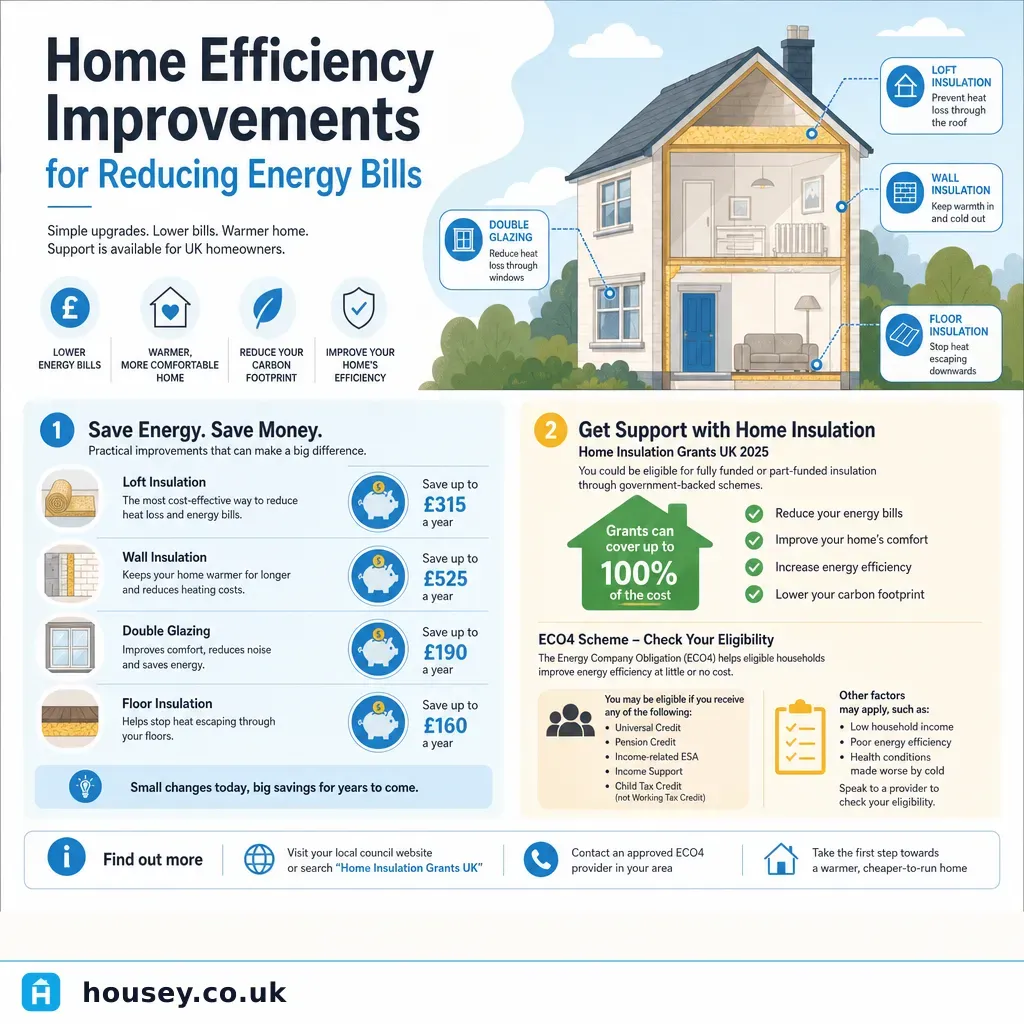
Home Efficiency Improvements for Reducing Energy Bills
The most cost-effective UK home efficiency improvements are usually loft insulation, cavity wall insulation, draught-proofing, and upgrading heating controls.
 Energy & Retrofit
The Value of an Energy Performance Audit for Your Home
A home energy performance audit is a detailed, site-specific assessment of a property's fabric, heating, ventilation, and controls.
 Energy & Retrofit
Mini Split Air Conditioning: Installation Costs and Performance
A mini-split (ductless) air conditioning unit costs roughly £1,500–£4,000 installed for a single room in the UK.