Costs for removing and replacing ceramic floor tiles
By Housey · Last reviewed 8th of May 2026
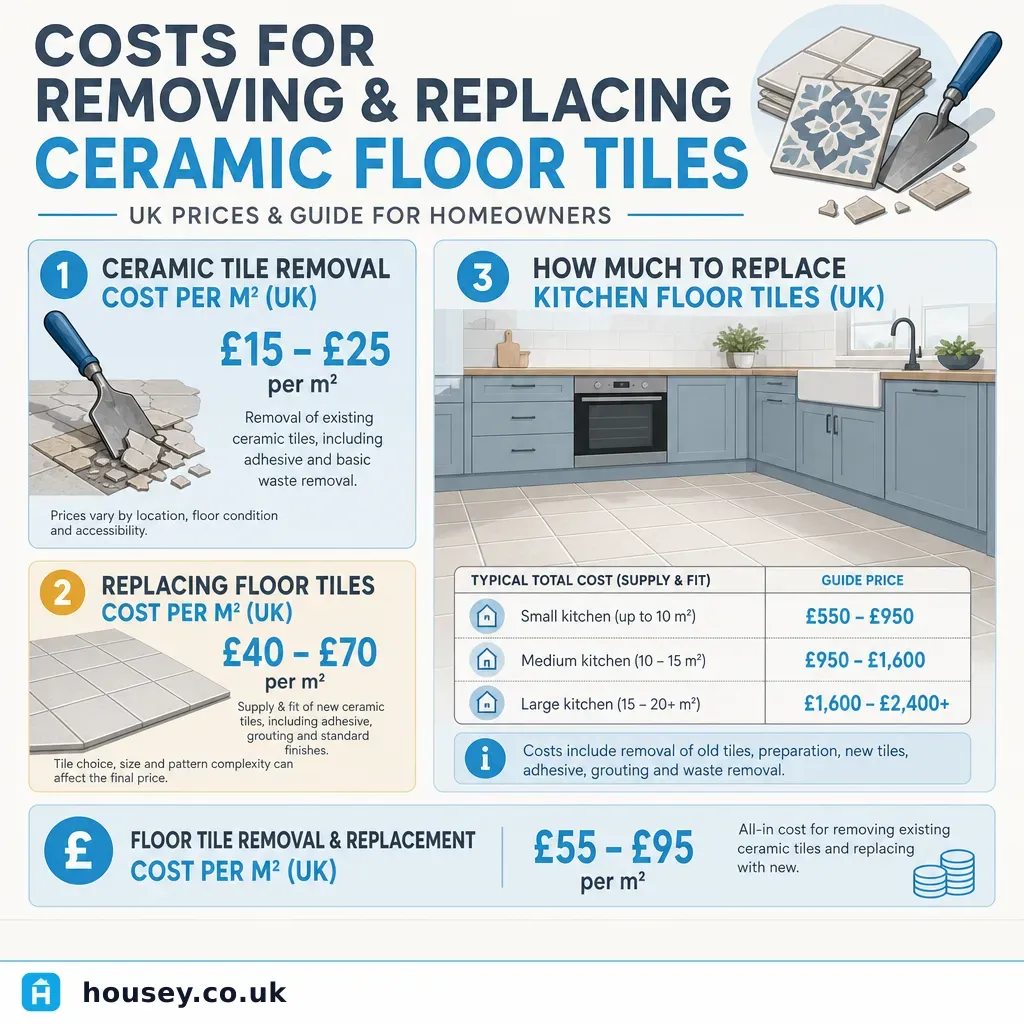
Costs for removing and replacing ceramic floor tiles
Ceramic tile removal and replacement is one of the more physically demanding and disruptive floor improvement projects a UK homeowner can undertake. Costs vary widely based on floor area, tile specification, the condition of what lies beneath, and how waste is handled — and mid-project surprises around subfloor condition are common enough to factor into any early budget. Getting comparable, scope-specific quotes upfront is the most reliable way to avoid unexpected extras once work has started.
Key points
- Labour for ceramic tile removal alone typically costs £10–£25 per m²; supply and professional fitting of replacement tiles adds a further £25–£60+ per m² depending on tile type (Indicative UK costs, last reviewed 2026-05-08; quotes vary by region and project complexity).
- Subfloor condition is the most common source of unexpected cost — cracked screeds, adhesive residue, and uneven surfaces often require self-levelling compound or board replacement before new tiles can be laid.
- Large-format tiles (600×600mm and above) generally cost more per m² to lay because precise levelling, cutting, and handling require more time and skill.
- Waste disposal — skip hire, grab lorry, or tip runs — is frequently excluded from initial quotes; broken ceramic is heavy and cannot go in a standard household bin.
- If underfloor heating (UFH) is present beneath the existing tiles, the system must be switched off and its layout confirmed before any removal work begins; damage to UFH pipes or cables is a costly and common mistake.
What affects the total cost?
Removal costs
Ceramic tiles are bonded with adhesive and grouted at the joints, making removal labour-intensive. Cost drivers include:
- Adhesive type — flexible adhesive is harder to remove cleanly than traditional sand-and-cement bedding
- Subfloor material — tiles on a concrete slab are usually easier to lift than those on timber chipboard or plywood, where the board itself may be damaged in the process
- Tile condition — fully intact tiles bonded with epoxy adhesive can take several times longer to remove than cracked or already-lifting tiles
- Access and room layout — fitted units, awkward doorways, and non-rectangular shapes all add time and therefore cost
Replacement tile and installation costs
Tile type | Typical supply cost (per m²) | Typical fit cost (per m²) | Notes |
|---|---|---|---|
Standard ceramic (300×300mm) | £8–£20 | £25–£40 | Common format; straightforward to lay |
Large-format ceramic (600×600mm+) | £15–£50 | £35–£60 | Needs more precise levelling and handling |
Porcelain (various sizes) | £15–£70+ | £35–£65 | Denser, heavier, harder to cut; very durable |
Patterned or encaustic-style | £30–£100+ | £40–£70 | Pattern alignment adds significant labour time |
Indicative UK costs, last reviewed 2026-05-08. Tile supply costs vary significantly by retailer and specification. Prices shown exclude VAT where applicable.
Additional costs to budget for
- Subfloor preparation (self-levelling compound): £5–£15 per m²
- Adhesive and grout: often included in a supply-and-fit quote — confirm explicitly before accepting
- Backer board (for timber subfloors): £10–£20 per m² supply and fit
- Waste disposal: £150–£300 for a small skip; grab lorry from approximately £200 depending on location
- Threshold strips and edging profiles: £5–£20 per linear metre
- Tile wastage allowance: order 10–15% more than the measured area to cover cuts, breakages, and pattern matching
Worked UK property scenario
Property: 1990s semi-detached, kitchen/diner approximately 22 m², original ceramic tiles on a concrete screed, some tiles cracked and lifting at the edges. >Three quotes were obtained for full removal, subfloor check, and supply and fit of new tiles: >- Quote 1: £1,850 — removal, disposal, supply and fit of mid-range 600×600mm porcelain; subfloor preparation not explicitly included- Quote 2 (itemised): removal £520 + disposal £180 + new tile fit £780 + subfloor levelling flagged as likely at £220 — total up to £1,700 if prep needed- Quote 3: £2,100 — full package including subfloor assessment and any necessary preparation before tiling >The homeowner chose Quote 3, having been caught out by unlisted subfloor costs on a previous project. The final cost matched the estimate with no additional charges. >Illustrative scenario only; not a Housey quote or guarantee of costs.
DIY versus professional: a decision guide
- DIY removal may be reasonable if: you are comfortable with heavy physical work, have access to an SDS rotary hammer with a flat chisel bit, the subfloor is concrete (not timber), no underfloor heating is present, and you have a reliable means to dispose of the waste.
- Use a professional for removal if: the subfloor is timber (risk of board damage), UFH is present, tiles are bonded with epoxy or flexible adhesive, or you are working in a bathroom where the waterproofing layer beneath existing tiles must not be disturbed.
- Always use a professional for fitting if you want a flat, well-grouted result that lasts. Poorly laid tiles crack faster, are harder to regrout, and may not meet tile manufacturer warranty requirements.
What not to assume
- Do not assume waste disposal is included. Many tilers price removal and installation only. Ask explicitly whether skip hire and haulage form part of the quote.
- Do not assume the subfloor is sound. Ask your tiler to flag any subfloor condition concerns during the quoting visit. A quote with no mention of subfloor preparation may result in a mid-project variation order.
- Do not order exactly the area you measured. Allow 10–15% extra for cuts, breakages, and pattern matching — running short mid-project risks visible inconsistencies if the tile batch cannot be matched.
- Do not assume tile and adhesive compatibility with UFH. Not all ceramic tiles and adhesives are suitable for use over underfloor heating; check the tile and adhesive manufacturer's technical guidance before purchasing materials.
- Do not assume VAT is included. Sole-trader tilers may or may not be VAT registered; check whether quoted prices include VAT, particularly for larger projects where the difference is material.
Homeowner preparation checklist
Before inviting tilers to quote, have the following ready:
When to get professional help
Almost all ceramic tile removal and replacement is within the scope of a skilled tiler or general builder. Seek specialist advice if:
- Underfloor heating is present and you are unsure of the system layout, type, or condition
- The subfloor shows signs of damp, movement, or structural damage
- You are working in a bathroom and are concerned about the integrity of the waterproofing membrane beneath existing tiles
- The property is listed or in a conservation area and the existing tiles may have heritage significance requiring listed building consent
How Housey can help
Housey can connect you with vetted local tilers and flooring contractors across the UK. Use the Housey services directory to request quotes from tradespeople in your area, compare their responses side by side on identical scope, and check verified reviews before instructing anyone.
Frequently asked questions
How long does it take to remove and replace ceramic floor tiles?
For an average kitchen of 15–25 m², allow 1–2 days for removal and disposal and a further 1–2 days for laying and grouting. Grout needs at least 24 hours to cure before light foot traffic and 72 hours to fully harden. A combined project typically takes 3–5 working days in total, depending on subfloor preparation requirements.
Can I tile over existing ceramic tiles?
In some circumstances, yes — if the existing tiles are fully bonded, the floor is level, and the added height will not cause problems with doors, skirting boards, or adjacent flooring. Tiling over adds around 12–20mm of height, which is often problematic. Most tilers recommend removal for the best long-term result and to avoid future cracking caused by movement in the layer below.
Do I need building regulations approval to retile a floor?
Not for a standard like-for-like retiling project. Building Regulations may apply if underfloor heating is being installed as part of the work. Listed building consent may be required if the property is listed or in a conservation area and the existing tiles have heritage significance. Check with your local planning authority if in doubt.
Is removing ceramic floor tiles a job I can do myself?
Ceramic tile removal is physically demanding but not technically skilled. A hammer drill with a flat chisel attachment speeds up the work considerably. The main risks are subfloor damage on timber floors, dust inhalation (use an FFP2-rated mask), and cuts from tile shards (wear eye protection and sturdy gloves). If underfloor heating is present, leave removal to a professional.
Why do quotes for the same floor area vary so much?
Scope is the main reason. Some quotes include waste disposal; others do not. One tiler may flag likely subfloor preparation needs while another excludes them entirely. Trade tile supply accounts, day-rate versus m² pricing models, VAT registration status, and individual assessments of adhesive difficulty all contribute to significant variation. Always compare quotes on identical scope to make a fair judgement.
Sources and further reading
- TrustMark — find a registered tradesperson — TrustMark
- Federation of Master Builders — find a builder — Federation of Master Builders
- Planning permission: listed buildings and conservation areas — GOV.UK
Useful next reads
 General property advice
What to do when your boiler stops working
When your boiler stops working, check the pressure gauge (should read 1–1.
 General property advice
Property Market Trends: Activity Growth and Price Movements
UK property market activity is measured through completed sale registrations (HM Land Registry), lender mortgage data, and transaction volumes from HMRC.
 General property advice
Installing a water main shut-off valve for your property
A water main shut-off valve — commonly called a stopcock — controls all water entering your home from the mains.
 General property advice
Monthly House Price Index: August Market Report and Analysis
The UK House Price Index is published monthly using completed Land Registry transaction data, meaning August figures typically reflect sales agreed months earlier.
 General property advice
Scottish Property Market: Activity and Regional Trends
Scotland's property market operates under distinct legal rules: sellers must provide a Home Report before marketing, transactions become legally binding at conclusion of missives rather than exchange of contracts, and Land and Buildings Transaction Tax replaces Stamp Duty.