Charred Timber (Shou Sugi Ban) Cladding Installation Costs
By Housey · Last reviewed 18th of May 2026
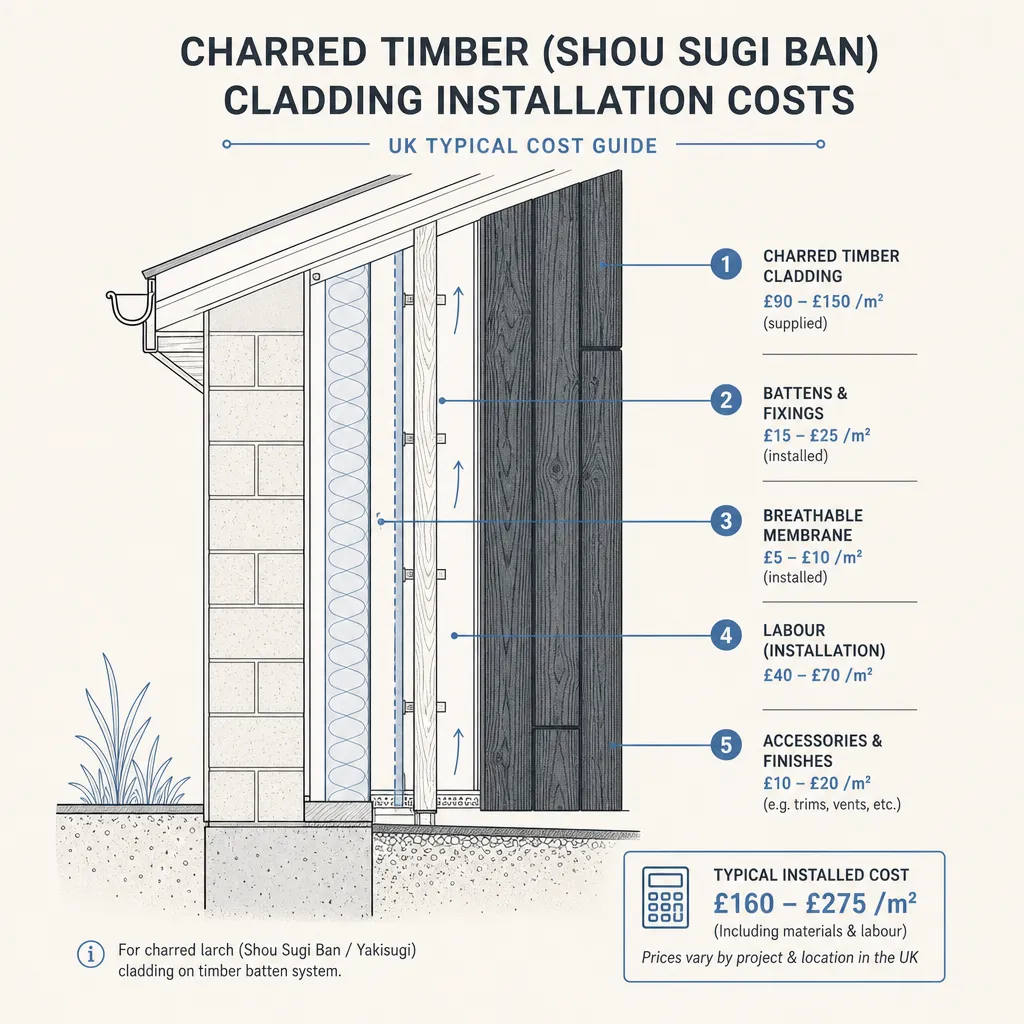
Charred Timber (Shou Sugi Ban) Cladding Installation Costs
Charred timber cladding — sold under the Japanese names shou sugi ban or yakisugi — has moved from specialist architectural practice into mainstream UK renovation and self-build over the past decade. Homeowners are drawn to its striking appearance, claimed durability, and low-maintenance surface, but accurately budgeting a project requires understanding the differences between supply costs, installation method, planning considerations, and fire performance requirements that can catch buyers out.
Key points
- Supply costs for pre-charred timber boards in the UK typically range from £40 to £120 per m², depending on species, charring depth, and board profile; installation labour adds £30–£70 per m² for a straightforward ground-floor elevation.
- Three charring depths are available — shou (surface, approximately 1–2mm), naka (medium, 2–5mm), and kuro (deep, 5–8mm) — each offering different aesthetics, durability, and maintenance requirements.
- Larch and Scots pine are the most commonly used UK-sourced species for charred cladding; western red cedar and hardwoods are available but generally more expensive.
- Re-cladding an existing house in England does not usually require planning permission under Class A of the Town and Country Planning (General Permitted Development) (England) Order 2015 (GPDO), but conservation areas, listed buildings, and Article 4 Direction areas are exceptions.
- Cladding on new-builds and extensions must comply with Building Regulations Approved Document B (fire) and Approved Document L (thermal performance); Regulation 7 of the Building Regulations 2010 restricts combustible materials on external walls of buildings over 18m in height.
What is shou sugi ban and why is it popular in the UK?
Shou sugi ban (焼杉板) is a traditional Japanese technique in which timber boards are charred, brushed, and sometimes oiled to create a protective carbon layer. This surface resists moisture absorption, UV degradation, insect attack, and — at deeper char depths — surface ignition. In the UK, the technique has gained traction in contemporary self-builds, barn conversions, and garden studios, where its visual contrast with stone, render, or weathering steel suits the aesthetic many clients seek.
UK manufacturers and importers now supply factory-charred boards with fire-performance test certificates and UKCA or CE marking, making specification on regulated projects more straightforward than in earlier years when site-charring was the only practical option.
How charring depth affects cost and performance
Charring depth | Description | Typical UK application | Maintenance interval | Relative supply cost |
|---|---|---|---|---|
Shou (surface, ~1–2mm) | Light char; grain pattern visible; warm brown-black tone | Sheltered cladding; interior feature walls | Oil annually; re-char every 10–15 years | Lower |
Naka (medium, ~2–5mm) | Moderate char; alligator-skin texture beginning to form | General UK external cladding | Brush and re-oil every 5–8 years | Mid-range |
Kuro (deep, ~5–8mm) | Pronounced cracked texture; deep matte black | Exposed locations; coastal sites; bold contemporary aesthetic | Minimal; allow weathering to silver-grey | Higher |
Deeper chars require thicker starting boards to retain structural integrity after charring and involve more process time — both of which increase the supply price.
What does charred timber cladding cost in the UK?
Indicative UK costs, last reviewed 2026-05-18. Prices vary by supplier, species, profile, and regional labour rates.
Supply costs — boards only:
Species and charring depth | Indicative cost per m² (supply only) |
|---|---|
Larch, shou (surface char) | £40–£65 |
Larch, naka (medium char) | £55–£85 |
Larch, kuro (deep char) | £70–£120 |
Scots pine, surface or medium char | £40–£70 |
Western red cedar, medium or deep char | £80–£140 |
Installation costs:
Fitting charred larch or pine featheredge or shiplap boards onto a prepared batten system typically costs £30–£70 per m² for labour on a straightforward ground-floor elevation. Complex profiles, curved walls, and high-level work requiring scaffolding push installation labour to £60–£100 per m².
Additional budget items:
- Counter-battening and breathable membrane (ventilated rain-screen system): £11–£28 per m²
- Stainless steel fixings (essential for exterior use): £2–£5 per m²
- Scaffolding for first-floor level or above: project-specific — obtain a separate quote
- Finishing oil for unfinished boards: approximately £5–£15 per m² in materials
Charred timber compared with alternative cladding options
Cladding material | Indicative supply and fit (per m²) | Approximate lifespan | Maintenance | Planning sensitivity |
|---|---|---|---|---|
Charred larch, kuro (deep) | £120–£200 | 40–60 years (supplier claims) | Low | As any external timber |
Painted softwood featheredge | £50–£100 | 15–25 years | Medium — repaint every 5–8 years | Generally low |
Fibre cement board | £60–£130 | 30–50 years | Low | Generally low |
Composite engineered wood | £80–£160 | 25–40 years | Low | Generally low |
Western red cedar, uncharred | £90–£160 | 30–50 years | Low to medium | As any external timber |
Lifespan figures are supplier estimates; independent long-term UK performance data for charred timber in the British climate is limited given the technique's relative novelty here.
Planning permission and building regulations
Re-cladding an existing house: In England, replacing external cladding is generally permitted development for houses under Class A of the GPDO 2015. However:
- Conservation areas, World Heritage Sites, and Areas of Outstanding Natural Beauty may restrict cladding materials — check with your local planning authority.
- Listed buildings require listed building consent for any external alteration, regardless of material.
- Some local authorities have issued Article 4 Directions removing cladding permitted development rights in specific streets or areas; check before starting.
New extensions and new-builds: Cladding that forms part of an external wall must comply with Approved Document B (fire safety). Regulation 7 of the Building Regulations 2010 (as amended in 2018) prohibits combustible materials on external walls of buildings over 18m in height. For residential buildings under 11m, requirements are less prescriptive, but the specification should still be confirmed with your building control body. Approved Document L applies where the cladding forms part of the building's thermal envelope.
Worked example: re-cladding a garden studio in Surrey
A homeowner in Surrey is re-cladding a timber-frame garden studio with approximately 55 m² of external wall area using charred larch naka boards on a ventilated batten system.
Item | Indicative cost |
|---|---|
Charred larch naka boards (55 m² plus 10% for waste) | £3,630–£5,115 |
Battening and breathable membrane | £605–£1,540 |
Stainless steel fixings | £110–£275 |
Labour — installation (approx. 60 m² at £40–£65/m²) | £2,400–£3,900 |
Finishing oil if required | £275–£825 |
Estimated total | £7,020–£11,655 |
Indicative UK costs, last reviewed 2026-05-18. Scaffolding, planning fees, and substrate repairs are excluded.
What to ask a cladding installer before accepting a quote
- What species and charring depth are you quoting, and from which supplier?
- Are the boards CE or UKCA marked, and do they carry a fire-performance test certificate?
- Is the ventilated batten system and breathable membrane included in your price?
- Will all fixings be stainless steel throughout — including any secret-fix clips?
- Can you provide examples or photos of previous charred timber installations?
- Does the price include cutting waste and sealing all cut ends with oil?
- Will you apply finishing oil, or are boards supplied pre-oiled?
- What workmanship warranty do you offer, and what does it cover?
When to get professional help
Most experienced timber cladding contractors can install charred boards competently — the skills are the same as for other timber rain-screen cladding systems. Seek additional professional input when:
- The building is listed or in a conservation area — speak to a planning consultant or the local conservation officer before proceeding.
- The wall forms a fire-compartment boundary in a multi-unit dwelling — building control sign-off on the complete wall specification is needed.
- You are adding cladding to an extension and need to demonstrate Approved Document L compliance — confirm with your energy assessor or building control body.
- The existing substrate shows rot, damp penetration, or structural movement before re-cladding begins — investigate and resolve these issues first.
How Housey can help
Housey can connect you with specialists for external cladding projects across the UK. Whether you need extension builders managing cladding projects as part of a wider build or roofers experienced in timber rain-screen detailing at eaves and verge junctions, compare quotes through Housey to find a contractor suited to your specification and location.
Frequently asked questions
Does charred timber cladding need planning permission?
For most houses in England, re-cladding with charred timber falls within permitted development rights under the GPDO 2015 and does not require planning permission. The main exceptions are listed buildings, conservation areas, and areas subject to an Article 4 Direction removing those rights. Always check with your local planning authority before starting work, as rules vary by location.
How long does shou sugi ban cladding last?
Suppliers typically claim 40–60 years for deep-charred boards in exposed conditions. The carbon surface layer — not the underlying wood — provides the majority of the protection. Maintaining that layer through periodic brushing and re-oiling extends the board's useful life. Independent long-term UK performance data is limited given the technique's relative novelty in the British climate.
Can charred timber cladding be used on a new extension?
Yes, subject to building regulations compliance. Approved Document B (fire safety) and Approved Document L (thermal performance) both apply when cladding forms part of the external envelope of a new extension. Confirm the full wall specification with your building control officer before installation begins to ensure it meets current requirements.
Is shou sugi ban the same as yakisugi?
Yakisugi (焼杉) is the correct Japanese term; shou sugi ban is a westernised phonetic variant that became common in English-language architecture and interiors markets. Both refer to the same charred-timber technique. Some UK suppliers use yakisugi to indicate boards produced using traditional hand-charring methods, though practices vary between manufacturers.
Sources and further reading
- Town and Country Planning (General Permitted Development) (England) Order 2015 — legislation.gov.uk
- Building Regulations Approved Document B: Fire Safety — GOV.UK
- Building Regulations Approved Document L: Conservation of Fuel and Power — GOV.UK
- Historic England: Works to Listed Buildings and Conservation Areas — Historic England
Useful next reads
 Improvement & Build
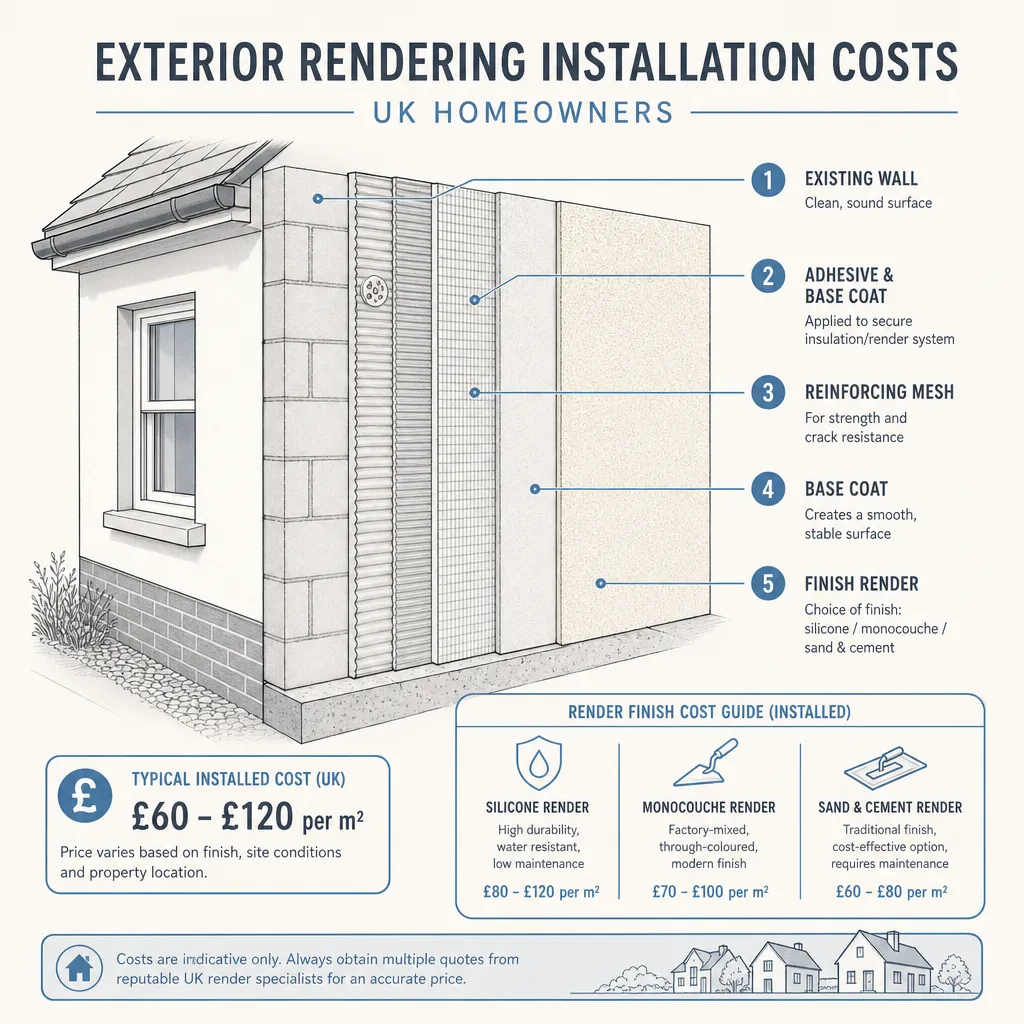
Exterior Rendering Installation Costs
Exterior rendering in the UK typically costs £20–£60 per square metre for standard render systems, or £80–£150 per square metre for External Wall Insulation with a render finish.
 Improvement & Build
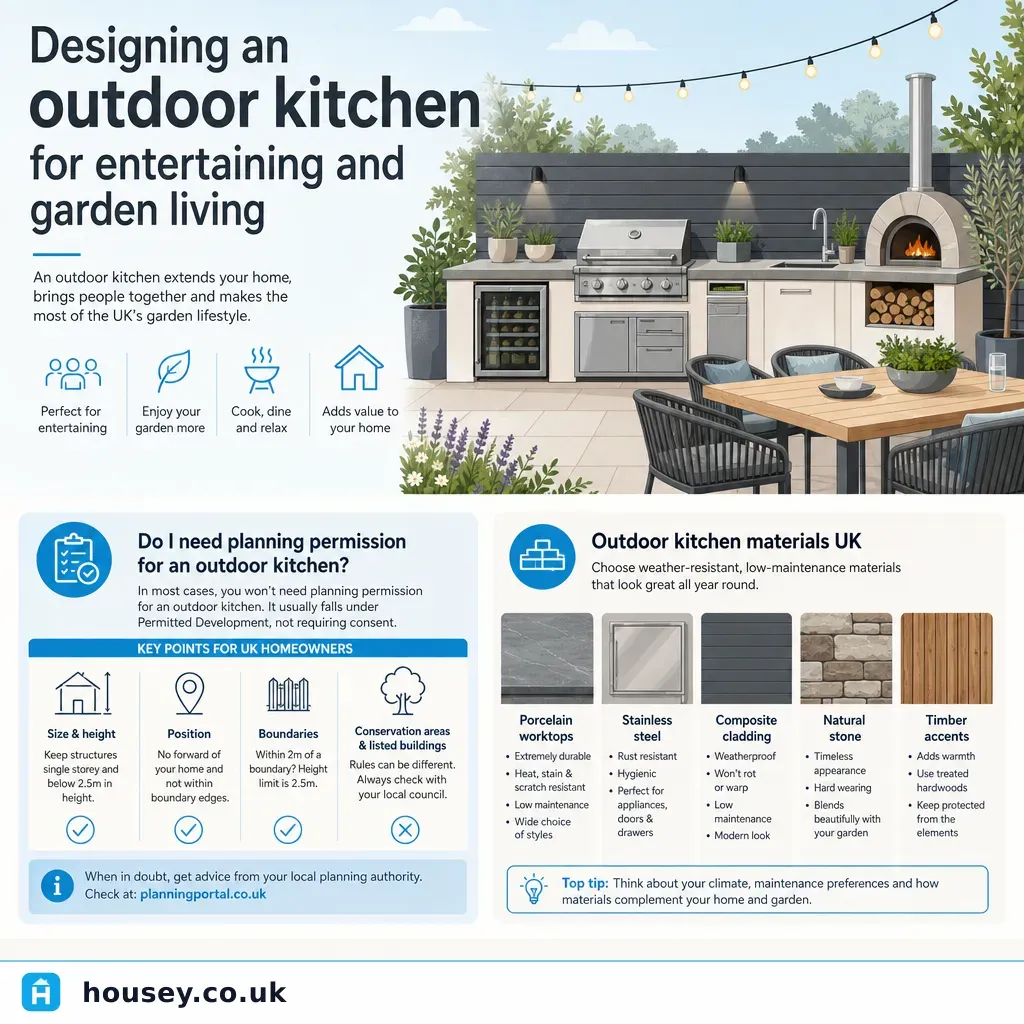
Designing an outdoor kitchen for entertaining and garden living
An outdoor kitchen in a UK garden needs a stable, level base — typically a concrete slab or quality paving — with weather-rated materials such as stainless steel grade 316 or frost-rated porcelain.
 Improvement & Build
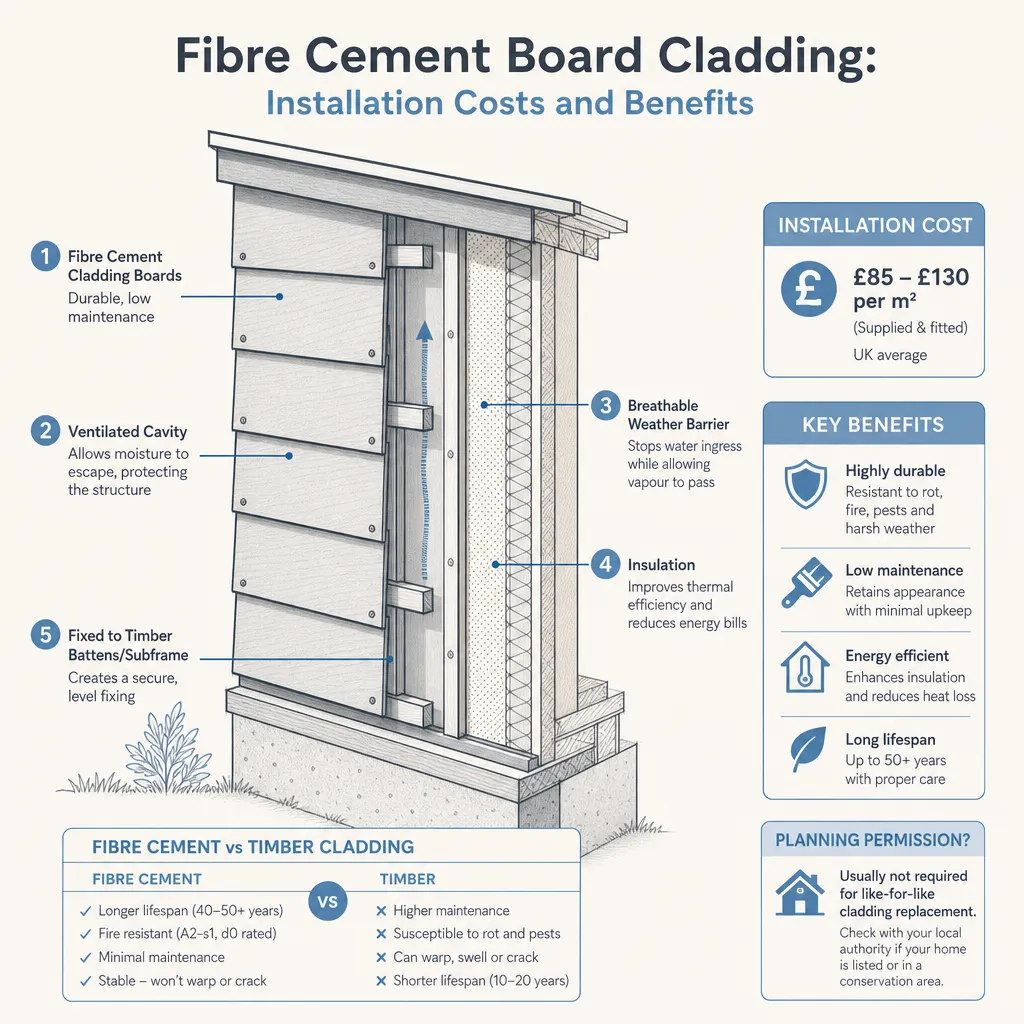
Fibre Cement Board Cladding: Installation Costs and Benefits
Fibre cement board cladding typically costs £80–£180 per m² installed in the UK, including boards, battens, breather membrane, and labour.
 Improvement & Build
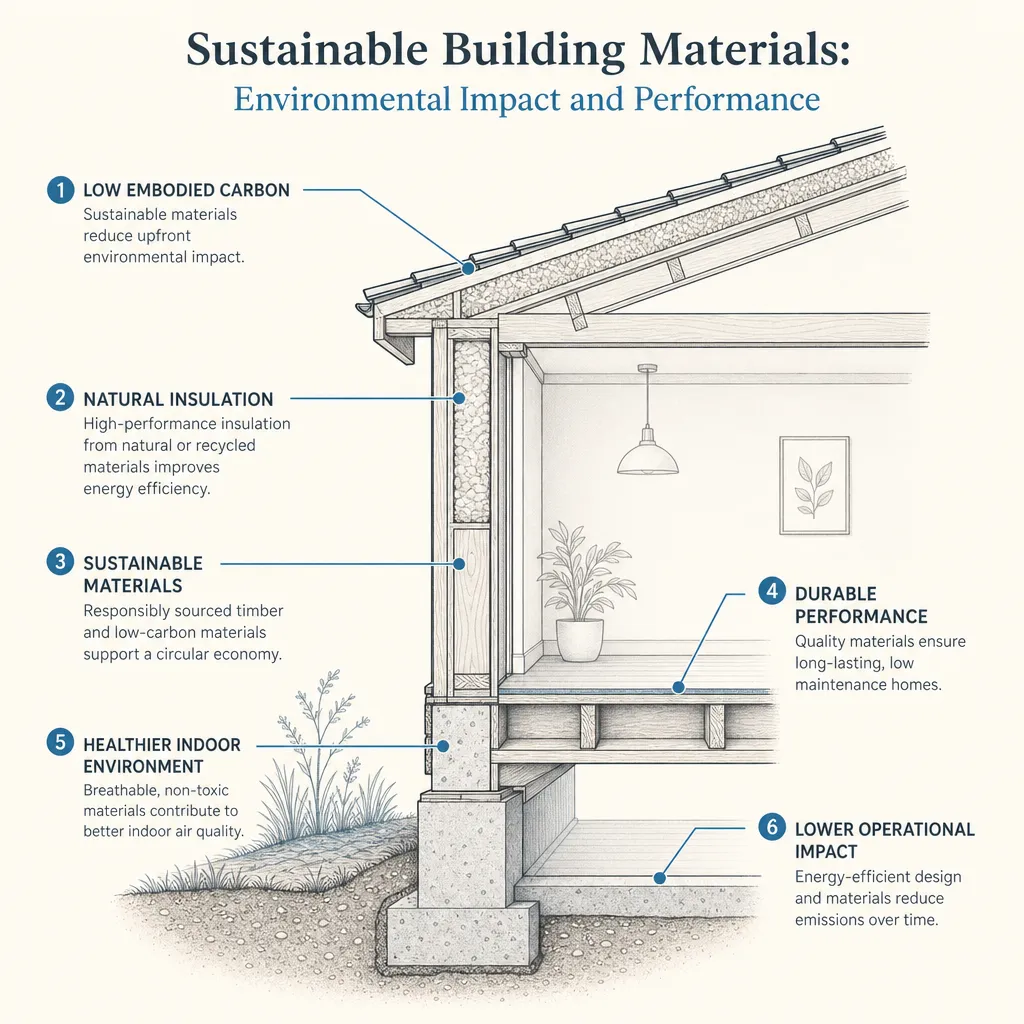
Sustainable Building Materials: Environmental Impact and Performance
Sustainable building materials are assessed on embodied carbon, thermal performance, durability, and end-of-life recovery.
 Improvement & Build
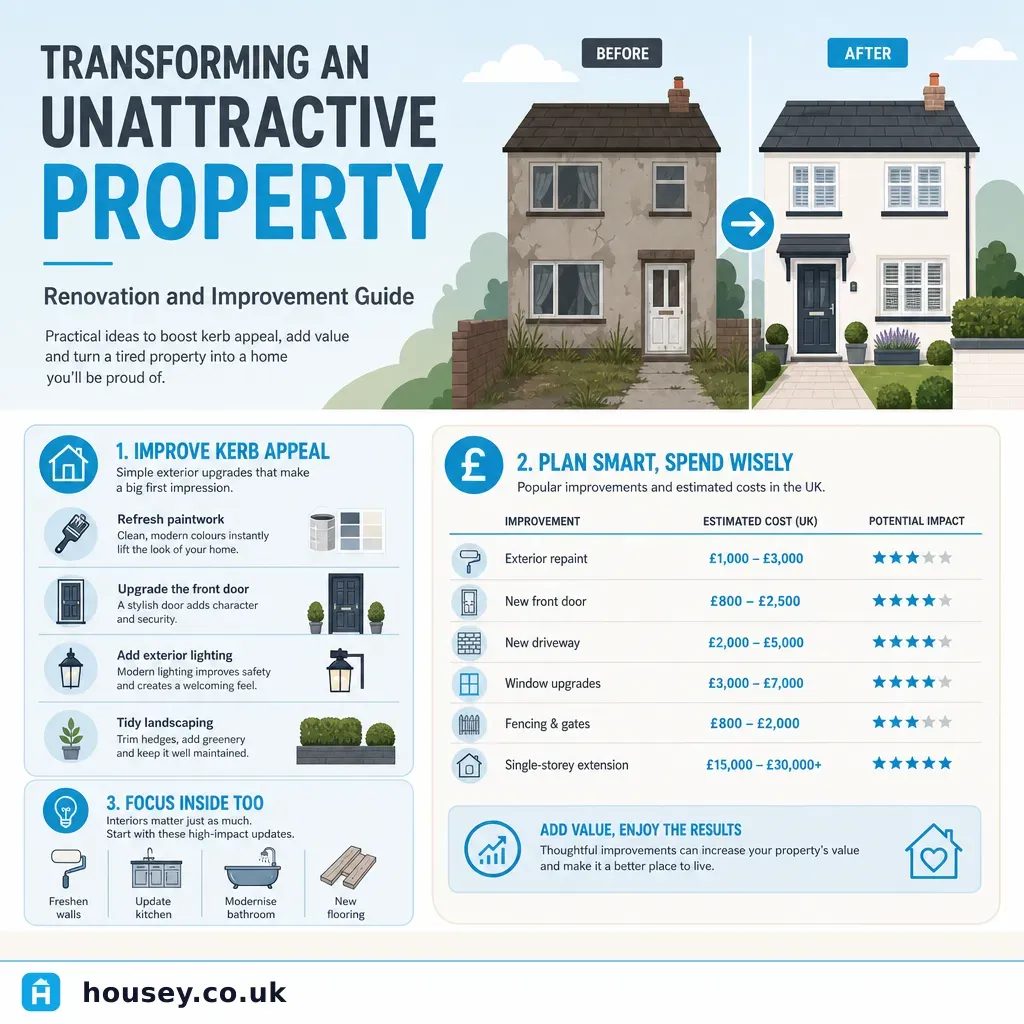
Transforming an Unattractive Property: Renovation and Improvement Guide
Transforming an unattractive UK property usually starts with surface-level improvements — render, windows, doors, and front landscaping — before tackling structural changes like extensions.