Sustainable Building Materials: Environmental Impact and Performance
By Housey · Last reviewed 1st of June 2026
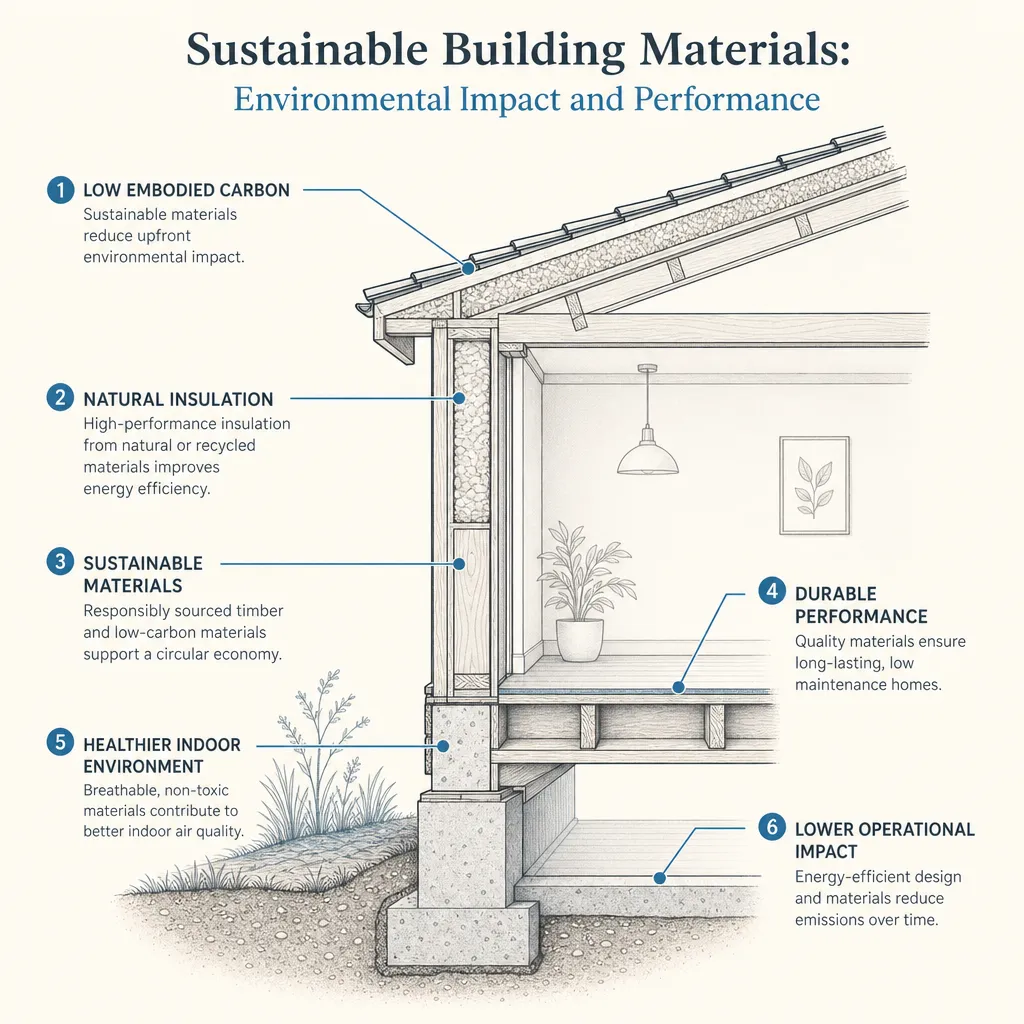
Sustainable Building Materials: Environmental Impact and Performance
The choice of building materials has moved from a niche environmental concern to a mainstream consideration in UK construction and renovation. Tightening Building Regulations — particularly Approved Document L and the trajectory toward the Future Homes Standard — combined with growing developer and homeowner interest in embodied carbon, means that anyone planning a new build, extension, or major renovation increasingly faces the same questions: which materials carry the lowest environmental impact, and do they perform reliably in UK conditions?
Key points
- Embodied carbon — the carbon emitted during material extraction, manufacture, and transport — is not yet regulated under UK Building Regulations for domestic buildings, but PAS 2080:2023 (BSI) provides a recognised framework for measuring it in the built environment.
- Timber from FSC- or PEFC-certified sources is one of the few mainstream structural materials that sequesters carbon during its growth phase, making it a significant choice for low-carbon construction.
- Hempcrete and lime are non-structural, vapour-permeable insulating materials with very low embodied carbon, particularly well suited to solid-wall retrofit and sympathetic new-build projects.
- Building Regulations Approved Document L sets minimum energy performance standards that any material specification must meet — sustainable credentials alone do not guarantee regulatory compliance.
- BREEAM and the RICS Whole Life Carbon Assessment (WLCA) framework provide the most widely used UK methodologies for measuring and reporting material sustainability in building projects.
What makes a building material sustainable?
Sustainability in construction materials is assessed across several dimensions, not a single environmental headline:
- Embodied carbon — the total greenhouse gas emissions from raw material extraction through manufacture and delivery to site, sometimes described as cradle-to-gate or cradle-to-grave.
- In-use energy performance — the material's thermal conductivity, contribution to airtightness, and durability in the UK's temperate, damp climate.
- End-of-life recovery — whether the material can be reused, recycled, or safely composted at the end of the building's life.
- Supply chain transparency — independent certifications such as FSC and PEFC (timber), BES 6001 (responsible sourcing of construction products), and Environmental Product Declarations (EPDs) verify claims independently.
- Local sourcing — transport distance contributes to embodied carbon; UK-quarried stone or home-grown timber has a smaller transport footprint than equivalent imported materials.
No single material scores perfectly on every dimension. The right specification depends on building type, construction method, location, budget, and the client's priorities.
Sustainable material options: a comparison
Material | Embodied carbon profile | Thermal performance | Structural use | Best suited to | Key UK certification |
|---|---|---|---|---|---|
Cross-laminated timber (CLT) | Low — sequesters carbon during tree growth | Good; works well alongside added insulation | Yes — walls, floors, roofs | New-build residential and commercial | FSC/PEFC; BM TRADA Q-Mark |
Hempcrete (hemp + lime binder) | Very low; potentially carbon-negative if UK-grown | Moderate — thermal conductivity ~0.10–0.13 W/mK; additional insulation often needed for Part L compliance | No — infill and insulation only | Solid-wall retrofit; timber-frame self-build | No single UK standard; request EPD from supplier |
Recycled structural steel | Significantly lower than virgin steel (up to 75% reduction) | High conductivity — thermal breaks are essential at junctions | Yes — frames, beams, long spans | Commercial; extensions; industrial | BREEAM Mat 01 credits; BS 5950 |
Reclaimed brick | Near-zero embodied carbon (reuse avoids manufacture) | Variable; broadly similar to new brick | Limited — non-structural in most modern applications | Extensions matching existing fabric; renovation and conservation | Supplier performance data; BS EN 772 for testing if required |
Mineral wool insulation | Moderate; long service life offsets initial manufacturing carbon | Excellent — 0.032–0.044 W/mK thermal conductivity | No — insulation only | Loft, cavity wall, and floor insulation | BBA certification; Approved Document L compliant |
Sheep's wool insulation | Low; renewable and biodegradable | Good — ~0.035–0.040 W/mK thermal conductivity | No — insulation only | Timber-frame buildings; loft insulation | BBA or KIWA certification |
Lime render and plaster | Low; natural material with long service life when well maintained | Moderate; vapour-permeable — critical for historic fabric | No — finish and protection only | Historic and solid-wall buildings; retrofit of pre-1919 properties | NHL classification per EN 459-1 |
Performance data is indicative. Always obtain Environmental Product Declarations (EPDs) and technical data sheets from specific suppliers, as values vary by product, mix, and thickness.
Environmental impact: embodied carbon in context
Buildings and their construction account for a significant share of UK greenhouse gas emissions — a share that grows in relative terms as operational energy use falls through improved insulation and low-carbon heating. The UK government has not yet introduced mandatory embodied carbon reporting for domestic buildings, though the Future Homes Standard consultation process and the UK Green Building Council's Whole Life Carbon Roadmap both signal increasing regulatory attention in this area.
For those wishing to measure or reduce embodied carbon, the recognised approach involves three steps:
- Specify materials with EPDs — independently verified, standardised data on a material's carbon footprint per functional unit, enabling like-for-like comparisons between products.
- Apply the RICS Whole Life Carbon Assessment (WLCA) framework — a consistent methodology for comparing material choices across a project and communicating results to clients, funders, and planners.
- Reference PAS 2080:2023 — the BSI standard for carbon management in buildings and infrastructure, increasingly applied to residential and commercial schemes beyond its original infrastructure focus.
In-use performance in the UK climate
Sustainable material credentials must be matched by reliable performance in the UK's temperate and damp conditions. Key considerations include:
- Moisture management — vapour-permeable materials (hempcrete, lime, sheep's wool) allow walls to breathe and release moisture, reducing interstitial condensation risk in solid-wall construction. Applying impermeable insulation or render systems to existing solid walls without specialist assessment can trap moisture and cause serious structural damage over time.
- Thermal mass — dense materials such as rammed earth, stone, and brick moderate temperature swings. Useful in passive solar designs, but requires careful orientation and shading specification to avoid overheating under future climate scenarios.
- Airtightness — sustainable credentials do not automatically guarantee airtightness. Well-designed CLT panels and structural insulated panels (SIPs) can achieve very low air leakage rates; natural fibre insulations require careful detailing at junctions and penetrations to avoid unintended air paths.
- Fire performance — all materials used in building work must satisfy Building Regulations Approved Document B. Timber, natural fibre insulations, and some composite panels may require additional fire treatment or protective cladding depending on application, building type, and height.
- Durability — a material with low embodied carbon but a short service life may carry a higher lifetime environmental impact than a slightly more carbon-intensive but longer-lasting alternative. Whole life assessment is essential for accurate comparison.
UK regulatory and certification landscape
Framework or certification | What it covers | Relevance to material choice |
|---|---|---|
Building Regulations Approved Document L (2021) | Minimum operational energy performance for new builds and major renovations | Material U-values and fabric performance must meet or exceed minimum standards |
Future Homes Standard (phased introduction from 2025) | Higher fabric performance and low-carbon heating requirements for new homes | Specifications will need to achieve significantly lower heat loss than current Part L minimums |
BREEAM | Holistic building sustainability — materials, ecology, energy, water, transport | Mat 01 credits reward responsible sourcing and EPD use; assessor involvement needed from design stage |
PAS 2080:2023 | Embodied carbon measurement and management in the built environment | Provides consistent methodology for quantifying and reporting material carbon impact |
RICS WLCA | Whole life carbon assessment for buildings | Used by surveyors, architects, and developers to compare specifications and report to clients |
FSC / PEFC | Responsible forestry certification for timber products | Specified by architects; required by many public-sector clients and BREEAM assessors |
BES 6001 | Responsible sourcing of construction products (aggregates, concrete, and others) | Demonstrable supply chain sustainability for non-timber products |
Which professional do you need?
- Choose an architectural technologist if you need technically compliant material specifications — including U-value calculations, vapour control layer design, and thermal bridging assessment — for a Building Regulations submission.
- Choose a design-and-build firm if you want end-to-end responsibility for sustainable design, material procurement, and construction, with a single point of accountability from concept to handover.
- Commission a build cost estimate before committing to a sustainable material specification — some options (CLT, hempcrete) carry a cost premium over conventional construction that affects overall project viability and needs to be modelled early.
- Consult a structural engineer if you are proposing non-conventional structural materials such as CLT, rammed earth, or straw bale — these require engineering calculations and building control sign-off regardless of their environmental credentials.
- Engage a BREEAM assessor from the outset if a formal sustainability rating is required — credits for material choices must be recorded at design stage and cannot be retrospectively claimed.
When to get professional help
Material specification for sustainable buildings is rarely straightforward without professional guidance. Seek advice promptly if:
- You are unsure whether a proposed material meets Building Regulations requirements for thermal performance (Part L), fire safety (Part B), or structural adequacy — sustainable labelling is not evidence of compliance.
- You are retrofitting a solid-wall historic or pre-1919 building — interstitial condensation modelling, using tools such as BS EN ISO 13788, is essential before specifying any additional insulation layer.
- A contractor proposes a material you have not encountered before — ask for the EPD, third-party certification, reference UK projects in comparable building types, and confirmation of building control acceptance.
- You want to achieve a BREEAM, Passivhaus, or similar certification — these require specialist assessor involvement from an early design stage, not retrospective documentation.
How Housey can help
Housey connects homeowners and self-builders with vetted professionals across the UK. If you are planning a sustainable build or renovation, our architectural technologists can advise on compliant material specifications, thermal bridging details, and Building Regulations submissions. Our design-and-build firms offer integrated design and construction with sustainability credentials. Use our build cost estimating service to understand the budget implications of sustainable material choices before finalising your specification.
Frequently asked questions
Are sustainable building materials more expensive in the UK?
Some are and some are not. Reclaimed brick, lime plaster, and sheep's wool insulation are often cost-competitive with conventional alternatives. Cross-laminated timber and hempcrete typically carry a cost premium at current UK market rates. The lifetime cost picture — factoring in durability, reduced maintenance, and long-term energy savings — often narrows or closes that gap. A build cost estimate helps model the full financial picture before committing to a specification.
Does using sustainable materials affect Building Regulations approval?
Building Regulations assess performance outcomes — thermal values, fire performance, structural adequacy — rather than prescribing specific materials. Sustainable materials must meet the same standards as conventional ones. Some less common materials may require a third-party assessment or structural engineer's sign-off to satisfy building control. Check with your local authority building control (LABC) or an approved inspector early in the design process.
What is embodied carbon and why does it matter for UK homeowners?
Embodied carbon is the carbon dioxide equivalent emitted during a material's extraction, manufacture, transport, and installation. As buildings become more energy-efficient in use, the proportion of their lifetime carbon attributable to materials grows. The UK has no mandatory embodied carbon target for domestic buildings yet, but RICS, UKGBC, and the government's net-zero trajectory all point toward increasing regulatory attention in this area.
Is hempcrete suitable for all UK buildings?
Hempcrete is best suited to timber-frame new builds and as infill insulation in solid-wall buildings undergoing renovation. It is not a structural material and cannot replace load-bearing elements. It performs best in vapour-open wall constructions — pairing it with impermeable membranes or renders reduces its moisture-management benefits. Always consult a specialist with experience of hempcrete construction in UK conditions before specifying it.
Sources and further reading
- UKGBC — Whole Life Carbon Roadmap — UK Green Building Council guidance on reducing embodied and operational carbon in buildings.
- RICS — Whole Life Carbon Assessment for the Built Environment — Professional standard for whole life carbon assessment in UK buildings.
- GOV.UK — Approved Document L: Conservation of Fuel and Power — Building Regulations energy performance requirements for new builds and renovations.
- BSI — PAS 2080:2023 Carbon Management in Buildings and Infrastructure — The UK standard for managing carbon in the built environment.
- Forest Stewardship Council (FSC) — Responsible timber sourcing certification used across the UK construction industry.
- Energy Saving Trust — Insulation — Practical guidance on insulation options and their benefits for UK homeowners.
Useful next reads
 Improvement & Build
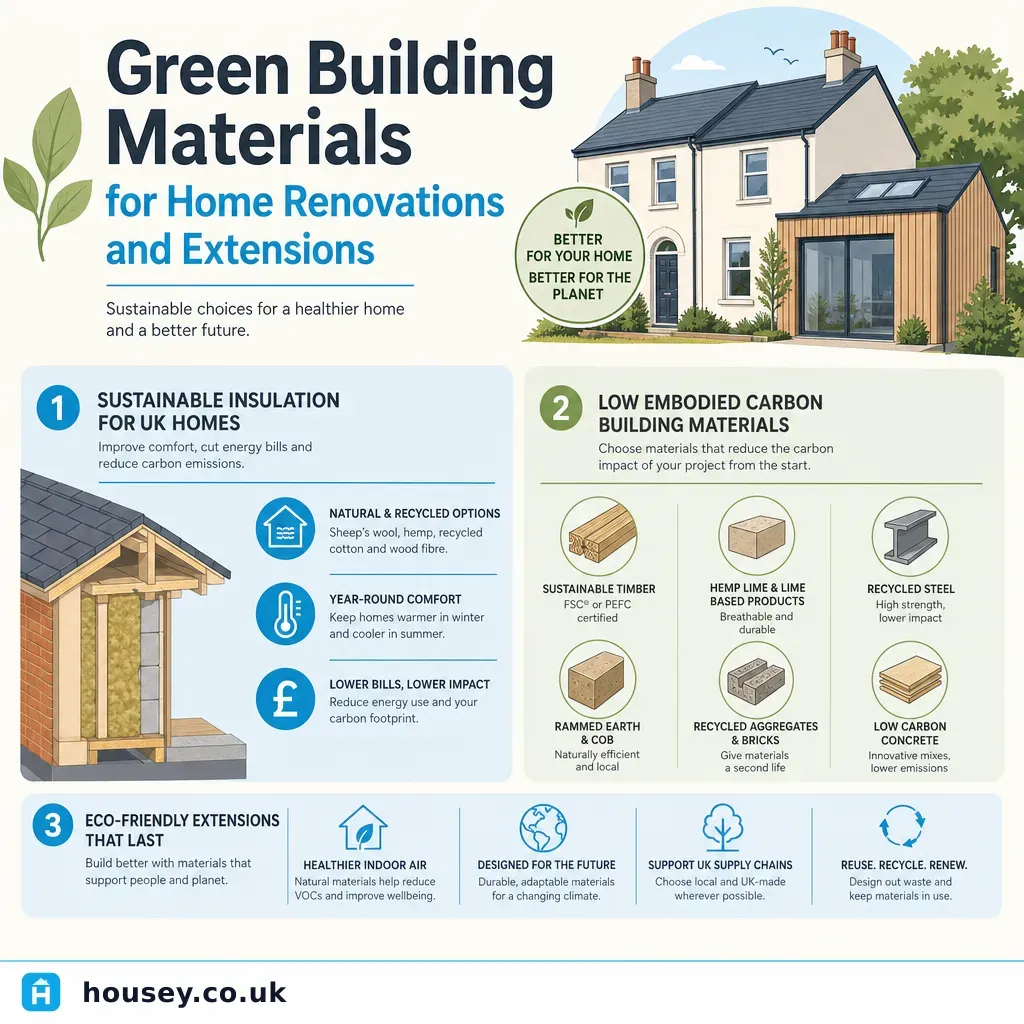
Green Building Materials for Home Renovations and Extensions
Green building materials are those with lower embodied carbon, better whole-life environmental performance, or improved breathability compared to conventional alternatives.
 Improvement & Build
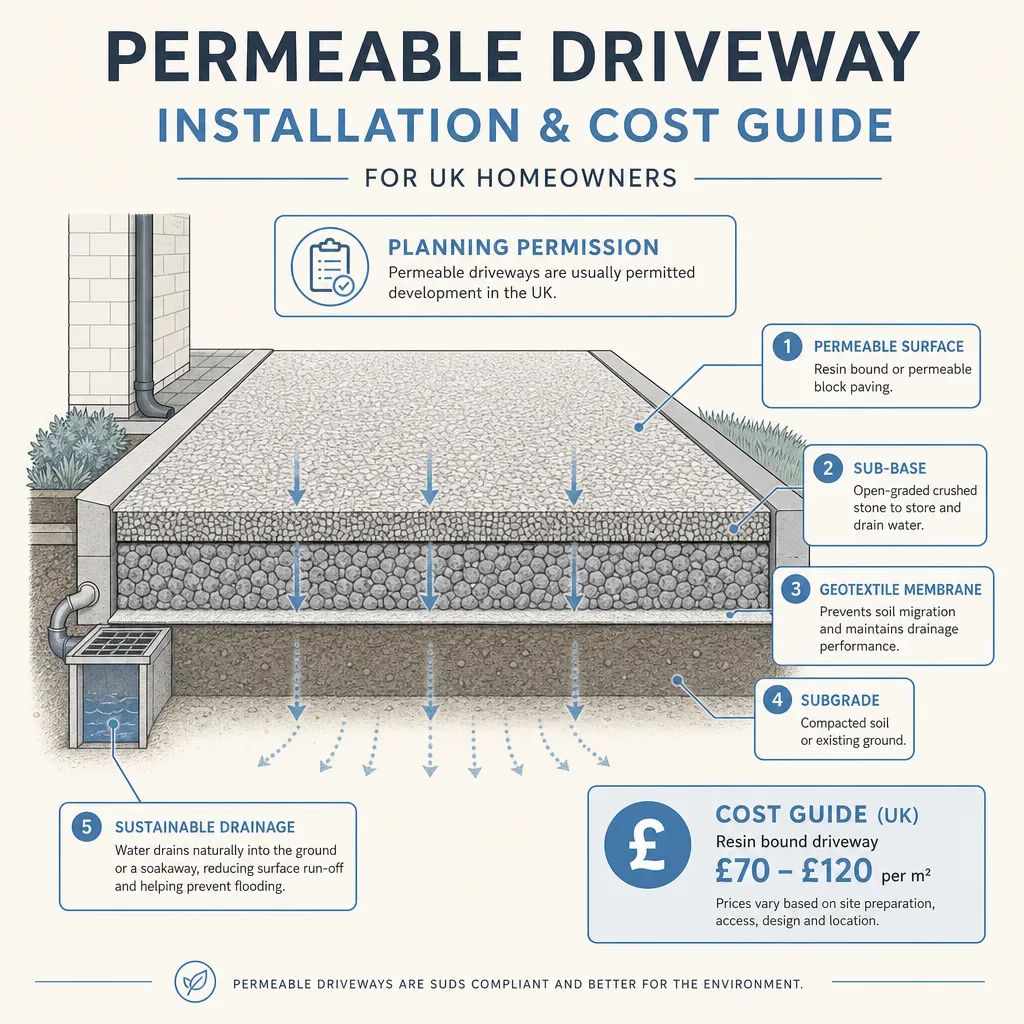
Permeable Driveway Installation and Cost Guide
A permeable driveway lets rainwater drain through or around the surface rather than running off into the road or drainage system.
 Improvement & Build
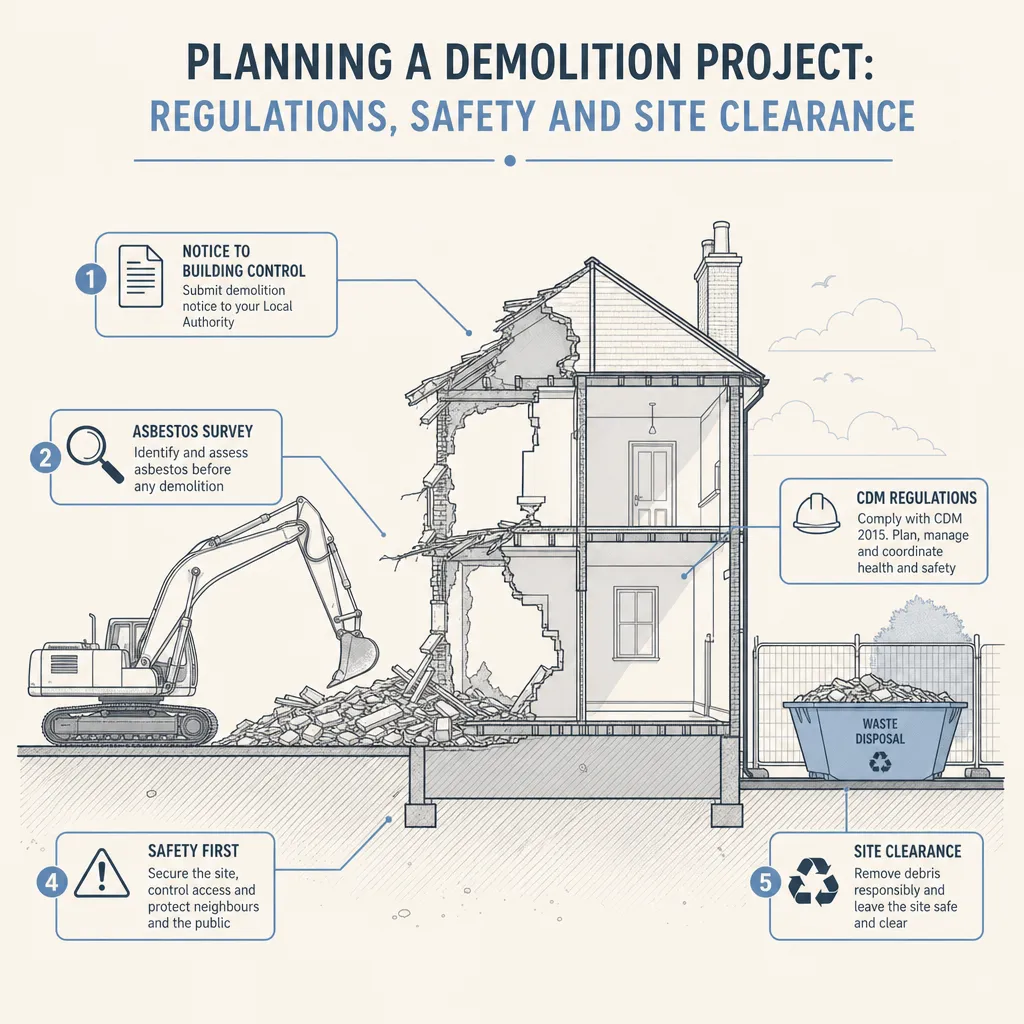
Planning a Demolition Project: Regulations, Safety and Site Clearance
Demolishing a building in England requires a Section 80 building control notice served at least six weeks before work starts, a Refurbishment and Demolition asbestos survey before any demolition begins, and compliance with CDM 2015.
 Improvement & Build
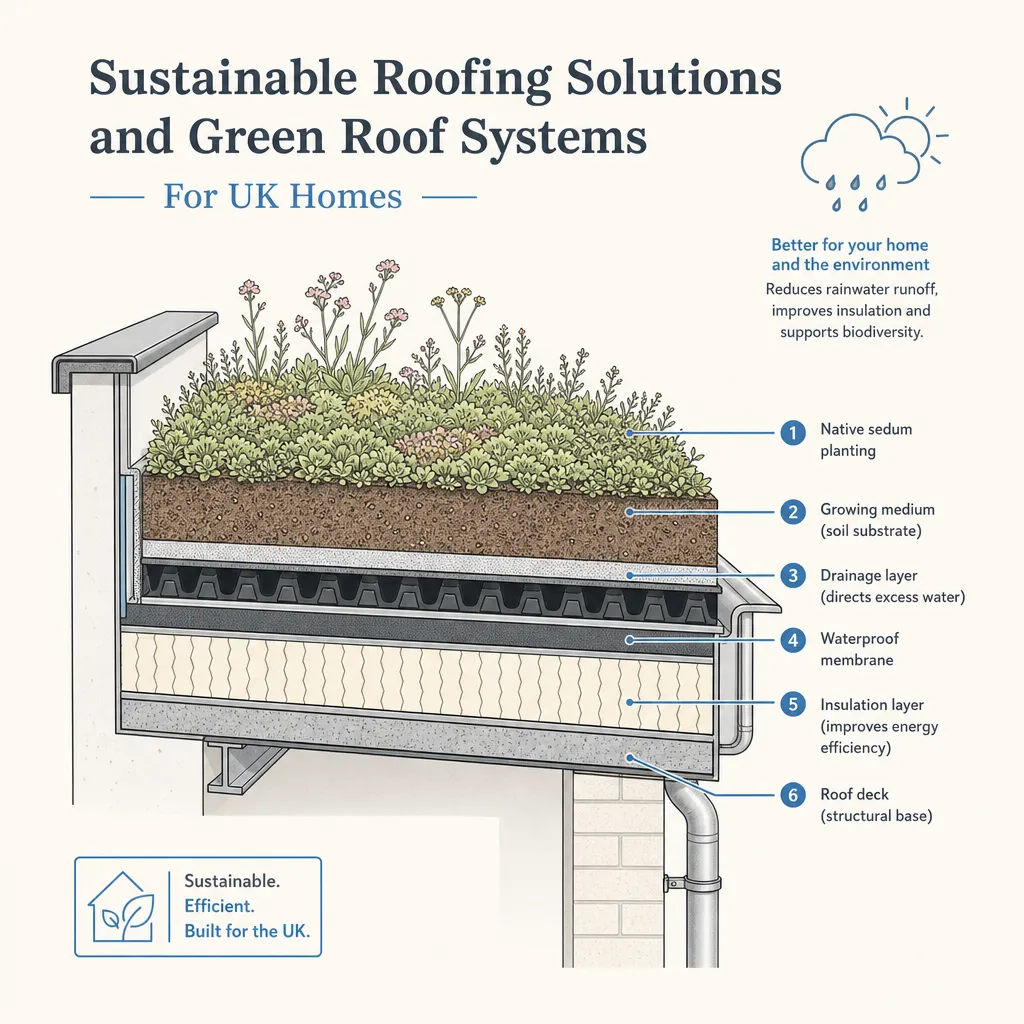
Sustainable Roofing Solutions and Green Roof Systems
Sustainable roofing in the UK covers several options: sedum or living roofs, recycled-content tiles, reclaimed slate, and solar-integrated roofing.
 Improvement & Build
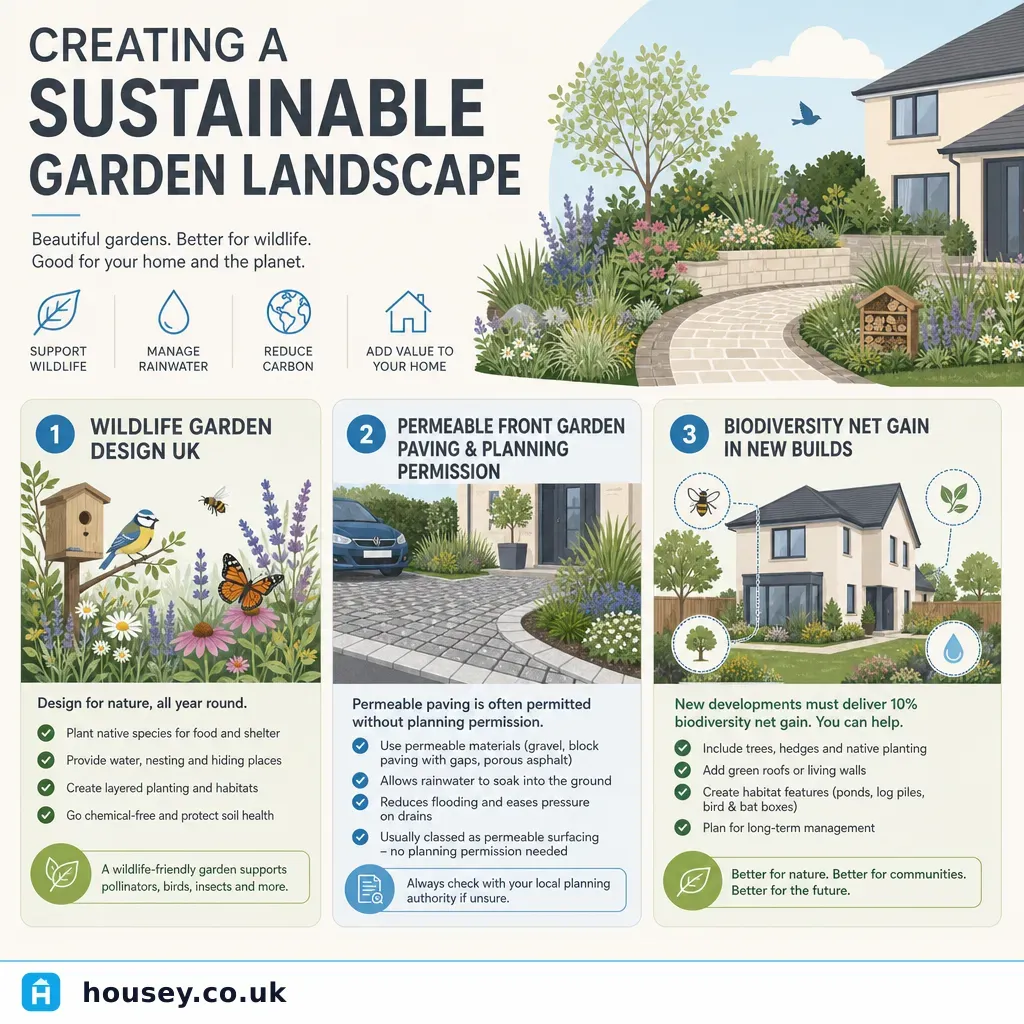
Creating a Sustainable Garden Landscape
Sustainable garden design in the UK combines native planting for biodiversity, permeable surfaces to manage rainfall, and habitat features such as ponds and log piles.