Chimney maintenance: landlord responsibilities and requirements
By Housey · Last reviewed 11th of May 2026
Chimney maintenance: landlord responsibilities and requirements
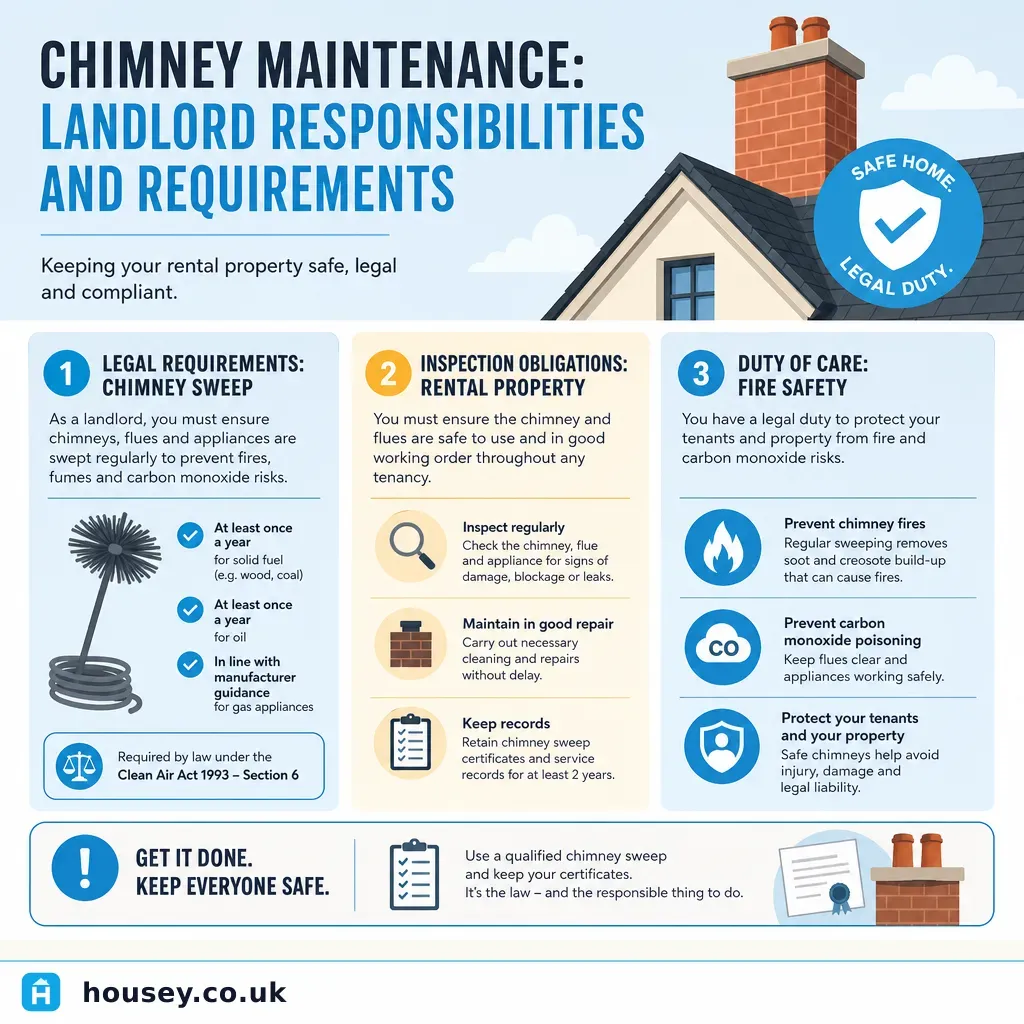
Chimney and flue maintenance sits at the intersection of property law, fire safety, and tenant welfare — and for landlords, getting it wrong carries real legal and financial risk. Questions about landlord obligations typically arise when a tenancy begins, when a tenant reports a problem with a fireplace or stove, or when a gas safety inspection flags a flue concern. The consequences of neglect range from enforcement notices under the Housing Health and Safety Rating System (HHSRS) to liability in the event of a chimney fire or carbon monoxide incident.
Key points
- Section 11 of the Landlord and Tenant Act 1985 requires landlords to keep in repair and proper working order all installations for heating, including the flues serving those appliances.
- The Smoke and Carbon Monoxide Alarm (Amendment) Regulations 2022 require landlords in England to install a CO alarm in any room containing a fixed solid-fuel burning appliance — failure to comply carries a civil penalty of up to £5,000.
- Gas appliances and their flues must be inspected annually by a Gas Safe registered engineer under the Gas Safety (Installation and Use) Regulations 1998; landlords must give tenants a copy of the gas safety record within 28 days of each inspection.
- HETAS recommends sweeping solid-fuel appliance chimneys at least once a year under normal use, and twice a year for heavy use; the National Association of Chimney Sweeps (NACS) advises similar intervals for wood-burning stoves.
- Under the Housing Act 2004 HHSRS framework, an unsafe chimney can constitute a Category 1 fire hazard, exposing landlords to mandatory improvement notices and potential rent repayment orders.
What the law actually requires
No single UK statute specifies a precise chimney-sweep interval for all fuel types — but the cumulative effect of several pieces of legislation makes regular maintenance effectively compulsory for landlords.
Section 11 of the Landlord and Tenant Act 1985 covers the structure and heating installations of a rented property; the Housing Act 2004 HHSRS framework assesses fire risk across the whole building. If a chimney fire or carbon monoxide incident occurs and a landlord cannot demonstrate reasonable maintenance, the HHSRS framework allows local authorities to pursue enforcement action.
For gas appliances, the position is clearer. The Gas Safety (Installation and Use) Regulations 1998 require an annual inspection by a Gas Safe registered engineer, covering the appliance and its flue or chimney. The resulting gas safety record must be kept for two years and provided to the tenant within 28 days of each inspection.
For solid-fuel and wood-burning appliances, HETAS — the official body for solid-fuel heating — recommends sweeping at least once a year under normal use. Landlords who follow recognised industry guidance are better placed to demonstrate reasonable care should a dispute arise.
Sweep frequency by fuel type
Appliance type | Recommended sweep frequency | Key guidance source |
|---|---|---|
Open fire (coal or smokeless fuel) | At least twice a year | HETAS, NACS |
Open fire (wood) | At least twice a year | HETAS, NACS |
Wood-burning or multi-fuel stove | At least once a year; twice if heavily used | HETAS |
Gas fire or boiler flue | Annual inspection by Gas Safe registered engineer | Gas Safety (Installation and Use) Regulations 1998 |
Oil-fired boiler flue | Annual service by OFTEC-registered engineer | OFTEC |
Indicative guidance based on HETAS and NACS recommendations, last reviewed 2026-05-11. Usage patterns and appliance condition may require more frequent maintenance.
Carbon monoxide alarms: the 2022 requirements
The Smoke and Carbon Monoxide Alarm (Amendment) Regulations 2022 significantly strengthened landlord obligations in England. From 1 October 2022:
- A CO alarm must be installed in any room used as living accommodation that contains a fixed combustion appliance (excluding gas cookers).
- Alarms must be tested on the first day of each new tenancy.
- Faulty alarms must be repaired or replaced promptly following a tenant report.
The civil penalty for non-compliance is up to £5,000, enforced by the local housing authority. Scotland, Wales, and Northern Ireland have their own overlapping requirements — landlords with properties across multiple nations should check the rules for each jurisdiction separately.
Which professional do you need?
Task | Who to instruct | Credential to check |
|---|---|---|
Sweep solid-fuel or wood-burning chimney | Chimney sweep | NACS or HETAS registered |
Inspect and service gas fire or boiler flue | Gas engineer | Gas Safe Register |
Inspect and service oil boiler flue | Oil engineer | OFTEC registered |
Inspect chimney structure (cracks, spalling, leaning) | Surveyor or specialist chimney contractor | RICS or relevant specialist body |
Commission new solid-fuel installation | HETAS-registered installer | HETAS |
Red flags that need urgent attention
The following signs mean the appliance should not be used until a qualified professional has inspected the flue:
- Tenant reports black staining near the fireplace, a persistent smoke smell, or visible smoke entering the room — stop using the appliance immediately.
- Visible cracking, spalling brickwork, or a leaning chimney stack observed from outside the property.
- CO alarm sounding, or a tenant experiencing headache, dizziness, or nausea near a combustion appliance — treat as a potential carbon monoxide emergency: ventilate, evacuate, and call 999.
- A Gas Safe engineer issues an Immediately Dangerous (ID) or At Risk (AR) notice following an inspection.
- A chimney sweep reports a blockage such as a bird nest or debris — do not resume use until the flue has been cleared and re-checked.
Important limitations
This article provides general information about landlord obligations in England and Wales as of May 2026. Regulations in Scotland, Wales, and Northern Ireland differ in certain respects, and legislative requirements may change. Nothing in this article constitutes legal advice. If you are uncertain whether your specific property or tenancy arrangement meets current requirements, consult a solicitor with residential landlord experience or contact your local housing authority. All gas safety work must be carried out by a Gas Safe registered engineer; structural chimney concerns should be assessed by a qualified professional.
What to ask a qualified professional
Before instructing a chimney sweep, gas engineer, or surveyor:
- What professional body are you registered with, and can I see evidence of that registration?
- Will you issue a certificate or written report, and what exactly does it cover?
- If you find a defect, what remedial work do you recommend and what is the indicative cost?
- Does your inspection cover the full length of the flue or only accessible sections?
- Are you able to carry out remedial work yourself, or will you refer me to another contractor?
- What records should I retain to demonstrate my compliance as a landlord?
When to get professional help
Arrange a professional inspection — not just a routine sweep — when:
- A tenant reports unusual smells, smoke, or soot entering a room from a fireplace or stove.
- The property has been vacant for more than six months and there is no record of recent chimney maintenance.
- You are acquiring a rental property and have no documentation of previous chimney or flue inspections.
- A gas engineer raises a concern about flue condition during an annual service visit.
- You are installing or re-commissioning a solid-fuel stove or open fireplace — HETAS-registered installation may be required to self-certify under Building Regulations Part J.
How Housey can help
Housey connects landlords with vetted local professionals for property safety and maintenance work. Whether you need a HETAS-registered chimney sweep, an OFTEC-registered oil engineer, or a qualified surveyor to assess a deteriorating chimney stack, you can submit a request through Housey and receive competitive quotes from qualified local contractors.
Frequently asked questions
Is there a legal requirement for landlords to sweep chimneys every year?
No single UK law specifies an annual sweep for all fuel types, but Section 11 of the Landlord and Tenant Act 1985, the Housing Act 2004 HHSRS framework, and fire safety obligations combine to make regular maintenance effectively mandatory. HETAS guidance recommends at least once a year for solid-fuel appliances; following recognised industry guidance helps demonstrate reasonable care if an incident occurs.
Does a landlord need to provide tenants with a chimney sweep certificate?
There is no blanket legal requirement to share a sweep certificate for solid-fuel appliances, unlike the gas safety record. However, retaining and sharing a certificate from a NACS or HETAS-registered sweep is good practice and demonstrates the landlord's duty of care should a dispute or incident arise.
Who pays for chimney maintenance in a rental property?
Unless the tenancy agreement specifies otherwise, chimney maintenance is generally the landlord's responsibility under Section 11 of the Landlord and Tenant Act 1985, as the chimney forms part of the structure and heating installation. Tenants are usually responsible for reasonable use and for notifying the landlord promptly of any defects they notice.
Does a gas fire need an annual service if it is never used?
Yes. The Gas Safety (Installation and Use) Regulations 1998 require annual inspection of all gas appliances and flues in rented properties regardless of whether the appliance is actively used. An unused but connected gas fire should be inspected annually — or isolated and capped by a Gas Safe registered engineer if it will not be used, with records kept.
Do chimney maintenance rules differ in Scotland, Wales, and Northern Ireland?
Yes. Scotland's duties fall under the Housing (Scotland) Act 2006 Repairing Standard and the Housing (Scotland) Act 2014 for CO alarms. Wales follows requirements under the Renting Homes (Wales) Act 2016. Northern Ireland has its own statutory framework. Always verify the specific rules for the nation where your rental property is located.
Sources and further reading
- Landlord and Tenant Act 1985, Section 11 — legislation.gov.uk
- Smoke and Carbon Monoxide Alarm (Amendment) Regulations 2022 — landlord guidance — GOV.UK
- Gas safety: information for landlords — HSE
- HETAS: guidance on solid-fuel heating — HETAS
- National Association of Chimney Sweeps — NACS
- Housing Health and Safety Rating System guidance for landlords — GOV.UK
Useful next reads
 Improvement & Build
How to plan a tree removal project
Planning a tree removal project starts with checking whether the tree is protected by a Tree Preservation Order or sits in a conservation area, as both require council consent before any work begins.
 Improvement & Build
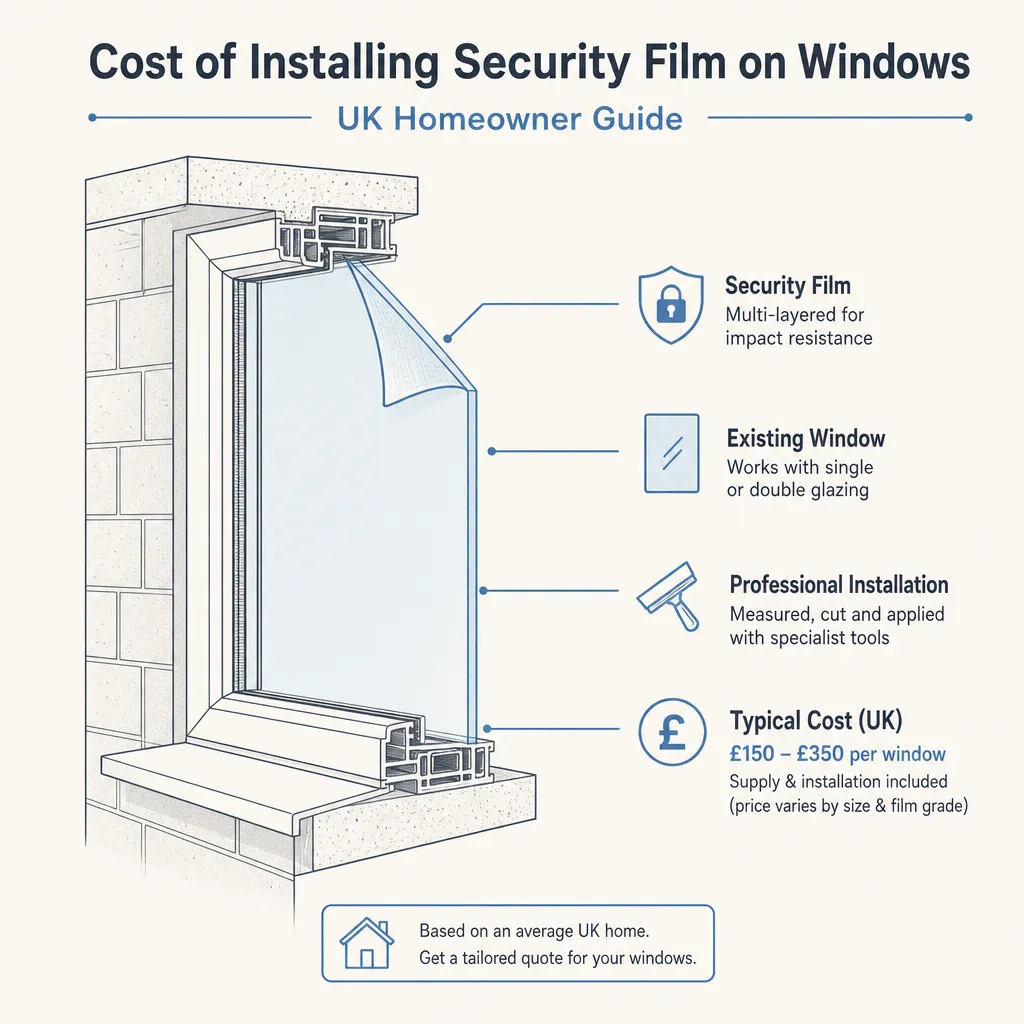
Cost of Installing Security Film on Windows
Security film for windows in the UK typically costs £25–£60 per m² for supply and professional installation, depending on film specification and window count.
 Improvement & Build
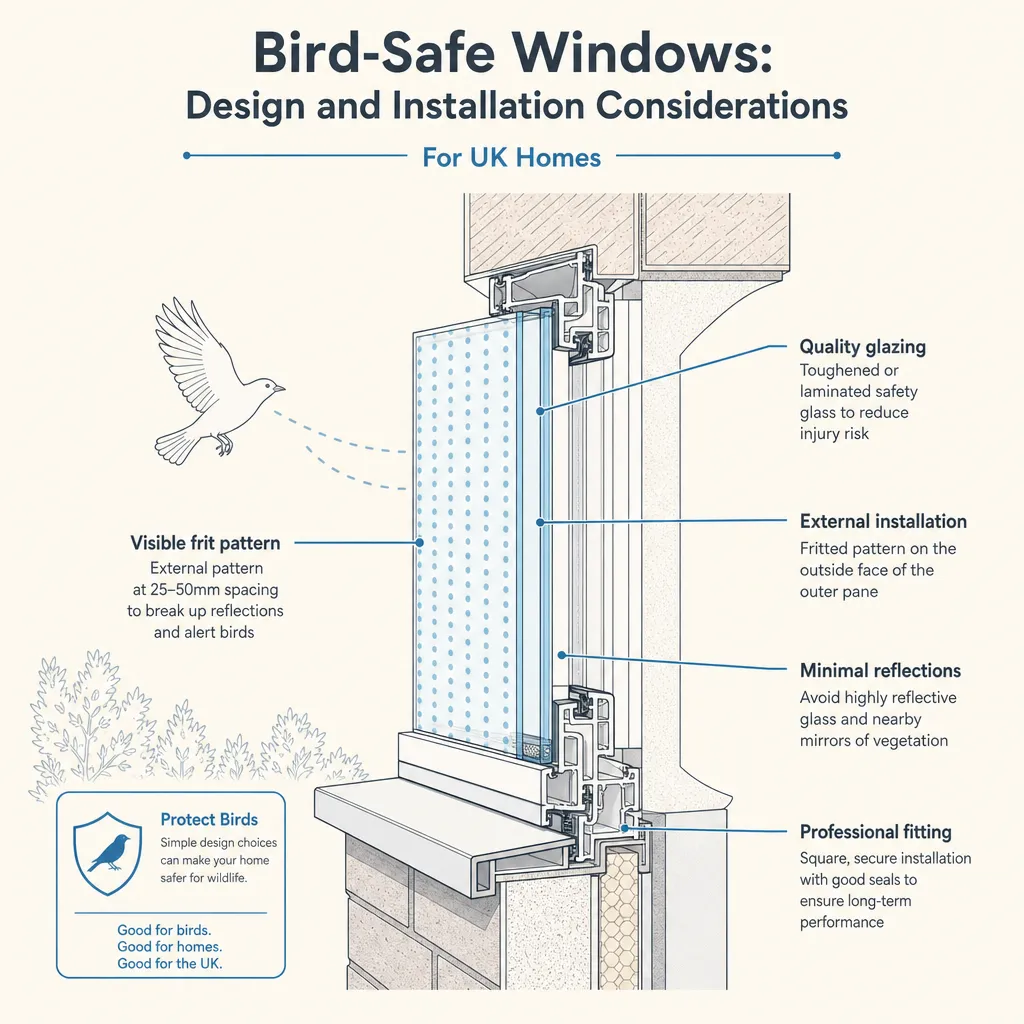
Bird-Safe Windows: Design and Installation Considerations
Bird-safe windows use patterns, coatings, or films on the exterior glazing surface to make glass visible to birds in flight.
 Improvement & Build
Tree Removal Service Costs
Professional tree removal costs in the UK depend on tree height, access, species, and the scope of work included.
 Improvement & Build
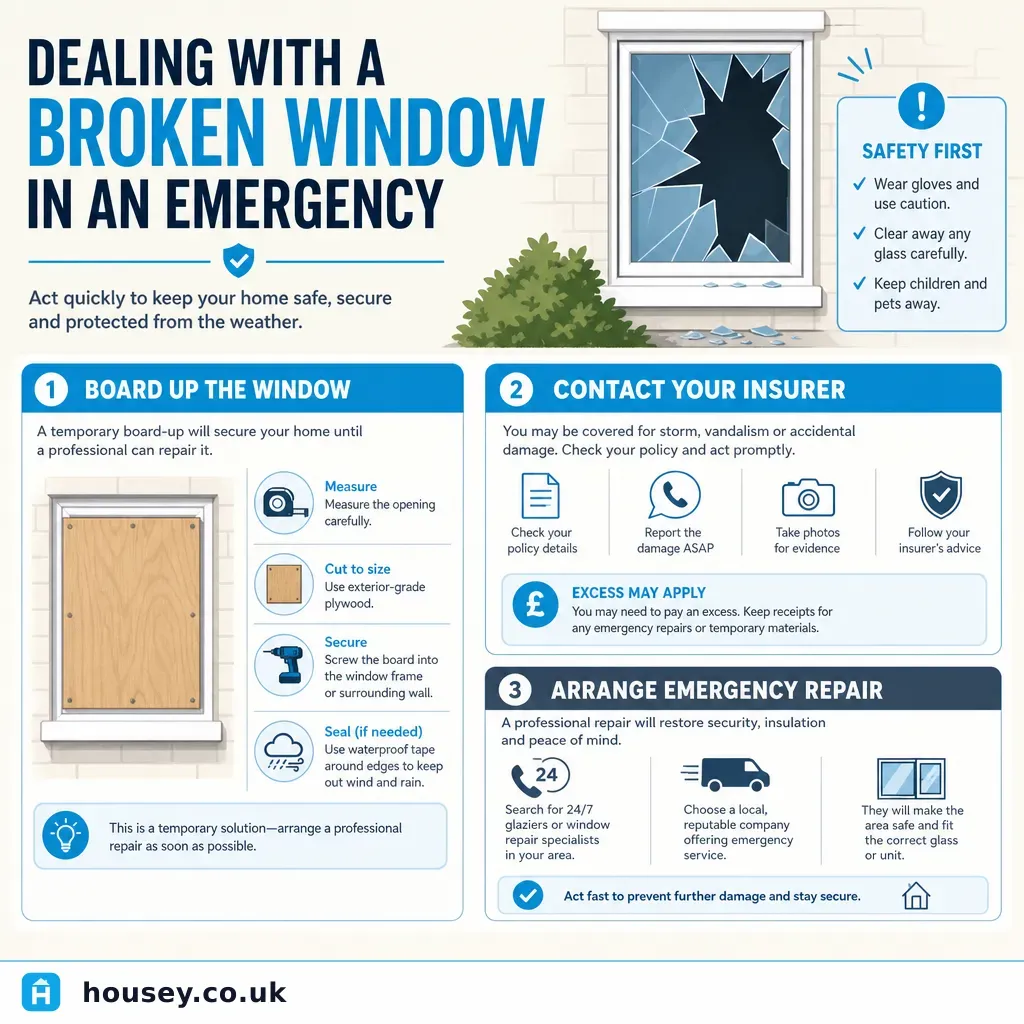
Dealing with a broken window in an emergency
If a window breaks, your priority is clearing loose glass safely while wearing thick gloves, then sealing the opening with heavy-duty polythene or plywood before contacting your insurer.