Tree Removal Service Costs
By Housey · Last reviewed 11th of May 2026
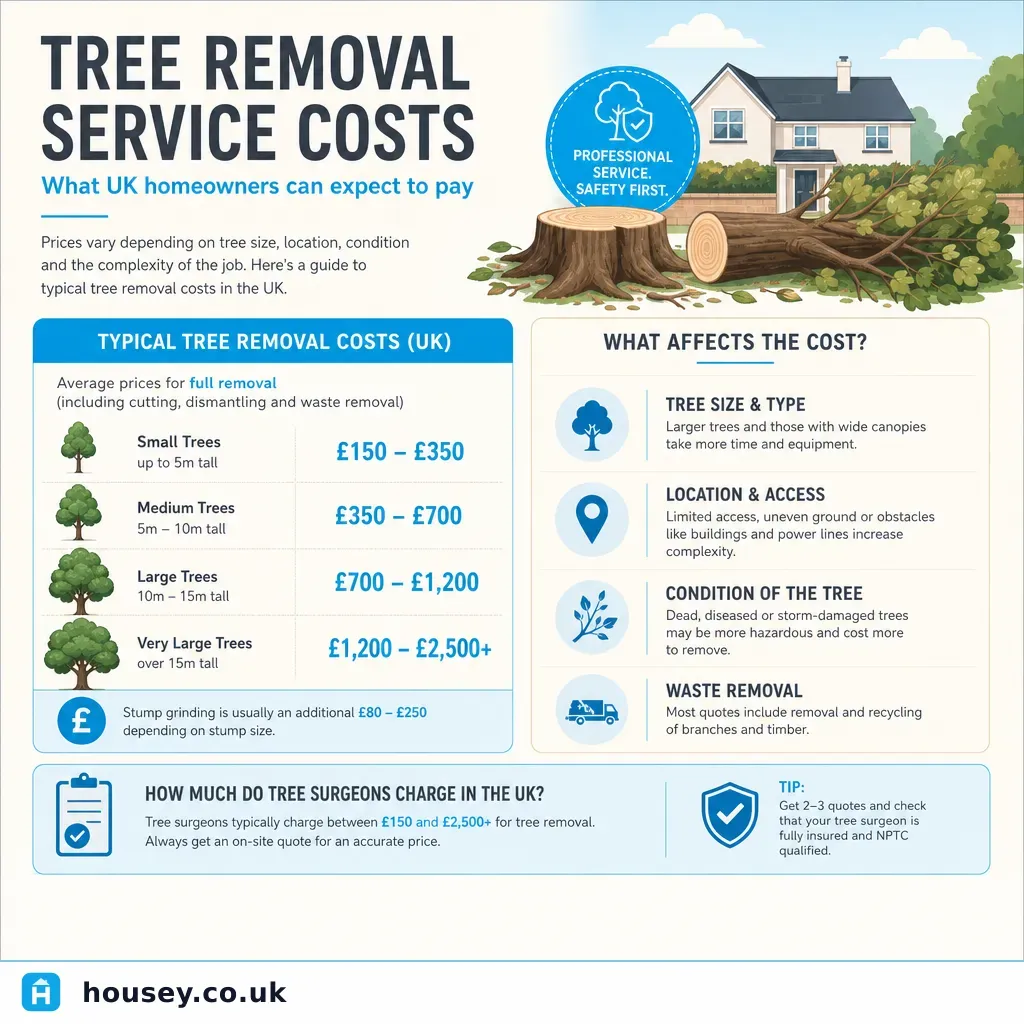
Tree Removal Service Costs
When a tree surgeon quotes for removal, the figure they offer reflects a combination of skilled labour, specialist equipment, risk management, and responsible disposal — not simply the tree's size. Understanding how the service is structured helps you evaluate competing quotes fairly and avoid unexpected charges once work is under way.
Key points
- A professional two-person tree surgery team commands roughly £400–£800 per day in most UK regions; work requiring crane hire can add £600–£1,500 or more on top of that (indicative UK costs, last reviewed 2026-05-11).
- Under Sections 210 and 211 of the Town and Country Planning Act 1990, removing a tree subject to a Tree Preservation Order (TPO) or in a conservation area without LPA consent is a criminal offence.
- Contractors should hold at least £5 million public liability insurance; request the certificate before authorising any work.
- Emergency callouts for storm damage or partially failed trees typically attract a 50–100% premium over standard daytime rates.
- The Arboricultural Association's approved contractor scheme is a reliable starting point for finding qualified, insured tree surgeons across the UK.
What does a tree removal service include?
A professional tree removal service typically covers the following:
- Site survey and risk assessment — evaluating the tree's structure, lean, root condition, and proximity to buildings, utilities, and boundaries.
- Sectional or whole-tree felling — tight urban gardens require sectional dismantling piece by piece; open ground may allow a controlled fell.
- Rigging and lowering — ropes and rigging equipment guide sections safely to the ground in confined spaces.
- Chipping or sectioning — green waste is usually fed through a wood chipper; larger stems may be left as rounds if requested.
- Site clearance — a reputable contractor leaves the working area free of debris.
- Stump treatment (if included) — either mechanical grinding or chemical application; typically priced separately.
Cost by service component
Service component | Typical UK cost | Notes |
|---|---|---|
Small tree removal (up to 5 m) | £150–£400 | Half-day, 1–2 crew |
Medium tree removal (5–10 m) | £400–£800 | Full day, 2 crew typical |
Large tree removal (10–20 m) | £800–£2,000+ | Specialist rigging required |
Very large tree (over 20 m) | £2,000–£5,000+ | Crane hire often needed |
Stump grinding | £60–£200 per stump | Charged by stump diameter |
Crown reduction (not full removal) | £200–£800 | Reduces height and spread |
Emergency or out-of-hours callout | 50–100% premium | Storm damage, fallen trees |
Log splitting or stacking | £50–£150 extra | If you want usable timber |
Indicative UK costs, last reviewed 2026-05-11. Costs vary by region, contractor, access conditions, and species.
Worked UK property scenario
Property: A 1960s detached house in suburban Surrey. A mature silver birch approximately 12 m tall stands close to the rear boundary fence, with roots beginning to lift a section of patio. A large branch overhangs the neighbour's greenhouse.
Process:
- The owners checked their LPA's online TPO map — no order was registered on this tree, and the property is not in a conservation area. No consent application required.
- Three quotes were obtained from Arboricultural Association approved contractors.
- Quotes ranged from £900 to £1,350 for full removal and green-waste disposal; stump grinding was priced at £120 separately in each quote.
- The chosen contractor completed the sectional removal in one day using two climbers and a ground crew member, chipped all green waste on site, and left cut rounds of the main stem at the owners' request.
- Total cost: £1,050 plus £120 stump grinding = £1,170 including VAT.
This example illustrates two practical points: the £450 spread between quotes for similar scopes of work underlines the value of getting multiple quotes, and in this case the competitively priced contractor was also an Arboricultural Association approved member.
What to ask before accepting a tree removal quote
- Is the full scope itemised — removal, disposal, and stump treatment as separate line items?
- Who exactly will carry out the work, and what qualifications do they hold (NPTC/Lantra Level 2 or equivalent)?
- Does the contractor hold public liability insurance of at least £5 million? Ask for the certificate before work starts.
- Has the contractor confirmed whether the tree is subject to a TPO or in a conservation area?
- Will the site be left clear, and how will green waste be disposed of?
- What assumptions is the quote based on, and what could change the price or scope?
- Is VAT included in the quoted figure?
- Is there a written contract, and what is the payment schedule?
- What happens if additional hazards — decay, bee nests, or overhead cable proximity — are found during the work?
When to get professional help
Tree removal should always be carried out by a qualified contractor. Chainsaws at height are among the most dangerous workplace tools in use, and the Health and Safety Executive (HSE) specifically identifies working above 2 m with cutting equipment as a high-risk activity. Never attempt to fell a tree over 3 m, near structures, or in structurally poor condition without professional help.
Contact a specialist immediately if:
- A tree has partially fallen or is leaning suddenly following a storm
- There is cracking at the base, lifting root buttresses, or sap weeping from the trunk
- Active fungal growth (bracket fungi) is visible at the base or on major limbs
- Any branch is in contact with overhead power or telecommunications lines
How Housey can help
Housey's network of vetted tree surgeons covers most UK regions. Submit a single request to receive up to four itemised quotes from local contractors, allowing you to compare qualifications, scope, and price through one convenient dashboard.
Frequently asked questions
How do I know if my tree has a Tree Preservation Order?
Your Local Planning Authority maintains a register of TPOs, usually published as a map on the council's planning portal. You can also contact the planning department by phone or email. Reputable tree surgeons will check protection status before quoting, but the legal responsibility rests with the landowner.
Is tree surgery VAT-exempt?
No. Tree surgery and removal are subject to standard-rate VAT, currently 20%. Always clarify whether a quote is VAT-inclusive or exclusive before comparing figures between contractors. Additional services such as stump grinding, log splitting, and emergency callouts are also subject to VAT at the standard rate.
Who is liable if a tree damages a neighbour's property?
Liability depends on whether the tree owner was aware of a risk and failed to act. If a tree is visibly diseased, dead, or structurally hazardous and the owner takes no action, they may face civil liability for resulting damage. A written condition report from a qualified arborist creates a documented record of the tree's assessed state.
Can I fell a tree myself to save money?
Cutting down trees over approximately 3 m, near structures, or using a chainsaw at height requires professional training and equipment. Working above 2 m with a chainsaw is a high-risk activity as defined by the Health and Safety Executive. Housey strongly recommends engaging a qualified contractor for any tree removal beyond the most minor garden work.
Sources and further reading
- Tree Preservation Orders and trees in conservation areas — GOV.UK
- Working safely with chainsaws — Health and Safety Executive
- Arboricultural Association approved contractor scheme — Arboricultural Association
- Town and Country Planning Act 1990 — legislation.gov.uk
Useful next reads
 Improvement & Build
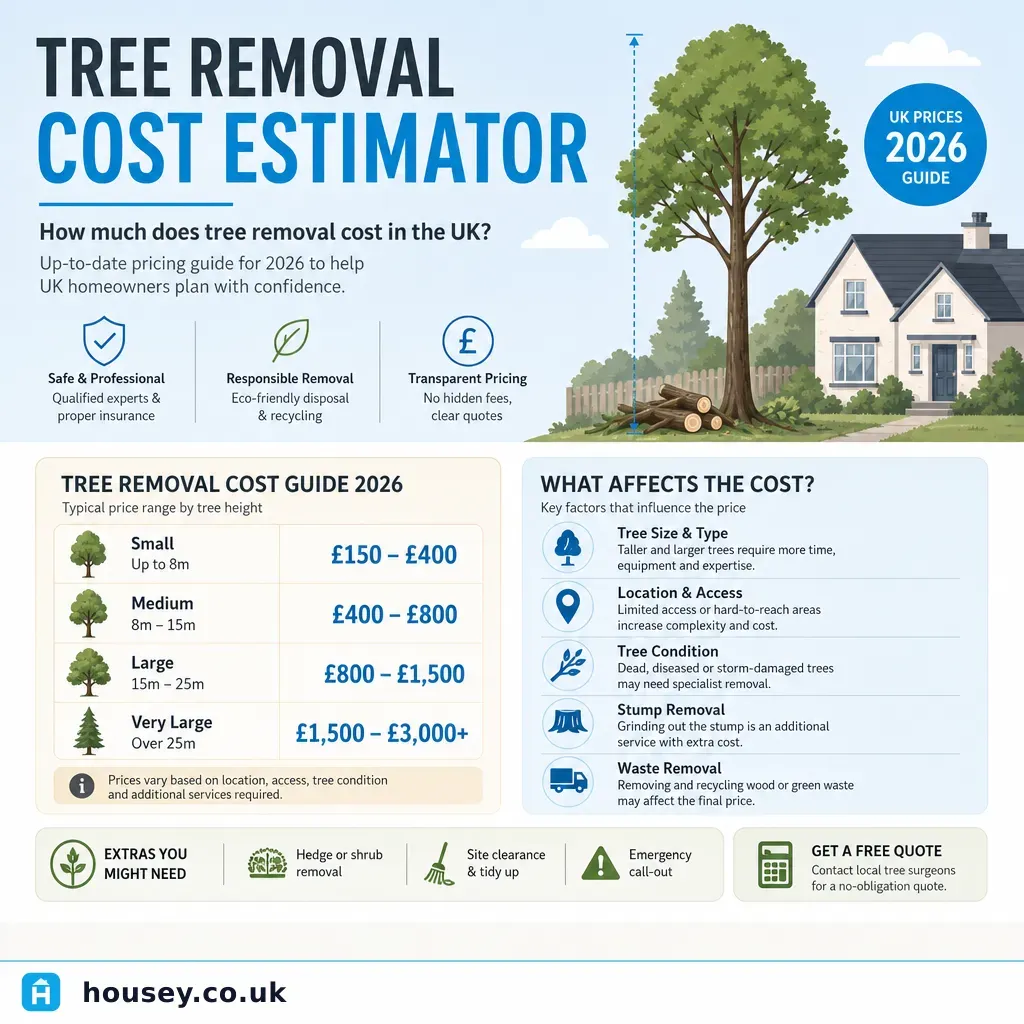
Tree Removal Cost Estimator
Tree removal in the UK costs roughly £150 to £5,000 or more, depending on the tree's height, species, access conditions, and whether stump removal is needed.
 Improvement & Build
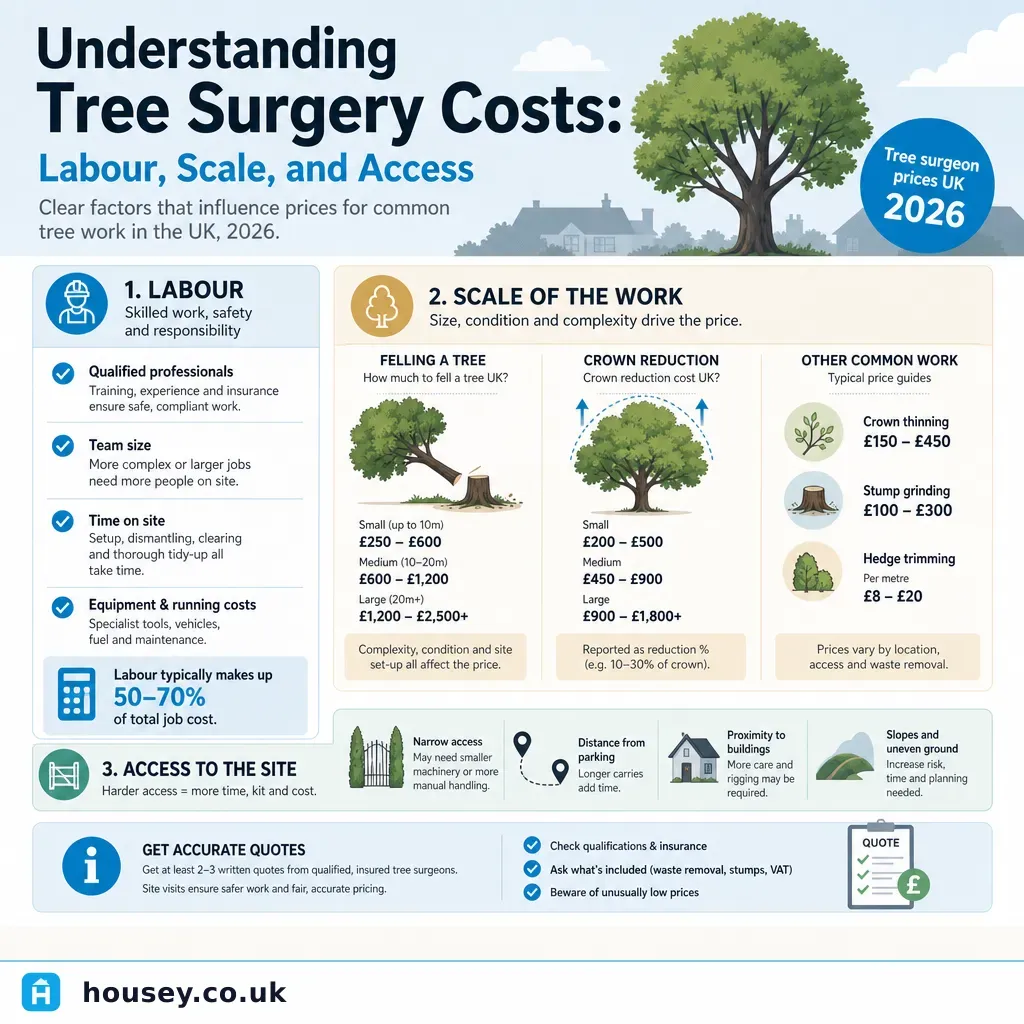
Understanding Tree Surgery Costs: Labour, Scale, and Access
Tree surgery costs in the UK depend on tree height, species, condition, and site access.
 Improvement & Build
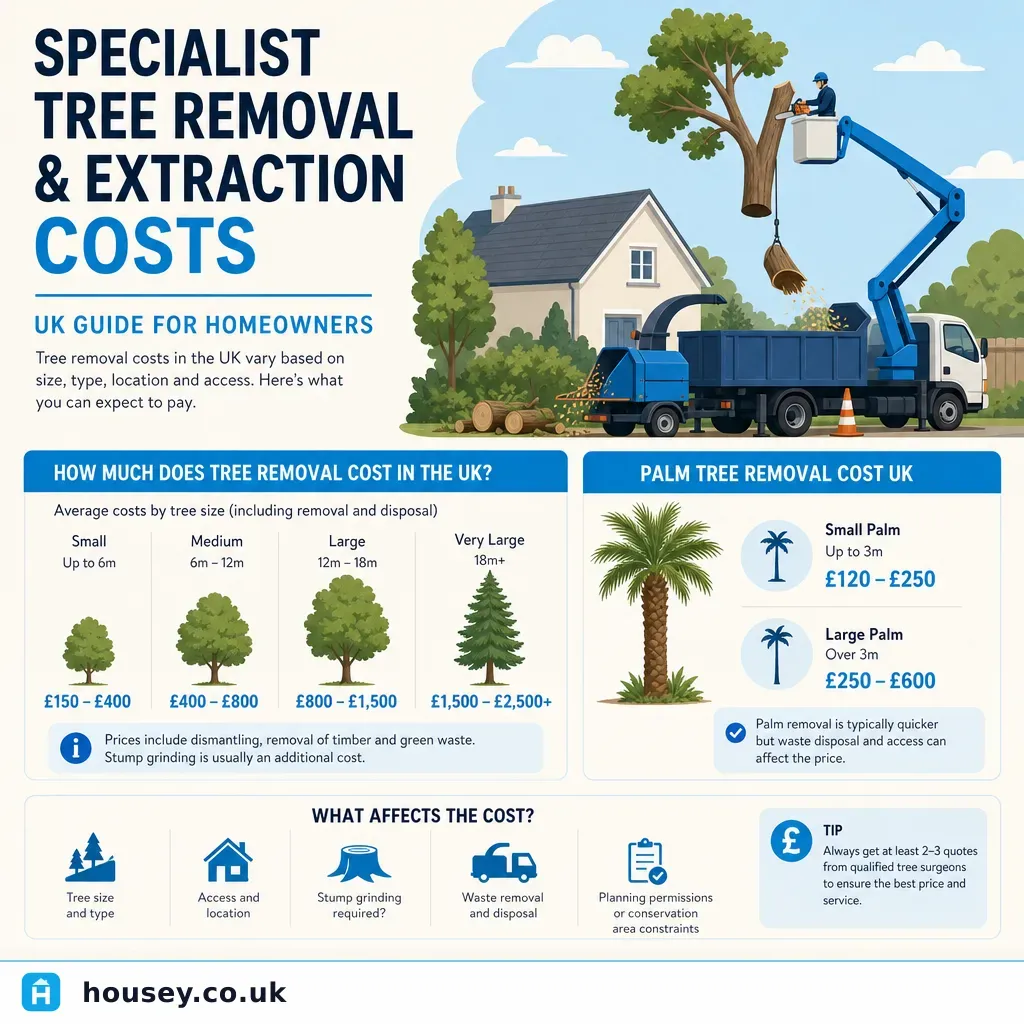
Specialist Tree Removal and Extraction Costs
Specialist tree removal costs in the UK range from around £150 for small trees to £3,000 or more for large mature specimens, with palm trees typically costing more due to specialist technique.
 Improvement & Build
How to plan a tree removal project
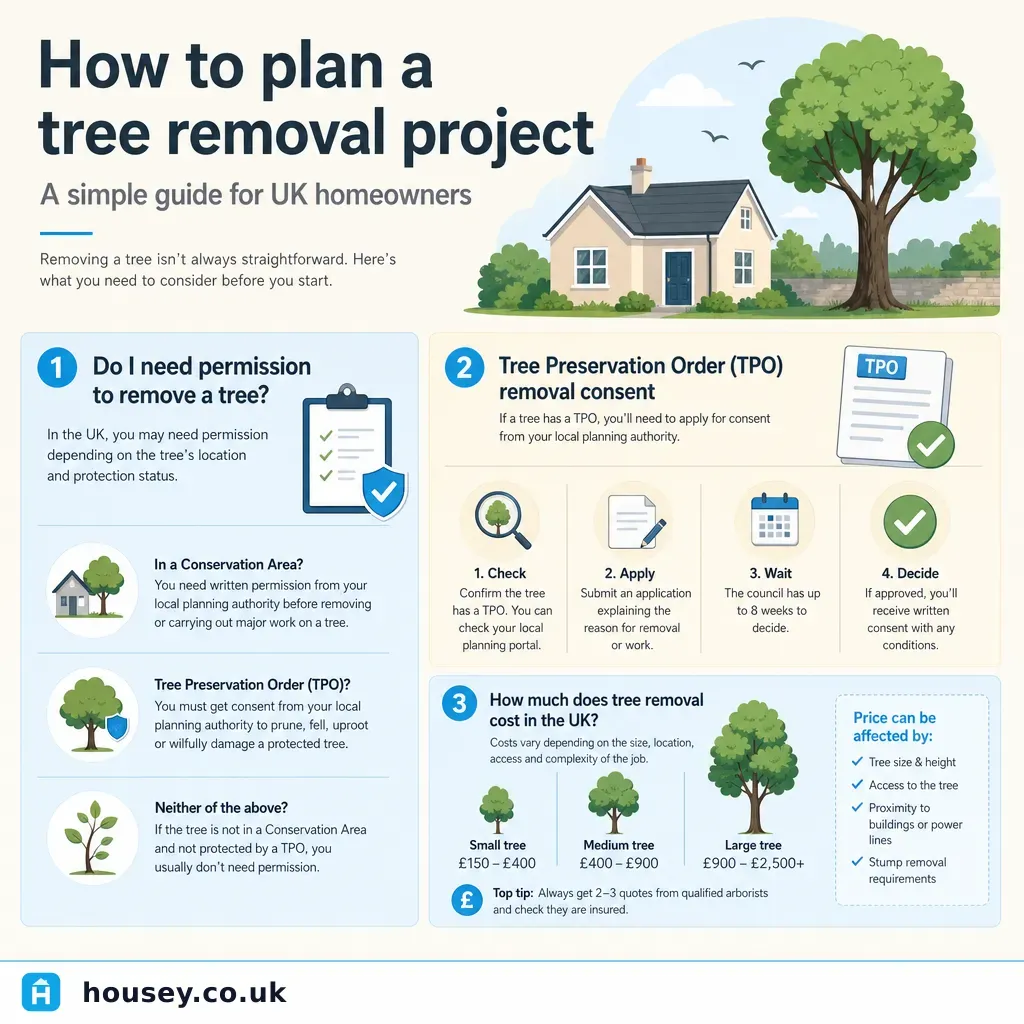
Planning a tree removal project starts with checking whether the tree is protected by a Tree Preservation Order or sits in a conservation area, as both require council consent before any work begins.
 Improvement & Build
Tree Crown Reduction and Management Costs
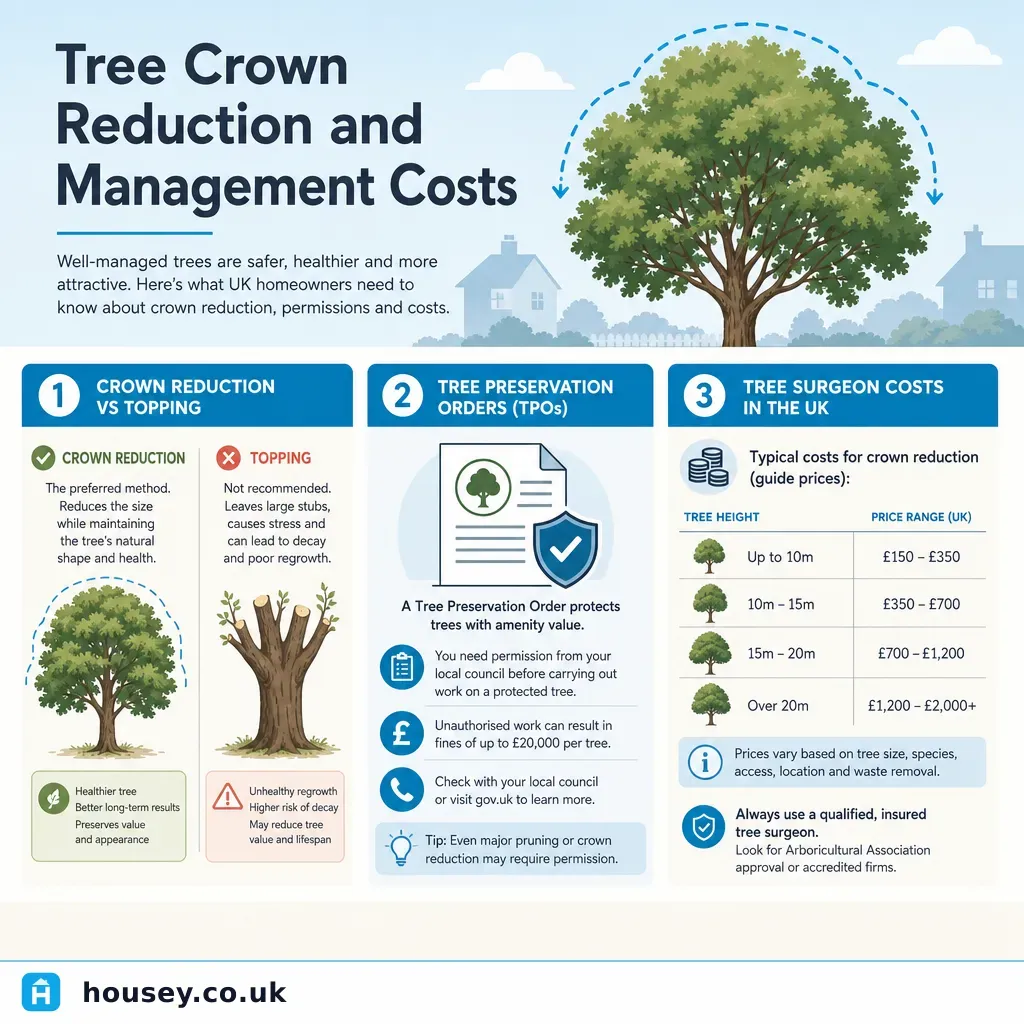
Crown reduction reduces a tree's overall size by 15–30% while preserving its natural shape, and must follow BS 3998:2010.