Choosing the Best Materials for Pipe Insulation
By Housey · Last reviewed 31st of May 2026
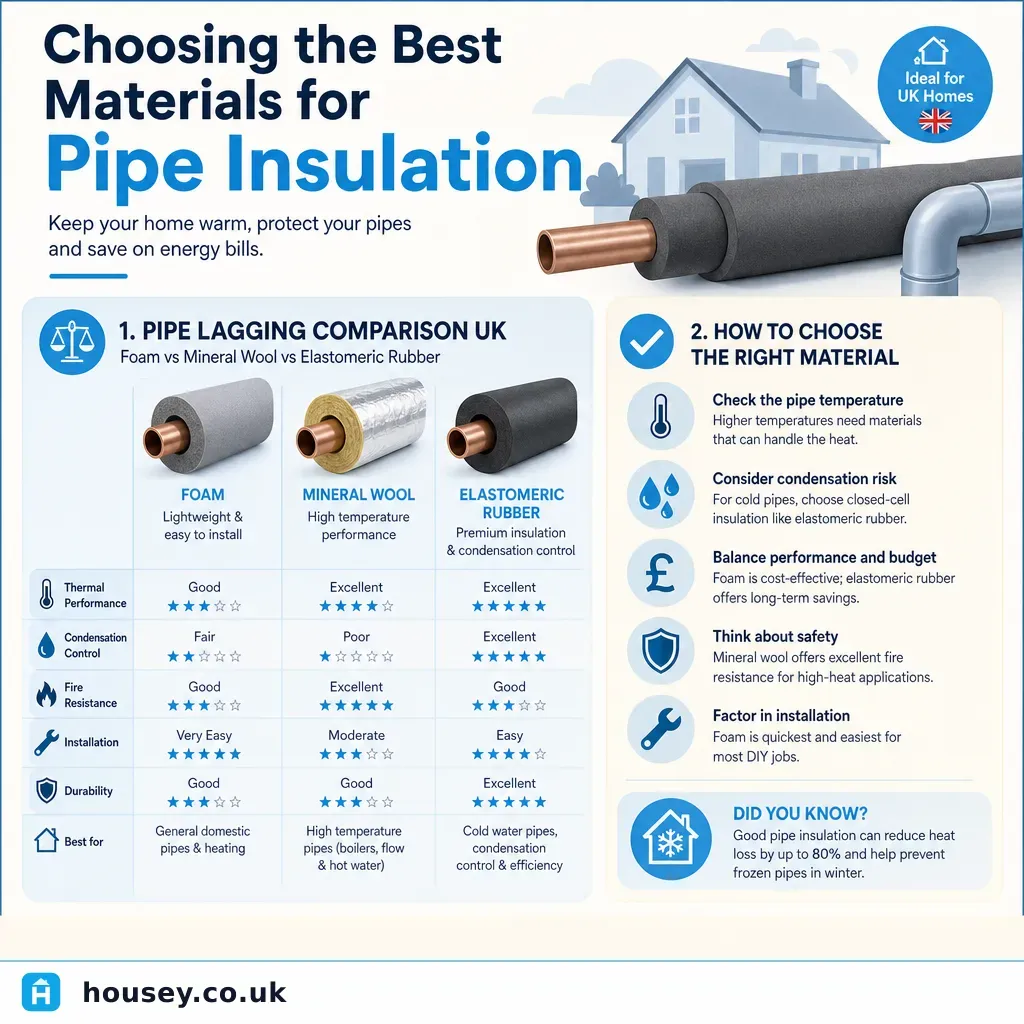
Choosing the Best Materials for Pipe Insulation
Pipe insulation becomes a priority for UK homeowners when energy bills climb, a surveyor flags unlagged pipes, or a boiler service reveals vulnerable pipework in an unheated loft or garage. The material you choose affects thermal performance, longevity, moisture resistance, and compliance with Building Regulations Part L — and the right option varies significantly depending on whether the pipe carries hot water, cold water, or refrigerant, and where it runs in the building.
Key points
- Building Regulations Part L (Conservation of Fuel and Power) requires pipe insulation for hot water pipes connected to a newly installed or replaced boiler, with minimum insulation thickness set by the Domestic Heating Compliance Guide.
- Closed-cell polyethylene foam (foam lagging) is the most widely used domestic pipe insulation in the UK, suitable for pipes up to around 80°C.
- Mineral wool pipe sections are preferred for higher-temperature applications (up to 650°C) and appear in commercial mechanical services and some domestic settings.
- Elastomeric rubber (e.g. Armaflex) is valued for cold-water and chilled pipework where condensation resistance is critical, as its closed-cell structure resists moisture ingress.
- Phenolic foam offers the best thermal performance per millimetre of thickness, making it useful where installation space is constrained.
What are the main pipe insulation materials?
Five materials dominate UK pipe insulation applications:
Material | Temperature range | Best for | Condensation resistance | Indicative cost per metre |
|---|---|---|---|---|
Closed-cell polyethylene foam | Up to ~80°C | Domestic hot and cold water, central heating | Good | £1–£4 |
Mineral wool (fibreglass or rockwool) | Up to 650°C | High-temperature pipework, commercial services | Poor — absorbs moisture | £2–£6 |
Elastomeric rubber (e.g. Armaflex) | −50°C to 105°C | Cold water, chilled pipes, refrigerant lines | Excellent | £4–£12 |
Phenolic foam | Up to ~120°C | Space-constrained runs, high-efficiency schemes | Good | £5–£15 |
Polyisocyanurate (PIR) foam | Up to ~120°C | Flat-section applications, pipe supports | Good | £4–£10 |
Indicative UK costs, last reviewed 2026-05-31. Prices vary by pipe diameter, manufacturer, and supplier.
How to choose the right material for your situation
The correct choice depends on four factors: pipe operating temperature, location inside or outside the thermal envelope, risk of condensation, and available installation space.
Hot water pipes and central heating
For standard domestic hot water cylinders and central heating flow and return pipes (typically 60–80°C), closed-cell polyethylene foam is the most practical choice. It is widely available, simple to split and fit around existing pipes, and meets minimum insulation thickness requirements in the Domestic Heating Compliance Guide used alongside Building Regulations Part L.
Typical minimum thicknesses for a 22mm copper pipe carrying hot water range from 25mm (for pipes in heated spaces) to 32mm or more (for pipes in unheated spaces), depending on the insulation conductivity value and pipe diameter. Check the Compliance Guide tables for your specific situation.
Cold water pipes and condensation risk
Cold pipes in warm spaces — in a boiler cupboard, kitchen, or against an external wall — can sweat and drip in warm weather, causing damp and mould. Elastomeric rubber (closed-cell, low vapour permeability) is the industry standard here because its continuous closed-cell structure prevents moisture migrating through the insulation and condensing on the pipe surface.
Outdoor and exposed pipework
For pipes running outside — external boiler pipework, heat pump refrigerant lines, condensate drain pipes — insulation must be UV-stable and weatherproof. Elastomeric rubber with an outer UV-resistant coating is commonly specified; standard polyethylene foam can degrade outdoors unless specifically rated for external use. Always check the manufacturer's data sheet before installing.
Loft and unheated space pipework
In lofts and unheated outbuildings, the priority is preventing freeze damage to cold water supply pipes and reducing heat loss from hot water pipes. Foam lagging is the standard choice. The Energy Saving Trust notes that pipes running above the main loft insulation layer are particularly exposed to low temperatures in a UK winter and should be lagged as a priority.
Which material should you choose? A decision guide
- Choose closed-cell polyethylene foam if the pipe carries domestic hot or cold water at standard temperatures in a dry, indoor location.
- Choose elastomeric rubber (Armaflex or equivalent) if the pipe carries cold water in a warm space, carries refrigerant (heat pump or air conditioning), or requires vapour barrier protection.
- Choose mineral wool sections if the pipe temperature exceeds 100°C, or for mechanical services pipework where fire performance is a factor.
- Choose phenolic foam if the installation space is very restricted and you need the highest thermal performance per millimetre.
- Ask an M&E engineer or insulation specialist if the pipework relates to a heat pump, solar thermal system, or commercial heating installation — material specification affects system efficiency and may form part of an MCS or manufacturer warranty requirement.
Building Regulations and compliance
Part L of the Building Regulations (England) requires pipe insulation for primary and secondary hot water circuits connected to newly installed or replaced heat generators. The Domestic Heating Compliance Guide sets out minimum insulation thicknesses by pipe size and insulation conductivity. Compliance is checked by building control when a boiler or heating system is replaced under a building notice or full plans application.
For heat pump installations, MCS standards apply to refrigerant pipe sizing and insulation specification. An MCS-certified installer is required for most grant-funded installations under the Boiler Upgrade Scheme.
Red flags that mean you should act sooner
- Pipes in the loft have no insulation at all, particularly near the eaves where temperatures can fall well below freezing in winter.
- The condensate drain pipe from a condensing boiler runs externally with no freeze-protection lagging.
- A heat pump refrigerant line runs uninsulated outdoors — this reduces system efficiency and may breach MCS requirements.
- Existing foam lagging is crumbling, split open, or feels damp — degraded insulation can trap moisture against the pipe and cause corrosion.
- Cold water pipes in a warm kitchen or boiler cupboard are showing signs of surface condensation or rust staining.
When to get professional help
Fitting clip-on foam lagging on accessible domestic pipes is generally a DIY task for standard copper or plastic pipework. Call a professional insulation installer if:
- The work involves pipework buried in floors, behind plasterboard, or within complex manifold arrangements.
- The pipework relates to a heat pump, solar thermal, or chilled water system where insulation specification affects system performance and warranties.
- Building Regulations compliance is required following a boiler replacement, and you need a registered competent person to self-certify the work.
- There is any suspicion of asbestos on pre-1985 pipe lagging — do not disturb it; arrange an asbestos survey before proceeding.
How Housey can help
Housey connects UK homeowners with vetted insulation installers who can advise on the right pipe insulation material for your property, carry out the work to building regulations standards, and provide any compliance documentation required.
Frequently asked questions
What thickness of pipe insulation do I need under Building Regulations?
Minimum thicknesses are set in the Domestic Heating Compliance Guide (used alongside Building Regulations Part L). As a general guide, a 22mm copper pipe carrying hot water in an unheated space typically requires at least 25–32mm of insulation, depending on the product's conductivity value. Check the Guide's look-up tables for your specific pipe diameter and insulation product.
Can I insulate pipes myself, or do I need a professional?
Clip-on foam lagging on accessible domestic hot and cold pipes is generally a DIY task for standard pipework. However, work on gas pipework, boiler connections, refrigerant lines (heat pumps), or any pipework requiring building control sign-off should be carried out by a competent person registered with the relevant scheme.
Does pipe insulation help with condensation on cold pipes?
Yes — closed-cell insulation materials, particularly elastomeric rubber (such as Armaflex), prevent condensation by maintaining the outer pipe surface above the surrounding air's dew point. The continuous closed-cell structure also blocks moisture vapour from migrating through the insulation and condensing on the pipe itself, preventing drips, damp patches, and corrosion.
What pipe insulation is best for outdoor use in the UK?
Elastomeric rubber with a UV-resistant outer jacket is the most durable choice for outdoor pipework. Standard polyethylene foam can degrade in prolonged sunlight unless specifically manufactured for external use. For heat pump refrigerant lines, check MCS installer guidance and the manufacturer's data sheet before specifying a product.
Sources and further reading
- Approved Document L: Conservation of Fuel and Power — GOV.UK
- Domestic Heating Compliance Guide — Department for Energy Security and Net Zero
- Home insulation advice — Energy Saving Trust
- MCS: find a certified installer — Microgeneration Certification Scheme
Useful next reads
 Energy & Retrofit
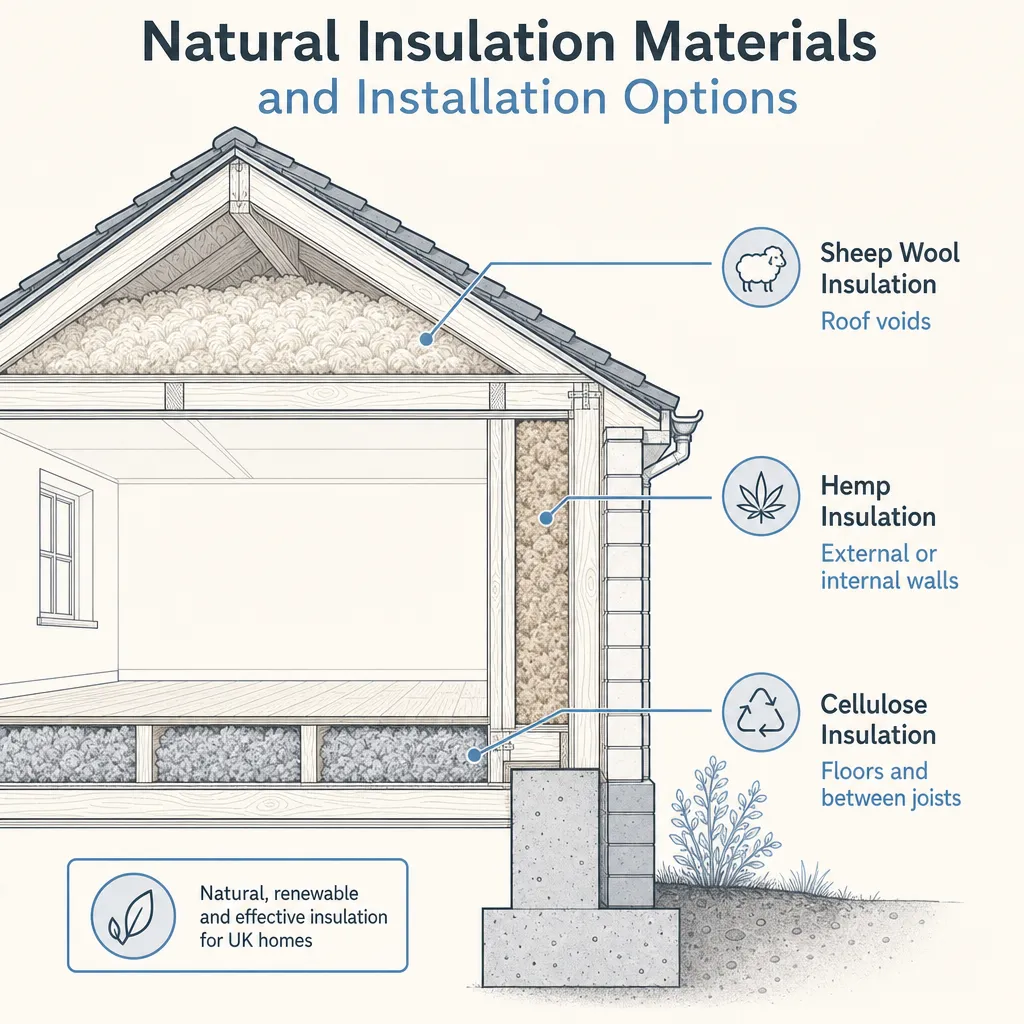
Natural Insulation Materials and Installation Options
Natural insulation materials such as sheep wool, hemp, cellulose, wood fibre, and cork can match mineral wool for thermal performance and offer additional benefits including moisture buffering and lower embodied carbon.
 Energy & Retrofit
Electric Versus Gas Boiler Systems: A Practical Comparison
Electric boilers convert nearly all electricity into heat (98–99% efficiency) but electricity costs roughly 3–4 times more per kWh than gas, making running costs higher in most UK homes.
 Energy & Retrofit
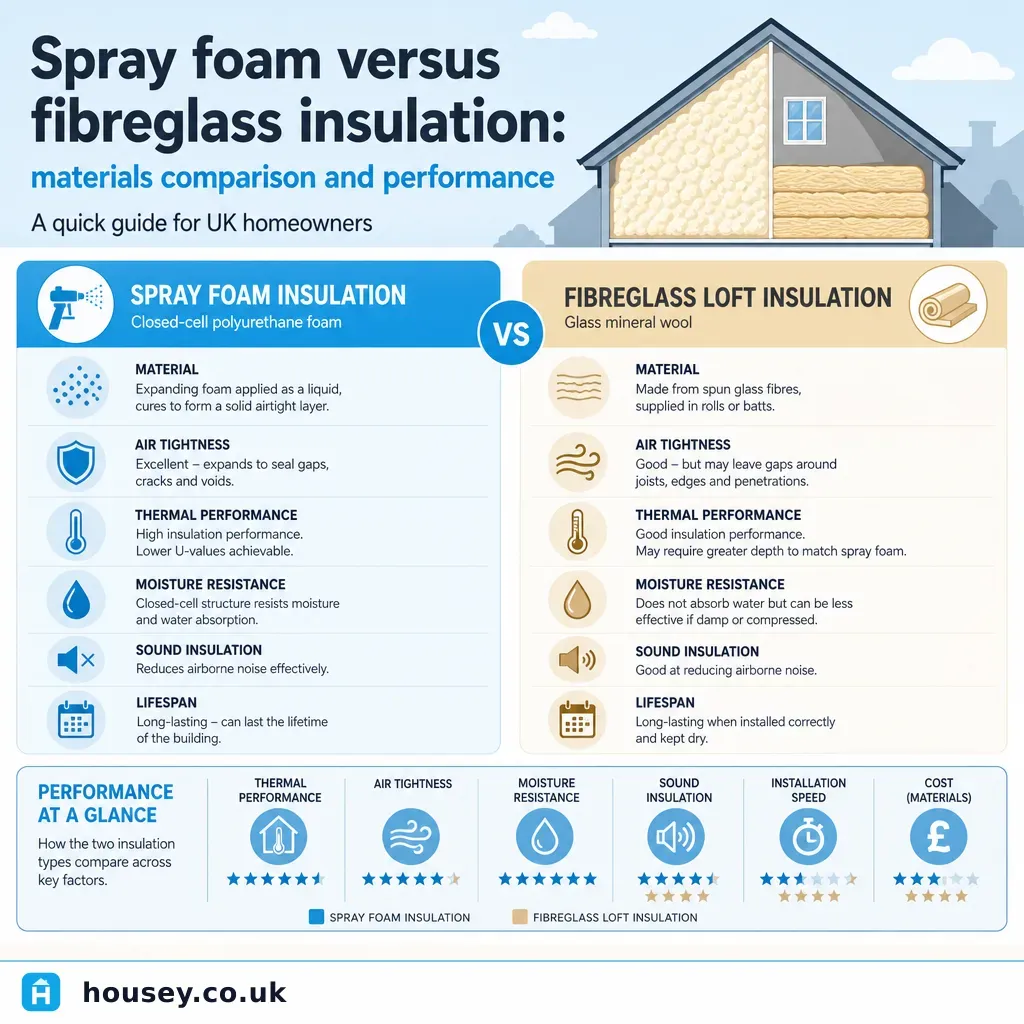
Spray foam versus fibreglass insulation: materials comparison and performance
Spray foam insulation offers higher thermal performance per centimetre than fibreglass, but in UK homes it carries significant mortgage and resale risks when applied to roof timbers.
 Energy & Retrofit
Selecting a Boiler: Key Brands and Performance Comparisons
Most UK homes are heated by a combi, system, or heat-only boiler.
 Energy & Retrofit
Electric Heating Systems: Options and Comparisons
Electric heating in the UK ranges from direct-acting radiators and storage heaters to heat pumps and electric boilers.