Spray foam versus fibreglass insulation: materials comparison and performance
By Housey · Last reviewed 12th of May 2026
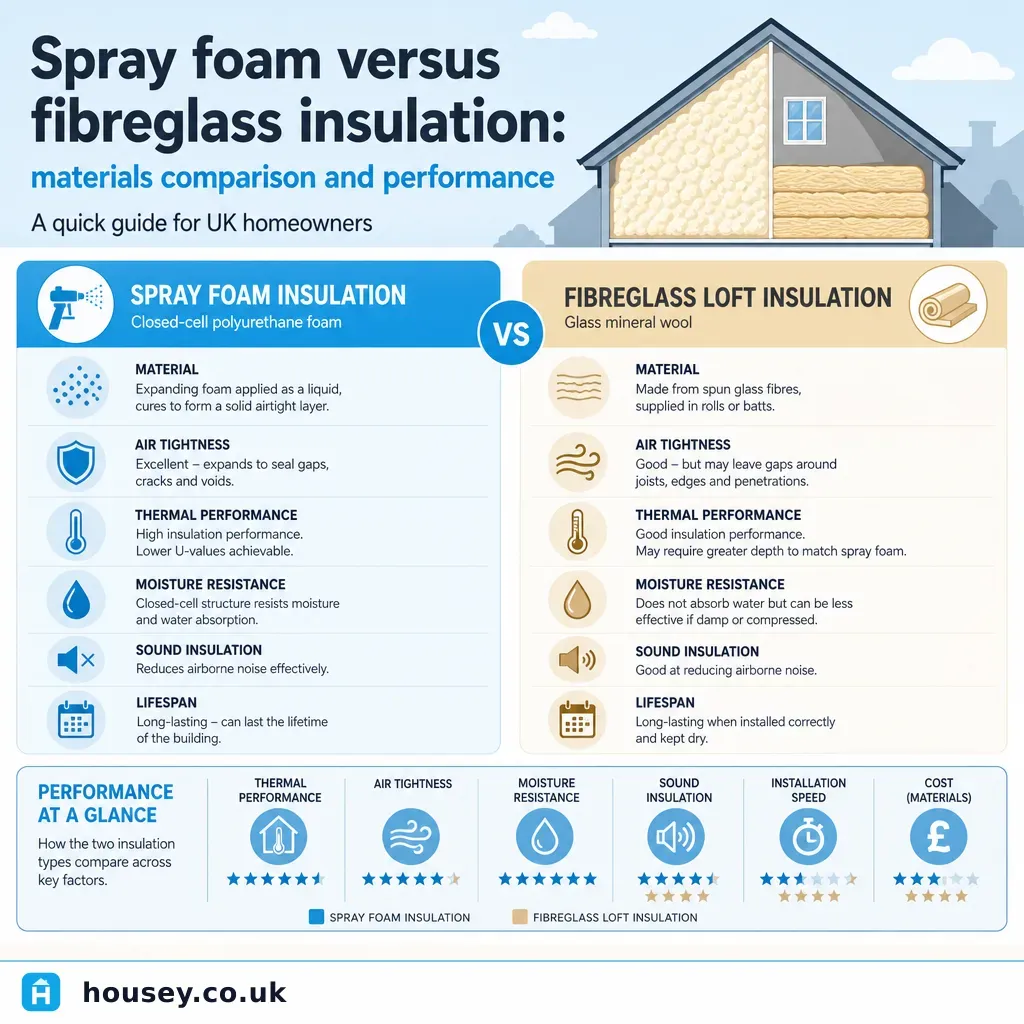
Spray foam versus fibreglass insulation: materials comparison and performance
Choosing the right insulation material is one of the most consequential decisions in any UK home energy retrofit. Whether you are improving loft insulation to meet a new EPC target, upgrading ahead of a sale, or accessing funded support through ECO4 or the Great British Insulation Scheme, the material you specify affects thermal performance, moisture behaviour, installation cost, and — in the case of spray foam — your ability to sell or remortgage the property. These two materials are frequently compared, but they serve quite different use cases in British housing stock.
Key points
- Closed-cell spray polyurethane foam has a thermal conductivity (lambda value) of approximately 0.022–0.028 W/mK, compared to 0.032–0.044 W/mK for standard glass wool (fibreglass) rolls.
- RICS, the Building Societies Association, and many UK mortgage lenders advise caution when spray foam has been applied to roof timbers, as it can prevent structural inspection and affect mortgage eligibility.
- Under PAS 2035 — the UK's quality standard for retrofit energy measures — an assessment by a Retrofit Coordinator is required before funded insulation is installed in most older properties.
- The Energy Saving Trust recommends a minimum loft insulation depth of 270 mm for fibreglass rolls (100 mm between joists plus 170 mm across joists) to meet Building Regulations Part L guidance.
- Open-cell spray foam is vapour-permeable; closed-cell spray foam is an effective vapour barrier — specifying the wrong type for a given construction can cause interstitial condensation in cold-roof or warm-roof configurations.
How spray foam and fibreglass compare thermally
Both materials reduce heat loss by trapping air within their structure, but they differ substantially in density, lambda value, and achievable U-values at equivalent thicknesses.
Property | Closed-cell spray foam | Open-cell spray foam | Fibreglass rolls |
|---|---|---|---|
Lambda value (W/mK) | ~0.022–0.028 | ~0.035–0.040 | ~0.032–0.044 |
Typical thickness for ~0.16 U-value | 90–120 mm | 150–200 mm | 270–300 mm |
Vapour control | Acts as vapour barrier | Vapour-permeable | Vapour-permeable |
Water resistance | High | Low–medium | Low (absorbs moisture) |
Bond to substrate | Yes (adheres firmly) | Yes (adheres firmly) | No (laid loose) |
Reversibility | Difficult to remove | Difficult to remove | Easily removed or topped up |
DIY suitability | No (specialist equipment) | No (specialist equipment) | Yes (with PPE) |
Fibreglass achieves adequate performance at greater thickness, but 270 mm+ is usually achievable in a standard pitched loft with joists and counter-battens. Spray foam achieves high performance at lower thickness, which matters in rafter-level or slim-floor applications where space is constrained.
Where each material is typically used in UK homes
Fibreglass rolls (glass wool) are the standard loft insulation material across UK housing stock. They are well-suited to:
- Cold loft spaces with accessible floors — the most common UK loft type
- Top-up installations on older partial insulation
- ECO4- or GBIS-funded schemes where contractors use tried-and-tested materials
- DIY installation by competent homeowners wearing appropriate PPE
Spray foam is typically specified for:
- Warm roof configurations where insulation must be between or beneath rafters (e.g. loft conversion preparation)
- Flat roof sections or solid roofs where there is insufficient depth for deep rolls
- Hard-to-treat cavities and irregular voids where rolls cannot conform to shape
In practice, most UK surveyors and retrofit professionals recommend fibreglass rolls for straightforward cold-loft applications unless a specific technical constraint rules them out.
The mortgage and resale implications of spray foam
This is the most significant practical risk for UK homeowners considering spray foam in the roof space.
When spray foam is applied to roof rafters or the underside of roof tiles, it bonds firmly to the structure. This makes it very difficult for surveyors to inspect the timber condition beneath — a serious concern for lenders assessing mortgage risk. Timber rot, woodworm, or structural movement can remain hidden.
As a result:
- Many UK mortgage lenders, including several major high-street banks and building societies, have policies that limit or exclude lending on properties with spray foam in the roof space.
- RICS guidance notes that the presence of spray foam should be recorded and flagged in a Home Survey report, and further investigation may be recommended.
- The Building Societies Association has highlighted the issue, and Propertymark has reported that spray-foamed roofs can delay or derail property sales.
- Removal is expensive, disruptive, and may leave the roof structure exposed or damaged in the process.
This risk applies primarily to spray foam applied within the roof space — it does not typically apply to spray foam used as flat-roof waterproofing on the exterior of a flat roof deck, which is a separate application.
Which material should you choose?
- Choose fibreglass rolls if: you have a cold pitched loft with a clear, accessible floor, are looking for a cost-effective and reversible solution, may sell or remortgage within the next 10–15 years, or are accessing ECO4 or GBIS funding.
- Choose open-cell spray foam if: you are insulating at rafter level in a new build or unencumbered property, depth is constrained, and a specialist retrofit consultant has confirmed the specification is appropriate for your construction type.
- Choose closed-cell spray foam if: your application requires a vapour barrier and high performance at minimal thickness (e.g. below-slab insulation, solid-floor edge details), following specialist advice.
- Ask a Retrofit Coordinator if: you are accessing funded retrofit work under PAS 2035, your property is pre-1919, has solid walls, or you have had previous moisture problems.
- Avoid spray foam in the roof space if: you plan to sell the property, your mortgage provider's terms do not accept spray foam, or you cannot confirm the installer is TrustMark-registered with appropriate product certification.
Red flags to watch for
- A contractor recommending spray foam in a cold loft with no clear technical justification for choosing it over fibreglass.
- No mention of a Retrofit Assessment or PAS 2035 compliance before installation in a funded scheme.
- A quote for spray foam on roof rafters that does not address mortgage implications.
- Spray foam marketed as a solution to roof tile or felt deterioration — this conflates roof repair with insulation and may not address the underlying structural problem.
- Installers who are not TrustMark-registered or cannot provide product data sheets from the manufacturer.
Important limitations
The information in this article is general guidance only. Insulation performance depends on the specific product, installation quality, construction type, and site conditions. Mortgage lender policies on spray foam vary by provider and change over time. Before selecting an insulation material, obtain a professional assessment from a qualified Retrofit Coordinator or Retrofit Assessor familiar with your property's construction and tenure.
What to ask a qualified professional
- Is my loft configuration suited to a cold-roof (rolls) or warm-roof (rafter-level) specification?
- If spray foam is recommended, what is the specific technical reason fibreglass rolls or boards cannot be used?
- Is this installation compliant with PAS 2035, and will a Retrofit Coordinator oversee the work?
- Will the chosen material affect my mortgage eligibility or ability to sell?
- Is the installer TrustMark-registered and do they hold certification for the specific product?
- What warranties or guarantees come with the installation, and who backs them?
When to get professional help
Seek professional guidance before installation if:
- Your property was built before 1919 with solid walls or a solid roof construction
- You have experienced condensation, damp, or mould in the loft or top-floor rooms
- You are planning a loft conversion alongside the insulation work
- The property is listed or in a conservation area
- A previous survey flagged roof structure concerns
A qualified energy-efficiency consultant or Retrofit Coordinator can specify the correct material for your construction and help you avoid costly remediation later.
How Housey can help
Housey connects you with vetted insulation installers and energy-efficiency consultants who can assess your property and recommend the right specification. Request quotes from multiple providers to compare experience, accreditations, and warranties with no obligation to proceed.
Frequently asked questions
Does spray foam insulation affect my mortgage in the UK?
Not automatically, but it can seriously affect your ability to remortgage or sell. Many UK lenders will not lend on properties with spray foam applied to roof timbers. The situation varies by lender and product, so check your mortgage provider's policy and obtain written confirmation before proceeding. If you are unsure, seek advice from an independent mortgage broker before any insulation work begins.
Is fibreglass insulation safe to install yourself?
Fibreglass rolls can be DIY-installed in accessible cold lofts, but appropriate PPE is essential — a dust mask rated at least FFP2, safety goggles, gloves, and long sleeves. Glass wool fibres irritate skin, eyes, and airways. Do not attempt loft insulation if the loft is inaccessible, has fragile ceiling tiles, or requires working close to live electrical cables without a qualified electrician present.
Does spray foam qualify for ECO4 or GBIS funding?
Spray foam is generally not used under ECO4 or the Great British Insulation Scheme for standard loft insulation. These schemes most commonly fund fibreglass rolls and mineral wool. Contact your energy supplier or a TrustMark-registered installer to confirm which measures are available for your property type and circumstances.
What is PAS 2035 and why does it matter for insulation?
PAS 2035 is the UK's publicly available specification for the energy retrofit of domestic buildings. It requires a Retrofit Coordinator to oversee insulation measures in most older homes funded under government schemes. Compliance ensures the insulation is correctly specified for your construction type, reducing the risk of moisture damage and poor thermal performance.
Sources and further reading
- Roof and loft insulation guidance — Energy Saving Trust
- Great British Insulation Scheme — GOV.UK
- Building Regulations Approved Document L: Conservation of Fuel and Power — GOV.UK
- RICS Home Survey Standard — RICS
- TrustMark registered businesses — TrustMark
Useful next reads
 Energy & Retrofit
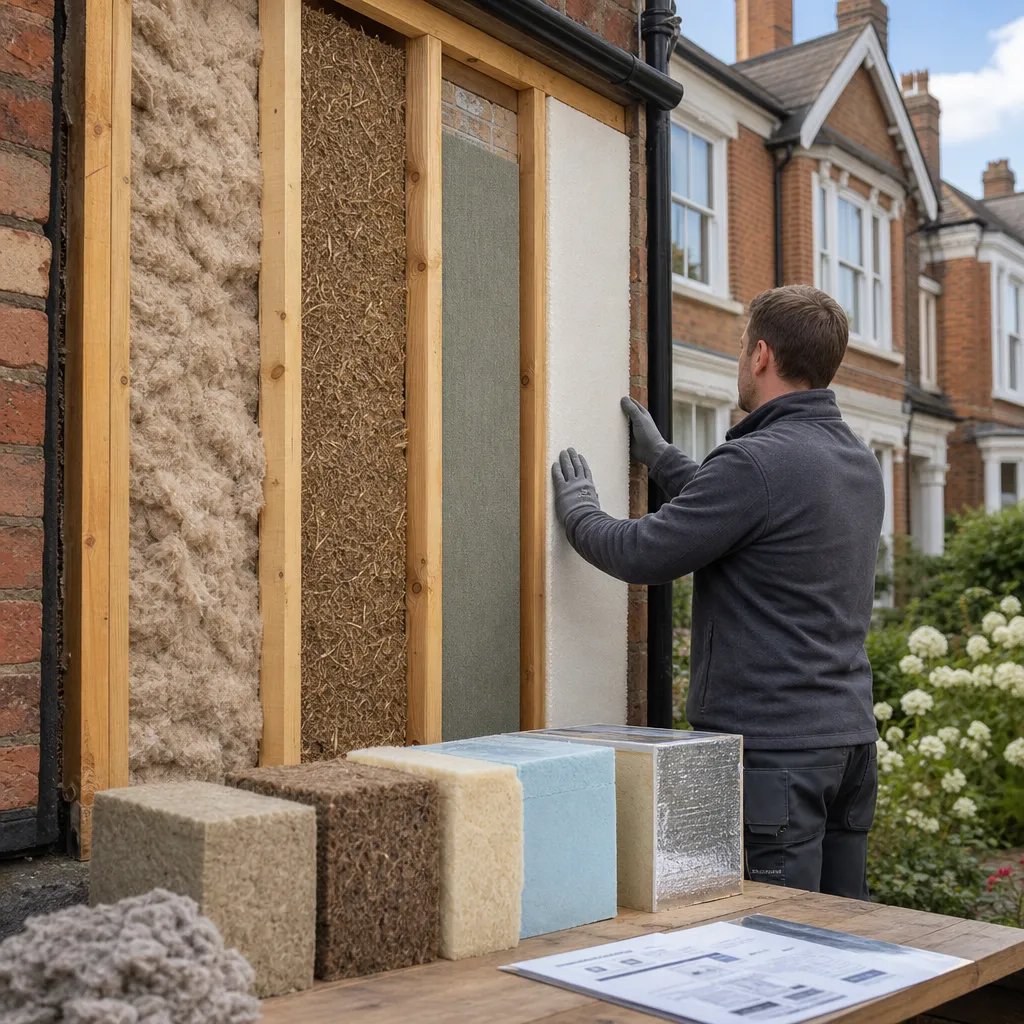
Alternative Insulation Materials: Comparing Natural and Modern Options
The best insulation for a UK home depends on property type, available thickness, and moisture risk.
 Energy & Retrofit
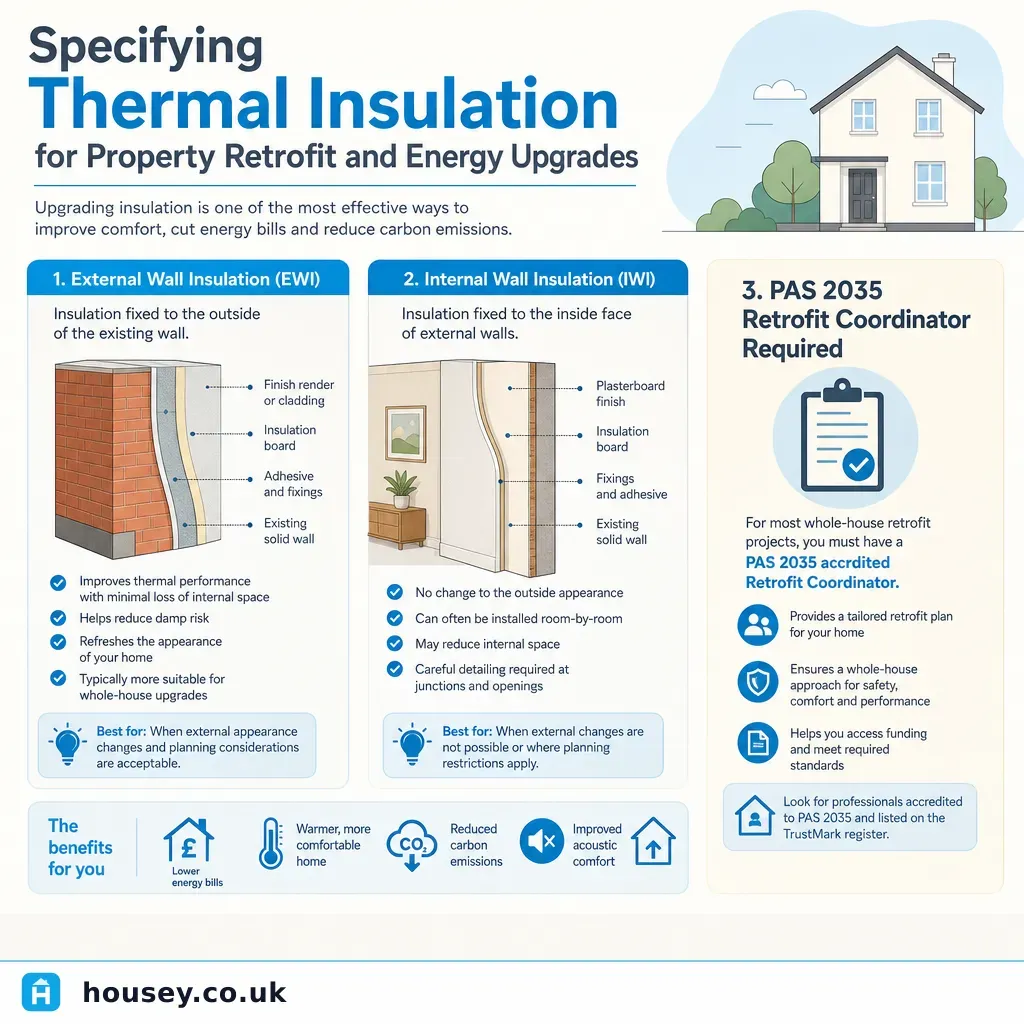
Specifying Thermal Insulation for Property Retrofit and Energy Upgrades
Specifying thermal insulation for UK retrofit requires matching the product to your property's construction, moisture conditions, and heating system.
 Energy & Retrofit
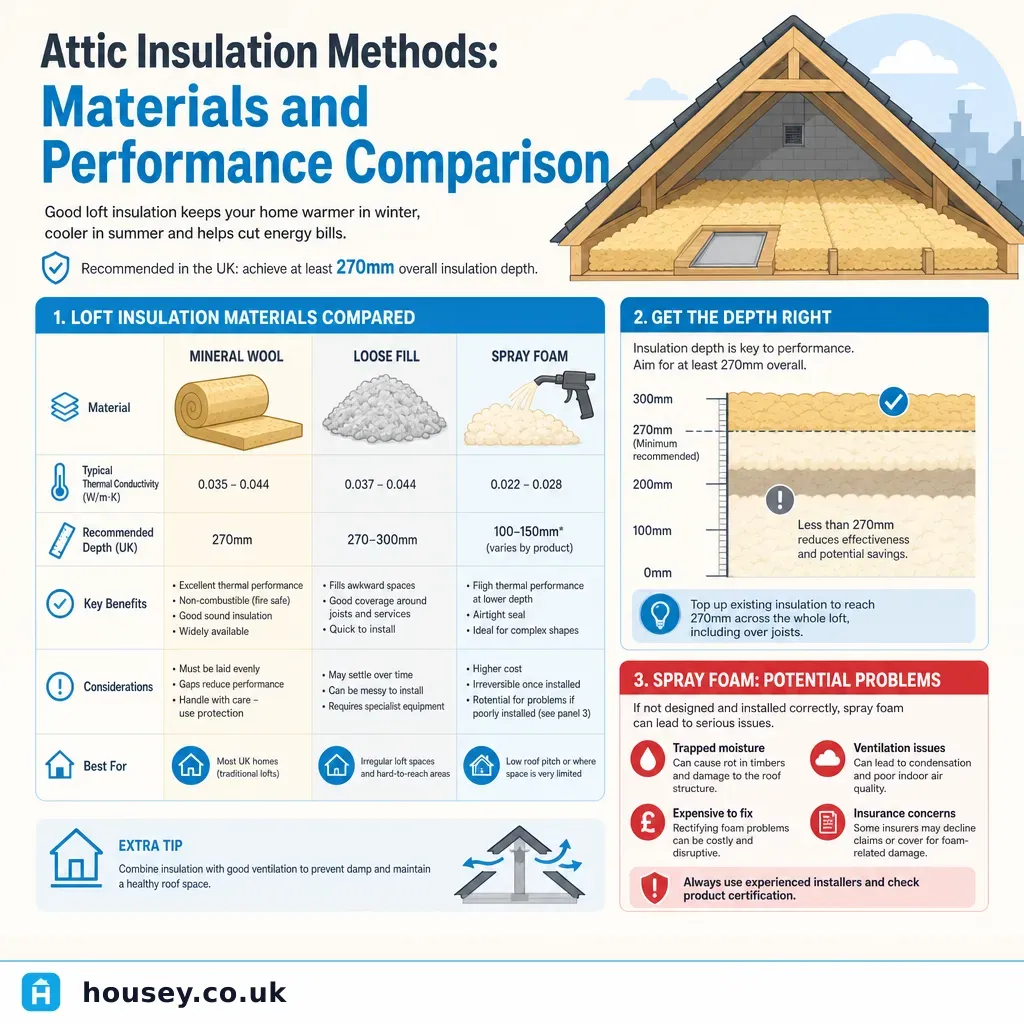
Attic Insulation Methods: Materials and Performance Comparison
UK loft insulation options include mineral wool rolls (most common and grant-funded), blown loose-fill for irregular lofts, and rigid PIR board for warm roof conversions.
 Energy & Retrofit
Insulation Types: Understanding Your Options for Home Energy Efficiency
The main insulation types used in UK homes are mineral wool, rigid foam boards, blown loose fill, spray foam, and natural materials such as wood fibre or sheep's wool.
 Energy & Retrofit
Selecting the Right Insulation for Your Home: Types and Benefits
Most UK homes benefit from loft insulation (270mm mineral wool recommended), cavity wall fill for post-1920 properties, or solid wall insulation — either EWI or IWI — for Victorian and Edwardian homes.