Structural considerations for internal walls
By Housey · Last reviewed 19th of May 2026
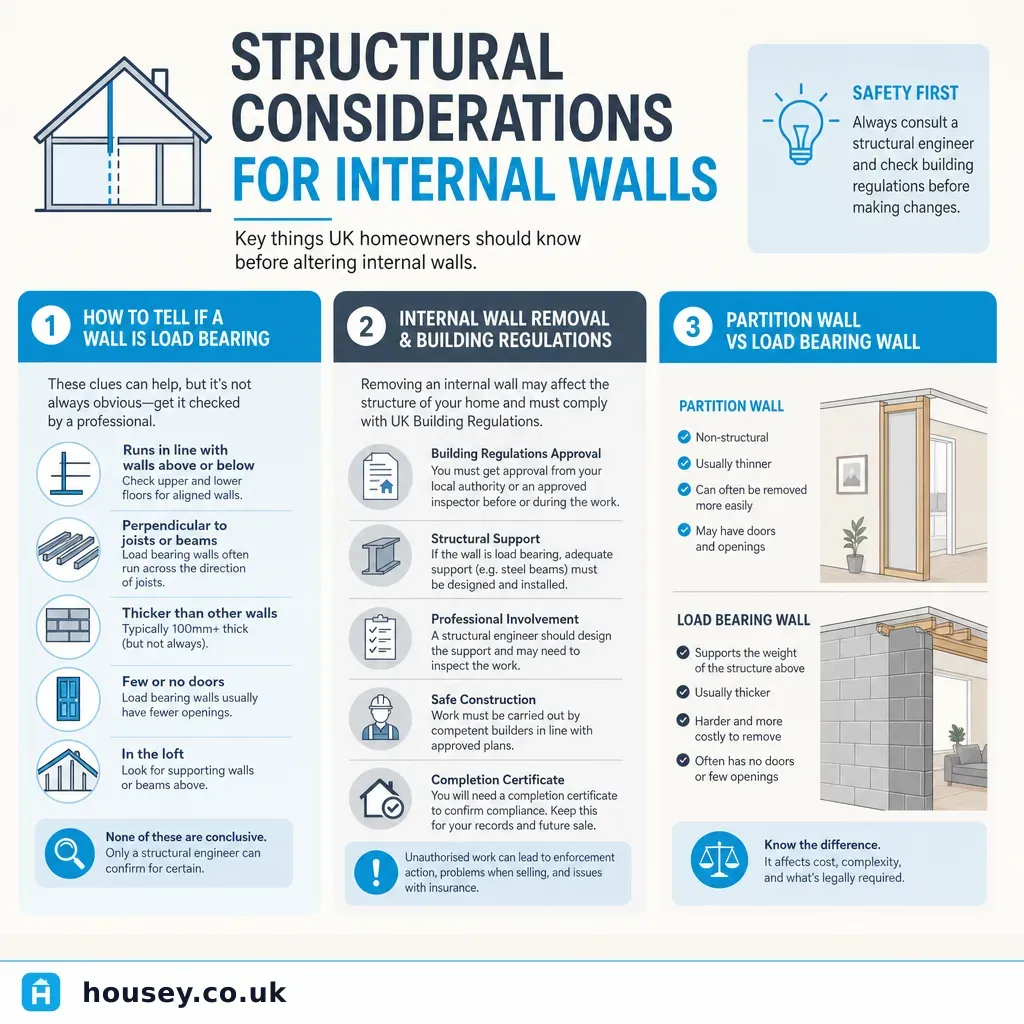
Structural considerations for internal walls
Whether you're planning to knock through a wall to create a more open layout, or add a new partition to divide a room, understanding the structural implications is one of the most important steps before work begins. Misjudging a load-bearing wall — or failing to plan the right partition specification — can result in costly remediation, failed building control inspections, or, in serious cases, structural collapse. This applies equally to Victorian terraces, 1930s semis, and modern new-builds, as each era of construction uses different load paths and framing methods.
Key points
- A load-bearing wall carries the weight of the floor, roof, or structure above it; removing or altering one always requires structural engineer input and Building Regulations approval under Part A (Structure).
- Building Regulations Part A applies whenever a load-bearing element is affected; you need building control approval via a local authority building control (LABC) application or an approved inspector.
- Non-load-bearing partition walls can generally be removed without structural calculations, but may still trigger a building control notification depending on fire compartmentation requirements or the wall's material.
- The Building Act 1984 and subsequent Building Regulations govern structural alterations in England and Wales; Scotland uses the Building (Scotland) Regulations 2004, and Northern Ireland the Building Regulations (Northern Ireland) 2012.
- In leasehold flats, removing or adding internal walls may require written consent from your freeholder or management company under your lease, entirely separately from building control.
How to tell if a wall is load-bearing
No single rule of thumb is completely reliable, but these indicators are worth checking before instructing anyone:
Indicators that a wall may be load-bearing:
- It runs at right angles (perpendicular) to the floor joists — in most houses joists run front-to-back, so a wall running side to side across the house is more likely to be load-bearing.
- There is a wall directly above it on a higher storey, or it sits over a wall or beam on the floor below.
- It is a masonry (brick or blockwork) wall positioned centrally in the floor plan.
- The property was built before roughly 1985 and the wall sits near the centre of the building.
Indicators that a wall may be non-load-bearing:
- It runs parallel to the floor joists.
- It is a lightweight timber-stud or metal-stud partition with plasterboard finishes.
- It appears to have been added after the original build — inconsistent with the layout on other floors, or visible on an original floor plan.
These are guides only. The only reliable way to confirm is a structural assessment by a chartered structural engineer or a suitably experienced chartered surveyor.
Partition wall types and their structural role
Wall type | Typical materials | Load-bearing? | Key considerations |
|---|---|---|---|
Solid masonry | Brick, dense blockwork | Often yes | Heavy; requires lintels if openings are made; good sound separation |
Timber-stud partition | Softwood studs, plasterboard | Usually no | Lightweight; easy to route services; acoustic performance varies |
Metal-stud partition | Metal C-studs, plasterboard | No | Common in modern builds and commercial conversions |
Beam-and-block or precast concrete | Precast concrete panels | Sometimes | Common in 1960s–1980s system-built homes; specialist assessment essential |
Building Regulations and building control
Any structural alteration — including removing a load-bearing wall or inserting a new structural opening — requires compliance with Building Regulations Part A (Structure) in England and Wales. You will need either:
- A full plans application to local authority building control or an approved inspector, submitted before work starts; or
- A building notice for simpler works, which allows work to start sooner but places the onus on the builder to comply without pre-approved drawings.
A structural engineer's calculations will almost always be required to support either application. The engineer specifies the steel beam (universal beam, commonly called an RSJ), the bearing pad requirements, and any temporary propping needed during construction.
Completion certificates matter: when you sell the property, your conveyancing solicitor and the buyer's surveyor will ask for evidence of building control sign-off. Works carried out without approval can delay or complicate a sale.
In Scotland a building warrant from the local authority is required before structural work begins. In Northern Ireland building regulation approval from the relevant district council is similarly required.
Which option should you choose?
- Choose a non-load-bearing timber-stud partition if you are dividing a room, the wall will carry no load, and acoustic requirements are modest.
- Instruct a structural engineer before removing any masonry wall, or any wall where you are unsure of the load path.
- Apply for building control approval before starting work that affects a load-bearing element.
- Check your lease if you own a leasehold flat — alteration clauses commonly require written landlord consent before any internal wall is removed or added.
- Contact a conservation officer if your property is listed or in a conservation area; internal alterations to listed buildings may require listed building consent as well as building regulations approval.
- Check with your local planning authority if permitted development rights may have been removed by an Article 4 Direction in your area.
Important limitations
This article provides general information about structural considerations for internal walls in UK domestic properties. Structural behaviour varies significantly by property era, construction type, condition, and layout. Nothing in this article constitutes structural advice. A qualified structural engineer or chartered surveyor must assess your individual property before any load-bearing wall is altered or removed.
When to get professional help
Seek professional advice immediately if any of the following apply:
- You are unsure whether the wall is load-bearing.
- The wall is in a listed building or a leasehold flat.
- You notice cracks, deflection, or sagging in floors or ceilings near the wall.
- A contractor proposes removing a wall without structural calculations or building control involvement.
- The property is system-built or non-traditional construction — common in 1950s–1970s housing estates.
- There is a chimney breast on or adjacent to the wall.
What to ask a qualified professional
Before instructing a structural engineer or building control consultant, ask:
- Can you confirm whether this wall is load-bearing and describe the load path?
- What structural calculations will be required, and what beam specification will you recommend?
- Will you produce drawings suitable for a building control application?
- How long will temporary propping and the structural works take, and what disruption should I expect?
- Do I need to notify any other party — freeholder, party wall surveyor, planning authority?
- What completion certificate will be issued, and who holds it?
How Housey can help
Housey connects you with experienced building control consultants who can advise on approval routes and help you avoid compliance problems, as well as architectural technologists who can produce the drawings and specifications your building control application will need.
Frequently asked questions
Do I need building regulations approval to remove a non-load-bearing internal wall?
In most cases, removing a non-load-bearing partition wall in England and Wales does not require a formal building regulations application, provided it does not affect fire compartmentation. If you own a flat, or are in any doubt, check with your local authority building control before proceeding to confirm the position.
Can I carry out internal wall removal work myself?
You may legally carry out your own building work in England and Wales, but you remain bound by Building Regulations. If the wall is load-bearing, you will need structural calculations, a correctly specified beam, proper temporary propping, and building control sign-off. Most mortgage lenders and insurers expect approved work to be verifiable.
What is a steel RSJ and do I always need one?
An RSJ (rolled steel joist), formally a universal beam (UB), carries the load over a new opening when a load-bearing wall is removed. Whether you need one, and what size, depends on the span, load above, and construction type. A structural engineer's calculations determine this — never estimate the beam size.
How long does building control sign-off take for a structural wall removal?
A building notice allows work to begin 48 hours after submission. Full plans applications typically receive a decision within five weeks, though many local authority building control offices process straightforward domestic applications more quickly. Allow additional time for inspections during and after the structural works.
Sources and further reading
- Building Regulations Approved Document A (Structure) — GOV.UK
- Building control: when you need it and how to apply — GOV.UK
- RICS guidance on home surveys — RICS
- Making changes to your listed home — Historic England
Useful next reads
 Planning & Pre-Build
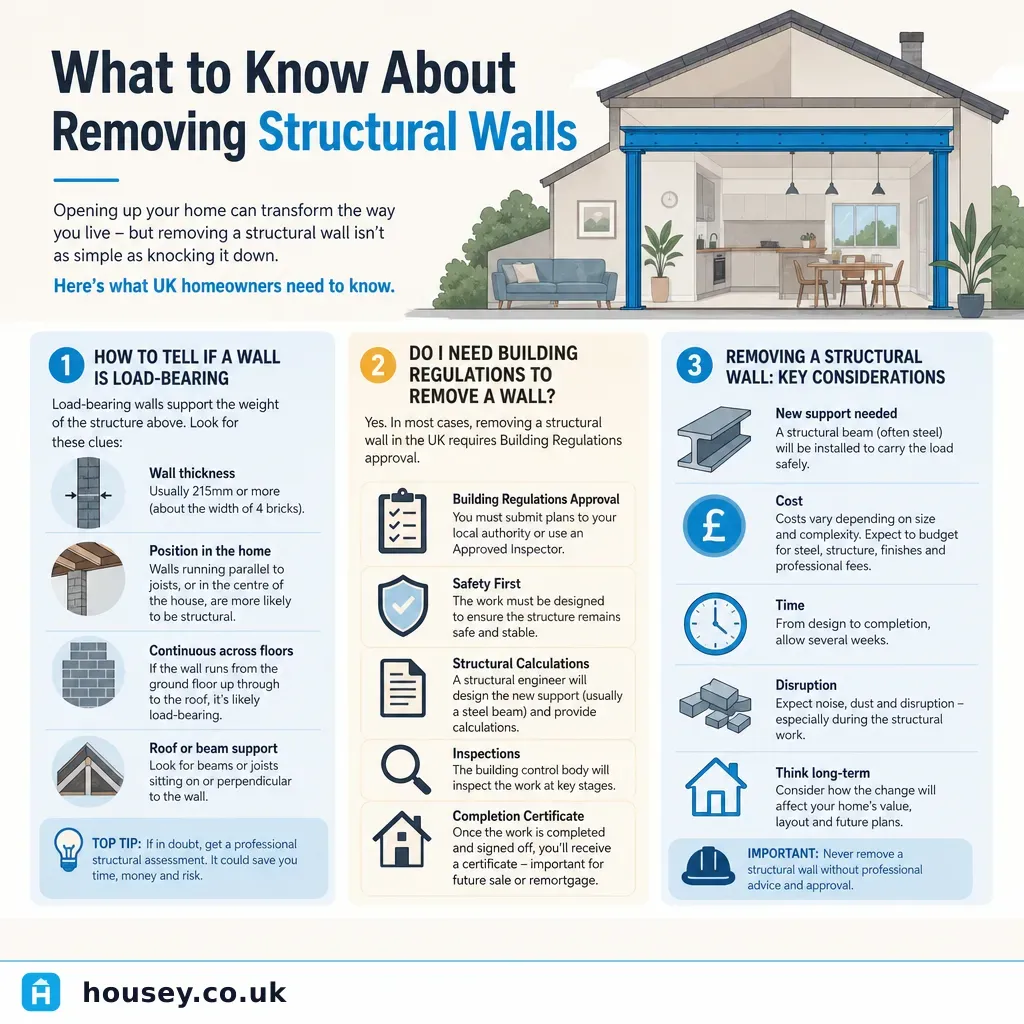
What to Know About Removing Structural Walls
Removing a structural or load-bearing wall in a UK home requires a structural engineer's assessment, a correctly specified steel beam (RSJ), and Building Regulations approval.
 Planning & Pre-Build
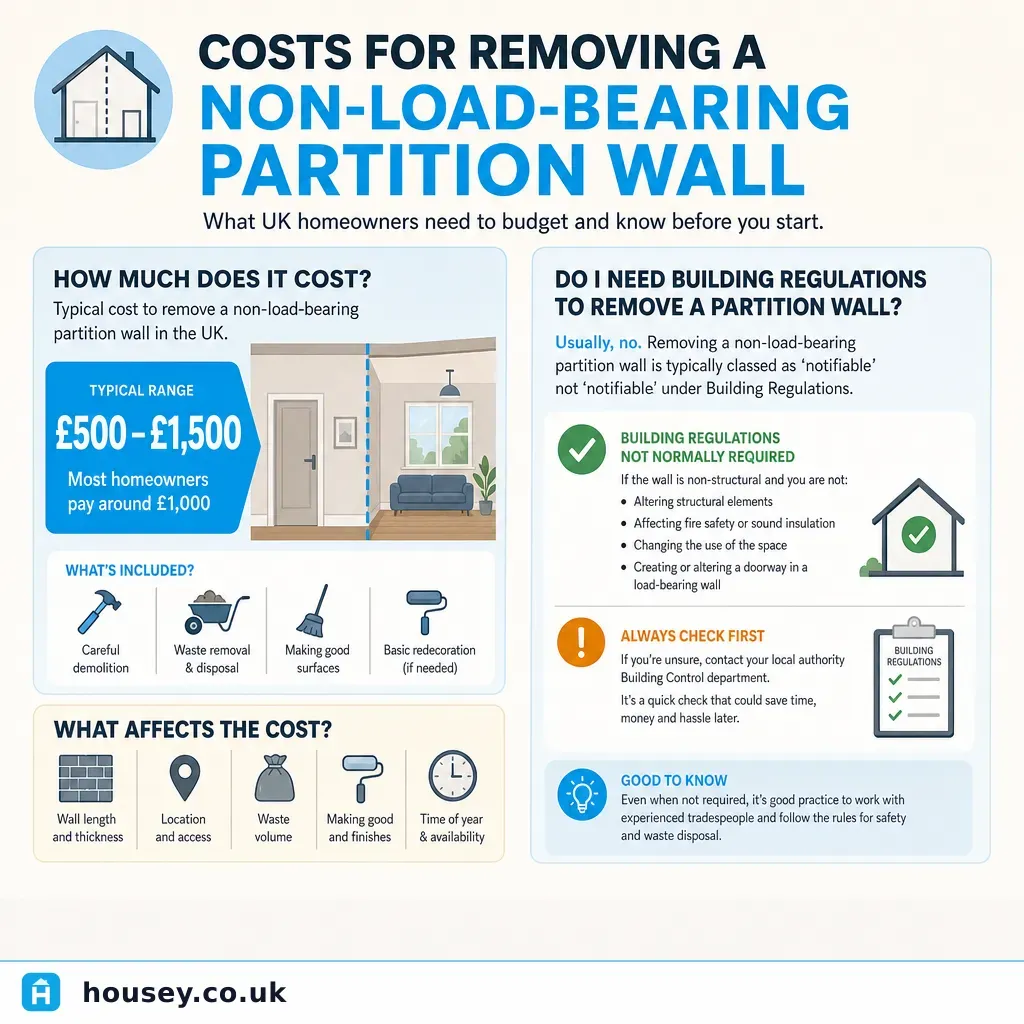
Costs for removing a non-load-bearing partition wall
Removing a non-load-bearing partition wall in a UK home typically costs £300–£1,500 in labour, plus £200–£600 or more for replastering and making good.
 Planning & Pre-Build
Planning an open-plan kitchen and living space
Creating an open-plan kitchen and living area almost always involves removing a load-bearing wall, which requires structural engineer calculations and Building Regulations approval under Parts A, B, and F in England and Wales.
 Planning & Pre-Build
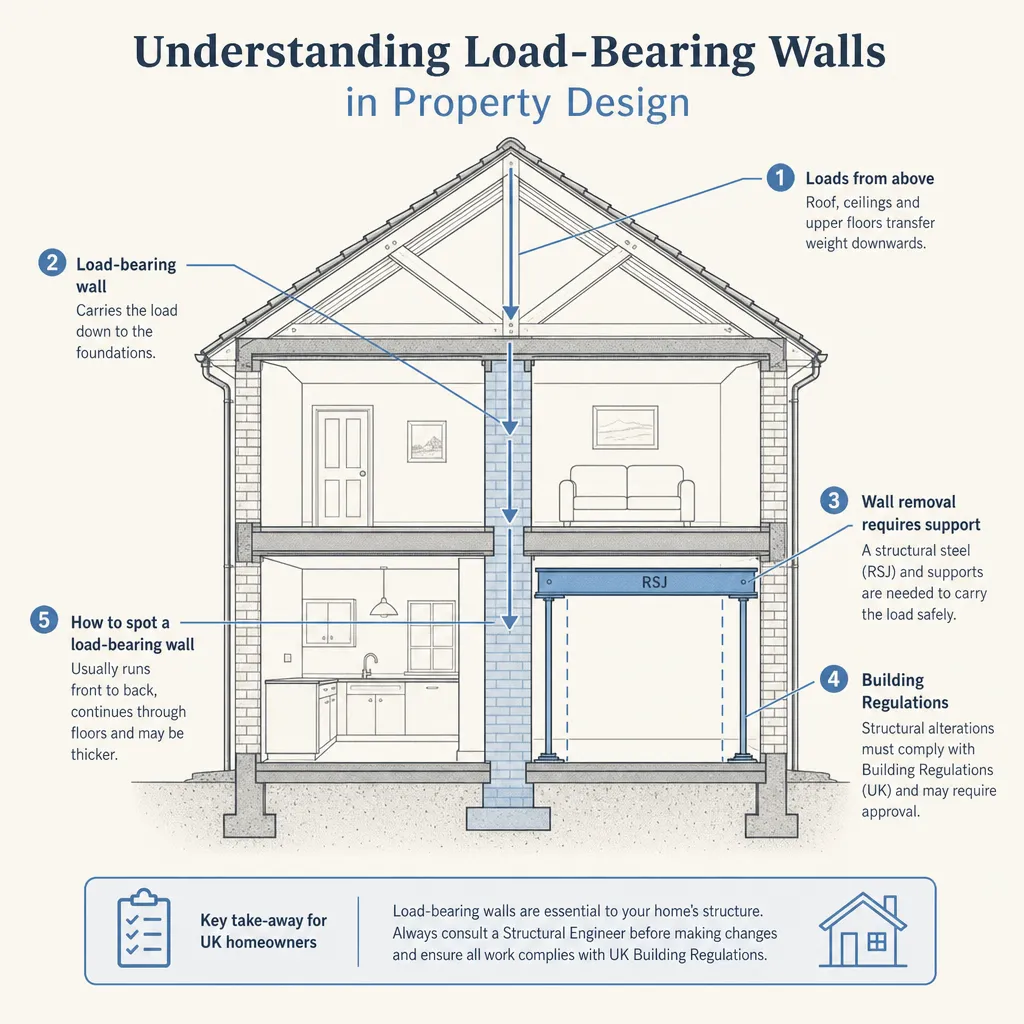
Understanding Load-Bearing Walls in Property Design
A load-bearing wall carries the weight of floors, roofs, or other walls above it down to the foundations.
 Planning & Pre-Build
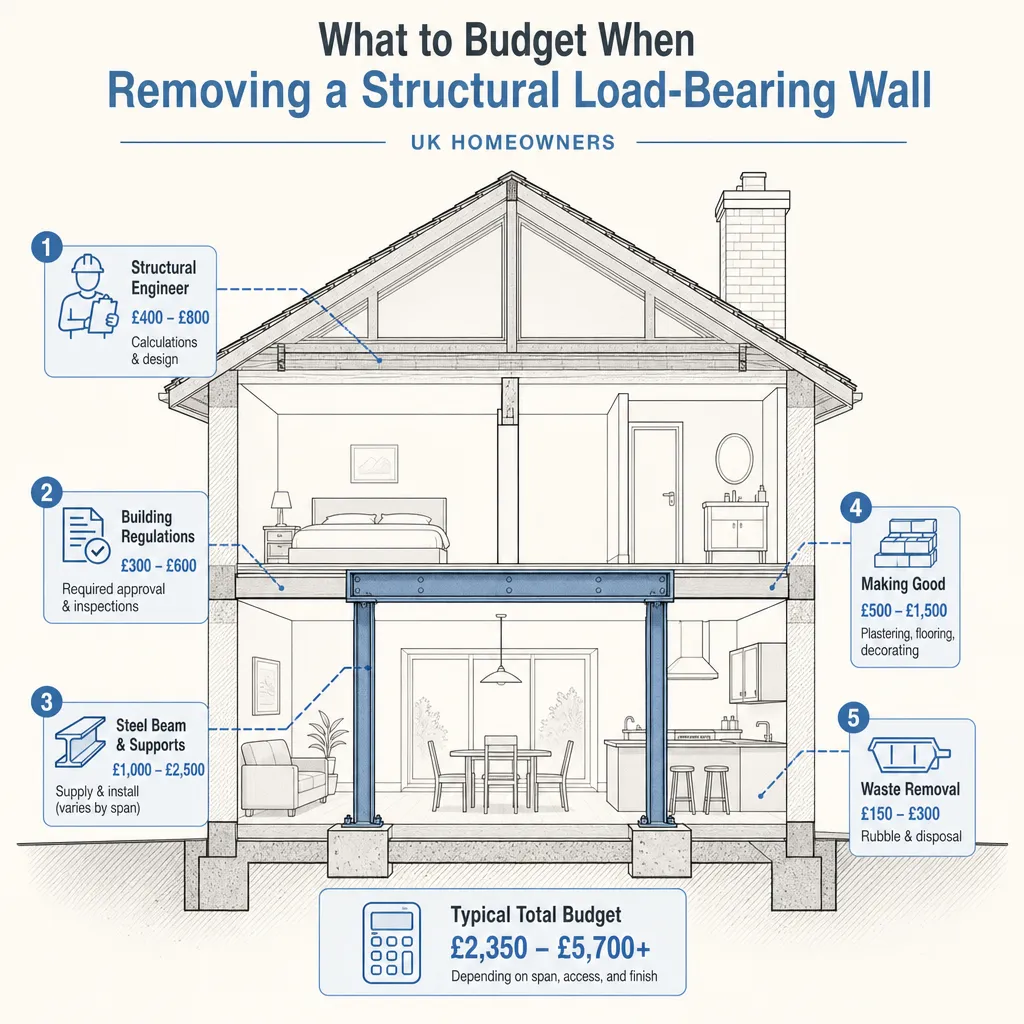
What to Budget When Removing a Structural Load-Bearing Wall
Removing a load-bearing wall in a typical UK home costs £2,500–£8,000 or more in total, covering a structural engineer's calculations, Building Regulations approval, the steel beam, builder's labour, and replastering.