Choosing and Installing a New Front Door: Style, Security, and Performance
By Housey · Last reviewed 18th of May 2026
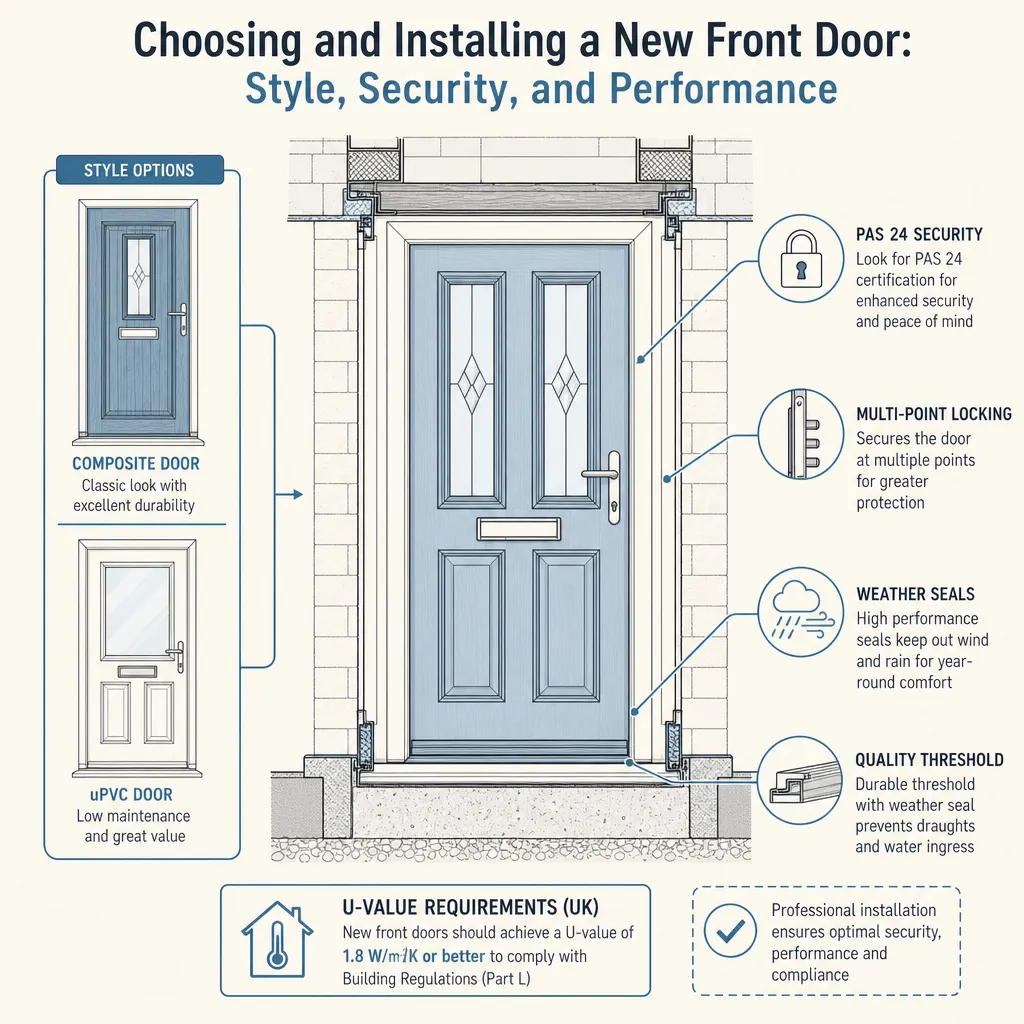
Choosing and Installing a New Front Door: Style, Security, and Performance
A front door is simultaneously a security device, a thermal barrier, and the first visual impression a property makes. In the UK, homeowners typically face this decision after a break-in, as part of a broader renovation, or when a draughty original-specification door begins affecting heating bills — particularly common in pre-1980s housing stock where door performance has never been upgraded. Getting the specification right before ordering matters: the wrong choice can leave a home under-secured, fail Part L energy performance requirements, or require planning consent the homeowner had not anticipated.
Key points
- PAS 24:2022 is the British Standard for enhanced security performance of windows and doors; Secured by Design (SBD) Police Preferred Specification requires compliance with it.
- Building Regulations Part Q requires doors in new dwellings and extensions to meet enhanced security standards — in practice, PAS 24 or STS 201 compliance.
- FENSA-registered installers can self-certify replacement doors for building control compliance without a separate local authority application.
- Approved Document L (2022 edition, England) sets a maximum U-value of 1.4 W/m²K for replacement doors in existing dwellings.
- Listed buildings and properties in conservation areas may require Listed Building Consent or planning permission before replacing a front door, even like-for-like.
Which door material is right for your property?
Material | Best for | Not ideal for | Typical U-value (W/m²K) | Security notes |
|---|---|---|---|---|
Composite (GRP skin, insulated core) | Most modern and traditional homes; low maintenance | Very traditional or listed properties requiring authentic materials | 1.0–1.4 | PAS 24 options widely available; good multipoint locking |
uPVC | Budget replacement; contemporary homes | Period properties; some conservation areas restrict visible uPVC | 1.2–1.6 | PAS 24 options available; confirm specification before purchasing |
Timber (solid or engineered) | Listed buildings; conservation areas; period properties | Exposed positions without a good maintenance regime; can warp | 1.8–2.2 (solid) | Hardware must be specified carefully to achieve PAS 24 compliance |
Aluminium (thermally broken) | Contemporary and modernist homes; coastal locations | Period properties; higher cost | 1.0–1.5 | Slim profiles with multipoint locking widely available |
Indicative U-values only; precise figures depend on product specification and glazing. Last reviewed 2026-05-18.
Which door type should you choose?
- Choose composite if you want low maintenance, strong thermal performance, and broad PAS 24 availability for a non-listed home — it suits the widest range of UK property types.
- Choose timber if the property is listed, in a conservation area, or if the original door character must be preserved. Confirm acceptability with your local planning authority or conservation officer before ordering.
- Choose uPVC if budget is the primary consideration and the property's style is suited to it; confirm the installer offers a PAS 24-compliant product.
- Choose thermally broken aluminium if the property is contemporary, you want narrow sightlines, or the door is in a salt-laden coastal environment.
- Ask your local planning authority if you are unsure whether consent is needed before ordering — it is cheaper to confirm beforehand than to replace an installed door.
Security requirements: understanding the standards
PAS 24:2022 is the performance standard referenced by Secured by Design. It tests resistance to physical attack methods including drilling, levering, and jemmy attacks at the frame-to-door and lock junctions. Doors carrying the SBD Police Preferred Specification logo have been independently tested to this standard.
Building Regulations Part Q applies to new dwellings and to extensions that include a new external door. For like-for-like replacement doors in existing homes, Part Q is not a direct requirement, but Approved Document L energy standards do apply. Regardless of regulation, fitting a PAS 24-compliant door is widely considered best practice.
Key hardware considerations:
- Multipoint locking (engaging at three or more points along the door edge) is standard on most composite and modern uPVC doors.
- Cylinders should meet TS 007 three-star rating, or combine a one-star cylinder with a two-star handle to achieve equivalent resistance to cylinder snapping.
- Anti-snap cylinders are a worthwhile upgrade if the existing door already meets other security requirements.
Energy performance and Part L
Approved Document L (2022 edition, England) requires replacement doors to achieve a U-value no worse than 1.4 W/m²K. Wales uses the Technical Guidance documents; Scotland follows Section 6 of the Technical Handbooks; Northern Ireland follows Technical Booklet F. If a new door forms part of an extension or new build, the whole-building energy calculation may require a tighter target — confirm with your architect or installer before specification.
FENSA-registered installers self-certify compliance and notify the local authority on your behalf. The FENSA certificate they provide must be retained with your property documents, as it will be requested during conveyancing when you sell.
Planning permission and listed buildings
For most homes, replacing a like-for-like front door is permitted development and requires no planning permission. Exceptions:
- Listed buildings require Listed Building Consent from the local planning authority for any works affecting the building's character, including door replacement.
- Conservation areas — some local authorities require prior approval or consent for visible changes to front doors, particularly where an Article 4 Direction has removed permitted development rights.
- Flats and maisonettes — the lease may require landlord or management company consent before altering a door that forms part of the building envelope.
Always verify with your local planning authority before ordering, especially for pre-1919 properties or those in designated areas.
Pre-installation checklist
Before accepting a quote or placing an order, confirm:
When to get professional help
Most front door installations are straightforward for a FENSA-registered installer. Seek additional specialist advice if:
- The property is listed or in a conservation area — involve a conservation architect or planning consultant before specifying the door.
- There is visible rot, movement, or damp in the existing frame surround — a builder or surveyor should identify the cause before a new door is fitted.
- The door opening forms part of a structural wall where the lintel condition is uncertain.
- Leasehold consent is required and the freeholder or management company has raised objections.
How Housey can help
Housey connects you with experienced window and door installers who can advise on PAS 24-compliant products, manage FENSA registration on your behalf, and ensure your new front door meets the energy performance requirements of Approved Document L.
Frequently asked questions
Do I need planning permission to replace my front door?
For most homes, replacing a front door is permitted development and does not require planning permission. However, listed buildings always require Listed Building Consent, and some conservation areas have Article 4 Directions that remove permitted development rights. Check with your local planning authority before ordering — it is cheaper to confirm beforehand than to replace an installed door.
What does FENSA registration mean for my front door installation?
FENSA is an industry scheme that allows registered installers to self-certify that replacement windows and doors comply with Building Regulations. An FENSA certificate confirms the installation has been notified to the local authority and meets energy performance requirements. Retain this certificate with your property documents — it will be requested during conveyancing when you come to sell.
What is PAS 24 and why does it matter for a front door?
PAS 24:2022 is a British Standard for enhanced security performance of windows and doors. Doors tested to PAS 24 have demonstrated resistance to physical attack including drilling, levering, and jemmy attacks on frame and lock junctions. The Secured by Design scheme uses PAS 24 as its baseline. Fitting a compliant door alongside a TS 007 three-star cylinder is considered best practice for front doors in the UK.
How much does a new composite front door cost in the UK?
Indicative UK costs, last reviewed 2026-05-18: supply and installation of a composite front door typically ranges from £900 to £2,500 depending on size, glazing, hardware, and installer. uPVC doors are generally lower (£500–£1,500 installed); timber and aluminium tend to be higher (£1,500–£4,000+). Obtain at least three quotes and confirm what is included, including frame replacement and FENSA registration.
Sources and further reading
- Approved Document L: Conservation of fuel and power (2022) — GOV.UK
- Approved Document Q: Security – dwellings — GOV.UK
- Secured by Design: door guidance — Police Crime Prevention Initiatives
- FENSA homeowner guidance — FENSA
- Planning Portal: listed buildings and conservation areas — Planning Portal
Useful next reads
 Improvement & Build
How to Replace Internal Doors in Your Home
Replacing internal doors is a straightforward home improvement that most competent DIYers or a joiner can complete.
 Improvement & Build
Choosing the Right Patio Doors for Your Home
The right patio doors depend on your opening width, available swing space, home style, and budget.
 Improvement & Build
Door Manufacturer Consolidation and Market Impact on Installation Services
When door and window manufacturers merge or are acquired, the immediate impact for homeowners is often seen in product range changes, revised lead times, and updated installer training requirements.
 Improvement & Build
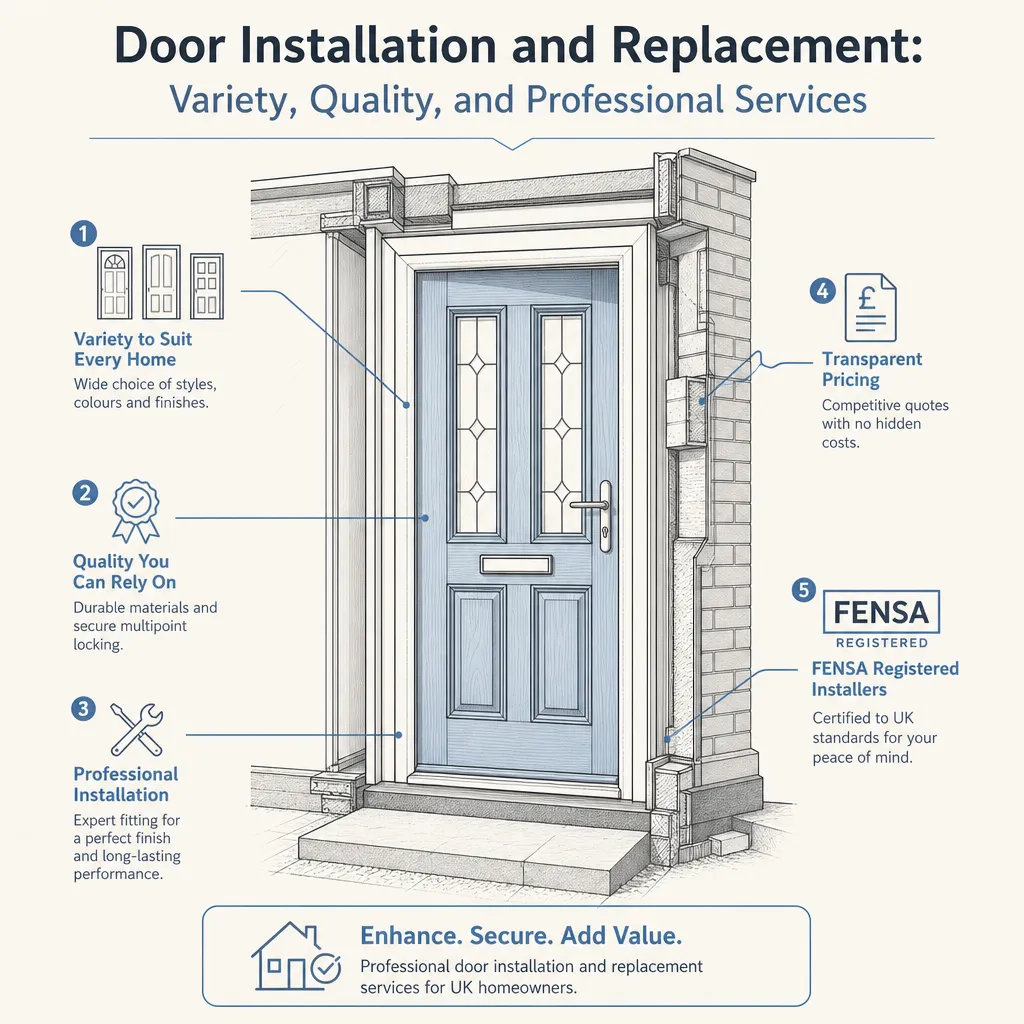
Door Installation and Replacement: Variety, Quality, and Professional Services
Door installation in UK homes ranges from straightforward interior hanging, which requires few regulations, to external replacements subject to Building Regulations Part L.
 Improvement & Build
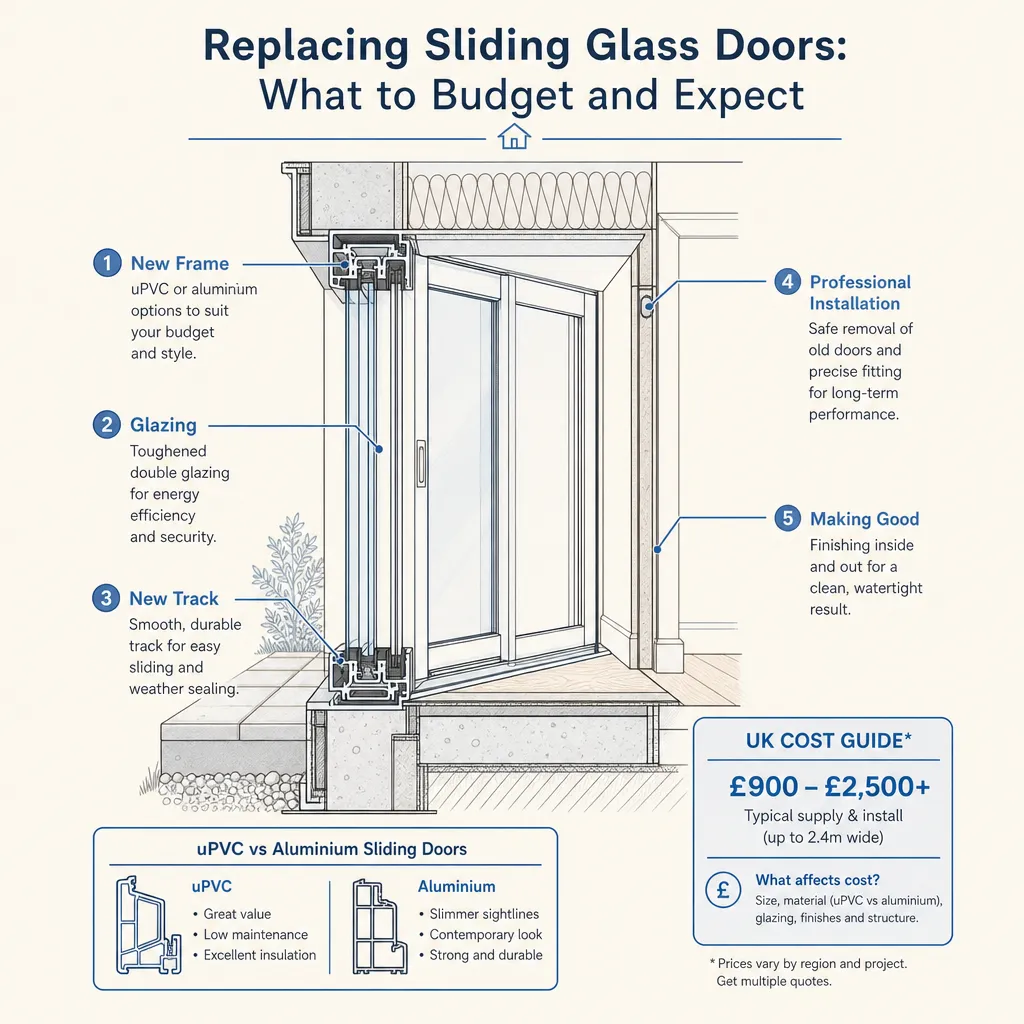
Replacing Sliding Glass Doors: What to Budget and Expect
Replacing sliding glass doors in a UK home typically costs £1,500–£4,500 depending on door size, glazing specification, and frame material.