Door Installation and Replacement: Variety, Quality, and Professional Services
By Housey · Last reviewed 19th of May 2026
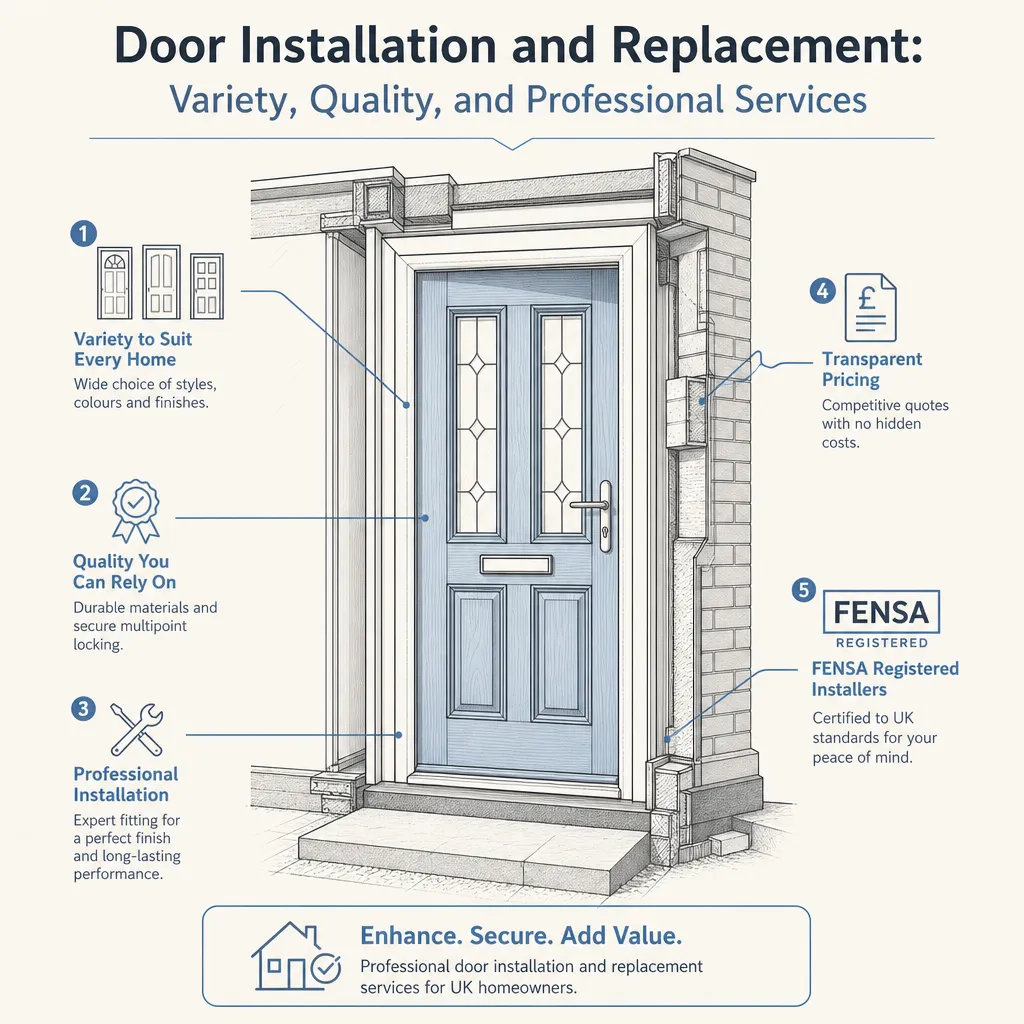
Door Installation and Replacement: Variety, Quality, and Professional Services
Replacing a door — whether a tired front door, a warped internal room door, or a damaged back door — is one of the more accessible home improvement projects, but the quality of the outcome depends heavily on correct specification and a skilled installer. Across UK homes, door replacements range from straightforward like-for-like swaps to more involved projects requiring structural modifications, fire-door compliance, or building regulations sign-off. Knowing which category your project falls into before instructing anyone avoids unexpected costs and missing documentation.
Key points
- Interior door installation typically does not require building regulations approval unless the door is fire-rated — for example, between an integral garage and living space, or in an HMO (House in Multiple Occupation).
- External door replacements must comply with Building Regulations Part L (thermal performance) — a FENSA-registered or CERTASS-registered installer can self-certify compliance without a separate building control application.
- Fire doors must be FD30 or FD60 rated and installed by a competent person; poorly fitted fire doors may fail to perform in a fire and can affect building insurance validity.
- Hanging interior doors in older UK properties requires checking frame squareness — building movement in Victorian and Edwardian terraces often results in out-of-square frames that need addressing before a new door will operate correctly.
- FENSA and CERTASS certificates are part of your property's legal documentation and should be retained — solicitors and conveyancers will request them on sale.
Types of door replacement projects
Door installation projects vary significantly in scope. Understanding which category your project falls into helps you brief contractors accurately and anticipate what approvals or documentation you will need.
Project type | Building regs required? | Self-certification possible? | Fire door rules apply? | Planning permission? |
|---|---|---|---|---|
Interior door — like-for-like | No | N/A | No (unless garage-to-house or HMO) | No |
Interior door — fire-rated | Yes | Yes (competent person scheme) | Yes — FD30 or FD60 rating required | No |
External door — no glazing, like-for-like | Yes (Part L) | Building control notification required unless FENSA/CERTASS | No (unless escape route) | Usually no |
External door — with glazing | Yes (Part L) | FENSA or CERTASS self-certification | No (unless escape route) | Usually no |
New door opening (structural alteration) | Yes | No — full building control application needed | Possibly | Possibly |
Interior doors: options and quality considerations
Interior door replacement is one of the more manageable home improvement tasks, though specification choices affect acoustics, draught performance, fire compliance, and appearance.
Door construction types
- Hollow-core (honeycomb) doors — lightweight and low cost; suited to low-traffic bedrooms. Poor acoustic performance and not available in fire-rated configurations.
- Solid-core (flush or panel) doors — denser, better sound insulation, more substantial feel. Available in FD30 fire-door specification.
- Solid timber doors — the traditional choice for period properties; can be painted or stained; may require minor adjustment as timber moves with seasonal humidity changes.
- Pre-finished vs unfinished — pre-finished doors are ready to hang; unfinished timber doors require priming and painting before or after installation.
Measuring for an interior door: what to check
Before ordering, take these measurements carefully:
- Measure door height — floor to head of frame, less 6–10 mm clearance at the top.
- Measure door width — between frame rebates, less 2–3 mm clearance each side.
- Check frame squareness — measure both diagonal distances; a difference of more than 5 mm indicates an out-of-square frame that needs addressing before hanging.
- Note hinge position and hand (which direction the door swings and where the handle sits).
Standard UK interior door sizes are 1981 × 762 mm and 1981 × 838 mm — older UK homes frequently have non-standard openings requiring made-to-measure doors.
External door replacement: a worked example
The following example shows the typical sequence for a composite front door installation on a 1970s semi-detached house — one of the most common external door replacement projects in the UK.
Property: 1970s semi-detached; existing steel-reinforced door with failing seals and poor thermal performance. The homeowner wants a composite door with a side panel and new frame.
- Survey and measure — the installer measures the existing opening and checks the frame condition to determine whether the frame can be retained or must be replaced.
- Specification agreed — composite door with multi-point locking, PAS 24:2022 accreditation, laminated side panel glazing, U-value of 1.2 W/m²K or better.
- Order placed — made-to-measure composite doors typically take 3–6 weeks from a specialist manufacturer.
- Existing door and frame removed — the installer inspects the structural lintel above for any signs of movement or deterioration before proceeding.
- New frame fitted — fixed, checked plumb and level; the gap between frame and masonry is filled with low-expansion foam and sealed externally.
- Door hung and adjusted — multi-point lock aligned, weatherseal and operation checked throughout the full opening range.
- FENSA certificate issued — as the door includes glazing and the installer is FENSA-registered, a compliance certificate is issued and registered with the scheme, confirming Part L compliance.
What to ask before accepting a quote
Use these questions to compare quotes on a like-for-like basis:
- What is included — supply and fit, or fit only?
- What happens to the existing door and frame — is disposal included?
- Is the installer registered with FENSA or CERTASS (for external glazed doors)?
- What is the door's whole-door U-value, and does it meet Part L as standard?
- Does the doorset carry PAS 24:2022 security certification?
- What guarantee is provided, for how long, and what does it cover?
- What could change the price — for example, discovery of frame rot, non-standard opening size, or structural concerns?
- Is VAT included in the quoted price?
- What is the lead time from order to installation date?
Document checklist: what to keep after installation
Retain the following documents after any external door installation:
- FENSA or CERTASS certificate (required for all external glazed door installations)
- Written installer guarantee and full guarantee terms
- Product specification sheet confirming U-value and security rating
- Any building control completion certificate (for structural alterations or fire door installations)
When to get professional help
Most interior door replacements are within the capability of a competent DIYer or general joiner. Engage a qualified specialist for:
- Fire door installation — FD30 and FD60 fire doors must be fitted correctly to maintain their fire resistance; use an installer who is familiar with fire door requirements and refer to BWF Fire Door Alliance guidance on correct specification and fitting.
- External glazed doors — use a FENSA or CERTASS registered installer to self-certify Building Regulations compliance and receive the certificate needed for future property sales.
- Structural alterations — widening or creating a new opening requires a structural engineer's specification and a full building regulations application through your local building control authority.
- Listed buildings or conservation areas — seek advice from your local planning authority before replacing any door; incorrect materials may breach planning conditions.
How Housey can help
Housey connects homeowners with vetted window and door installers for interior and exterior door installation projects. Request quotes, compare prices and credentials, and check whether installers hold FENSA or CERTASS registration before committing to a booking.
Frequently asked questions
How much does door installation cost in the UK?
Interior door hanging typically costs £50–£150 per door (labour only, excluding the door itself). A supplied and fitted external composite door — including frame — typically ranges from £800 to £2,500 depending on specification, glazing, and location. Indicative UK costs, last reviewed 2026-05-19. Obtain at least three quotes and ensure comparisons are like-for-like in specification and scope.
How long does door installation take?
A like-for-like external door replacement usually takes half a day to a full day for an experienced installer. Multiple interior doors can often be hung in a single day. Projects involving structural alterations to the opening may take two to three days, including any required drying time for remedial masonry work.
Do I need a fire door between my garage and my house?
In England, Building Regulations Approved Document B requires a fire-resisting door (FD30 with a self-closing device) between an integral garage and the habitable rooms of a dwelling. This applies in new-build situations and when carrying out relevant building work in that area. Check with your local building control authority if you are unsure whether the requirement applies to your specific project.
Can I replace just the door leaf without replacing the frame?
Yes — for interior doors and in many external situations where the existing frame is sound and well aligned. However, if the frame is rotten, damaged, or not thermally adequate, replacing it alongside the door gives a better long-term result. For external composite doors, the doorset is most often supplied as a complete frame-and-door unit to ensure security and thermal ratings are met as a complete assembly.
Sources and further reading
- Building Regulations Approved Document L: Conservation of fuel and power — GOV.UK
- Building Regulations Approved Document B: Fire safety — GOV.UK
- FENSA scheme information — Government-authorised self-certification scheme for replacement windows and doors
- BWF Fire Door Alliance: fire door guidance — British Woodworking Federation
Useful next reads
 Improvement & Build
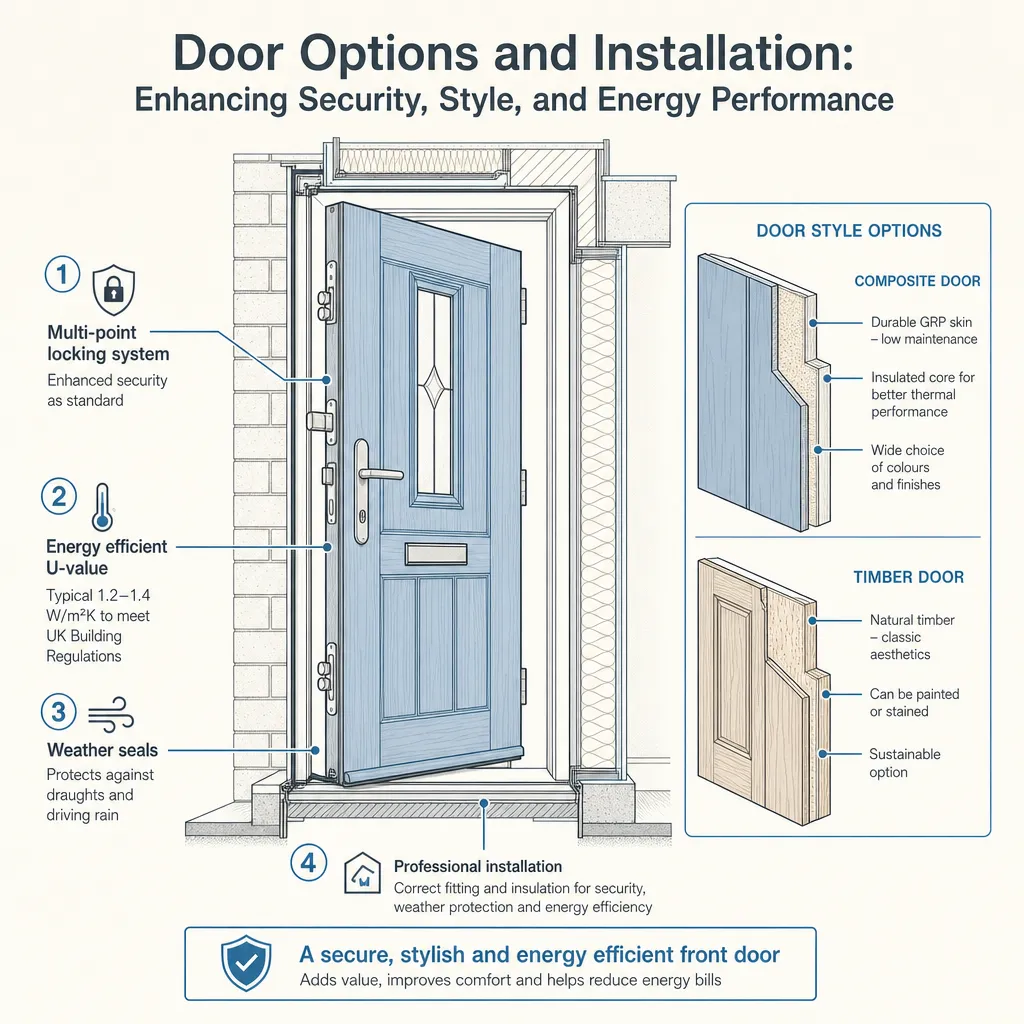
Door Options and Installation: Enhancing Security, Style, and Energy Performance
Choosing a new external door involves balancing security ratings, thermal performance, and style.
 Improvement & Build
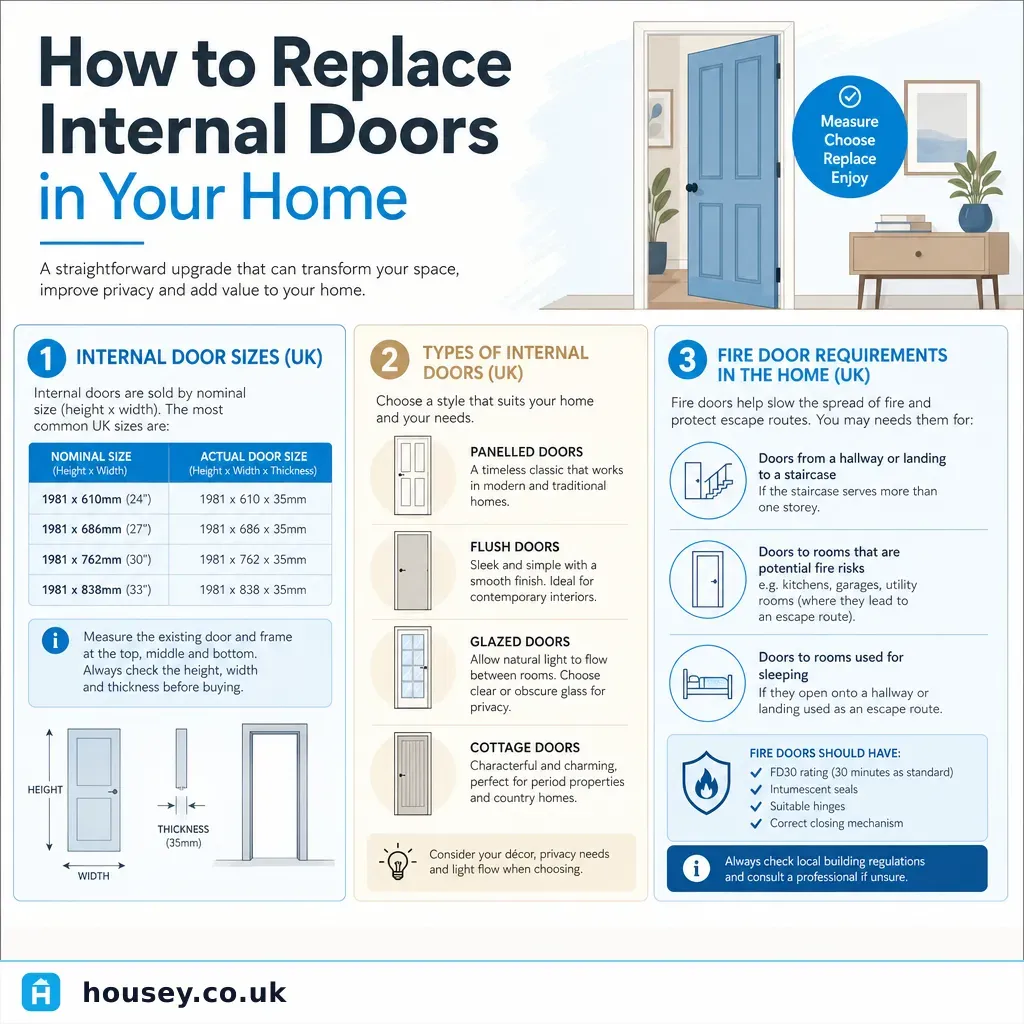
How to Replace Internal Doors in Your Home
Replacing internal doors is a straightforward home improvement that most competent DIYers or a joiner can complete.
 Improvement & Build
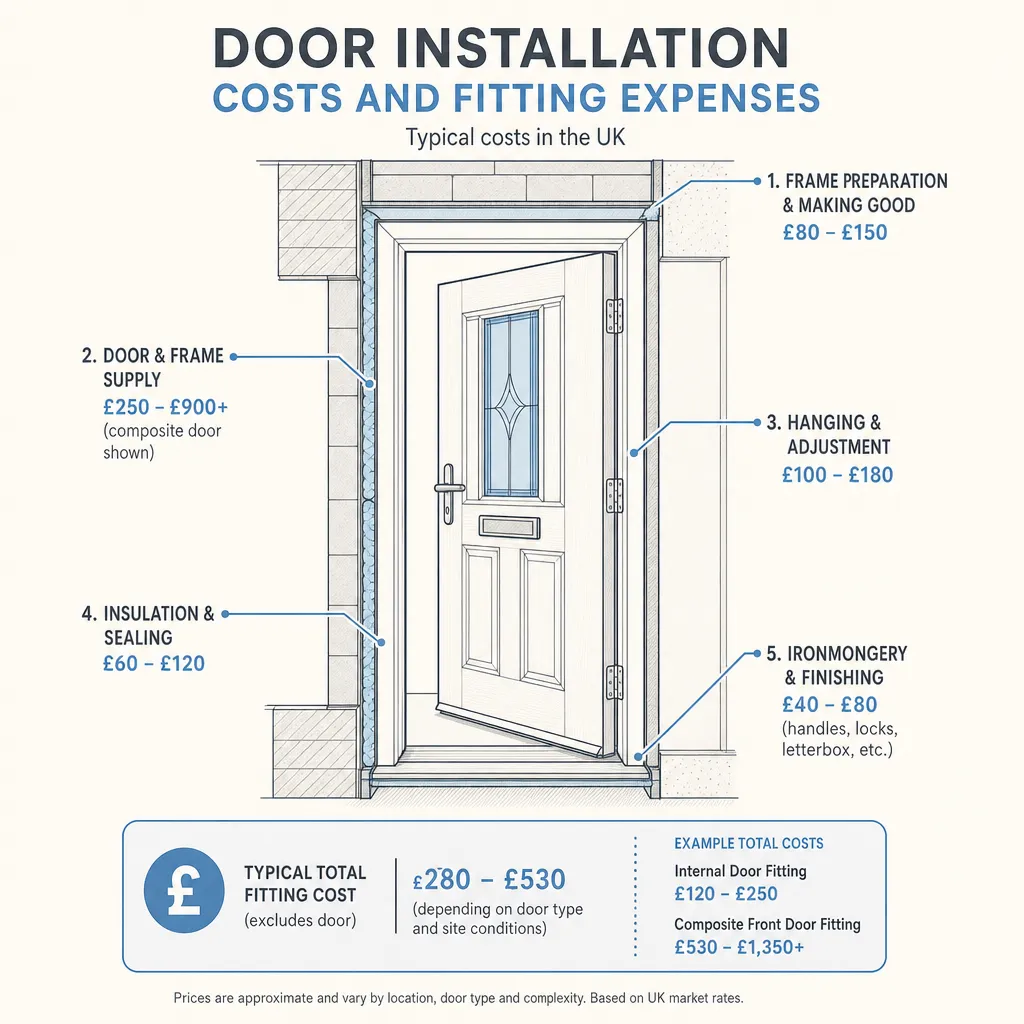
Door Installation Costs and Fitting Expenses
Door installation costs in the UK typically range from £50–£150 labour for an internal door to £400–£900 installed for a UPVC external door, or £800–£2,000+ for a composite front door.
 Improvement & Build
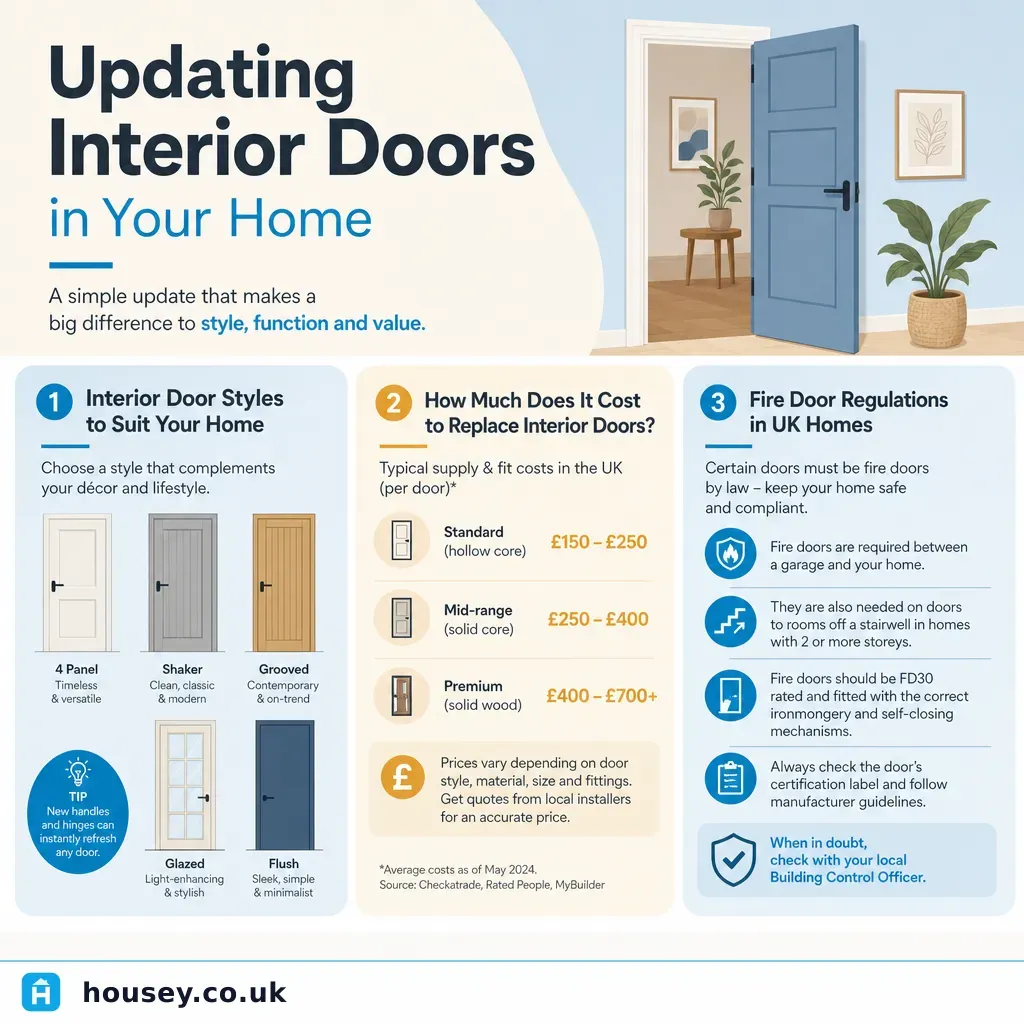
Updating Interior Doors in Your Home
Replacing interior doors is one of the more impactful home upgrades a UK homeowner can make without building regulations approval.
 Improvement & Build
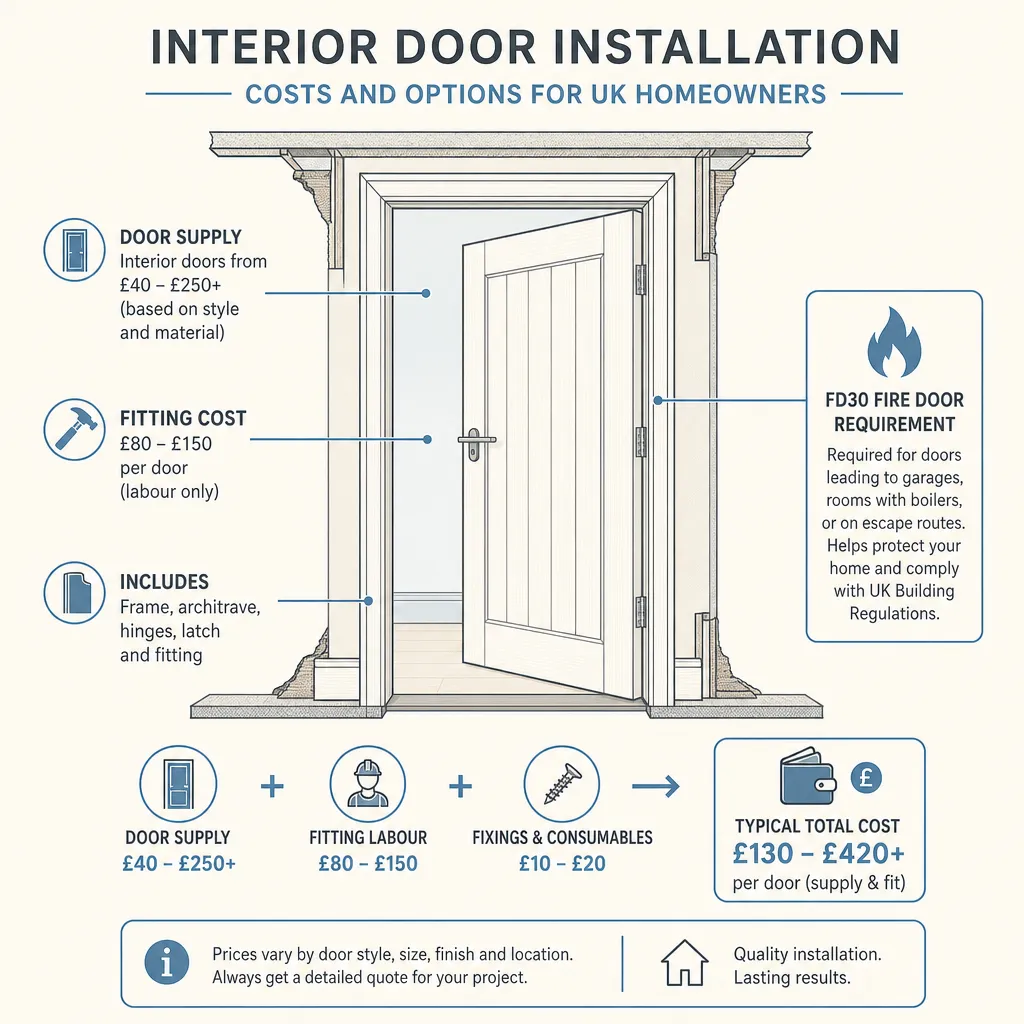
Interior Door Installation Costs and Options
Interior door installation in the UK typically costs between £100 and £300 per door for labour when fitting a door you supply, or £200 to £500 or more for supply and fit, depending on door type and finish.