Choosing the Right Patio Doors for Your Home
By Housey · Last reviewed 30th of May 2026
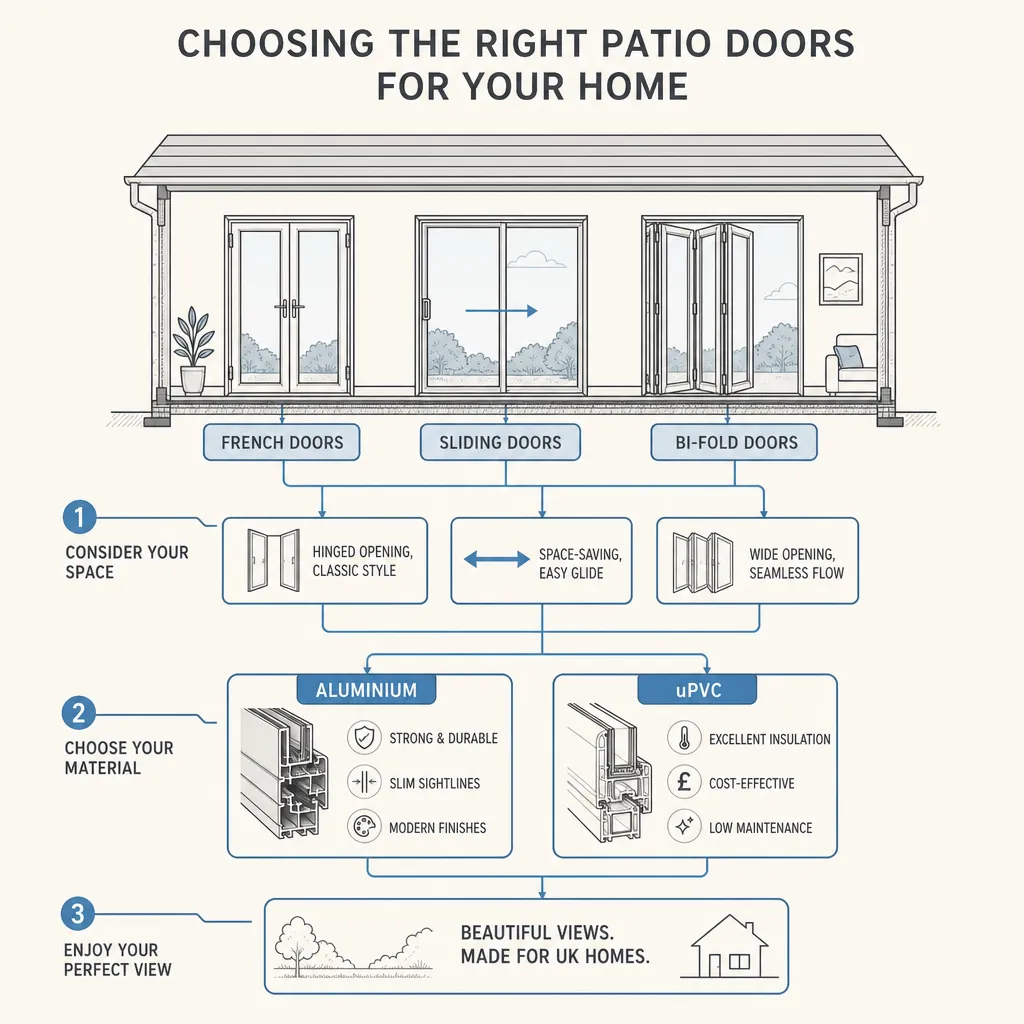
Choosing the Right Patio Doors for Your Home
Patio doors sit at the intersection of practical function and visual impact — they shape how a room connects to outdoor space, influence thermal performance, and affect how much natural light enters a home. Whether you are replacing ageing French doors on a 1930s semi or fitting new bifold doors into a rear extension, the choice of door type, material, and glazing specification matters for day-to-day use, energy efficiency, and compliance with Building Regulations.
Key points
- Patio doors fall broadly into four types: French doors, sliding patio doors, bifold doors, and inline sliding (lift-and-slide) — each with different space requirements, opening widths, and price bands.
- Replacement patio doors in England are subject to Building Regulations Part L (thermal performance) and Part K (safety glazing); work must be notified to building control, typically handled by a FENSA- or CERTASS-registered installer who self-certifies compliance.
- Under Approved Document L 2022, replacement doors must achieve a whole-unit U-value of 1.4 W/m²K or better.
- Bifold doors spanning more than approximately 3.5 m typically require a structural lintel above the opening; this should be confirmed by a structural engineer or building control before installation begins.
- Planning permission is not usually required for like-for-like replacement, but properties in conservation areas or that are listed may have restrictions on glazing style and materials.
Which type of patio door suits your home?
The four main types have distinct space, cost, and aesthetic profiles:
Door type | Typical opening width | Space needed | Best for | Watch out for |
|---|---|---|---|---|
French doors | 1.2 m – 2.4 m | Inward or outward swing clearance | Period homes, narrower openings, classic aesthetics | Swing space reduces usable area; may obstruct furniture |
Sliding patio doors | 1.5 m – 4 m+ | No swing space needed | Space-limited rooms, contemporary interiors | One panel is fixed; narrower effective opening per m of frame |
Bifold doors | 2 m – 8 m+ | Small stack at one or both ends | Wide openings, rear extensions, open-plan living | Higher cost; more moving parts; structural work often needed |
Inline sliding (lift-and-slide) | 2 m – 8 m+ | Panels slide behind fixed panels | Premium specification, very wide openings | High cost; specialist installation required |
Decision tree: which patio door style?
- Choose French doors if your opening is under 2 m wide and you prefer a traditional or period aesthetic.
- Choose sliding patio doors if you have limited indoor space for a door swing and want a low-maintenance, mid-budget option.
- Choose bifold doors if you want to open up a span of 2.4 m or more and create a seamless indoor-outdoor connection to a terrace or garden.
- Choose inline sliding (lift-and-slide) if you are specifying a premium rear extension and want very slim sightlines or very large glass panels.
- Check with a structural engineer or building control before widening an existing opening for bifold or wide sliding doors — the structural and cost implications can be significant.
- Check with your local planning authority if the property is in a conservation area or is listed before committing to any material or style.
Material comparison: uPVC, aluminium, and timber
uPVC is the most common choice across the UK. It is relatively affordable, thermally efficient when well-specified, and requires only occasional cleaning. Modern profiles are significantly slimmer than older versions. It is less suited to very large spans where aluminium's structural strength becomes relevant.
Aluminium offers slim sightlines, an excellent strength-to-weight ratio, and a very long service life. Powder-coated finishes are durable and available in a wide range of colours. Thermal performance depends on the quality of the thermal break within the profile — specify a system with an adequate warm-edge thermal break for compliance with Part L. Aluminium doors sit at a higher price point than uPVC.
Timber remains the preferred — or sometimes required — option for listed buildings and many conservation area properties. It requires periodic repainting or staining, typically every 5–10 years depending on exposure and species. Accoya and engineered hardwood products offer better dimensional stability than standard softwood. Timber can achieve excellent thermal performance when correctly specified and maintained.
Building Regulations and FENSA certification
Replacing patio doors triggers Building Regulations in England:
- Part L (conservation of fuel and power): replacement doors must meet a minimum whole-unit U-value of 1.4 W/m²K per Approved Document L 2022.
- Part K (protection from falling, collision, and impact): glazing in critical locations — including doors and low-level panels — must be toughened or laminated safety glass to BS 6206.
Most homeowners use an installer registered with FENSA or CERTASS, who self-certifies compliance and issues a certificate on completion. This certificate is important at the point of sale — buyers' solicitors routinely request it. Keep it with your property documents. If your installer is not FENSA or CERTASS registered, you will need to notify your local authority building control before installation begins.
What to ask before accepting a quote
- What is the whole-unit U-value of the door, and does it comply with Approved Document L?
- Is the installer FENSA or CERTASS registered, and will they issue a compliance certificate on completion?
- Is a new or upgraded lintel needed, and has the structural implication of the opening been assessed?
- What glazing specification is included — double or triple glazed, low-E coating, argon-filled sealed unit?
- What hardware is included, and do the locks meet your insurer's requirements or the Secured by Design standard?
- What are the manufacture and installation lead times?
- Is VAT included, and what is the payment schedule?
- What warranty is provided on the frames, sealed units, and installation workmanship?
When to get professional help
Most reputable installation companies handle Building Regulations compliance. However, seek additional professional input when:
- You are widening or creating a new opening, particularly on a load-bearing wall. A structural engineer or chartered building surveyor should confirm the lintel specification and any temporary propping requirements before work begins.
- Your property is listed or in a conservation area. Contact your local planning authority before ordering doors — retrospective enforcement is costly and can require reinstatement works.
- Signs of damp, rot, or structural movement appear around the existing door frame during replacement work. These should be investigated and resolved before the new frame is fitted.
- You are concerned about Party Wall etc. Act 1996 implications on a semi-detached or terraced property — consult a party wall surveyor if works affect a shared wall.
How Housey can help
Housey connects homeowners with vetted window and door installers who provide written specifications, FENSA certification, and itemised quotes. Compare quotes from multiple registered installers before committing to ensure you are getting the right door style, material, and glazing specification for your home and budget.
Frequently asked questions
Do I need planning permission to replace patio doors?
In most cases, no. Replacing patio doors like-for-like is permitted development in England. Planning permission may be required if you are creating a new opening, if the property is listed, or if it sits in a conservation area. Check the Planning Portal's interactive guides or contact your local planning authority before ordering if you are unsure.
How much do patio doors cost to install in the UK?
French doors in uPVC typically range from £800–£2,500 supplied and fitted. Aluminium bifold doors for a 3–4 m opening often fall in the £3,000–£6,000+ range. Timber and lift-and-slide systems are generally higher. These are indicative UK costs, last reviewed 2026-05-30 — quotes vary significantly by size, material, and installer. Get at least three itemised quotes from FENSA-registered installers before committing.
What is the most energy-efficient patio door option?
Triple-glazed units with a low-E coating and warm-edge spacer bars offer the highest thermal performance. Well-specified double glazing provides a reasonable balance of cost and efficiency for most applications. Look for the BFRC (British Fenestration Rating Council) energy label — doors rated A or B perform well. Ensure both the frame and glazed unit U-values meet the 1.4 W/m²K requirement under Approved Document L 2022.
How long do patio doors last?
uPVC doors typically carry manufacturer guarantees of 10–20 years; aluminium doors can last 30–40 years with basic maintenance; well-maintained timber doors can last as long or longer. Sealed glazing units carry a separate 5–10 year warranty. Condensation between panes indicates seal failure and requires unit replacement, which is independent of the frame's overall lifespan.
Sources and further reading
Useful next reads
 Improvement & Build
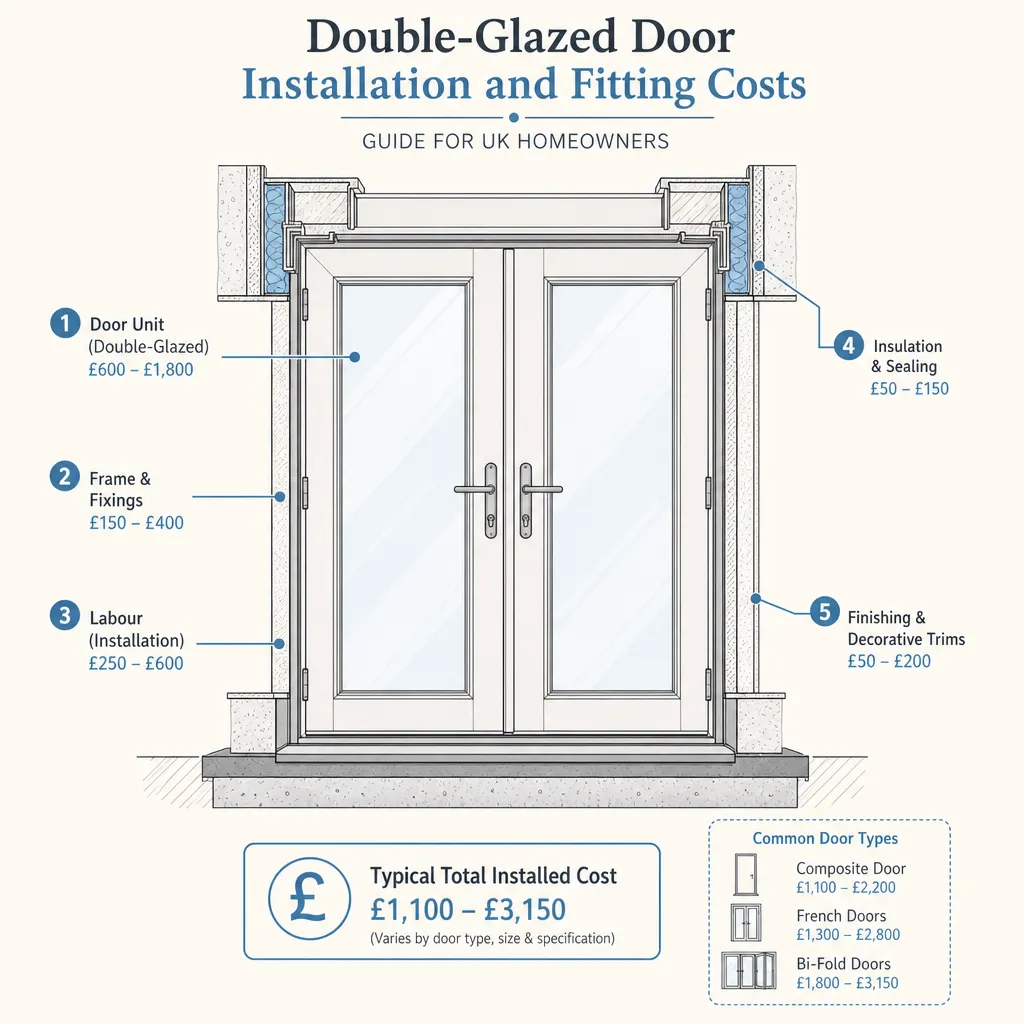
Double-Glazed Door Installation and Fitting Costs
Installing a double-glazed door in the UK typically costs £800–£1,800 for a composite front door, £1,500–£3,000 for French doors, and £2,500–£6,000 or more for bi-fold doors, installed.
 Improvement & Build
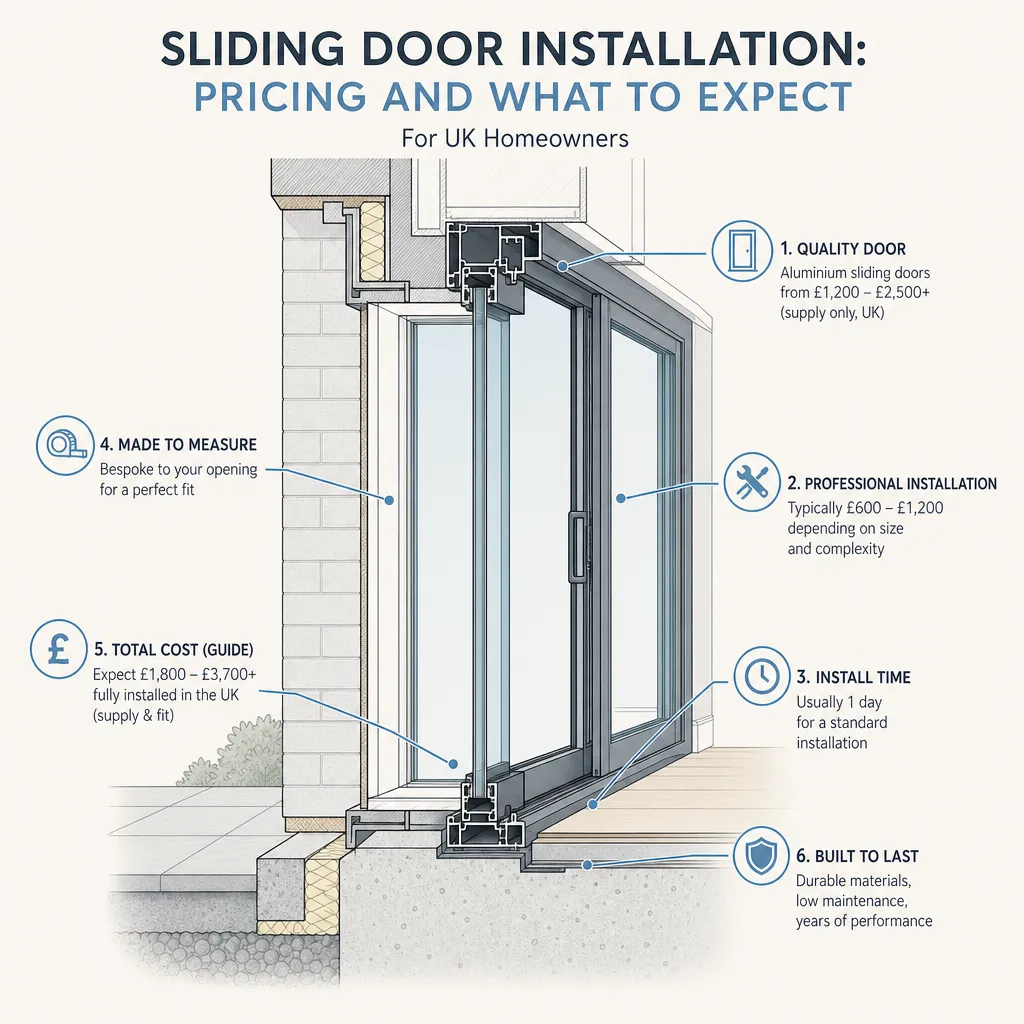
Sliding door installation: pricing and what to expect
A new sliding patio door in the UK typically costs £800–£3,000 fully installed, depending on size, material, and glazing specification.
 Improvement & Build
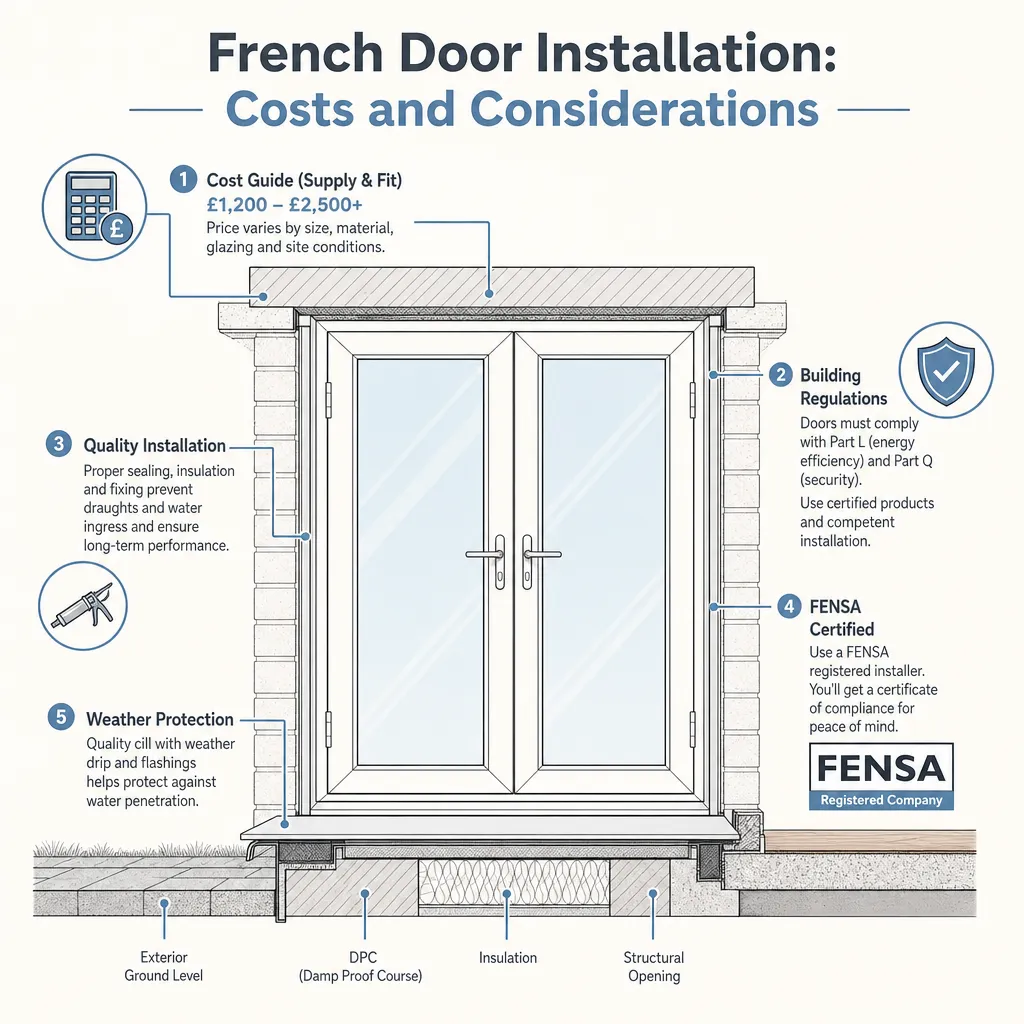
French Door Installation: Costs and Considerations
External French door installation typically costs £1,500–£4,000 in the UK, including supply and fitting, depending on material, glazing specification, and whether structural alterations are needed.
 Improvement & Build
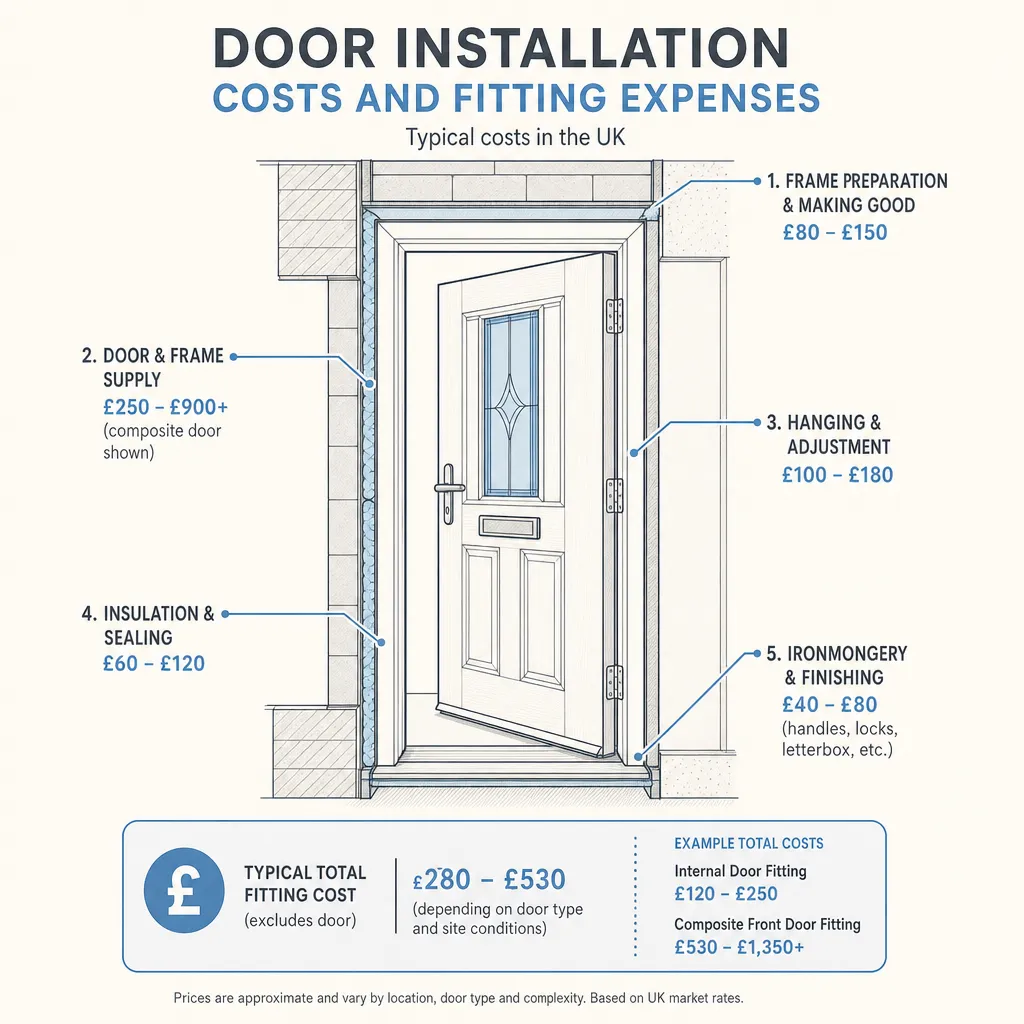
Door Installation Costs and Fitting Expenses
Door installation costs in the UK typically range from £50–£150 labour for an internal door to £400–£900 installed for a UPVC external door, or £800–£2,000+ for a composite front door.
 Improvement & Build
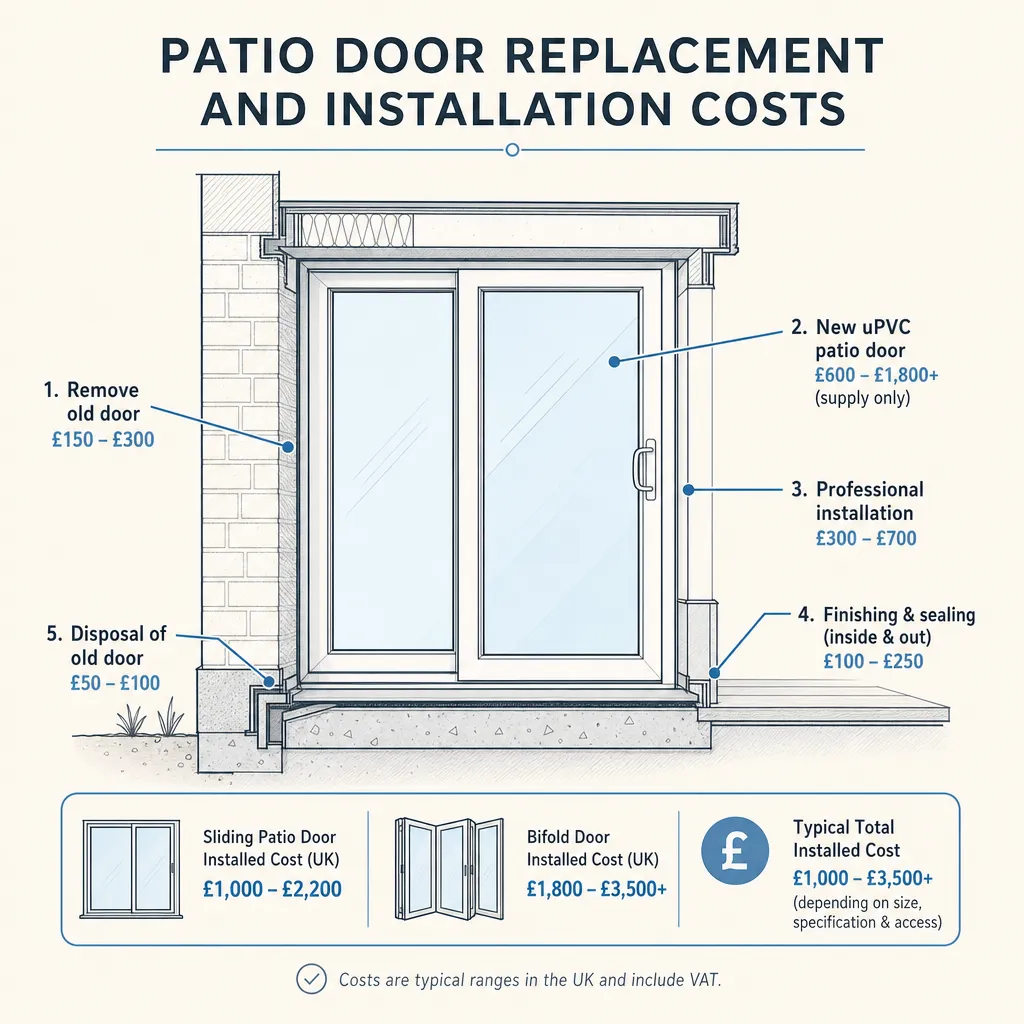
Patio Door Replacement and Installation Costs
Replacing patio doors in the UK typically costs £800–£2,000 installed for a standard uPVC sliding unit, rising to £3,000–£8,000 or more for aluminium bifold doors.