Replacing Sliding Glass Doors: What to Budget and Expect
By Housey · Last reviewed 30th of May 2026
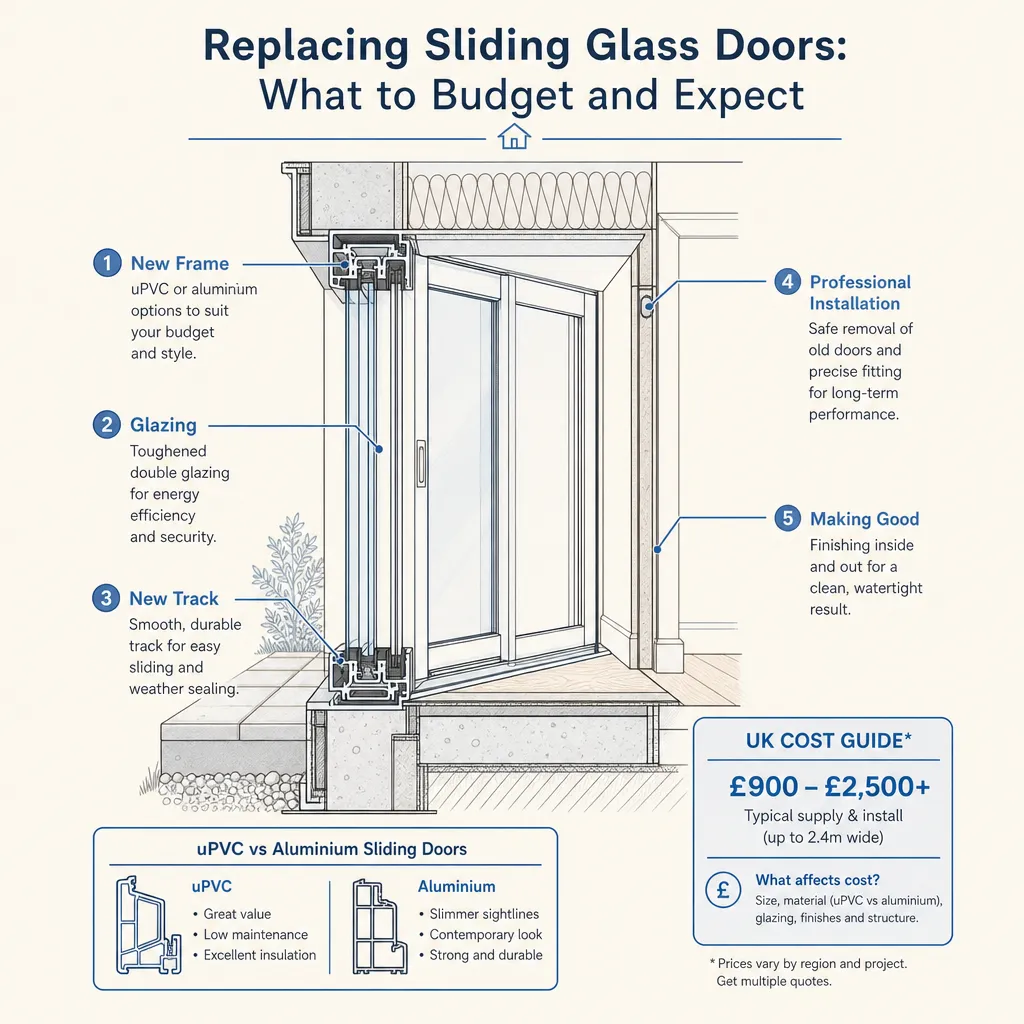
Replacing Sliding Glass Doors: What to Budget and Expect
Sliding glass doors — whether standard patio units or larger multi-panel sliders — are among the more impactful glazing upgrades a homeowner can commission. The decision to replace typically arises when sealed units mist over, frames warp and draughts develop, or when improving a home's energy performance ahead of sale or retrofit. With costs varying widely by specification and configuration, understanding what drives the final figure helps you compare quotes with confidence.
Key points
- Replacement sliding glass doors must meet Building Regulations Part L (conservation of fuel and power), which currently requires whole-unit U-values of 1.4 W/m²K or better in England.
- Work carried out by a FENSA-registered installer is self-certified under Building Regulations — you receive a FENSA certificate needed for conveyancing rather than arranging a separate building control inspection.
- Standard double-glazed uPVC patio doors typically cost £1,500–£2,500 supplied and fitted; aluminium-framed units and wider configurations generally fall in the £2,500–£5,000+ range.
- Toughened or laminated safety glass is required under Approved Document N for doors and critical glazing locations — this is not optional.
- Like-for-like replacement in an existing opening does not usually require planning permission, but listed buildings and conservation areas have additional requirements.
What affects the cost?
Several variables move the final quote significantly.
Frame material
- uPVC — most common, lowest upfront cost, minimal maintenance. Available in white, grey, cream, and woodgrain finishes.
- Aluminium — slimmer sightlines and a wider colour range (RAL palette); typically 30–50% more expensive than equivalent uPVC.
- Timber — preferred for listed buildings and period properties; higher upfront cost and requires repainting or staining every 5–7 years.
Glazing specification
Standard double glazing with a low-emissivity (low-E) coating and argon fill satisfies Part L requirements and is the most commonly quoted option. Triple glazing reduces heat loss further but adds 15–25% to the cost and increases the unit's weight.
Toughened or laminated safety glass is a legal requirement under Approved Document N for glazing in critical locations — patio and sliding doors almost always qualify.
Configuration and size
A standard two-panel slider at approximately 1,800 mm wide costs less than a three- or four-panel configuration. Widening or creating a new structural opening adds significantly to both labour and materials cost.
Indicative costs: supplied and fitted
Configuration | Frame | Indicative cost range |
|---|---|---|
2-panel patio door (~1,800 mm) | uPVC | £1,500–£2,500 |
2-panel patio door (~1,800 mm) | Aluminium | £2,200–£3,800 |
3-panel slider (~2,700 mm) | uPVC | £2,500–£4,000 |
3-panel slider (~2,700 mm) | Aluminium | £3,500–£5,500 |
Timber bespoke slider | Timber | £4,000–£7,000+ |
Indicative UK costs, last reviewed 2026-05-30. Prices vary by region, specification, and access. Obtain at least three itemised quotes.
Do you need planning permission?
Like-for-like replacement of sliding glass doors in an existing opening usually falls within permitted development rights and does not require a planning application. Exceptions apply if:
- The property is in a conservation area and the change would materially alter the appearance of a principal elevation.
- The property is listed — any alteration to glazing requires listed building consent.
- The work involves widening or creating a new structural opening — this requires a Building Regulations application regardless of location.
Check the Planning Portal or your local planning authority if there is any doubt before work begins.
FENSA and building control
Any installer replacing an external door in England or Wales must either be registered with an approved Competent Person Scheme — FENSA and CERTASS are the most widely used for glazing work — or notify building control directly.
Using a FENSA-registered installer:
- Means the work is self-certified against Part L and Part N without a separate building control inspection.
- Generates a FENSA certificate, which you will need when selling the property.
- Provides deposit protection and access to a guarantee scheme.
Verify your installer's registration directly on the FENSA or CERTASS register before work begins.
What to ask before accepting a quote
- Is your company registered with FENSA or CERTASS, or will you notify building control directly?
- What whole-unit U-value does the door achieve, and does it comply with Part L?
- Is the glazing toughened or laminated to satisfy Approved Document N?
- What is the guarantee period for the frame and for the sealed unit?
- Is removal and disposal of the existing door included?
- Is internal and external making-good included in the price?
- Is VAT included in the quoted figure?
- Are there any assumptions in this quote that could change the price or timeline?
When to get professional help
Most sliding glass door replacements are straightforward jobs. However, seek specialist advice if:
- There is cracking, settlement, or movement visible around the existing frame — consult a structural engineer before commissioning any replacement.
- The property is listed or in a conservation area and consent requirements are unclear.
- The installation requires structural alterations to widen or raise the opening.
- You cannot verify your installer's scheme registration — check the FENSA or CERTASS register directly.
How Housey can help
Housey connects homeowners with vetted window and door installers who can assess your opening, confirm regulatory requirements, and provide itemised quotes. Compare up to four FENSA-registered installers in your area before committing to a price.
Frequently asked questions
How long does it take to replace sliding glass doors?
A like-for-like replacement of a standard two-panel patio door typically takes one working day. Larger configurations, or those requiring structural work to alter the opening, may take two to three days. Your installer should be able to confirm a realistic timeline when they carry out a pre-installation survey of the opening.
Do I need a FENSA certificate for a replacement patio door?
If your installer is FENSA-registered, they will issue the certificate automatically — usually within 30 days of completion. Keep it with your property documents, as solicitors will request it during conveyancing when you sell. If no certificate was issued, demonstrating compliance through an alternative route can cause delays at exchange.
Can I replace sliding doors with bifold doors?
Yes, but bifold doors are a different product and often require a wider structural opening, involving a structural engineer's assessment and a Building Regulations application. Installed costs for aluminium bifold doors typically start around £3,000 and can exceed £10,000 for wider configurations.
Will new sliding doors improve my EPC rating?
Replacing old or single-glazed doors with compliant low-E double glazing can improve your property's Energy Performance Certificate rating. The size of the uplift depends on the overall fabric of the property, but a Part L-compliant installation is a positive step toward lower energy losses through the building envelope.
Is triple glazing worth the extra cost for patio doors?
High-quality double glazing with a low-E coating and warm-edge spacer bars satisfies Part L requirements and performs well in most UK homes. Triple glazing offers marginal additional thermal benefit and is most worthwhile in homes undergoing a deeper energy retrofit or in colder regions where large glass areas cause significant heat loss.
Sources and further reading
Useful next reads
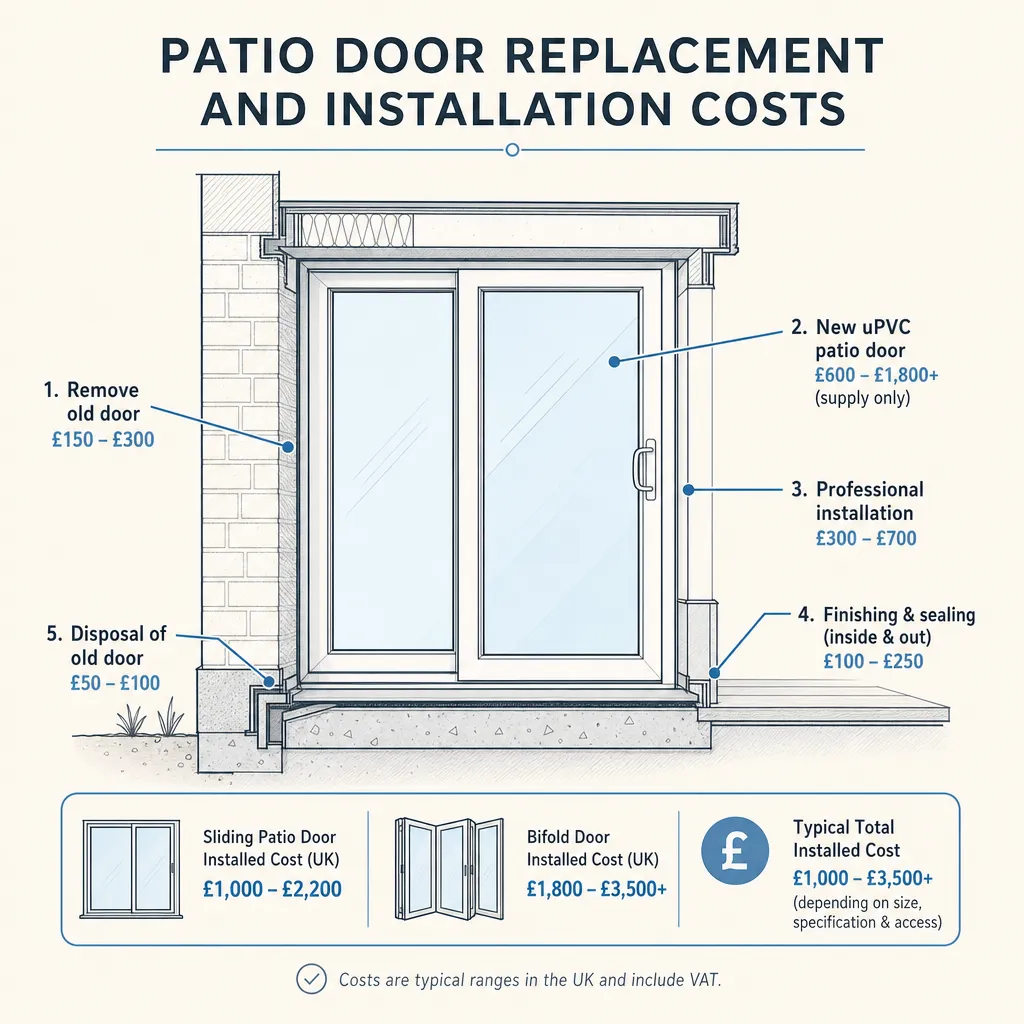 Improvement & Build
Patio Door Replacement and Installation Costs
Replacing patio doors in the UK typically costs £800–£2,000 installed for a standard uPVC sliding unit, rising to £3,000–£8,000 or more for aluminium bifold doors.
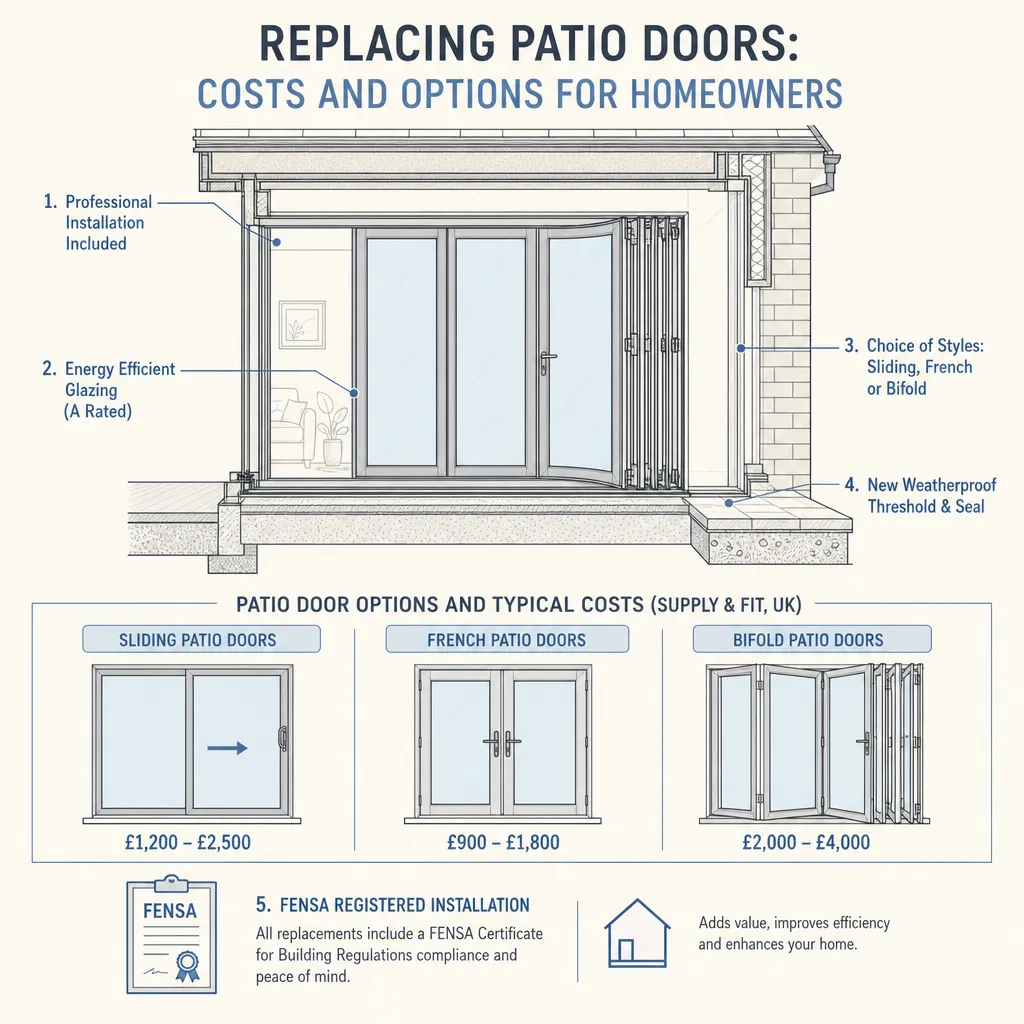 Improvement & Build
Replacing Patio Doors: Costs and Options for Homeowners
Replacing patio doors in the UK costs roughly £1,200–£2,500 for uPVC sliding or French doors, rising to £4,000–£9,000+ for aluminium bifold doors, including supply and installation.
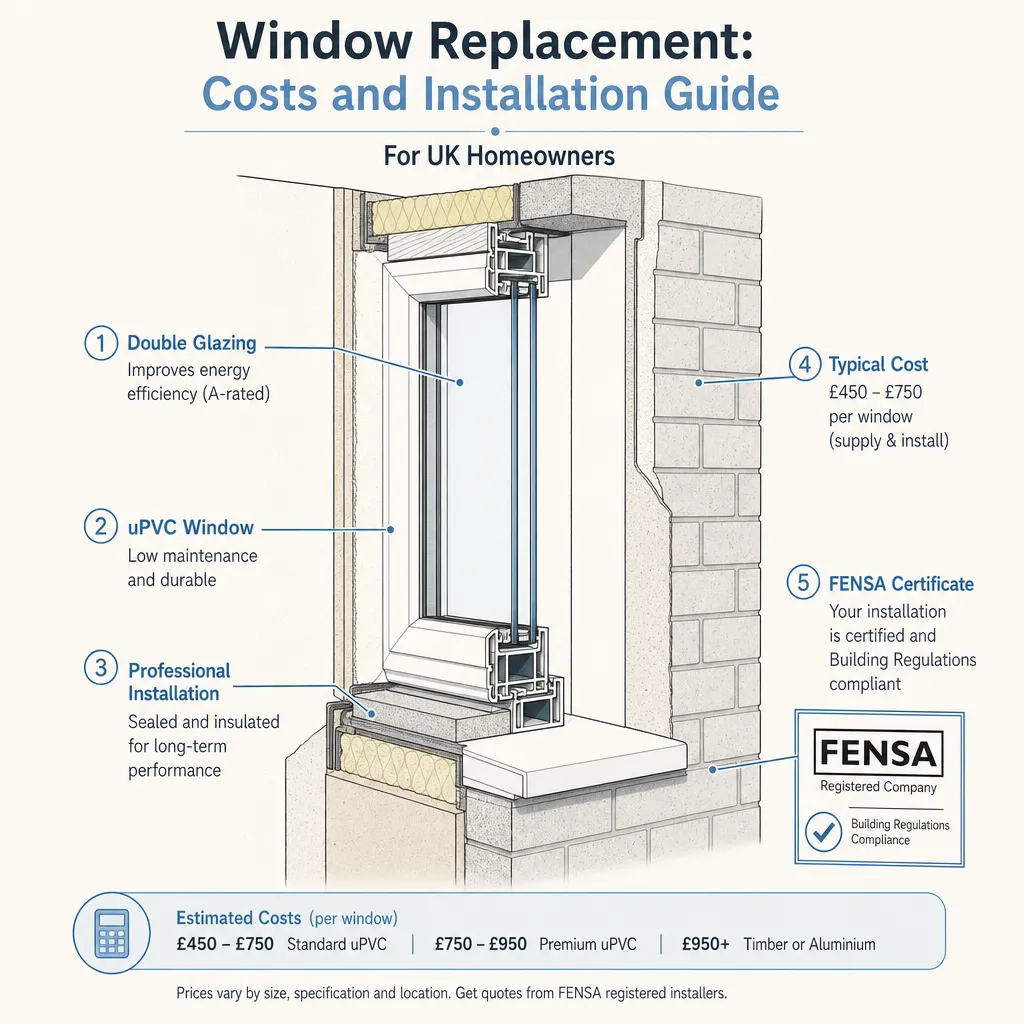 Improvement & Build
Window Replacement: Costs and Installation Guide
Replacing windows in a UK home typically costs £400–£900 per uPVC casement window installed, rising to £1,500–£3,000 for timber sash windows.
 Improvement & Build
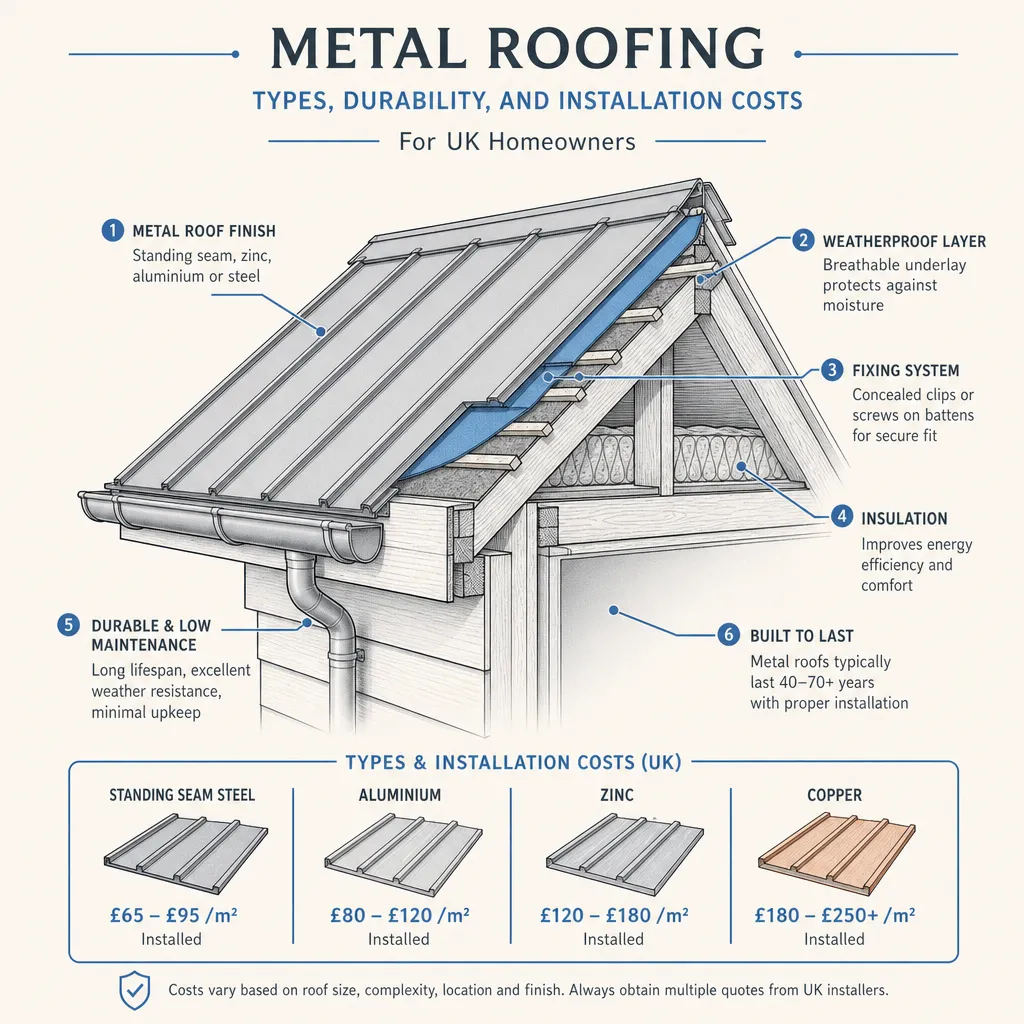
Metal Roofing: Types, Durability, and Installation Costs
Metal roofing in the UK includes standing seam, corrugated sheet, and metal tile systems in steel, aluminium, zinc, or copper.
 Improvement & Build
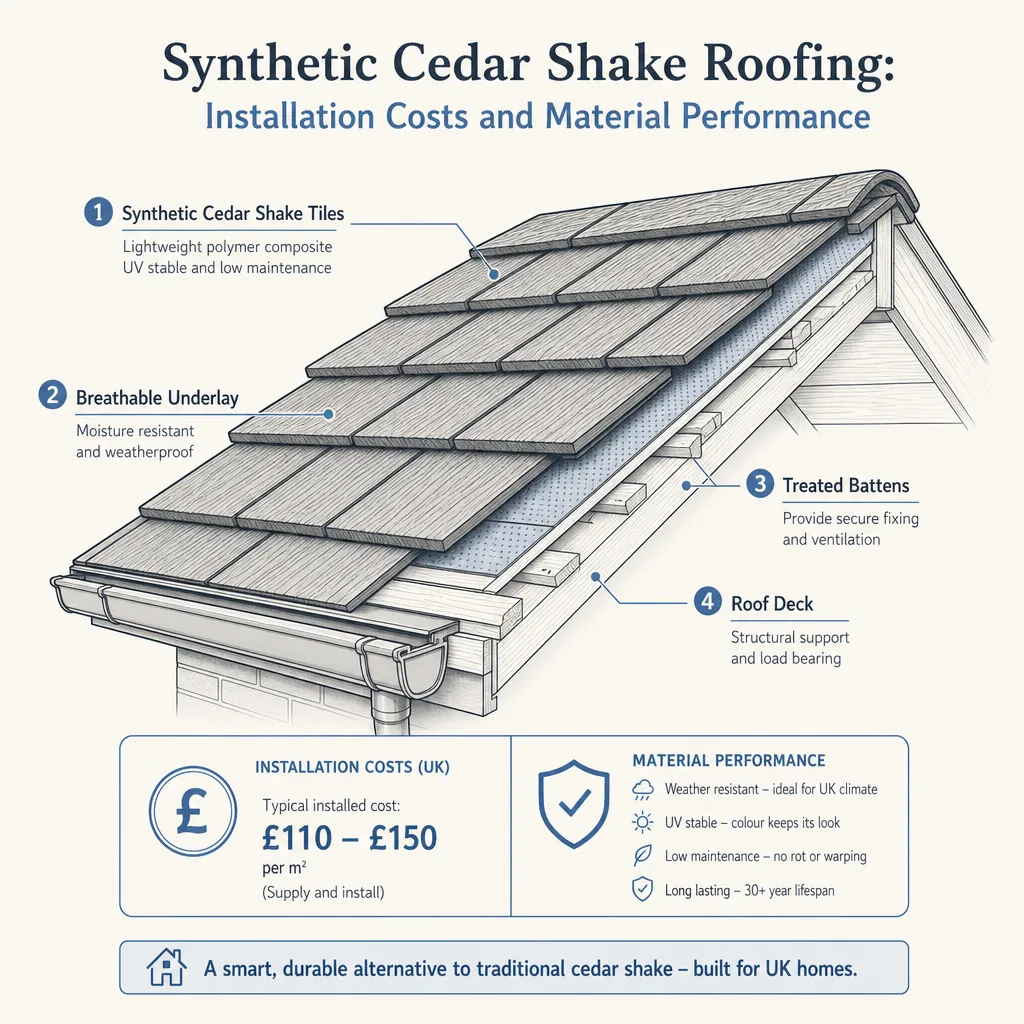
Synthetic Cedar Shake Roofing: Installation Costs and Material Performance
Synthetic cedar shake roofing uses polymer composite, rubber, or fibre-cement tiles to replicate the look of natural cedar wood shingles.