Choosing Replacement Windows: Types, Materials and Performance Standards
By Housey · Last reviewed 1st of June 2026
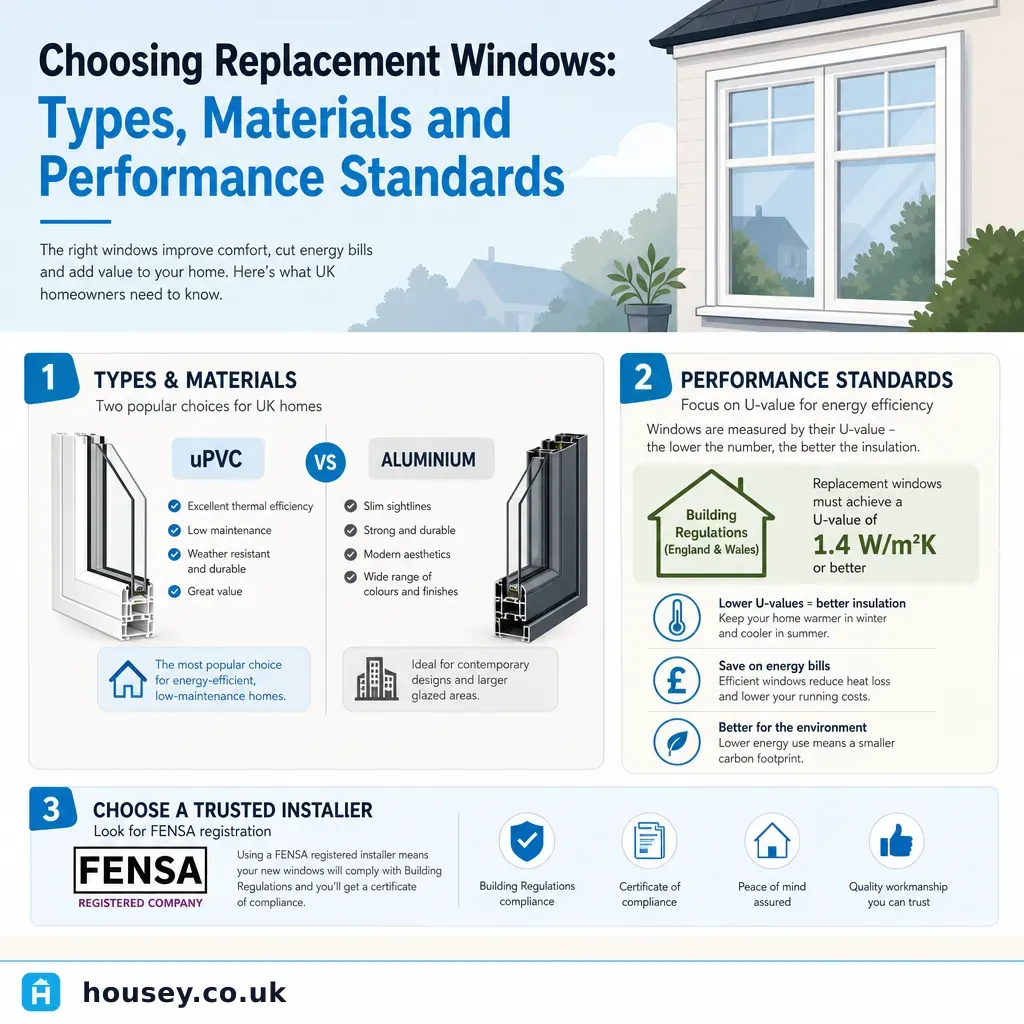
Choosing Replacement Windows: Types, Materials and Performance Standards
Replacing windows is one of the more significant home improvement decisions a UK homeowner faces — typically triggered by failed double-glazing seals, rising energy bills, a property refurbishment, or preparation for sale. The choice of frame material, glazing configuration, and installer certification has direct consequences for energy performance, planning compliance, and long-term maintenance. The right answer varies considerably between a 1930s semi, a Victorian terrace, and a 1990s new-build.
Key points
- Replacement windows must achieve a whole-window U-value of ≤1.6 W/m²K under Building Regulations Approved Document L (2022 edition).
- FENSA- or CERTASS-registered installers can self-certify compliance with Building Regulations, removing the need for a separate building control application.
- Window Energy Ratings (WER) run from A++ to E; most mainstream double-glazed products achieve A or A+.
- Replacing windows in a listed building or within a conservation area may require planning permission or listed building consent — permitted development rights often do not apply.
- Triple glazing typically achieves whole-window U-values of 0.8–1.2 W/m²K, compared with 1.2–1.6 W/m²K for quality double glazing with a warm-edge spacer and argon fill.
Which glazing configuration should you choose?
Most replacement windows are double-glazed units (two panes of glass with a sealed air or gas gap). Triple glazing offers improved thermal performance and noise reduction but costs 20–40% more and adds weight that affects frame and hinge specifications.
Double glazing remains the standard for the majority of UK homes. A modern unit with a warm-edge spacer bar, an argon or krypton gas fill between panes, and a low-emissivity (low-e) coating on the inner face of the outer pane can achieve a centre-pane U-value of around 1.0–1.1 W/m²K and a whole-window U-value (including the frame) of 1.2–1.6 W/m²K, comfortably meeting Part L requirements.
Triple glazing makes most sense in exposed locations, high-altitude properties, or where external noise is a primary concern. The additional weight — typically 25–35% heavier than an equivalent double-glazed unit — requires appropriately specified frames and may affect sash balance mechanisms in timber sash windows.
Secondary glazing — a separate internal panel fitted inside an existing single-glazed frame — is often the preferred option for listed buildings or conservation-area properties where the external appearance must not change.
Which frame material is right for your home?
The four mainstream frame materials each suit different property types, budgets, and planning contexts.
Frame material | Best for | Less ideal for | Maintenance | Typical lifespan | Planning note |
|---|---|---|---|---|---|
uPVC | Most post-1960s homes; budget-conscious refurbishments | Listed buildings; properties where white plastic raises conservation concerns | Very low (wipe clean) | 20–35 years | Generally acceptable under permitted development |
Timber | Victorian and Edwardian terraces; conservation areas; listed buildings | Low-maintenance priorities | Painting or staining every 5–8 years | 40–80+ years with maintenance | Often required in conservation areas and listed buildings |
Aluminium | Contemporary extensions; large apertures; minimal sight-lines | Budget projects | Low (powder-coated finish) | 30–45 years | Check with LPA in conservation areas |
Composite (timber-aluminium) | Traditional external look with low maintenance | Tight budgets | Low externally, slightly more internally | 30–50 years | Often acceptable where timber appearance is required externally |
Indicative UK costs, last reviewed 2026-06-01. Frame costs vary significantly by window size, configuration, and installer. Always obtain at least three quotes.
Building Regulations and installer certification
Any replacement window or external door in England is notifiable work under Building Regulations. Homeowners have two compliance routes:
- Use a FENSA or CERTASS registered installer. The installer self-certifies that the installation meets Part L thermal performance requirements and issues a compliance certificate. You should receive this within 30 days of installation; retain it as it will be required when selling the property.
- Apply to your local building control body. If your installer is not registered with a competent-person scheme, you or they must apply for building control approval before work starts and arrange an inspection.
FENSA (Fenestration Self-Assessment Scheme) and CERTASS are the two main competent-person schemes in England. Scotland, Wales, and Northern Ireland operate separate building control regimes — check with the relevant authority.
Planning permission and conservation areas
Replacing windows in a standard residential property in England is usually permitted development — no planning permission is required provided the replacement is similar in appearance to the original. However, permitted development rights do not apply if:
- the property is listed (Grade I, II* or II) — listed building consent is required;
- the property is in a conservation area and windows are visible from a public highway — an Article 4 Direction may have removed permitted development rights;
- the property is a flat — flats have more restricted permitted development rights.
Always check with your Local Planning Authority (LPA) before ordering windows for a listed or conservation-area property. Historic England publishes guidance on appropriate window specification for historic buildings.
What to check before you order — homeowner checklist
Choosing your window type: decision guide
- Choose uPVC if your home is post-1960s, not listed or in a conservation area, and you want low maintenance and competitive pricing.
- Choose timber if your home is Victorian, Edwardian, or in a conservation area, or if the local authority requires it for planning reasons.
- Choose aluminium or slimline aluminium if you are fitting large glazed areas, a feature window, or a contemporary extension requiring narrow sight-lines.
- Choose composite if you want a traditional external appearance without the maintenance burden of solid timber.
- Ask a window specialist or conservation officer if the property is listed, in a conservation area, or has non-standard aperture shapes.
- Check your LPA if you are unsure whether permitted development rights apply to your property.
When to get professional help
Most window replacements are straightforward when carried out by a FENSA or CERTASS registered installer. Seek specialist advice if:
- the property is listed or in a conservation area and you are unsure which materials or profiles are acceptable;
- you are replacing bay or bow windows with complex structural heads that may need a structural assessment;
- existing frames show evidence of damp penetration, rot to structural lintels, or cracked render — these may indicate problems beyond the window itself;
- the building uses non-standard construction (timber frame, insulated concrete formwork, or solid brick with no cavity) where water management detailing around the new frame is critical.
How Housey can help
Housey connects homeowners with vetted window and door installers who hold FENSA or CERTASS registration and can advise on frame materials, glazing specifications, and compliance with local planning requirements — including conservation area and listed building constraints.
Frequently asked questions
Do I need planning permission to replace my windows in England?
In most cases, no. Replacing windows in a standard house is permitted development provided the new windows are similar in appearance to the originals. However, if the property is listed, in a conservation area with an Article 4 Direction, or is a flat, you may need planning permission or listed building consent. Always check with your Local Planning Authority before ordering.
What is the minimum U-value for replacement windows under Building Regulations?
Building Regulations Approved Document L (2022) requires replacement windows in England to achieve a whole-window U-value of 1.6 W/m²K or better. Many modern double-glazed units achieve 1.2–1.4 W/m²K; triple-glazed units can reach 0.8–1.0 W/m²K. Always ask for the whole-window figure, not just the centre-pane value.
What is a FENSA certificate and why does it matter when selling?
A FENSA certificate confirms that replacement windows were installed by a registered competent-person scheme member and self-certified as compliant with Building Regulations. Solicitors routinely request it during a property sale; missing certificates can delay or complicate conveyancing. Keep the original safe in your property documents.
How long do uPVC windows typically last?
Quality uPVC windows generally last 20–35 years before frames or sealed units begin to degrade. Condensation or fogging between the panes indicates a failed seal; in many cases the sealed glass unit can be replaced without changing the outer frame, which is a more cost-effective repair.
Sources and further reading
- Building Regulations Approved Document L (2022) — GOV.UK
- FENSA homeowner information — FENSA
- Planning Portal: windows guidance — Planning Portal
- Windows in historic buildings — Historic England
- Windows and doors energy advice — Energy Saving Trust
Useful next reads
 Improvement & Build
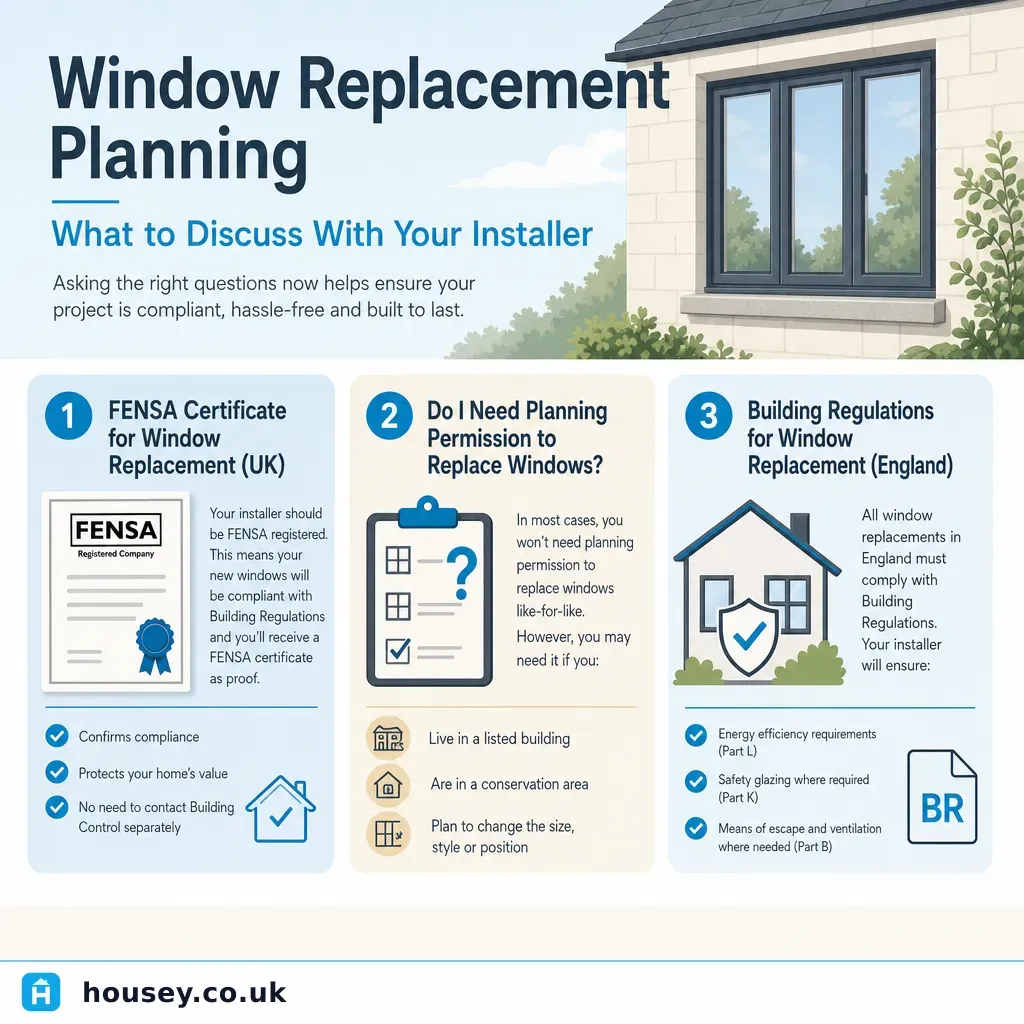
Window Replacement Planning: What to Discuss With Your Installer
Most window replacements in England fall under permitted development rights and do not require planning permission, but they must comply with Building Regulations Part L and Part K.
 Improvement & Build
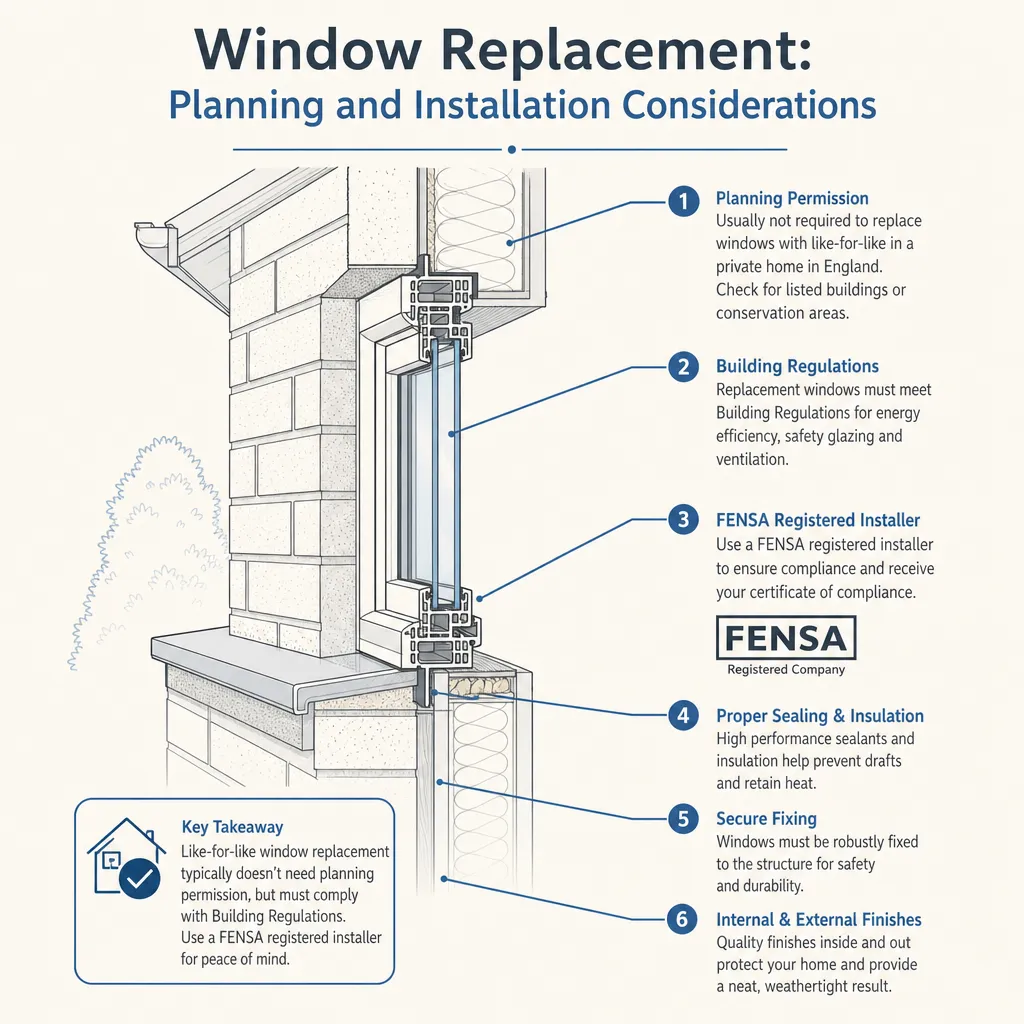
Window Replacement: Planning and Installation Considerations
Most window replacements in England fall under permitted development and do not need planning permission, though listed buildings, flats, and conservation areas are exceptions.
 Improvement & Build
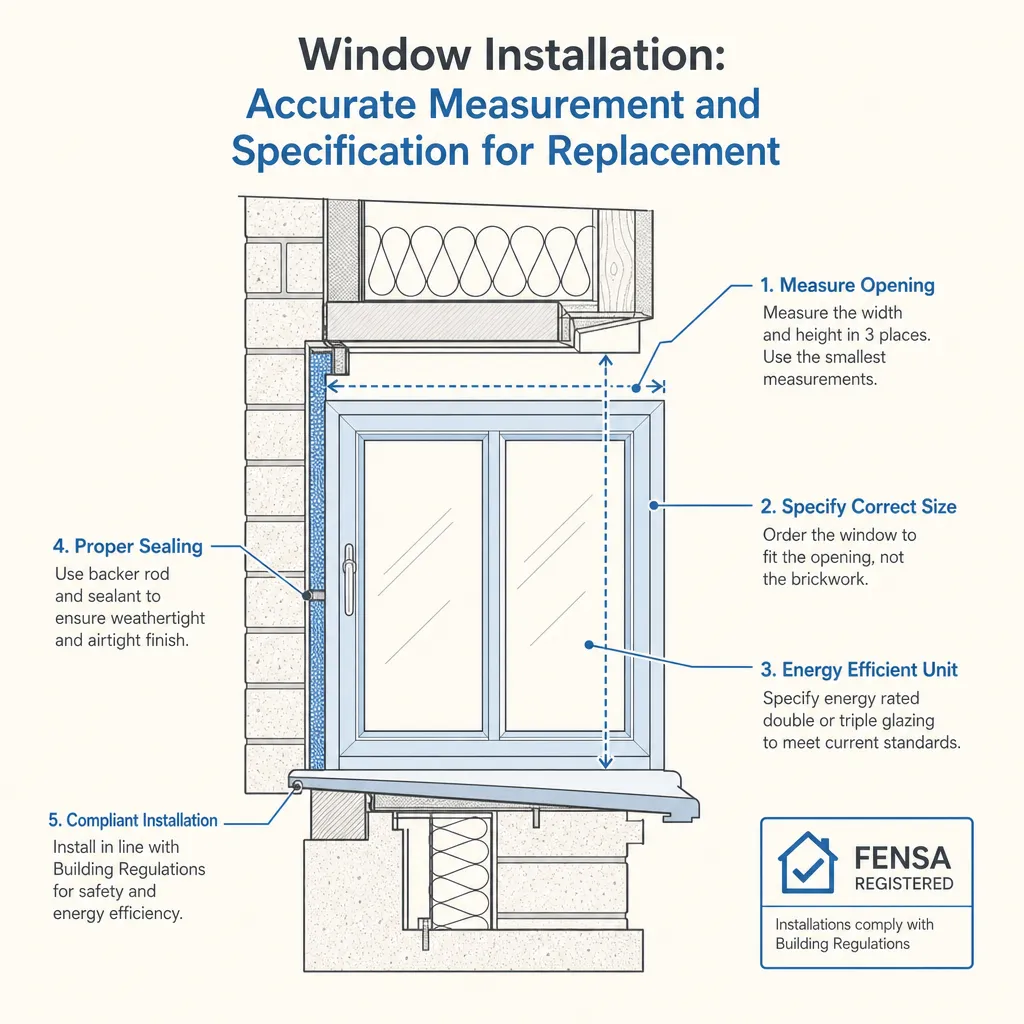
Window Installation: Accurate Measurement and Specification for Replacement
Accurate window measurement for replacement means recording the width and height of the existing frame opening in at least three places, noting the smallest dimension, and providing a full specification to your installer — including frame material, glazing type, opening style, and trickle ventilators.
 Improvement & Build
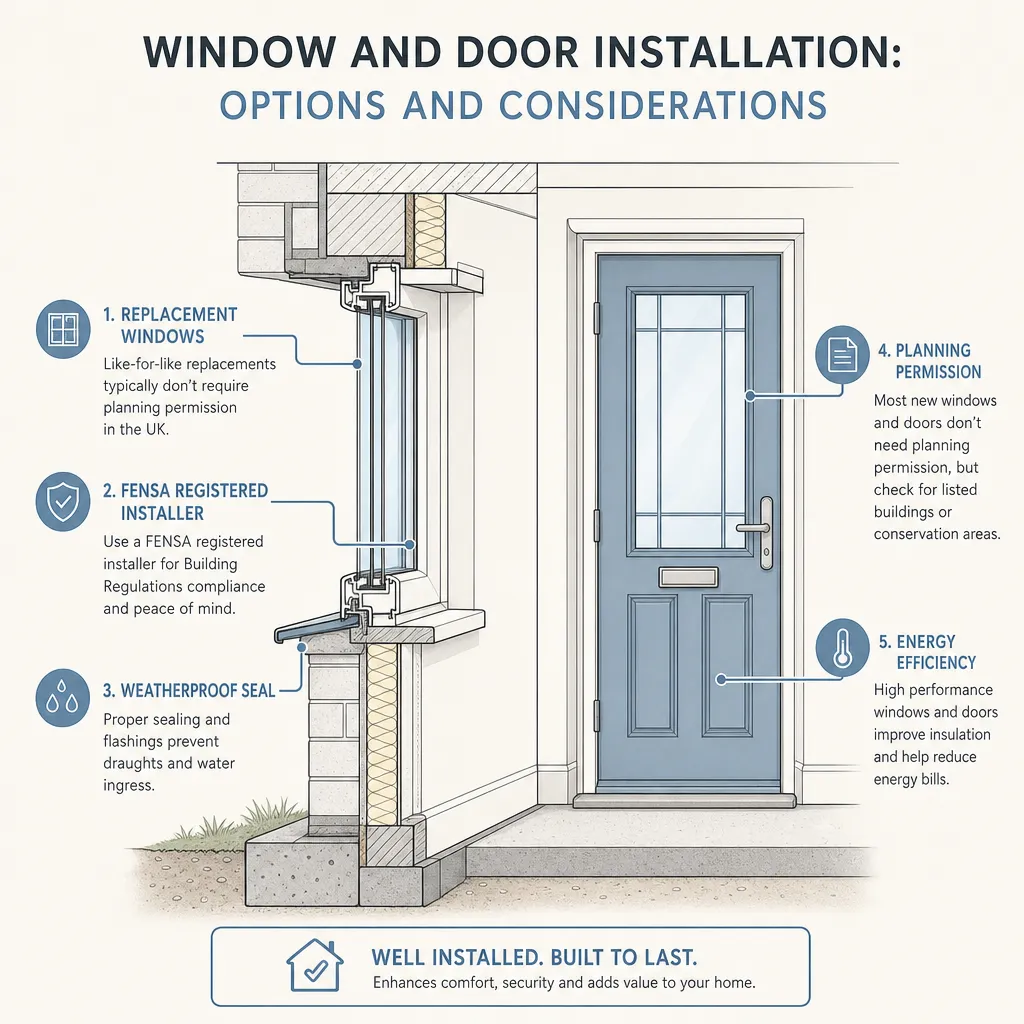
Window and Door Installation: Options and Considerations
Replacing windows and external doors in the UK requires compliance with Building Regulations Part L (thermal performance) and Part K (safety glazing).
 Improvement & Build
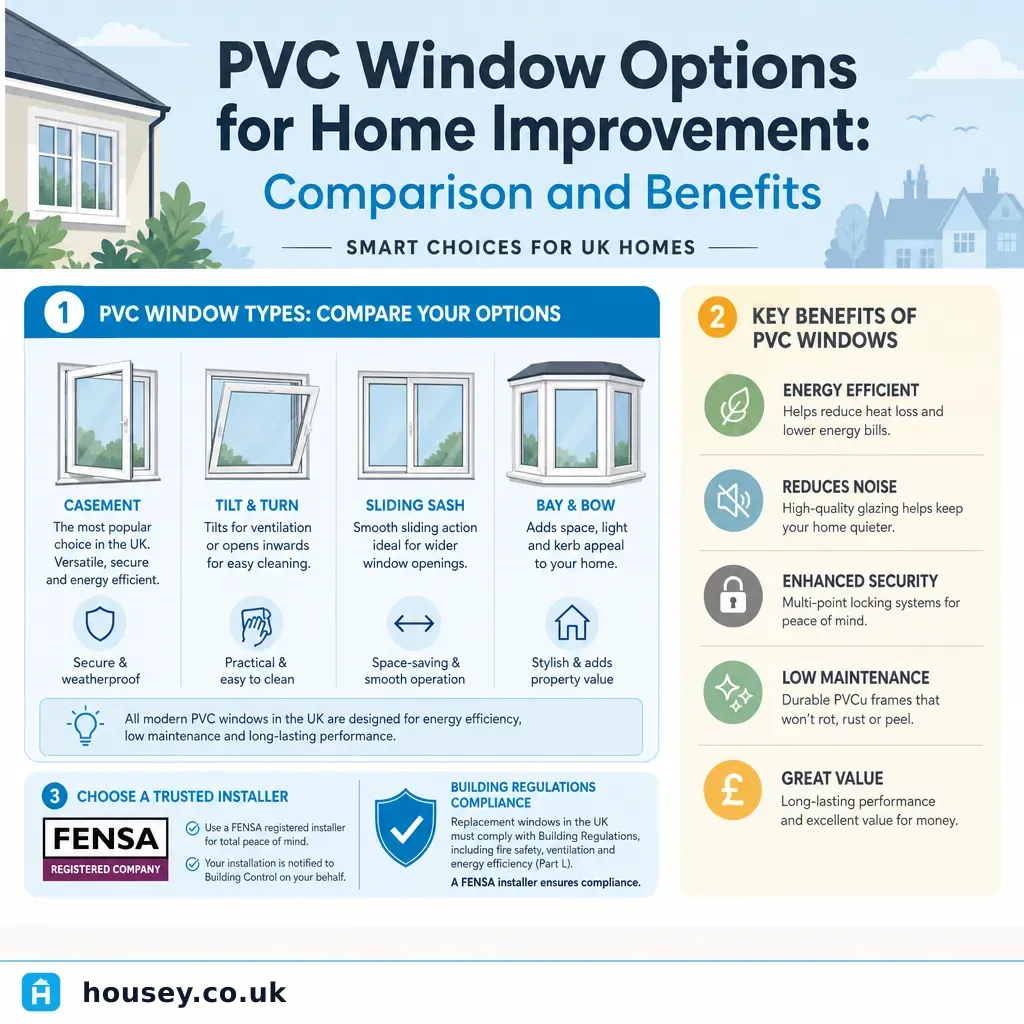
PVC Window Options for Home Improvement: Comparison and Benefits
uPVC (unplasticised PVC) is the most widely fitted material for replacement windows in UK homes, combining low maintenance with good thermal performance.