PVC Window Options for Home Improvement: Comparison and Benefits
By Housey · Last reviewed 11th of May 2026
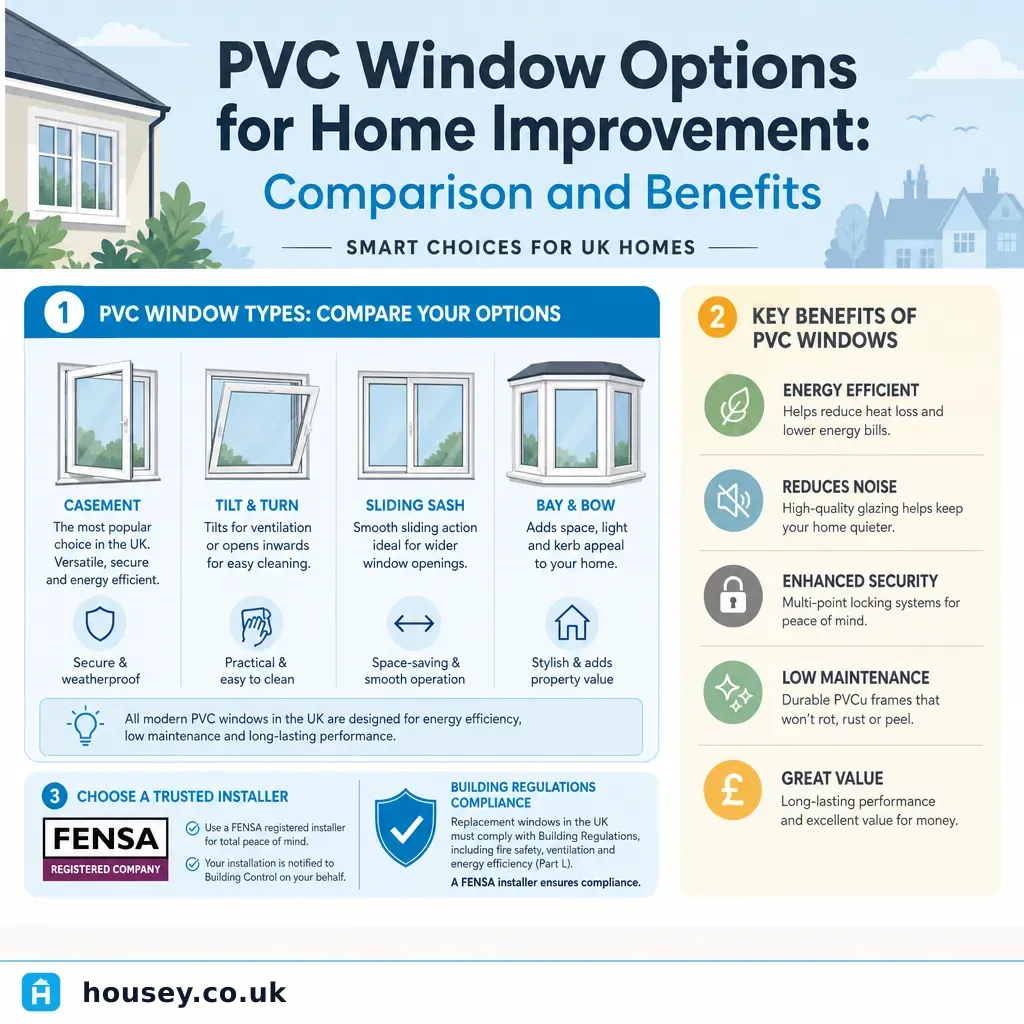
PVC Window Options for Home Improvement: Comparison and Benefits
Replacing windows is one of the most common home improvement projects in the UK, and PVC — more precisely, uPVC (unplasticised polyvinyl chloride) — accounts for the majority of residential replacement installations. Whether you're updating a 1970s property with single-glazed timber frames or replacing misted sealed units in a 1990s estate house, the choice of window style, specification, and installer affects energy performance, planning compliance, and long-term maintenance in ways that are worth understanding before you place an order.
Key points
- Replacement windows in England must achieve a minimum whole-window U-value of 1.4 W/m²K under Building Regulations Approved Document L (2022 edition); Scotland, Wales, and Northern Ireland have separate but comparable requirements.
- FENSA and CERTASS are the two main government-authorised competent person schemes for window installation — registered installers self-certify compliance with Building Regulations and issue a compliance certificate automatically, without requiring a separate building control application.
- The British Fenestration Rating Council (BFRC) Window Energy Rating (WER) uses an A–G scale; most modern uPVC double-glazed units achieve a B or A rating, and triple glazing can achieve A+.
- In conservation areas and for listed buildings, uPVC is often prohibited; the local planning authority (LPA) may specify timber or slim aluminium profiles instead, and conservation area consent or listed building consent may be required.
- Where existing windows include trickle ventilators, Approved Document F requires replacement windows to include them as well, unless the installer can demonstrate adequate alternative ventilation provision.
What does uPVC mean, and why is it the standard?
Standard PVC contains plasticisers that keep it flexible — unsuitable for structural window frames. uPVC has those plasticisers removed, making it rigid, dimensionally stable, and weatherproof without painting. It dominates the UK replacement window market for practical and cost reasons.
The main advantages for homeowners:
- Low maintenance: uPVC does not need painting, staining, or sealing. Periodic cleaning with warm soapy water is usually sufficient.
- Cost: uPVC is typically less expensive per unit than aluminium or timber for an equivalent glazing specification.
- Thermal performance: modern multi-chambered uPVC profiles combined with argon-filled double or triple glazing comfortably meet Part L thresholds.
- Security: most uPVC frames are supplied with, or designed to accept, multi-point locking mechanisms.
The main limitations:
- uPVC sight-lines are generally wider than those achievable with slim aluminium systems, which can affect the look of contemporary or large-glazed designs.
- Dark foil-wrapped colours absorb more solar heat and may fade more noticeably over time than lighter finishes.
- Planning authorities in conservation areas and for listed buildings routinely refuse uPVC on appearance grounds, as it does not replicate the profile or finish of original painted timber joinery.
uPVC window styles compared
Style | Opening method | Best for | Not ideal for |
|---|---|---|---|
Casement | Hinged outward (or inward) on side, top, or both | Most UK house types; straightforward ventilation control | Where outward projection is restricted, such as over a pavement or pathway |
Tilt-and-turn | Tilts inward at top for ventilation; opens fully inward for cleaning | Flats and upper floors; cleaning external glass from inside | Where inward swing would obstruct curtains, blinds, or furniture close to the window |
Vertical sliding sash | Two sashes slide vertically; traditional appearance | Victorian, Edwardian, and Georgian properties with original sash openings | Budget-priority projects where a casement offers equivalent performance at lower cost |
Bay configuration | Multiple windows set at angles to project from the wall | Front reception rooms in period and 1930s semis with existing bay openings | Where no bay projection exists and structural alteration would be needed |
Fixed light | Non-opening panel; admits light only | Rooms where ventilation is provided through other openings | Any room that requires openable ventilation under Approved Document F |
Building Regulations and certification
Replacing windows in England requires compliance with Building Regulations Approved Document L (thermal performance) and Approved Document F (ventilation). In practice, this means:
- Use a FENSA or CERTASS registered installer. They self-certify that the installation meets Building Regulations and issue a compliance certificate. Conveyancers routinely request this certificate when a property is sold — missing certificates can delay or complicate a transaction.
- If using a non-registered installer, either the homeowner or the installer must submit a building notice or full plans application to the local authority building control (LABC) department before work starts, and a building control officer must inspect and certify the completed installation.
- Trickle ventilators: if your existing windows have trickle vents, the replacement windows must include them. Omitting ventilation provision without compensating elsewhere is a common non-compliance issue that can create problems at resale.
Indicative cost of the building control route for non-registered installers: approximately £200–£400 to the local authority (indicative UK costs, last reviewed 2026-05-11). FENSA and CERTASS registered installers absorb this within their service.
Planning permission and conservation areas
Most like-for-like window replacements in England fall within permitted development and do not need a planning application. Key exceptions:
- Conservation areas: replacing windows visible from a highway often requires conservation area consent or full planning permission. Many councils specifically require timber or slim aluminium and will refuse uPVC outright.
- Listed buildings: listed building consent is required for any change to windows, with materials and profiles expected to match or be sympathetic to the original fabric of the building.
- Article 4 Directions: some local authorities withdraw permitted development rights for specific streets or areas, meaning planning permission is required for changes that would otherwise be routine.
Always confirm your planning position with the LPA in writing before placing an order. In ambiguous cases, a Lawful Development Certificate provides written confirmation that work is permitted development.
Decision tree: which uPVC window style should you choose?
- Choose casement if you want the most cost-effective, widely available option suited to most UK house types and you have no planning restrictions.
- Choose tilt-and-turn if you live in a flat, need to clean external glass from inside, or want a wide-opening ventilation option without a sash projecting outward.
- Choose vertical sliding sash if your property has traditional sash openings and uPVC is acceptable to your local planning authority.
- Choose bay configuration if you are replacing an existing bay window and want to retain projection and character with minimal ongoing maintenance.
- Consult your local planning authority or conservation officer before specifying any material if the property is listed, in a conservation area, or subject to an Article 4 Direction.
What to ask before accepting a quote
- Is VAT included in the quoted price?
- Are you registered with FENSA or CERTASS, and will you issue a compliance certificate on completion?
- What whole-window U-value and BFRC Window Energy Rating does the specified unit achieve?
- Are trickle ventilators included, and do they meet Approved Document F requirements?
- What is the profile system (manufacturer and series), and what warranties apply to the profiles and sealed units separately?
- What is the lead time, and what is the procedure if a unit arrives damaged on delivery?
- Does the price include removing and disposing of the existing frames?
- What happens if access issues or structural surprises are found on the day of installation?
How Housey can help
Housey connects homeowners with vetted window and door installers who can advise on specification, confirm FENSA or CERTASS registration, and provide itemised quotes for uPVC and alternative window installations across the UK.
Frequently asked questions
Do I need planning permission to replace my windows with uPVC?
Most like-for-like replacements in England are permitted development and don't require a planning application. However, conservation areas, listed buildings, and Article 4 Direction areas are exceptions where planning permission or conservation area consent is required. Scotland and Wales have separate rules. Always confirm with your local planning authority before ordering if you are in any doubt.
How long do uPVC windows last?
Quality uPVC profiles typically last 20–35 years before significant discolouration or distortion occurs. Sealed double-glazed units generally last 15–25 years before misting between panes indicates unit failure. Hinges, handles, and locking mechanisms may need attention or replacement sooner, though parts are usually straightforward to source and swap.
Can uPVC windows be repainted?
Standard uPVC cannot be painted reliably with ordinary paints. Specialist adhesion primers and uPVC-specific paints exist but results are rarely as durable as factory-applied foil finishes. If colour matters, ordering factory-coloured or foil-wrapped profiles at installation is far more reliable than attempting to paint frames later.
What is the difference between double and triple glazing for uPVC windows?
Double glazing typically achieves a whole-window U-value of around 1.2–1.6 W/m²K; triple glazing usually reaches 0.6–0.9 W/m²K. The incremental energy saving from triple over double has a long payback period for most UK homes. Triple glazing is more beneficial in very exposed locations or where noise reduction is also a priority alongside thermal performance.
Sources and further reading
- Approved Document L — Conservation of fuel and power (England, 2022) — GOV.UK
- FENSA homeowner guide to replacement windows and doors — FENSA
- British Fenestration Rating Council — Window Energy Ratings — BFRC
- Planning permission for windows, doors, and rooflights — Planning Portal
- Double glazing and windows: energy guidance — Energy Saving Trust
Useful next reads
 Improvement & Build
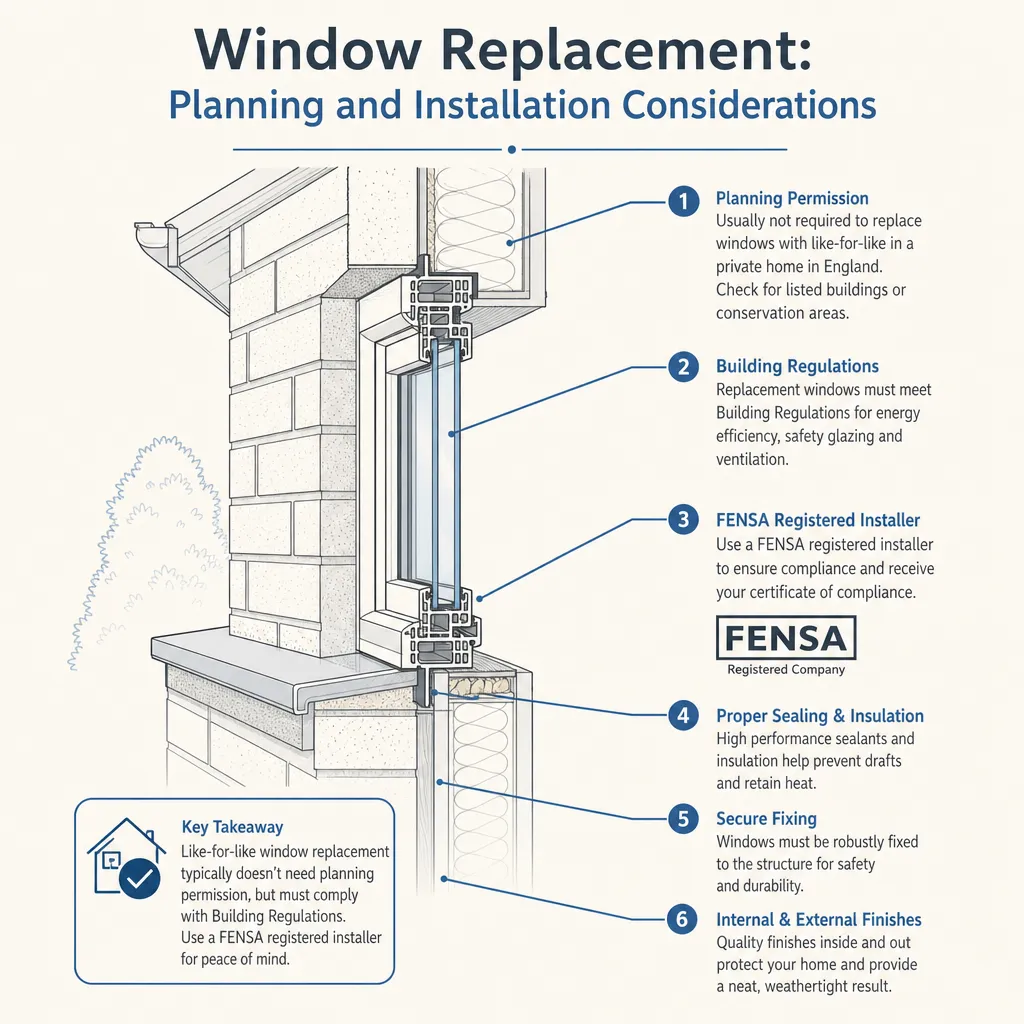
Window Replacement: Planning and Installation Considerations
Most window replacements in England fall under permitted development and do not need planning permission, though listed buildings, flats, and conservation areas are exceptions.
 Improvement & Build
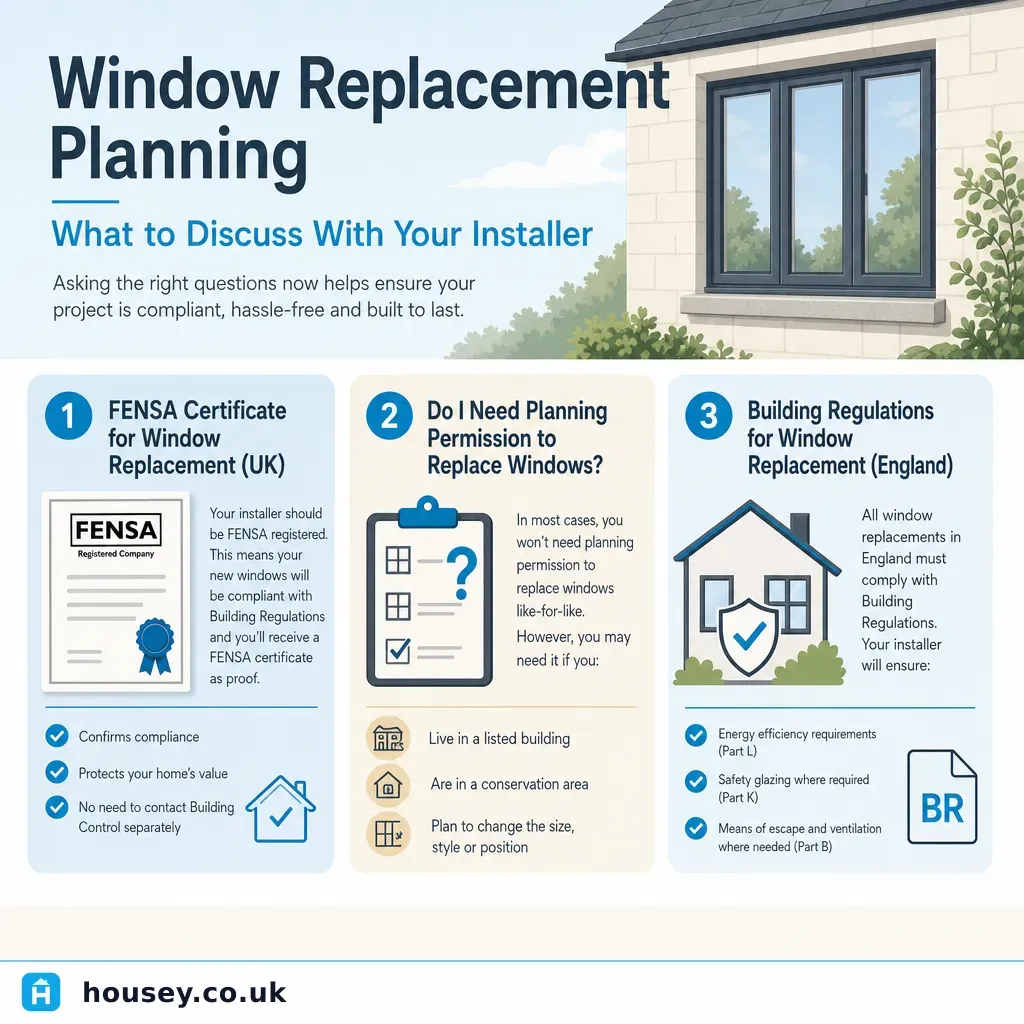
Window Replacement Planning: What to Discuss With Your Installer
Most window replacements in England fall under permitted development rights and do not require planning permission, but they must comply with Building Regulations Part L and Part K.
 Improvement & Build
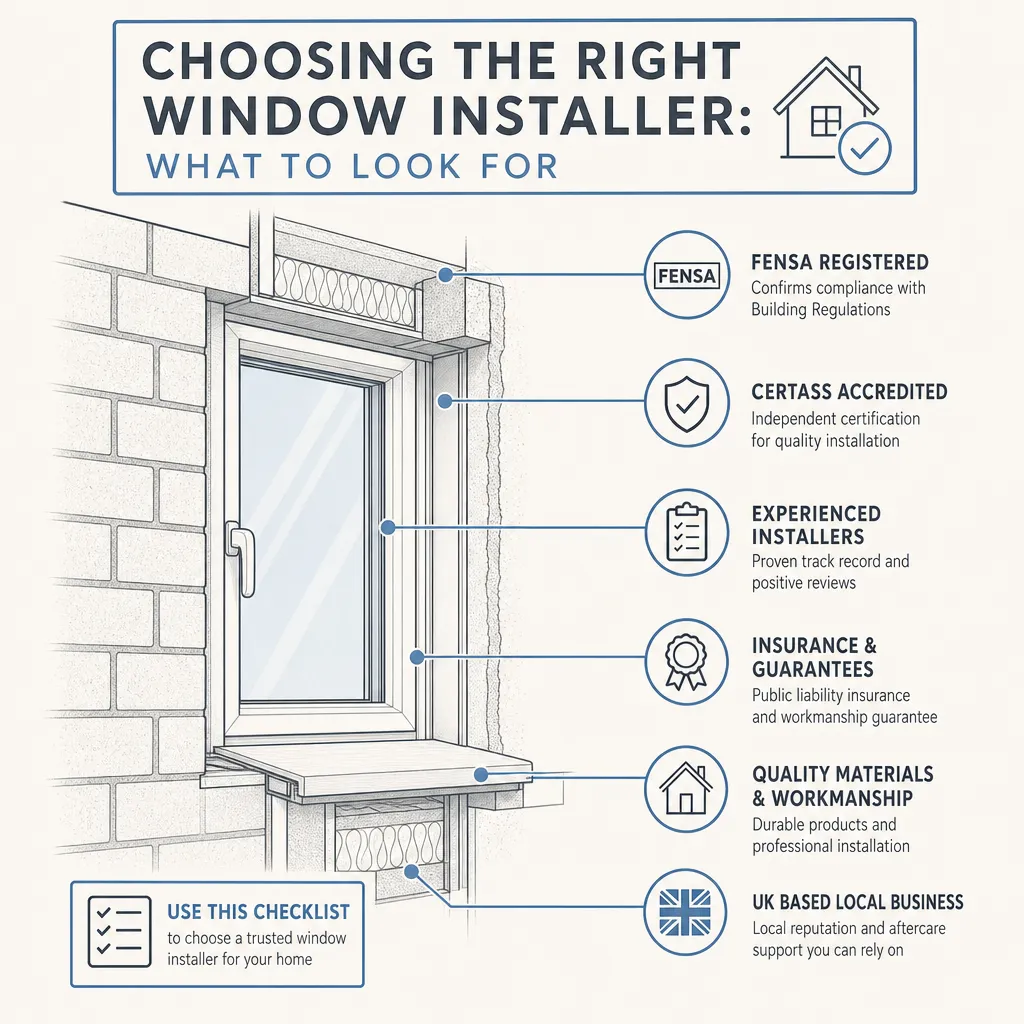
Choosing the Right Window Installer: What to Look For
When choosing a window installer in the UK, verify FENSA or CERTASS registration first — these schemes allow installers to self-certify Building Regulations compliance and issue the completion certificate you will need at resale.
 Improvement & Build
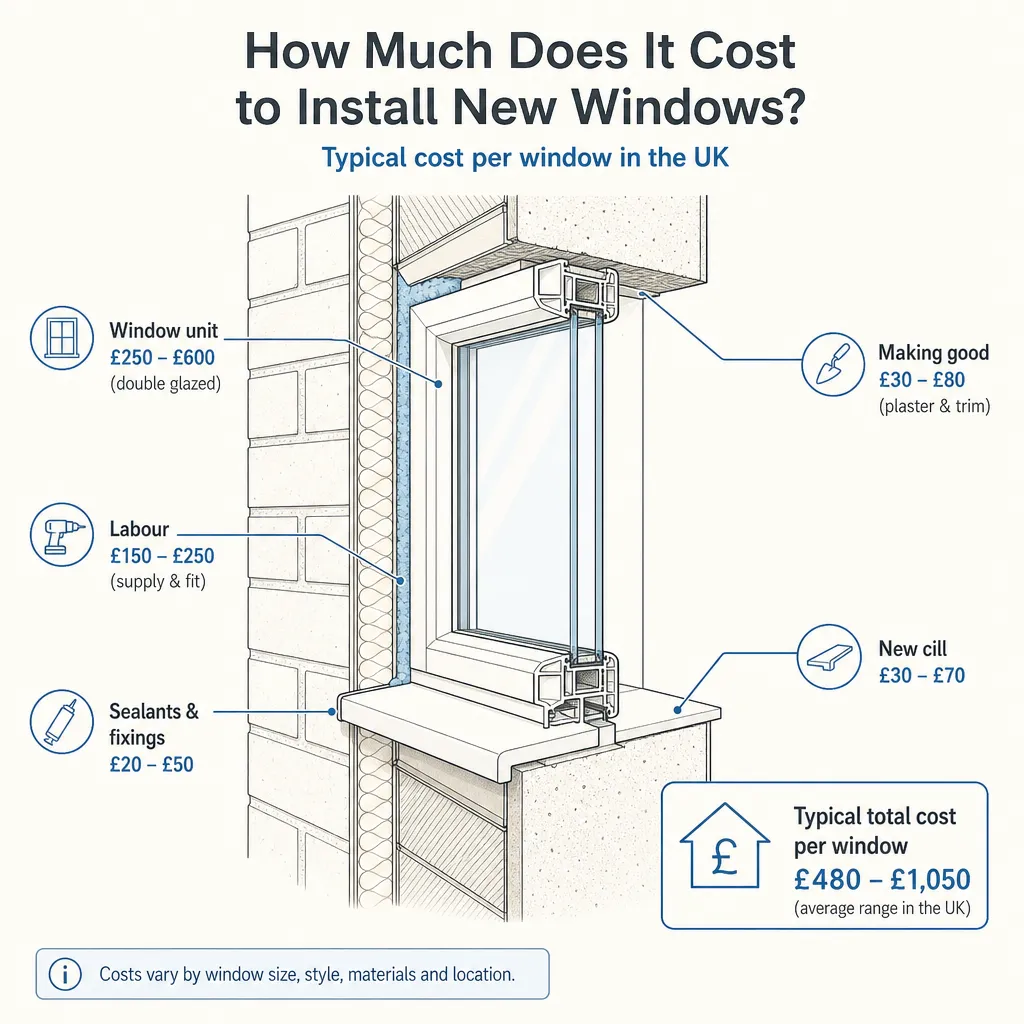
How Much Does It Cost to Install New Windows?
New window installation in the UK typically costs £300–£700 per uPVC double-glazed window (supply and fit), rising to £800–£2,500 for timber or sash windows.
 Improvement & Build
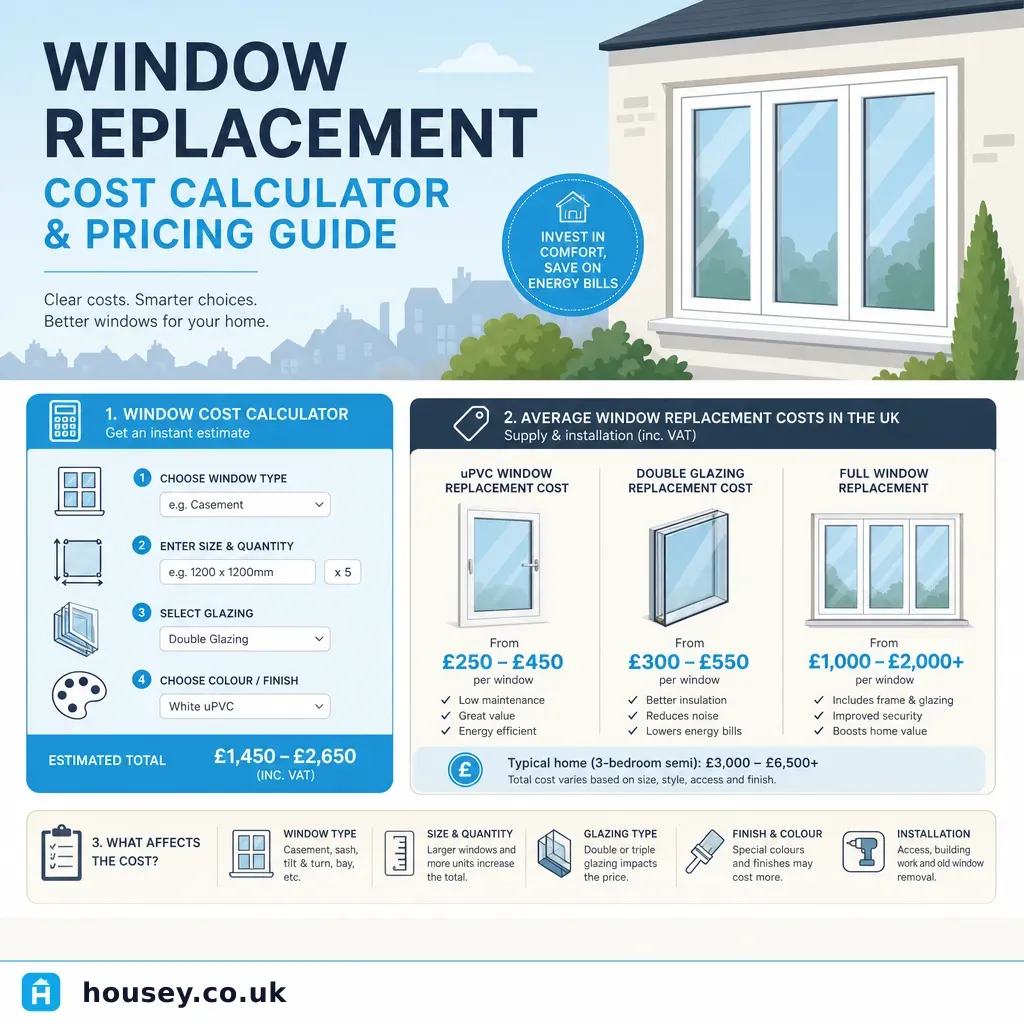
Window Replacement Cost Calculator and Pricing Guide
Replacing a standard uPVC double-glazed casement window in the UK typically costs £400–£800 supply and fit.