Window Installation: Accurate Measurement and Specification for Replacement
By Housey · Last reviewed 1st of June 2026
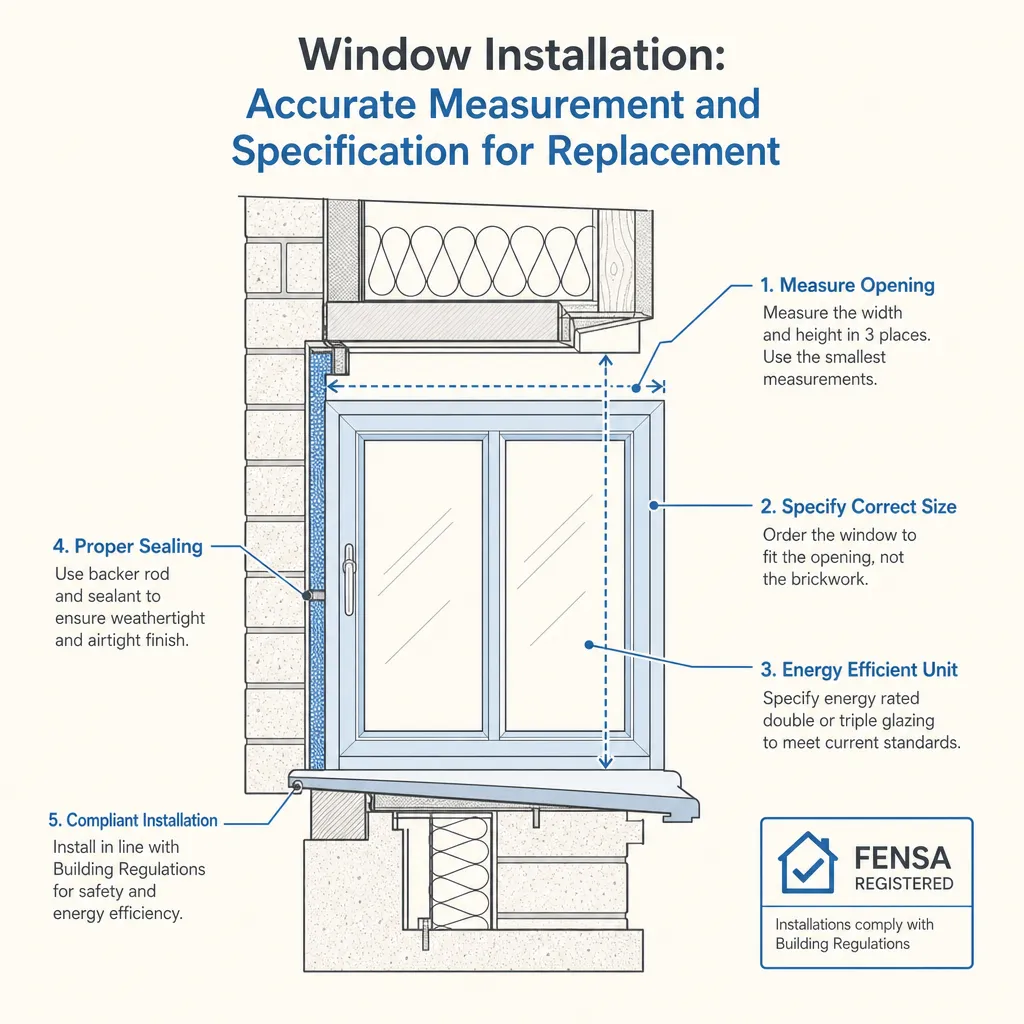
Window Installation: Accurate Measurement and Specification for Replacement
Replacing windows is one of the most common home improvement projects in the UK, but inaccurate measurements or poorly written specifications are a significant source of delay, wasted cost, and ill-fitting results. Whether you are replacing a single sash window in a Victorian terrace or re-windowing an entire 1990s semi-detached house, understanding how measurement and specification work helps you achieve the correct sizing, Building Regulations compliance, and a finished result that seals and operates correctly.
Key points
- Replacement windows in England and Wales must comply with Building Regulations Approved Document L (Conservation of fuel and power); the minimum whole-window U-value for replacements is 1.4 W/m²K, in force since June 2022.
- Installations by a FENSA-registered or CERTASS-registered installer are self-certified under a Competent Person Scheme — you receive a compliance certificate rather than requiring local authority building control approval; this certificate must be passed to buyers on sale.
- Always measure the existing frame opening in at least three places (top, middle, and bottom for width; left, centre, and right for height) and use the smallest dimension as the critical figure for specification.
- For timber sliding sash windows in pre-1919 properties, like-for-like replacement often requires bespoke sizing; standard off-the-shelf casement dimensions will not match.
- Planning permission is not normally required for replacement windows under permitted development in England, but properties in conservation areas, Article 4 Direction areas, or listed buildings require additional or listed building consent.
Understanding replacement window measurements
The frame opening versus the frame size
The most common measurement error is confusing the frame opening (the structural aperture in the wall) with the visible outer dimensions of the existing window frame. When ordering a replacement:
- Measure the frame opening — the width of the masonry or timber surround, not the existing frame's outer edge.
- Allow for fitting tolerances — most window installers work to a 5–10 mm tolerance around the perimeter to allow for shimming, levelling, and sealing.
- Your installer will re-measure before ordering — professional window installers carry out their own detailed survey before manufacturing or ordering frames; your initial measurements guide quotations, not final production.
How to measure: step-by-step
Use a steel tape measure and record all measurements in millimetres.
- Open the existing window fully and measure the clear opening width (the gap between the inner faces of the frame) at the top, middle, and bottom. Note the smallest figure.
- Measure the clear opening height at the left, centre, and right. Note the smallest figure.
- Measure the depth of the existing frame (front to back), particularly relevant for bay windows or thick-walled solid-masonry properties.
- Note the existing frame profile depth — this affects the new frame's compatibility with existing plastered reveals.
- For sash windows, measure the sash opening separately from the overall box frame and note the parting bead depth.
Homeowner measurement checklist
Window specification: what to agree with your installer
A complete window specification covers more than sizing. Agree these elements before any order is placed:
Specification element | Options | Relevant standard |
|---|---|---|
Frame material | uPVC, timber, aluminium, composite | — |
Glazing type | Double or triple glazing; low-E coated, argon-filled | Part L (whole-window U-value ≤1.4 W/m²K) |
Opening style | Fixed, casement (top-hung, side-hung), sash, tilt-and-turn | — |
Glass specification | Clear, obscure, self-cleaning, acoustic | BS EN 12600 (safety glazing in critical locations) |
Trickle ventilation | Background ventilator required in habitable rooms | Approved Document F (Ventilation) |
Colour and finish | White, anthracite grey, woodgrain foil, RAL painted | — |
Hardware | Handles, hinges, multi-point locks | PAS 24 (enhanced security standard) |
Safety glazing | Required within 800 mm of floor level or 300 mm of a door | Approved Document K (glazing) |
Which window type suits your property?
- Choose uPVC if budget is the priority, the property is post-1919, and you want low maintenance; widely available with good thermal performance at modest cost.
- Choose timber if the property is pre-1919, in a conservation area, or you prefer a traditional appearance; higher maintenance than uPVC but can match original profiles accurately.
- Choose aluminium if slim sightlines, large spans, or a contemporary aesthetic are priorities; typically the highest cost of the three mainstream frame types.
- Choose composite (aluminium-clad timber) if you want timber aesthetics internally with low-maintenance aluminium externally; suits conservation area properties where the external appearance must match traditional windows.
- Ask your local planning authority if the property is listed or in a conservation area — material and style choices may be restricted regardless of permitted development rights.
- Consult a structural engineer if the existing lintel, sill, or surrounding masonry is cracked, bowing, or visibly deteriorating before any window is removed.
Building Regulations and certification
Part L: thermal performance
Since the 2021 edition of Approved Document L came into force in June 2022, replacement windows in England must achieve a minimum whole-window U-value of 1.4 W/m²K. Standard double-glazed units with a low-emissivity (low-E) coating and argon fill typically achieve around 1.2–1.4 W/m²K. Triple glazing (U-value typically 0.8–1.0 W/m²K) exceeds this requirement and may be worth specifying for north-facing elevations or heavily exposed properties.
Part F: trickle ventilation
Since June 2022, replacement windows in habitable rooms (bedrooms, living rooms) in England must include trickle ventilators unless equivalent background ventilation is already provided by other means. This is a frequently overlooked requirement — confirm with your installer before the order is placed, as retro-fitting ventilators after installation is impractical.
FENSA and Competent Person Schemes
FENSA (Fenestration Self-Assessment Scheme) and CERTASS are the main Competent Person Schemes for window and door installation in England and Wales. A registered installer can self-certify that the installation meets Building Regulations without requiring local authority building control sign-off. Keep the compliance certificate — it must be passed to any buyer when the property is sold, and its absence can cause conveyancing delays and additional cost.
What to ask before accepting a quote
- Is the installer FENSA or CERTASS registered, and will they provide a compliance certificate?
- What whole-window U-value will the specified glazing achieve, and does it meet Part L?
- Do the specified windows include trickle ventilators as required under Part F?
- Does the quote include disposal of the existing frames?
- What is the lead time from order placement to installation?
- What warranty is provided on frames, sealed units, and installation work?
- Is VAT included in the quoted price?
When to get professional help
A FENSA-registered window and door installer will survey, specify, and install replacement windows in compliance with Building Regulations. Seek additional professional advice if:
- The property is listed or in a conservation area — a conservation officer can advise on appropriate materials and consent requirements before any order is placed.
- The existing lintel, sill, or surrounding masonry appears cracked, bowing, or deteriorating.
- You are replacing windows in a property subject to an Article 4 Direction, where permitted development rights may have been withdrawn.
- The windows form part of a larger extension or refurbishment project where building control is already engaged.
How Housey can help
Housey connects homeowners with vetted window and door installers who can carry out accurate pre-installation surveys, provide FENSA or CERTASS-certified installations, and advise on the right specification for your property type and local planning requirements.
Frequently asked questions
Do I need planning permission to replace windows in the UK?
In most cases, no. Replacing windows with similar windows is permitted development under the Town and Country Planning (General Permitted Development) (England) Order 2015. However, if the property is listed, in a conservation area, or subject to an Article 4 Direction, you may need conservation area consent or listed building consent. Always check with your local planning authority before proceeding.
What is a FENSA certificate and why does it matter?
A FENSA certificate proves that a replacement window installation has been self-certified as compliant with Building Regulations by a registered installer. It must be provided to a buyer when the property is sold. Without it — if the installer is also not CERTASS-registered — you would need retrospective building control approval, which can cause conveyancing delays and additional cost.
Can I measure windows myself before getting quotes?
Yes, and doing so helps you provide accurate information when requesting quotes remotely. However, all professional window installers carry out their own detailed survey before placing a manufacturing order. Your initial measurements guide quotations and comparisons; errors at the quoting stage are far cheaper to correct than errors discovered after frames have been manufactured.
What U-value do replacement windows need to meet?
Under Approved Document L (2021 edition, in force from 2022 in England), replacement windows must achieve a whole-window U-value of 1.4 W/m²K or better. Standard double-glazed low-E argon-filled units typically achieve 1.2–1.4 W/m²K. Triple glazing typically achieves 0.8–1.0 W/m²K. Requirements differ slightly in Scotland and Wales — check with your installer or local authority.
Sources and further reading
Useful next reads
 Improvement & Build
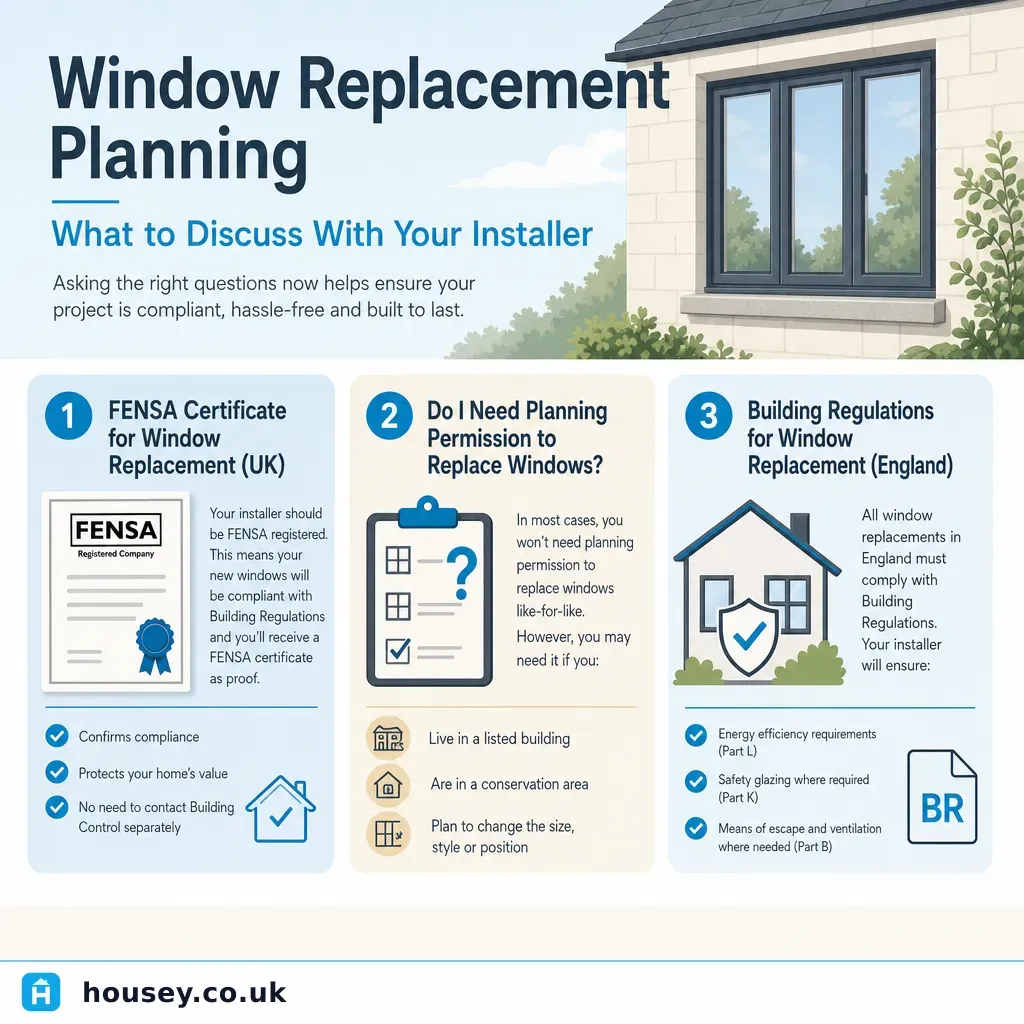
Window Replacement Planning: What to Discuss With Your Installer
Most window replacements in England fall under permitted development rights and do not require planning permission, but they must comply with Building Regulations Part L and Part K.
 Improvement & Build
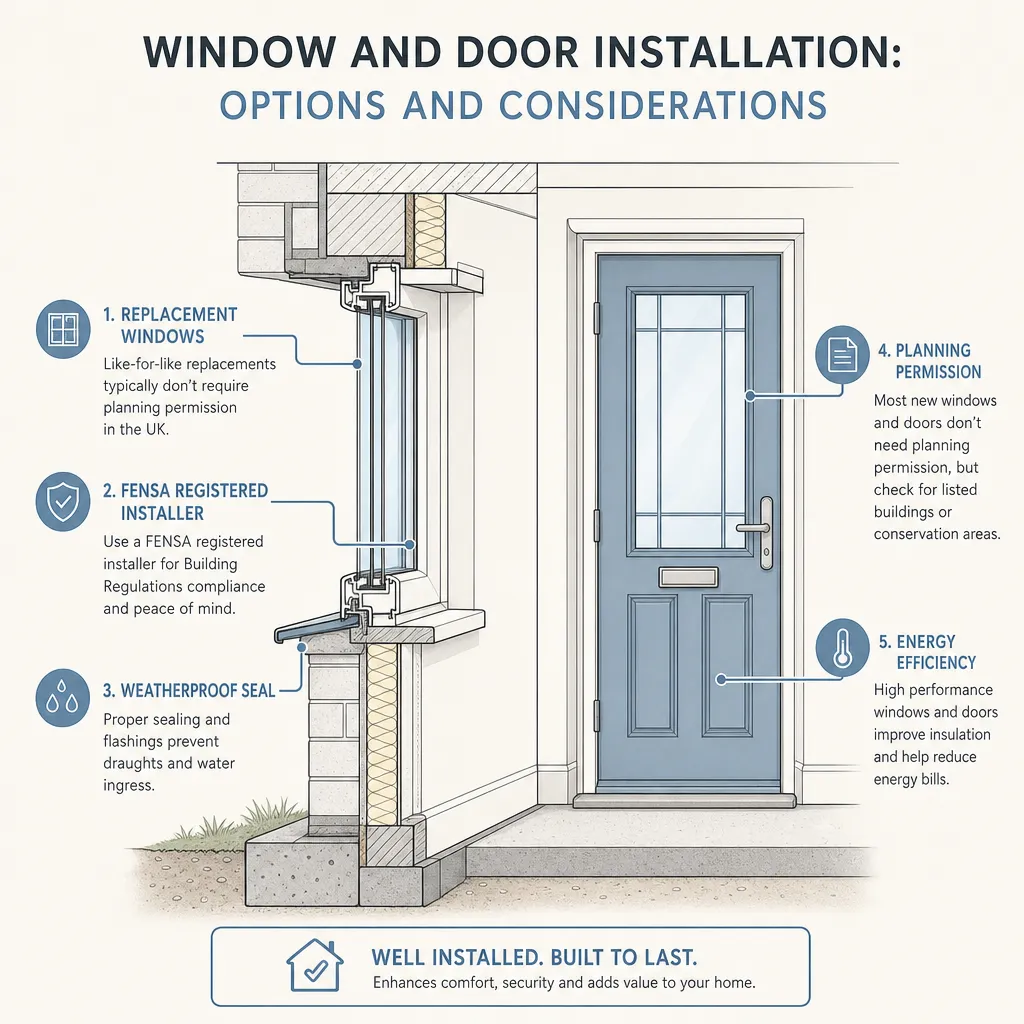
Window and Door Installation: Options and Considerations
Replacing windows and external doors in the UK requires compliance with Building Regulations Part L (thermal performance) and Part K (safety glazing).
 Improvement & Build
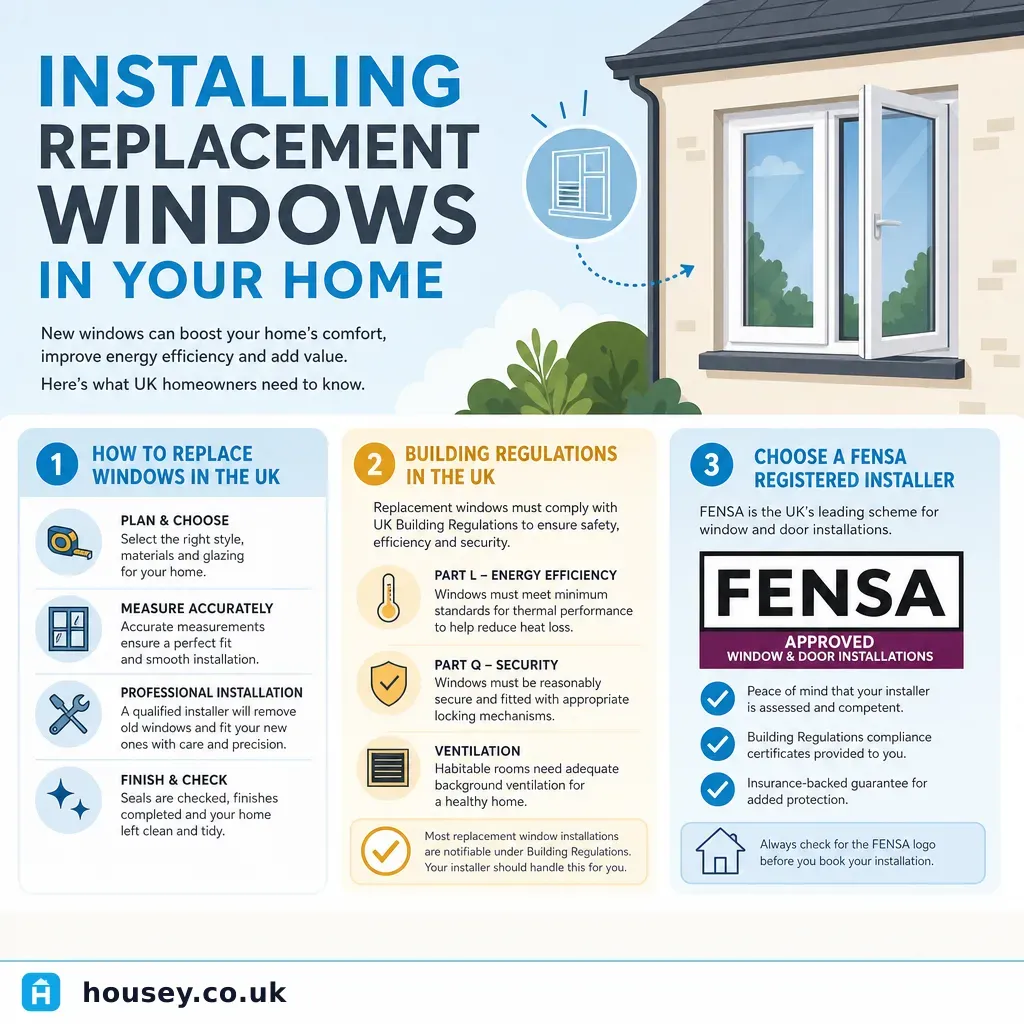
Installing Replacement Windows in Your Home
Replacing windows in the UK requires compliance with Building Regulations Part L — a minimum centre-pane U-value of 1.
 Improvement & Build
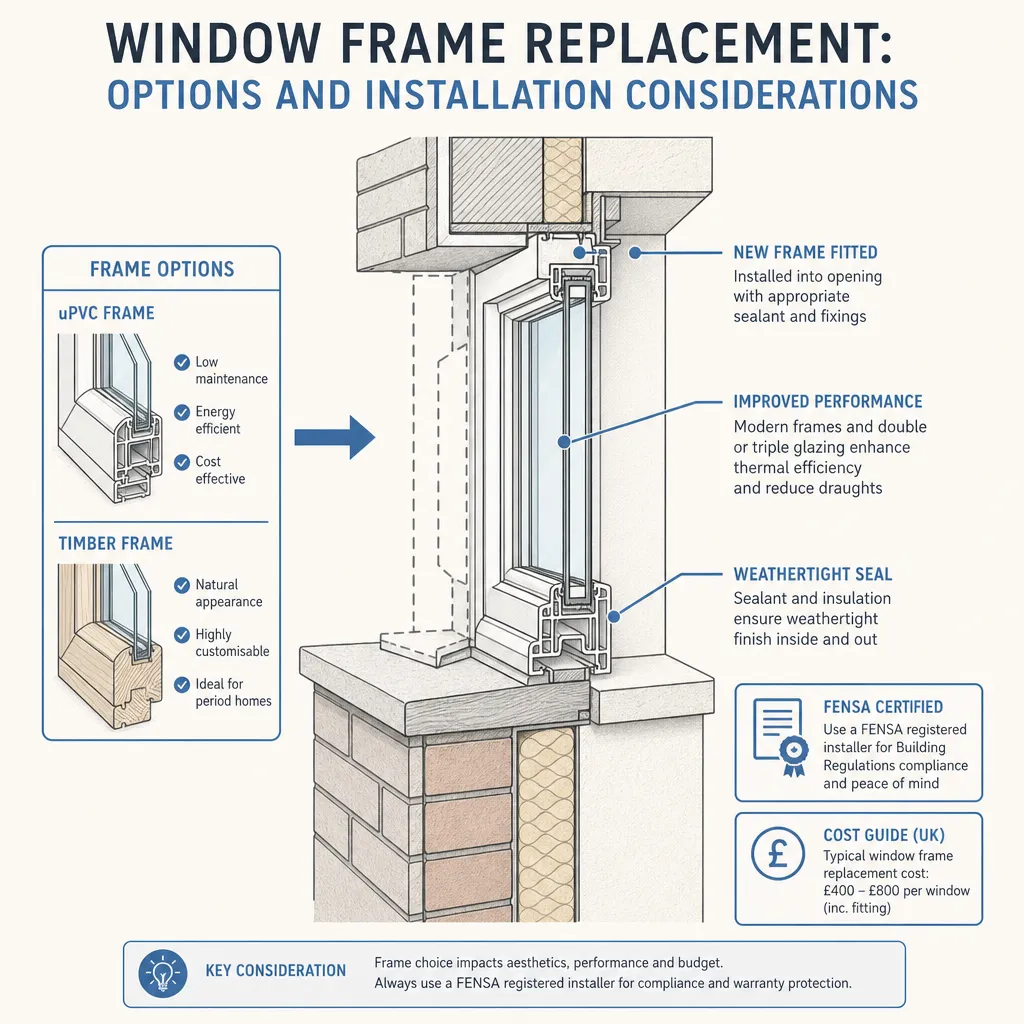
Window Frame Replacement: Options and Installation Considerations
Replacing window frames in the UK requires compliance with Part L of the Building Regulations and, in most cases, a FENSA or Certass certificate.
 Improvement & Build
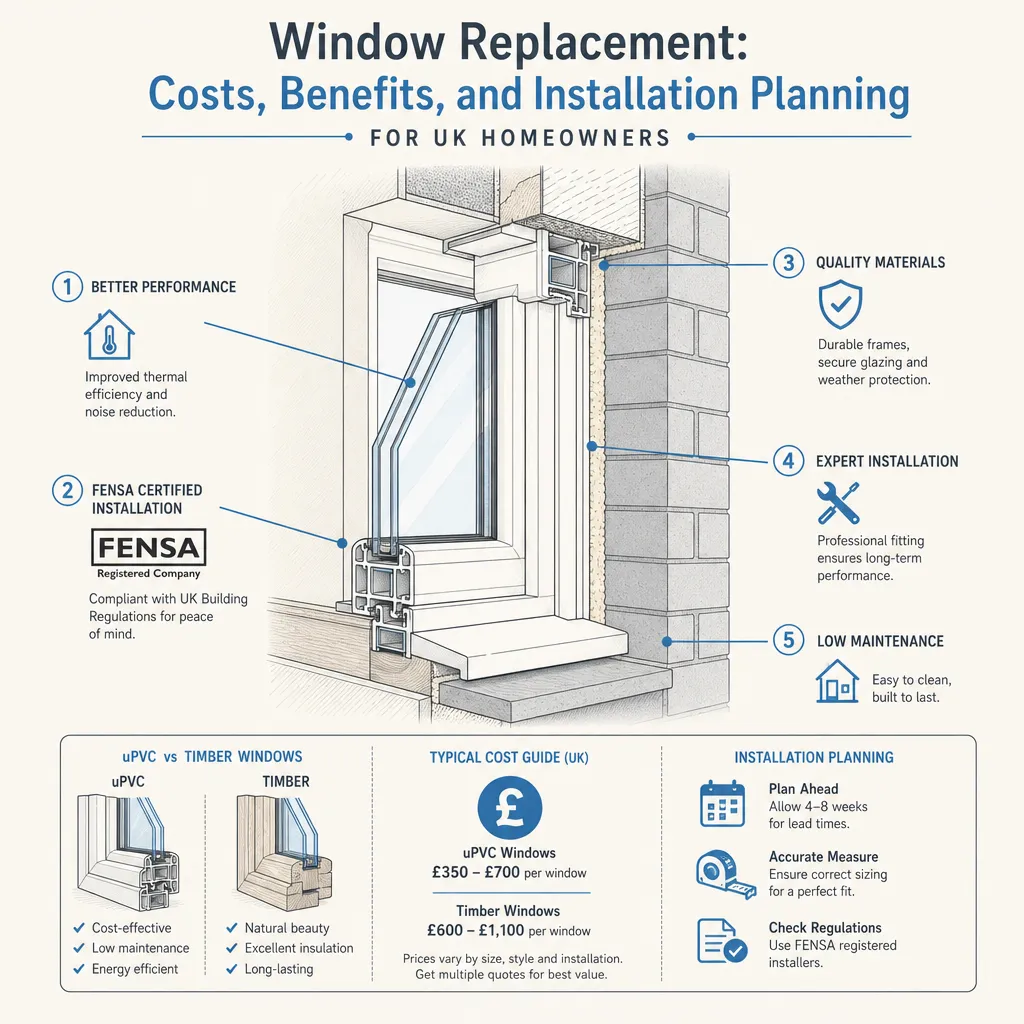
Window Replacement: Costs, Benefits, and Installation Planning
Replacing windows in most UK homes is permitted development but must meet Building Regulations Part L, requiring a whole-window U-value of 1.