Window and Door Installation: Options and Considerations
By Housey · Last reviewed 24th of May 2026
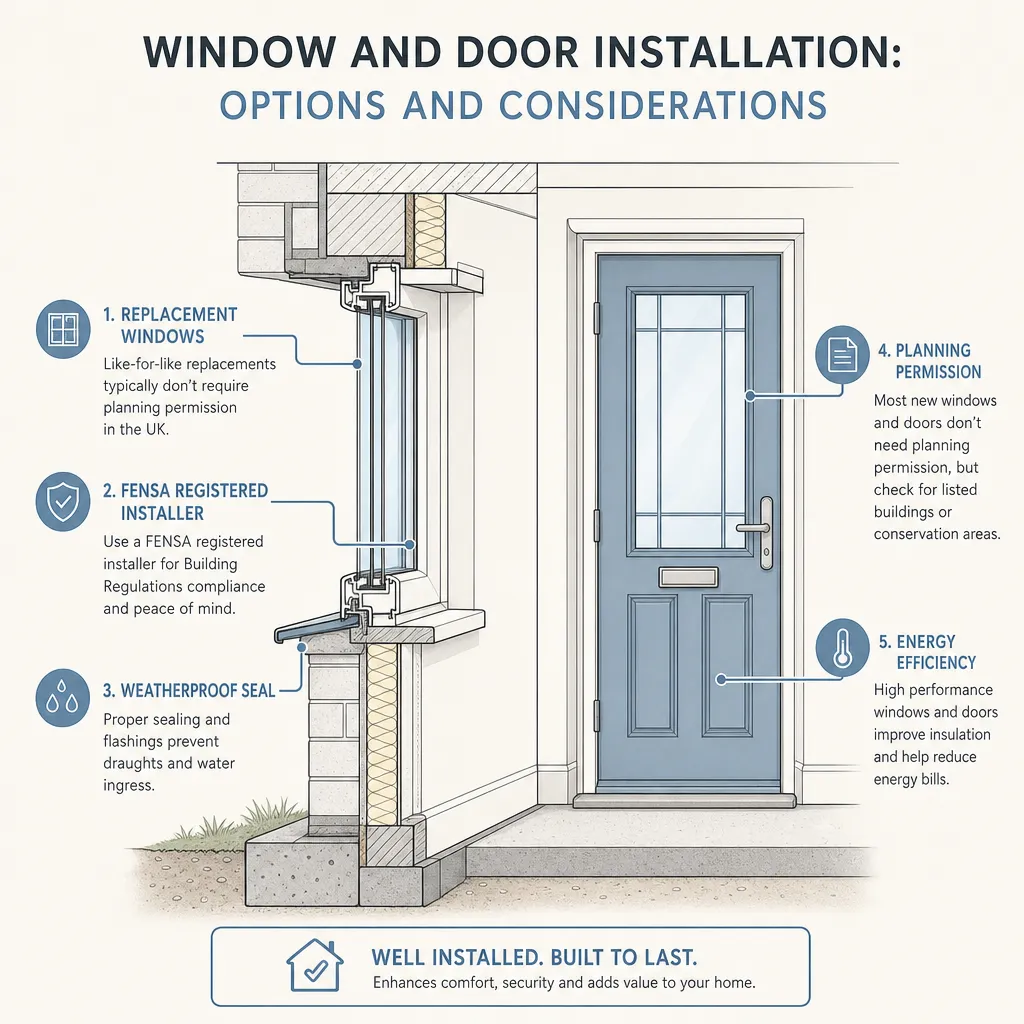
Window and Door Installation: Options and Considerations
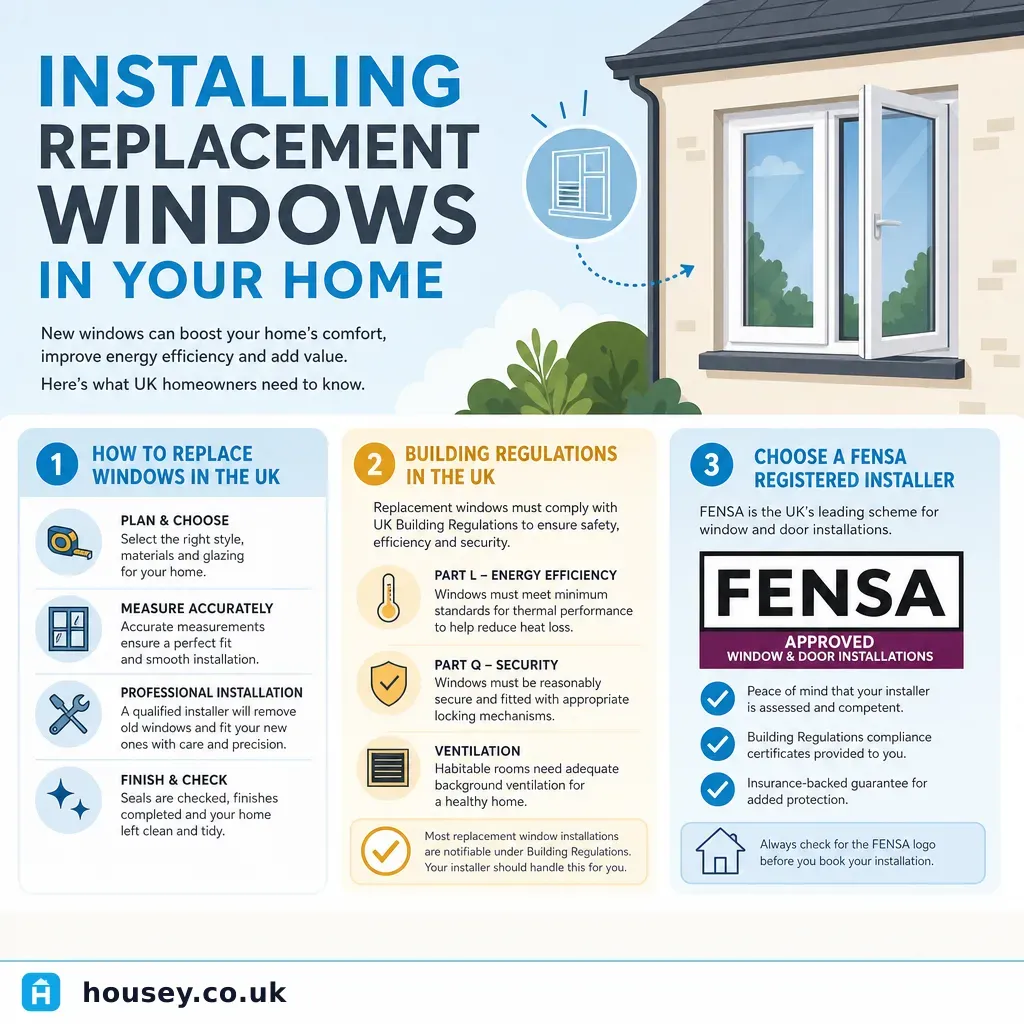
Replacing windows and external doors is one of the most common home improvements in the UK, driven by ageing or draughty frames, poor energy performance, or updating the appearance of a property. The choice of materials, glazing specification, and installer accreditation all affect the long-term outcome — and there are compliance obligations that apply regardless of the scale of the project.
Key points
- Replacement windows in England must meet minimum thermal performance standards under Building Regulations Part L; compliance can be demonstrated via a whole-window U-value of 1.4 W/m²K or better, or a minimum British Fenestration Rating Council (BFRC) Window Energy Rating (WER) of Band C.
- FENSA or CERTASS-registered installers can self-certify compliance and notify the local authority on your behalf, removing the need for a separate building control application; keep the certificate with your property documents for resale.
- Properties in conservation areas, Article 4 direction areas, or listed buildings may need planning permission even for like-for-like window or door replacements — always check with your local planning authority (LPA) before ordering.
- Safety glazing (toughened or laminated glass) is required by Building Regulations Part K in critical locations: within doors and door side panels, and in low-level glazing below 800 mm from floor level.
- External doors should carry PAS 24 certification (enhanced security testing) and multi-point locking; Secured by Design-certified products meet police-preferred specifications.
Window frame material options
The four main frame materials each carry different performance, maintenance, and appearance characteristics. The right choice depends on the property type, planning constraints, budget, and how much ongoing maintenance you want to carry out.
Material | Best for | Not ideal for | Typical lifespan | Maintenance |
|---|---|---|---|---|
uPVC | Cost-conscious projects; most property types | Period properties; conservation area homes | 20–35 years | Low (wipe-clean) |
Timber | Period and listed properties; conservation areas | High-maintenance aversion; rooms with high humidity | 30–60+ years with upkeep | High (paint or stain every 5–10 years) |
Aluminium | Contemporary builds; slim sightlines; large spans | Budget-sensitive projects | 30–45 years | Low to moderate |
Composite (timber-aluminium) | Best of both — timber internally, aluminium externally | Tightest budgets | 30–50 years | Low outside, some inside |
Glazing types and energy performance
Double glazing — two panes with an inert gas fill such as argon — is now standard for most UK replacements. Triple glazing adds a third pane for a lower U-value and improved acoustic performance, and is typically most worthwhile in very exposed locations or high-specification new builds.
Key terms to understand before specifying:
- U-value: measures heat loss through the whole window unit; lower is better. Building Regulations Part L requires 1.4 W/m²K or better for replacement windows in existing dwellings.
- Window Energy Rating (WER): an A++ to E label assessed by the BFRC, similar to appliance ratings. A minimum of Band C satisfies the Part L compliance alternative to U-values.
- G-value (solar factor): the proportion of solar heat admitted through the glass — relevant for south-facing glazing and passive solar design.
Low-emissivity (low-e) coatings on the inner pane reduce radiative heat loss and are standard in modern double-glazed units. Always ask for the centre-pane and whole-window U-values when comparing quotes.
Do you need planning permission?
Most window replacements in standard residential properties fall under permitted development (PD), meaning no formal planning application is needed. However, PD rights may not apply in several common situations.
Decision tree: do I need planning permission for new windows or doors?
- Listed building? → Yes: listed building consent is required, and planning permission is likely needed for any changes to windows or external doors. Engage a conservation officer or specialist architect before ordering.
- Conservation area? → Check with your LPA. Like-for-like replacements are often permitted but changes to front-elevation windows may need prior approval or full consent.
- Article 4 direction in place? → PD rights may be removed for windows and doors. Contact your LPA to confirm before proceeding.
- Flat or leasehold property? → Check your lease; freeholder or management company consent is usually needed regardless of the planning position.
- Standard house, no restrictions? → Window and door replacement is generally permitted development. Building Regulations still apply and installer certification is required.
Always confirm the position with your LPA in writing before ordering. The Planning Portal guidance on windows provides a useful starting point.
FENSA, CERTASS, and building control
Replacement windows and external doors in England and Wales must either:
- Be installed by a competent-person scheme member (FENSA or CERTASS), who self-certifies compliance and notifies the local authority on your behalf, or
- Be notified to local authority building control before work starts, with an inspection and completion certificate issued after.
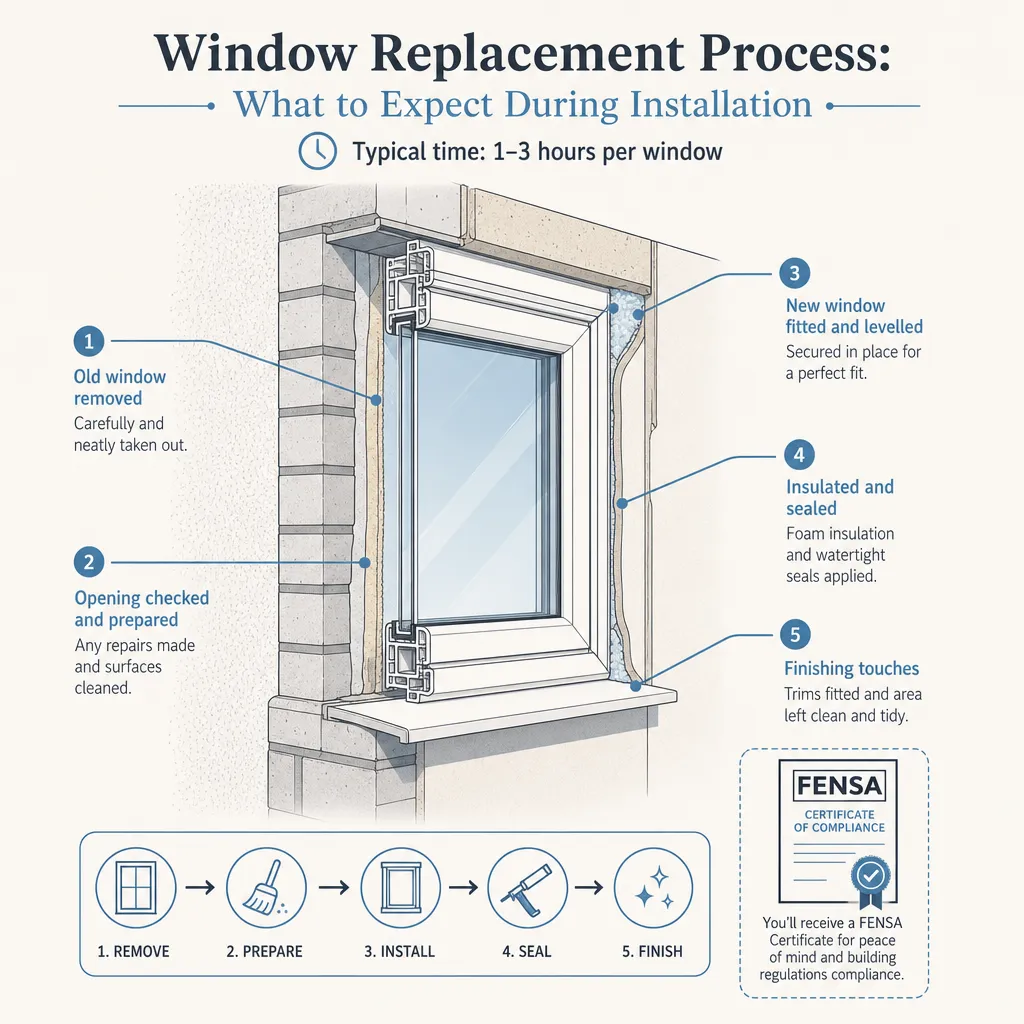
A FENSA or CERTASS certificate is important for resale: solicitors routinely request this as evidence of compliant installation. Keep any certificates with your property's legal documents.
Door installation considerations
External doors — front, back, French, and bifold — bring additional factors beyond glazing and frames.
- Security: look for PAS 24-rated doors and frames with multi-point locking. Secured by Design-certified products, developed in conjunction with UK police forces, provide further assurance.
- Thermal performance: composite doors typically offer better insulation than traditional timber doors and can achieve U-values of 1.0 W/m²K or lower. Fully glazed doors need to meet the 1.4 W/m²K Part L requirement.
- Fire doors: Building Regulations require FD30S-rated fire doors between an integral garage and the living area of a house, and in new-build homes of three or more storeys. If you are replacing any door in one of these positions, ensure the replacement meets the required specification.
- Accessibility: if you are widening a doorway, Building Regulations Part M specifies a minimum clear opening width of 775 mm for accessible doorways. Structural implications must be assessed if the opening is in a load-bearing wall.
When to get professional help
Most window and door installations are straightforward for a registered installer, but seek professional advice before ordering if:
- The property is listed or in a conservation area — get written confirmation from your LPA before committing to any specification.
- You plan to widen an existing opening in a load-bearing wall — a structural engineer or architect should verify the lintel specification before work starts.
- There are signs of damp, timber decay, or wall movement around existing frames — investigate the cause before replacing like-for-like or you may seal in the problem.
- You are unsure whether existing glazing in doors or low-level positions meets current safety glazing requirements — particularly relevant in older homes.
How Housey can help
Housey makes it straightforward to find FENSA- or CERTASS-registered window and door installers in your area. Describe the project, receive up to four fixed quotes from vetted installers, and compare accreditations, ratings, and pricing before you decide.
Frequently asked questions
How long does a window installation typically take?
A standard replacement of one to four windows usually takes one day. A full-house re-glaze or bay window installation may take two to three days depending on access and the number of units involved. Your installer should confirm the programme in writing before work starts, including when old frames will be removed.
Will replacing my windows improve my EPC rating?
Replacing single-glazed or poor-quality windows with rated double or triple glazing can improve an Energy Performance Certificate rating, particularly in pre-1980s homes. The scale of improvement depends on the number of windows, the existing glazing type, and the other envelope measures already in place. Your assessor can model this beforehand.
Do I need building regulations approval for a new front door?
Yes — replacing an external door in England and Wales is notifiable under Building Regulations. Using a FENSA- or CERTASS-registered installer means they self-certify on your behalf. If the work also involves structural changes such as widening the opening, building control involvement is required regardless of who carries out the installation.
What is the difference between double and triple glazing?
Double glazing uses two panes of glass with an argon gas fill. Triple glazing adds a third pane, typically achieving a whole-window U-value of 0.8–1.0 W/m²K versus 1.1–1.4 W/m²K for quality double glazing. Triple glazing also offers better acoustic performance and reduces cold-surface condensation, at higher upfront cost and frame weight.
Sources and further reading
- Approved Document L: Conservation of fuel and power — MHCLG
- Approved Document K: Protection from falling, collision and impact — MHCLG
- FENSA competent person scheme — FENSA
- CERTASS competent person scheme — CERTASS
- Planning permission for windows — Planning Portal
- Window Energy Ratings — British Fenestration Rating Council
Useful next reads
 Improvement & Build
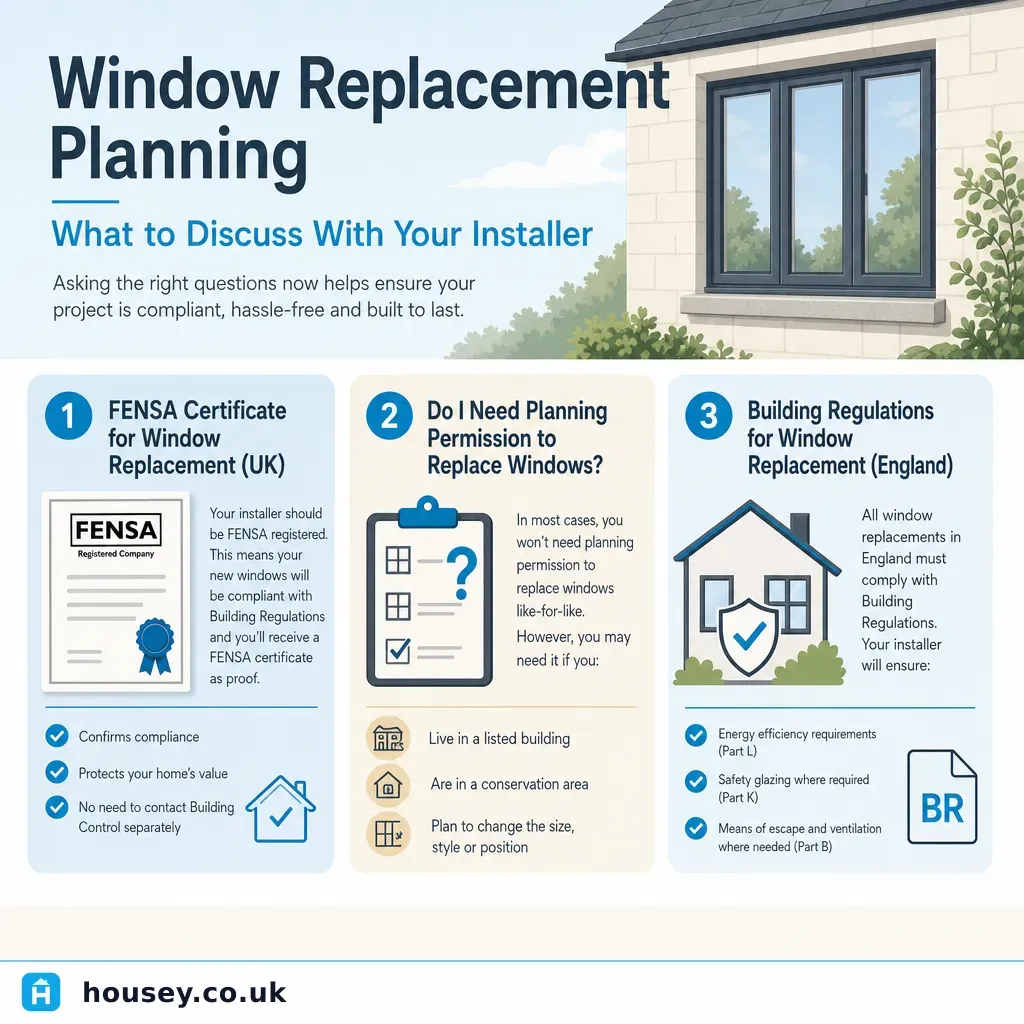
Window Replacement Planning: What to Discuss With Your Installer
Most window replacements in England fall under permitted development rights and do not require planning permission, but they must comply with Building Regulations Part L and Part K.
 Improvement & Build
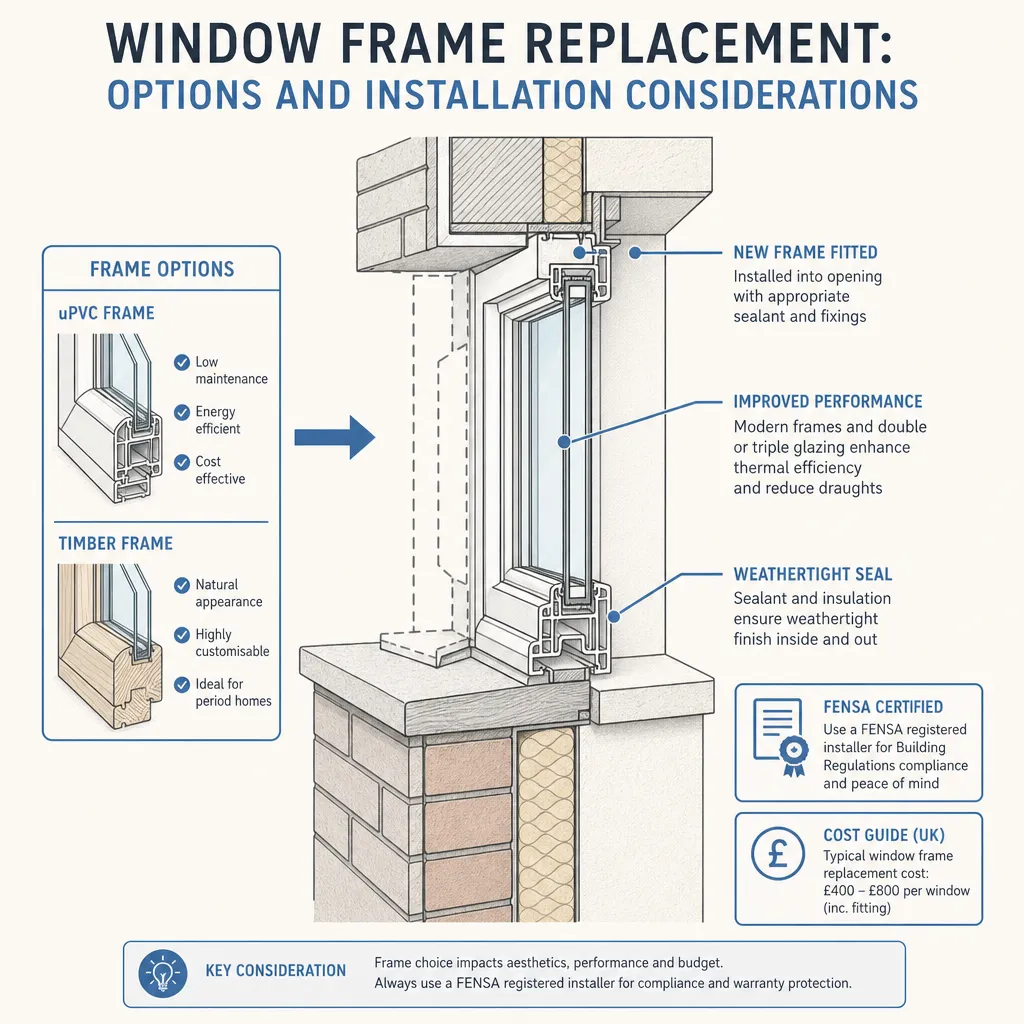
Window Frame Replacement: Options and Installation Considerations
Replacing window frames in the UK requires compliance with Part L of the Building Regulations and, in most cases, a FENSA or Certass certificate.
 Improvement & Build
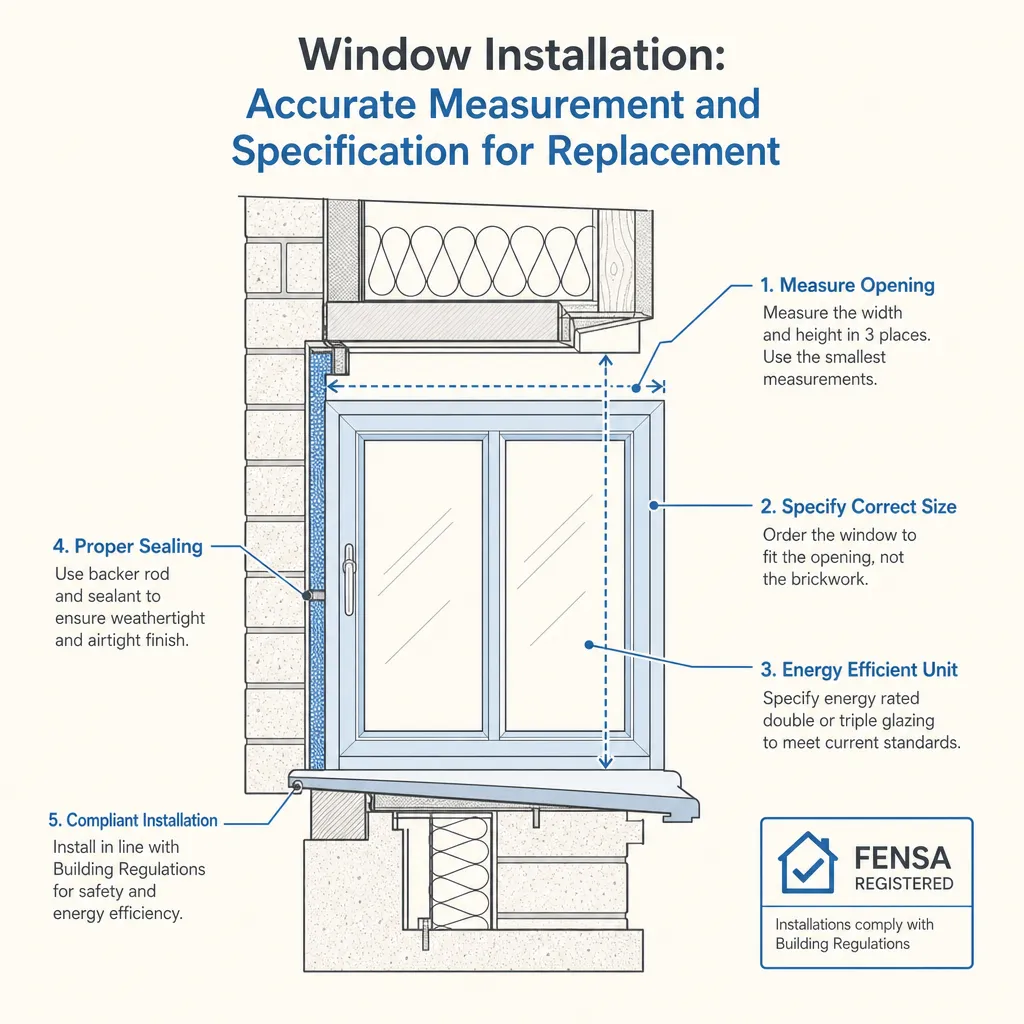
Window Installation: Accurate Measurement and Specification for Replacement
Accurate window measurement for replacement means recording the width and height of the existing frame opening in at least three places, noting the smallest dimension, and providing a full specification to your installer — including frame material, glazing type, opening style, and trickle ventilators.
 Improvement & Build
Installing Replacement Windows in Your Home
Replacing windows in the UK requires compliance with Building Regulations Part L — a minimum centre-pane U-value of 1.
 Improvement & Build
Window Replacement Process: What to Expect During Installation
Replacing windows in a UK home typically takes one to two days for a standard house.