Window Replacement: Costs, Benefits, and Installation Planning
By Housey · Last reviewed 30th of May 2026
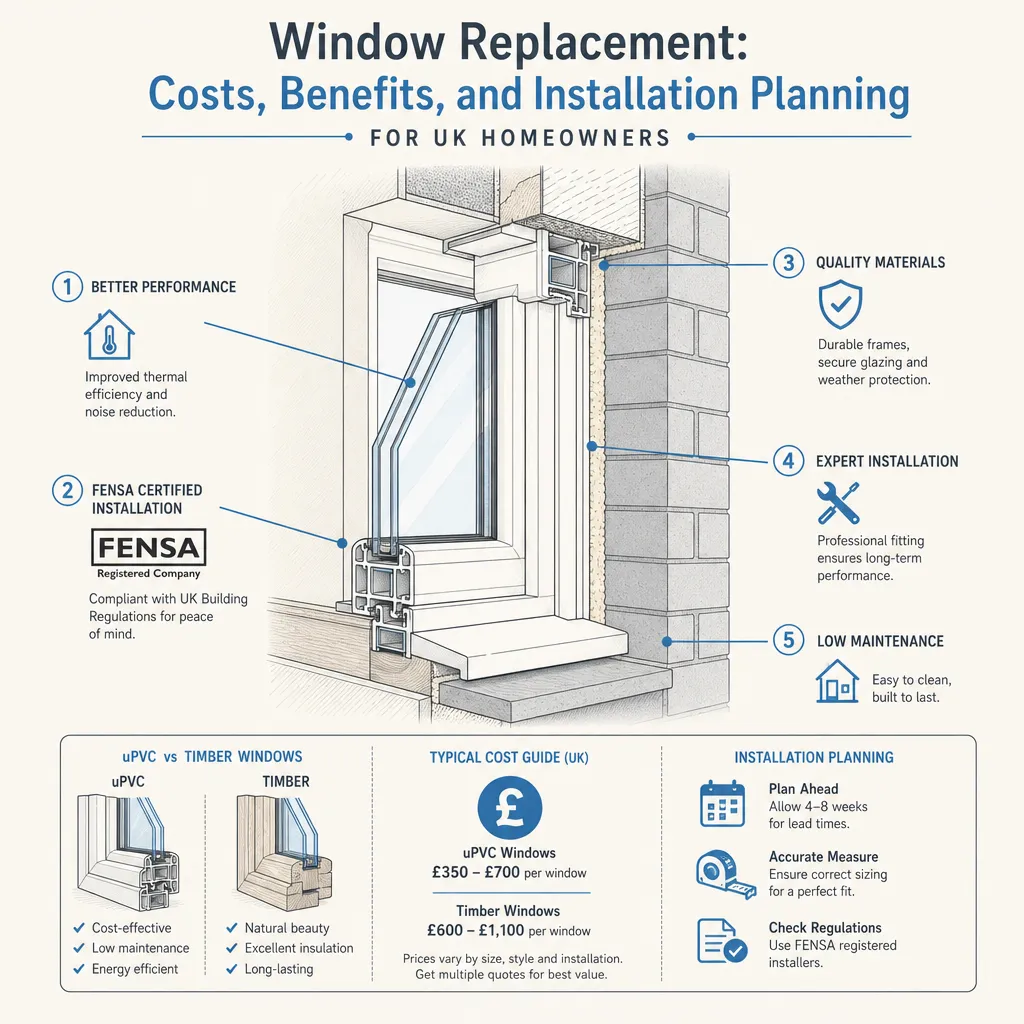
Window Replacement: Costs, Benefits, and Installation Planning
Replacing windows is one of the most common home improvement projects in the UK, typically prompted by draughts, failing double-glazing seals, rising energy bills, or preparation for a house sale. The decision involves balancing upfront costs against long-term savings, navigating building regulations, and choosing from a range of materials and glazing specifications that suit both the property and any local planning constraints.
Key points
- Replacement windows in England must meet Building Regulations Part L, which requires a whole-window U-value of 1.4 W/m²K or better; the equivalent standard applies in Wales, Scotland, and Northern Ireland under their respective regulations.
- Work must be carried out by a FENSA- or CERTASS-registered installer, or separately inspected and approved by local authority building control, to receive a valid compliance certificate.
- In conservation areas or for listed buildings, standard permitted development rights do not apply — planning permission is required before replacing windows, even on a like-for-like basis.
- Safety glazing under Part N of the Building Regulations is required in critical locations, including low-level glazing below 800 mm from floor level and glazing adjacent to doors.
- A FENSA compliance certificate is required when selling a property if replacement windows were fitted after April 2002; without one, conveyancing solicitors may request an indemnity policy.
What does window replacement cost in the UK?
Indicative UK costs, last reviewed 2026-05-30.
Window replacement costs vary significantly by frame material, glazing specification, window size, and quantity. The following ranges reflect typical installer quotes across the UK; actual prices will vary by region, access requirements, and specification.
Window type | Approximate cost per window (supply and fit) | Notes |
|---|---|---|
Standard uPVC casement (double glazed) | £300–£600 | Most common; lowest maintenance |
uPVC sash (double glazed) | £600–£1,000 | Higher than casement due to mechanism complexity |
Timber casement (double glazed) | £600–£1,200 | Higher maintenance; traditional appearance |
Aluminium casement (double glazed) | £700–£1,400 | Slimmer frames; wide colour choice via powder coating |
Triple glazing (any material) | Add 20–40% to above | Lower U-value; particularly suited to exposed locations |
Always obtain at least three written, like-for-like quotes before committing. Key cost drivers include:
- Quantity: installers often reduce the per-unit price for larger orders covering a whole house.
- Window size and shape: bay windows, arched heads, and non-standard proportions cost more than standard rectangular casements.
- Access: scaffolding for upper-floor windows typically adds £500–£1,500 or more depending on the property.
- Lintel condition: if an existing lintel is cracked, undersized, or missing, replacement adds both time and cost.
- VAT: standard rate (20%) applies to most window installations in existing residential properties. Confirm whether quotes are inclusive of VAT.
Which frame material should you choose?
Material | Best for | Not ideal for | Typical lifespan | Maintenance level |
|---|---|---|---|---|
uPVC | Modern homes, buy-to-let, budget-conscious owners | Conservation areas, listed buildings, traditional aesthetics | 20–30 years | Low |
Timber | Period properties, listed buildings, conservation areas | Owners who prefer minimal upkeep | 40+ years with care | Medium to high |
Aluminium | Contemporary extensions, large glazed areas, slim-frame design | Strict conservation area policies | 30–40 years | Low |
Composite (timber-aluminium) | Traditional interior appearance with low-maintenance exterior | Higher budgets | 30–40 years | Low (exterior) |
Do you need planning permission?
In most circumstances, replacing existing windows in England is permitted development — no planning application is required. However, planning permission is necessary in these situations:
- Conservation areas: replacing windows with different materials or styles usually requires consent. Many conservation area appraisals specify acceptable materials and glazing bar patterns.
- Listed buildings: any window alteration — including like-for-like replacement — requires Listed Building Consent (LBC). This applies regardless of whether the change is visible from the street.
- Article 4 Direction areas: some local planning authorities (LPAs) remove permitted development rights for window replacement in specific streets or neighbourhoods.
- New openings: creating a new window opening, rather than replacing an existing one, always requires planning permission.
Rules vary by LPA and by the individual property's planning history. Always check with your local authority before starting work if there is any doubt.
Building Regulations that apply to window replacement
Three Approved Documents are relevant to replacement windows in England:
- Part L (Conservation of fuel and power): the whole-window U-value must be 1.4 W/m²K or better. Alternatively, windows can be specified by Window Energy Rating (WER) — currently a minimum of band C.
- Part N (Glazing safety): safety glazing (toughened or laminated) is required in critical locations — low-level panels, within 300 mm of a door closing edge, and within door leaves.
- Part F (Ventilation): replacement windows must provide adequate background ventilation. In most cases this means including trickle vents, particularly if the existing windows had them.
The simplest compliance route is to use a FENSA- or CERTASS-registered installer, who self-certifies compliance and issues a certificate directly. If you use an unregistered contractor, the work must be submitted to local authority building control for inspection before completion.
Worked example: 1930s semi in a conservation area
A homeowner on a 1930s semi-detached street designated as a conservation area wants to replace single-glazed steel windows with double-glazed equivalents.
Planning check first: the LPA's conservation area appraisal states that windows must reflect the original Crittal steel-frame style. Standard uPVC replacement is not acceptable.
Options available: slim-profile steel or aluminium windows designed to replicate the original Crittal aesthetic; or secondary glazing fitted behind the existing frames as a non-intrusive alternative that does not require planning permission.
Compliance route: because planning permission is required, the FENSA self-certification route is unavailable. Building control approval must be obtained through the LPA as a separate step.
Cost implication: Crittal-style slim-frame aluminium windows are considerably more expensive than standard uPVC — indicatively £1,200–£2,500 per window for complex units — and lead times are often longer.
Homeowner checklist before replacing windows
When to get professional help
Window replacement is not typically complex, but independent professional input is valuable in these situations:
- Structural concerns: if lintels appear cracked, bowing, or inadequate for the opening span, a structural engineer should assess before new frames are ordered.
- Listed buildings: a conservation architect or heritage consultant can advise on acceptable materials and specification before you approach the LPA for Listed Building Consent.
- Damp or rot around frames: if there is evidence of wall rot, failing DPC, or structural deterioration around existing frames, a surveyor or builder should inspect before new windows are fitted.
- Planning disputes: if your LPA insists on materials or specifications you consider unreasonable, a planning consultant can advise on your options.
How Housey can help
Housey connects homeowners with accredited window and door installers across the UK. Describe your project, receive written quotes from FENSA-registered local firms, and compare them in one place — without the pressure of a single in-home sales appointment.
Frequently asked questions
Do I need planning permission to replace my windows?
In most cases, no. Replacing windows in England is permitted development provided the property is not listed and not in a conservation area or Article 4 Direction area. Conservation areas, listed buildings, and Article 4 restrictions all limit or remove this right. Always confirm with your local planning authority before ordering materials or instructing an installer.
How long does window installation take?
A full-house replacement across 8–12 windows usually takes one to two days for an experienced team. Individual windows can be replaced in a few hours. Jobs requiring scaffolding, structural repairs, or bespoke heritage-specification frames take longer and may require advance notice for access arrangements.
What is a FENSA certificate and do I need one?
A FENSA certificate is issued by a FENSA-registered installer confirming that replacement windows comply with Building Regulations. You will need it when selling your property if windows were replaced after April 2002. Without it, your conveyancing solicitor may require an indemnity policy, which can delay exchange of contracts.
Can I replace just one window rather than all at once?
Yes — there is no requirement to replace all windows at the same time. Individual window replacement is common, particularly when a single unit is failing. Replacing windows in phases can result in minor visual differences if materials or glazing specifications are not matched carefully across units.
Are triple-glazed windows worth the extra cost?
Triple glazing can achieve whole-window U-values below 0.8 W/m²K compared with 1.1–1.4 for quality double glazing, and reduces airborne noise transmission. Financial payback depends on heating costs and the performance of the glazing being replaced. It is generally most cost-effective on north- or east-facing elevations and in exposed or rural locations.
Sources and further reading
- Building Regulations Approved Document L: Conservation of Fuel and Power — GOV.UK
- FENSA — Fenestration Self-Assessment Scheme — FENSA
- Planning Portal: Windows and Doors guidance — Planning Portal
- Double glazing advice for UK homes — Energy Saving Trust
Useful next reads
 Improvement & Build
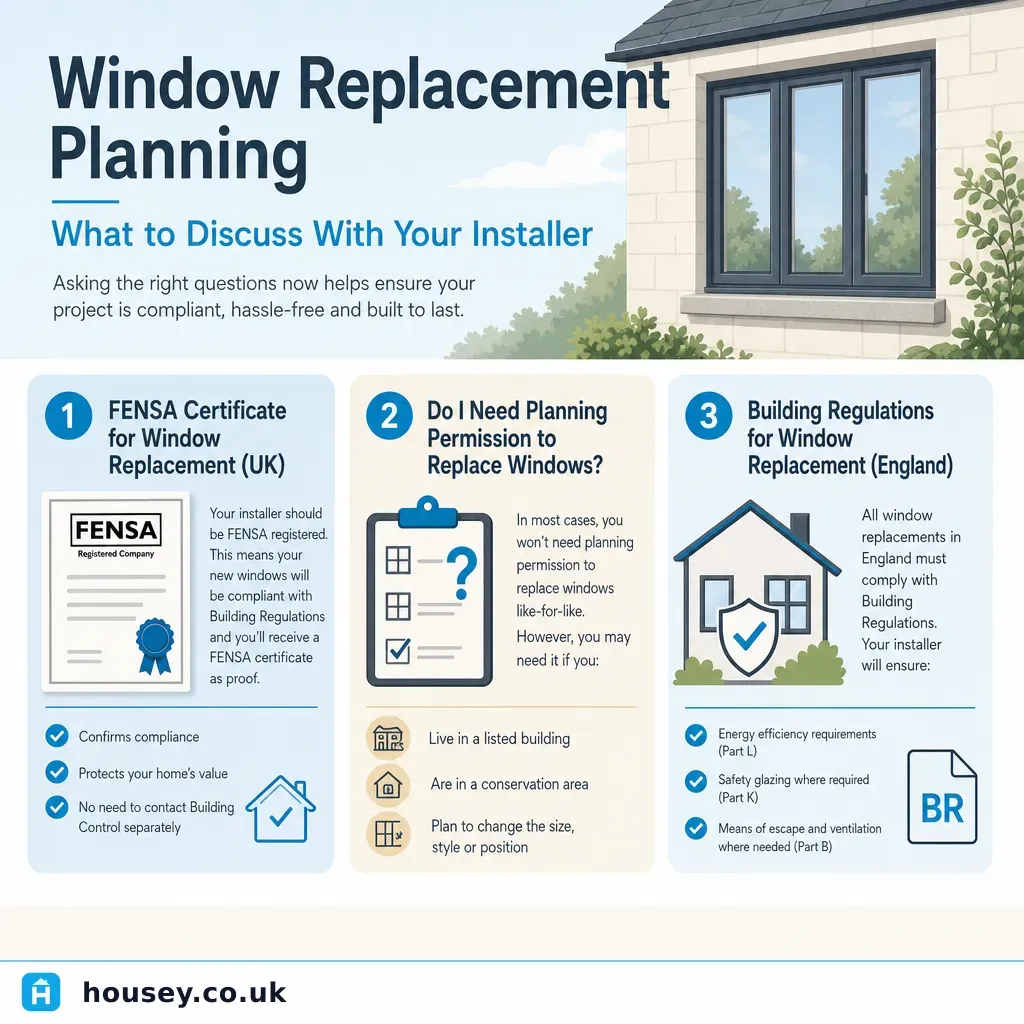
Window Replacement Planning: What to Discuss With Your Installer
Most window replacements in England fall under permitted development rights and do not require planning permission, but they must comply with Building Regulations Part L and Part K.
 Improvement & Build
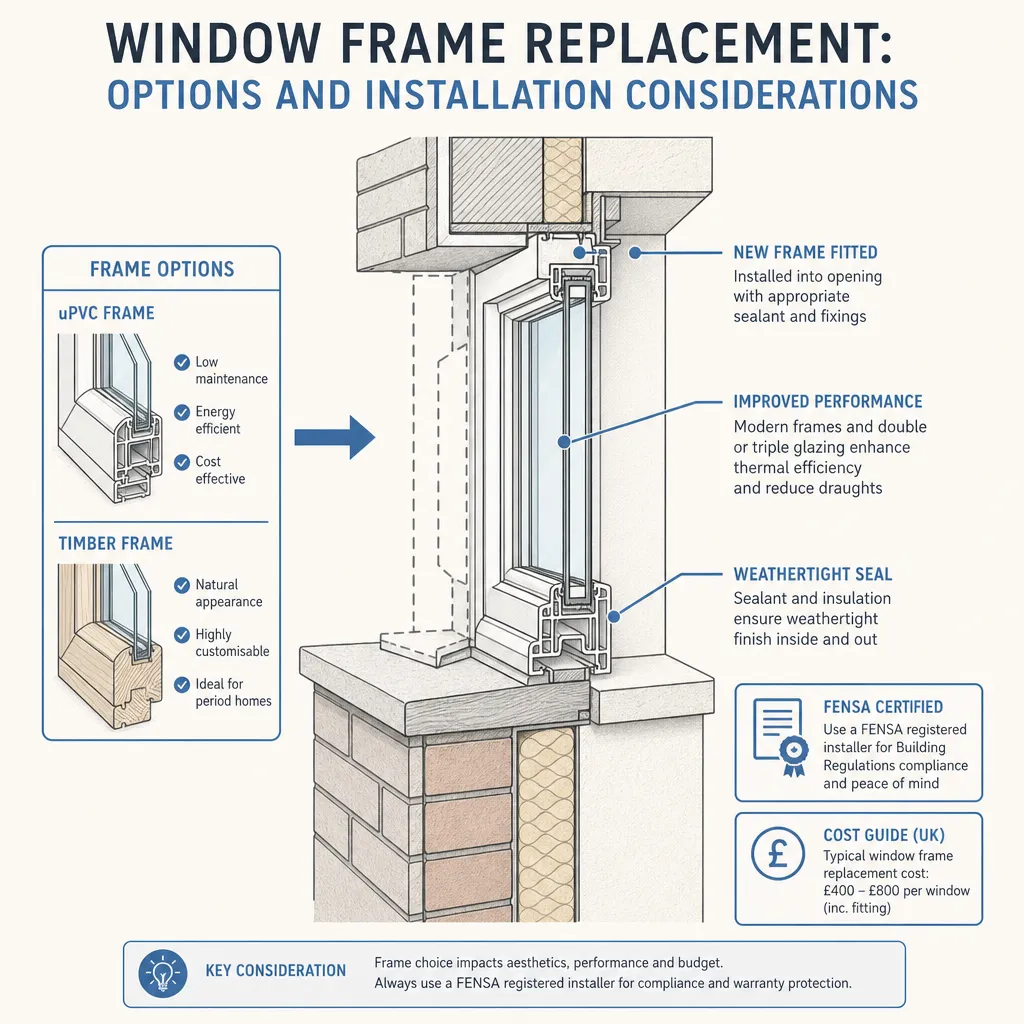
Window Frame Replacement: Options and Installation Considerations
Replacing window frames in the UK requires compliance with Part L of the Building Regulations and, in most cases, a FENSA or Certass certificate.
 Improvement & Build
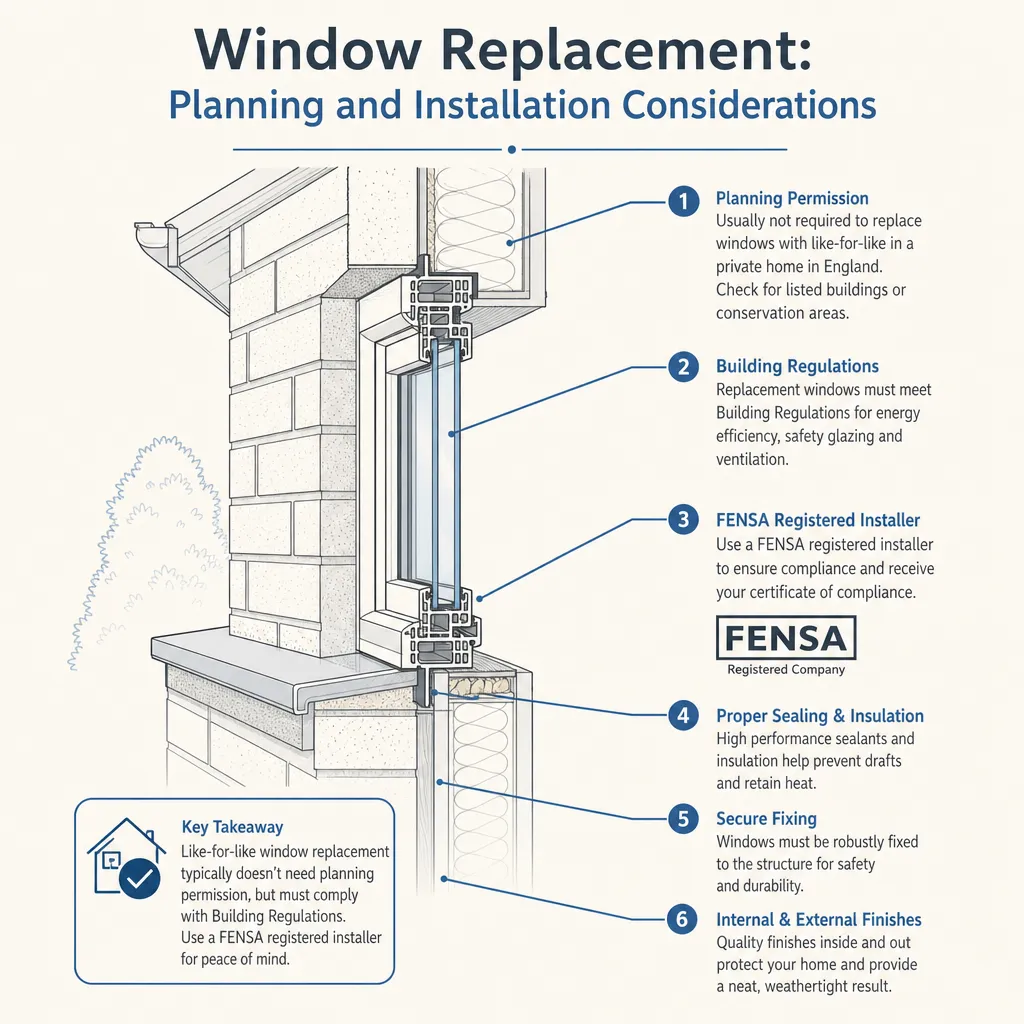
Window Replacement: Planning and Installation Considerations
Most window replacements in England fall under permitted development and do not need planning permission, though listed buildings, flats, and conservation areas are exceptions.
 Improvement & Build
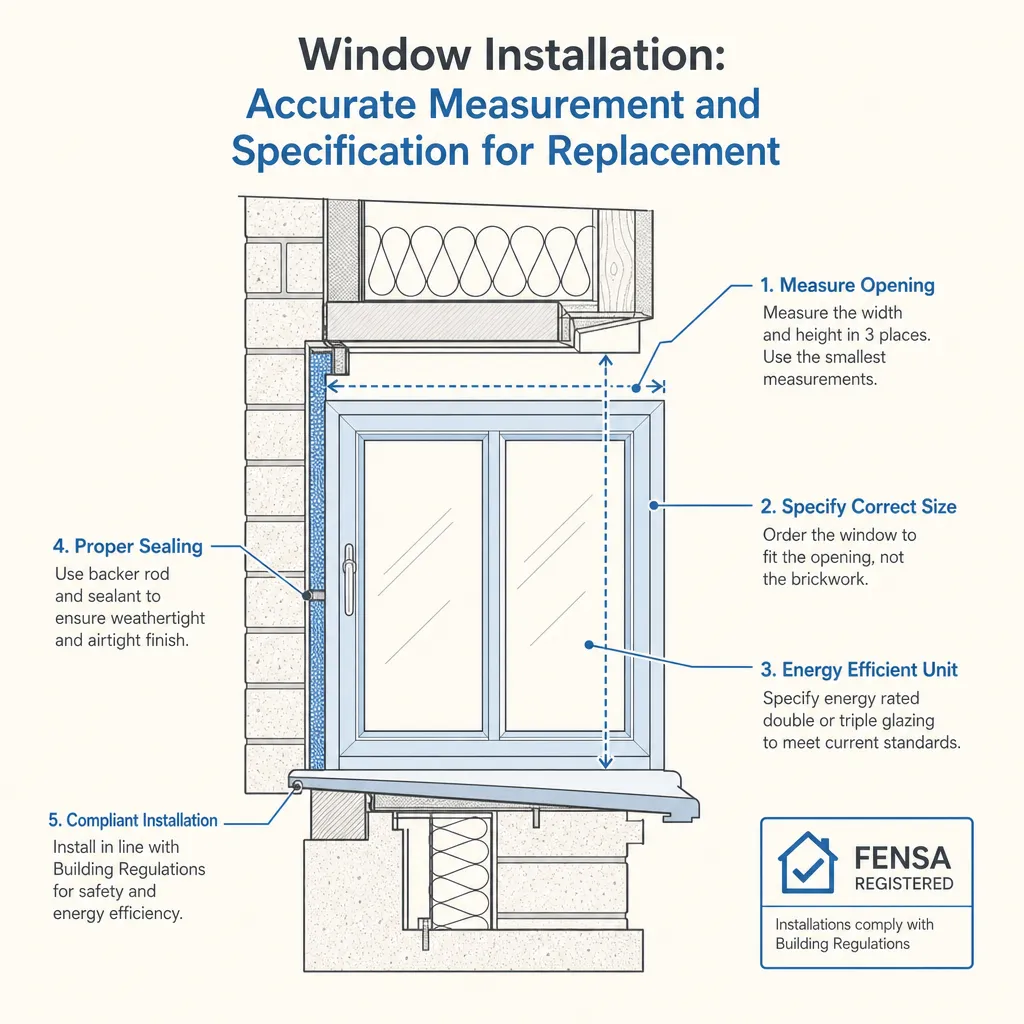
Window Installation: Accurate Measurement and Specification for Replacement
Accurate window measurement for replacement means recording the width and height of the existing frame opening in at least three places, noting the smallest dimension, and providing a full specification to your installer — including frame material, glazing type, opening style, and trickle ventilators.
 Improvement & Build
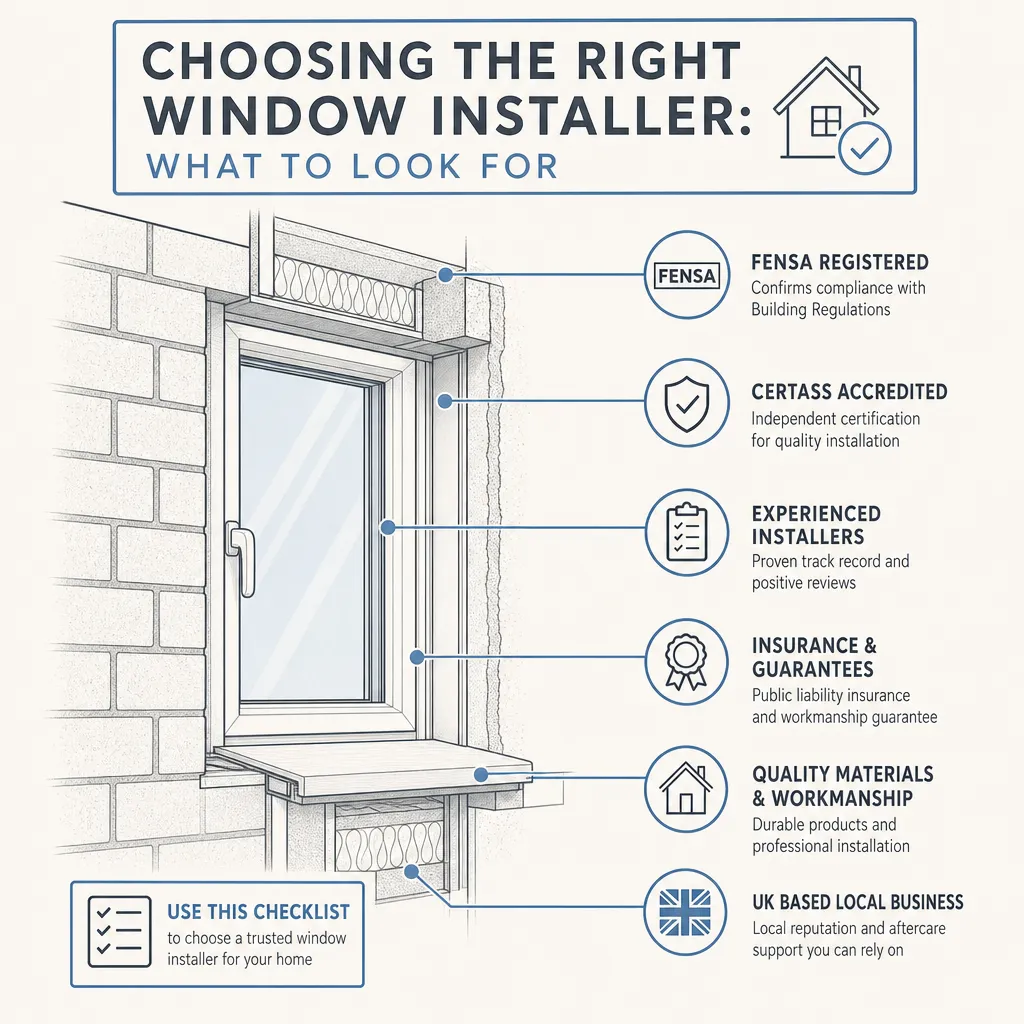
Choosing the Right Window Installer: What to Look For
When choosing a window installer in the UK, verify FENSA or CERTASS registration first — these schemes allow installers to self-certify Building Regulations compliance and issue the completion certificate you will need at resale.