Window Frame Replacement: Options and Installation Considerations
By Housey · Last reviewed 18th of May 2026
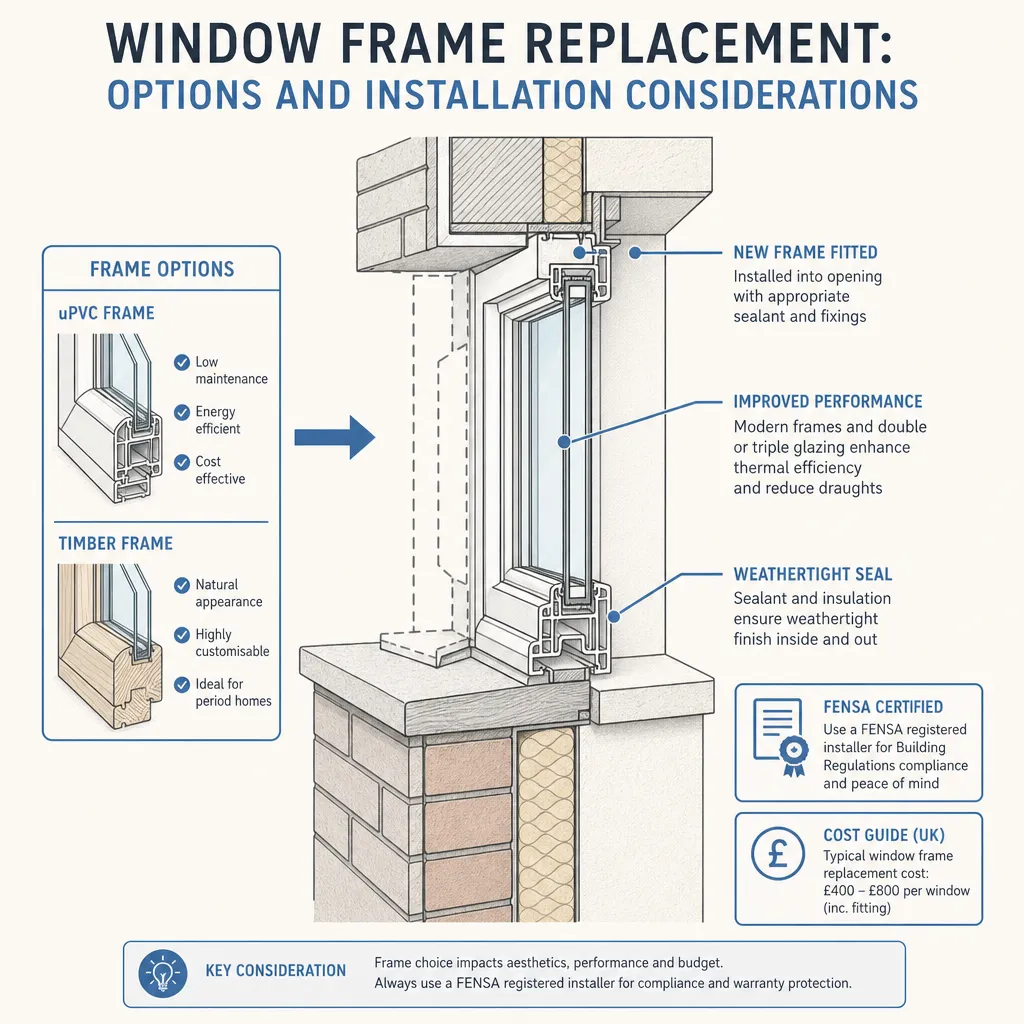
Window Frame Replacement: Options and Installation Considerations
Draughty windows, condensation between panes, rotting timber frames, or a desire to improve thermal performance all prompt UK homeowners to consider window replacement. The choice of frame material, glazing specification, and installer accreditation each have consequences for building regulations compliance, planning permission, and resale value — and getting any of these wrong can result in enforcement notices, complications on sale, or persistent thermal bridging that defeats the purpose of the project.
Key points
- Replacement windows in most homes fall under permitted development, but properties in conservation areas, Article 4 Direction areas, and listed buildings require planning permission or listed building consent before any work begins.
- Installers must be registered with a competent person scheme — FENSA or Certass — or the homeowner must notify local authority building control separately and have the work inspected to comply with Part L and Part K of the Building Regulations.
- Replacement windows in England must achieve a minimum Window Energy Rating (WER) of Band C, or a centre-pane U-value of 1.2 W/m²K or better, under Approved Document L (2022 edition).
- uPVC is the most common choice for post-war properties; timber is generally the most appropriate for pre-1919 buildings, listed properties, and conservation areas where profiles must match the original.
- A FENSA or Certass certificate will be requested by your conveyancer when you sell — always obtain it from your installer at the time of installation.
Frame materials: comparison
Material | Typical lifespan | Typical U-value (double glazed) | Best for | Not ideal for |
|---|---|---|---|---|
uPVC | 20–35 years | 1.2–1.6 W/m²K | Post-war homes; low-maintenance projects; budget-conscious buyers | Conservation areas; listed buildings; properties needing slim sightlines |
Timber (softwood) | 20–40 years with maintenance | 1.4–1.8 W/m²K | Pre-1919 properties; conservation areas; matching original profiles | Homeowners wanting minimal maintenance; high-moisture locations without proper treatment |
Timber (engineered/hardwood) | 40–60+ years | 1.4–1.8 W/m²K | High-specification period properties; conservation area compliance | High upfront cost; requires periodic redecoration |
Aluminium (thermally broken) | 30–45 years | 1.2–1.6 W/m²K | Contemporary homes; slim sightlines; large glazed spans | Period properties; cost-sensitive projects |
Composite (timber-aluminium) | 30–50 years | 1.2–1.4 W/m²K | High performance with period aesthetics; low external maintenance | Highest cost; complex repairs if damaged |
Indicative performance data; U-values vary by specification and glazing unit. Confirm product data sheets with your installer before ordering.
Decision tree: which frame material is right for you?
- Choose uPVC if your property is post-1945, you want low maintenance, and there is no planning constraint on profile appearance or material.
- Choose softwood timber if your property is pre-1919, in a conservation area, or if you need to match existing profile dimensions and decoration for permitted development or listed building consent purposes.
- Choose aluminium (thermally broken) if you want slim sightlines, large glazed areas, or a contemporary aesthetic, and cost is not the primary constraint.
- Choose composite (timber-aluminium) if you want the internal appearance of timber with aluminium external faces for low maintenance — common in higher-specification refurbishments.
- Check with your local planning authority before choosing any material if the property is in a conservation area — some LPAs specify not just the material but profile depth, glazing bar arrangement, and finish colour.
- Commission pre-application advice from a listed building officer if the property is listed — replacement windows almost always require listed building consent and must closely replicate the originals in material, profile, and detail.
Planning and building regulations: what you need to know
Permitted development
Most replacement windows (like-for-like) in standard residential properties fall under permitted development in England. However, permitted development rights are removed or restricted where:
- The property is in a conservation area — replacement windows visible from a highway or public space often require planning permission under Article 4 Directions.
- The property is subject to an Article 4 Direction — your local planning authority can withdraw permitted development rights for specific works in designated streets or areas.
- The property is a listed building — all external alterations require listed building consent; the character of the windows is integral to what was listed.
- The property is a flat or maisonette — permitted development rights for window replacement differ from those applying to houses.
Always check with your local planning authority if there is any doubt before proceeding.
Building regulations (England)
Replacement windows are notifiable works under Part L (Conservation of Fuel and Power) and Part K (Protection from Falling) of the Building Regulations. To comply:
- Use a registered competent person: A FENSA- or Certass-registered installer self-certifies compliance and registers the installation without requiring a separate building control application.
- Apply independently to building control if your installer is not registered — this adds cost and processing time.
- Part L requires a minimum WER of Band C or equivalent centre-pane U-value of 1.2 W/m²K for replacement glazing.
- Part K requires toughened or laminated safety glass in critical locations: within 800 mm of floor level and within 300 mm of a door edge.
Glazing options: double, triple, and secondary
Double glazing with a low-emissivity (low-e) coating and argon gas fill can achieve centre-pane U-values below 1.0 W/m²K — well above Part L requirements — and remains the standard choice for the majority of UK homes.
Triple glazing offers better thermal performance (centre-pane U-values of 0.5–0.7 W/m²K) and improved acoustic attenuation. It is heavier than double glazing and requires robust frames. In the UK's moderate climate, payback periods in energy savings alone are typically 15–25 years — assess carefully whether the marginal improvement justifies the additional cost for your property.
Secondary glazing — an inner frame fixed inside the existing window opening — is often the preferred option for listed buildings and conservation area properties where replacing the primary window is restricted or undesirable. It can provide significant acoustic improvement and useful thermal gains without altering the external appearance.
Homeowner checklist: before installation day
When to get professional help
Window replacement is a well-established trade, but professional advice is warranted in several situations:
- The property is listed or in a conservation area — obtain written confirmation from a conservation officer or the local planning authority before committing to any frame or glazing specification.
- Existing lintels show cracking, displacement, or signs of failure — window replacement should not proceed until a structural engineer has assessed the lintel condition.
- Signs of damp, mould, or timber decay are present around the existing reveals — address the root cause (which may include a failed cavity tray DPC above the opening) before fitting new frames.
- The installation requires altering or enlarging the structural opening.
How Housey can help
Housey connects homeowners with vetted window and door installers who are FENSA- or Certass-registered and experienced across the full range of frame materials and glazing specifications. Describe your project and compare quotes from qualified local professionals.
Frequently asked questions
Do I need a FENSA certificate when selling my house?
Yes. Your conveyancer will ask for a FENSA or Certass certificate for any replacement windows installed since April 2002. If you do not have one, you can apply for retrospective registration through FENSA or obtain building control sign-off — both carry a fee. Always obtain the certificate from your installer at the time of installation to avoid complications on sale.
How long does window frame replacement take?
A typical installation of 8–12 windows in a standard semi-detached house takes 1–2 days. Bespoke or heritage timber windows may have a manufacturing lead time of 4–12 weeks and take longer to fit. Allow additional time for internal making-good, as plasterwork and decoration are usually carried out separately after the installation is complete.
Is triple glazing worth it in the UK?
Triple glazing offers better thermal and acoustic performance than double glazing, but payback periods in energy savings alone are typically 15–25 years in the UK's moderate climate. It is most worthwhile in exposed locations, noisy environments near busy roads or flight paths, or high-specification passive house projects where every marginal performance gain counts.
Can I replace my own windows without a registered installer?
Legally you can, but the work is notifiable under building regulations. You must notify local authority building control before starting, pay an application fee, and have the work inspected and signed off. Using a FENSA- or Certass-registered installer is usually more straightforward and ensures a compliant certificate is issued automatically without a separate building control process.
Sources and further reading
- Planning permission — windows, doors and glazing — GOV.UK
- What is FENSA? — FENSA
- Approved Document L — Conservation of Fuel and Power (2022) — GOV.UK
- Approved Document K — Protection from Falling — GOV.UK
- Windows — Historic England
Useful next reads
 Improvement & Build
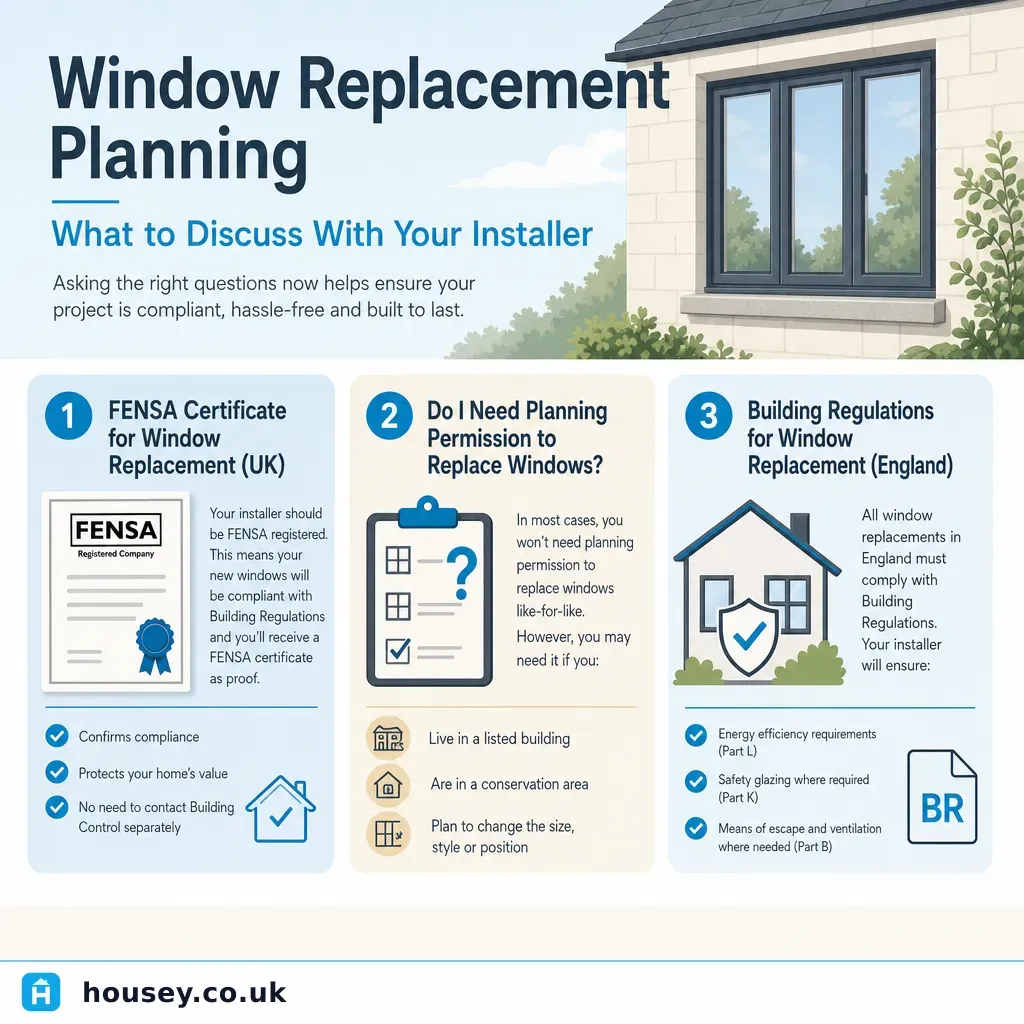
Window Replacement Planning: What to Discuss With Your Installer
Most window replacements in England fall under permitted development rights and do not require planning permission, but they must comply with Building Regulations Part L and Part K.
 Improvement & Build
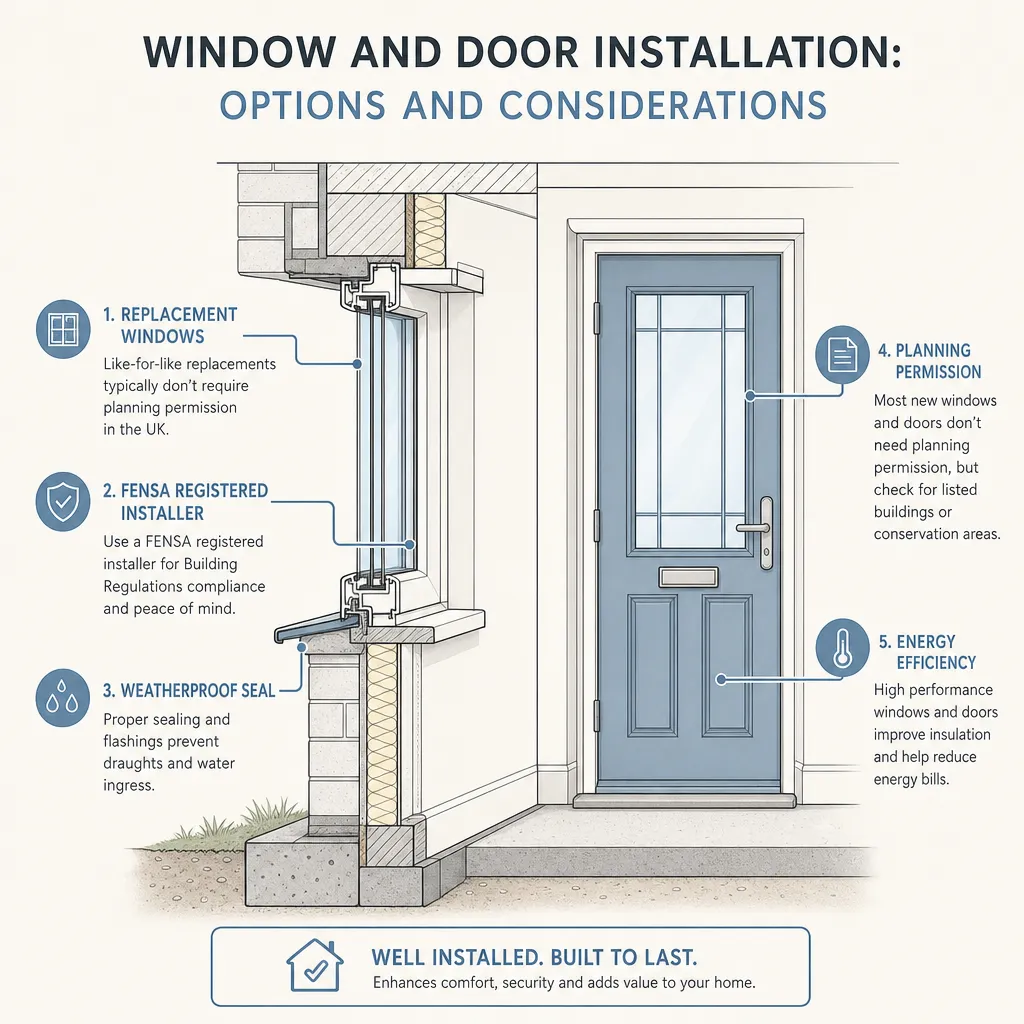
Window and Door Installation: Options and Considerations
Replacing windows and external doors in the UK requires compliance with Building Regulations Part L (thermal performance) and Part K (safety glazing).
 Improvement & Build
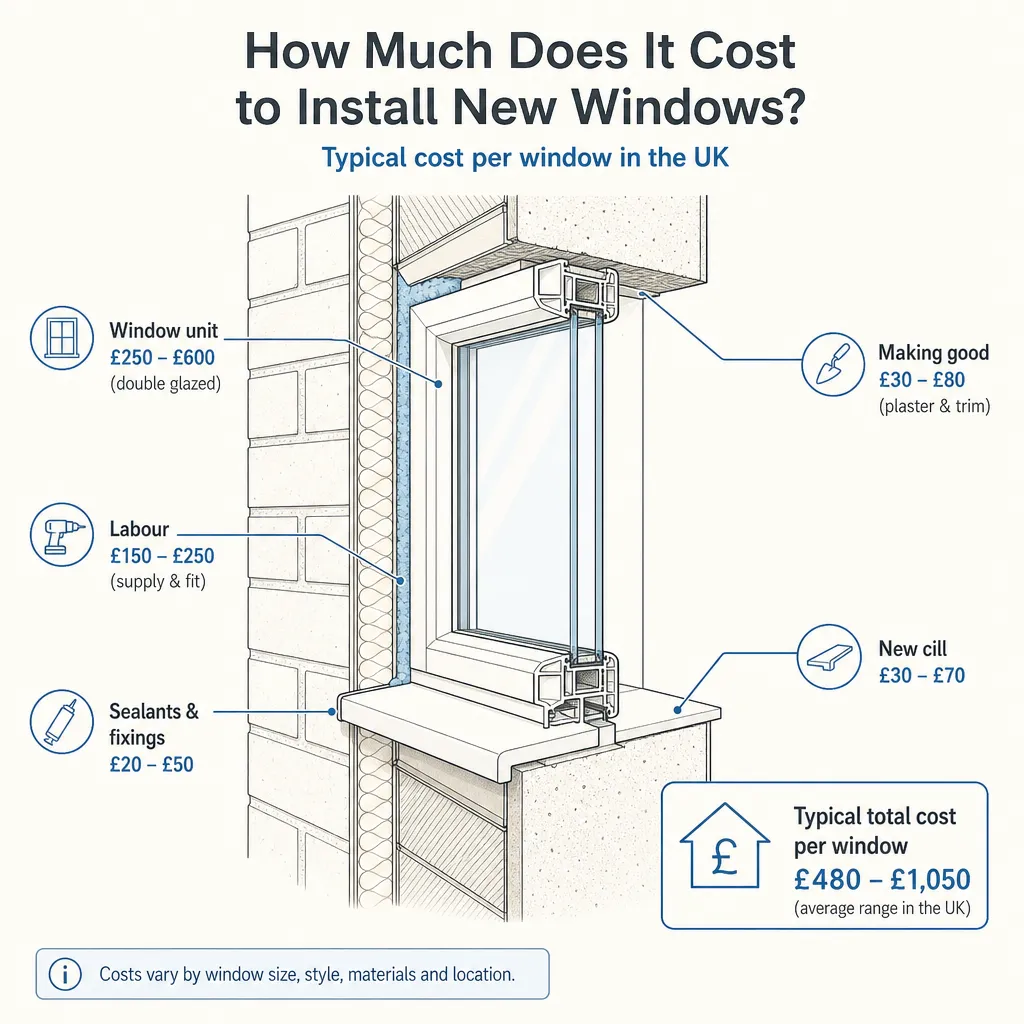
How Much Does It Cost to Install New Windows?
New window installation in the UK typically costs £300–£700 per uPVC double-glazed window (supply and fit), rising to £800–£2,500 for timber or sash windows.
 Improvement & Build
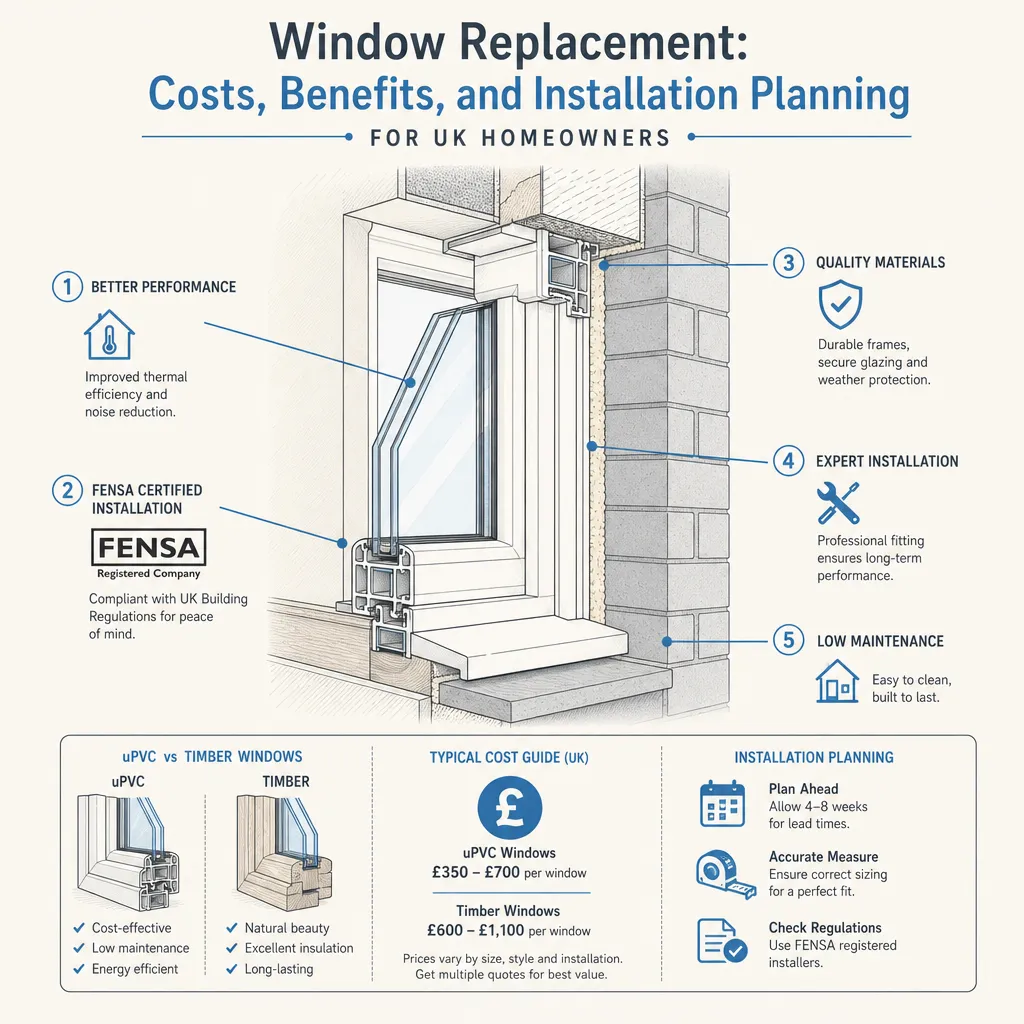
Window Replacement: Costs, Benefits, and Installation Planning
Replacing windows in most UK homes is permitted development but must meet Building Regulations Part L, requiring a whole-window U-value of 1.
 Improvement & Build
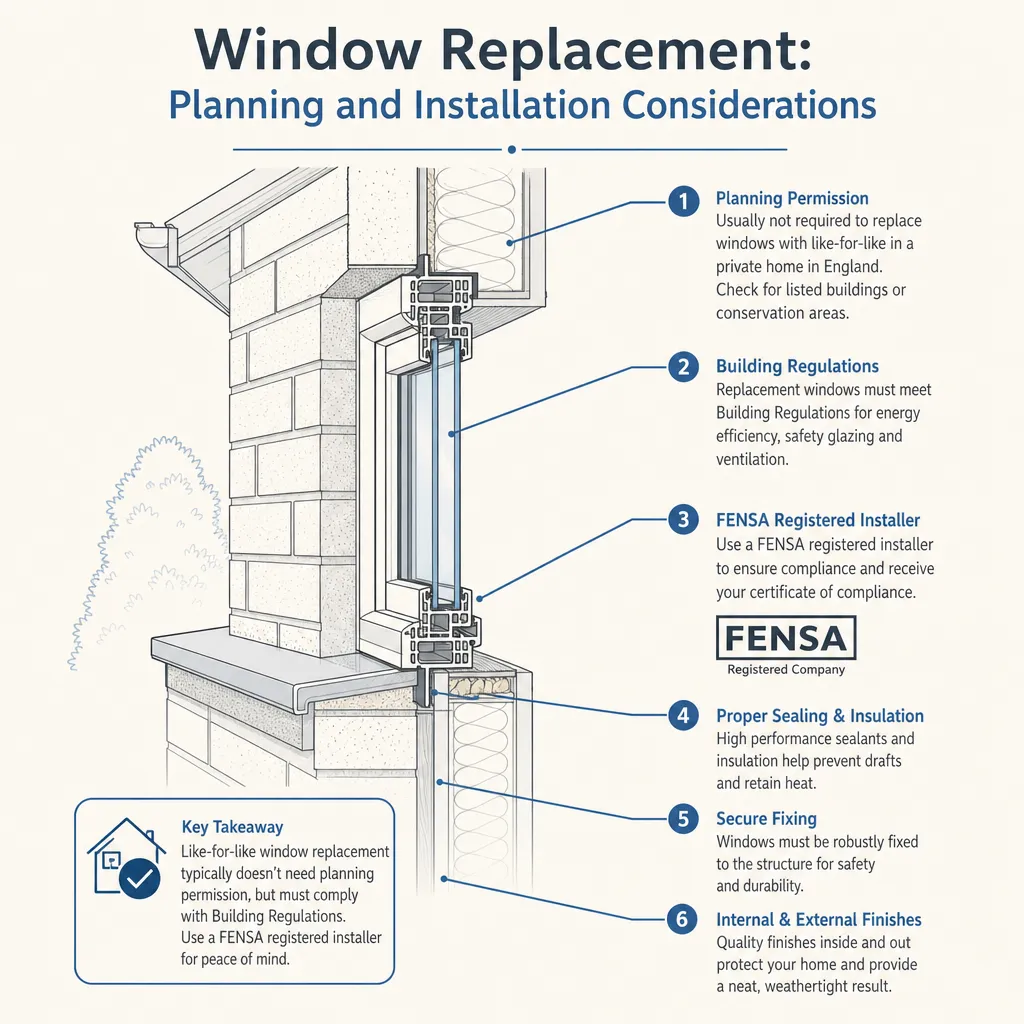
Window Replacement: Planning and Installation Considerations
Most window replacements in England fall under permitted development and do not need planning permission, though listed buildings, flats, and conservation areas are exceptions.