Choosing Your Own RICS Surveyor: Independence From Estate Agents
By Housey · Last reviewed 1st of June 2026
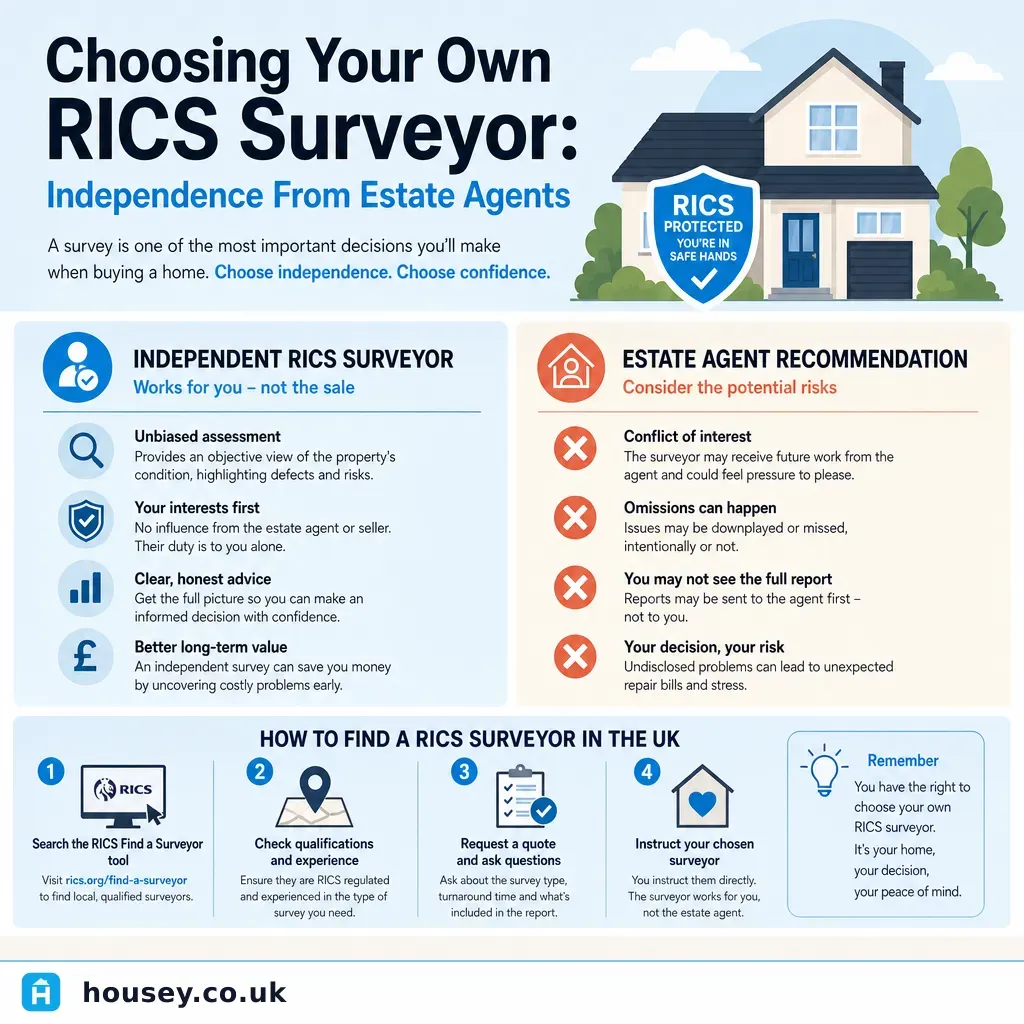
Choosing Your Own RICS Surveyor: Independence From Estate Agents
When you make an offer on a property, the estate agent will often suggest a surveyor — sometimes helpfully, sometimes as a referral arrangement that benefits them financially. Buyers have every right to instruct their own RICS surveyor entirely independently, and understanding how surveyor selection works before accepting the first name you are given can make a meaningful difference to the quality and impartiality of the report you receive. That report is the information on which you decide whether to proceed, renegotiate, or walk away from the purchase — so who produces it, and for whom, matters.
Key points
- You are never legally obliged to use a surveyor recommended by an estate agent; the choice of surveyor is entirely yours as the buyer.
- RICS (Royal Institution of Chartered Surveyors) is the UK's principal regulatory body for surveyors — look for MRICS (Member) or FRICS (Fellow) designations and verify credentials on the RICS register at rics.org.
- There are three RICS Home Survey levels: Level 1 (Condition Report), Level 2 (Home Survey), and Level 3 (Building Survey) — the right level depends on the property's age, construction type, and condition.
- Estate agents may receive referral fees from the surveyors they recommend; under the Consumer Protection from Unfair Trading Regulations 2008, agents must disclose material commercial relationships.
- A surveyor you instruct directly owes their professional duty of care solely to you and has no financial relationship with the selling agent.
Why you should choose your own surveyor
Estate agents act for the seller. Their commercial interest is in the sale completing quickly and at the agreed price. A surveyor instructed via an estate agent's referral will typically still owe their professional duty of care to you as the client — but there is a structural tension in a referral relationship that many buyers reasonably prefer to avoid.
Choosing your own surveyor also gives you:
- Relevant specialist experience — some surveyors focus on Victorian and Edwardian properties; others have expertise in timber-framed buildings, listed buildings, or new-build defect assessment. You can match the surveyor to the specific property type.
- Genuine local knowledge — a surveyor who regularly works in the area will recognise localised issues such as mining subsidence, clay soil movement, or local flood risk more readily than a generalist sent from elsewhere.
- Scope to discuss the instruction — when you contact a surveyor directly before booking, you can explain specific concerns, ask whether a Level 3 rather than Level 2 is advisable for this property, and explore whether specialist reports might be warranted.
- No conflict of interest — you can ask any surveyor directly and in writing whether they have a referral arrangement with the estate agent or any other party in the transaction.
Understanding the three RICS survey levels
RICS introduced its standardised Home Survey framework in 2021. All three levels use condition ratings (1 = no repair currently needed; 2 = defects requiring attention; 3 = serious or urgent defects) to describe the property's condition.
Survey level | Best for | Not ideal for | Typical output | Indicative cost (UK, 2026) |
|---|---|---|---|---|
Level 1 — Condition Report | New-build or recently built homes in good condition with standard construction | Anything older than ~20 years; visible defects; listed buildings; unusual construction | Traffic-light condition ratings; no repair advice; no valuation | £250–£400 |
Level 2 — Home Survey | Conventional post-war homes in reasonable condition; 1960s–2000s estate houses | Pre-1919 properties; significant visible defects; unusual or heavily altered construction | Condition ratings, concise defect descriptions, advice on urgent matters; optional valuation | £400–£700 |
Level 3 — Building Survey | Older, larger, altered, or visibly defective properties; Victorian, Edwardian, listed, or unusual construction | Simple modern new-builds where Level 3 detail is unnecessary | Full construction description, all visible defects, repair implications, maintenance advice; no standard valuation | £600–£1,500+ |
Indicative UK costs, last reviewed 2026-06-01. Costs vary by property size, location, and surveyor. Always request a written quote before instructing.
Which survey level do you need?
- Choose Level 1 if the property is a recently completed new-build or a modern home in demonstrably good condition with no visible defects, and you need basic condition confirmation.
- Choose Level 2 if the property is a conventional post-war home in reasonable condition and you want clear condition ratings and concise advice on defects found, without a full narrative report.
- Choose Level 3 if the property is pre-1919, listed, has had significant alterations, shows visible cracks, damp patches, or signs of movement, or is of unusual construction such as timber frame, thatched, or converted agricultural building.
- Request a specialist structural engineer's report if a RICS surveyor identifies suspected structural movement — the Level 3 report will flag this concern, but a structural engineer provides the diagnosis and remediation specification.
- Speak to a RICS-registered valuer separately if you need a formal market valuation for mortgage, probate, or matrimonial purposes — this is distinct from the indicative valuation sometimes offered as an optional add-on to Level 2 reports.
- Ask your surveyor which level they recommend once you have described the property — a good independent surveyor will advise honestly rather than defaulting to the cheapest option.
How to find and vet an independent surveyor
- Use the RICS Find a Surveyor tool at ricsfirms.com — search by postcode and service type to find regulated, insured firms in the area where the property is located.
- Check designations — MRICS and FRICS are full chartered memberships. AssocRICS is an associate grade; consider whether full membership is appropriate for the complexity of the property you are buying.
- Ask about local experience — how many Level 2 or Level 3 surveys has the surveyor completed on similar properties (same era, construction type) in the same area in the past year?
- Request professional indemnity insurance details — regulated RICS surveyors must carry PI insurance; ask for confirmation of cover before instructing.
- Get a written fee quote — confirm what is included (travel, report production, follow-up discussion), whether VAT is stated separately, and what the realistic report turnaround time is.
- Ask about conflicts of interest — does the firm or individual surveyor have any referral arrangement or financial relationship with the estate agent or any other party involved in this transaction?
Red flags when selecting a surveyor
- The surveyor cannot be found on the RICS register as MRICS or FRICS — verify at rics.org before instructing.
- A quote is provided without the surveyor asking about the property's age, construction type, or your specific concerns.
- The surveyor discourages a Level 3 report on a pre-1919 property without giving a clear, property-specific reason for the recommendation.
- You receive a report with generic or template wording that does not appear to reflect observations specific to the property inspected.
- The estate agent is reluctant to share contact details for any surveyor other than their own referral.
- The surveying firm has a financial or ownership link to the estate agency — if uncertain, check at Companies House.
What to ask before instructing a surveyor
- What RICS membership grade do you hold, and can you provide your registration number for verification?
- How many surveys of similar properties — same era, construction type, and general area — have you completed in the past year?
- What will the report cover, and what are the stated exclusions (for example, areas not inspected due to restricted access or fixed coverings)?
- Will you flag in the report whether specialist advice is advisable — structural engineer, damp specialist, drainage survey, or Electrical Installation Condition Report (EICR)?
- What is the turnaround time for the written report, and is a follow-up call to discuss the findings included in the fee?
- Do you have any referral arrangement or financial relationship with the estate agent, vendor, or any other party in this transaction?
- Is VAT included in the quoted fee, and what circumstances would cause the price to increase?
When to get professional help
A RICS surveyor is the professional at the centre of this decision. Seek additional specialist input when:
- A Level 2 or Level 3 report identifies suspected structural movement, significant damp, or evidence of previous undisclosed alterations — a structural engineer or specialist damp surveyor may be needed to provide a proper diagnosis and quantify remediation costs.
- You are buying a listed building — a surveyor with listed-building experience is strongly advisable, and any subsequent works will require separate consideration of listed building consent implications.
- There is a dispute about the quality or accuracy of the surveyor's report — raise a formal complaint with the firm first, then escalate to RICS Dispute Resolution Services if the matter is unresolved.
How Housey can help
Housey connects buyers with vetted, independent surveyors for RICS Home Surveys, including Level 1 condition reports, Level 2 surveys, and Level 3 Building Surveys. You can compare quotes from local RICS-registered surveyors with relevant experience for your property type — entirely independently of your estate agent.
Frequently asked questions
Can the estate agent insist I use their recommended surveyor?
No. The estate agent cannot legally require you to use any specific surveyor. You are free to instruct any RICS-regulated surveyor of your own choosing. If you feel pressured, ask the agent directly whether they receive a financial benefit from the referral — they are required to disclose this under the Consumer Protection from Unfair Trading Regulations 2008.
Does it matter if my mortgage lender has already instructed a valuation?
Yes — a mortgage valuation and a home survey are different things. The lender's valuation is a brief assessment of whether the property offers adequate security for the loan; it is carried out for the lender, not for you, and does not assess condition in detail. You should still commission your own RICS survey to understand the property's condition before exchange.
How long does a RICS survey take?
The physical inspection typically takes one to four hours depending on property size, age, and survey level. The written report is usually delivered within three to seven working days of the inspection. If you are working to an exchange deadline, discuss turnaround times with the surveyor before instructing and confirm the agreed timeline in writing.
Can I use one surveyor for both a valuation and a survey?
Some RICS surveyors offer a combined Level 2 report with a market valuation added as an optional extra. This valuation is conducted on your behalf and is not the same as the lender's mortgage valuation. Confirm whether your lender will accept a surveyor's valuation in this format before instructing, as lenders sometimes require their own panel valuation regardless.
What happens if the survey identifies serious defects?
A surveyor's report is information to help you make a decision — it does not block the transaction. Serious defects (Condition 3 ratings) give you grounds to renegotiate the price, request that the seller carries out remediation before exchange, or withdraw from the purchase. Your surveyor should be able to advise on the likely urgency and approximate cost range of significant items found.
Sources and further reading
- RICS Home Surveys standard and guidance — RICS
- Buying or selling your home: surveys and valuations — GOV.UK
- Estate Agents Act 1979 — legislation.gov.uk
- Consumer Protection from Unfair Trading Regulations 2008 — legislation.gov.uk
- Surveys when buying a home — Citizens Advice
Useful next reads
 Surveys & Inspections
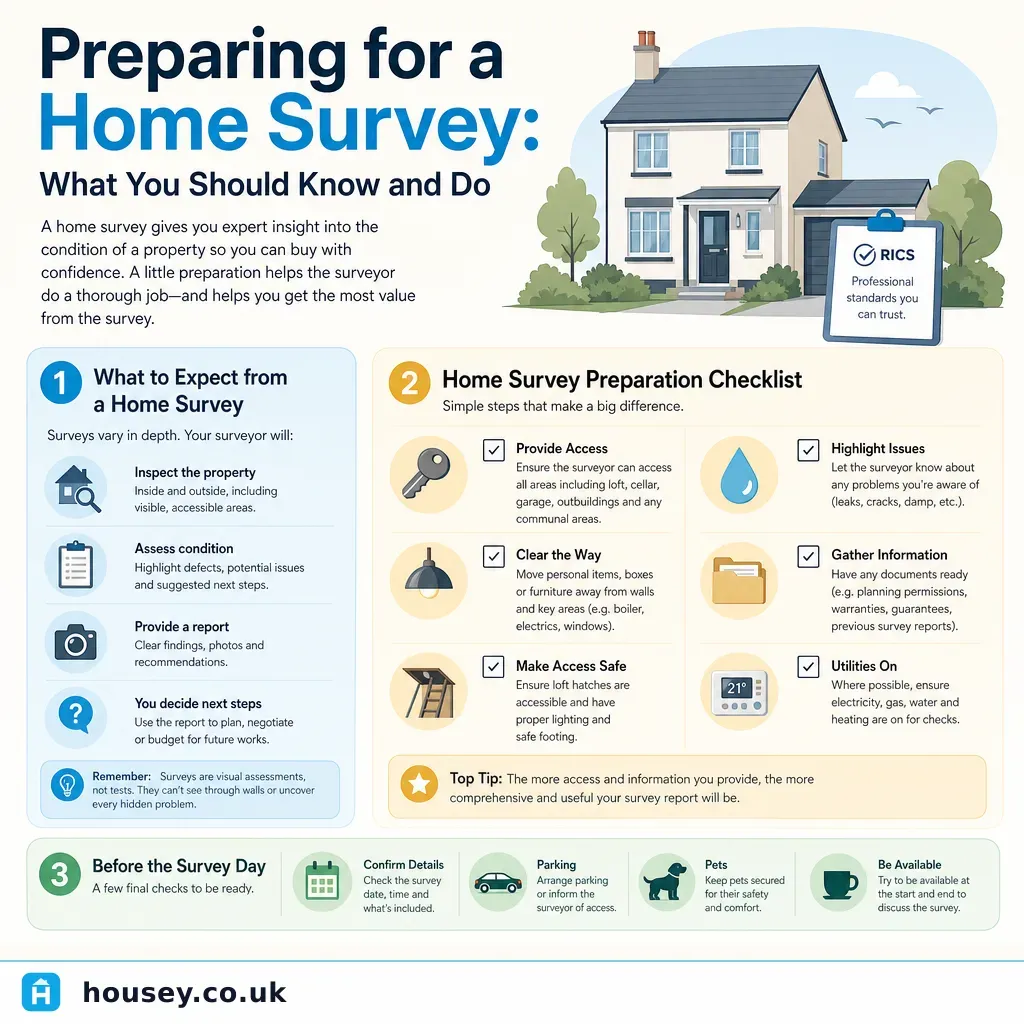
Preparing for a Home Survey: What You Should Know and Do
Preparing for a home survey means giving the surveyor clear access to all parts of the property, gathering relevant documents such as planning permissions and Building Regulations certificates, and knowing in advance which survey level has been instructed.
 Surveys & Inspections
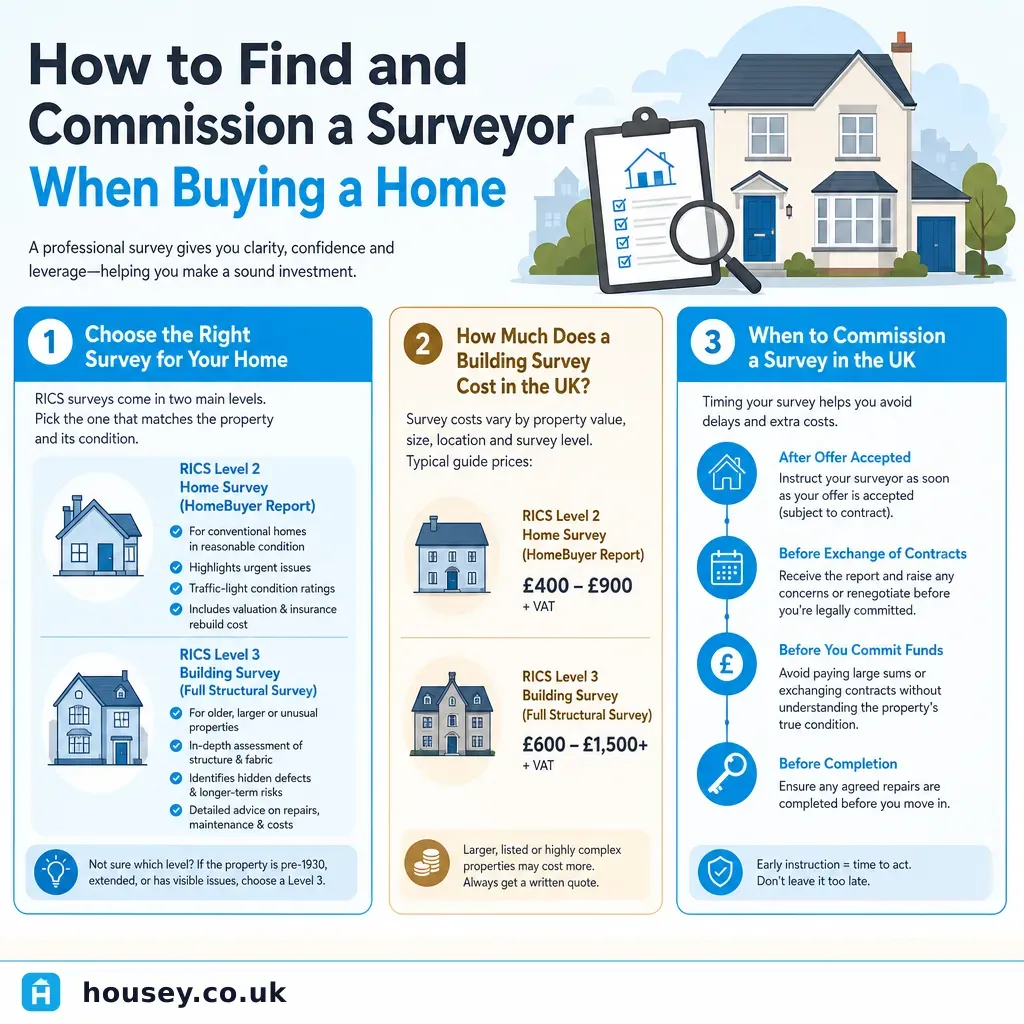
How to Find and Commission a Surveyor When Buying a Home
To commission a surveyor when buying a home, use the RICS Find a Surveyor tool to identify a regulated professional, choose between a RICS Level 2 Home Survey or Level 3 Building Survey based on the property's age and condition, and book as soon as your offer is accepted.
 Surveys & Inspections
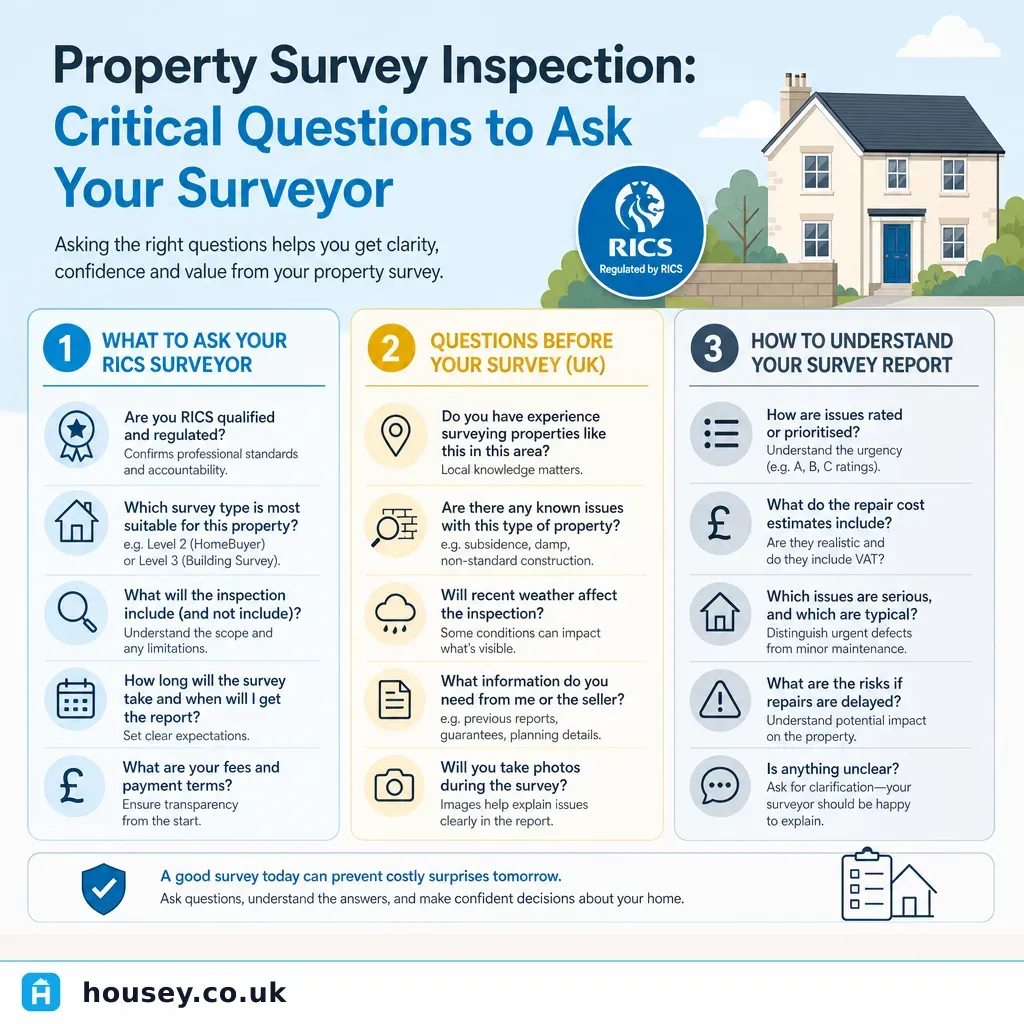
Property Survey Inspection: Critical Questions to Ask Your Surveyor
Before instructing a surveyor, ask which RICS level suits your property and what the report will and will not cover.
 Surveys & Inspections
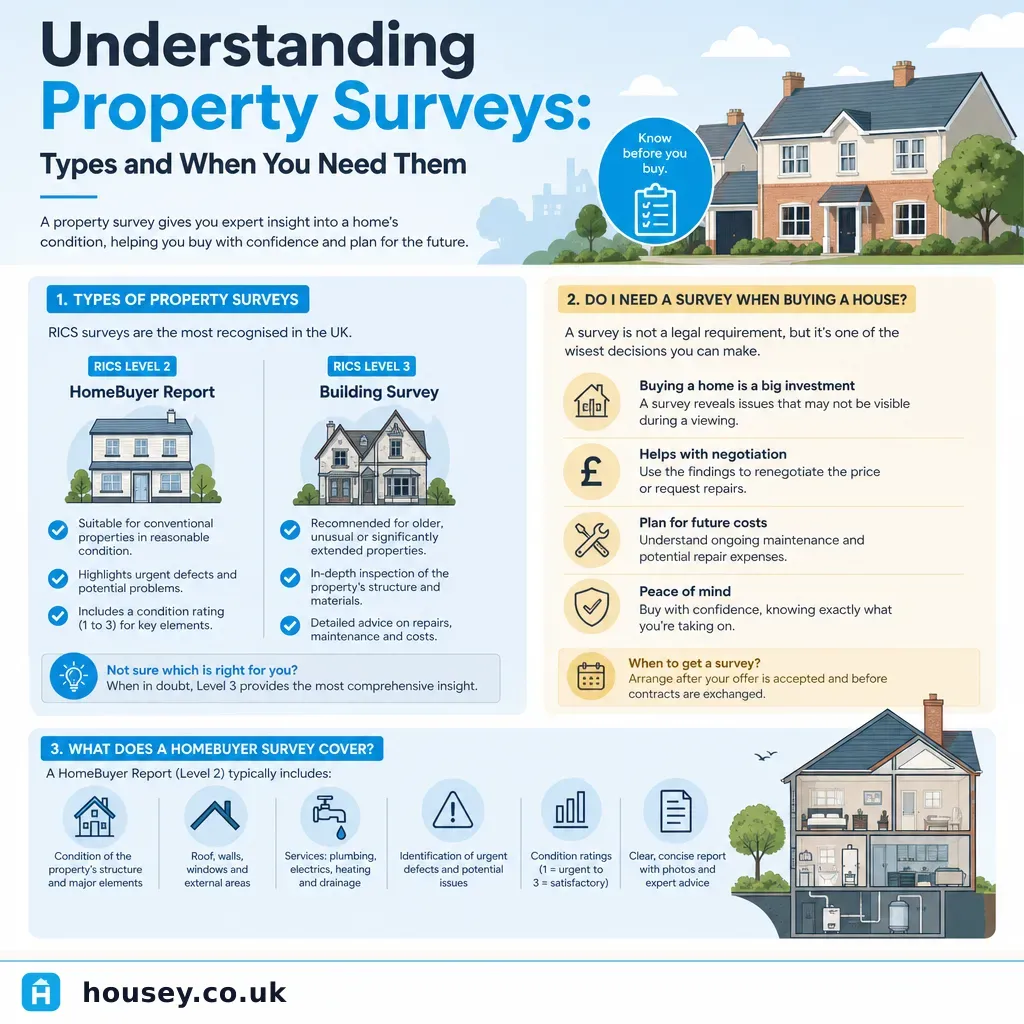
Understanding Property Surveys: Types and When You Need Them
The three main RICS survey types are the Level 1 Condition Report (for standard properties in good condition), the Level 2 Home Survey (conventional homes in reasonable condition), and the Level 3 Building Survey (older, unusual, or defective properties).
 Surveys & Inspections
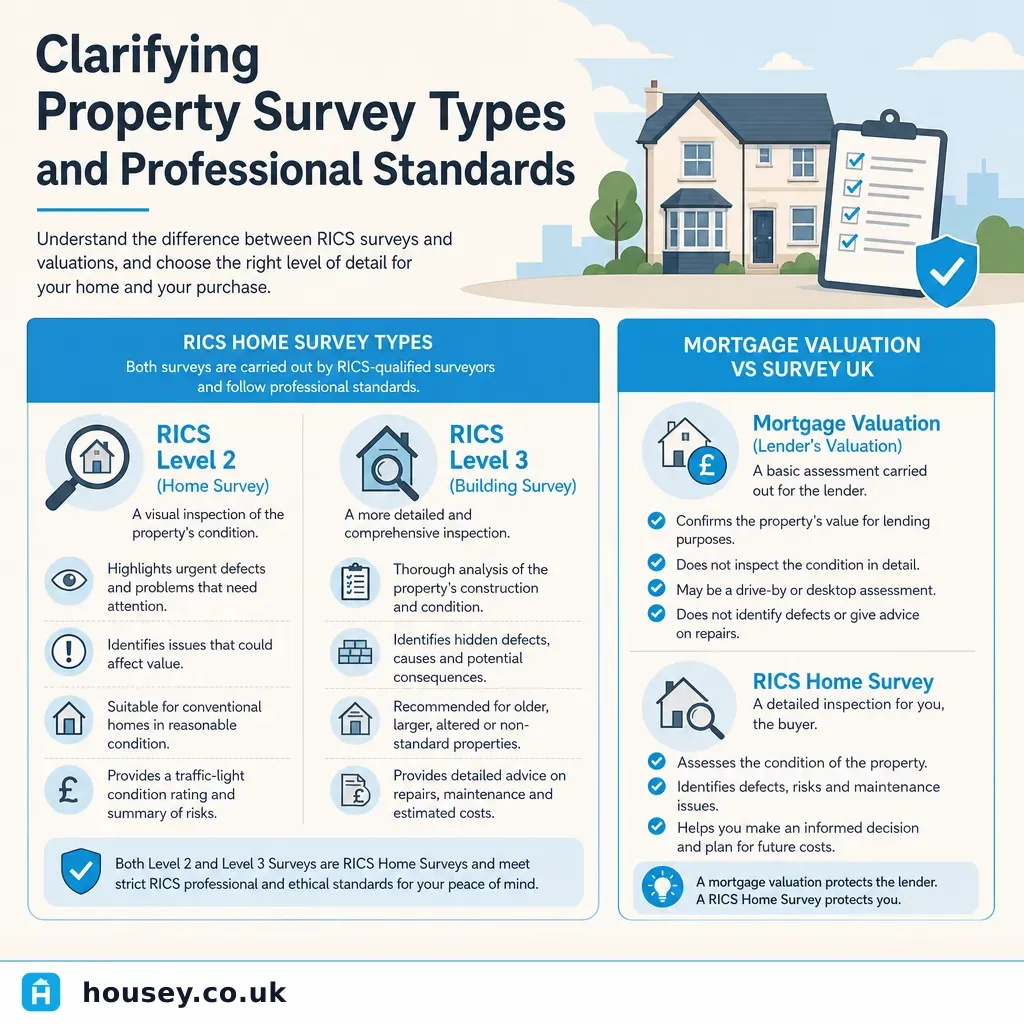
Clarifying Property Survey Types and Professional Standards
RICS Home Surveys come in three levels: Level 1 (condition ratings only), Level 2 (detailed visual inspection and defect advice), and Level 3 (comprehensive building survey for older or complex properties).