How to Find and Commission a Surveyor When Buying a Home
By Housey · Last reviewed 17th of May 2026
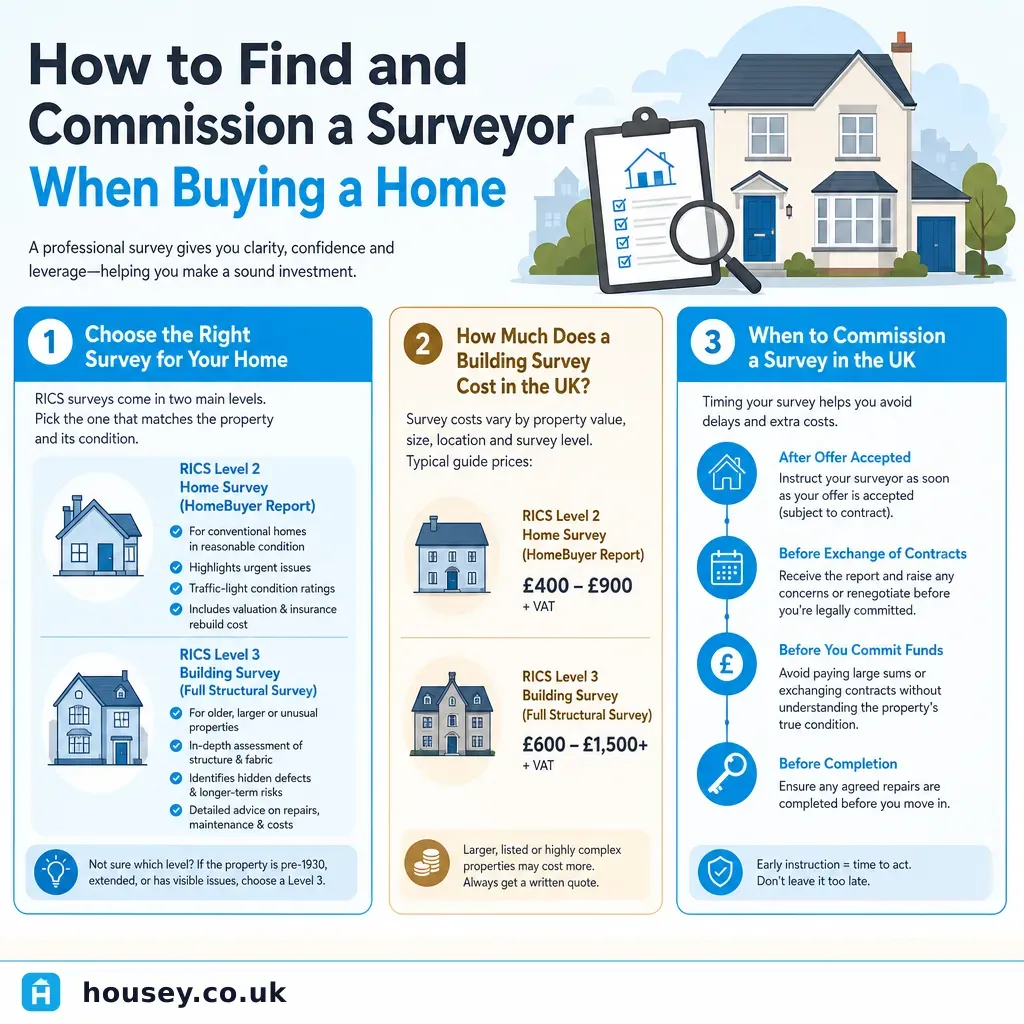
How to Find and Commission a Surveyor When Buying a Home
Most buyers think about commissioning a survey only after their offer has been accepted, and the urgency of an active chain can make the process feel like a tick-box exercise rather than genuine due diligence. In reality, the surveyor you choose and the level of survey you commission will determine how much useful, actionable information you have before exchange — and whether any defects identified give you time to renegotiate, investigate further, or withdraw safely.
Key points
- RICS regulates residential property surveyors in the UK; always confirm that any surveyor you appoint holds current RICS membership by searching the RICS Find a Surveyor tool at ricsfirms.com before instructing.
- The three RICS Home Survey levels are: Level 1 (Condition Report), Level 2 (Home Survey), and Level 3 (Building Survey) — each provides progressively greater depth of investigation and reporting detail.
- A RICS Level 3 Building Survey is generally appropriate for properties built before 1900, those with visible defects or significant alterations, listed buildings, and timber-framed or other non-standard construction.
- Always appoint your surveyor directly rather than accepting a referral from the estate agent — when you instruct the surveyor yourself, the duty of care runs to you, not to the agent.
- Building surveys typically cost £400–£1,500 or more depending on property size, age, type, and location; a mortgage valuation carried out for the lender is not a condition survey and does not protect your interests (Indicative UK costs, last reviewed 2026-05-17).
Which survey level do you need?
Choosing the wrong survey level is the most common mistake buyers make. A Level 2 on a Georgian end-of-terrace with suspected damp can miss significant hidden defects; a Level 3 on a straightforward 2010 estate house adds cost without proportionate benefit.
Survey type | Best for | Not ideal for | Typical output | Main risk if you choose wrong |
|---|---|---|---|---|
RICS Level 1 Condition Report | New-builds and modern homes in demonstrably good condition with no visible defects | Older, altered, or visibly imperfect properties | Traffic-light condition ratings; no advice or market valuation | May miss significant defects in period or altered properties |
RICS Level 2 Home Survey | Conventional homes in reasonable condition, typically post-1900 construction | Properties with known defects, large extensions, unusual construction, or solid walls | Condition ratings, defect commentary, market valuation, and reinstatement cost estimate | May not investigate behind finishes or in inaccessible areas where defects are concealed |
RICS Level 3 Building Survey | Older, larger, altered, listed, or visibly defective properties of any age | Straightforward modern homes where the additional cost is difficult to justify | In-depth defect analysis, likely causes, remediation options, and indicative cost guidance | Under-commissioning for a complex property can result in costly post-exchange surprises |
Which survey should you choose?
- Choose a RICS Level 2 if the property is post-1919, of conventional brick-and-block cavity-wall construction, in reasonable condition, and has not been materially altered.
- Choose a RICS Level 3 if the property is pre-1919, solid-walled, listed, thatched, timber-framed, or shows visible defects such as cracking, damp staining, or a sagging roofline; or if you plan significant renovation and need to understand the fabric in detail.
- Commission a structural engineer separately if the surveyor flags suspected structural movement, subsidence, or a foundation concern that requires specialist diagnosis beyond a general survey.
- Ask the surveyor which level they recommend if you are uncertain — most will advise briefly by telephone before you book, at no charge.
How to find a qualified surveyor
Step 1: Use the RICS Find a Surveyor directory
Search RICS Find a Surveyor by postcode and service type. All firms listed are RICS-regulated, which means they must meet mandatory professional standards and are subject to RICS's complaints and disciplinary process. Do not rely on a surveyor's own assurance of RICS membership — verify on the live register.
Step 2: Check for relevant property-type experience
A surveyor familiar with the specific construction era and type is more useful than one who is merely nearby or cheapest. Before booking, ask whether the surveyor has inspected:
- Properties of the same era and construction type (e.g., Victorian terrace, 1930s semi, solid-wall cottage)
- Properties in the same local authority area, particularly if conservation area or listed building rules apply
- Any specialist building type relevant to your purchase — timber-frame, steel-frame, or prefabricated concrete construction
Step 3: Request a written scope confirmation before instructing
A reputable firm will confirm in writing what the survey covers and excludes before you instruct. Ask whether the fee includes a market valuation, a reinstatement cost assessment, and whether outbuildings or garages are within scope.
Step 4: Appoint directly, not through the estate agent
Instruct the surveyor yourself. When an estate agent recommends a specific firm, there may be a referral arrangement in place. Appointing directly ensures the surveyor's contractual duty of care runs solely to you, and you retain full control of the survey level and process.
Document preparation list: before the survey
Gathering the following before booking and before the survey inspection helps the surveyor and may affect their findings:
- Copies of planning permissions and building regulations approvals for any extensions or material alterations
- Details of defects, remedial works, or investigations disclosed by the seller in the Property Information Form (TA6)
- Listed building consent documentation if the property is listed
- Previous structural engineer reports or specialist surveys, if available from the seller
- Flood risk check using the Environment Agency Flood Map for Planning
- New-build warranty details (NHBC Buildmark, Premier Guarantee, or similar) if the property is a new-build or recently converted
When to book: timing in the purchase process
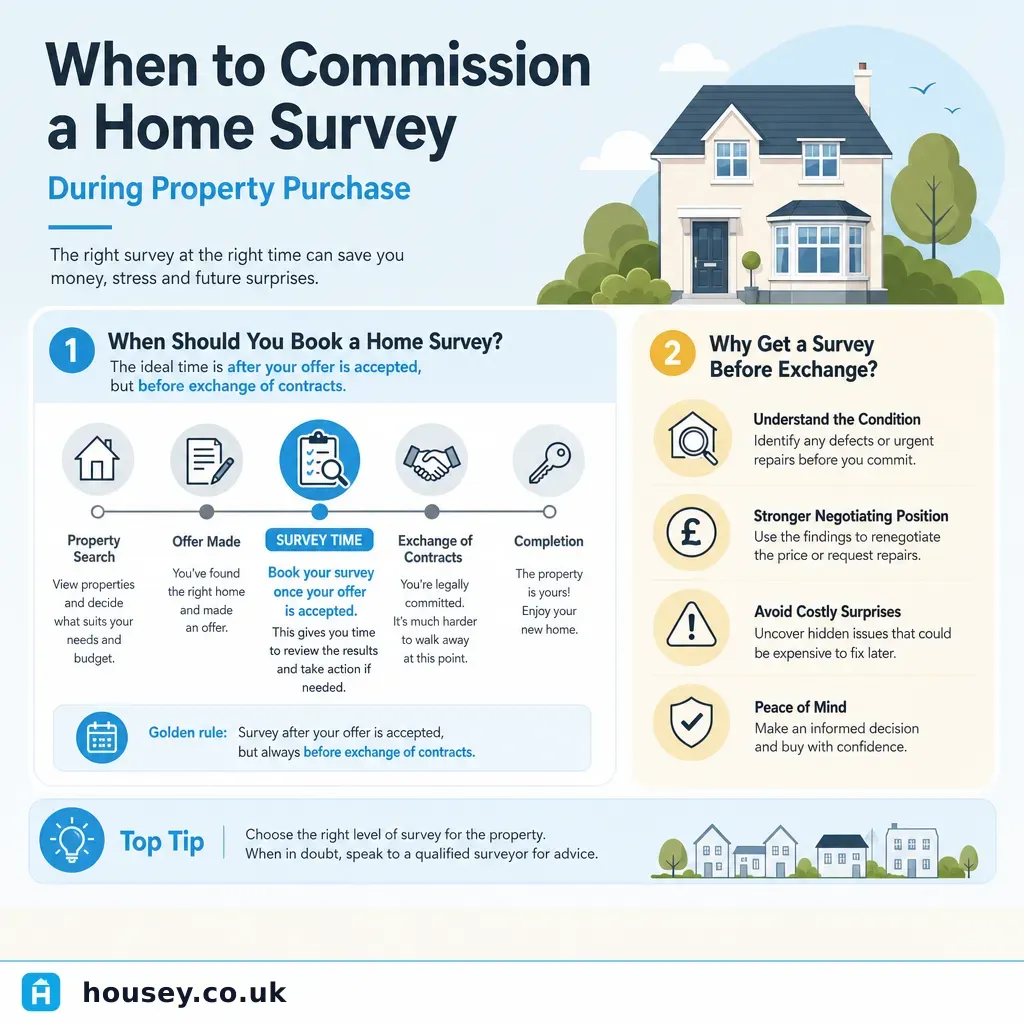
Commission your surveyor as soon as your offer is accepted and you have the property address confirmed. In active markets and popular areas, a 1–3 week wait for an appointment is common. Booking early:
- Gives you time to review and act on the report before exchange of contracts
- Allows time to obtain specialist quotes for any defects flagged for further investigation — damp, timber, drainage, or asbestos
- Gives you a negotiating window on price or seller remediation if significant defects are identified
Do not delay until solicitors are near exchange. A late survey finding can stall the entire chain, and in serious cases may require you to reassess the transaction altogether.
When to get professional help
A survey report represents a professional opinion formed during a visual inspection — not a guarantee of condition. Seek further professional assistance if:
- The survey identifies suspected structural movement, subsidence, or a foundation concern and recommends a structural engineer's investigation
- Asbestos-containing materials are suspected — common in properties built between approximately 1950 and 1999
- Japanese knotweed, flooding, or drainage defects are flagged — each may require a specialist assessment and can affect mortgage eligibility
- The property is listed and you plan to carry out alterations — listed building consent requirements are additional to and separate from planning permission
How Housey can help
Housey makes it straightforward to find and compare RICS Home Surveys from qualified, regulated surveyors matched to your property type and location. Whether you need a RICS Level 2 survey for a post-war semi or a RICS Level 3 survey for a Victorian terrace with suspected damp, we connect you with surveyors who have relevant local experience and can advise on the appropriate level of inspection before you commit.
Frequently asked questions
Is a mortgage valuation the same as a survey?
No. A mortgage valuation is carried out for the lender's benefit to confirm the property is adequate security for the loan. It does not assess defects in detail, you may not receive a copy, and it carries no duty of care to you as a buyer. Always commission a separate RICS Home Survey to protect your own interests and make an informed decision before exchange.
Can I use the survey report to renegotiate the purchase price?
Yes. If the survey reveals material defects not previously disclosed, it is common practice to seek a price reduction equivalent to the estimated cost of remediation, or to request that the seller carries out works before exchange. Your solicitor can advise on the appropriate approach; the surveyor's cost guidance in the report is a useful starting point for any negotiation.
How long does a building survey take?
A RICS Level 2 survey typically takes 2–4 hours on site for a standard residential property. A RICS Level 3 survey may take 4–8 hours for a larger or more complex property. Written reports are usually delivered within 3–5 working days of the inspection, though turnaround times can vary between firms and during busy periods.
What if I have concerns about the surveyor's report?
Raise concerns directly with the surveyor first — most will take a follow-up call to clarify findings at no additional charge. If you believe the survey was negligent or failed to identify a defect a competent surveyor should have noticed, RICS operates a formal complaints and redress process. You may also be able to pursue a professional negligence claim if you can demonstrate loss arising from an inadequate report.
Sources and further reading
- RICS Home Surveys — standards and guidance — RICS
- RICS Find a Surveyor — RICS
- Buying a home — GOV.UK
- Getting a survey — Citizens Advice
- Flood map for planning — Environment Agency
Useful next reads
 Surveys & Inspections
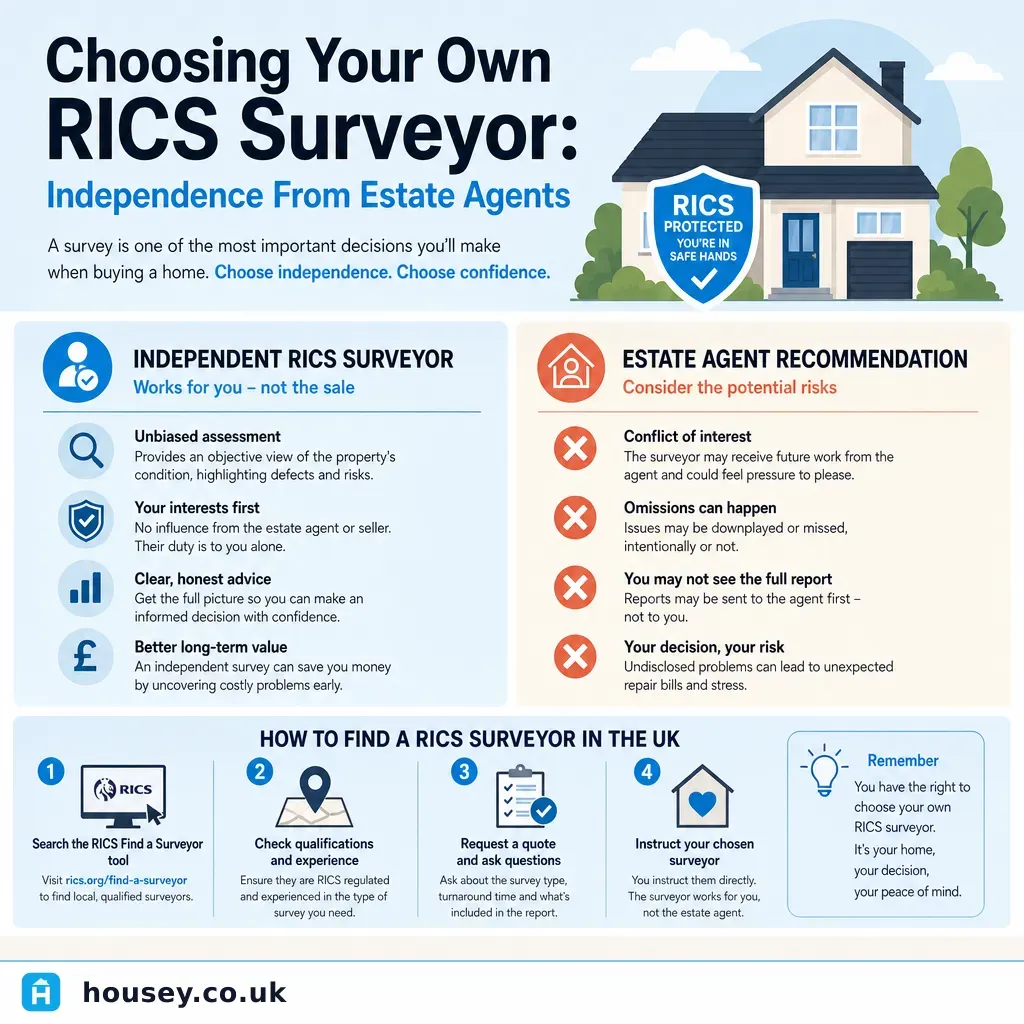
Choosing Your Own RICS Surveyor: Independence From Estate Agents
You have every right to choose your own RICS surveyor independently of your estate agent's recommendation.
 Surveys & Inspections
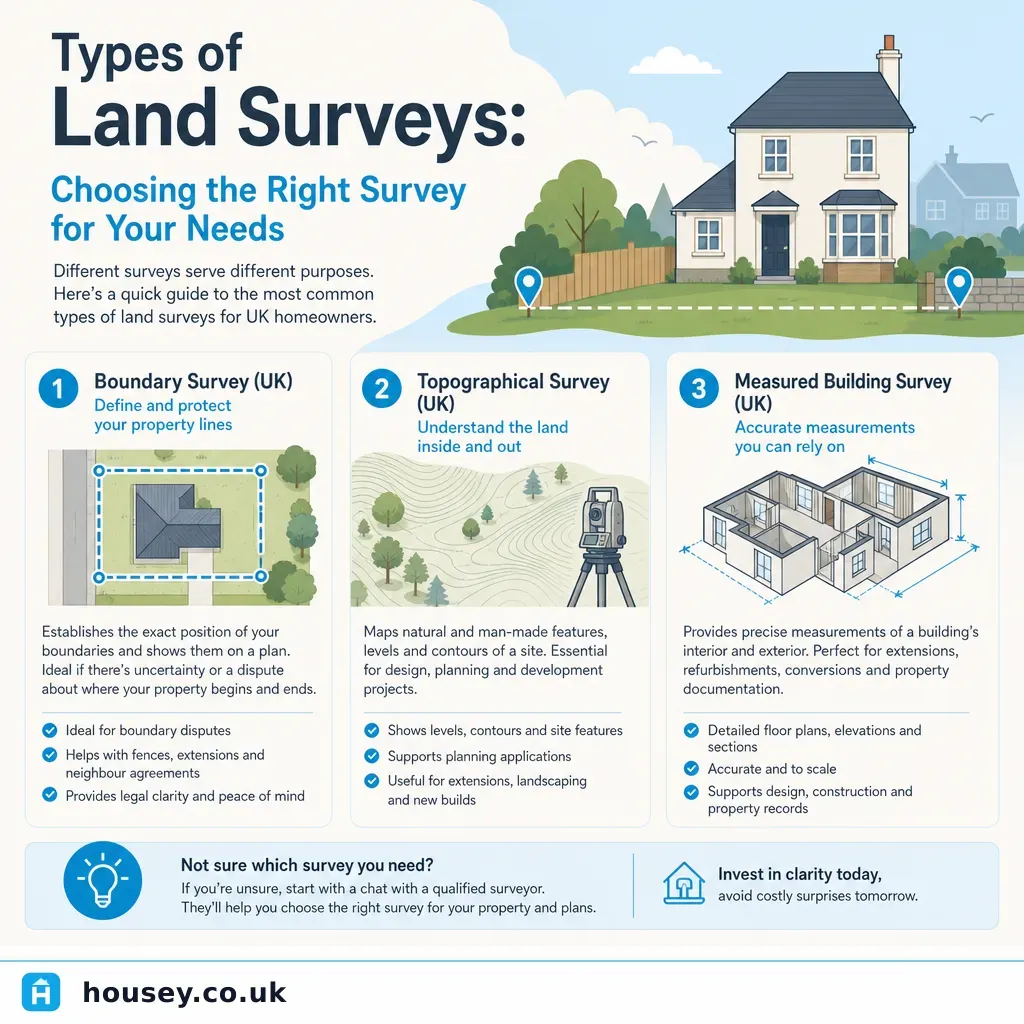
Types of Land Surveys: Choosing the Right Survey for Your Needs
UK land surveys fall into distinct types: topographical surveys map terrain and features for planning and design; measured building surveys record existing structures for extension or conversion work; boundary surveys establish legal property limits; and ground investigation surveys assess soil and foundation conditions.
 Surveys & Inspections
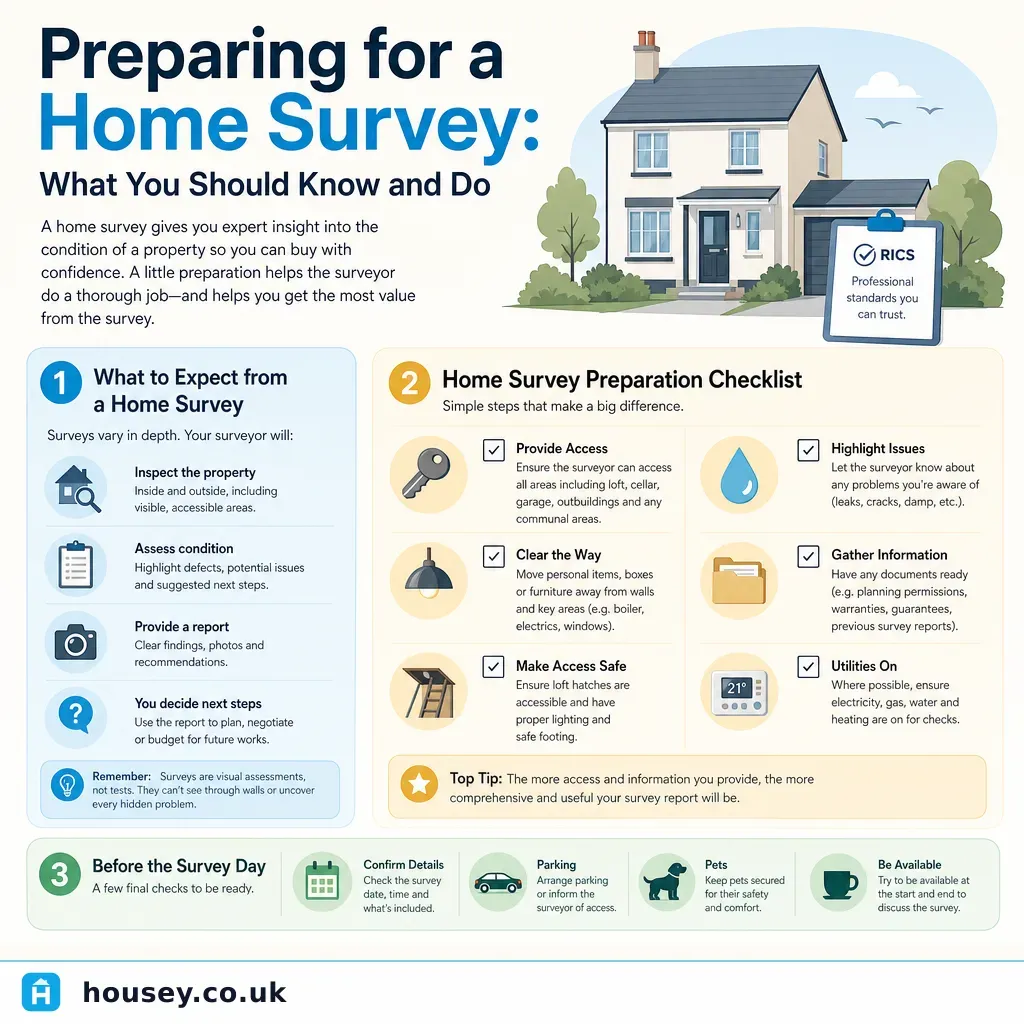
Preparing for a Home Survey: What You Should Know and Do
Preparing for a home survey means giving the surveyor clear access to all parts of the property, gathering relevant documents such as planning permissions and Building Regulations certificates, and knowing in advance which survey level has been instructed.
 Surveys & Inspections
When to Commission a Home Survey During Property Purchase
Commission a home survey after your offer is accepted and before exchange of contracts.
 Surveys & Inspections
Finding an Independent Damp Surveyor
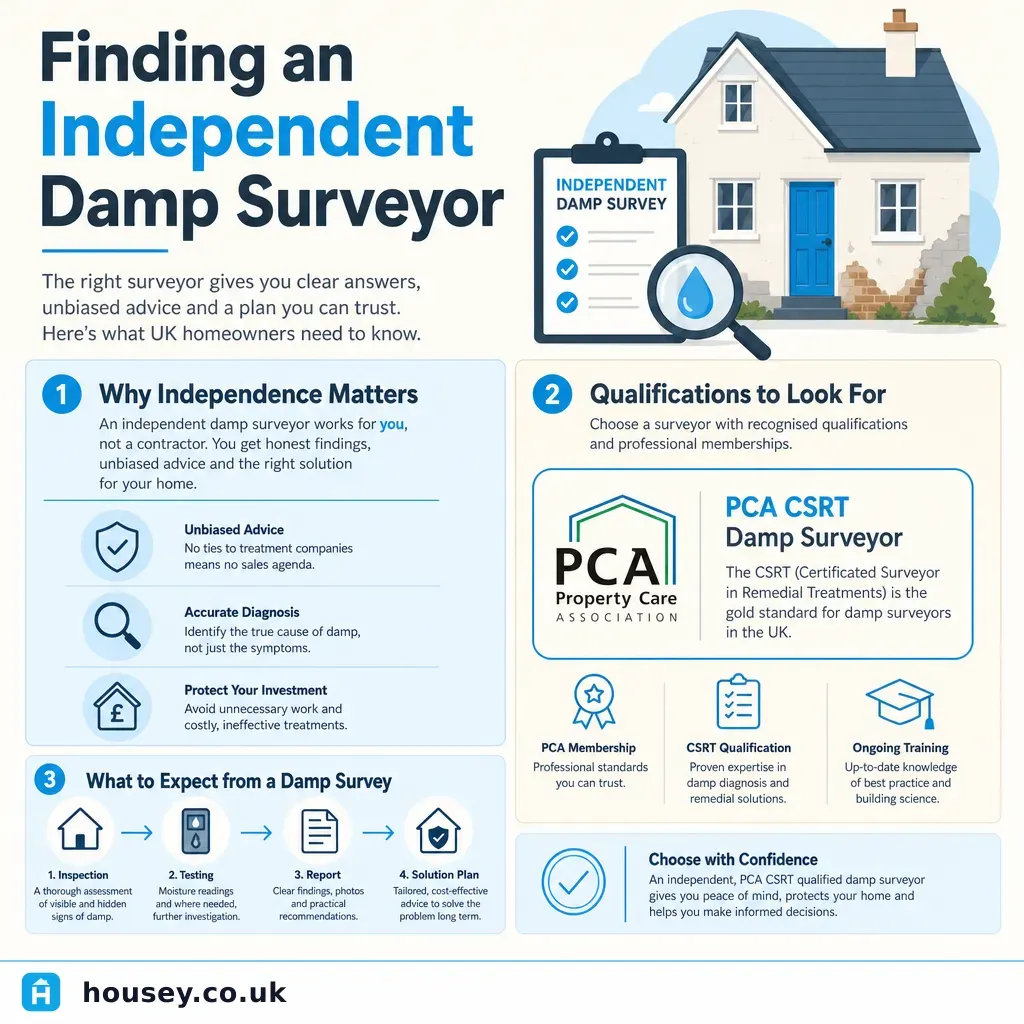
An independent damp surveyor has no financial tie to remediation contractors, so their diagnosis is less likely to reflect a sales interest.