Clarifying Property Survey Types and Professional Standards
By Housey · Last reviewed 30th of May 2026
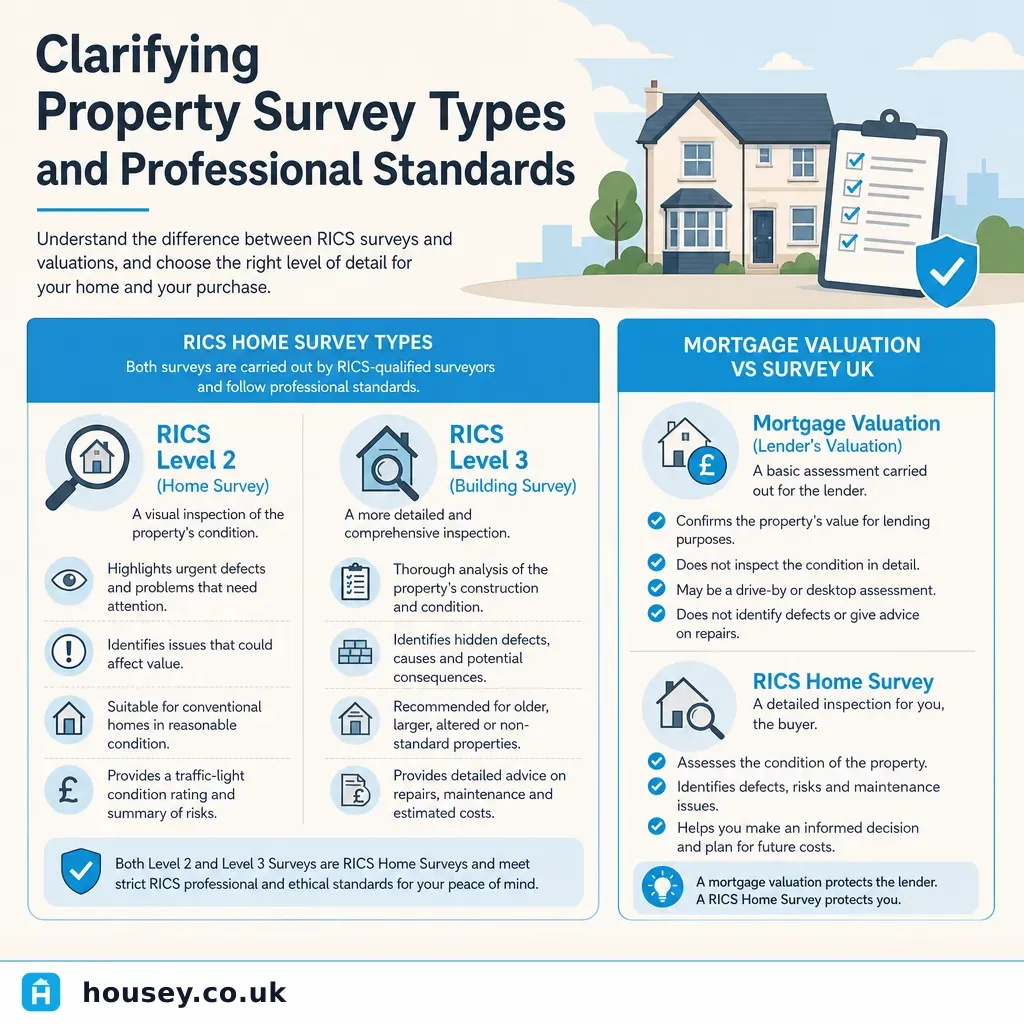
Clarifying Property Survey Types and Professional Standards
Most buyers in England and Wales arrange a mortgage valuation and assume it constitutes a survey — it does not. A mortgage valuation is carried out for the lender's benefit and typically tells you almost nothing about the physical condition of the building. Understanding the range of survey types available, which professional standards govern them, and when each is appropriate helps buyers, homeowners, and investors make a better-informed choice before committing to a purchase or instructing further investigations.
Key points
- The RICS Home Survey Standard (2nd edition), mandatory from March 2022, replaced previous report formats with three defined levels: Level 1 (Condition Report), Level 2 (Home Survey), and Level 3 (Building Survey).
- A mortgage valuation is not a structural inspection — it assesses whether the property is adequate security for the lender's loan, not whether it is in good physical condition.
- All RICS Home Surveys use a traffic-light condition rating system: CR1 (no repair needed), CR2 (non-urgent defects), and CR3 (serious defects requiring urgent attention).
- RICS members carrying out home surveys must hold MRICS or FRICS status and comply with the RICS Home Survey Standard; membership can be verified via the RICS Find a Surveyor directory.
- Specific defect surveys address a single concern — cracking, damp, or roof condition — and may be carried out by a structural engineer or specialist surveyor rather than a general home surveyor.
The RICS Home Survey Standard: what changed in 2022
Before March 2022, RICS-qualified surveyors offered a range of report types — including the Homebuyer Report — under varying terminology that could confuse buyers. The RICS Home Survey Standard consolidated these into three clearly defined levels:
- RICS Level 1 — Condition Report: a concise visual inspection producing condition ratings (CR1–CR3) for main building elements. No advice on repairs or maintenance, and no valuation. Best suited to recently built properties in apparent good condition.
- RICS Level 2 — Home Survey: a more detailed visual inspection including advice on significant defects, repair and maintenance considerations, and the surveyor's view on whether further specialist investigations are needed. A valuation is an optional add-on — some surveyors include it at additional cost.
- RICS Level 3 — Building Survey: the most thorough inspection available, covering construction type, materials, and all accessible elements. Includes an assessment of repair options and indicative costs where appropriate. Suitable for older, larger, altered, unusual, or visibly defective properties.
Survey types compared
Survey type | Typical use case | Inspection depth | Valuation included | Typical professional |
|---|---|---|---|---|
Mortgage valuation | Lender requirement only | Minimal — lender interest only | Yes (for lender) | Lender-appointed RICS surveyor |
RICS Level 1 Condition Report | New-build or recently constructed property | Visual; condition ratings (CR1–CR3) | Not usually | MRICS or FRICS surveyor |
RICS Level 2 Home Survey | Post-war conventional property in reasonable condition | Detailed visual; defect advice; maintenance guidance | Optional add-on | MRICS or FRICS surveyor |
RICS Level 3 Building Survey | Pre-1920s, altered, unusual, complex, or defective properties | Comprehensive; construction detail; repair options | Not usually | MRICS or FRICS surveyor |
Specific defect survey | Single flagged concern (crack, damp, roof, subsidence) | Targeted specialist assessment | No | Structural engineer or specialist surveyor |
New-build snagging survey | New-build before or at legal completion | Detailed defect list for developer | No | Independent snagging inspector |
Which survey level should you choose?
Decision guide
- Choose a RICS Level 1 Condition Report if the property is a new-build or recently constructed with no visible defects, and you want a concise document with condition ratings.
- Choose a RICS Level 2 Home Survey if the property was built post-1945, is of conventional cavity-wall and tiled-roof construction, appears in reasonable condition, and you want clear advice on defects and likely repair needs.
- Choose a RICS Level 3 Building Survey if the property was built before approximately 1920, has been significantly extended or altered, is of unusual construction (timber frame, thatched roof, concrete panel), is listed, or shows visible signs of damp, cracking, or settlement.
- Commission a specific defect survey if a previous inspection flagged a concern requiring specialist diagnosis — for example, a structural engineer to assess a crack pattern, or a damp specialist for persistent rising or penetrating damp.
- Request a new-build snagging survey if buying a new-build; arrange this ideally before legal completion so the developer is contractually obliged to address identified defects.
- Ask your surveyor before booking — a brief pre-survey conversation about the property's age, construction, and visible condition will confirm the right level and flag any likely access limitations.
What RICS membership means for buyers
RICS (Royal Institution of Chartered Surveyors) is the UK's primary regulator for property surveyors. Qualified members hold MRICS (Member) or FRICS (Fellow) status and are subject to:
- The RICS Rules of Conduct and ethical framework.
- Mandatory Continuing Professional Development (CPD) requirements.
- Professional Indemnity Insurance (PII) obligations.
- The RICS Complaints Handling Procedure in the event of a dispute.
Only MRICS or FRICS members complying fully with the RICS Home Survey Standard may describe their report as an RICS Home Survey. Always verify a surveyor's membership via the RICS Find a Surveyor directory before instructing them.
What to ask before commissioning a survey
Before instructing a surveyor:
- Are you MRICS or FRICS accredited, and may I verify your membership number via the RICS directory?
- Do you have recent experience with properties of this age, construction type, and condition?
- Will the report comply with the RICS Home Survey Standard (2nd edition)?
- Which elements are likely to be marked Not Inspected, and what do you recommend if key elements cannot be accessed?
- Will you carry out the inspection personally, or will it be delegated to another surveyor?
- What is your complaints procedure if I am dissatisfied with the report?
- How soon after inspection will the written report be delivered?
- Is a valuation included, and if so, how is the figure derived?
What not to assume about property surveys
"The mortgage valuation means the property is in good condition." A mortgage valuation protects the lender, not you. It may involve only a brief visit or a desktop assessment and does not inspect roof structures, subfloor voids, chimney flues, or drainage runs.
"A Level 2 survey is always sufficient." RICS guidance indicates Level 2 suits conventional, post-war homes in reasonable condition. For pre-1920s or structurally complex properties, a Level 3 survey provides substantially greater detail and is usually worth the additional fee.
"Defects found in a survey mean I should pull out." Many survey findings are negotiable — buyers regularly use reports to renegotiate the purchase price or request remedial works before exchange. A survey finding is information, not necessarily a reason to walk away.
"Any surveyor can produce an RICS survey." Only MRICS or FRICS members complying with the RICS Home Survey Standard may describe their report as an RICS Home Survey. Verify credentials before instructing.
"The surveyor will inspect everything." All RICS surveys are visual inspections of accessible elements. Furniture, fixed flooring, inaccessible roof voids, and concealed pipework are commonly marked NI (Not Inspected). A Level 3 surveyor will flag what further investigations are warranted.
When to get professional help
Always instruct a RICS Level 2 or Level 3 survey for any property purchase. The fee — typically £400–£1,500 depending on property size and survey level (indicative UK costs, last reviewed 2026-05-30) — is proportionately small against the purchase price and the cost of undiscovered defects. Additionally, instruct a structural engineer if:
- Your survey identifies potential structural movement, cracking, or subsidence.
- The surveyor recommends further specialist investigation of any element.
- You are planning significant structural alterations after purchase.
How Housey can help
Housey makes it straightforward to compare quotes from RICS-qualified surveyors across all levels. Whether you need an overview of RICS Home Surveys, a RICS Level 1 survey for a new-build property, a RICS Level 2 survey for a post-war home, a RICS Level 3 building survey for an older or complex property, or a specific defect survey targeting a single concern, you can compare qualified professionals in one place.
Frequently asked questions
How much does a property survey cost in the UK?
Survey costs vary by property size, type, survey level, and location. Indicative UK costs, last reviewed 2026-05-30: a RICS Level 2 Home Survey typically ranges from £400 to £900; a RICS Level 3 Building Survey from £600 to £1,500 or more for larger or complex properties; a new-build snagging survey typically £300–£600. Obtain at least two quotes and confirm exactly what each includes before instructing.
How long does a property survey take?
A Level 2 inspection typically takes 1.5–3 hours depending on property size; a Level 3 survey may take 3–6 hours for a larger or more complex property. Report delivery usually follows within 3–7 working days of the inspection. The inspection is a visual assessment of accessible elements — the surveyor will flag anything that could not be reached or inspected in the written report.
Can I rely on a survey commissioned by the seller?
A seller-commissioned survey provides background information, but the surveyor's duty of care runs to the person who instructed them. If you did not commission the report, you have no direct recourse against the surveyor if it proves inaccurate or incomplete. For any significant purchasing decision, always instruct your own independent RICS-qualified surveyor rather than relying on a report prepared for the vendor.
What is a snagging survey for a new-build?
A snagging survey is a detailed inspection of a newly built property identifying defects, incomplete finishes, and items falling short of specification — which the developer should then rectify. Snagging inspectors are not required to hold RICS membership, though some do. The NHBC Buildmark warranty and the New Homes Quality Code (from 2023) set quality standards for new builds; review your warranty terms carefully before accepting legal completion.
Sources and further reading
- RICS Home Survey Standard — RICS
- Find a RICS-regulated surveyor — RICS
- NHBC Buildmark warranty — NHBC
- New Homes Quality Board — NHQB
- Which? guide to property surveys — Which?
Useful next reads
 Surveys & Inspections
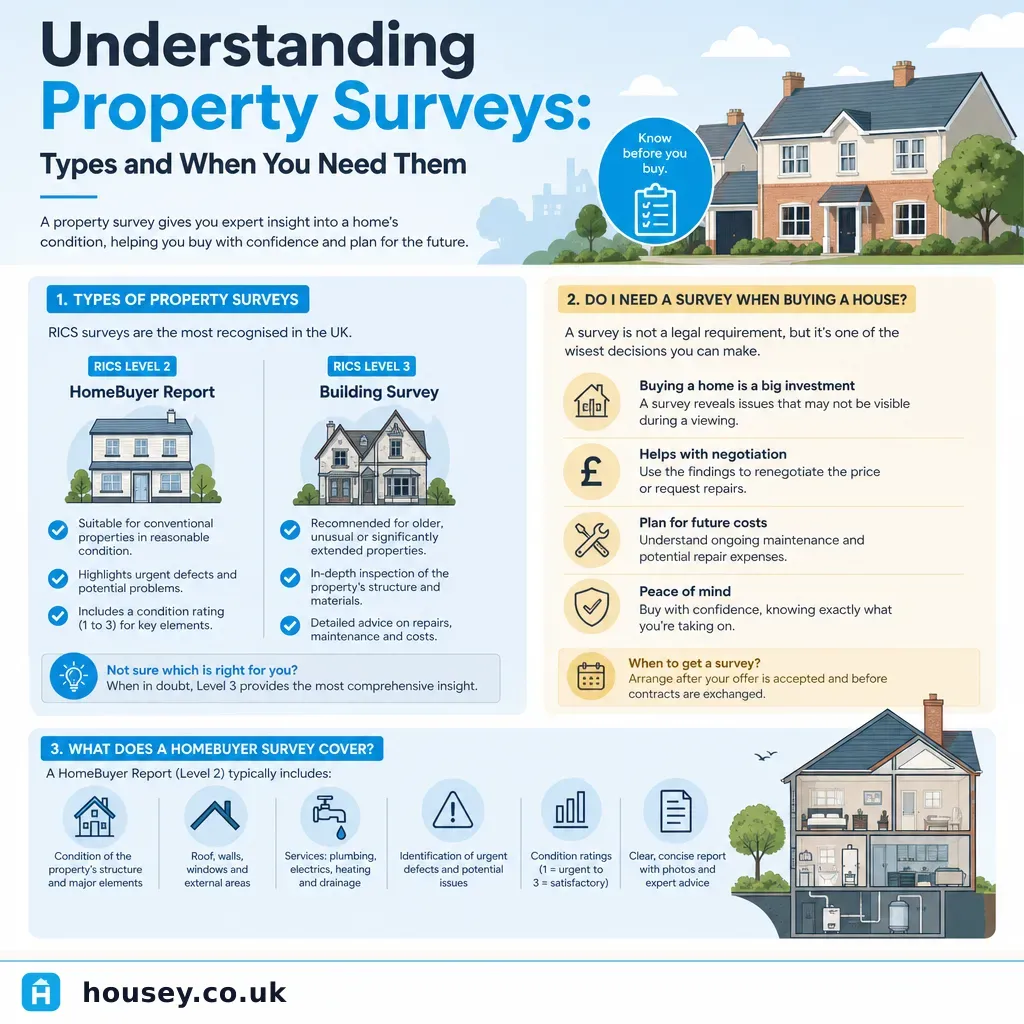
Understanding Property Surveys: Types and When You Need Them
The three main RICS survey types are the Level 1 Condition Report (for standard properties in good condition), the Level 2 Home Survey (conventional homes in reasonable condition), and the Level 3 Building Survey (older, unusual, or defective properties).
 Surveys & Inspections
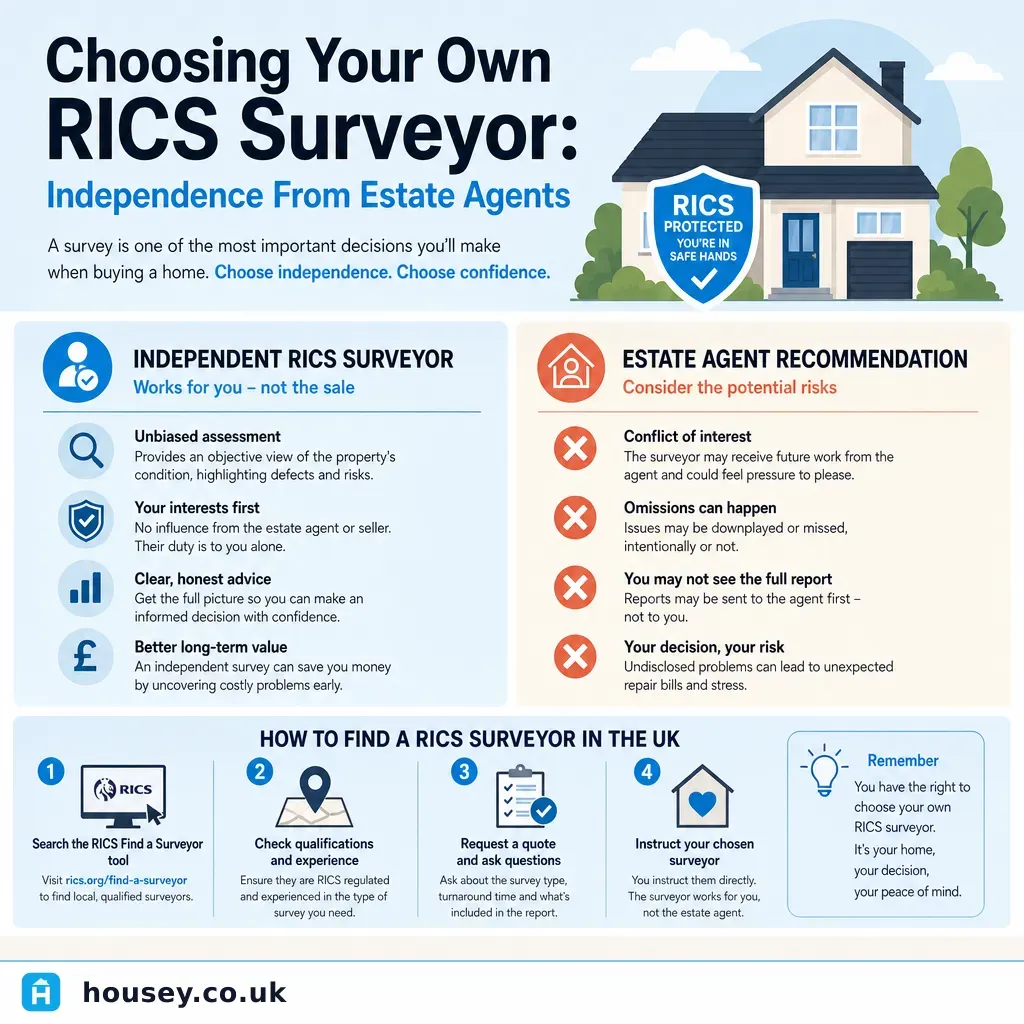
Choosing Your Own RICS Surveyor: Independence From Estate Agents
You have every right to choose your own RICS surveyor independently of your estate agent's recommendation.
 Surveys & Inspections
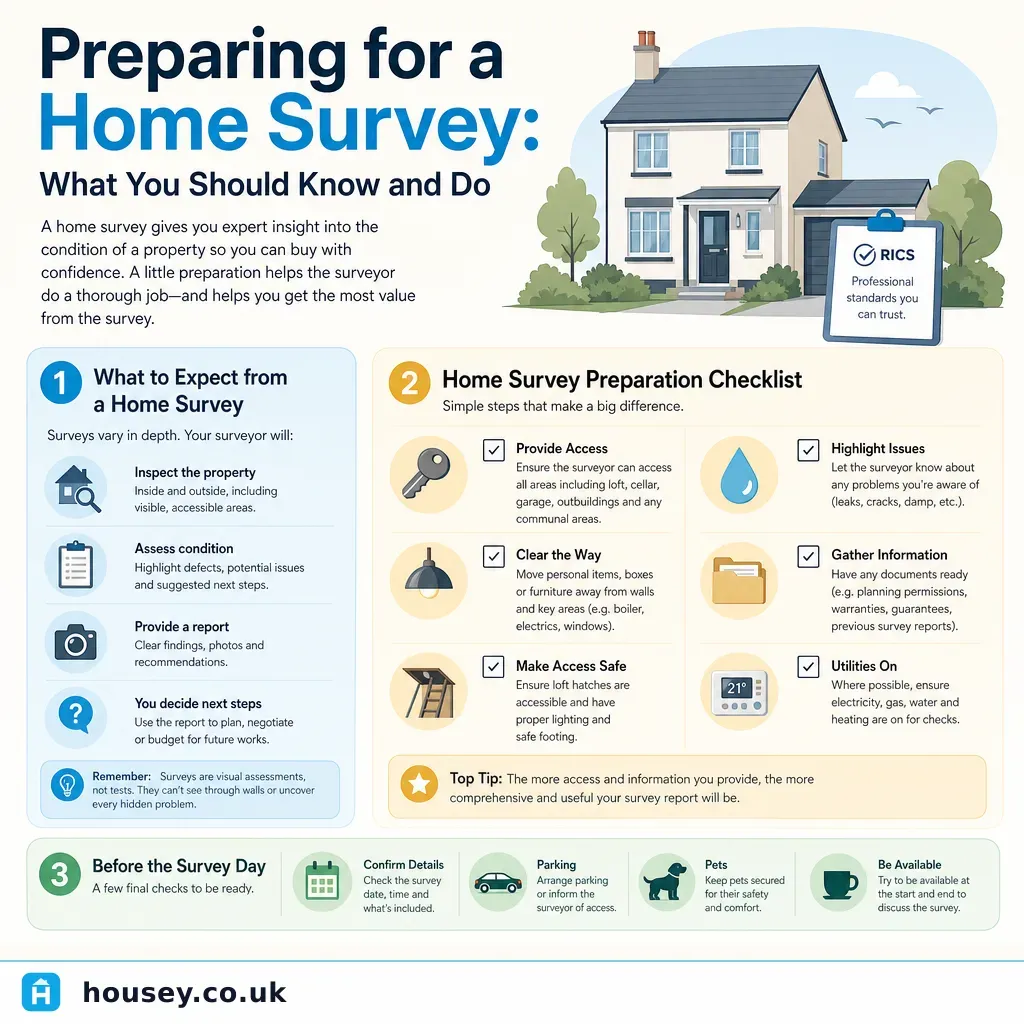
Preparing for a Home Survey: What You Should Know and Do
Preparing for a home survey means giving the surveyor clear access to all parts of the property, gathering relevant documents such as planning permissions and Building Regulations certificates, and knowing in advance which survey level has been instructed.
 Surveys & Inspections
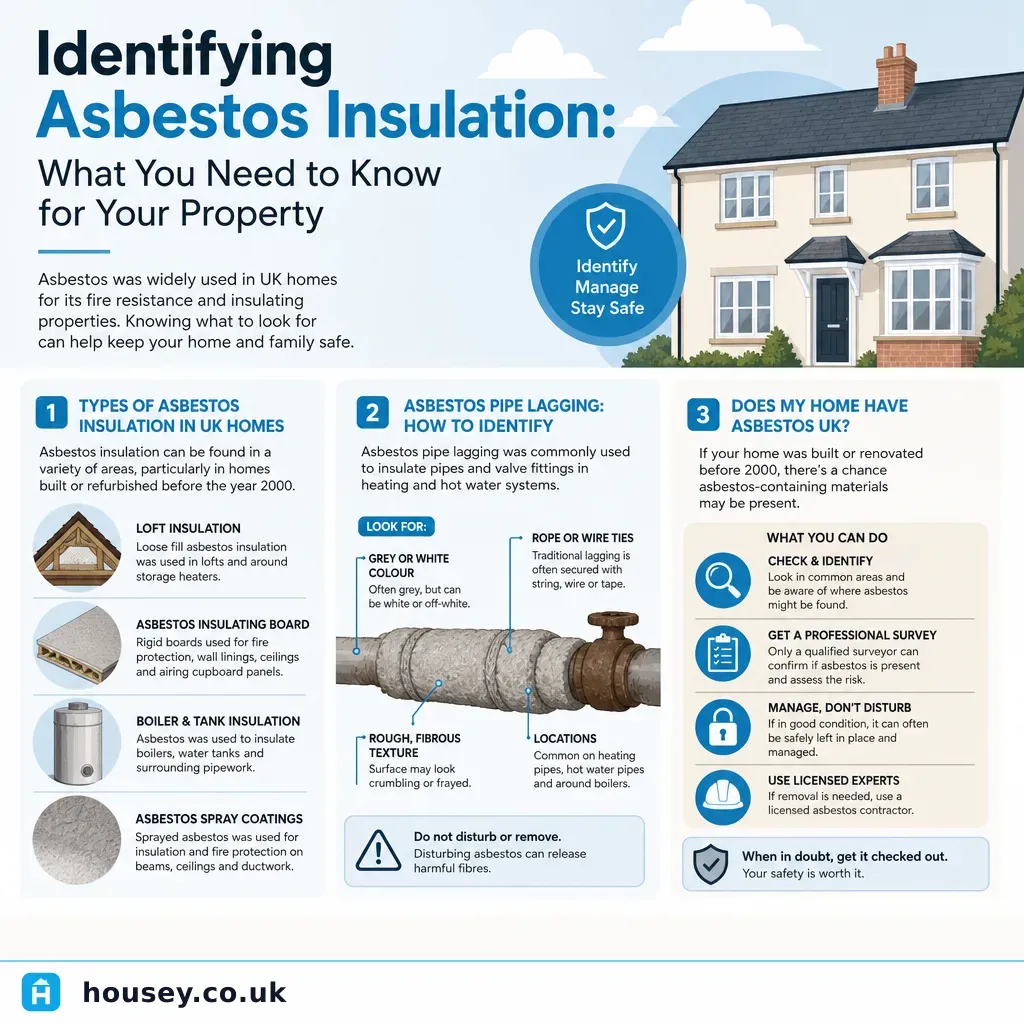
Identifying Asbestos Insulation: What You Need to Know for Your Property
Asbestos insulation was widely used in UK properties built before 2000, commonly found in pipe lagging, ceiling tiles, loose-fill loft insulation, and around boilers.
 Surveys & Inspections
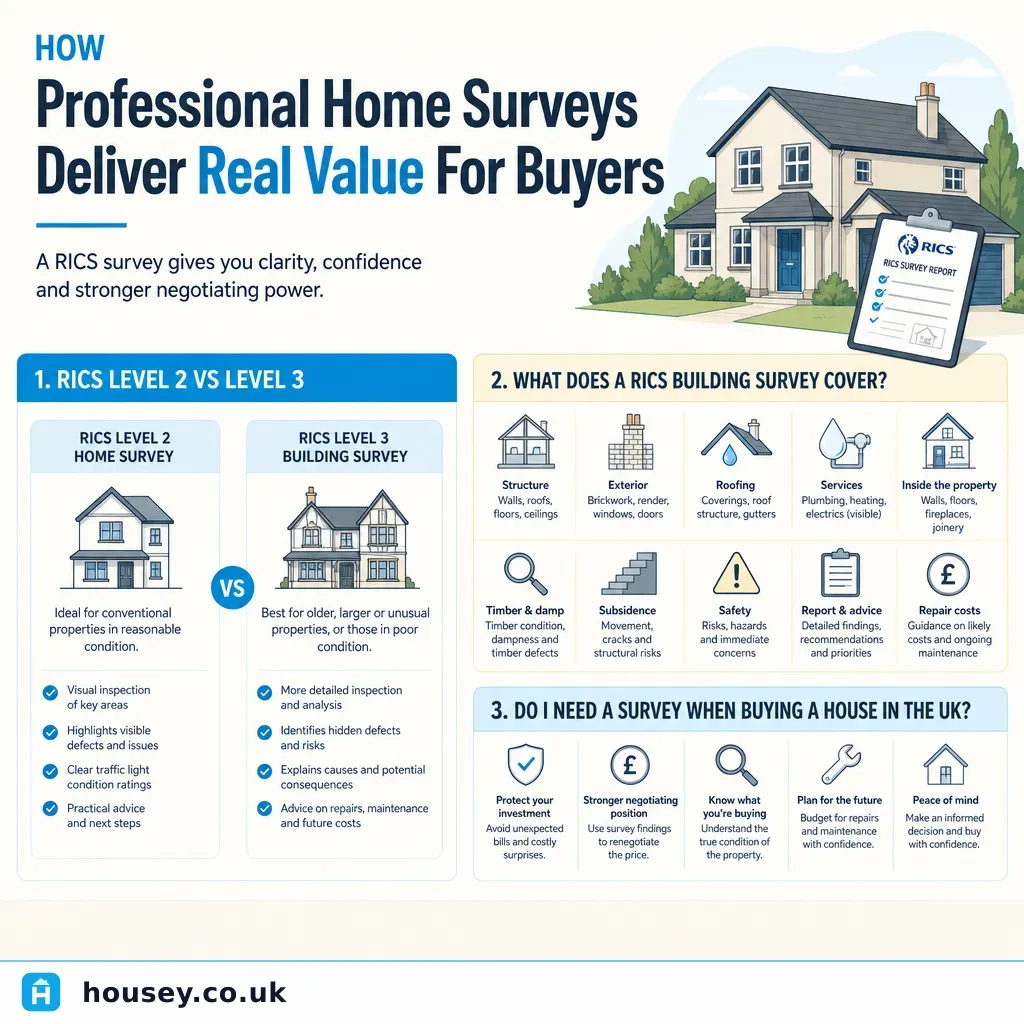
How Professional Home Surveys Deliver Real Value For Buyers
A professional home survey by a RICS-registered surveyor can identify defects, legal compliance gaps, and cost liabilities before exchange of contracts, giving buyers an evidence base for negotiation or withdrawal.